Curriculum development is a continuous and dynamic process that generally follows a cyclical model.pptx
Curriculum development is a continuous and dynamic process that generally follows a cyclical model. While different sources may use slightly different terms, the core phases are consistently
Curriculum development
is adynamic process involving many different people and procedures. Development connotes
systematic changes. A change for the better means alteration, modification, or improvement of
the existing condition. To produce positive changes, development should be purposeful, planned,
and progressive. A well-developed, current curriculum provides several benefits for students and
teachers. A curriculum that lays out course objectives and content sequencing lets the teacher
focus on designing specific lessons and assessments to teach individual students effectively.
Usually, it is linear and follows a logical step-by-step fashion involving the following phases:
curriculum planning, curriculum designing, curriculum implementation, and curriculum evaluation.
3.
Four Phases ofCurriculum Development:
1. Curriculum planning considers the school’s vision, mission, and goals. It also
includes the philosophy of strong education belief of the school. All of these will
eventually be translated to classroom desired learning outcomes for the learners.
2. Curriculum designing is the way curriculum is conceptualized to include the
selection and organization of learning experiences or activities and the selection of the
assessment procedure and tools to measure achieved learning outcomes.
3. Curriculum implementation is putting into action the plan which is based on the
curriculum design in the classroom setting or the learning environment.
4. Curriculum evaluation determines the extent to which the desired outcomes have
been achieved
4.
Curriculum Plan
is theadvanced arrangement of learning opportunities for a particular
population of learners. A curriculum planning is a process whereby
the arrangement of curriculum plans or learning opportunities or
created.
It is the process of preparing for the duties of teaching, deciding upon
goals and emphasis, determining curriculum content, selecting
learning resources and classroom procedures, evaluating progress,
and looking toward the next steps.
5.
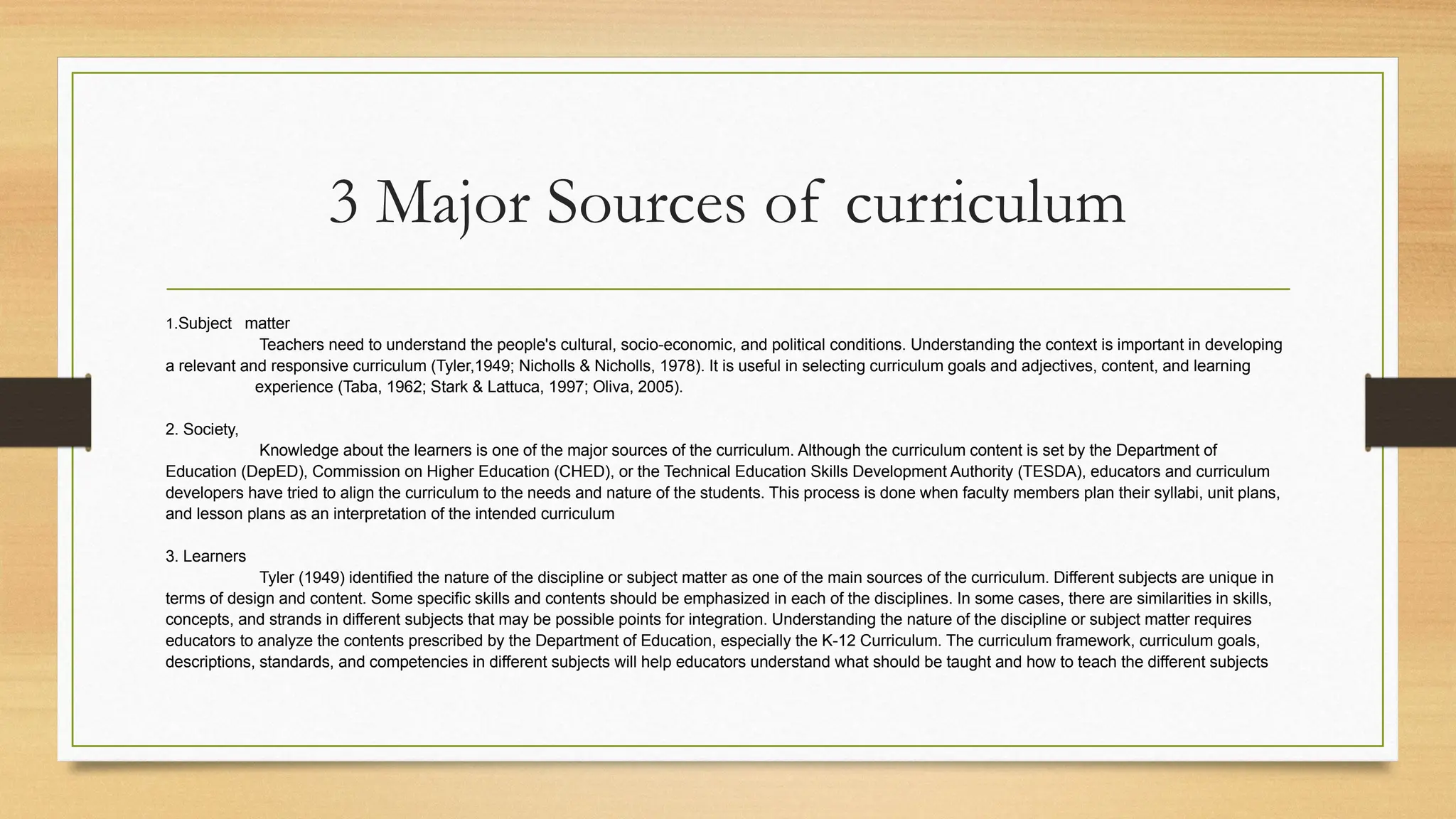
3 Major Sourcesof curriculum
1.Subject matter
Teachers need to understand the people's cultural, socio-economic, and political conditions. Understanding the context is important in developing
a relevant and responsive curriculum (Tyler,1949; Nicholls & Nicholls, 1978). It is useful in selecting curriculum goals and adjectives, content, and learning
experience (Taba, 1962; Stark & Lattuca, 1997; Oliva, 2005).
2. Society,
Knowledge about the learners is one of the major sources of the curriculum. Although the curriculum content is set by the Department of
Education (DepED), Commission on Higher Education (CHED), or the Technical Education Skills Development Authority (TESDA), educators and curriculum
developers have tried to align the curriculum to the needs and nature of the students. This process is done when faculty members plan their syllabi, unit plans,
and lesson plans as an interpretation of the intended curriculum
3. Learners
Tyler (1949) identified the nature of the discipline or subject matter as one of the main sources of the curriculum. Different subjects are unique in
terms of design and content. Some specific skills and contents should be emphasized in each of the disciplines. In some cases, there are similarities in skills,
concepts, and strands in different subjects that may be possible points for integration. Understanding the nature of the discipline or subject matter requires
educators to analyze the contents prescribed by the Department of Education, especially the K-12 Curriculum. The curriculum framework, curriculum goals,
descriptions, standards, and competencies in different subjects will help educators understand what should be taught and how to teach the different subjects
6.
Curriculum Design
Curriculum designcan be equated with curriculum organization for it is defined as
“the arrangement of the elements into a substantive whole.” This definition assumes
that the curriculum developer has already thought of, or perhaps formulated, the
curricular aims, goals, and objectives, and selected the appropriate curriculum
content, learning experiences, and evaluation procedures. The organization of these
components of a curriculum into a coherent, meaningful, curriculum plan is termed
curriculum design. This curriculum design is influenced by the philosophical,
psychological, sociological, and historical orientation of the curriculum developer and
ideally, by the characteristics of a sound curriculum. Furthermore, designing a
curriculum takes into account horizontal and vertical organization.
7.
Vertical organization
This simplymeans that content and skills are arranged so that they build on
one another; that they align with the general sequence of cognitive development.
They indicate what students have learned and what they will earn later.
Horizontal organization
It involves how skills and content that are taught during one level or one
period of time are related to another.
8.
PRINCIPLES of CURRICULUMDESIGN
1. Curriculum change is inevitable, necessary, and desirable.
2. Curriculum is a product of its time.
3. Curriculum changes made earlier can exist concurrently with newer curriculum changes.
4. Curriculum change depends on the people who will implement the change.
5. Curriculum development is a cooperative group activity.
6. Curriculum development is a decision-making process made from choices of alternatives.
7. Curriculum development is an ongoing process.
8. Curriculum development is more effective if it is a comprehensive process, rather than a “piecemeal”.
9. Curriculum development is more effective when it follows a systematic process.
10. Curriculum development starts from where the curriculum is.
9.
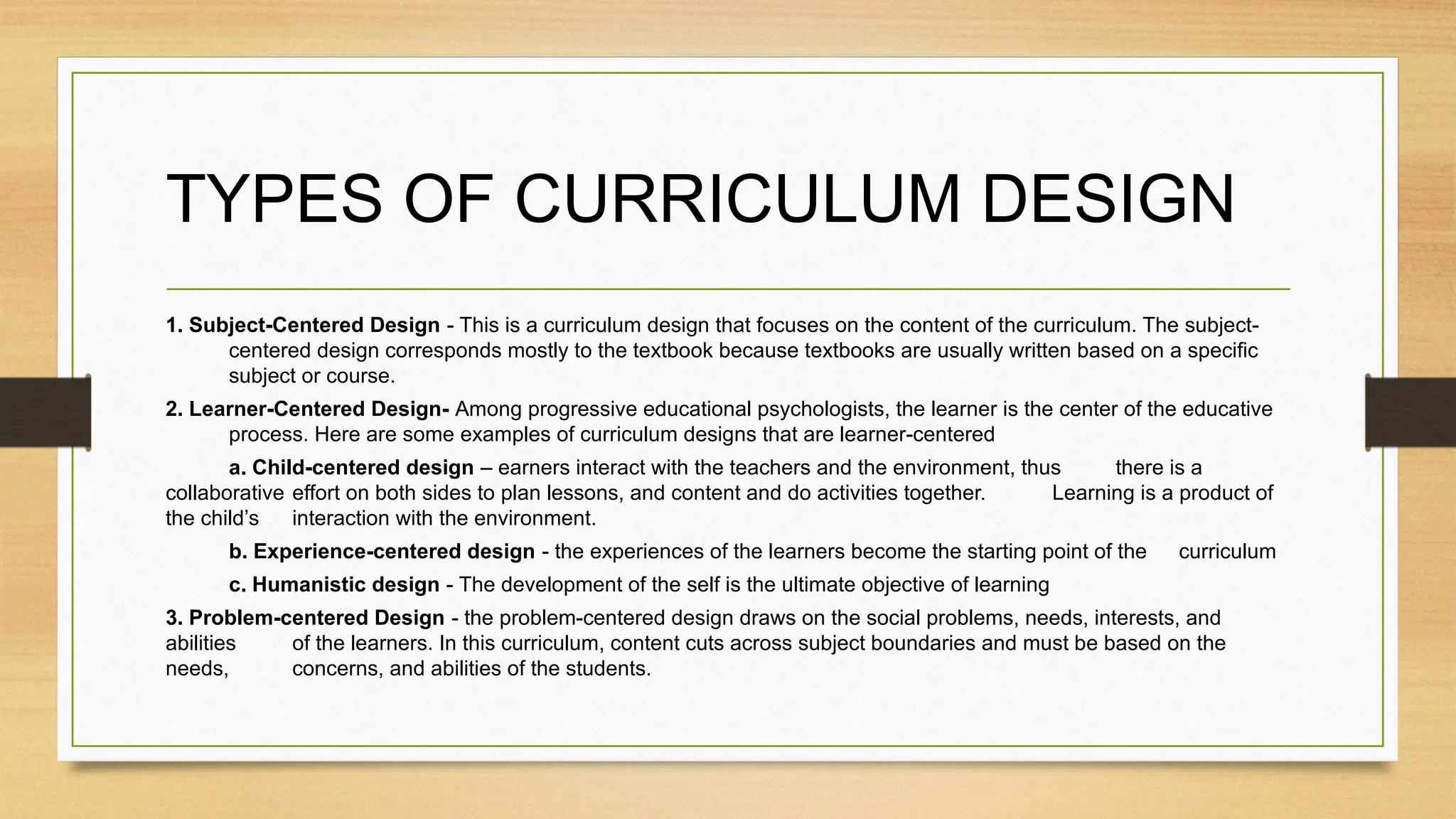
TYPES OF CURRICULUMDESIGN
1. Subject-Centered Design - This is a curriculum design that focuses on the content of the curriculum. The subject-
centered design corresponds mostly to the textbook because textbooks are usually written based on a specific
subject or course.
2. Learner-Centered Design- Among progressive educational psychologists, the learner is the center of the educative
process. Here are some examples of curriculum designs that are learner-centered
a. Child-centered design – earners interact with the teachers and the environment, thus there is a
collaborative effort on both sides to plan lessons, and content and do activities together. Learning is a product of
the child’s interaction with the environment.
b. Experience-centered design - the experiences of the learners become the starting point of the curriculum
c. Humanistic design - The development of the self is the ultimate objective of learning
3. Problem-centered Design - the problem-centered design draws on the social problems, needs, interests, and
abilities of the learners. In this curriculum, content cuts across subject boundaries and must be based on the
needs, concerns, and abilities of the students.
10.
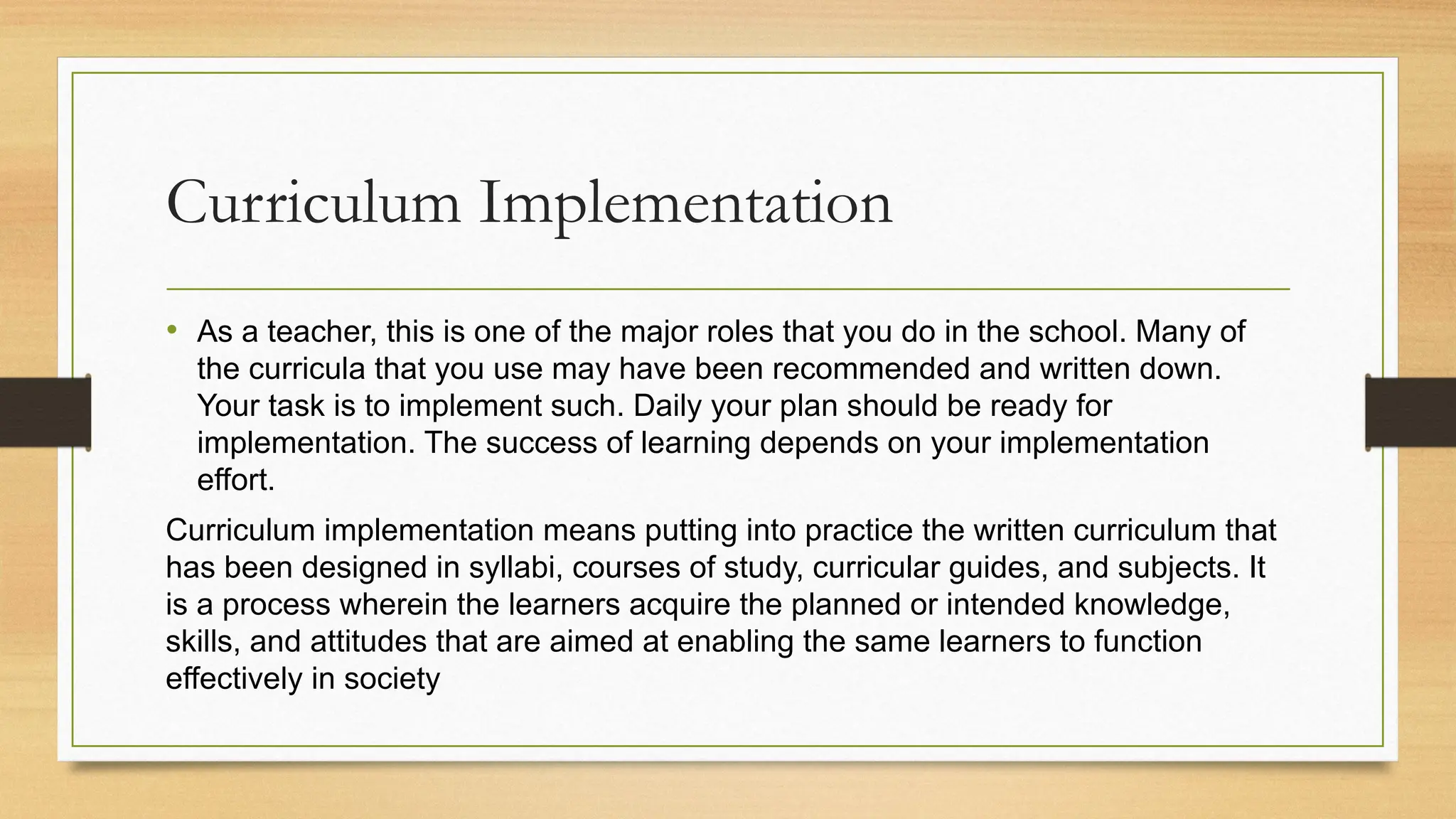
Curriculum Implementation
• Asa teacher, this is one of the major roles that you do in the school. Many of
the curricula that you use may have been recommended and written down.
Your task is to implement such. Daily your plan should be ready for
implementation. The success of learning depends on your implementation
effort.
Curriculum implementation means putting into practice the written curriculum that
has been designed in syllabi, courses of study, curricular guides, and subjects. It
is a process wherein the learners acquire the planned or intended knowledge,
skills, and attitudes that are aimed at enabling the same learners to function
effectively in society
11.
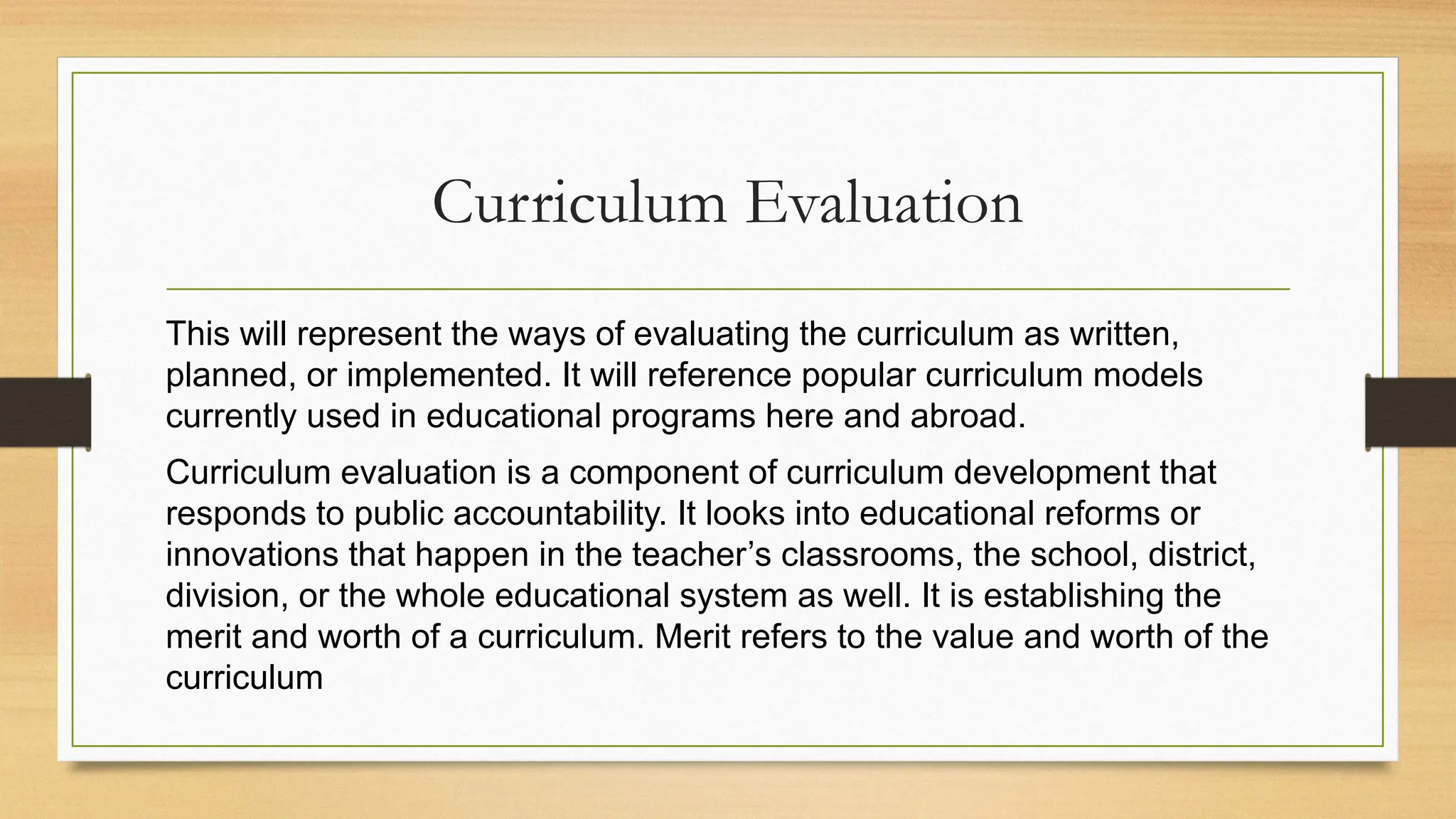
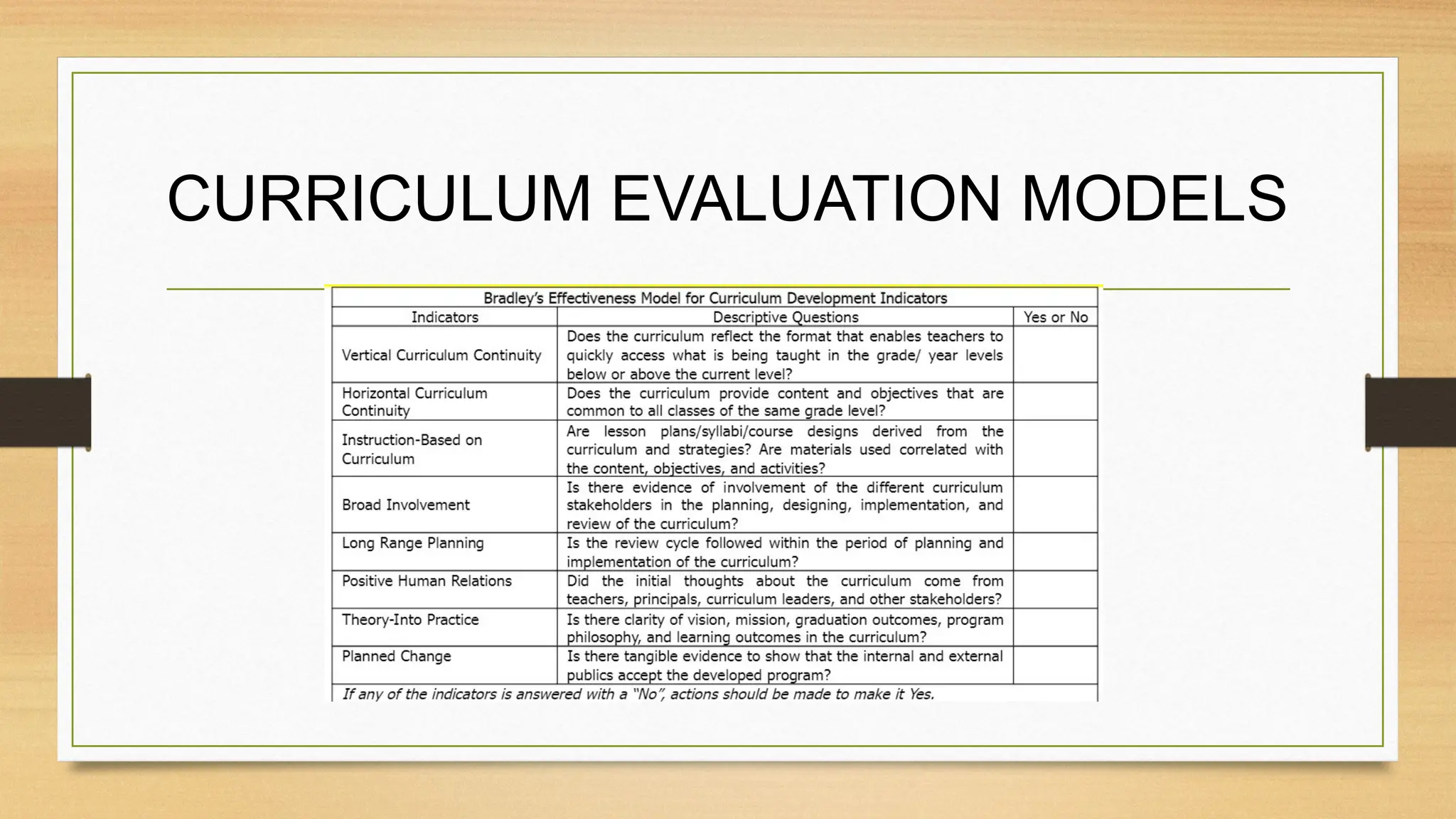
Curriculum Evaluation
This willrepresent the ways of evaluating the curriculum as written,
planned, or implemented. It will reference popular curriculum models
currently used in educational programs here and abroad.
Curriculum evaluation is a component of curriculum development that
responds to public accountability. It looks into educational reforms or
innovations that happen in the teacher’s classrooms, the school, district,
division, or the whole educational system as well. It is establishing the
merit and worth of a curriculum. Merit refers to the value and worth of the
curriculum
12.
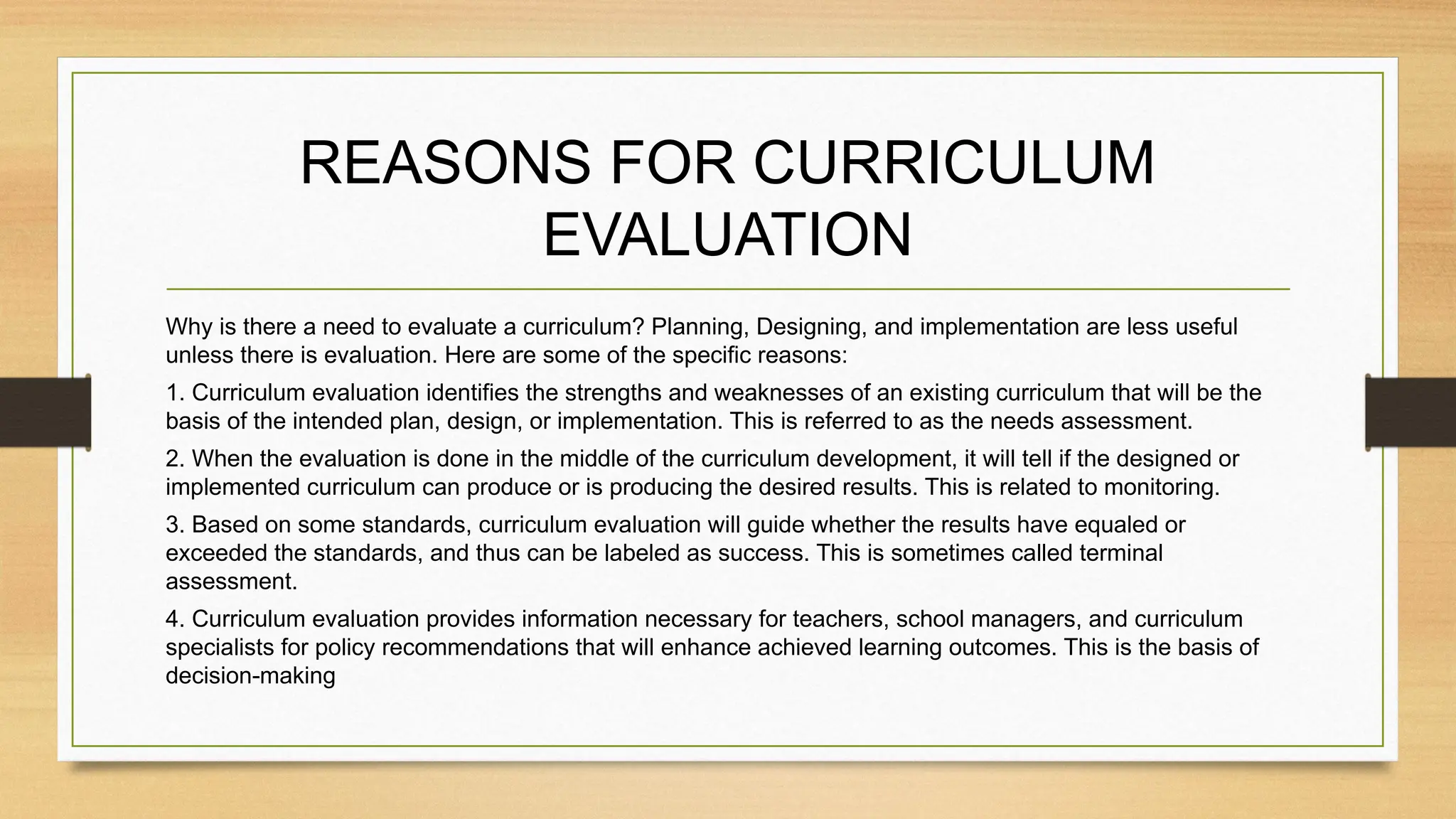
REASONS FOR CURRICULUM
EVALUATION
Whyis there a need to evaluate a curriculum? Planning, Designing, and implementation are less useful
unless there is evaluation. Here are some of the specific reasons:
1. Curriculum evaluation identifies the strengths and weaknesses of an existing curriculum that will be the
basis of the intended plan, design, or implementation. This is referred to as the needs assessment.
2. When the evaluation is done in the middle of the curriculum development, it will tell if the designed or
implemented curriculum can produce or is producing the desired results. This is related to monitoring.
3. Based on some standards, curriculum evaluation will guide whether the results have equaled or
exceeded the standards, and thus can be labeled as success. This is sometimes called terminal
assessment.
4. Curriculum evaluation provides information necessary for teachers, school managers, and curriculum
specialists for policy recommendations that will enhance achieved learning outcomes. This is the basis of
decision-making
13.
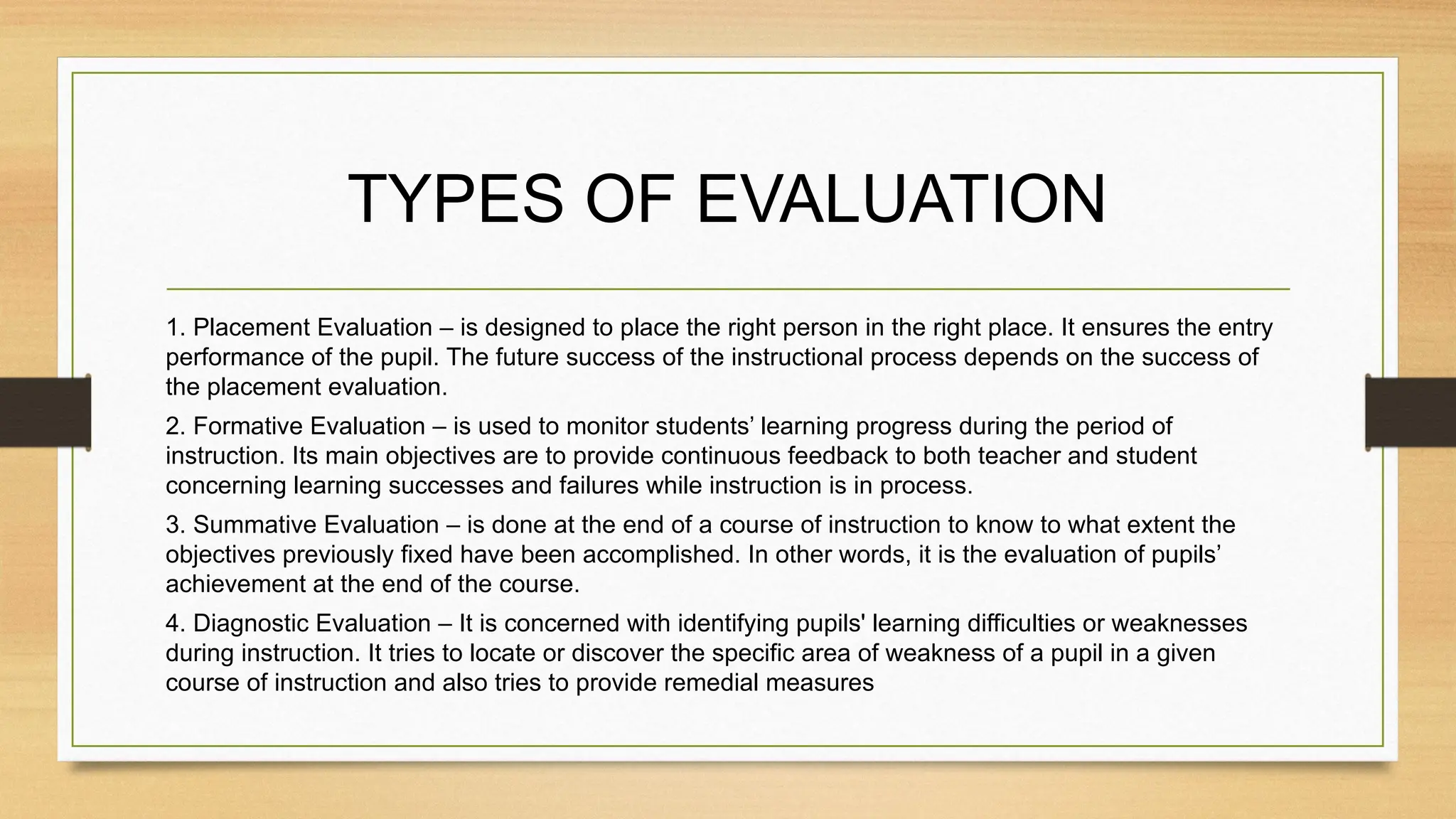
TYPES OF EVALUATION
1.Placement Evaluation – is designed to place the right person in the right place. It ensures the entry
performance of the pupil. The future success of the instructional process depends on the success of
the placement evaluation.
2. Formative Evaluation – is used to monitor students’ learning progress during the period of
instruction. Its main objectives are to provide continuous feedback to both teacher and student
concerning learning successes and failures while instruction is in process.
3. Summative Evaluation – is done at the end of a course of instruction to know to what extent the
objectives previously fixed have been accomplished. In other words, it is the evaluation of pupils’
achievement at the end of the course.
4. Diagnostic Evaluation – It is concerned with identifying pupils' learning difficulties or weaknesses
during instruction. It tries to locate or discover the specific area of weakness of a pupil in a given
course of instruction and also tries to provide remedial measures
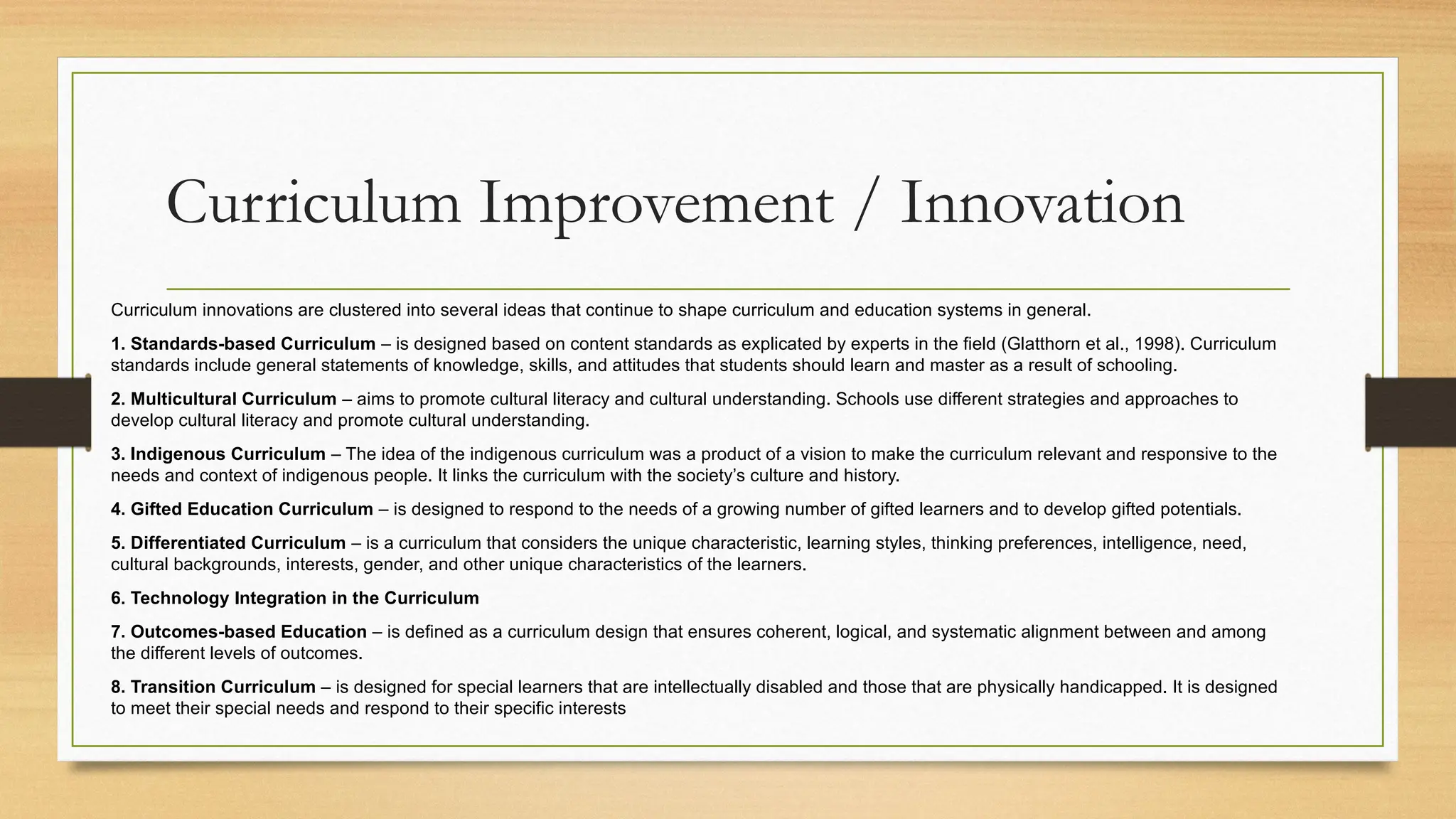
Curriculum Improvement /Innovation
Curriculum innovations are clustered into several ideas that continue to shape curriculum and education systems in general.
1. Standards-based Curriculum – is designed based on content standards as explicated by experts in the field (Glatthorn et al., 1998). Curriculum
standards include general statements of knowledge, skills, and attitudes that students should learn and master as a result of schooling.
2. Multicultural Curriculum – aims to promote cultural literacy and cultural understanding. Schools use different strategies and approaches to
develop cultural literacy and promote cultural understanding.
3. Indigenous Curriculum – The idea of the indigenous curriculum was a product of a vision to make the curriculum relevant and responsive to the
needs and context of indigenous people. It links the curriculum with the society’s culture and history.
4. Gifted Education Curriculum – is designed to respond to the needs of a growing number of gifted learners and to develop gifted potentials.
5. Differentiated Curriculum – is a curriculum that considers the unique characteristic, learning styles, thinking preferences, intelligence, need,
cultural backgrounds, interests, gender, and other unique characteristics of the learners.
6. Technology Integration in the Curriculum
7. Outcomes-based Education – is defined as a curriculum design that ensures coherent, logical, and systematic alignment between and among
the different levels of outcomes.
8. Transition Curriculum – is designed for special learners that are intellectually disabled and those that are physically handicapped. It is designed
to meet their special needs and respond to their specific interests