By Muhammad Ali Asghar

MUHAMMAD ALI ASGHAR
VC&ML NINVAST
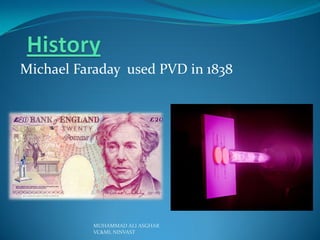
Michael Faraday used PVD in 1838

MUHAMMAD ALI ASGHAR
VC&ML NINVAST
Deposition
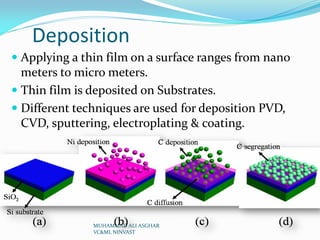
 Applying a thin film on a surface ranges from nano

meters to micro meters.
 Thin film is deposited on Substrates.
 Different techniques are used for deposition PVD,
CVD, sputtering, electroplating & coating.

MUHAMMAD ALI ASGHAR
VC&ML NINVAST
Physical vapor deposition
 Physical coating process involve,

condensation & evaporation of material
 PVD is used for high melting point & low
vapor pressure materials.
 PVD is carried out at high temperature and
vacuum.
 In contrary to PVD, CVD is a method in which

chemical adhesion or chemical deposition occurs.
MUHAMMAD ALI ASGHAR
VC&ML NINVAST
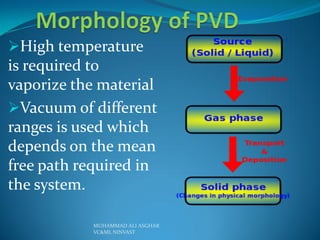
High temperature

is required to
vaporize the material
Vacuum of different
ranges is used which
depends on the mean
free path required in
the system.
MUHAMMAD ALI ASGHAR
VC&ML NINVAST
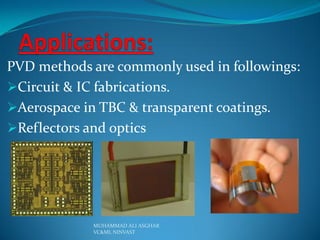
PVD methods are commonly used in followings:
Circuit & IC fabrications.
Aerospace in TBC & transparent coatings.
Reflectors and optics

MUHAMMAD ALI ASGHAR
VC&ML NINVAST
Evaporative deposition
Electron beam vapor deposition
Pulsed laser deposition

Sputter deposition
Ion induced deposition
Cathode Arc Deposition
MUHAMMAD ALI ASGHAR
VC&ML NINVAST
Evaporative deposition
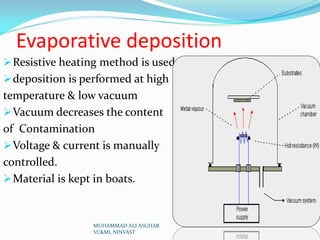
 Resistive heating method is used.
 deposition is performed at high

temperature & low vacuum
 Vacuum decreases the content
of Contamination
 Voltage & current is manually
controlled.
 Material is kept in boats.

MUHAMMAD ALI ASGHAR
VC&ML NINVAST
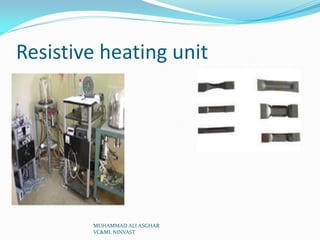
Resistive heating unit

MUHAMMAD ALI ASGHAR
VC&ML NINVAST
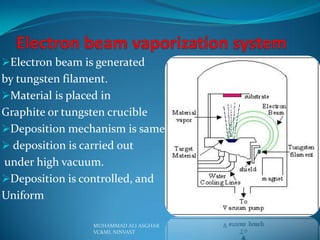
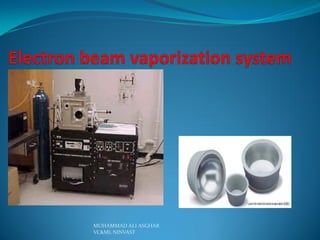
Electron beam is generated

by tungsten filament.
Material is placed in
Graphite or tungsten crucible
Deposition mechanism is same
 deposition is carried out
under high vacuum.
Deposition is controlled, and
Uniform
MUHAMMAD ALI ASGHAR
VC&ML NINVAST
MUHAMMAD ALI ASGHAR
VC&ML NINVAST
Pulsed laser deposition

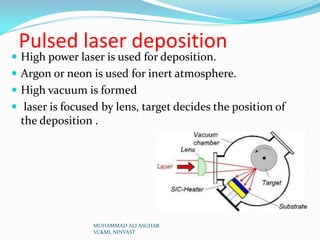
 High power laser is used for deposition.

 Argon or neon is used for inert atmosphere.
 High vacuum is formed
 laser is focused by lens, target decides the position of

the deposition .

MUHAMMAD ALI ASGHAR
VC&ML NINVAST
Sputter deposition
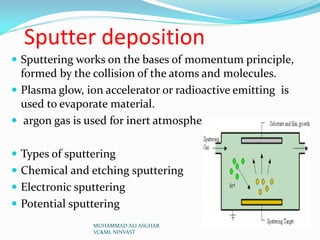
 Sputtering works on the bases of momentum principle,

formed by the collision of the atoms and molecules.
 Plasma glow, ion accelerator or radioactive emitting is
used to evaporate material.
 argon gas is used for inert atmosphere.
 Types of sputtering
 Chemical and etching sputtering
 Electronic sputtering
 Potential sputtering
MUHAMMAD ALI ASGHAR
VC&ML NINVAST
 In this process ions are deposited

on the substrates.
 This process is used for IC
fabrication, micro circuit printing
nano printing or pattering . &
lithography.
 It will be discussed in detail with
nano pattering.
MUHAMMAD ALI ASGHAR
VC&ML NINVAST
PVD advantages & Disadvantages
 Environment friendly then  Cooling systems are required.

paint & electroplating.
 Mostly high temperature and
 more than one PVD
vacuum control needs skill &
technique can be used for
experience.
coating.
 PVD coated materials has no
 Usually topcoats are not
chemical interaction with the
required.
surface that
 Good strength and
durability.

MUHAMMAD ALI ASGHAR
VC&ML NINVAST
MUHAMMAD ALI ASGHAR
VC&ML NINVAST
MUHAMMAD ALI ASGHAR
VC&ML NINVAST

Physical vapor deposition

  • 1.
    By Muhammad AliAsghar MUHAMMAD ALI ASGHAR VC&ML NINVAST
  • 2.
    Michael Faraday usedPVD in 1838 MUHAMMAD ALI ASGHAR VC&ML NINVAST
  • 3.
    Deposition  Applying athin film on a surface ranges from nano meters to micro meters.  Thin film is deposited on Substrates.  Different techniques are used for deposition PVD, CVD, sputtering, electroplating & coating. MUHAMMAD ALI ASGHAR VC&ML NINVAST
  • 4.
    Physical vapor deposition Physical coating process involve, condensation & evaporation of material  PVD is used for high melting point & low vapor pressure materials.  PVD is carried out at high temperature and vacuum.  In contrary to PVD, CVD is a method in which chemical adhesion or chemical deposition occurs. MUHAMMAD ALI ASGHAR VC&ML NINVAST
  • 5.
    High temperature is requiredto vaporize the material Vacuum of different ranges is used which depends on the mean free path required in the system. MUHAMMAD ALI ASGHAR VC&ML NINVAST
  • 6.
    PVD methods arecommonly used in followings: Circuit & IC fabrications. Aerospace in TBC & transparent coatings. Reflectors and optics MUHAMMAD ALI ASGHAR VC&ML NINVAST
  • 7.
    Evaporative deposition Electron beamvapor deposition Pulsed laser deposition Sputter deposition Ion induced deposition Cathode Arc Deposition MUHAMMAD ALI ASGHAR VC&ML NINVAST
  • 8.
    Evaporative deposition  Resistiveheating method is used.  deposition is performed at high temperature & low vacuum  Vacuum decreases the content of Contamination  Voltage & current is manually controlled.  Material is kept in boats. MUHAMMAD ALI ASGHAR VC&ML NINVAST
  • 9.
    Resistive heating unit MUHAMMADALI ASGHAR VC&ML NINVAST
  • 10.
    Electron beam isgenerated by tungsten filament. Material is placed in Graphite or tungsten crucible Deposition mechanism is same  deposition is carried out under high vacuum. Deposition is controlled, and Uniform MUHAMMAD ALI ASGHAR VC&ML NINVAST
  • 11.
  • 12.
    Pulsed laser deposition High power laser is used for deposition.  Argon or neon is used for inert atmosphere.  High vacuum is formed  laser is focused by lens, target decides the position of the deposition . MUHAMMAD ALI ASGHAR VC&ML NINVAST
  • 13.
    Sputter deposition  Sputteringworks on the bases of momentum principle, formed by the collision of the atoms and molecules.  Plasma glow, ion accelerator or radioactive emitting is used to evaporate material.  argon gas is used for inert atmosphere.  Types of sputtering  Chemical and etching sputtering  Electronic sputtering  Potential sputtering MUHAMMAD ALI ASGHAR VC&ML NINVAST
  • 14.
     In thisprocess ions are deposited on the substrates.  This process is used for IC fabrication, micro circuit printing nano printing or pattering . & lithography.  It will be discussed in detail with nano pattering. MUHAMMAD ALI ASGHAR VC&ML NINVAST
  • 15.
    PVD advantages &Disadvantages  Environment friendly then  Cooling systems are required. paint & electroplating.  Mostly high temperature and  more than one PVD vacuum control needs skill & technique can be used for experience. coating.  PVD coated materials has no  Usually topcoats are not chemical interaction with the required. surface that  Good strength and durability. MUHAMMAD ALI ASGHAR VC&ML NINVAST
  • 16.
  • 17.