This document summarizes a seminar on sputtering processes. Sputtering is a thin film deposition technique where atoms are ejected from a target material when bombarded by energetic particles in vacuum. The ejected atoms then deposit onto a substrate to form a thin film. Key aspects of sputtering discussed include sputtering yield, how various parameters like ion mass, energy and pressure affect the process, and applications in microelectronics, decorative coatings, and medical devices.
Sputtering – General
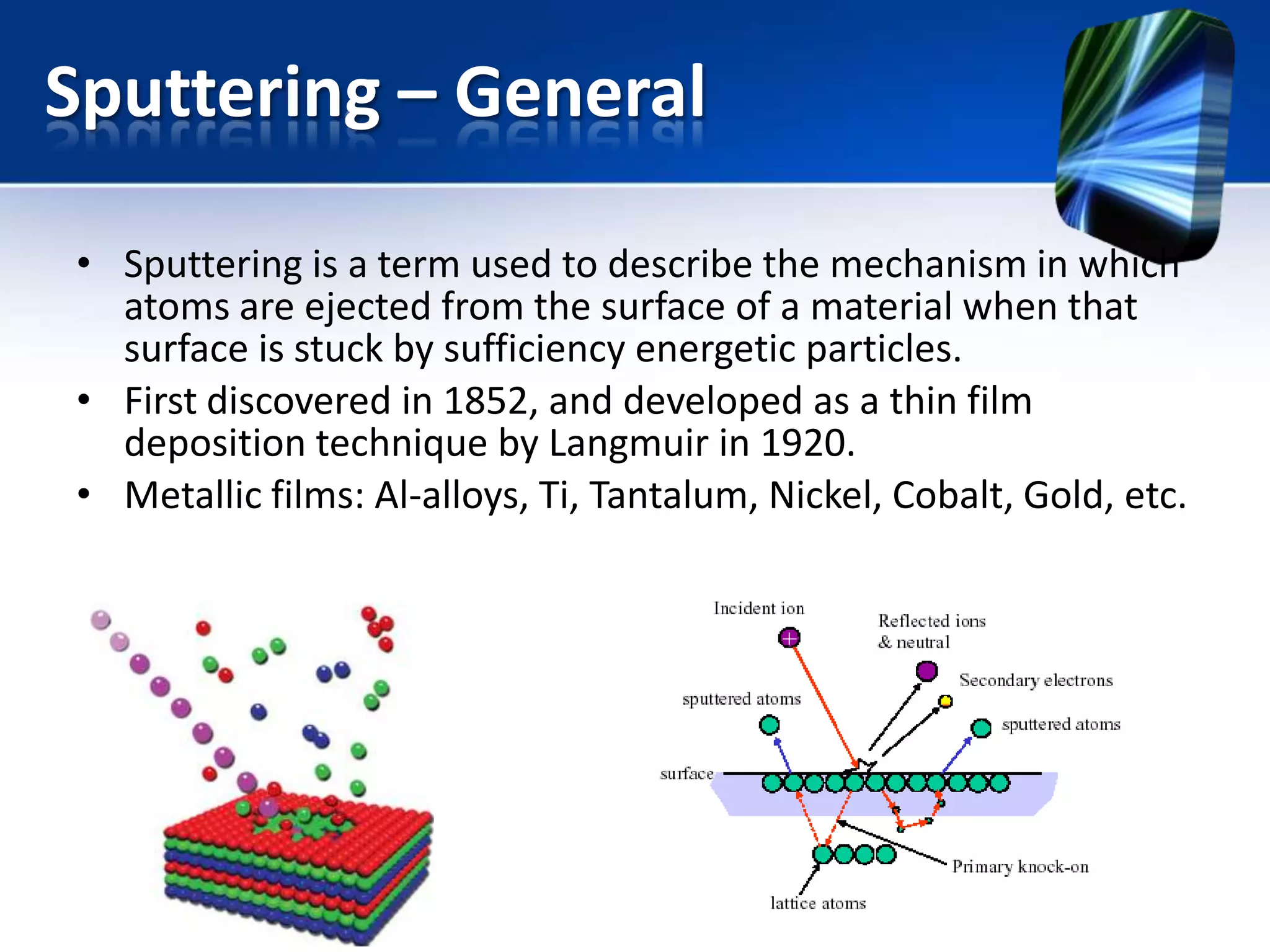
•Sputtering is a term used to describe the mechanism in which
atoms are ejected from the surface of a material when that
surface is stuck by sufficiency energetic particles.
• First discovered in 1852, and developed as a thin film
deposition technique by Langmuir in 1920.
• Metallic films: Al-alloys, Ti, Tantalum, Nickel, Cobalt, Gold, etc.
7.
Reasons for sputtering
•Use large-area-targets which gives uniform thickness
over the wafer.
• Control the thickness by Deposition time and other
parameters.
• Even materials with very high melting points are easily
sputtered.
• Sputtered films typically have a better adhesion on the
substrate.
• Sputtering can be performed top-down.
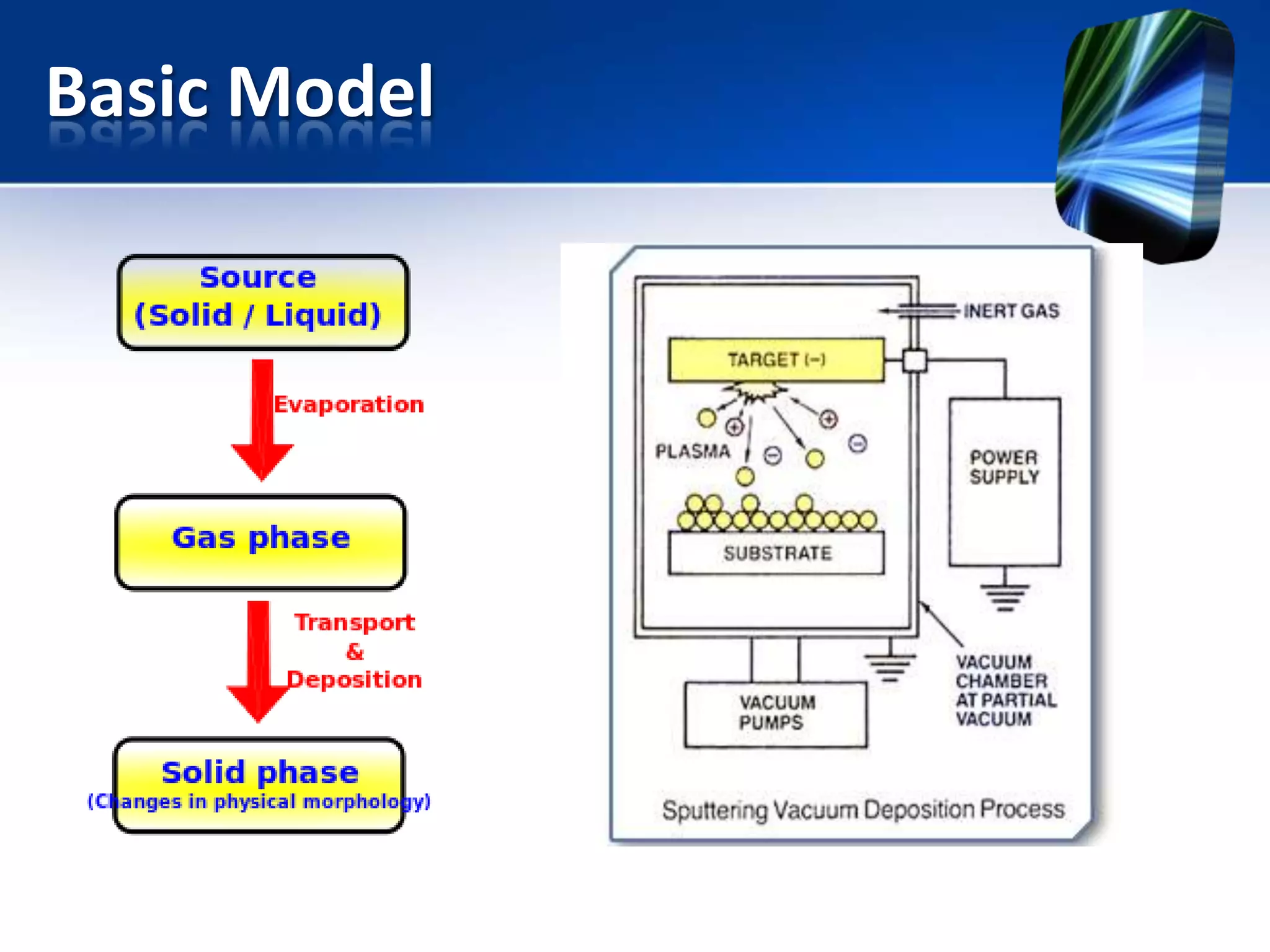
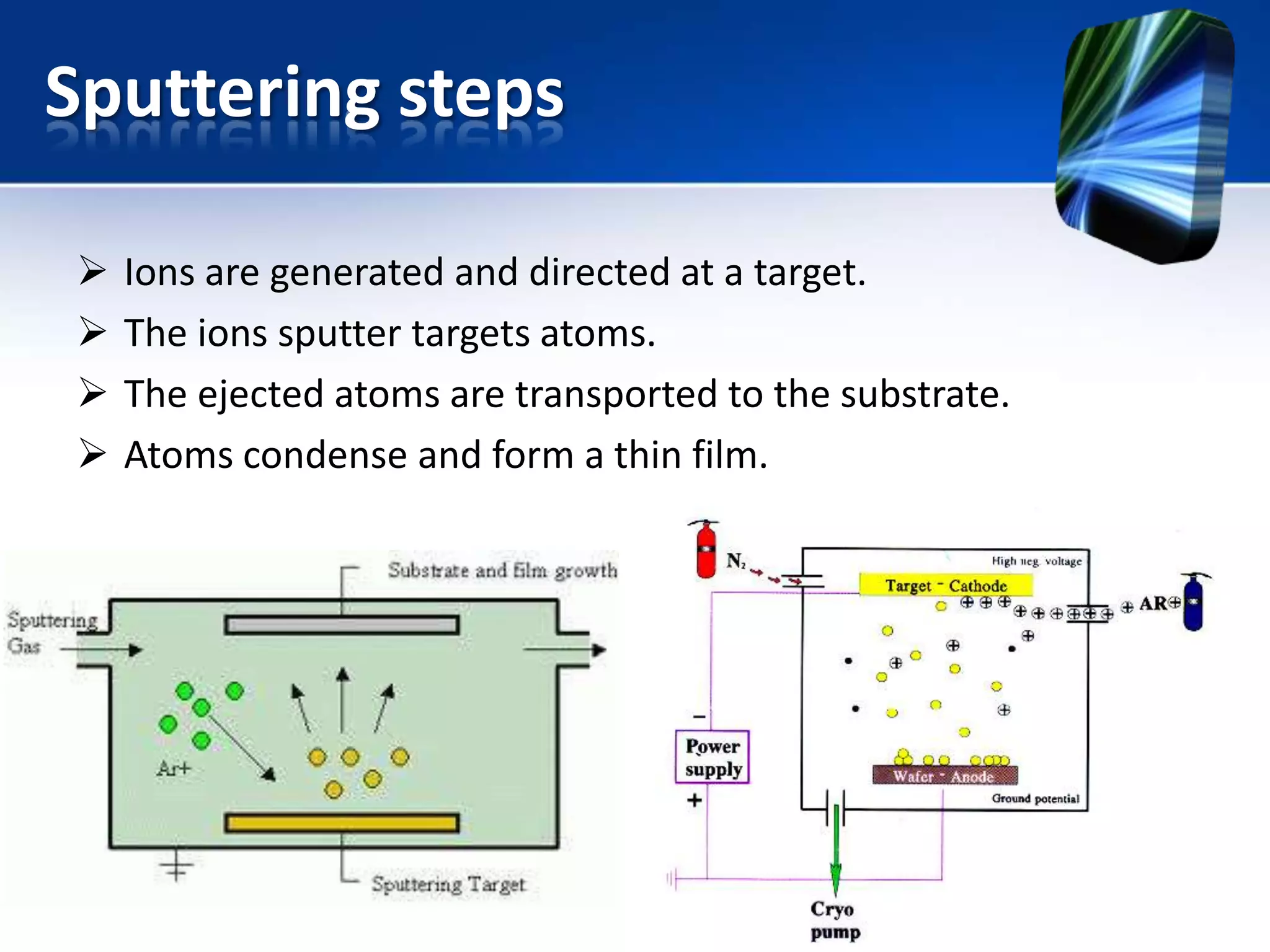
Sputtering steps
Ions aregenerated and directed at a target.
The ions sputter targets atoms.
The ejected atoms are transported to the substrate.
Atoms condense and form a thin film.
11.
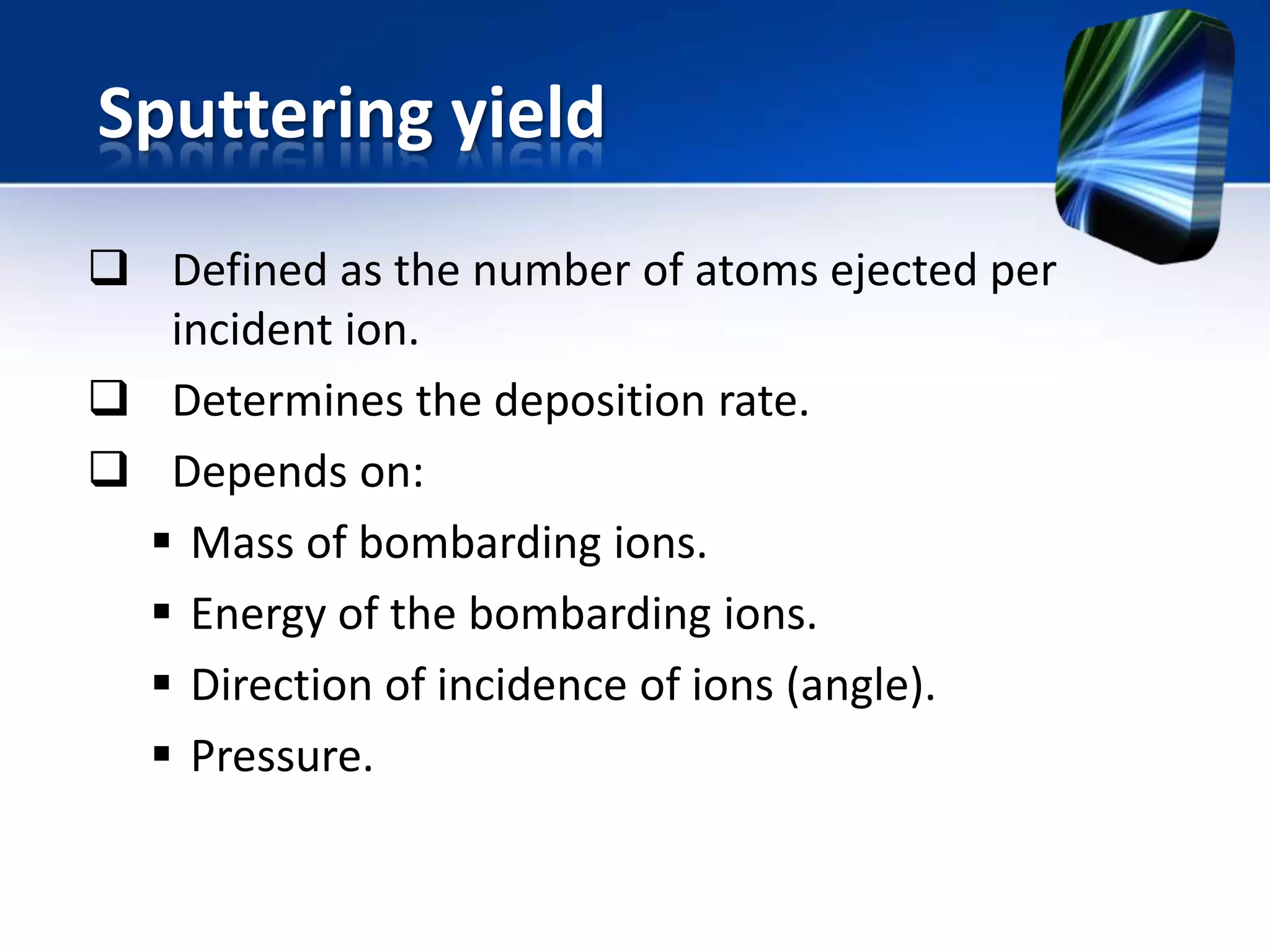
Sputtering yield
Definedas the number of atoms ejected per
incident ion.
Determines the deposition rate.
Depends on:
Mass of bombarding ions.
Energy of the bombarding ions.
Direction of incidence of ions (angle).
Pressure.
12.
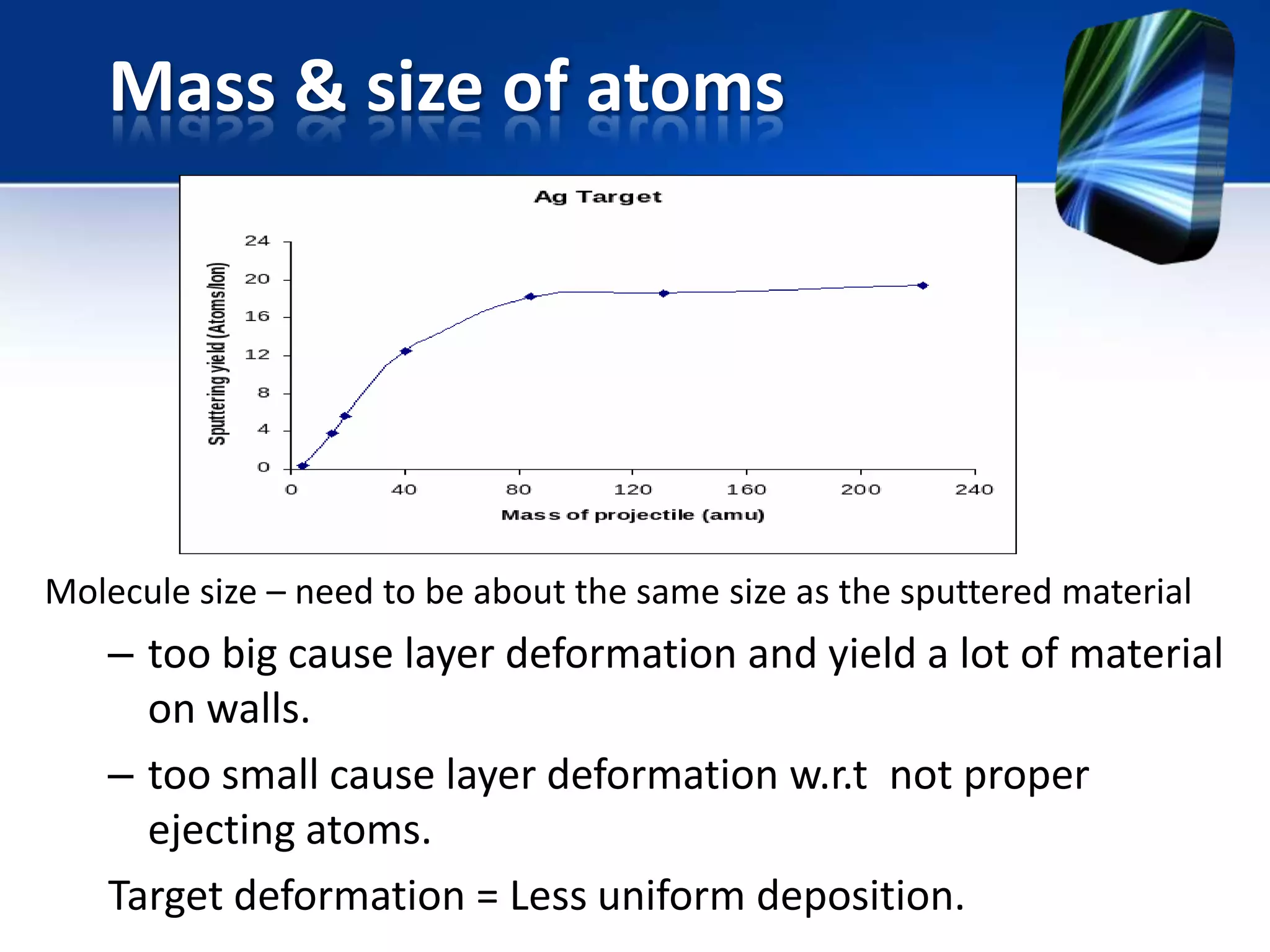
Mass & sizeof atoms
Molecule size – need to be about the same size as the sputtered material
– too big cause layer deformation and yield a lot of material
on walls.
– too small cause layer deformation w.r.t not proper
ejecting atoms.
Target deformation = Less uniform deposition.
13.
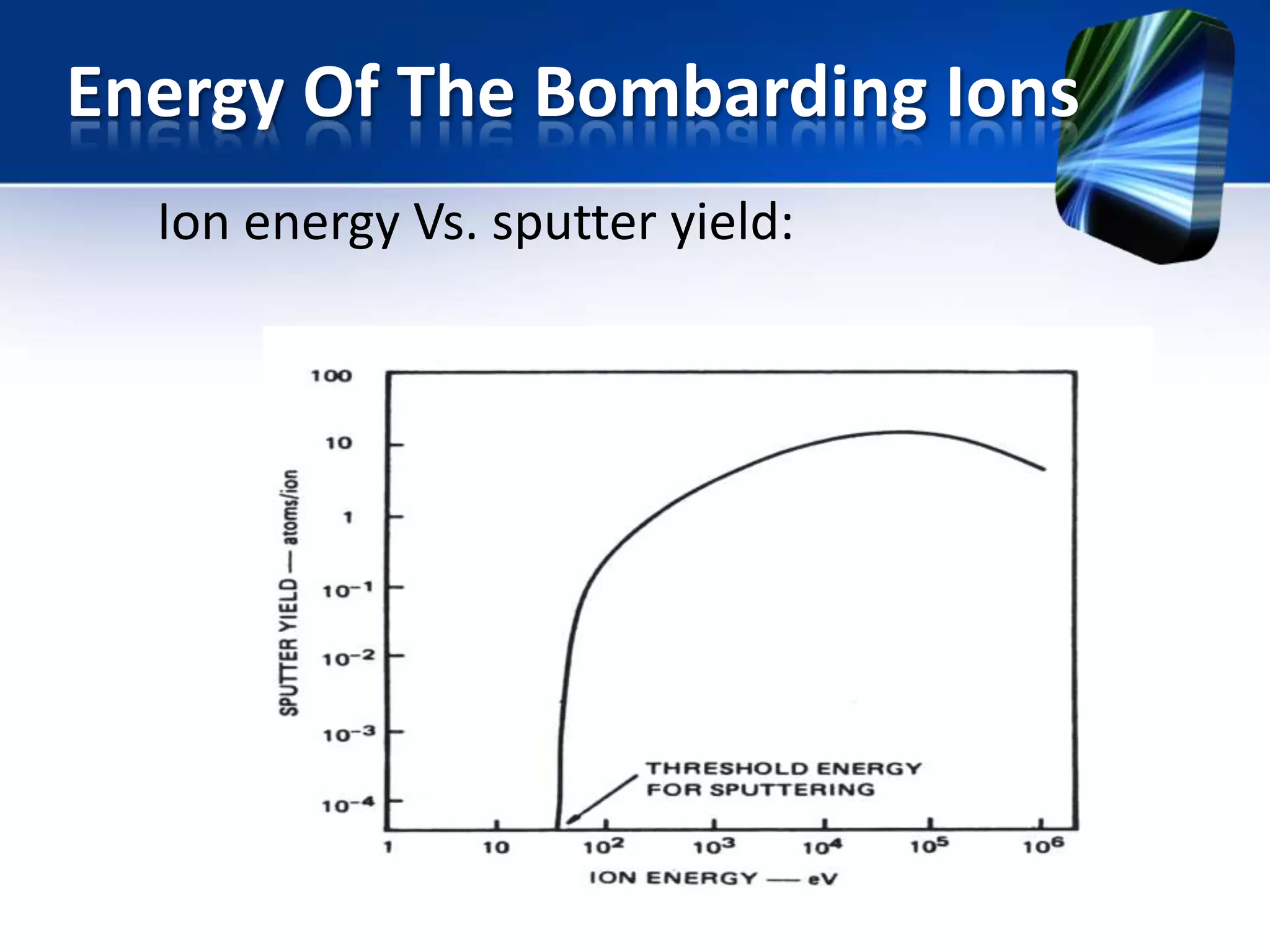
Energy Of TheBombarding Ions
Ion energy Vs. sputter yield:
14.
Direction
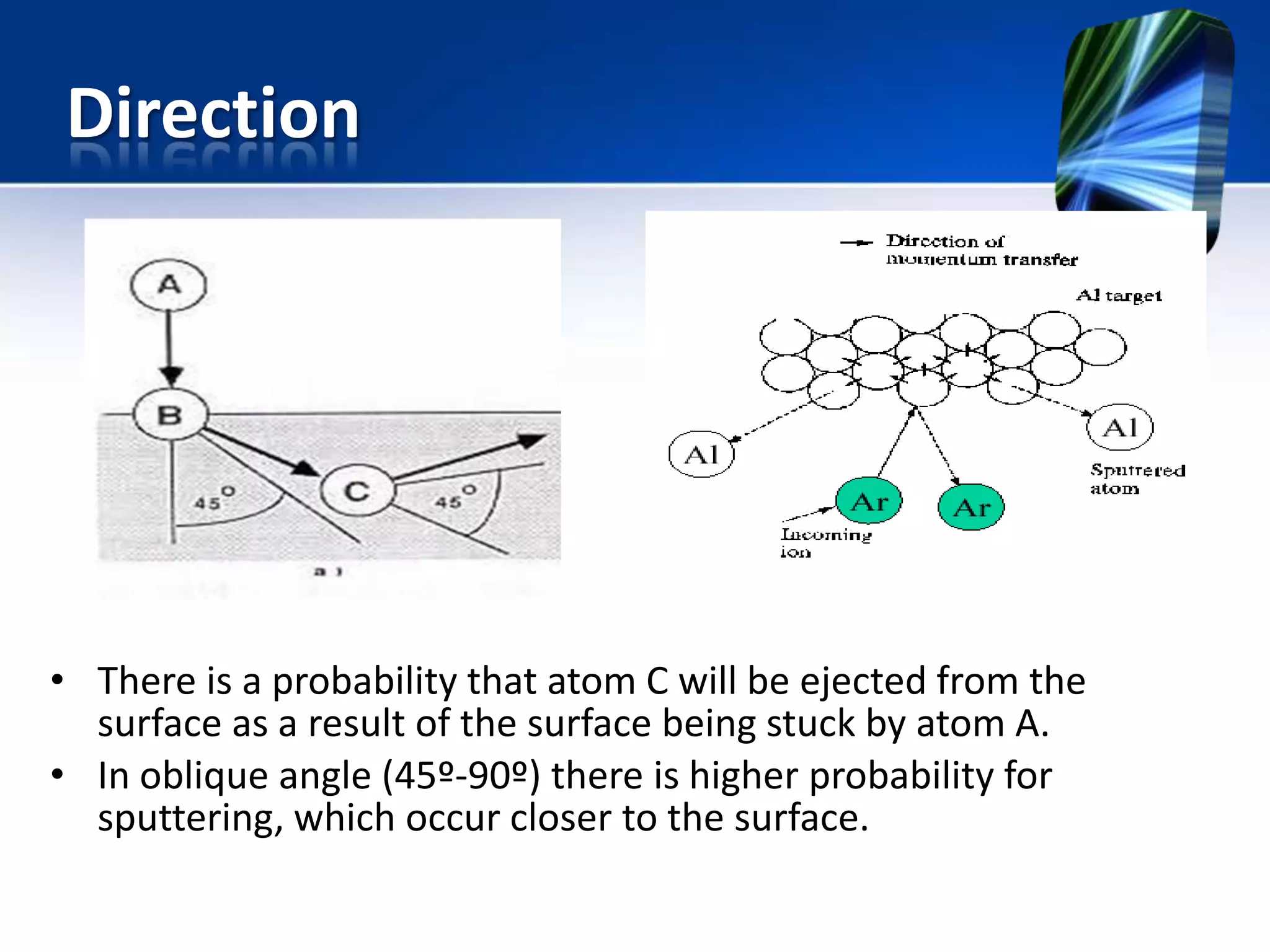
• There isa probability that atom C will be ejected from the
surface as a result of the surface being stuck by atom A.
• In oblique angle (45º-90º) there is higher probability for
sputtering, which occur closer to the surface.
15.
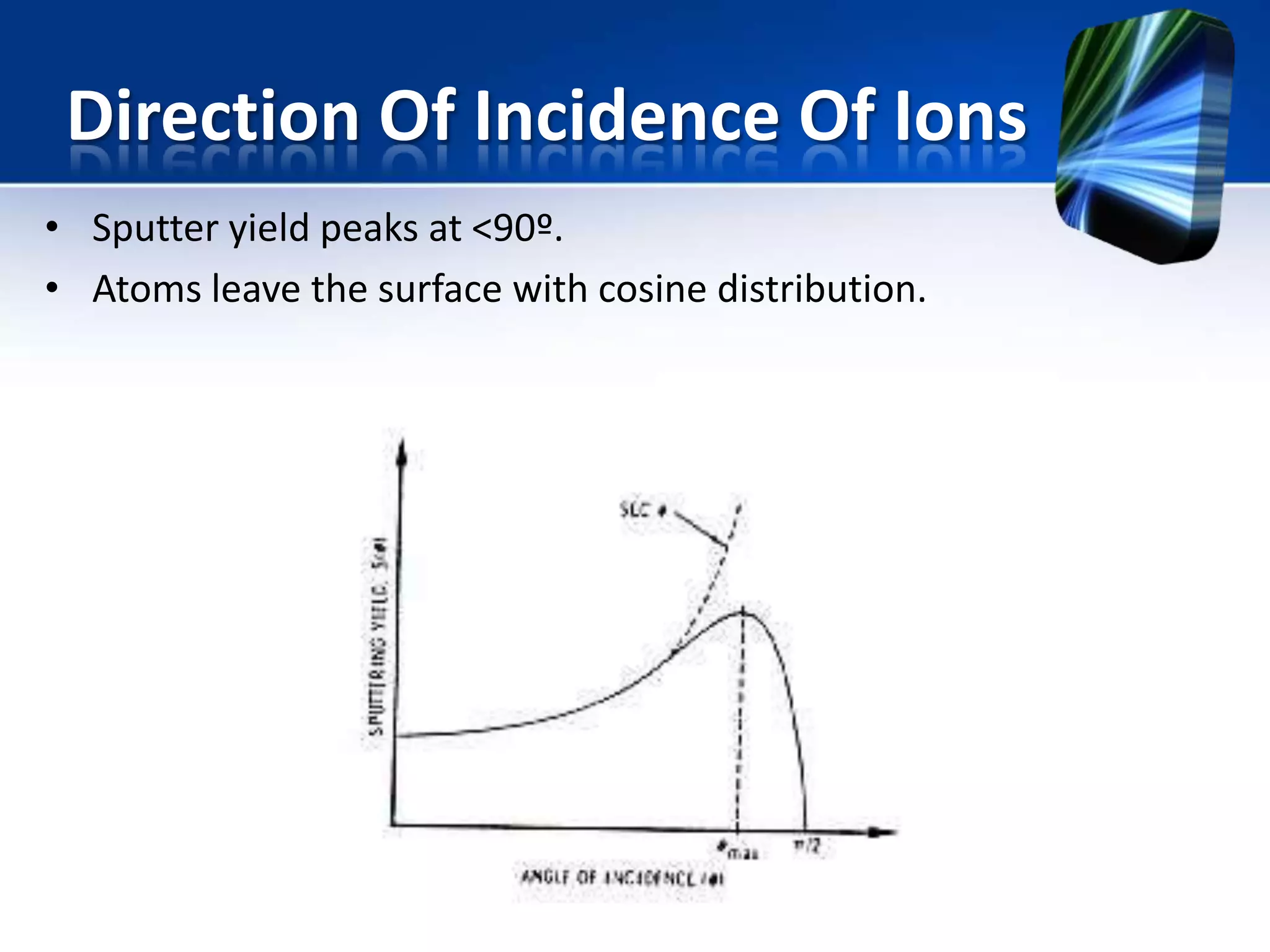
Direction Of IncidenceOf Ions
• Sputter yield peaks at <90º.
• Atoms leave the surface with cosine distribution.
16.
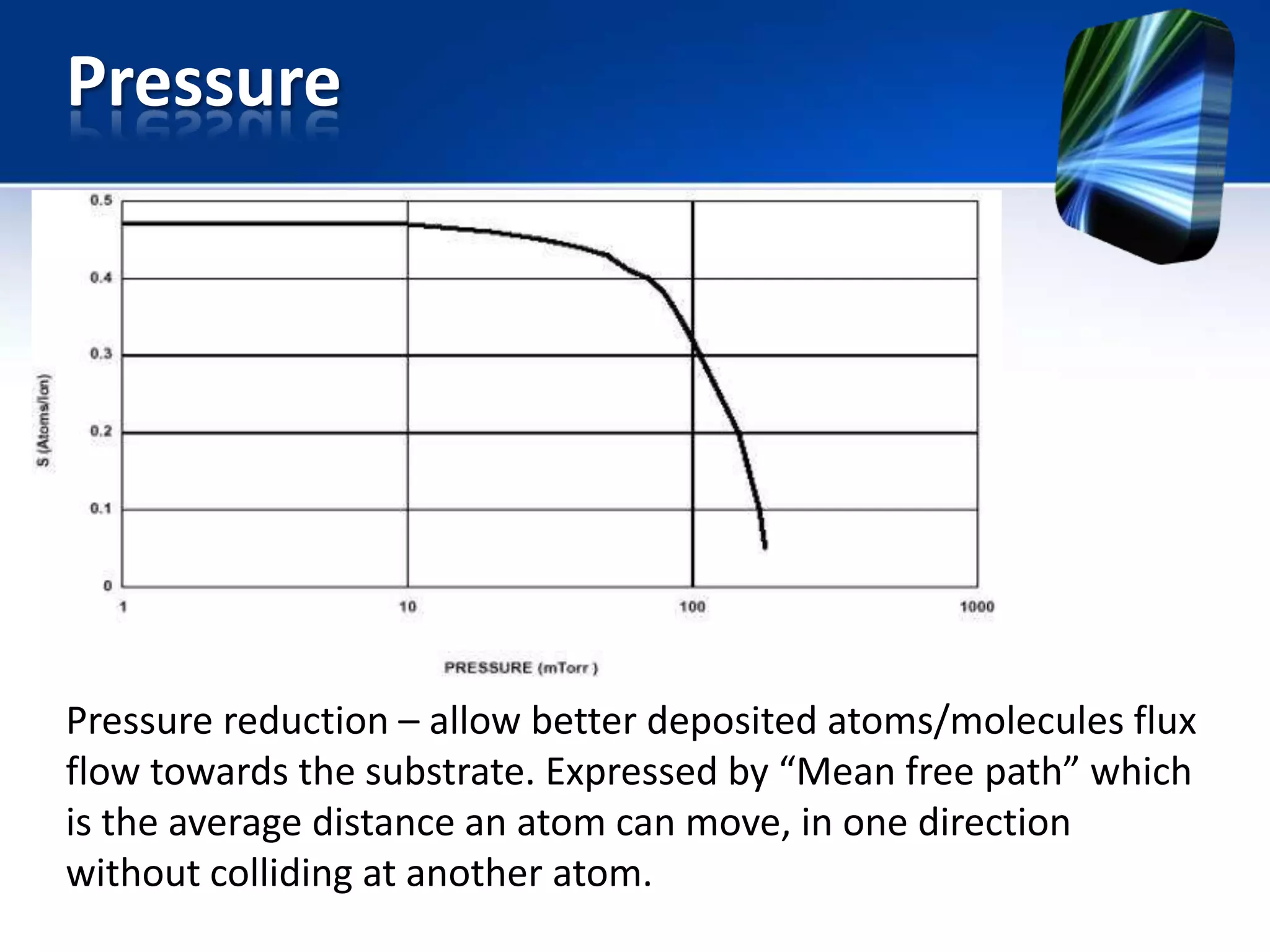
Pressure
Pressure reduction –allow better deposited atoms/molecules flux
flow towards the substrate. Expressed by “Mean free path” which
is the average distance an atom can move, in one direction
without colliding at another atom.
17.
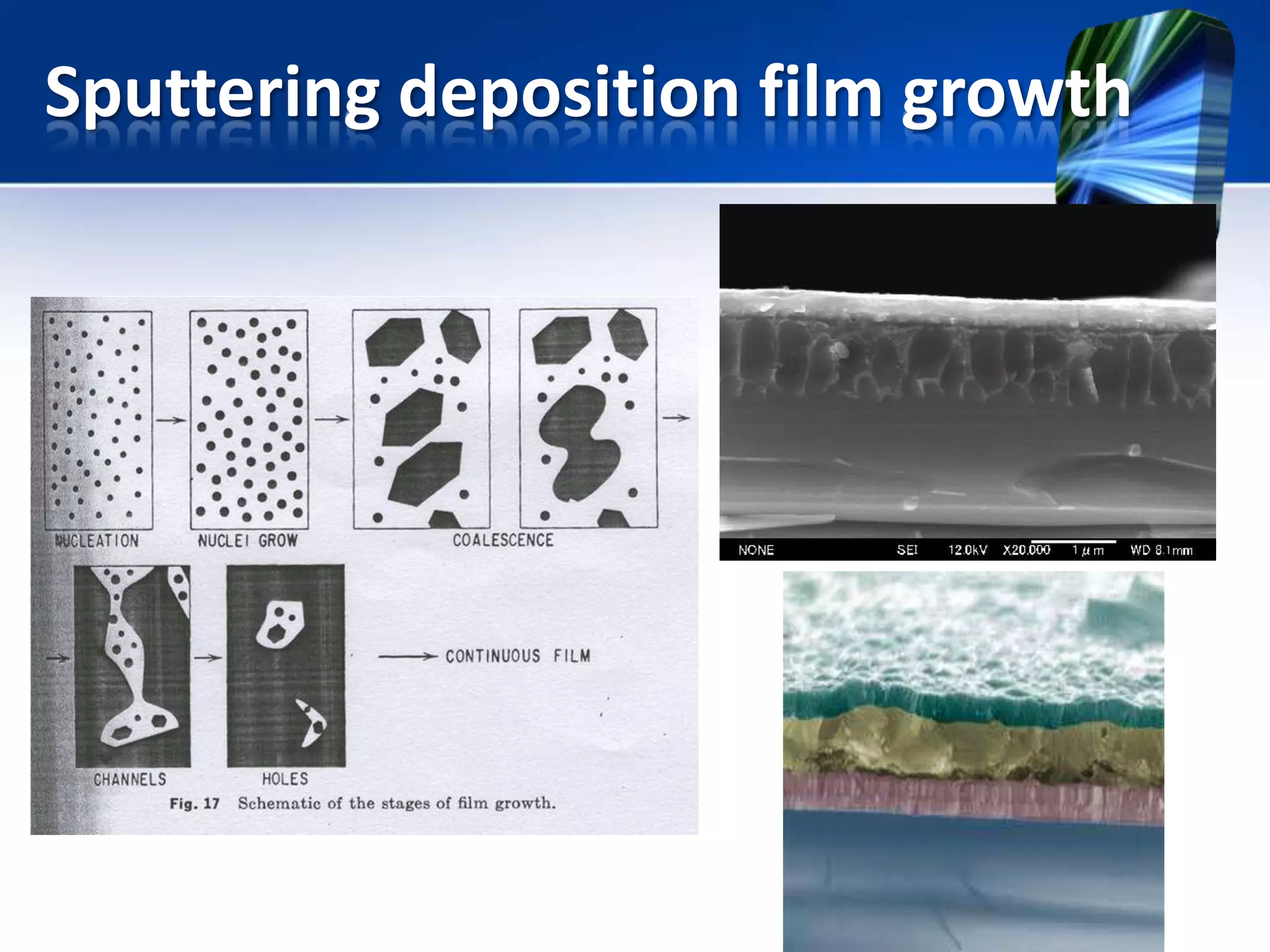
Sputtering deposition filmgrowth
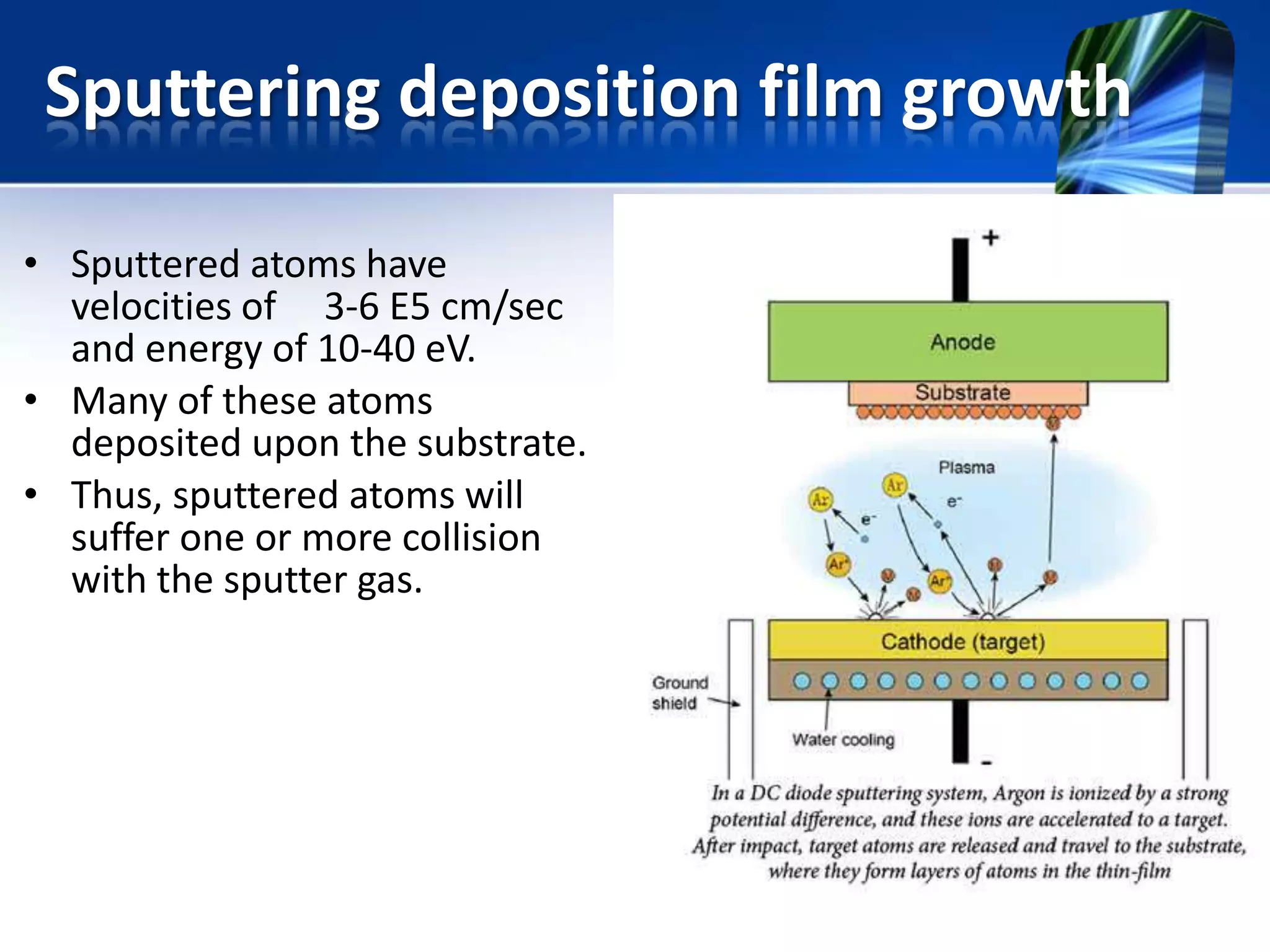
• Sputtered atoms have
velocities of 3-6 E5 cm/sec
and energy of 10-40 eV.
• Many of these atoms
deposited upon the substrate.
• Thus, sputtered atoms will
suffer one or more collision
with the sputter gas.
18.
Sputtering deposition filmgrowth
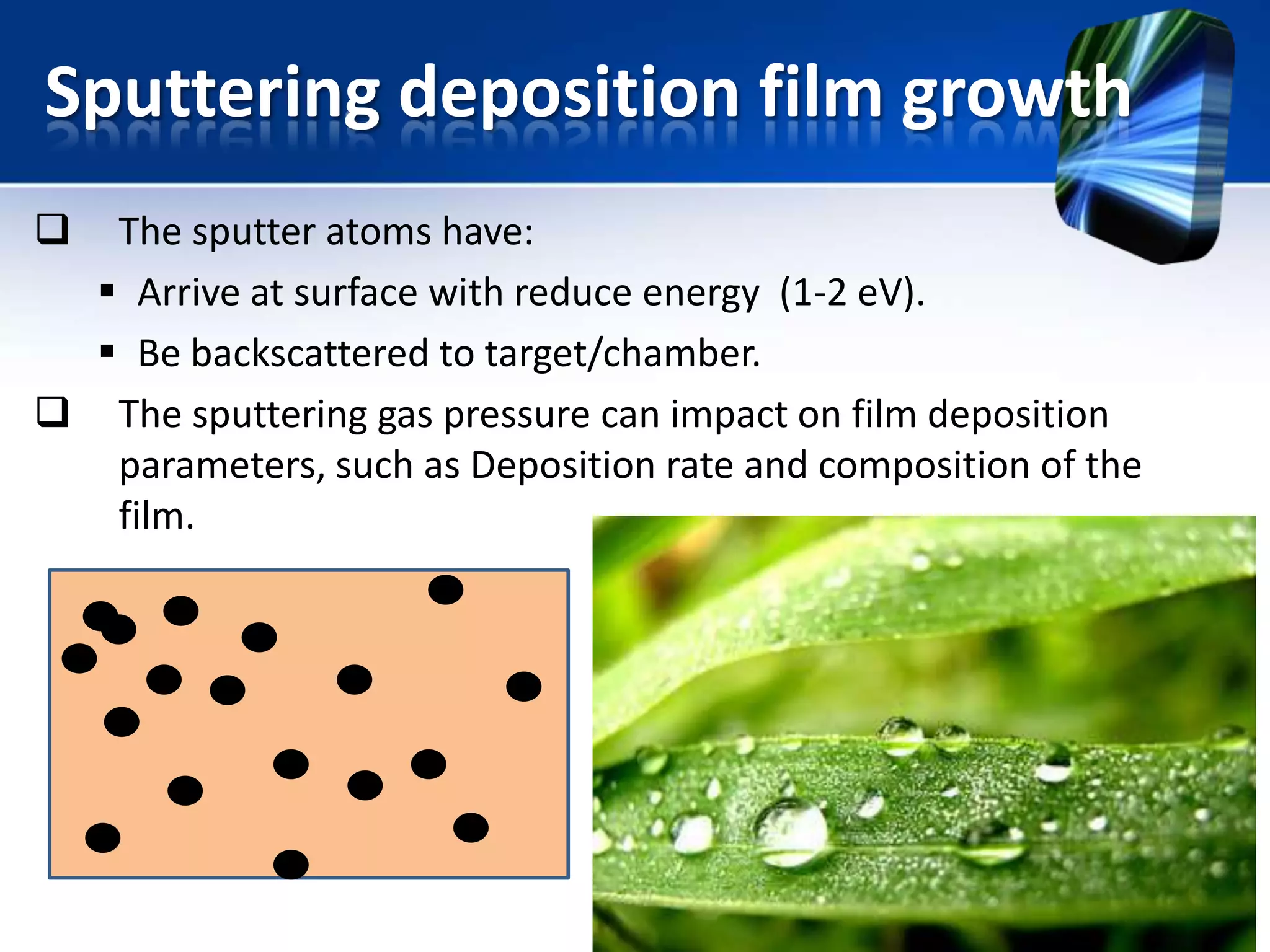
The sputter atoms have:
Arrive at surface with reduce energy (1-2 eV).
Be backscattered to target/chamber.
The sputtering gas pressure can impact on film deposition
parameters, such as Deposition rate and composition of the
film.
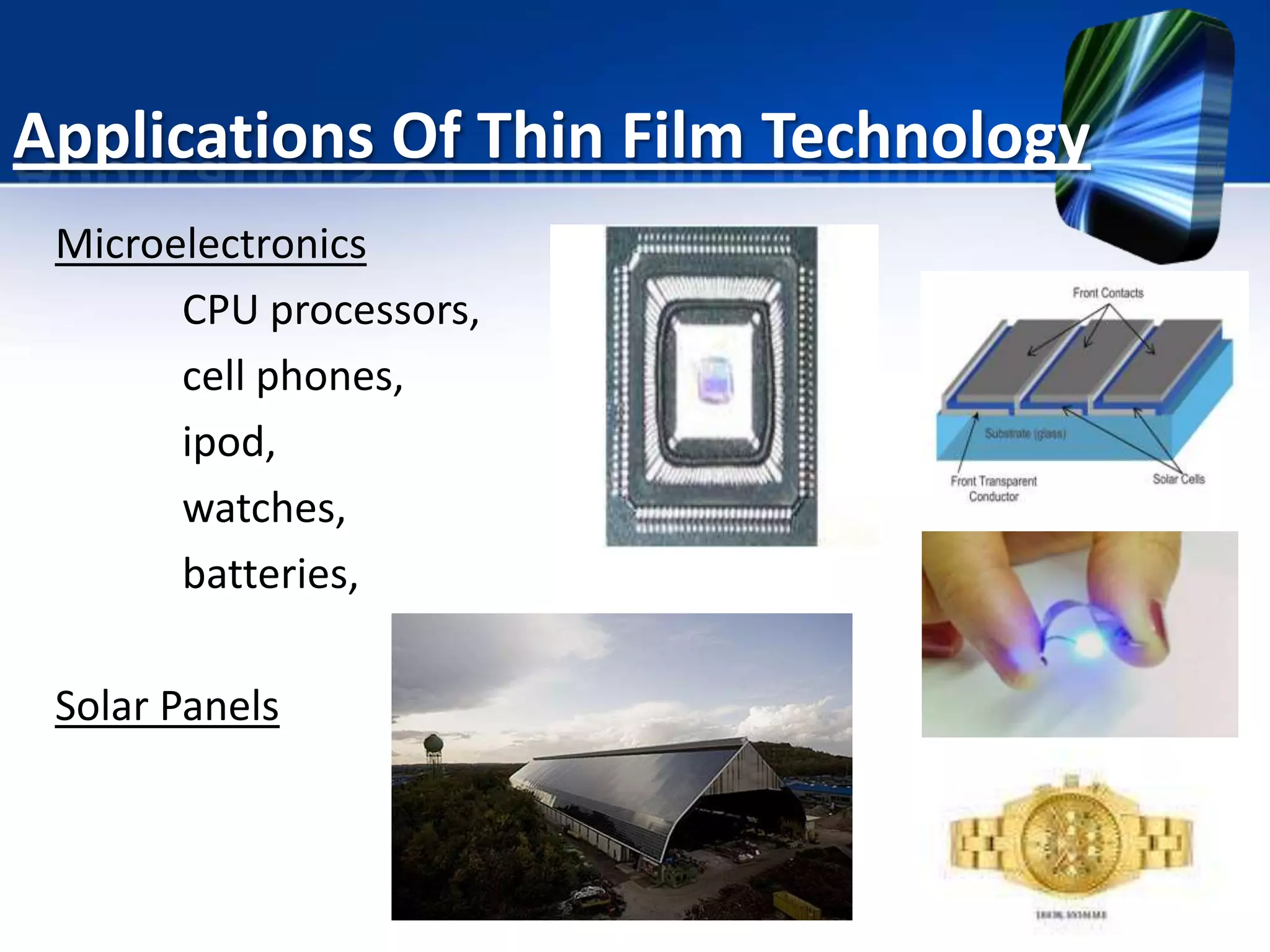
Applications Of ThinFilm Technology
Microelectronics
CPU processors,
cell phones,
ipod,
watches,
batteries,
Solar Panels
23.
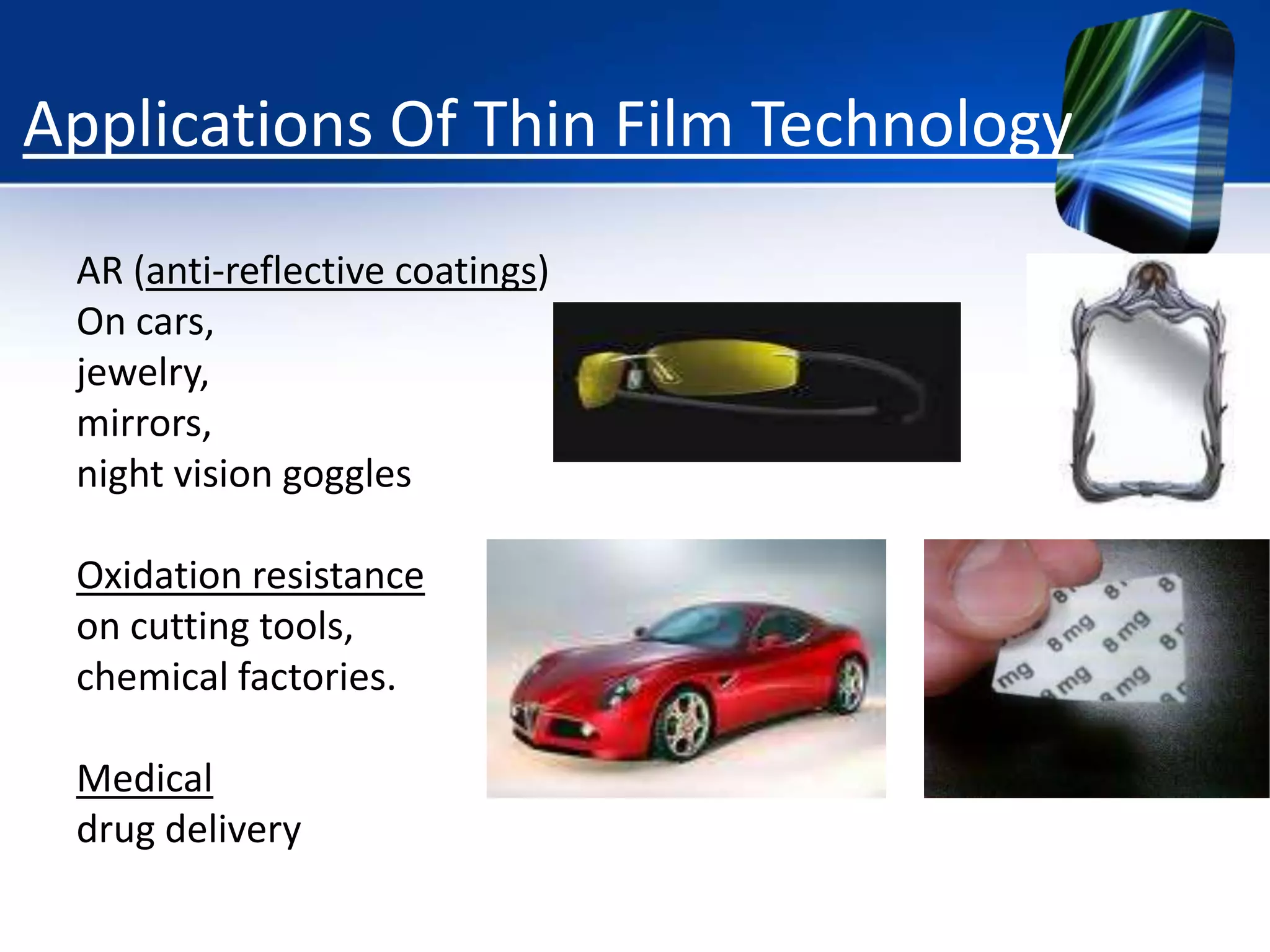
Applications Of ThinFilm Technology
AR (anti-reflective coatings)
On cars,
jewelry,
mirrors,
night vision goggles
Oxidation resistance
on cutting tools,
chemical factories.
Medical
drug delivery
References
• Hand bookof thin film deposition process and techniques- By
Krishna Seshan
• Thin Film Phenomena - Kasturi L. Chopra
• http://en.wikipedia.org/wiki/Thin-film_memory
• http://www.uccs.edu/~tchriste/courses/PHYS549/549lectures/
• http://nptel.iitm.ac.in/syllabus/syllabus.php?subjectId=11510201
9
• http://www.azom.com/article.aspx?ArticleID=8796