Crystallization
Mass Transfer 2
B.Tech. 3rd Year
Instructor
U. K. Arun Kumar
Introduction
• Finished solid products from process industries are
often in the form of crystals
• Examples: Sugar, NaCl, citric acid, ammonium
sulphate etc.
• Sugar production:
– Juice extraction from crushed cane
– Removal of suspended and colloidal materials (juice)
– Clear juice is then concentrated and cooled to get raw
sugar crystals
• Sugar production:
– Raw sugar is refined to remove residual colours and
impurities
– Crystals are redissolved in limited water.
– Impurities and colouring matters are removed by
adsorption
– Clear and purified solution is again evaporated and
cooled to get snow white crystals.
• Crystallization produce products in an acceptable
and granular form.
• An important quality of crystal products are size
distribution – should be narrow range
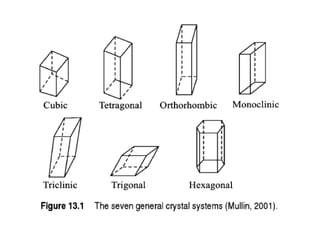
• A crystal is a solid body with plane faces in
which the atoms are arranged in an orderly
repetitive array.
• Crystalline materials generally have high
degree of purity -
• Even when obtained from impure solution.
• Size distribution (also shape) is an important
parameter of commercial importance.
• The process of formation or production of
crystals from a solution or a melt is called
crystallization.
• When crystals are formed by cooling a
saturated solution, it is called solution
crystallization.
• Melt crystallization: Crystals are generated by
cooling a molten solid in the absence of any
solvent.
• Example: Separation of xylene isomers – by
melt crystallization.
• Crystallization process:
• Saturation of solution
– When the solution concentration is increased
(either by evaporating solvent or by cooling),
solution becomes saturated.
• Supersaturated - When concentration of
solution is more than the solubility of the solid
at a particular temperature it is supersaturated.
• Supersaturation can be created and maintained
for almost all systems.
• The level of supersaturation depends upon
the system, also on how calm and free from
disturbances the system is.
• Sugar solution can have very high degree of
supersaturation.
• Up to 80 % concentration more than
saturation level.
• But in NaCl, it is too small.
• Spontaneous formation and growth of tiny
crystals called nuclei, take place in a
supersaturated solution.
• If a nucleus or a seed crystal is added to a
supersaturated solution, it gradually grows to
larger size.
• Supersaturation in a solution - is the driving
force for transport of solute from bulk
solution to crystal surface.
• On reaching the surface, solute molecules get
oriented and integrated into crystal lattice.
• Commercially, solution is heated in a heat
exchanger and led to crystallization chamber.
• In the chamber, some more solvent is
evaporated.
• Solution gets supresaturated and
crystallization takes place.
• The suspension or slurry with crystals and
solution is called magma.
• Solution remaining after removal of crystals is
mother liquor.
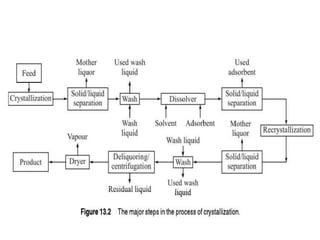
• Crystal production steps
– Crystallization
– Separation of crystals from mother liquor by
filtration or centrifugation.
– Washing crystals with fresh water to remove
adhering mother liquor.
– Drying of moist crystals.
Solid-liquid phase equilibrium
• Crystallization is opposite to dissolution of a
solid in a liquid or solvent.
• Solids dissolve as long as it reaches saturated
value.
• Conversely, in a supersaturated solution,
addition of few seed crystals -
• - creates a driving force for the transportation
of solute from bulk to crystal surface.
• The extent of supersaturation in a solution is
the driving force for crystallization.
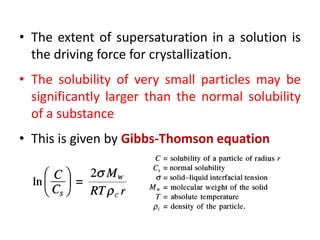
• The solubility of very small particles may be
significantly larger than the normal solubility
of a substance
• This is given by Gibbs-Thomson equation
• Smaller particles have more than normal
solubility.
• They dissolve even in a saturated solution
• Thus rising the concentration creating
supersaturation.
• Due to this the larger particles present in the
suspension starts growing
• Overall process is: dissolution of smaller
particles making the larger particles to grow.
• This process is called Ostwald ripening.
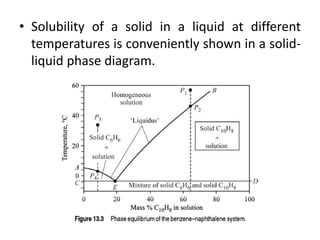
• Solubility of a solid in a liquid at different
temperatures is conveniently shown in a solid-
liquid phase diagram.
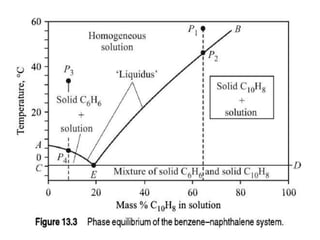
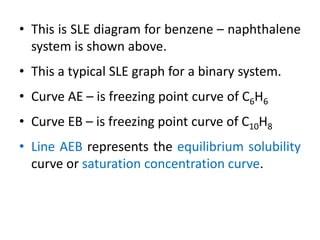
• This is SLE diagram for benzene – naphthalene
system is shown above.
• This a typical SLE graph for a binary system.
• Curve AE – is freezing point curve of C6H6
• Curve EB – is freezing point curve of C10H8
• Line AEB represents the equilibrium solubility
curve or saturation concentration curve.
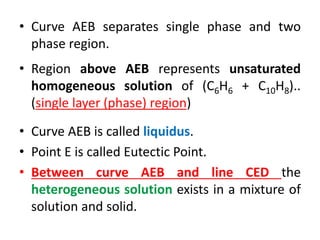
• Curve AEB separates single phase and two
phase region.
• Region above AEB represents unsaturated
homogeneous solution of (C6H6 + C10H8)..
(single layer (phase) region)
• Curve AEB is called liquidus.
• Point E is called Eutectic Point.
• Between curve AEB and line CED the
heterogeneous solution exists in a mixture of
solution and solid.
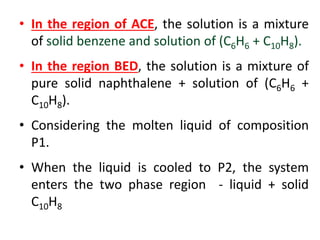
• In the region of ACE, the solution is a mixture
of solid benzene and solution of (C6H6 + C10H8).
• In the region BED, the solution is a mixture of
pure solid naphthalene + solution of (C6H6 +
C10H8).
• Considering the molten liquid of composition
P1.
• When the liquid is cooled to P2, the system
enters the two phase region - liquid + solid
C10H8
• Almost pure solid C10H8 begins to come out of
solution,
• The remaining liquid becomes rich in Benzene.
• When cooled to further below than P2, more
of C10H8 forms.
• The relative amounts are given by lever rule.
• The corresponding composition of benzene is
given by drawing a horizontal line to reach the
equilibrium line.
• The liquid is richer in benzene than before.
• P3 represents unsaturated solution,
• When it reaches P4, it reaches the two phase
region – solid benzene and solution.
• On further cooling below P4, the solution
reaches, CED line, corresponding to point E.
• Point E – represents Eutectic point. The
freezing point, is lower than the two pure
components.
• At Eutectic point – three phases co-exists
together – solid benzene + solid naphthalene
+ solution.
• Below line CED, only mixture of solids (C6H6
and C10H8) are presents at different
compositions.
• Line CED – is called SOLIDUS.
Nucleation and Crystal Growth.
• Nucleation – is formation of tiny new crystals
in a supersatured solution.
• A new crystal that is formed is called nucleus.
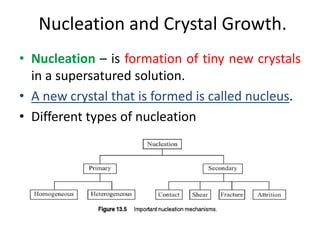
• Different types of nucleation
Primary Nucleation
• Primary nucleation – phenomenon of
formation of new crystals, independent of
presence of other crystals.
• Primary nucleation – two types
– Homogeneous nucleation
– Heterogeneous nucleation
• Homogeneous nucleation – it is formed by
the clustering of the solute molecules or ions
in a supersaturated solution.
• At normal levels of supersaturation, the
homogeneous nucleation is slow.
• It increases rapidly, if supersaturation is high.
• Solution Viscosity – if solution viscosity is
high, homogeneous nucleation rate is slowed
down.
• Temperature: Increase in T, decreases μ, so B0
increases.
• Heterogeneous nucleation: Formation of
crystals on tiny suspended foreign solid
particles. Also on crystallizer surface.
Secondary Nucleation(SN)
• Secondary nucleation: Formation of new
crystals from the existing crystals, is called
secondary nucleation.
•
• SN can happen by
– Fracture and attrition
• Fracture of existing crystals with impeller blades
• Attrition between two crystals.
– Contact nucleation – it is predominant
• Contact nucleation:
– Diffusion or convection of ion-pairs or molecules
from bulk solution to crystal surface.
– Continuous adsorption on crystals forming lattice
leading to crystal growth.
• Loosely adsorbed molecules on crystals gets
displaced by agitator or pump disturbances.
• Breeding: secondary nucleation is also called
as breeding.
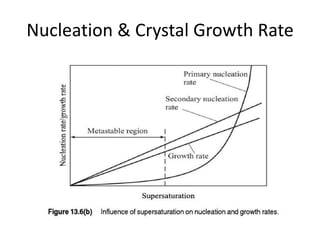
Nucleation & Crystal Growth Rate
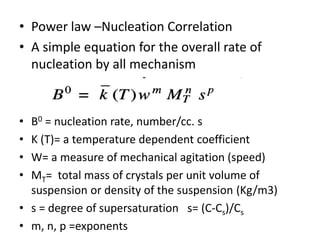
• Power law –Nucleation Correlation
• A simple equation for the overall rate of
nucleation by all mechanism
• B0 = nucleation rate, number/cc. s
• K (T)= a temperature dependent coefficient
• W= a measure of mechanical agitation (speed)
• MT= total mass of crystals per unit volume of
suspension or density of the suspension (Kg/m3)
• s = degree of supersaturation s= (C-Cs)/Cs
• m, n, p =exponents
Crystal Growth
• Crystal growth theories
– Adsorption theory
– Mass transfer theory
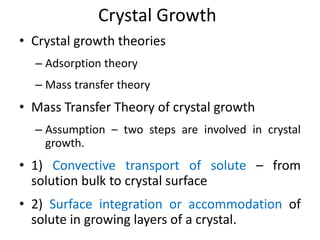
• Mass Transfer Theory of crystal growth
– Assumption – two steps are involved in crystal
growth.
• 1) Convective transport of solute – from
solution bulk to crystal surface
• 2) Surface integration or accommodation of
solute in growing layers of a crystal.
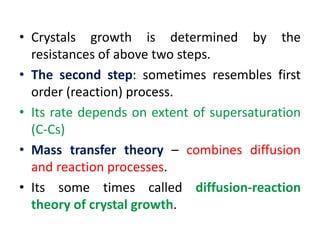
• Crystals growth is determined by the
resistances of above two steps.
• The second step: sometimes resembles first
order (reaction) process.
• Its rate depends on extent of supersaturation
(C-Cs)
• Mass transfer theory – combines diffusion
and reaction processes.
• Its some times called diffusion-reaction
theory of crystal growth.
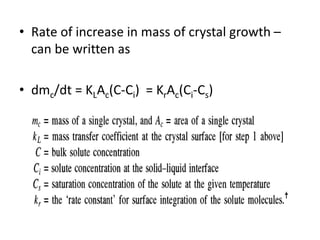
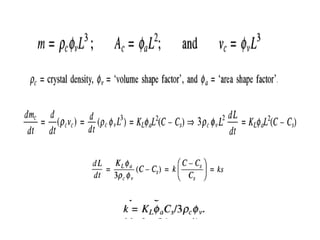
• Rate of increase in mass of crystal growth –
can be written as
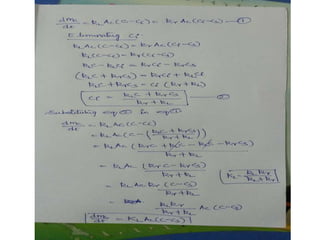
• dmc/dt = KLAc(C-Ci) = KrAc(Ci-Cs)
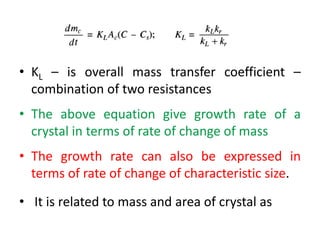
• KL – is overall mass transfer coefficient –
combination of two resistances
• The above equation give growth rate of a
crystal in terms of rate of change of mass
• The growth rate can also be expressed in
terms of rate of change of characteristic size.
• It is related to mass and area of crystal as
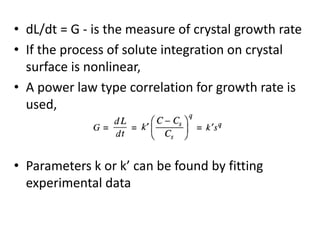
• dL/dt = G - is the measure of crystal growth rate
• If the process of solute integration on crystal
surface is nonlinear,
• A power law type correlation for growth rate is
used,
• Parameters k or k’ can be found by fitting
experimental data
McCabe ΔL law
• McCabe in 1929, based on several research
work, showed that
• The rate of crystal growth G, is independent
of crystal size, L.
• dG/dL =0
• This is well-known McCabe ΔL law
• Not all system obey this law.
• Sometime G, depends on L.
Crystal Size Distribution (CSD)
• Supersaturation of a solution is ‘lost’ by the
competition between nucleation and crystal
growth.
• Their relative rates depend upon various
factors including supersaturation.
• In a continuous crystallizer, a nuclei remain for
a short period of time and then leaves with
the mother liquor.
• At any time - crystals in the apparatus vary in
size
• It is determined by Crystal Size Distribution
(CSD).
• CSD is extremely important in design and
analysis of crystallizers.
• A narrow size distribution is always preferred.
• Theoretical analysis of CSD is conveniently
done by population balance technique.
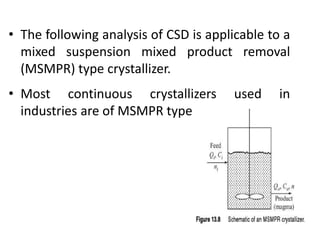
• The following analysis of CSD is applicable to a
mixed suspension mixed product removal
(MSMPR) type crystallizer.
• Most continuous crystallizers used in
industries are of MSMPR type.
• Assumption of MSMPR
– Particles remain uniformly distributed in the
suspension
– Feed enters continuously and product is removed
continuously
– The suspension density and particle size
distribution inside vessel and in the outlet stream
are same.
– Negligible breakage of crystal occurs
– Steady-state operation takes place.
• Let n (L) - CSD based on length of crystals.
• n(L)dL – number of crystals with the
infinitesimal range L to L + dL in unit volume
of suspension.
• n(L) – also called population density function.
• Making a population balance of crystal
• Considering crystals only the arbitrary size
range L1 to L2
• Population density for the size L1 is n1
• Population density for the size L2 is n2
• The average population density in the size
range L1 to L2 be - ñ
• Over a small time, dt
• Some crystals little small than L1, would grow
and enter the size range [L1, L2]
• Similarly,
• Some crystals little smaller than L2 would
become oversize in time dt, and leave the
range [L1, L2]
• Number of crystals in suspension volume V is
given below
• Number of crystals that crosses size L1 and
enters the range [L1, L2] over a time dt,
• Number of crystals that crosses size L2 and
leaves the range [L1, L2] over a time dt,
• Feed source (inlet): crystal in feed in range
[L1,L2]
– Crystal in the range [L1,L2] may enter along with
the feed
• In exit stream:
– crystal in range [L1,L2] may leave the device with
suspension withdrawn as product.
• Let ni –population density function of crystal
in feed.
• Average value of the density function in the
size range [L1,L2] is given by ñi
• If Qi – flow rate of liquor into crystallizer,
• Number of crystals entering with the feed in
time dt,
• Let Qo - flow rate of product (exit) stream
with crystal size range [L1,L2] -
• Number of crystal in product stream is
• Writing a population balance equation for
crystal size range [L1,L2]
• {No. of particles that grow and enter the size
range [L1,L2]
+ No. of particles that enter the vessel with
feed} =
• {No. of particles that grow (>L2) and leave the
range [L1,L2]
• + No. of particles that leave the vessel (with
product)}
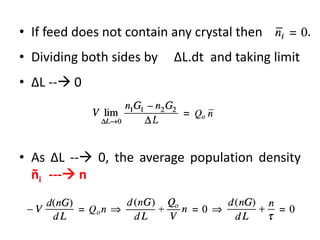
• If feed does not contain any crystal then
• Dividing both sides by ΔL.dt and taking limit
• ΔL -- 0
• As ΔL -- 0, the average population density
ñi --- n
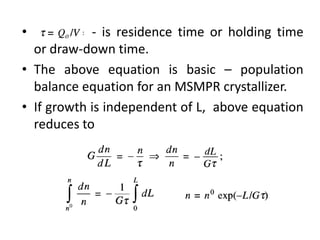
• - is residence time or holding time
or draw-down time.
• The above equation is basic – population
balance equation for an MSMPR crystallizer.
• If growth is independent of L, above equation
reduces to
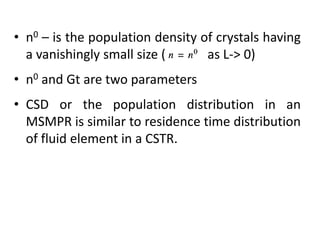
• n0 – is the population density of crystals having
a vanishingly small size ( as L-> 0)
• n0 and Gt are two parameters
• CSD or the population distribution in an
MSMPR is similar to residence time distribution
of fluid element in a CSTR.
Average Particle Size
• Ordinary average size – length, area and mass
average size.
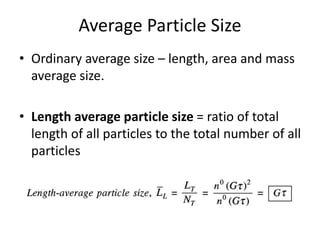
• Length average particle size = ratio of total
length of all particles to the total number of all
particles
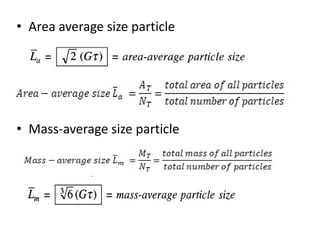
• Area average size particle
• Mass-average size particle
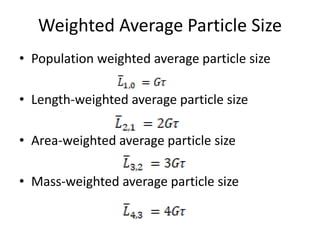
Weighted Average Particle Size
• Population weighted average particle size
• Length-weighted average particle size
• Area-weighted average particle size
• Mass-weighted average particle size
Crystal size control
• An ideal MSMPR crystallizer give a product of
wide size distribution.
• Few modifications in operation produces
crystals of narrow size range.
• It is done by controlling the residence time of
the crystals.
• If smaller particles are not allowed to remain
in the vessel for long,
• Product will contain more bigger crystals and
less of fines.
• This is because the fines, do not get sufficient
time to grow.
• Three common options for controlling are
– Double draw-off (DDO) or Clear liquid overflow
(CLO) or clear liquid advance (CLA)
– Fines removal with destruction
– Classified product removal
Double draw-off strategy
• Two streams are drawn from the crystallizer
• A clear liquid stream having few fine crystals
from near the top of the vessel (overflow)
and
• A slurry or suspension from a lower level
(underflow) is removed
• If some ‘fines’ are continuously removed from
the vessel,
• The concentration of the fines can be reduced.
Crystallizer with fines removal and
destruction
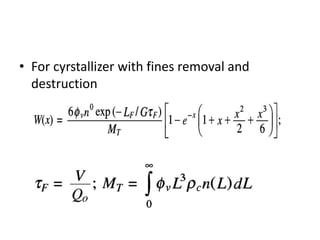
• A stream containing small crystals (L < LF) is
withdrawn from the top at a volumetric rate
Q0
• The crystals are dissolved by heating in a heat
exchanger
• The solution is recycled back into the
crystallizer, with volume V
• Product stream is drawn with a rate Qp
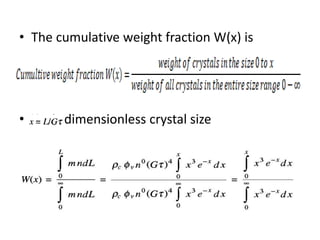
• The cumulative weight fraction W(x) is
• X – is dimensionless crystal size
• For cyrstallizer with fines removal and
destruction
Crystallizers
• Nucleation and growth both depend on
supersaturation (SS) of solution.
• At high SS level – nucleation is high
• At low SS level – rate of nucleation is slow.
• Secondary nucleation rate can be controlled
by maintaining low mechanical energy input.
Mixed Suspension Mixed Product Removal
Crystallizer or Circulating Magma Crystallizer
• In this growing crystals are kept in suspension
by agitation: 20-40 % solids in suspension
• Two types of such crystallizers are
– Forced-circulation (evaporative) crystallizer
– Draft-tube-baffle (DTB) crystallizer
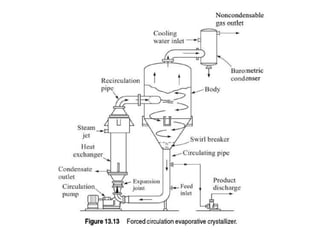
Forced circulation crystallizer
• It has four major components:
• The slurry is pumped through an external
steam heated vertical heat exchanger to raise
T from 2 to 6 °C
• Heat exchanger tubes : 11/4 to 13/4 inch
• Liquid velocity: 2-3 m/s
• No boiling occurs in the heat exchanger.
• Hot liquid is introduced into crystallizer –
evaporation of liquid occurs.
• Thus generating supersaturation for crystal
growth.
• A condenser removes the vapor at the top.
• Product is removed from the circulating pipe.
• The feed also enters the vessel through this
pipe, at a lower level
• Pump speed should be low to reduce
mechanical energy input – to maintain small
secondary nucleation.
• Ammonium sulphate, NaCl, citric acid, sugar
are crystallized by using FC crystallizer.
• Crystals typically of size range 30-60 mesh are
produced.
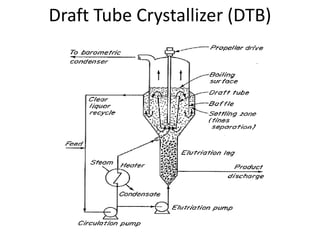
Draft Tube Crystallizer (DTB)
• It contains an inner baffle tube and a skirt
baffle.
• A long-shaft slow moving impeller throws
liquid upwards through baffle tube towards
the boiling surface.
• This causes circulation of magma in the
cyrstallizer
• More circulation is achieved at the same
power input.
• Fouling is also less than in a FC.
• Magma flows out of body through annular
space between skirt baffle and the wall.
• Then enters a steam –heated exchanger.
• Then is recycled back to the crystallizer vessel.
• Some of the fines may dissolve in the heat
exchanger.
• Thus the crystallizer has a fine destruction
feature.
• Settling of large crystals occurs in the annular
region,
• So that only the fines leave the re-circulating
slurry.
• However this happens only when the mother
liquor and the crystals have sufficiently
different densities.
• Crystals ranging from 8 to 30 mesh may be
produced.
• Applications: adipic acid, KCl, K2SO4 etc.
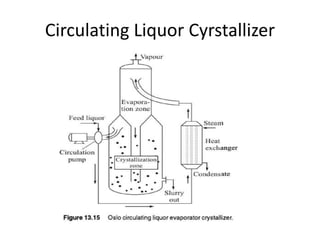
Circulating Liquor Cyrstallizer
• In this crystallizer - crystals are retained
within the vessel
• Only the liquor is circulated through an
external heat exchanger
• In this liquor is either heated by steam or
cooled to generate supersaturation.
• Crystals are kept in suspension by the
upflowing liquid in the vessel.
• Liquid velocity is maintained so that hardly
any crystals are present in the top region of
the vessel
• Virtually clear liquid enters the circulating pipe
• An Oslo-krystal crystallizer is shown above.
• Significance: supersaturation is created in a
separate region before the liquor enters the
vessel.
• The level of supersaturation drops down as
the liquor from (SS) zone mixes with the
slurry.
• This helps to achieve uniform crystal growth
and low rate of secondary nucleation
• This type of crystallizer produces narrow range
CSD

Crystalization (Mass Transfer)

  • 1.
    Crystallization Mass Transfer 2 B.Tech.3rd Year Instructor U. K. Arun Kumar
  • 2.
    Introduction • Finished solidproducts from process industries are often in the form of crystals • Examples: Sugar, NaCl, citric acid, ammonium sulphate etc. • Sugar production: – Juice extraction from crushed cane – Removal of suspended and colloidal materials (juice) – Clear juice is then concentrated and cooled to get raw sugar crystals
  • 3.
    • Sugar production: –Raw sugar is refined to remove residual colours and impurities – Crystals are redissolved in limited water. – Impurities and colouring matters are removed by adsorption – Clear and purified solution is again evaporated and cooled to get snow white crystals. • Crystallization produce products in an acceptable and granular form. • An important quality of crystal products are size distribution – should be narrow range
  • 4.
    • A crystalis a solid body with plane faces in which the atoms are arranged in an orderly repetitive array. • Crystalline materials generally have high degree of purity - • Even when obtained from impure solution. • Size distribution (also shape) is an important parameter of commercial importance. • The process of formation or production of crystals from a solution or a melt is called crystallization.
  • 5.
    • When crystalsare formed by cooling a saturated solution, it is called solution crystallization. • Melt crystallization: Crystals are generated by cooling a molten solid in the absence of any solvent. • Example: Separation of xylene isomers – by melt crystallization.
  • 6.
    • Crystallization process: •Saturation of solution – When the solution concentration is increased (either by evaporating solvent or by cooling), solution becomes saturated. • Supersaturated - When concentration of solution is more than the solubility of the solid at a particular temperature it is supersaturated. • Supersaturation can be created and maintained for almost all systems.
  • 7.
    • The levelof supersaturation depends upon the system, also on how calm and free from disturbances the system is. • Sugar solution can have very high degree of supersaturation. • Up to 80 % concentration more than saturation level. • But in NaCl, it is too small.
  • 8.
    • Spontaneous formationand growth of tiny crystals called nuclei, take place in a supersaturated solution. • If a nucleus or a seed crystal is added to a supersaturated solution, it gradually grows to larger size. • Supersaturation in a solution - is the driving force for transport of solute from bulk solution to crystal surface.
  • 9.
    • On reachingthe surface, solute molecules get oriented and integrated into crystal lattice. • Commercially, solution is heated in a heat exchanger and led to crystallization chamber. • In the chamber, some more solvent is evaporated. • Solution gets supresaturated and crystallization takes place.
  • 10.
    • The suspensionor slurry with crystals and solution is called magma. • Solution remaining after removal of crystals is mother liquor. • Crystal production steps – Crystallization – Separation of crystals from mother liquor by filtration or centrifugation. – Washing crystals with fresh water to remove adhering mother liquor. – Drying of moist crystals.
  • 13.
    Solid-liquid phase equilibrium •Crystallization is opposite to dissolution of a solid in a liquid or solvent. • Solids dissolve as long as it reaches saturated value. • Conversely, in a supersaturated solution, addition of few seed crystals - • - creates a driving force for the transportation of solute from bulk to crystal surface.
  • 14.
    • The extentof supersaturation in a solution is the driving force for crystallization. • The solubility of very small particles may be significantly larger than the normal solubility of a substance • This is given by Gibbs-Thomson equation
  • 15.
    • Smaller particleshave more than normal solubility. • They dissolve even in a saturated solution • Thus rising the concentration creating supersaturation. • Due to this the larger particles present in the suspension starts growing • Overall process is: dissolution of smaller particles making the larger particles to grow. • This process is called Ostwald ripening.
  • 16.
    • Solubility ofa solid in a liquid at different temperatures is conveniently shown in a solid- liquid phase diagram.
  • 18.
    • This isSLE diagram for benzene – naphthalene system is shown above. • This a typical SLE graph for a binary system. • Curve AE – is freezing point curve of C6H6 • Curve EB – is freezing point curve of C10H8 • Line AEB represents the equilibrium solubility curve or saturation concentration curve.
  • 19.
    • Curve AEBseparates single phase and two phase region. • Region above AEB represents unsaturated homogeneous solution of (C6H6 + C10H8).. (single layer (phase) region) • Curve AEB is called liquidus. • Point E is called Eutectic Point. • Between curve AEB and line CED the heterogeneous solution exists in a mixture of solution and solid.
  • 20.
    • In theregion of ACE, the solution is a mixture of solid benzene and solution of (C6H6 + C10H8). • In the region BED, the solution is a mixture of pure solid naphthalene + solution of (C6H6 + C10H8). • Considering the molten liquid of composition P1. • When the liquid is cooled to P2, the system enters the two phase region - liquid + solid C10H8
  • 21.
    • Almost puresolid C10H8 begins to come out of solution, • The remaining liquid becomes rich in Benzene. • When cooled to further below than P2, more of C10H8 forms. • The relative amounts are given by lever rule. • The corresponding composition of benzene is given by drawing a horizontal line to reach the equilibrium line.
  • 22.
    • The liquidis richer in benzene than before. • P3 represents unsaturated solution, • When it reaches P4, it reaches the two phase region – solid benzene and solution. • On further cooling below P4, the solution reaches, CED line, corresponding to point E. • Point E – represents Eutectic point. The freezing point, is lower than the two pure components.
  • 23.
    • At Eutecticpoint – three phases co-exists together – solid benzene + solid naphthalene + solution. • Below line CED, only mixture of solids (C6H6 and C10H8) are presents at different compositions. • Line CED – is called SOLIDUS.
  • 24.
    Nucleation and CrystalGrowth. • Nucleation – is formation of tiny new crystals in a supersatured solution. • A new crystal that is formed is called nucleus. • Different types of nucleation
  • 25.
    Primary Nucleation • Primarynucleation – phenomenon of formation of new crystals, independent of presence of other crystals. • Primary nucleation – two types – Homogeneous nucleation – Heterogeneous nucleation • Homogeneous nucleation – it is formed by the clustering of the solute molecules or ions in a supersaturated solution.
  • 26.
    • At normallevels of supersaturation, the homogeneous nucleation is slow. • It increases rapidly, if supersaturation is high. • Solution Viscosity – if solution viscosity is high, homogeneous nucleation rate is slowed down. • Temperature: Increase in T, decreases μ, so B0 increases. • Heterogeneous nucleation: Formation of crystals on tiny suspended foreign solid particles. Also on crystallizer surface.
  • 27.
    Secondary Nucleation(SN) • Secondarynucleation: Formation of new crystals from the existing crystals, is called secondary nucleation. • • SN can happen by – Fracture and attrition • Fracture of existing crystals with impeller blades • Attrition between two crystals. – Contact nucleation – it is predominant
  • 28.
    • Contact nucleation: –Diffusion or convection of ion-pairs or molecules from bulk solution to crystal surface. – Continuous adsorption on crystals forming lattice leading to crystal growth. • Loosely adsorbed molecules on crystals gets displaced by agitator or pump disturbances. • Breeding: secondary nucleation is also called as breeding.
  • 29.
  • 30.
    • Power law–Nucleation Correlation • A simple equation for the overall rate of nucleation by all mechanism • B0 = nucleation rate, number/cc. s • K (T)= a temperature dependent coefficient • W= a measure of mechanical agitation (speed) • MT= total mass of crystals per unit volume of suspension or density of the suspension (Kg/m3) • s = degree of supersaturation s= (C-Cs)/Cs • m, n, p =exponents
  • 31.
    Crystal Growth • Crystalgrowth theories – Adsorption theory – Mass transfer theory • Mass Transfer Theory of crystal growth – Assumption – two steps are involved in crystal growth. • 1) Convective transport of solute – from solution bulk to crystal surface • 2) Surface integration or accommodation of solute in growing layers of a crystal.
  • 32.
    • Crystals growthis determined by the resistances of above two steps. • The second step: sometimes resembles first order (reaction) process. • Its rate depends on extent of supersaturation (C-Cs) • Mass transfer theory – combines diffusion and reaction processes. • Its some times called diffusion-reaction theory of crystal growth.
  • 33.
    • Rate ofincrease in mass of crystal growth – can be written as • dmc/dt = KLAc(C-Ci) = KrAc(Ci-Cs)
  • 35.
    • KL –is overall mass transfer coefficient – combination of two resistances • The above equation give growth rate of a crystal in terms of rate of change of mass • The growth rate can also be expressed in terms of rate of change of characteristic size. • It is related to mass and area of crystal as
  • 37.
    • dL/dt =G - is the measure of crystal growth rate • If the process of solute integration on crystal surface is nonlinear, • A power law type correlation for growth rate is used, • Parameters k or k’ can be found by fitting experimental data
  • 38.
    McCabe ΔL law •McCabe in 1929, based on several research work, showed that • The rate of crystal growth G, is independent of crystal size, L. • dG/dL =0 • This is well-known McCabe ΔL law • Not all system obey this law. • Sometime G, depends on L.
  • 39.
    Crystal Size Distribution(CSD) • Supersaturation of a solution is ‘lost’ by the competition between nucleation and crystal growth. • Their relative rates depend upon various factors including supersaturation. • In a continuous crystallizer, a nuclei remain for a short period of time and then leaves with the mother liquor.
  • 40.
    • At anytime - crystals in the apparatus vary in size • It is determined by Crystal Size Distribution (CSD). • CSD is extremely important in design and analysis of crystallizers. • A narrow size distribution is always preferred. • Theoretical analysis of CSD is conveniently done by population balance technique.
  • 41.
    • The followinganalysis of CSD is applicable to a mixed suspension mixed product removal (MSMPR) type crystallizer. • Most continuous crystallizers used in industries are of MSMPR type.
  • 42.
    • Assumption ofMSMPR – Particles remain uniformly distributed in the suspension – Feed enters continuously and product is removed continuously – The suspension density and particle size distribution inside vessel and in the outlet stream are same. – Negligible breakage of crystal occurs – Steady-state operation takes place.
  • 43.
    • Let n(L) - CSD based on length of crystals. • n(L)dL – number of crystals with the infinitesimal range L to L + dL in unit volume of suspension. • n(L) – also called population density function. • Making a population balance of crystal • Considering crystals only the arbitrary size range L1 to L2
  • 44.
    • Population densityfor the size L1 is n1 • Population density for the size L2 is n2 • The average population density in the size range L1 to L2 be - ñ • Over a small time, dt • Some crystals little small than L1, would grow and enter the size range [L1, L2]
  • 45.
    • Similarly, • Somecrystals little smaller than L2 would become oversize in time dt, and leave the range [L1, L2] • Number of crystals in suspension volume V is given below • Number of crystals that crosses size L1 and enters the range [L1, L2] over a time dt,
  • 46.
    • Number ofcrystals that crosses size L2 and leaves the range [L1, L2] over a time dt, • Feed source (inlet): crystal in feed in range [L1,L2] – Crystal in the range [L1,L2] may enter along with the feed • In exit stream: – crystal in range [L1,L2] may leave the device with suspension withdrawn as product.
  • 47.
    • Let ni–population density function of crystal in feed. • Average value of the density function in the size range [L1,L2] is given by ñi • If Qi – flow rate of liquor into crystallizer, • Number of crystals entering with the feed in time dt,
  • 48.
    • Let Qo- flow rate of product (exit) stream with crystal size range [L1,L2] - • Number of crystal in product stream is • Writing a population balance equation for crystal size range [L1,L2]
  • 49.
    • {No. ofparticles that grow and enter the size range [L1,L2] + No. of particles that enter the vessel with feed} = • {No. of particles that grow (>L2) and leave the range [L1,L2] • + No. of particles that leave the vessel (with product)}
  • 50.
    • If feeddoes not contain any crystal then • Dividing both sides by ΔL.dt and taking limit • ΔL -- 0 • As ΔL -- 0, the average population density ñi --- n
  • 51.
    • - isresidence time or holding time or draw-down time. • The above equation is basic – population balance equation for an MSMPR crystallizer. • If growth is independent of L, above equation reduces to
  • 52.
    • n0 –is the population density of crystals having a vanishingly small size ( as L-> 0) • n0 and Gt are two parameters • CSD or the population distribution in an MSMPR is similar to residence time distribution of fluid element in a CSTR.
  • 53.
    Average Particle Size •Ordinary average size – length, area and mass average size. • Length average particle size = ratio of total length of all particles to the total number of all particles
  • 54.
    • Area averagesize particle • Mass-average size particle
  • 55.
    Weighted Average ParticleSize • Population weighted average particle size • Length-weighted average particle size • Area-weighted average particle size • Mass-weighted average particle size
  • 56.
    Crystal size control •An ideal MSMPR crystallizer give a product of wide size distribution. • Few modifications in operation produces crystals of narrow size range. • It is done by controlling the residence time of the crystals. • If smaller particles are not allowed to remain in the vessel for long, • Product will contain more bigger crystals and less of fines.
  • 57.
    • This isbecause the fines, do not get sufficient time to grow. • Three common options for controlling are – Double draw-off (DDO) or Clear liquid overflow (CLO) or clear liquid advance (CLA) – Fines removal with destruction – Classified product removal
  • 58.
    Double draw-off strategy •Two streams are drawn from the crystallizer • A clear liquid stream having few fine crystals from near the top of the vessel (overflow) and • A slurry or suspension from a lower level (underflow) is removed • If some ‘fines’ are continuously removed from the vessel, • The concentration of the fines can be reduced.
  • 60.
    Crystallizer with finesremoval and destruction • A stream containing small crystals (L < LF) is withdrawn from the top at a volumetric rate Q0 • The crystals are dissolved by heating in a heat exchanger • The solution is recycled back into the crystallizer, with volume V • Product stream is drawn with a rate Qp
  • 62.
    • The cumulativeweight fraction W(x) is • X – is dimensionless crystal size
  • 63.
    • For cyrstallizerwith fines removal and destruction
  • 64.
    Crystallizers • Nucleation andgrowth both depend on supersaturation (SS) of solution. • At high SS level – nucleation is high • At low SS level – rate of nucleation is slow. • Secondary nucleation rate can be controlled by maintaining low mechanical energy input.
  • 65.
    Mixed Suspension MixedProduct Removal Crystallizer or Circulating Magma Crystallizer • In this growing crystals are kept in suspension by agitation: 20-40 % solids in suspension • Two types of such crystallizers are – Forced-circulation (evaporative) crystallizer – Draft-tube-baffle (DTB) crystallizer
  • 66.
    Forced circulation crystallizer •It has four major components: • The slurry is pumped through an external steam heated vertical heat exchanger to raise T from 2 to 6 °C
  • 68.
    • Heat exchangertubes : 11/4 to 13/4 inch • Liquid velocity: 2-3 m/s • No boiling occurs in the heat exchanger. • Hot liquid is introduced into crystallizer – evaporation of liquid occurs. • Thus generating supersaturation for crystal growth. • A condenser removes the vapor at the top. • Product is removed from the circulating pipe.
  • 69.
    • The feedalso enters the vessel through this pipe, at a lower level • Pump speed should be low to reduce mechanical energy input – to maintain small secondary nucleation. • Ammonium sulphate, NaCl, citric acid, sugar are crystallized by using FC crystallizer. • Crystals typically of size range 30-60 mesh are produced.
  • 70.
  • 71.
    • It containsan inner baffle tube and a skirt baffle. • A long-shaft slow moving impeller throws liquid upwards through baffle tube towards the boiling surface. • This causes circulation of magma in the cyrstallizer • More circulation is achieved at the same power input. • Fouling is also less than in a FC.
  • 72.
    • Magma flowsout of body through annular space between skirt baffle and the wall. • Then enters a steam –heated exchanger. • Then is recycled back to the crystallizer vessel. • Some of the fines may dissolve in the heat exchanger. • Thus the crystallizer has a fine destruction feature. • Settling of large crystals occurs in the annular region,
  • 73.
    • So thatonly the fines leave the re-circulating slurry. • However this happens only when the mother liquor and the crystals have sufficiently different densities. • Crystals ranging from 8 to 30 mesh may be produced. • Applications: adipic acid, KCl, K2SO4 etc.
  • 74.
  • 75.
    • In thiscrystallizer - crystals are retained within the vessel • Only the liquor is circulated through an external heat exchanger • In this liquor is either heated by steam or cooled to generate supersaturation. • Crystals are kept in suspension by the upflowing liquid in the vessel.
  • 76.
    • Liquid velocityis maintained so that hardly any crystals are present in the top region of the vessel • Virtually clear liquid enters the circulating pipe • An Oslo-krystal crystallizer is shown above. • Significance: supersaturation is created in a separate region before the liquor enters the vessel.
  • 77.
    • The levelof supersaturation drops down as the liquor from (SS) zone mixes with the slurry. • This helps to achieve uniform crystal growth and low rate of secondary nucleation • This type of crystallizer produces narrow range CSD