
NUCLEATION
1
Presented to : Dr. Renu Chadha
Professor ,UIPS, Panjab University
SEMINAR ON
Email: shubham00sharma70@gmail.com
Presented by: Shubham Sharma
Pharmaceutical Chemistry
Roll no. : 20029
CONTENTS
INTRODUCTION TO CRYSTALLIZATION
STEPS INVOLVED IN CRSTALLIZATION
NUCLEATION
TYPES OF NUCLEATION
FACTORS AFFECTING NUCLEATION AND INTURN CRYSTALLIZATION
REFRENCES
3
•
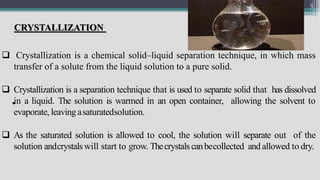
 Crystallization is a chemical solid–liquid separation technique, in which mass
transfer of a solute from the liquid solution to a pure solid.
 Crystallization is a separation technique that is used to separate solid that has dissolved
in a liquid. The solution is warmed in an open container, allowing the solvent to
evaporate, leaving asaturatedsolution.
 As the saturated solution is allowed to cool, the solution will separate out of the
solution andcrystalswill start to grow. Thecrystalscanbecollected and allowed to dry.
CRYSTALLIZATION
4
 Crystalcanbe defined asa
solid particle, which is
formed by the
solidification process
under suitable
environment in which
structural units are
arranged by a fixed
geometric pattern or
lattice.
CRYSTAL STRUCTURE OFNaCl
CRYSTALS :
MECHANISMOFCR
YST
ALLIZATION:
5
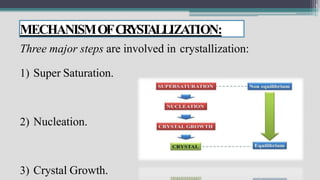
Three major steps are involved in crystallization:
1) Super Saturation.
2) Nucleation.
3) Crystal Growth.
6
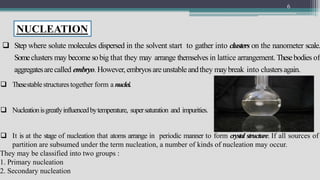
 Step where solute molecules dispersed in the solvent start to gather into clusters on the nanometer scale.
Someclusters may become sobig that they may arrange themselves in lattice arrangement. Thesebodies of
aggregatesarecalled embryo. However,embryos areunstableandthey maybreak into clustersagain.
 Thesestablestructurestogether form a nuclei.
 Nucleationisgreatlyinfluencedbytemperature, supersaturation and impurities.
 It is at the stage of nucleation that atoms arrange in periodic manner to form crystal structure. If all sources of
partition are subsumed under the term nucleation, a number of kinds of nucleation may occur.
They may be classified into two groups :
1. Primary nucleation
2. Secondary nucleation
NUCLEATION
PRIMARY NUCLEATION
 The phenomenon of the nucleation is the same for crystallization from the
solution , crystallization from a melt , condensation of fog drops in a super cooled
vapor and generation of bubble In a supersaturated liquid.
 There are two types :
a) Homogeneous nucleation
b) Heterogeneous nucleation
HOMOGENEOUS NUCLEATION
In crystallization from solution , homogenous nucleation almost never happens, except
perhaps in some precipitation reaction.
Initially several molecule or ions or atoms associated to from clusters.
 These are loose aggregates, which usually disappear quickly.
When enough particles associate to form a embryo , then is beginning of the lattice
arrangement and the formation of new solid phase .
The initially formed crystals are of molecular size, which are termed as nuclei.
 If effect holds that if the nucleus wets the surface of the catalyst , then
nucleation formation is reduced by a factor that is a function of the angle of
wetting between the nucleus and the catalyst .
Experiment data on the heterogeneous nucleation of potassium chloride solution
shows that the nucleation of the substance is consists with an apparent value of
the interfacial tension in the range 2 to 3 ergs/Cm2 for both catalyzed nucleation
and nucleation without an added catalyst.
HETREROGENOUS NUCLEATION
SECONDARY NUCLEATION
 The formation of nuclei attributable to the influence of the existing macroscopic
crystal the magma is called secondary nucleation.
Fluid share nucleation: when supersaturated solution moves past the surface of a
growing crystals at substantial velocity, the shear stresses in the boundary layer
may sweep away embryos or nuclei that would otherwise be incorporated into the
growing crystals and so appear as new crystals.
This has been reported in work on sucrose crystallization.
11
FACTORS AFFECTING CRYSTALLIZATION
1) Presence of another substance
2) Solvent
3) Nucleation
4) Crystal growth
5) Rate of cooling
6) Time
PRESENCE OF ANOTHER SUBSTANCE IN MOTHER
LIQUOR:
12
Sodium chloride crystallized from aqueous solutions
produces cubic crystals.
If sodium chloride is crystallized from a solution containing
a small amount of urea, the crystals obtained will have
octahedral faces. Both types of crystals belong to the cubic
crystal form but differ in habit.
13
 Moderate solubility is best (avoidsuper saturation).Likedissolves like.
 Hydrogen bonding canhelp or hinder crystallization.
 Presenceof benzenecanhelp crystal growth. Avoid highly volatile solvents.
 Avoid long chain alkyl solvents canbesignificantly disordered in crystals.
 Choosesolvents with “rigid geometries”.
SOLVENT CONSIDERATIONS
14
 Nucleationisgreatlyinfluencedbytemperature,supersaturationandimpurities.
 Crystalsinitially form via “nucleatingevents”.
 After acrystallite hasnucleated it mustgrow.
 Nucleation sites arenecessary.
 Excessnucleation sitescausesmaller averagecrystal size.
NUCLEATION
CRYSTALGROWTH
15
 Crystals grow by the ordered deposition of the solute molecules onto the
surface of apre-existing crystal.
 Crystal growth is facilitated by the environment changing slowly over time.
 Keep crystal growth vessel away from sources of mechanical agitation (e.g.
vibrations).
 Set-up away from vacuum pumps, rotovaps, hoods, doors, drawers, and so on
Leave samplesalone for 1 week, don't “check in” with it.
TIME
 Thelonger the time, the better the crystals.
 Faster crystallization is not as good as slow crystallization. Faster crystallization higher
chanceof lower quality crystals
16
 Quality crystals grow best over time in near equilibrium conditions.
17
 Purification of drugs.
 Improve bioavailability of the drug andchoosethe most stable form.
 Acrystalline powder is easily handled ,stable , possessesgood flow properties and an attractive appearance
.
 Crystallization from solution is important industrially because of the variety of materials that are
marketed in the crystallineform.
 Crystallization affords a practical method of obtaining pure chemical substances in a satisfactory
condition for packaging and storing. A crystal formed from an impure solution is itself pure (unless
mixed crystals occur).
IMPORTANCE OFCRYSTALLIZATION
18
 Adrug mayremain in different crystalline forms, someare stable,and rests are metastable.
 The metastable forms have greater solubility in water, thus have better bioavailability. By
controlling the conditions during crystallization, the quantity of metastable to stable forms
maybecontrolled.
 After crystallization water or solvent molecules may be entrapped within the crystal
structure and thus form hydrates or solvates which have different physical properties that
maybe utilized in various pharmaceutical purpose.
 Particles with various micromeritic properties, compressibility and wettability can be
prepared by controlling the crystallization process.
References
 Martin D. Johnson, Christopher L. Burcham, Scott A. May, Joel R. Calvin, Jennifer McClary Groh, Steven S.
Myers, Luke P. Webster, Jeffrey C. Roberts, Venkata Ramana Reddy, Carla V. Luciani, Aoife P. Corrigan, Richard
D. Spencer, Robert Moylan, Raymond Boyse, John D. Murphy, James R. Stout. API Continuous Cooling and
Antisolvent Crystallization for Kinetic Impurity Rejection in cGMP Manufacturing. Organic Process Research &
Development 2021, Article ASAP.
 Cedric Devos, Tom Van Gerven, Simon Kuhn. A Review of Experimental Methods for Nucleation Rate
Determination in Large-Volume Batch and Microfluidic Crystallization. Crystal Growth & Design 2021, 21 (4) ,
2541-2565. https://doi.org/10.1021/acs.cgd.0c01606
 Jaka Orehek, Dušan Teslić, Blaž Likozar. Continuous Crystallization Processes in Pharmaceutical Manufacturing: A
Review. Organic Process Research & Development 2021, 25 (1) , 16-42. https://doi.org/10.1021/acs.oprd.0c00398
 https://www.slideshare.net/JaveriaMalik16/crystallization-crystals
 https://www.slideshare.net/ShikhaPopali1/crystallization-easily-described
20

Nucleation

  • 1.
    NUCLEATION 1 Presented to :Dr. Renu Chadha Professor ,UIPS, Panjab University SEMINAR ON Email: shubham00sharma70@gmail.com Presented by: Shubham Sharma Pharmaceutical Chemistry Roll no. : 20029
  • 2.
    CONTENTS INTRODUCTION TO CRYSTALLIZATION STEPSINVOLVED IN CRSTALLIZATION NUCLEATION TYPES OF NUCLEATION FACTORS AFFECTING NUCLEATION AND INTURN CRYSTALLIZATION REFRENCES
  • 3.
    3 •  Crystallization isa chemical solid–liquid separation technique, in which mass transfer of a solute from the liquid solution to a pure solid.  Crystallization is a separation technique that is used to separate solid that has dissolved in a liquid. The solution is warmed in an open container, allowing the solvent to evaporate, leaving asaturatedsolution.  As the saturated solution is allowed to cool, the solution will separate out of the solution andcrystalswill start to grow. Thecrystalscanbecollected and allowed to dry. CRYSTALLIZATION
  • 4.
    4  Crystalcanbe definedasa solid particle, which is formed by the solidification process under suitable environment in which structural units are arranged by a fixed geometric pattern or lattice. CRYSTAL STRUCTURE OFNaCl CRYSTALS :
  • 5.
    MECHANISMOFCR YST ALLIZATION: 5 Three major stepsare involved in crystallization: 1) Super Saturation. 2) Nucleation. 3) Crystal Growth.
  • 6.
    6  Step wheresolute molecules dispersed in the solvent start to gather into clusters on the nanometer scale. Someclusters may become sobig that they may arrange themselves in lattice arrangement. Thesebodies of aggregatesarecalled embryo. However,embryos areunstableandthey maybreak into clustersagain.  Thesestablestructurestogether form a nuclei.  Nucleationisgreatlyinfluencedbytemperature, supersaturation and impurities.  It is at the stage of nucleation that atoms arrange in periodic manner to form crystal structure. If all sources of partition are subsumed under the term nucleation, a number of kinds of nucleation may occur. They may be classified into two groups : 1. Primary nucleation 2. Secondary nucleation NUCLEATION
  • 7.
    PRIMARY NUCLEATION  Thephenomenon of the nucleation is the same for crystallization from the solution , crystallization from a melt , condensation of fog drops in a super cooled vapor and generation of bubble In a supersaturated liquid.  There are two types : a) Homogeneous nucleation b) Heterogeneous nucleation
  • 8.
    HOMOGENEOUS NUCLEATION In crystallizationfrom solution , homogenous nucleation almost never happens, except perhaps in some precipitation reaction. Initially several molecule or ions or atoms associated to from clusters.  These are loose aggregates, which usually disappear quickly. When enough particles associate to form a embryo , then is beginning of the lattice arrangement and the formation of new solid phase . The initially formed crystals are of molecular size, which are termed as nuclei.
  • 9.
     If effectholds that if the nucleus wets the surface of the catalyst , then nucleation formation is reduced by a factor that is a function of the angle of wetting between the nucleus and the catalyst . Experiment data on the heterogeneous nucleation of potassium chloride solution shows that the nucleation of the substance is consists with an apparent value of the interfacial tension in the range 2 to 3 ergs/Cm2 for both catalyzed nucleation and nucleation without an added catalyst. HETREROGENOUS NUCLEATION
  • 10.
    SECONDARY NUCLEATION  Theformation of nuclei attributable to the influence of the existing macroscopic crystal the magma is called secondary nucleation. Fluid share nucleation: when supersaturated solution moves past the surface of a growing crystals at substantial velocity, the shear stresses in the boundary layer may sweep away embryos or nuclei that would otherwise be incorporated into the growing crystals and so appear as new crystals. This has been reported in work on sucrose crystallization.
  • 11.
    11 FACTORS AFFECTING CRYSTALLIZATION 1)Presence of another substance 2) Solvent 3) Nucleation 4) Crystal growth 5) Rate of cooling 6) Time
  • 12.
    PRESENCE OF ANOTHERSUBSTANCE IN MOTHER LIQUOR: 12 Sodium chloride crystallized from aqueous solutions produces cubic crystals. If sodium chloride is crystallized from a solution containing a small amount of urea, the crystals obtained will have octahedral faces. Both types of crystals belong to the cubic crystal form but differ in habit.
  • 13.
    13  Moderate solubilityis best (avoidsuper saturation).Likedissolves like.  Hydrogen bonding canhelp or hinder crystallization.  Presenceof benzenecanhelp crystal growth. Avoid highly volatile solvents.  Avoid long chain alkyl solvents canbesignificantly disordered in crystals.  Choosesolvents with “rigid geometries”. SOLVENT CONSIDERATIONS
  • 14.
    14  Nucleationisgreatlyinfluencedbytemperature,supersaturationandimpurities.  Crystalsinitiallyform via “nucleatingevents”.  After acrystallite hasnucleated it mustgrow.  Nucleation sites arenecessary.  Excessnucleation sitescausesmaller averagecrystal size. NUCLEATION
  • 15.
    CRYSTALGROWTH 15  Crystals growby the ordered deposition of the solute molecules onto the surface of apre-existing crystal.  Crystal growth is facilitated by the environment changing slowly over time.  Keep crystal growth vessel away from sources of mechanical agitation (e.g. vibrations).  Set-up away from vacuum pumps, rotovaps, hoods, doors, drawers, and so on Leave samplesalone for 1 week, don't “check in” with it.
  • 16.
    TIME  Thelonger thetime, the better the crystals.  Faster crystallization is not as good as slow crystallization. Faster crystallization higher chanceof lower quality crystals 16  Quality crystals grow best over time in near equilibrium conditions.
  • 17.
    17  Purification ofdrugs.  Improve bioavailability of the drug andchoosethe most stable form.  Acrystalline powder is easily handled ,stable , possessesgood flow properties and an attractive appearance .  Crystallization from solution is important industrially because of the variety of materials that are marketed in the crystallineform.  Crystallization affords a practical method of obtaining pure chemical substances in a satisfactory condition for packaging and storing. A crystal formed from an impure solution is itself pure (unless mixed crystals occur). IMPORTANCE OFCRYSTALLIZATION
  • 18.
    18  Adrug mayremainin different crystalline forms, someare stable,and rests are metastable.  The metastable forms have greater solubility in water, thus have better bioavailability. By controlling the conditions during crystallization, the quantity of metastable to stable forms maybecontrolled.  After crystallization water or solvent molecules may be entrapped within the crystal structure and thus form hydrates or solvates which have different physical properties that maybe utilized in various pharmaceutical purpose.  Particles with various micromeritic properties, compressibility and wettability can be prepared by controlling the crystallization process.
  • 19.
    References  Martin D.Johnson, Christopher L. Burcham, Scott A. May, Joel R. Calvin, Jennifer McClary Groh, Steven S. Myers, Luke P. Webster, Jeffrey C. Roberts, Venkata Ramana Reddy, Carla V. Luciani, Aoife P. Corrigan, Richard D. Spencer, Robert Moylan, Raymond Boyse, John D. Murphy, James R. Stout. API Continuous Cooling and Antisolvent Crystallization for Kinetic Impurity Rejection in cGMP Manufacturing. Organic Process Research & Development 2021, Article ASAP.  Cedric Devos, Tom Van Gerven, Simon Kuhn. A Review of Experimental Methods for Nucleation Rate Determination in Large-Volume Batch and Microfluidic Crystallization. Crystal Growth & Design 2021, 21 (4) , 2541-2565. https://doi.org/10.1021/acs.cgd.0c01606  Jaka Orehek, Dušan Teslić, Blaž Likozar. Continuous Crystallization Processes in Pharmaceutical Manufacturing: A Review. Organic Process Research & Development 2021, 25 (1) , 16-42. https://doi.org/10.1021/acs.oprd.0c00398  https://www.slideshare.net/JaveriaMalik16/crystallization-crystals  https://www.slideshare.net/ShikhaPopali1/crystallization-easily-described
  • 20.