ITS Engineering College, Gr Noida
Topic: Crystal Growth
Technique
(Czochralski
method)
Contents
1) CRYSTAL GROWTH
2) CONDITION OF CRYSTAL GROWTH
3) CRYSTAL GROWTH TECHNIQUE
4) CZOCHRALSKI METHOD
5) ADVANTAGES AND DISADVANTAGES
Crystal Growth
growth is
Crystal
existing crystal becomes
the process
larger as more
where
growth
a pre-
units (e.g.
molecules, ions) add in their positions in the crystal lattice or
a solution is developed into a crystal and further growth is
processed.
Nucleation and Growth are the main factors of crystal growth. If
nucleation rates are slow and growth is rapid, large crystals will
result. On the other hand, if nucleation is rapid, relative to
growth, small crystals or even polycrystalline samples will result.
The growth of crystals generally occurs by means of
following:
---- diffusion of the molecule of the crystallizing
---- Substance through the surrounding environment
Condition of Crystal Growth
Achievement
super cooling
Formation
of super saturation or
of crystal nucleus of
microscopic size
Successive growth of crystals to yield
distinct faces
Basic growth methods available
for crystal growth
The basic growth methods available for
crystal growth are broadly
1. Growth from melt.
2. Growth from vapour .
3. Growth from solution.
4. Growth from solid.
Crystal Growth Techniques
 Bridgmann method
 Czochralski method
 Vernuil method
 Zone melting method
 Kyropoulos technique.
 Skull melting.
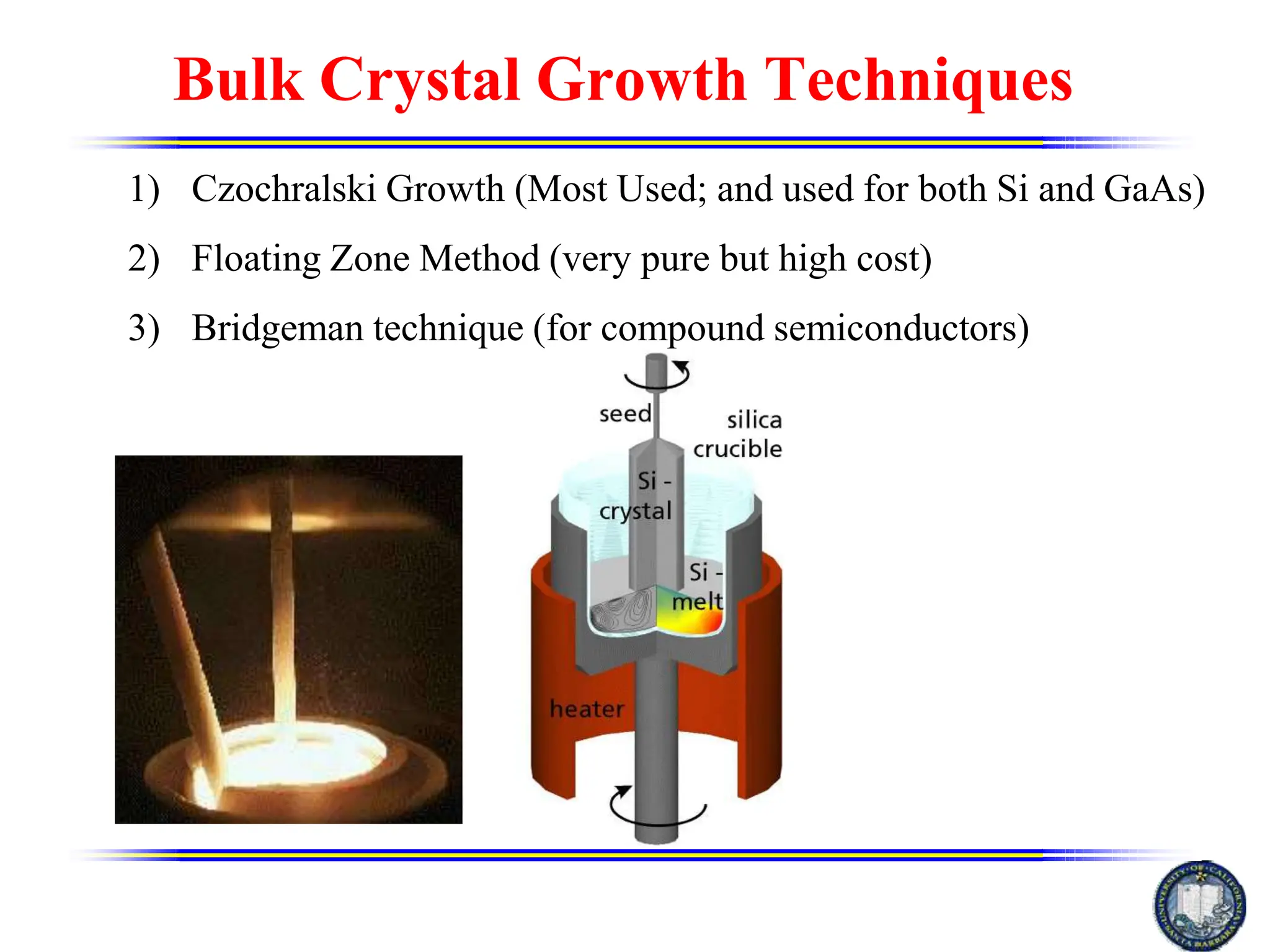
Bulk Crystal Growth Techniques
1) Czochralski Growth (Most Used; and used for both Si and GaAs)
2) Floating Zone Method (very pure but high cost)
3) Bridgeman technique (for compound semiconductors)
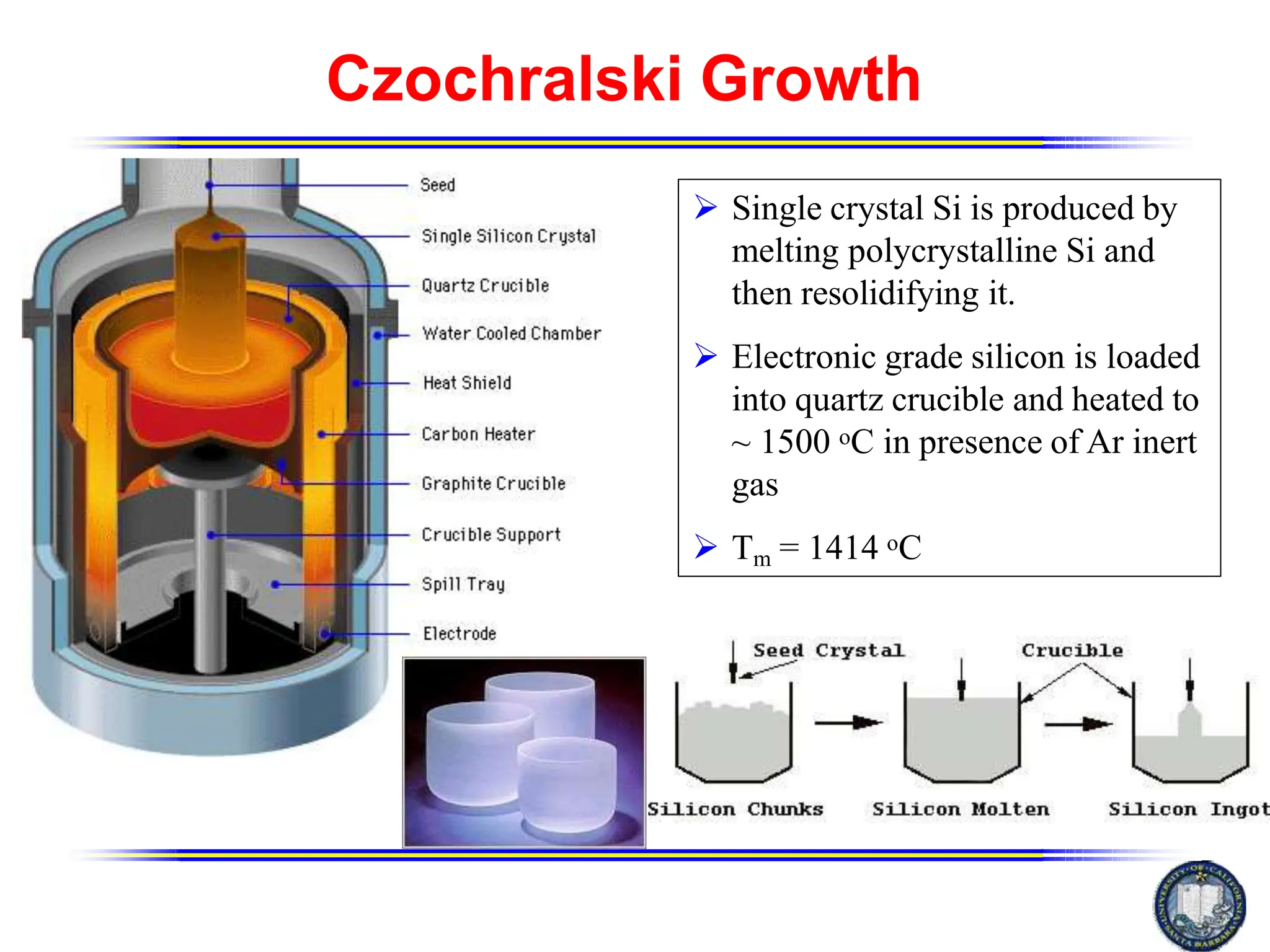
Czochralski Growth
 Single crystal Si is produced by
melting polycrystalline Si and
then resolidifying it.
 Electronic grade silicon is loaded
into quartz crucible and heated to
~ 1500 oC in presence of Ar inert
gas
 Tm = 1414 oC
Czochralski Growth
 A seed crystal with the desired
orientation is lowered into the melt
and rotated ccw slowly while
crucible is rotated cw
 A neck region (“tang”)
is produced to trap
dislocations in the seed
 The pull rate is ~
1/diameter. The
“Shoulder” is formed by
lowering the pull rate.
The “Boule”
Wafers
 Boule is ground from the sides, cut into disks with a diamond saw
and polished on one or both sides. Thickness (0.5-1 mm)
 Currently 8” (200 mm) and 12” (300 mm) diameter wafers are
used for production
Czochralski method
 Used for crystal growth to obtain single crystals of
semiconductors(e.g. silicon, germanium, GaAS), metals (e.g.
palladium, platinum, silver, gold), salts and synthetic gemstones.
 It is also known as Pulling Technique
 In the Czochralski process a seed crystal is required to create a
larger crystal, or ingot. This seed crystal is dipped into the pure
molten silicon and slowly extracted. The molten silicon grows on
the seed crystal in a crystalline fashion. As the seed is extracted
the silicon solidifies and eventually a large, cylindrical boule is
produced.[3]
 In this method the charge is melted and maintained at a
temperature slightly above the melting point. The pulling rod is
lowered to just touch the melt. Since the rod is at lower
temperature of melt occurs at the point tip of the pulling rod.
The crystal is pulled slowly.
Czochralski method
The rate of pulling depend upon various factors like
thermal conductivity, latent heat of fusion of charge and
rate of cooling of the pulling rod. The seed is rotated to
keep the grow crystal uniform and cylindrical.
A seed crystal is attached to a rod, which is rotated slowly.
The seed crystal is dipped into a melt held at a
temperature slightly above the melting point.
A temperature gradient is set up by cooling the rod and
slowly withdrawing it from the melt (the surrounding
atmosphere is cooler than the melt)
Decreasing the speed with which the crystal is pulled from
the melt, increases the quality of the crystals (fewer
defects) but decreases the growth rate.
Czochralski method
1. A boule is a single-crystal ingot produced by synthetic means.[1]
2. A boule of silicon is the starting material for most of
the integrated circuits used today.
3. In the semiconductor industry synthetic boules can be made by a
number of methods, such as the Bridgman technique[2] and
the Czochralski process, which result in a cylindrical rod of material.
In the Czochralski process a seed crystal is required to create a
larger crystal, or ingot. This seed crystal is dipped into the pure
molten silicon and slowly extracted. The molten silicon grows on
the seed crystal in a crystalline fashion. As the seed is extracted the
silicon solidifies and eventually a large, cylindrical boule is
produced.[3]
A semiconductor crystal boule is normally cut into
circular wafers using an inside hole diamond saw or diamond wire
saw, and each wafer is lapped and polished to provide substrates
suitable for the fabrication of semiconductor devices on its
surface.[4]
Czochralski Process
Czochralski Crystal Growth
Process
APPLICATION
• The most important application of the Czochralski Process may be
the growth of large cylindrical ingots, or boules, of single crystal
silicon used in the electronics industry to make semiconductor
devices like integrated circuits. Other semiconductors, such as
gallium arsenide can also be grown by this method.
• Monocrystalline silicon (mono-Si) grown by the
method is often referred to as monocrystalline
silicon (Cz-Si). It is the basic material in the
Czochralski
Czochralski
production
of integrated circuits used in computers, TVs, mobile phones and
all types of electronic equipment and semiconductor
devices. Monocrystalline silicon is also used in large quantities by
the photovoltaic industry for the production of conventional mono-
Si solar cells. The almost perfect crystal structure yields the highest
light-to-electricity conversion efficiency for silicon.
Advantages
• This method is used to grow large
single crystals. Thus it is used
extensively in the semiconductor
industry.
• There is no direct contact between
the crucible walls and the crystal
which helps to produce unstressed
single crystal.
Disadvantages
• In general this method is not
suitable for incongruently melting
compounds and of course the
need for a seed crystal of the
same composition limits is used
as tool for exploratory synthetic
research.
CZ md_ppt_mj_unit-1.pptx

CZ md_ppt_mj_unit-1.pptx

  • 1.
    ITS Engineering College,Gr Noida Topic: Crystal Growth Technique (Czochralski method)
  • 2.
    Contents 1) CRYSTAL GROWTH 2)CONDITION OF CRYSTAL GROWTH 3) CRYSTAL GROWTH TECHNIQUE 4) CZOCHRALSKI METHOD 5) ADVANTAGES AND DISADVANTAGES
  • 3.
    Crystal Growth growth is Crystal existingcrystal becomes the process larger as more where growth a pre- units (e.g. molecules, ions) add in their positions in the crystal lattice or a solution is developed into a crystal and further growth is processed. Nucleation and Growth are the main factors of crystal growth. If nucleation rates are slow and growth is rapid, large crystals will result. On the other hand, if nucleation is rapid, relative to growth, small crystals or even polycrystalline samples will result. The growth of crystals generally occurs by means of following: ---- diffusion of the molecule of the crystallizing ---- Substance through the surrounding environment
  • 4.
    Condition of CrystalGrowth Achievement super cooling Formation of super saturation or of crystal nucleus of microscopic size Successive growth of crystals to yield distinct faces
  • 5.
    Basic growth methodsavailable for crystal growth The basic growth methods available for crystal growth are broadly 1. Growth from melt. 2. Growth from vapour . 3. Growth from solution. 4. Growth from solid.
  • 6.
    Crystal Growth Techniques Bridgmann method  Czochralski method  Vernuil method  Zone melting method  Kyropoulos technique.  Skull melting.
  • 7.
    Bulk Crystal GrowthTechniques 1) Czochralski Growth (Most Used; and used for both Si and GaAs) 2) Floating Zone Method (very pure but high cost) 3) Bridgeman technique (for compound semiconductors)
  • 8.
    Czochralski Growth  Singlecrystal Si is produced by melting polycrystalline Si and then resolidifying it.  Electronic grade silicon is loaded into quartz crucible and heated to ~ 1500 oC in presence of Ar inert gas  Tm = 1414 oC
  • 9.
    Czochralski Growth  Aseed crystal with the desired orientation is lowered into the melt and rotated ccw slowly while crucible is rotated cw  A neck region (“tang”) is produced to trap dislocations in the seed  The pull rate is ~ 1/diameter. The “Shoulder” is formed by lowering the pull rate.
  • 10.
  • 11.
    Wafers  Boule isground from the sides, cut into disks with a diamond saw and polished on one or both sides. Thickness (0.5-1 mm)  Currently 8” (200 mm) and 12” (300 mm) diameter wafers are used for production
  • 12.
    Czochralski method  Usedfor crystal growth to obtain single crystals of semiconductors(e.g. silicon, germanium, GaAS), metals (e.g. palladium, platinum, silver, gold), salts and synthetic gemstones.  It is also known as Pulling Technique  In the Czochralski process a seed crystal is required to create a larger crystal, or ingot. This seed crystal is dipped into the pure molten silicon and slowly extracted. The molten silicon grows on the seed crystal in a crystalline fashion. As the seed is extracted the silicon solidifies and eventually a large, cylindrical boule is produced.[3]  In this method the charge is melted and maintained at a temperature slightly above the melting point. The pulling rod is lowered to just touch the melt. Since the rod is at lower temperature of melt occurs at the point tip of the pulling rod. The crystal is pulled slowly.
  • 13.
    Czochralski method The rateof pulling depend upon various factors like thermal conductivity, latent heat of fusion of charge and rate of cooling of the pulling rod. The seed is rotated to keep the grow crystal uniform and cylindrical. A seed crystal is attached to a rod, which is rotated slowly. The seed crystal is dipped into a melt held at a temperature slightly above the melting point. A temperature gradient is set up by cooling the rod and slowly withdrawing it from the melt (the surrounding atmosphere is cooler than the melt) Decreasing the speed with which the crystal is pulled from the melt, increases the quality of the crystals (fewer defects) but decreases the growth rate.
  • 14.
    Czochralski method 1. Aboule is a single-crystal ingot produced by synthetic means.[1] 2. A boule of silicon is the starting material for most of the integrated circuits used today. 3. In the semiconductor industry synthetic boules can be made by a number of methods, such as the Bridgman technique[2] and the Czochralski process, which result in a cylindrical rod of material. In the Czochralski process a seed crystal is required to create a larger crystal, or ingot. This seed crystal is dipped into the pure molten silicon and slowly extracted. The molten silicon grows on the seed crystal in a crystalline fashion. As the seed is extracted the silicon solidifies and eventually a large, cylindrical boule is produced.[3] A semiconductor crystal boule is normally cut into circular wafers using an inside hole diamond saw or diamond wire saw, and each wafer is lapped and polished to provide substrates suitable for the fabrication of semiconductor devices on its surface.[4]
  • 15.
  • 16.
  • 17.
    APPLICATION • The mostimportant application of the Czochralski Process may be the growth of large cylindrical ingots, or boules, of single crystal silicon used in the electronics industry to make semiconductor devices like integrated circuits. Other semiconductors, such as gallium arsenide can also be grown by this method. • Monocrystalline silicon (mono-Si) grown by the method is often referred to as monocrystalline silicon (Cz-Si). It is the basic material in the Czochralski Czochralski production of integrated circuits used in computers, TVs, mobile phones and all types of electronic equipment and semiconductor devices. Monocrystalline silicon is also used in large quantities by the photovoltaic industry for the production of conventional mono- Si solar cells. The almost perfect crystal structure yields the highest light-to-electricity conversion efficiency for silicon.
  • 18.
    Advantages • This methodis used to grow large single crystals. Thus it is used extensively in the semiconductor industry. • There is no direct contact between the crucible walls and the crystal which helps to produce unstressed single crystal.
  • 19.
    Disadvantages • In generalthis method is not suitable for incongruently melting compounds and of course the need for a seed crystal of the same composition limits is used as tool for exploratory synthetic research.