PRESENTED BY:
DIVYA PRATAP RAV
M.PHARMA 1ST
YEAR (2nd
Sems)
SUBMITTED TO:
Dr. Rakhi Mishra
(Professor)
NOIDA INSTITUTE OF ENGINEERING AND
TECHNOLOGY (PHARMACY INSTITUTE)
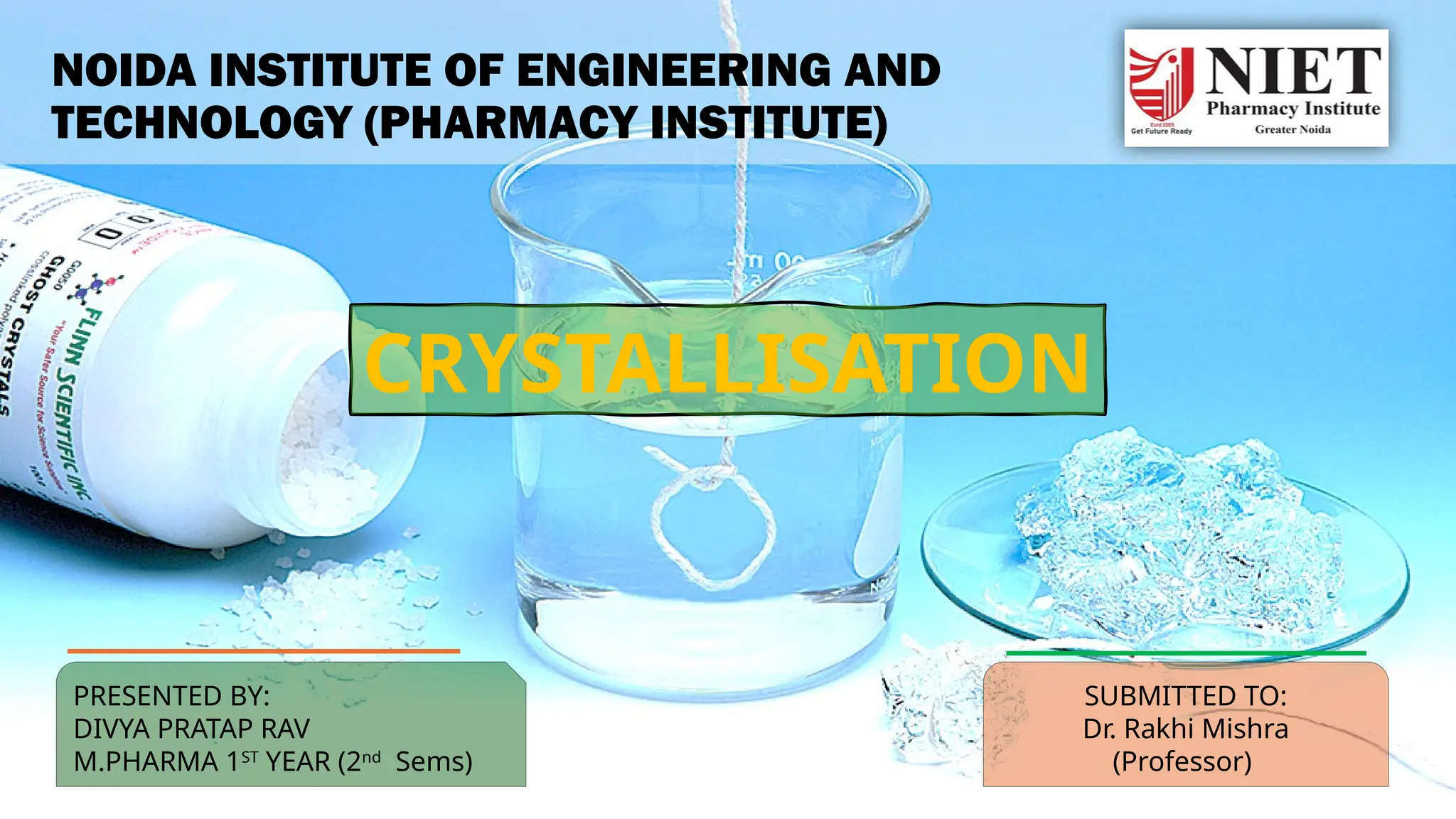
CRYSTALLISATION
Introduction
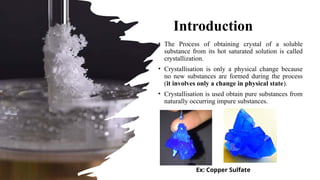
• The Process of obtaining crystal of a soluble
substance from its hot saturated solution is called
crystallization.
• Crystallisation is only a physical change because
no new substances are formed during the process
(it involves only a change in physical state).
• Crystallisation is used obtain pure substances from
naturally occurring impure substances.
Ex: Copper Sulfate
Principle & Understand simple process of
Crystallisation
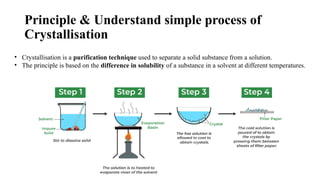
• Crystallisation is a purification technique used to separate a solid substance from a solution.
• The principle is based on the difference in solubility of a substance in a solvent at different temperatures.
TERMINOLOGY
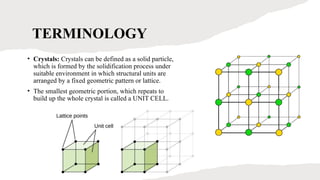
• Crystals: Crystals can be defined as a solid particle,
which is formed by the solidification process under
suitable environment in which structural units are
arranged by a fixed geometric pattern or lattice.
• The smallest geometric portion, which repeats to
build up the whole crystal is called a UNIT CELL.
TERMINOLOGY continue……
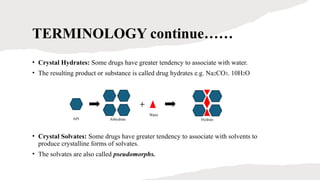
• Crystal Hydrates: Some drugs have greater tendency to associate with water.
• The resulting product or substance is called drug hydrates e.g. Na2CO3. 10H2O
• Crystal Solvates: Some drugs have greater tendency to associate with solvents to
produce crystalline forms of solvates.
• The solvates are also called pseudomorphs.
API Anhydrate
Water
Hydrate
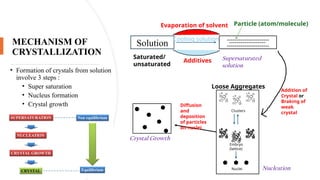
MECHANISM OF
CRYSTALLIZATION
• Formation of crystals from solution
involve 3 steps :
• Super saturation
• Nucleus formation
• Crystal growth
Solution ----------------------
-------------------
----------------------
Embryo
(lattice)
Nuclei
Clusters
Cooling solution
Evaporation of solvent
Additives
Saturated/
unsaturated
Supersaturated
solution
Addition of
Crystal or
Braking of
weak
crystal
Loose Aggregates
Particle (atom/molecule)
Nucleation
Crystal Growth
Diffusion
and
deposition
of particles
on nuclei
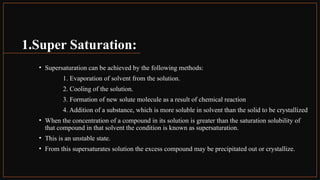
1.Super Saturation:
• Supersaturation can be achieved by the following methods:
1. Evaporation of solvent from the solution.
2. Cooling of the solution.
3. Formation of new solute molecule as a result of chemical reaction
4. Addition of a substance, which is more soluble in solvent than the solid to be crystallized
• When the concentration of a compound in its solution is greater than the saturation solubility of
that compound in that solvent the condition is known as supersaturation.
• This is an unstable state.
• From this supersaturates solution the excess compound may be precipitated out or crystallize.
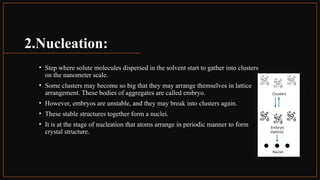
2.Nucleation:
• Step where solute molecules dispersed in the solvent start to gather into clusters
on the nanometer scale.
• Some clusters may become so big that they may arrange themselves in lattice
arrangement. These bodies of aggregates are called embryo.
• However, embryos are unstable, and they may break into clusters again.
• These stable structures together form a nuclei.
• It is at the stage of nucleation that atoms arrange in periodic manner to form
crystal structure.
Embryo
(lattice)
Nuclei
Clusters
3.Crystal Growth:
• Crystal growth is a diffusion process and a surface phenomenon. Every crystal is
surrounded by a layer of liquid known as stagnant layer.
• Once the crystals are formed, nuclei formation stops, and crystal growth begins.
• From the bulk solution a solute particle (molecule, atom or ion) diffuse through this
stagnant layer and then reaches the surface of the crystal.
• These particles then organize themselves in the crystal lattice. This phenomenon
continues at the surface at a slow rate. This process will happen if the bulk solution is
supersaturated.
Types of Crystallization Solutions
2.1. Crystallization from Aqueous Solutions
• Involves dissolving a solute in water, followed by conditions that lead to supersaturation and subsequent crystal
formation.
• Example:
Formation of sugar crystals from a supersaturated sugar solution.
2.2. Crystallization from Non-Aqueous Solutions
• Utilizes solvents other than water, such as ethanol or acetone, to dissolve solutes that are insoluble or unstable in
water.
• Example:
Crystallization of certain organic compounds using ethanol as a solvent.
Nucleation
Nucleation is the initial step in crystallization where solute molecules aggregate to form a
stable nucleus, which serves as the foundation for further crystal growth.
Types of Nucleation:
•Primary Nucleation: Occurs spontaneously without any external influence.
•Homogeneous: Nucleation occurs uniformly throughout the solution.
•Heterogeneous: Nucleation occurs on surfaces or impurities.
•Secondary Nucleation: Initiated by the presence of existing crystals, often through
mechanical agitation or collision.
Importance:
The rate and type of nucleation significantly influence the size, number, and quality of the
resulting crystals.
Factors Affecting Crystallization
• Supersaturation
• Temperature
• Solvent
• Impurities
• Cooling rate
• Agitation
• pH
• Additives
Factors Affecting Crystallization
1. Supersaturation
• Definition: Supersaturation is the driving force for crystallization. It occurs when the
concentration of solute exceeds its solubility.
• Effect:
• Higher supersaturation → faster nucleation → smaller crystals
• Lower supersaturation → slower nucleation → larger, purer crystals
• Control: Supersaturation must be carefully regulated to balance nucleation and growth
Factors Affecting Crystallization (cont…)
2. Temperature
• Definition: Temperature affects the solubility of solutes and the rate at which crystals form.
• Effect:
• Cooling a solution can cause supersaturation, initiating crystallization.
• Rapid cooling leads to many small crystals (more nucleation).
• Slow cooling promotes fewer but larger crystals (dominant growth).
• Optimal Strategy: Gradual cooling is often preferred for better crystal quality.
Factors Affecting Crystallization (cont…)
3. Solvent Choice
• Definition: The solvent affects the solubility of the solute and the resulting crystal structure (habit).
• Effect:
• Good solvent-solute interactions ensure complete dissolution.
• Poorly chosen solvents can lead to amorphous (non-crystalline) precipitation.
• Example: Organic compounds might crystallize better in ethanol than in water.
Factors Affecting Crystallization (cont…)
4. Impurities
• Definition: Foreign particles or dissolved substances that are not part of the desired solute.
• Effect:
• Impurities can block crystal lattice growth, causing defects.
• They can also initiate unwanted nucleation.
• Impact: Reduced purity, altered crystal shape or color, and irregular crystal size.
Factors Affecting Crystallization (cont…)
5. Cooling Rate
• Definition: The speed at which the temperature is reduced in a crystallization system.
• Effect:
• Fast cooling: Quick supersaturation, numerous small crystals.
• Slow cooling: Fewer nuclei form, allowing large crystals to grow.
• Importance: Cooling profiles must be designed carefully to meet desired crystal properties
Factors Affecting Crystallization (cont…)
6. Agitation (Stirring)
• Definition: Mechanical stirring or movement of the solution.
• Effect:
• Promotes uniform supersaturation throughout the solution.
• Induces secondary nucleation by breaking crystals and creating new growth sites.
• Impact: Smaller, more numerous crystals if stirring is intense
Factors Affecting Crystallization (cont…)
7. pH of the Solution
• Definition: pH influences the solubility of ionic compounds and biomolecules.
• Effect:
• Changes in pH can lead to precipitation of acids, bases, or salts.
• Especially critical for crystallizing proteins or pharmaceuticals.
• Example: Crystallizing calcium phosphate at a specific pH level
Factors Affecting Crystallization (cont…)
8. Presence of Additives or Crystal Growth Modifiers
• Definition: Substances added intentionally to control crystal size and habit.
• Effect:
• Can inhibit growth on certain crystal faces, altering shape.
• Help improve crystal purity and mechanical properties
Application:
Purification of compounds Formation of materials with
specific properties
Ex: Monocrystalline Silicon
(Si)
Essential in industries like
pharmaceuticals, food
processing, and materials
science
References
• Mullin JW. Crystallization. 4th ed. Oxford: Butterworth-Heinemann; 2001. 594 p.
• Myerson AS. Handbook of Industrial Crystallization. 2nd ed. Boston: Butterworth-
Heinemann; 2002. 575 p.
• Jones AG. Crystallization Process Systems. 1st ed. Philadelphia: Butterworth-
Heinemann; 2002. 430 p.
• Perry RH, Green DW, Maloney JO. Perry’s Chemical Engineers’ Handbook. 7th ed.
New York: McGraw-Hill; 1997. p. 12-34.
• Zoltan K. Nucleation: Theory and Applications. 1st ed. Oxford: Butterworth-Heinemann;
1999. p. 45-98.
THANK YOU

Crystallisation and their classification and mechanism.pptx

  • 1.
    PRESENTED BY: DIVYA PRATAPRAV M.PHARMA 1ST YEAR (2nd Sems) SUBMITTED TO: Dr. Rakhi Mishra (Professor) NOIDA INSTITUTE OF ENGINEERING AND TECHNOLOGY (PHARMACY INSTITUTE) CRYSTALLISATION
  • 2.
    Introduction • The Processof obtaining crystal of a soluble substance from its hot saturated solution is called crystallization. • Crystallisation is only a physical change because no new substances are formed during the process (it involves only a change in physical state). • Crystallisation is used obtain pure substances from naturally occurring impure substances. Ex: Copper Sulfate
  • 3.
    Principle & Understandsimple process of Crystallisation • Crystallisation is a purification technique used to separate a solid substance from a solution. • The principle is based on the difference in solubility of a substance in a solvent at different temperatures.
  • 4.
    TERMINOLOGY • Crystals: Crystalscan be defined as a solid particle, which is formed by the solidification process under suitable environment in which structural units are arranged by a fixed geometric pattern or lattice. • The smallest geometric portion, which repeats to build up the whole crystal is called a UNIT CELL.
  • 5.
    TERMINOLOGY continue…… • CrystalHydrates: Some drugs have greater tendency to associate with water. • The resulting product or substance is called drug hydrates e.g. Na2CO3. 10H2O • Crystal Solvates: Some drugs have greater tendency to associate with solvents to produce crystalline forms of solvates. • The solvates are also called pseudomorphs. API Anhydrate Water Hydrate
  • 6.
    MECHANISM OF CRYSTALLIZATION • Formationof crystals from solution involve 3 steps : • Super saturation • Nucleus formation • Crystal growth Solution ---------------------- ------------------- ---------------------- Embryo (lattice) Nuclei Clusters Cooling solution Evaporation of solvent Additives Saturated/ unsaturated Supersaturated solution Addition of Crystal or Braking of weak crystal Loose Aggregates Particle (atom/molecule) Nucleation Crystal Growth Diffusion and deposition of particles on nuclei
  • 7.
    1.Super Saturation: • Supersaturationcan be achieved by the following methods: 1. Evaporation of solvent from the solution. 2. Cooling of the solution. 3. Formation of new solute molecule as a result of chemical reaction 4. Addition of a substance, which is more soluble in solvent than the solid to be crystallized • When the concentration of a compound in its solution is greater than the saturation solubility of that compound in that solvent the condition is known as supersaturation. • This is an unstable state. • From this supersaturates solution the excess compound may be precipitated out or crystallize.
  • 8.
    2.Nucleation: • Step wheresolute molecules dispersed in the solvent start to gather into clusters on the nanometer scale. • Some clusters may become so big that they may arrange themselves in lattice arrangement. These bodies of aggregates are called embryo. • However, embryos are unstable, and they may break into clusters again. • These stable structures together form a nuclei. • It is at the stage of nucleation that atoms arrange in periodic manner to form crystal structure. Embryo (lattice) Nuclei Clusters
  • 9.
    3.Crystal Growth: • Crystalgrowth is a diffusion process and a surface phenomenon. Every crystal is surrounded by a layer of liquid known as stagnant layer. • Once the crystals are formed, nuclei formation stops, and crystal growth begins. • From the bulk solution a solute particle (molecule, atom or ion) diffuse through this stagnant layer and then reaches the surface of the crystal. • These particles then organize themselves in the crystal lattice. This phenomenon continues at the surface at a slow rate. This process will happen if the bulk solution is supersaturated.
  • 10.
    Types of CrystallizationSolutions 2.1. Crystallization from Aqueous Solutions • Involves dissolving a solute in water, followed by conditions that lead to supersaturation and subsequent crystal formation. • Example: Formation of sugar crystals from a supersaturated sugar solution. 2.2. Crystallization from Non-Aqueous Solutions • Utilizes solvents other than water, such as ethanol or acetone, to dissolve solutes that are insoluble or unstable in water. • Example: Crystallization of certain organic compounds using ethanol as a solvent.
  • 11.
    Nucleation Nucleation is theinitial step in crystallization where solute molecules aggregate to form a stable nucleus, which serves as the foundation for further crystal growth. Types of Nucleation: •Primary Nucleation: Occurs spontaneously without any external influence. •Homogeneous: Nucleation occurs uniformly throughout the solution. •Heterogeneous: Nucleation occurs on surfaces or impurities. •Secondary Nucleation: Initiated by the presence of existing crystals, often through mechanical agitation or collision. Importance: The rate and type of nucleation significantly influence the size, number, and quality of the resulting crystals.
  • 12.
    Factors Affecting Crystallization •Supersaturation • Temperature • Solvent • Impurities • Cooling rate • Agitation • pH • Additives
  • 13.
    Factors Affecting Crystallization 1.Supersaturation • Definition: Supersaturation is the driving force for crystallization. It occurs when the concentration of solute exceeds its solubility. • Effect: • Higher supersaturation → faster nucleation → smaller crystals • Lower supersaturation → slower nucleation → larger, purer crystals • Control: Supersaturation must be carefully regulated to balance nucleation and growth
  • 14.
    Factors Affecting Crystallization(cont…) 2. Temperature • Definition: Temperature affects the solubility of solutes and the rate at which crystals form. • Effect: • Cooling a solution can cause supersaturation, initiating crystallization. • Rapid cooling leads to many small crystals (more nucleation). • Slow cooling promotes fewer but larger crystals (dominant growth). • Optimal Strategy: Gradual cooling is often preferred for better crystal quality.
  • 15.
    Factors Affecting Crystallization(cont…) 3. Solvent Choice • Definition: The solvent affects the solubility of the solute and the resulting crystal structure (habit). • Effect: • Good solvent-solute interactions ensure complete dissolution. • Poorly chosen solvents can lead to amorphous (non-crystalline) precipitation. • Example: Organic compounds might crystallize better in ethanol than in water.
  • 16.
    Factors Affecting Crystallization(cont…) 4. Impurities • Definition: Foreign particles or dissolved substances that are not part of the desired solute. • Effect: • Impurities can block crystal lattice growth, causing defects. • They can also initiate unwanted nucleation. • Impact: Reduced purity, altered crystal shape or color, and irregular crystal size.
  • 17.
    Factors Affecting Crystallization(cont…) 5. Cooling Rate • Definition: The speed at which the temperature is reduced in a crystallization system. • Effect: • Fast cooling: Quick supersaturation, numerous small crystals. • Slow cooling: Fewer nuclei form, allowing large crystals to grow. • Importance: Cooling profiles must be designed carefully to meet desired crystal properties
  • 18.
    Factors Affecting Crystallization(cont…) 6. Agitation (Stirring) • Definition: Mechanical stirring or movement of the solution. • Effect: • Promotes uniform supersaturation throughout the solution. • Induces secondary nucleation by breaking crystals and creating new growth sites. • Impact: Smaller, more numerous crystals if stirring is intense
  • 19.
    Factors Affecting Crystallization(cont…) 7. pH of the Solution • Definition: pH influences the solubility of ionic compounds and biomolecules. • Effect: • Changes in pH can lead to precipitation of acids, bases, or salts. • Especially critical for crystallizing proteins or pharmaceuticals. • Example: Crystallizing calcium phosphate at a specific pH level
  • 20.
    Factors Affecting Crystallization(cont…) 8. Presence of Additives or Crystal Growth Modifiers • Definition: Substances added intentionally to control crystal size and habit. • Effect: • Can inhibit growth on certain crystal faces, altering shape. • Help improve crystal purity and mechanical properties
  • 21.
    Application: Purification of compoundsFormation of materials with specific properties Ex: Monocrystalline Silicon (Si) Essential in industries like pharmaceuticals, food processing, and materials science
  • 22.
    References • Mullin JW.Crystallization. 4th ed. Oxford: Butterworth-Heinemann; 2001. 594 p. • Myerson AS. Handbook of Industrial Crystallization. 2nd ed. Boston: Butterworth- Heinemann; 2002. 575 p. • Jones AG. Crystallization Process Systems. 1st ed. Philadelphia: Butterworth- Heinemann; 2002. 430 p. • Perry RH, Green DW, Maloney JO. Perry’s Chemical Engineers’ Handbook. 7th ed. New York: McGraw-Hill; 1997. p. 12-34. • Zoltan K. Nucleation: Theory and Applications. 1st ed. Oxford: Butterworth-Heinemann; 1999. p. 45-98.
  • 23.