SOL-GEL
METHOD
 involves the evolution of inorganic
 networks through the formation of a
 colloidal suspension (sol) and gelation of
 the sol to form a network in a
 continuous liquid phase (gel)
 The precursors for synthesizing these colloids
  consist :
  - metal alkoxides
    e.g: tetramethoxysilane (TMOS) and
   tetraethoxysilane (TEOS)
  -metal chlorides
 they readily react with water.
 three reactions are generally used to
  describe the sol-gel process:
  - hydrolysis
  - polycondensation
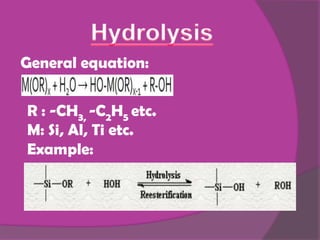
General equation:


R : -CH3, -C2H5 etc.
M: Si, Al, Ti etc.
Example:
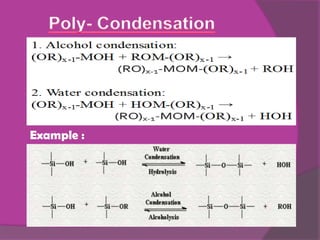
Example :
 Protective Coatings
 Thin film and fibers
 Nanoscales powder
 Opto-mechanical
 Cheap   and low temperature operation
 Very thin of metals oxide can be
  obtained
 Better alternative approach to
  conventional production of glasses
 Sol gel material can be obtained as
  bulks, thin films (nano) powders

Sol-Gel Method

  • 1.
  • 2.
     involves theevolution of inorganic networks through the formation of a colloidal suspension (sol) and gelation of the sol to form a network in a continuous liquid phase (gel)
  • 3.
     The precursorsfor synthesizing these colloids consist : - metal alkoxides e.g: tetramethoxysilane (TMOS) and tetraethoxysilane (TEOS) -metal chlorides  they readily react with water.  three reactions are generally used to describe the sol-gel process: - hydrolysis - polycondensation
  • 4.
    General equation: R :-CH3, -C2H5 etc. M: Si, Al, Ti etc. Example:
  • 5.
  • 6.
     Protective Coatings Thin film and fibers  Nanoscales powder  Opto-mechanical
  • 7.
     Cheap and low temperature operation  Very thin of metals oxide can be obtained  Better alternative approach to conventional production of glasses  Sol gel material can be obtained as bulks, thin films (nano) powders