Presented by
DR.K.KAVITHA
Asst. Professor,
University College of Engineering,
BIT campus, Anna University,
Tiruchirappalli.
INTRODUCTION
 Crystallization is the spontaneous arrangement of the
particles into a repetitive orderly array that is regular
geometric patterns.
 A crystal is defined as a solid particle, which is formed by
the solidification process in which structural units are
arranged by a fixed geometric pattern or lattice.
 Crystals are commonly obtained from liquid state. Example
salt from brine solution.
 Crystallization differ from precipitation in that product is
deposited from a supersaturated solution.
 Precipitation occurs when solutions of materials react
chemically to form a product which is sparingly soluble in
the liquid and therefore deposits outs.
CHARACTERISTICS OF CRYSTALS
 Crystal lattice
 Crystal systems
 Crystal habit
1. Crystal lattice
 it is defined as an orderly internal arrangement of particles
in the three dimensional space.
 The geometric form of the arrangement in a crystal is
determined by means of x-ray diffraction method.
 The units that constitute the crystal structure are the ions,
atoms, or molecules.
 Ions with opposite charges bonded by the electrostatic
attraction. (e.g.) NaCl
 Atoms are bonded by covalent bonds. (e.g.) diamond and
graphite
 Organic molecules held together by vanderwaals forces and
hydrogen bonding.
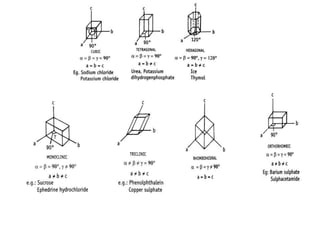
2. Crystal systems or forms
 A finite number of symmetrical arrangement are possible
for a crystal lattice and these are termed as crystal forms
or systems.
 In the crystal, the angle between two perpendiculars to
the intersecting faces is termed as the axial angle.
 Axial length can be defined as the distance between the
centers of the two atoms.
 Depending upon the axial length and the axial angle,
crystals are cubic, hexagonal, tetragonal, orthorhombic,
monoclinic, triclinic.
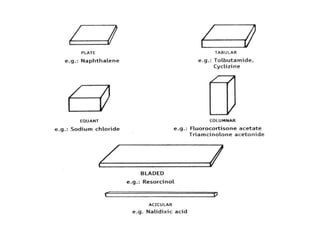
3. Crystal habit
 a substance crystallizes in such a way that the angle
between a given pair of faces irrespective of the relative
sizes of the faces.
 The shape and sizes of the crystals formed are markedly
dependent on the condition under which crystallization
is carried out.
 For example, griseofulvin crystallized from acetone has
a different forms from the same drug crystallized from
benzene or chloroform.
Theory of crystallization
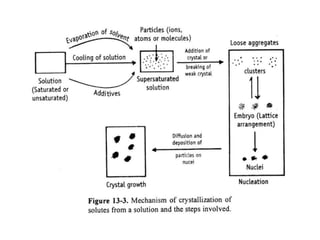
Mechanism of crystallization:
The formation of the crystals from solution
involves three steps,
Super saturation
Nucleus formation
Crystal growth
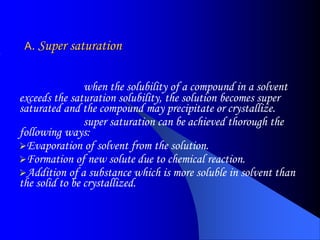
A. Super saturation
when the solubility of a compound in a solvent
exceeds the saturation solubility, the solution becomes super
saturated and the compound may precipitate or crystallize.
super saturation can be achieved thorough the
following ways:
Evaporation of solvent from the solution.
Formation of new solute due to chemical reaction.
Addition of a substance which is more soluble in solvent than
the solid to be crystallized.
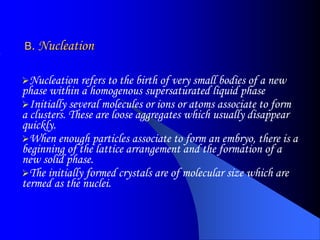
B. Nucleation
Nucleation refers to the birth of very small bodies of a new
phase within a homogenous supersaturated liquid phase
Initially several molecules or ions or atoms associate to form
a clusters. These are loose aggregates which usually disappear
quickly.
When enough particles associate to form an embryo, there is a
beginning of the lattice arrangement and the formation of a
new solid phase.
The initially formed crystals are of molecular size which are
termed as the nuclei.
Method of nucleation
There are several ways available for nucleation. They are
Soft or weak crystals on impact with moving parts can break
into fragments which act as nuclei.
Small crystals which are formed in the previous process are
added to act as nuclei.
C. Crystal growth
It is the diffusion process and surface phenomenon.
From solution the solute molecules or ions reach the faces of a
crystal by diffusion. On reaching the surface the molecules or ions
must be accepted by the crystals and organized into the space
lattice. Neither the diffusion nor the interfacial step will proceed
unless the solution is super saturated.
Mier’s super saturation theory
postulates a definite relationship between concentration
and temperature at which crystals will spontaneously
form in an initially unseeded solution.
according to it the super solubility
curve represent the limit at which nucleus formation
begins spontaneously and consequently the point at
which crystallization can start in the absence of any
solid particles.
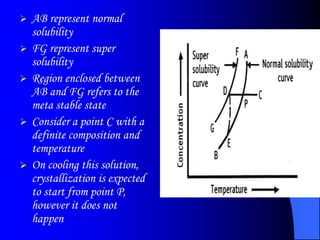
 AB represent normal
solubility
 FG represent super
solubility
 Region enclosed between
AB and FG refers to the
meta stable state
 Consider a point C with a
definite composition and
temperature
 On cooling this solution,
crystallization is expected
to start from point P,
however it does not
happen
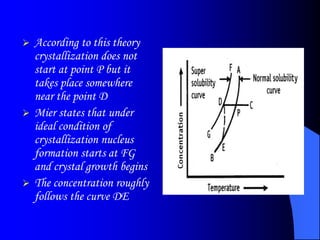
 According to this theory
crystallization does not
start at point P but it
takes place somewhere
near the point D
 Mier states that under
ideal condition of
crystallization nucleus
formation starts at FG
and crystal growth begins
 The concentration roughly
follows the curve DE
Condition for obeying Mier’s theory:
 The solute and the solvent must be pure
 The solution must be free from solid solute particles
 The solution must be free from foreign solid particles
 Soft and weak crystals must not form during the process
 No temperature fluctuation should be there
Limitation:
 According to the theory crystallization starts at super
solubility curve but general tendency is that crystallization
take place in an area rather than in a line
 If the solution is kept for a longer time nucleation starts
well before the super solubility curve
 If the solution is available in large volume, nucleation
starts well below the super solubility curve
 It is only applicable when pure solvents and pure solute are
used
 For crystallization it should be stored or a longer duration,
during which dust may enter which may also initiate the
nucleation
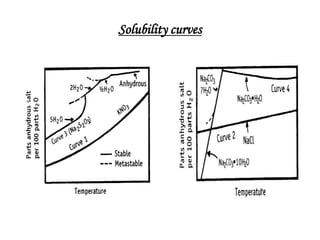
Solubility curve
 Solubility curves are useful in predicting the
experimental condition desired for crystallizing a
substance
 Since super saturation is achieved by reducing the
temperature the influence of temperature on the
solubility is important
 A substance dissolves and goes into solution, if the
solution is not saturated. If the solution is super
saturated crystallization takes place
 The graph drawn by taking temperature in the x-
axis and solubility on y- axis gives solubility curve
Solubility curves
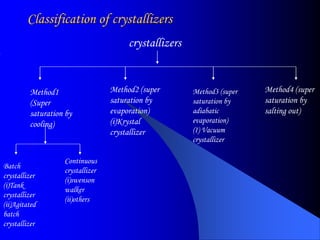
Classification of crystallizers
crystallizers
Method1
(Super
saturation by
cooling)
Method2 (super
saturation by
evaporation)
(i)Krystal
crystallizer
Method3 (super
saturation by
adiabatic
evaporation)
(I) Vacuum
crystallizer
Method4 (super
saturation by
salting out)
Batch
crystallizer
(i)Tank
crystallizer
(ii)Agitated
batch
crystallizer
Continuous
crystallizer
(i)swenson
walker
(ii)others
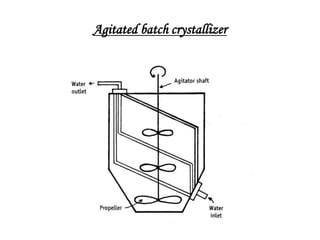
Agitated batch crystallizer
Principle:
In this, saturated solution is made super saturated by
reducing the temperature. The crystals formed from super
saturated solution. Agitation of the solution facilitates the
production of uniform crystals
Agitated batch crystallizer
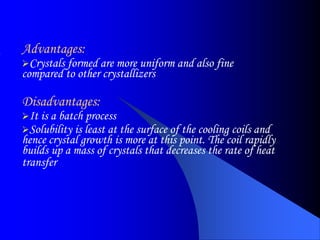
Advantages:
Crystals formed are more uniform and also fine
compared to other crystallizers
Disadvantages:
It is a batch process
Solubility is least at the surface of the cooling coils and
hence crystal growth is more at this point. The coil rapidly
builds up a mass of crystals that decreases the rate of heat
transfer
Tank crystallizers:
Hot , nearly saturated solution is run into an open
rectangular tank in which the solution is allowed to cool
and deposit crystals.
No attempt is made to seed the tanks, to provide for
agitation or to accelerate or control the rate of
crystallization.
When the solution has sufficiently cooled which normally
takes a number of days, the remaining mother liquor is
drained off and the crystals removed manually.
Disadvantage:
 Needs more labor
 Crystals are contaminated with impurities that settle at
the bottom of the tank
 Needs more floor space
Advantage:
 Produces large crystals
 Simpler
 Cheaper process
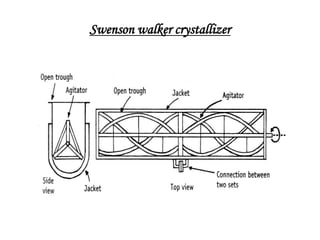
Swenson walker crystallizer
Principle:
crystallization is induced by passing the cold
water in a direction opposite to the flow of hot
concentrated solution. This results in the super
saturation and subsequently crystals are deposited.
Agitation prevents the accumulation of crystals on
the cooling surface. The crystals are simultaneously
separated from the mother liquor.
Swenson walker crystallizer
Advantages:
 large saving in the floor space, material and labor cost
It is a continuous process
Crystals of uniform size and free from inclusions and
aggregates can be obtained
Disadvantage:
 the scrapper may break the crystals to a little extent while
agitating the suspension
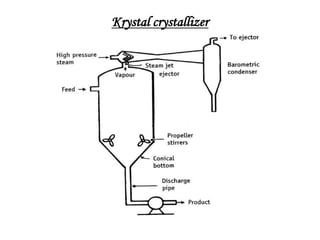
Krystal crystallizer :
Principle:
In this type the concentration of the liquid and
crystallization are obtained in different chambers. The super
saturation is induced by evaporation of hot solvent with
the help of a vacuum pump. In the crystallization chamber
the super saturated solution and crystals are maintained in
a fluidized state for uniform crystal growth. As the crystals
of desired size settle down by gravity the fine crystals and
the super saturated solution is recirculated for further
crystallization.
Krystal crystallizer
Use:
 for the crystallization of sodium chloride and magnesium
sulphate
Advantage:
 large quantities of crystals of required size
 available in large size with a body up to 4.5m diameter
and 6.0m height
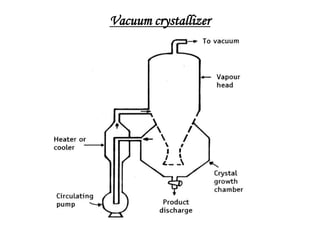
Vacuum crystallizer :
Principle:
super saturation is obtained by adiabatic
evaporation cooling. When warm saturated solution is
introduced into the crystallizer, due to high vacuum the
solution undergoes flashing. A part of the solvent gets
evaporated there by causing cooling of solution resulting in
crystal formation.
Vacuum crystallizer
Use:
vacuum crystallizer suitable for thermo labile
substances.
Advantages:
 simple without any moving parts
 corrosive material can be used, as the inner surface can be
made acid resistant
 it can be constructed as large size as desired
 operated as either batch process or continuous
Caking of crystals
Definition:
caking is defined as the process of formation of clumps or
cakes when crystals are improperly stored.
After crystallization, the crystals are required to
be stored in bulk either for use or for transportation or for
formulation of dosage form. The crystals must retain good flow
properties during storage.
During storage crystals tend to form cakes. This
is a serious problem in case of small packages than in bulk
packages.
Factors affecting caking:
 Size of the crystals:
Larger crystals have less point of contact and
smaller particle have more point of contact. The more the point
of contact the higher will be rate of caking. Hence, smaller
particle tend to cake more than larger particle.
 Shape of crystals:
Spherical particle possess the least point of
contact. Hence, distorted crystals tend to cake more than
spherical particle.
 Humidity:
The higher the humidity of the atmosphere to
which the crystals are exposed , more will be the rate of caking.
 Time of exposure:
The higher the time of exposure the more will be
the caking, provided the exposed atmosphere has humidity more
than critical humidity.
 Impurities in crystals:
The crystals can be coated with the impurities
derived from mother liquor. This may increase or decrease
critical humidity. Once the critical humidity changes, the
property of caking also changes.
 Melting point of crystals:
Melting point of crystals is near room
temperature, crystals may melt. Then solidification by fusion of
the melt leads to caking.
Prevention of caking:
 crystals must be more spherical in shape with least point of
contact.
 crystals must be larger in size with more voids.
 crystals should have highest possible critical humidity.
 crystals must be coated with powdery inert substances to
prevent absorption of moisture. For example, table salt coated
with magnesium or tricalcium phosphate.
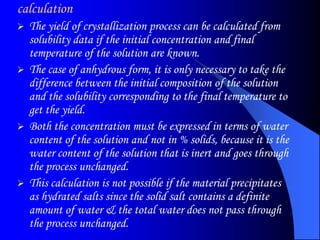
calculation
 The yield of crystallization process can be calculated from
solubility data if the initial concentration and final
temperature of the solution are known.
 The case of anhydrous form, it is only necessary to take the
difference between the initial composition of the solution
and the solubility corresponding to the final temperature to
get the yield.
 Both the concentration must be expressed in terms of water
content of the solution and not in % solids, because it is the
water content of the solution that is inert and goes through
the process unchanged.
 This calculation is not possible if the material precipitates
as hydrated salts since the solid salt contains a definite
amount of water & the total water does not pass through
the process unchanged.
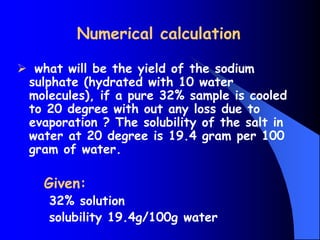
Numerical calculation
 what will be the yield of the sodium
sulphate (hydrated with 10 water
molecules), if a pure 32% sample is cooled
to 20 degree with out any loss due to
evaporation ? The solubility of the salt in
water at 20 degree is 19.4 gram per 100
gram of water.
Given:
32% solution
solubility 19.4g/100g water
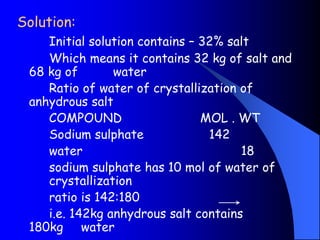
Solution:
Initial solution contains – 32% salt
Which means it contains 32 kg of salt and
68 kg of water
Ratio of water of crystallization of
anhydrous salt
COMPOUND MOL . WT
Sodium sulphate 142
water 18
sodium sulphate has 10 mol of water of
crystallization
ratio is 142:180
i.e. 142kg anhydrous salt contains
180kg water
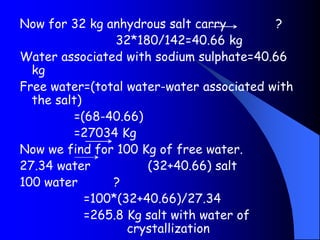
Now for 32 kg anhydrous salt carry ?
32*180/142=40.66 kg
Water associated with sodium sulphate=40.66
kg
Free water=(total water-water associated with
the salt)
=(68-40.66)
=27034 Kg
Now we find for 100 Kg of free water.
27.34 water (32+40.66) salt
100 water ?
=100*(32+40.66)/27.34
=265.8 Kg salt with water of
crystallization
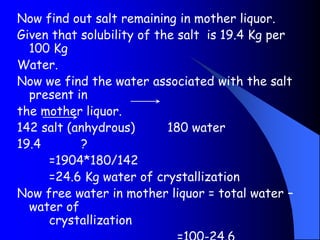
Now find out salt remaining in mother liquor.
Given that solubility of the salt is 19.4 Kg per
100 Kg
Water.
Now we find the water associated with the salt
present in
the mother liquor.
142 salt (anhydrous) 180 water
19.4 ?
=1904*180/142
=24.6 Kg water of crystallization
Now free water in mother liquor = total water –
water of
crystallization
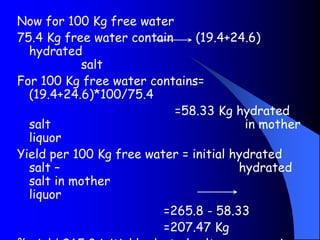
Now for 100 Kg free water
75.4 Kg free water contain (19.4+24.6)
hydrated
salt
For 100 Kg free water contains=
(19.4+24.6)*100/75.4
=58.33 Kg hydrated
salt in mother
liquor
Yield per 100 Kg free water = initial hydrated
salt – hydrated
salt in mother
liquor
=265.8 - 58.33
=207.47 Kg
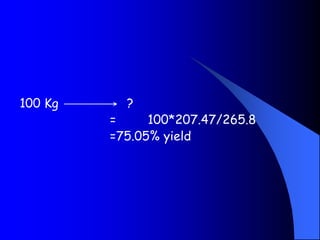
100 Kg ?
= 100*207.47/265.8
=75.05% yield
References
 Pharmaceutical Technology by C.V.S.Subrahmanyam
 Pharmaceutical Engineering by K.Sambamurthy
Pharmaceutical Engineering – 2 by Dr. Girish k. Jani

Crystallization in pharmaceutical industry

  • 1.
    Presented by DR.K.KAVITHA Asst. Professor, UniversityCollege of Engineering, BIT campus, Anna University, Tiruchirappalli.
  • 2.
    INTRODUCTION  Crystallization isthe spontaneous arrangement of the particles into a repetitive orderly array that is regular geometric patterns.  A crystal is defined as a solid particle, which is formed by the solidification process in which structural units are arranged by a fixed geometric pattern or lattice.  Crystals are commonly obtained from liquid state. Example salt from brine solution.  Crystallization differ from precipitation in that product is deposited from a supersaturated solution.  Precipitation occurs when solutions of materials react chemically to form a product which is sparingly soluble in the liquid and therefore deposits outs.
  • 3.
    CHARACTERISTICS OF CRYSTALS Crystal lattice  Crystal systems  Crystal habit
  • 4.
    1. Crystal lattice it is defined as an orderly internal arrangement of particles in the three dimensional space.  The geometric form of the arrangement in a crystal is determined by means of x-ray diffraction method.  The units that constitute the crystal structure are the ions, atoms, or molecules.  Ions with opposite charges bonded by the electrostatic attraction. (e.g.) NaCl  Atoms are bonded by covalent bonds. (e.g.) diamond and graphite  Organic molecules held together by vanderwaals forces and hydrogen bonding.
  • 5.
    2. Crystal systemsor forms  A finite number of symmetrical arrangement are possible for a crystal lattice and these are termed as crystal forms or systems.  In the crystal, the angle between two perpendiculars to the intersecting faces is termed as the axial angle.  Axial length can be defined as the distance between the centers of the two atoms.  Depending upon the axial length and the axial angle, crystals are cubic, hexagonal, tetragonal, orthorhombic, monoclinic, triclinic.
  • 7.
    3. Crystal habit a substance crystallizes in such a way that the angle between a given pair of faces irrespective of the relative sizes of the faces.  The shape and sizes of the crystals formed are markedly dependent on the condition under which crystallization is carried out.  For example, griseofulvin crystallized from acetone has a different forms from the same drug crystallized from benzene or chloroform.
  • 9.
    Theory of crystallization Mechanismof crystallization: The formation of the crystals from solution involves three steps, Super saturation Nucleus formation Crystal growth
  • 11.
    A. Super saturation whenthe solubility of a compound in a solvent exceeds the saturation solubility, the solution becomes super saturated and the compound may precipitate or crystallize. super saturation can be achieved thorough the following ways: Evaporation of solvent from the solution. Formation of new solute due to chemical reaction. Addition of a substance which is more soluble in solvent than the solid to be crystallized.
  • 12.
    B. Nucleation Nucleation refersto the birth of very small bodies of a new phase within a homogenous supersaturated liquid phase Initially several molecules or ions or atoms associate to form a clusters. These are loose aggregates which usually disappear quickly. When enough particles associate to form an embryo, there is a beginning of the lattice arrangement and the formation of a new solid phase. The initially formed crystals are of molecular size which are termed as the nuclei.
  • 13.
    Method of nucleation Thereare several ways available for nucleation. They are Soft or weak crystals on impact with moving parts can break into fragments which act as nuclei. Small crystals which are formed in the previous process are added to act as nuclei. C. Crystal growth It is the diffusion process and surface phenomenon. From solution the solute molecules or ions reach the faces of a crystal by diffusion. On reaching the surface the molecules or ions must be accepted by the crystals and organized into the space lattice. Neither the diffusion nor the interfacial step will proceed unless the solution is super saturated.
  • 14.
    Mier’s super saturationtheory Mier’s super saturation theory postulates a definite relationship between concentration and temperature at which crystals will spontaneously form in an initially unseeded solution. according to it the super solubility curve represent the limit at which nucleus formation begins spontaneously and consequently the point at which crystallization can start in the absence of any solid particles.
  • 15.
     AB representnormal solubility  FG represent super solubility  Region enclosed between AB and FG refers to the meta stable state  Consider a point C with a definite composition and temperature  On cooling this solution, crystallization is expected to start from point P, however it does not happen
  • 16.
     According tothis theory crystallization does not start at point P but it takes place somewhere near the point D  Mier states that under ideal condition of crystallization nucleus formation starts at FG and crystal growth begins  The concentration roughly follows the curve DE
  • 17.
    Condition for obeyingMier’s theory:  The solute and the solvent must be pure  The solution must be free from solid solute particles  The solution must be free from foreign solid particles  Soft and weak crystals must not form during the process  No temperature fluctuation should be there Limitation:  According to the theory crystallization starts at super solubility curve but general tendency is that crystallization take place in an area rather than in a line
  • 18.
     If thesolution is kept for a longer time nucleation starts well before the super solubility curve  If the solution is available in large volume, nucleation starts well below the super solubility curve  It is only applicable when pure solvents and pure solute are used  For crystallization it should be stored or a longer duration, during which dust may enter which may also initiate the nucleation
  • 19.
    Solubility curve  Solubilitycurves are useful in predicting the experimental condition desired for crystallizing a substance  Since super saturation is achieved by reducing the temperature the influence of temperature on the solubility is important  A substance dissolves and goes into solution, if the solution is not saturated. If the solution is super saturated crystallization takes place  The graph drawn by taking temperature in the x- axis and solubility on y- axis gives solubility curve
  • 20.
  • 21.
    Classification of crystallizers crystallizers Method1 (Super saturationby cooling) Method2 (super saturation by evaporation) (i)Krystal crystallizer Method3 (super saturation by adiabatic evaporation) (I) Vacuum crystallizer Method4 (super saturation by salting out) Batch crystallizer (i)Tank crystallizer (ii)Agitated batch crystallizer Continuous crystallizer (i)swenson walker (ii)others
  • 22.
    Agitated batch crystallizer Principle: Inthis, saturated solution is made super saturated by reducing the temperature. The crystals formed from super saturated solution. Agitation of the solution facilitates the production of uniform crystals
  • 23.
  • 24.
    Advantages: Crystals formed aremore uniform and also fine compared to other crystallizers Disadvantages: It is a batch process Solubility is least at the surface of the cooling coils and hence crystal growth is more at this point. The coil rapidly builds up a mass of crystals that decreases the rate of heat transfer
  • 25.
    Tank crystallizers: Hot ,nearly saturated solution is run into an open rectangular tank in which the solution is allowed to cool and deposit crystals. No attempt is made to seed the tanks, to provide for agitation or to accelerate or control the rate of crystallization. When the solution has sufficiently cooled which normally takes a number of days, the remaining mother liquor is drained off and the crystals removed manually.
  • 26.
    Disadvantage:  Needs morelabor  Crystals are contaminated with impurities that settle at the bottom of the tank  Needs more floor space Advantage:  Produces large crystals  Simpler  Cheaper process
  • 27.
    Swenson walker crystallizer Principle: crystallizationis induced by passing the cold water in a direction opposite to the flow of hot concentrated solution. This results in the super saturation and subsequently crystals are deposited. Agitation prevents the accumulation of crystals on the cooling surface. The crystals are simultaneously separated from the mother liquor.
  • 28.
  • 29.
    Advantages:  large savingin the floor space, material and labor cost It is a continuous process Crystals of uniform size and free from inclusions and aggregates can be obtained Disadvantage:  the scrapper may break the crystals to a little extent while agitating the suspension
  • 30.
    Krystal crystallizer : Principle: Inthis type the concentration of the liquid and crystallization are obtained in different chambers. The super saturation is induced by evaporation of hot solvent with the help of a vacuum pump. In the crystallization chamber the super saturated solution and crystals are maintained in a fluidized state for uniform crystal growth. As the crystals of desired size settle down by gravity the fine crystals and the super saturated solution is recirculated for further crystallization.
  • 31.
  • 32.
    Use:  for thecrystallization of sodium chloride and magnesium sulphate Advantage:  large quantities of crystals of required size  available in large size with a body up to 4.5m diameter and 6.0m height
  • 33.
    Vacuum crystallizer : Principle: supersaturation is obtained by adiabatic evaporation cooling. When warm saturated solution is introduced into the crystallizer, due to high vacuum the solution undergoes flashing. A part of the solvent gets evaporated there by causing cooling of solution resulting in crystal formation.
  • 34.
  • 35.
    Use: vacuum crystallizer suitablefor thermo labile substances. Advantages:  simple without any moving parts  corrosive material can be used, as the inner surface can be made acid resistant  it can be constructed as large size as desired  operated as either batch process or continuous
  • 36.
    Caking of crystals Definition: cakingis defined as the process of formation of clumps or cakes when crystals are improperly stored. After crystallization, the crystals are required to be stored in bulk either for use or for transportation or for formulation of dosage form. The crystals must retain good flow properties during storage. During storage crystals tend to form cakes. This is a serious problem in case of small packages than in bulk packages.
  • 37.
    Factors affecting caking: Size of the crystals: Larger crystals have less point of contact and smaller particle have more point of contact. The more the point of contact the higher will be rate of caking. Hence, smaller particle tend to cake more than larger particle.  Shape of crystals: Spherical particle possess the least point of contact. Hence, distorted crystals tend to cake more than spherical particle.  Humidity: The higher the humidity of the atmosphere to which the crystals are exposed , more will be the rate of caking.
  • 38.
     Time ofexposure: The higher the time of exposure the more will be the caking, provided the exposed atmosphere has humidity more than critical humidity.  Impurities in crystals: The crystals can be coated with the impurities derived from mother liquor. This may increase or decrease critical humidity. Once the critical humidity changes, the property of caking also changes.  Melting point of crystals: Melting point of crystals is near room temperature, crystals may melt. Then solidification by fusion of the melt leads to caking.
  • 39.
    Prevention of caking: crystals must be more spherical in shape with least point of contact.  crystals must be larger in size with more voids.  crystals should have highest possible critical humidity.  crystals must be coated with powdery inert substances to prevent absorption of moisture. For example, table salt coated with magnesium or tricalcium phosphate.
  • 40.
    calculation  The yieldof crystallization process can be calculated from solubility data if the initial concentration and final temperature of the solution are known.  The case of anhydrous form, it is only necessary to take the difference between the initial composition of the solution and the solubility corresponding to the final temperature to get the yield.  Both the concentration must be expressed in terms of water content of the solution and not in % solids, because it is the water content of the solution that is inert and goes through the process unchanged.  This calculation is not possible if the material precipitates as hydrated salts since the solid salt contains a definite amount of water & the total water does not pass through the process unchanged.
  • 41.
    Numerical calculation  whatwill be the yield of the sodium sulphate (hydrated with 10 water molecules), if a pure 32% sample is cooled to 20 degree with out any loss due to evaporation ? The solubility of the salt in water at 20 degree is 19.4 gram per 100 gram of water. Given: 32% solution solubility 19.4g/100g water
  • 42.
    Solution: Initial solution contains– 32% salt Which means it contains 32 kg of salt and 68 kg of water Ratio of water of crystallization of anhydrous salt COMPOUND MOL . WT Sodium sulphate 142 water 18 sodium sulphate has 10 mol of water of crystallization ratio is 142:180 i.e. 142kg anhydrous salt contains 180kg water
  • 43.
    Now for 32kg anhydrous salt carry ? 32*180/142=40.66 kg Water associated with sodium sulphate=40.66 kg Free water=(total water-water associated with the salt) =(68-40.66) =27034 Kg Now we find for 100 Kg of free water. 27.34 water (32+40.66) salt 100 water ? =100*(32+40.66)/27.34 =265.8 Kg salt with water of crystallization
  • 44.
    Now find outsalt remaining in mother liquor. Given that solubility of the salt is 19.4 Kg per 100 Kg Water. Now we find the water associated with the salt present in the mother liquor. 142 salt (anhydrous) 180 water 19.4 ? =1904*180/142 =24.6 Kg water of crystallization Now free water in mother liquor = total water – water of crystallization
  • 45.
    Now for 100Kg free water 75.4 Kg free water contain (19.4+24.6) hydrated salt For 100 Kg free water contains= (19.4+24.6)*100/75.4 =58.33 Kg hydrated salt in mother liquor Yield per 100 Kg free water = initial hydrated salt – hydrated salt in mother liquor =265.8 - 58.33 =207.47 Kg
  • 46.
    100 Kg ? =100*207.47/265.8 =75.05% yield
  • 47.
    References  Pharmaceutical Technologyby C.V.S.Subrahmanyam  Pharmaceutical Engineering by K.Sambamurthy Pharmaceutical Engineering – 2 by Dr. Girish k. Jani