GROWTH OF SINGLE CRYSTALSevices
[Paper I – Solid State Chemistry]
- Jaiswal Priyanka
M.Sc. II [Inorganic]
Mithibai College
CONTENTS
 Growth of single crystals
 Growth from melt
 Czochralski technique
 Stockbarger- Bridgman technique
 Zone melting technique
 Verneuil technique
GROWTH OF SINGLE CRYSTALS
MICRONS TO METERSMICRONS TO METERS
• Vapor, liquid, solid phase crystallization techniques
• Single crystals - meaningful materials property measurements
• Allow measurement of anisotropic phenomena (electrical,optical,
magnetic, mechanical, thermal) in anisotropic crystals (symmetry
lower than cubic)
• Single crystals important for fabrication of devices, like siliconSingle crystals important for fabrication of devices, like silicon
chips, yttrium aluminum garnet solid state lasers, beta-berylliumchips, yttrium aluminum garnet solid state lasers, beta-beryllium
borate for doubling and tripling the frequency of CW or pulsedborate for doubling and tripling the frequency of CW or pulsed
laser light, lithium niobate optoelectronic switch for guiding light inlaser light, lithium niobate optoelectronic switch for guiding light in
miniature optical circuits, quartz crystal oscillators for ultra-sensitiveminiature optical circuits, quartz crystal oscillators for ultra-sensitive
nanogram mass monitorsnanogram mass monitors
GROWTH FROM MELT
• All materials can be grown in single crystal form from
the melt provided they melt congruently without
decomposition at the melting point
• They should not undergo any phase transformation
between the melting point and room temperature
• Depending on the thermal characteristics, the
following techniques are employed.
1. Czochralski technique
2. Stockbarger-Bridgman technique
3. Zone melting technique
4. Verneuil technique
1.1. CZOCHRALSKI METHODCZOCHRALSKI METHOD
• Single crystal growth from the melt precursor(s)
• Crystal seed of material to be grown placed in contact
with surface of melt
• Temperature of melt held just above melting point,
highest viscosity, lowest vapor pressure favors crystalhighest viscosity, lowest vapor pressure favors crystal
growthgrowth
• Seed gradually pulled out of the melt, 1mm per hour
• Melt solidifies on surface of seed
CZOCHRALSKI METHOD
•Melt and seed usually rotated counterclockwise with
respect to each other to maintain constant
temperature and to facilitate uniformity of the melt
during crystal growth, 10 rpm
•Produces higher quality crystals, less defects
•Inert atmosphere, often under pressure around
growing crystal and melt to prevent any materials loss
and undesirable reactions like oxidation, nitridation
etc
•Examples – Si, Ge, GaAs, LiNbO3. Large single
crystals grown in the form of rods.
Pulling direction of
seed on rod
Heater
CZOCHRALSKICZOCHRALSKI
Crucible
Inert atmosphere under
pressure prevents
material loss and
unwanted reactions
Layer of molten oxide
like B2O3 prevents
preferential
volatilization of one
component - precise
stoichiometry control
Melt just above mp
High viscosity low
vapor pressure
Growing crystal
Crystal seed
Counterclockwise
rotation of melt and
crystal being pulled
from melt, helps
maintain uniform T,
composition and
homogeneity of crystal
growth
2. BRIDGMAN AND STOCKBARGER
METHODS
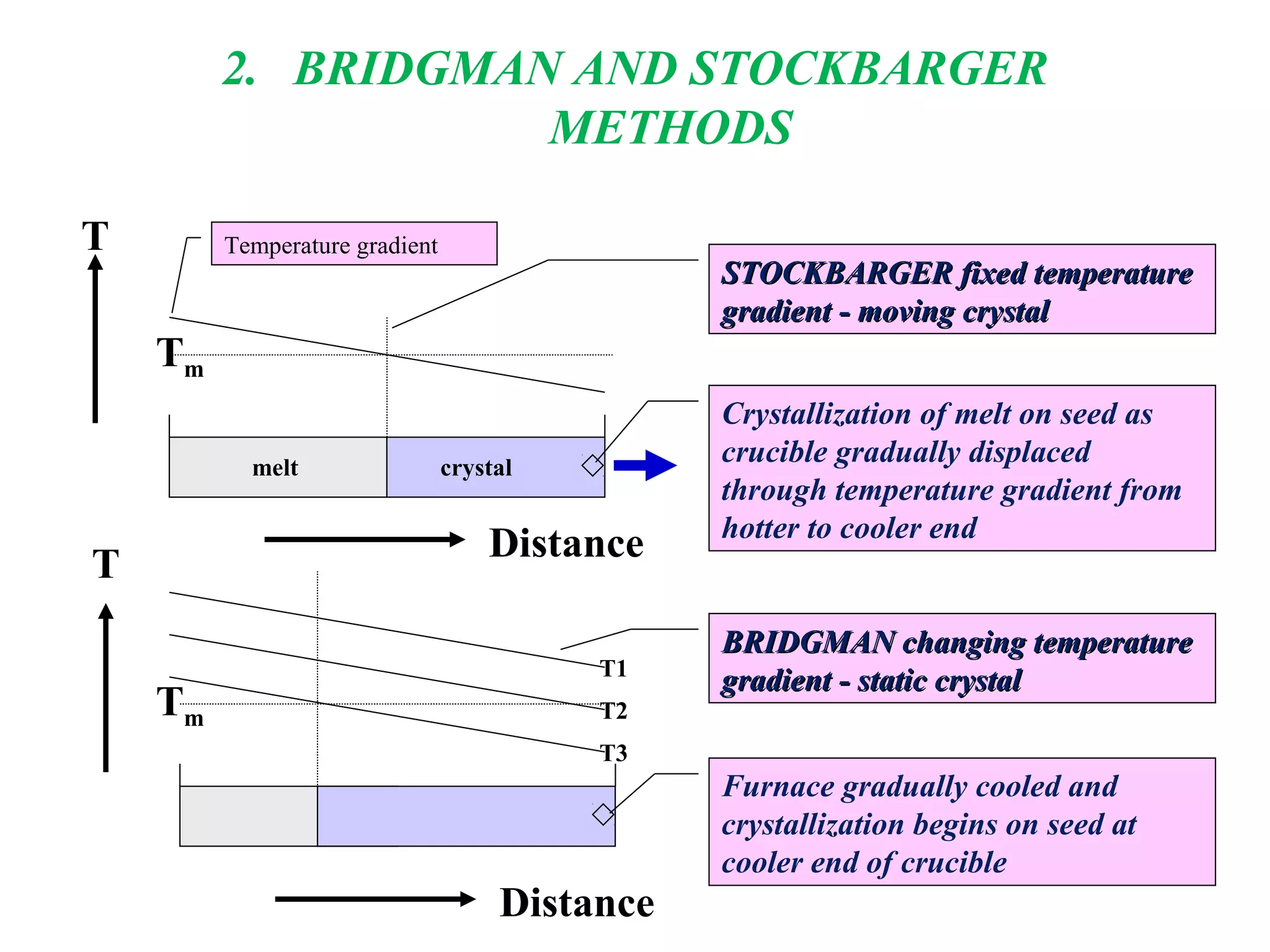
STOCKBARGER fixed temperatureSTOCKBARGER fixed temperature
gradient - moving crystalgradient - moving crystal
BRIDGMAN changing temperatureBRIDGMAN changing temperature
gradient - static crystalgradient - static crystal
T
T
Distance
Distance
Crystallization of melt on seed as
crucible gradually displaced
through temperature gradient from
hotter to cooler end
melt crystal
Furnace gradually cooled and
crystallization begins on seed at
cooler end of crucible
Tm
Tm
T1
T2
T3
Temperature gradient
BRIDGMAN AND STOCKBARGER METHODS
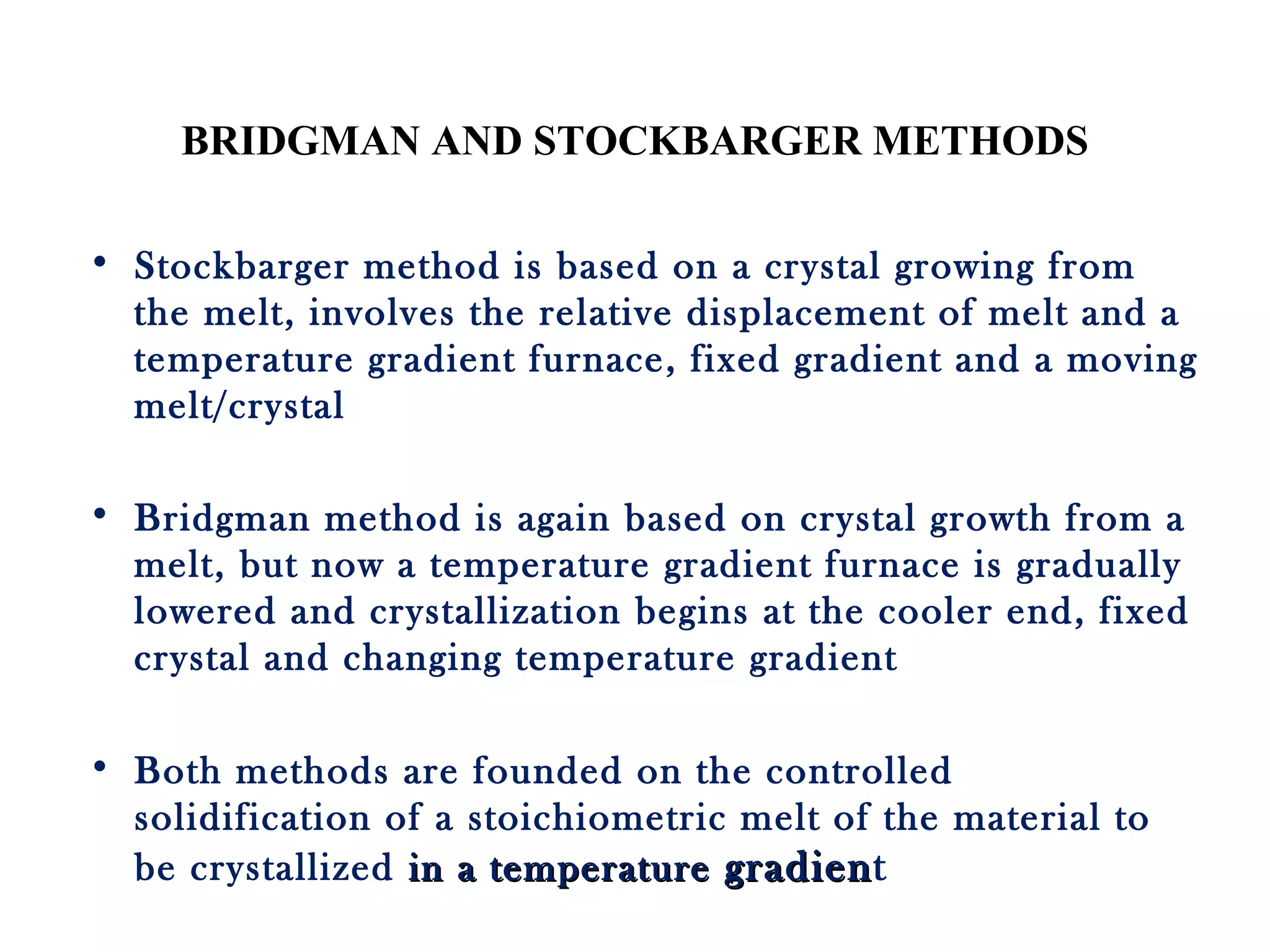
• Stockbarger method is based on a crystal growing from
the melt, involves the relative displacement of melt and a
temperature gradient furnace, fixed gradient and a moving
melt/crystal
• Bridgman method is again based on crystal growth from a
melt, but now a temperature gradient furnace is gradually
lowered and crystallization begins at the cooler end, fixed
crystal and changing temperature gradient
• Both methods are founded on the controlled
solidification of a stoichiometric melt of the material to
be crystallized in a temperaturein a temperature gradiengradient
T
Distance
Crystal or powder
Localized melt region - impurities
concentrated in melt – energetic benefit
Crystal growing from seed
Temperature profile furnace
Pulling direction
Tm
3. ZONE MELTING
[CRYSTAL GROWTH AND PURIFICATION OF SOLIDS]
ZONE MELTING
• Thermal profile furnace, arc, electron beam
heating. Material contained in a boat (must be inert
to the melt)
• Only a small region of the charge is melted at any
one time - initially part of the melt is in contact
with the seed
• Boat containing sample pulled at a controlledBoat containing sample pulled at a controlled
velocity through the thermal profile furnacevelocity through the thermal profile furnace
• Zone of material meltedZone of material melted, hence the name of the
method - oriented solidification of crystal occurs
on the seed - simultaneously more of the charge
ZONE MELTING
• Partitioning of impurities occurs between melt andPartitioning of impurities occurs between melt and
crystalcrystal
• Basis of the zone refining methods is used for
purifying solids
• Impurities concentrate in melt more than the solid
phase where structure-energy constraints of crystalwhere structure-energy constraints of crystal
sites are more severe than meltsites are more severe than melt - impurities swept
out of crystal by moving the liquid zone
• Used for purifying materials like W, Si, Ge, Au, Ptpurifying materials like W, Si, Ge, Au, Pt
to ppbto ppb level of impurities, often required for device
applications
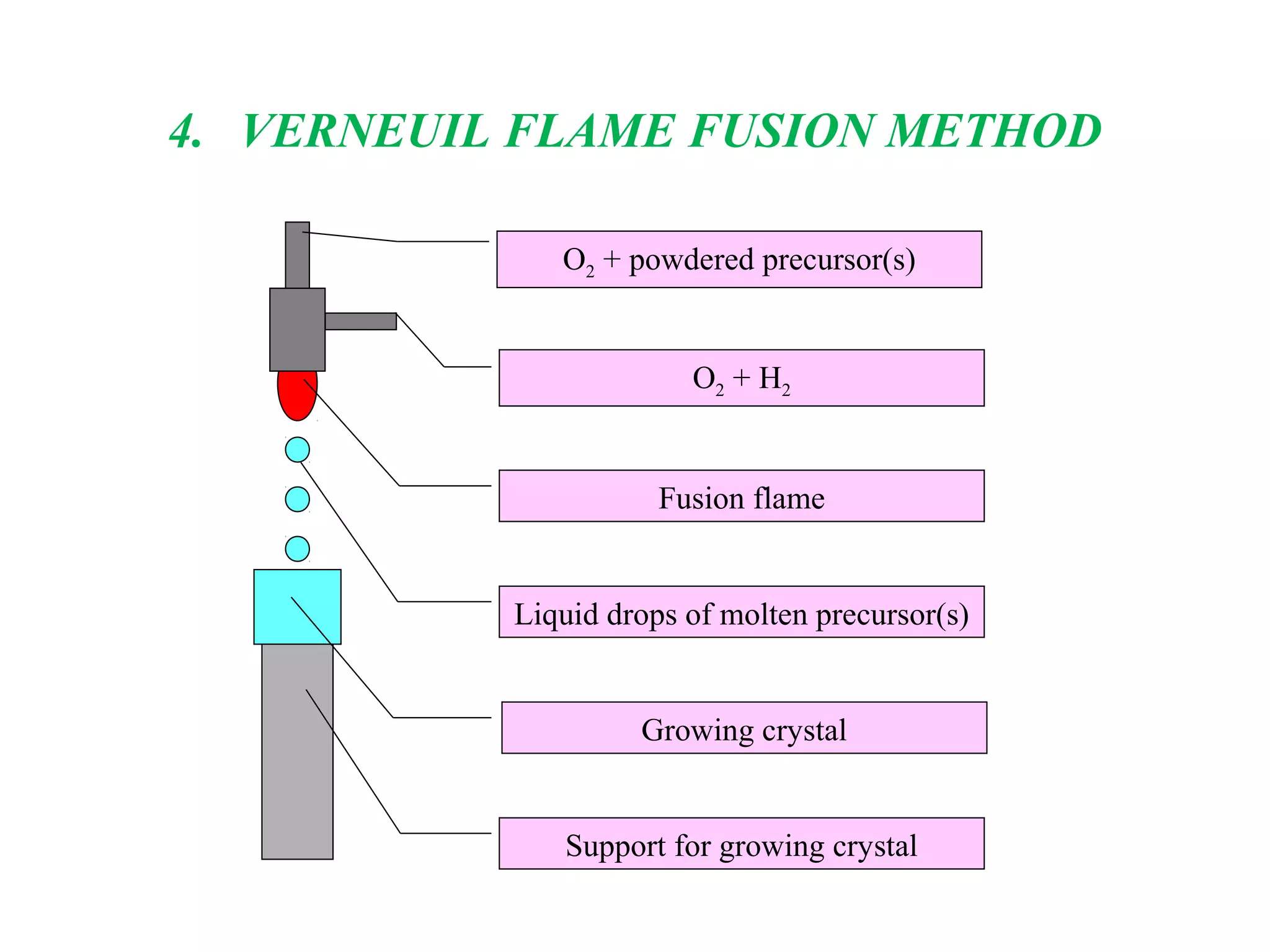
O2 + powdered precursor(s)
O2 + H2
Fusion flame
Liquid drops of molten precursor(s)
Growing crystal
Support for growing crystal
4. VERNEUIL FLAME FUSION METHOD
VERNEUIL FLAME FUSION METHOD
• 1904 first recorded use of the method. Useful for
growing crystals of extremely high melting metal
oxides
• Examples include: Ruby from Cr3+/
Al2O3 powder,
Sapphire from Cr2
6+
/Al2O3 powder, Spinel, CoO,
ferrites
• Starting material fine powder passed through O2/H2
flame or plasma torch
• Melting of the powder occurs in the flame. Molten
droplets fall onto the surface of a seed or growing
 BIBLIOGRAPHY
1. West A.R., 1984. Solid State Chemistry and its
Application. 2nd ed. University of Aberdeen: John Wiley
& Sons Ltd.
2. Alan Holden, Phylis Singer, 1958. Crystals and Crystals
Growing. 1st ed. Newyork: Anchor books-Doubleday.
3. Laudise, R.A., 1970. The Growth of Single Crystals. 1st ed.
Newyork: Prentice Hall.Inc.
4. Rudolph Peter, 1993. Handbook of Crystal Growth: Bulk
Crystal Growth, Vol 2, Part A. 1st ed. USA: Elsevier.

Growth of single crystals

  • 1.
    GROWTH OF SINGLECRYSTALSevices [Paper I – Solid State Chemistry] - Jaiswal Priyanka M.Sc. II [Inorganic] Mithibai College
  • 2.
    CONTENTS  Growth ofsingle crystals  Growth from melt  Czochralski technique  Stockbarger- Bridgman technique  Zone melting technique  Verneuil technique
  • 3.
    GROWTH OF SINGLECRYSTALS MICRONS TO METERSMICRONS TO METERS • Vapor, liquid, solid phase crystallization techniques • Single crystals - meaningful materials property measurements • Allow measurement of anisotropic phenomena (electrical,optical, magnetic, mechanical, thermal) in anisotropic crystals (symmetry lower than cubic) • Single crystals important for fabrication of devices, like siliconSingle crystals important for fabrication of devices, like silicon chips, yttrium aluminum garnet solid state lasers, beta-berylliumchips, yttrium aluminum garnet solid state lasers, beta-beryllium borate for doubling and tripling the frequency of CW or pulsedborate for doubling and tripling the frequency of CW or pulsed laser light, lithium niobate optoelectronic switch for guiding light inlaser light, lithium niobate optoelectronic switch for guiding light in miniature optical circuits, quartz crystal oscillators for ultra-sensitiveminiature optical circuits, quartz crystal oscillators for ultra-sensitive nanogram mass monitorsnanogram mass monitors
  • 4.
    GROWTH FROM MELT •All materials can be grown in single crystal form from the melt provided they melt congruently without decomposition at the melting point • They should not undergo any phase transformation between the melting point and room temperature • Depending on the thermal characteristics, the following techniques are employed. 1. Czochralski technique 2. Stockbarger-Bridgman technique 3. Zone melting technique 4. Verneuil technique
  • 5.
    1.1. CZOCHRALSKI METHODCZOCHRALSKIMETHOD • Single crystal growth from the melt precursor(s) • Crystal seed of material to be grown placed in contact with surface of melt • Temperature of melt held just above melting point, highest viscosity, lowest vapor pressure favors crystalhighest viscosity, lowest vapor pressure favors crystal growthgrowth • Seed gradually pulled out of the melt, 1mm per hour • Melt solidifies on surface of seed
  • 6.
    CZOCHRALSKI METHOD •Melt andseed usually rotated counterclockwise with respect to each other to maintain constant temperature and to facilitate uniformity of the melt during crystal growth, 10 rpm •Produces higher quality crystals, less defects •Inert atmosphere, often under pressure around growing crystal and melt to prevent any materials loss and undesirable reactions like oxidation, nitridation etc •Examples – Si, Ge, GaAs, LiNbO3. Large single crystals grown in the form of rods.
  • 7.
    Pulling direction of seedon rod Heater CZOCHRALSKICZOCHRALSKI Crucible Inert atmosphere under pressure prevents material loss and unwanted reactions Layer of molten oxide like B2O3 prevents preferential volatilization of one component - precise stoichiometry control Melt just above mp High viscosity low vapor pressure Growing crystal Crystal seed Counterclockwise rotation of melt and crystal being pulled from melt, helps maintain uniform T, composition and homogeneity of crystal growth
  • 8.
    2. BRIDGMAN ANDSTOCKBARGER METHODS STOCKBARGER fixed temperatureSTOCKBARGER fixed temperature gradient - moving crystalgradient - moving crystal BRIDGMAN changing temperatureBRIDGMAN changing temperature gradient - static crystalgradient - static crystal T T Distance Distance Crystallization of melt on seed as crucible gradually displaced through temperature gradient from hotter to cooler end melt crystal Furnace gradually cooled and crystallization begins on seed at cooler end of crucible Tm Tm T1 T2 T3 Temperature gradient
  • 9.
    BRIDGMAN AND STOCKBARGERMETHODS • Stockbarger method is based on a crystal growing from the melt, involves the relative displacement of melt and a temperature gradient furnace, fixed gradient and a moving melt/crystal • Bridgman method is again based on crystal growth from a melt, but now a temperature gradient furnace is gradually lowered and crystallization begins at the cooler end, fixed crystal and changing temperature gradient • Both methods are founded on the controlled solidification of a stoichiometric melt of the material to be crystallized in a temperaturein a temperature gradiengradient
  • 10.
    T Distance Crystal or powder Localizedmelt region - impurities concentrated in melt – energetic benefit Crystal growing from seed Temperature profile furnace Pulling direction Tm 3. ZONE MELTING [CRYSTAL GROWTH AND PURIFICATION OF SOLIDS]
  • 11.
    ZONE MELTING • Thermalprofile furnace, arc, electron beam heating. Material contained in a boat (must be inert to the melt) • Only a small region of the charge is melted at any one time - initially part of the melt is in contact with the seed • Boat containing sample pulled at a controlledBoat containing sample pulled at a controlled velocity through the thermal profile furnacevelocity through the thermal profile furnace • Zone of material meltedZone of material melted, hence the name of the method - oriented solidification of crystal occurs on the seed - simultaneously more of the charge
  • 12.
    ZONE MELTING • Partitioningof impurities occurs between melt andPartitioning of impurities occurs between melt and crystalcrystal • Basis of the zone refining methods is used for purifying solids • Impurities concentrate in melt more than the solid phase where structure-energy constraints of crystalwhere structure-energy constraints of crystal sites are more severe than meltsites are more severe than melt - impurities swept out of crystal by moving the liquid zone • Used for purifying materials like W, Si, Ge, Au, Ptpurifying materials like W, Si, Ge, Au, Pt to ppbto ppb level of impurities, often required for device applications
  • 13.
    O2 + powderedprecursor(s) O2 + H2 Fusion flame Liquid drops of molten precursor(s) Growing crystal Support for growing crystal 4. VERNEUIL FLAME FUSION METHOD
  • 14.
    VERNEUIL FLAME FUSIONMETHOD • 1904 first recorded use of the method. Useful for growing crystals of extremely high melting metal oxides • Examples include: Ruby from Cr3+/ Al2O3 powder, Sapphire from Cr2 6+ /Al2O3 powder, Spinel, CoO, ferrites • Starting material fine powder passed through O2/H2 flame or plasma torch • Melting of the powder occurs in the flame. Molten droplets fall onto the surface of a seed or growing
  • 15.
     BIBLIOGRAPHY 1. WestA.R., 1984. Solid State Chemistry and its Application. 2nd ed. University of Aberdeen: John Wiley & Sons Ltd. 2. Alan Holden, Phylis Singer, 1958. Crystals and Crystals Growing. 1st ed. Newyork: Anchor books-Doubleday. 3. Laudise, R.A., 1970. The Growth of Single Crystals. 1st ed. Newyork: Prentice Hall.Inc. 4. Rudolph Peter, 1993. Handbook of Crystal Growth: Bulk Crystal Growth, Vol 2, Part A. 1st ed. USA: Elsevier.