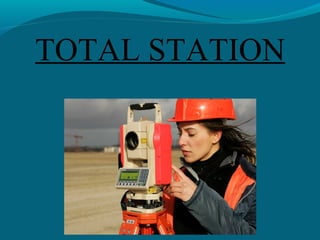
TOTAL STATION
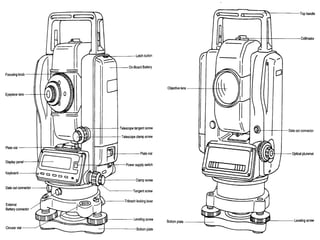
Total station is a combination of :

          EDM
          Theodolite
          Auto Leveler
          Microprocessor with specific memory
          Battery/spare
            which works about 5 working hours

    About 100 models were released till now by
different firms.
     
Principle of Total station:

Distance = Velocity x
 Time
Basic components of Total Station


Prism reflector:
        It is a combination of ranging rod, staff and and
               optical cuboidal mirror.
        having 2/3 lifts with 5cms interval graduations.

        adjustable height from 1.5m to 3.75m.

        More number of prisms, will give more accuracy.
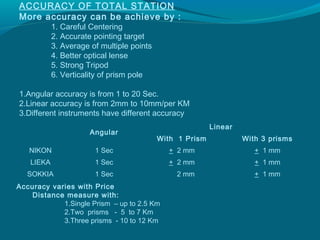
ACCURACY OF TOTAL STATION
More accuracy can be achieve by :
           1. Careful Centering
           2. Accurate pointing target
           3. Average of multiple points
           4. Better optical lense
           5. Strong Tripod
           6. Verticality of prism pole

1.Angular accuracy is from 1 to 20 Sec.
2.Linear accuracy is from 2mm to 10mm/per KM
3.Different instruments have different accuracy
                                                          Linear
                      Angular
                                           With 1 Prism            With 3 prisms
   NIKON               1 Sec                 + 2 mm                   + 1 mm
   LIEKA               1 Sec                 + 2 mm                   + 1 mm
   SOKKIA              1 Sec                   2 mm                   + 1 mm
Accuracy varies with Price
    Distance measure with:
            1.Single Prism – up to 2.5 Km
            2.Two prisms - 5 to 7 Km
            3.Three prisms - 10 to 12 Km
Functions of T.S:
1. It simultaneously measures angles & distances and Record
2. Correcting the measured distance with:
                                     1. Prism constant
                                     2. Atmospheric Pr.
                                     3. Temperature
                                     4. Curvature of earth
                                     5. Refraction correction
3. Computing the point elevation
4. Computing the coordinates of every point
5. Remote elevation measurement
6. Remote distance measurement
7. Area calculations
8. Data Transferring facility from instrument to S/W and S/W
   to instrument
9. Format of conversion of units
Application of Total station:
         1. Updating mapping
         2. Topographic survey
         3. Hydrographic survey
         4. Cadastral survey
         5. Project construction survey
         6. Road, Rail Survey
         7. Mining survey
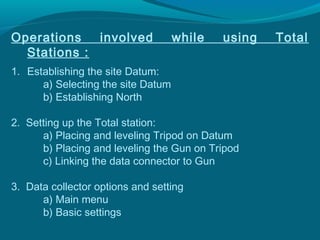
Operations   involved               while   using   Total
  Stations :
1. Establishing the site Datum:
      a) Selecting the site Datum
      b) Establishing North

2. Setting up the Total station:
      a) Placing and leveling Tripod on Datum
      b) Placing and leveling the Gun on Tripod
      c) Linking the data connector to Gun

3. Data collector options and setting
      a) Main menu
      b) Basic settings
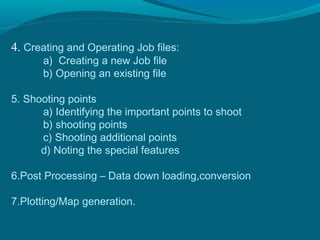
4. Creating and Operating Job files:
      a) Creating a new Job file
      b) Opening an existing file

5. Shooting points
      a) Identifying the important points to shoot
      b) shooting points
      c) Shooting additional points
      d) Noting the special features

6.Post Processing – Data down loading,conversion

7.Plotting/Map generation.
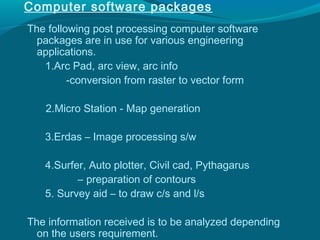
Computer software packages
The following post processing computer software
  packages are in use for various engineering
  applications.
   1.Arc Pad, arc view, arc info
         -conversion from raster to vector form

   2.Micro Station - Map generation

   3.Erdas – Image processing s/w

   4.Surfer, Auto plotter, Civil cad, Pythagarus
          – preparation of contours
   5. Survey aid – to draw c/s and l/s

The information received is to be analyzed depending
  on the users requirement.
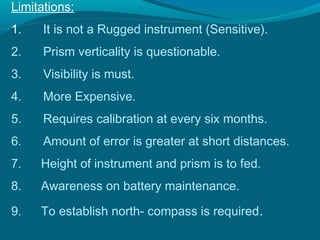
Limitations:
1.    It is not a Rugged instrument (Sensitive).
2.    Prism verticality is questionable.
3.    Visibility is must.
4.    More Expensive.
5.    Requires calibration at every six months.
6.    Amount of error is greater at short distances.
7.   Height of instrument and prism is to fed.
8.   Awareness on battery maintenance.

9.   To establish north- compass is required.
SAFETY PRECAUTIONS
1.   Focusing directly at the sun, can result - loss of eyesight
     on the spot. Use a filter when observing the sun.

2.   Never remove the hand grip carelessly. If the grip is
     loosely or incompletely attached, the instrument could fall
     and may cause a serious injury.

3.   Make sure not to short the battery terminals. If these are
     shorted, the resulting high current would not only damage
     to the battery, but also start a fire.

4.   If the instrument or battery comes in contact with water,
     wipe it off as quickly as possible and set it in a dry place
     for a while. When it is completely dry, put it back in the
     case.

5.   Never disassemble the instrument, if you find a problem.
     Contact the dealer.
THANK YOU

Total station

  • 1.
  • 2.
    Total station isa combination of : EDM Theodolite Auto Leveler Microprocessor with specific memory Battery/spare which works about 5 working hours About 100 models were released till now by different firms.  
  • 3.
    Principle of Totalstation: Distance = Velocity x Time
  • 4.
    Basic components ofTotal Station Prism reflector: It is a combination of ranging rod, staff and and optical cuboidal mirror. having 2/3 lifts with 5cms interval graduations. adjustable height from 1.5m to 3.75m. More number of prisms, will give more accuracy.
  • 6.
    ACCURACY OF TOTALSTATION More accuracy can be achieve by : 1. Careful Centering 2. Accurate pointing target 3. Average of multiple points 4. Better optical lense 5. Strong Tripod 6. Verticality of prism pole 1.Angular accuracy is from 1 to 20 Sec. 2.Linear accuracy is from 2mm to 10mm/per KM 3.Different instruments have different accuracy Linear Angular With 1 Prism With 3 prisms NIKON 1 Sec + 2 mm + 1 mm LIEKA 1 Sec + 2 mm + 1 mm SOKKIA 1 Sec 2 mm + 1 mm Accuracy varies with Price Distance measure with: 1.Single Prism – up to 2.5 Km 2.Two prisms - 5 to 7 Km 3.Three prisms - 10 to 12 Km
  • 7.
    Functions of T.S: 1.It simultaneously measures angles & distances and Record 2. Correcting the measured distance with: 1. Prism constant 2. Atmospheric Pr. 3. Temperature 4. Curvature of earth 5. Refraction correction 3. Computing the point elevation 4. Computing the coordinates of every point 5. Remote elevation measurement 6. Remote distance measurement 7. Area calculations 8. Data Transferring facility from instrument to S/W and S/W to instrument 9. Format of conversion of units
  • 8.
    Application of Totalstation: 1. Updating mapping 2. Topographic survey 3. Hydrographic survey 4. Cadastral survey 5. Project construction survey 6. Road, Rail Survey 7. Mining survey
  • 9.
    Operations involved while using Total Stations : 1. Establishing the site Datum: a) Selecting the site Datum b) Establishing North 2. Setting up the Total station: a) Placing and leveling Tripod on Datum b) Placing and leveling the Gun on Tripod c) Linking the data connector to Gun 3. Data collector options and setting a) Main menu b) Basic settings
  • 10.
    4. Creating andOperating Job files: a) Creating a new Job file b) Opening an existing file 5. Shooting points a) Identifying the important points to shoot b) shooting points c) Shooting additional points d) Noting the special features 6.Post Processing – Data down loading,conversion 7.Plotting/Map generation.
  • 11.
    Computer software packages Thefollowing post processing computer software packages are in use for various engineering applications. 1.Arc Pad, arc view, arc info -conversion from raster to vector form 2.Micro Station - Map generation 3.Erdas – Image processing s/w 4.Surfer, Auto plotter, Civil cad, Pythagarus – preparation of contours 5. Survey aid – to draw c/s and l/s The information received is to be analyzed depending on the users requirement.
  • 12.
    Limitations: 1. It is not a Rugged instrument (Sensitive). 2. Prism verticality is questionable. 3. Visibility is must. 4. More Expensive. 5. Requires calibration at every six months. 6. Amount of error is greater at short distances. 7. Height of instrument and prism is to fed. 8. Awareness on battery maintenance. 9. To establish north- compass is required.
  • 13.
    SAFETY PRECAUTIONS 1. Focusing directly at the sun, can result - loss of eyesight on the spot. Use a filter when observing the sun. 2. Never remove the hand grip carelessly. If the grip is loosely or incompletely attached, the instrument could fall and may cause a serious injury. 3. Make sure not to short the battery terminals. If these are shorted, the resulting high current would not only damage to the battery, but also start a fire. 4. If the instrument or battery comes in contact with water, wipe it off as quickly as possible and set it in a dry place for a while. When it is completely dry, put it back in the case. 5. Never disassemble the instrument, if you find a problem. Contact the dealer.
  • 14.