An important consideration in
mapping our world
Map Projections
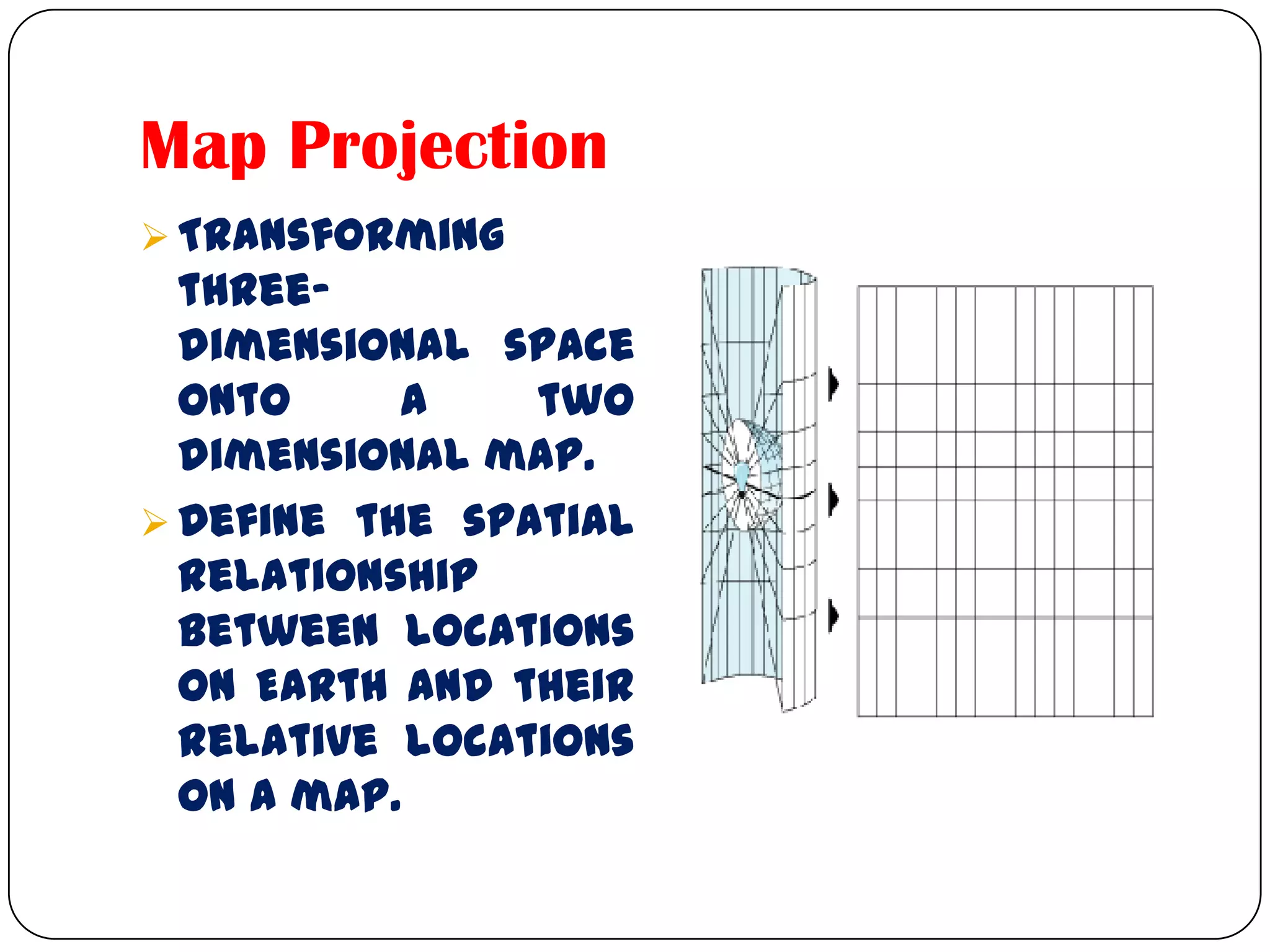
Map Projection
 Transforming
three-
dimensional space
onto a two
dimensional map.
 Define the spatial
relationship
between locations
on Earth and their
relative locations
on a map.
Why project data?
 Data often comes in geographic, or spherical
coordinates (latitude and longitude) and
cannot be used for area calculations.
 Some projections work better for different
parts of the globe giving more accurate
calculations.
“All maps lie flat, therefore all
maps lie.”
Issues and Limitations
Map projections are attempts to portray the surface
of the Earth or a portion of the Earth on a flat
surface.
Some distortions of different types always result
from this process.
Some projections minimize distortions in some of
these properties at the expense of maximizing errors
in others.
Some projections are attempts to only moderately
distort all of these properties.
Thus, the best projection depends
upon the use of the map.
Choosing a Map Projection
depends on
• which region to display (e.g. world, north pole,
equator, US)
• Resolution of the region
• Geometric properties of the region
• Purpose of using maps
such that distortion can be minimized
Distortion Types
 Conformality
When the scale of a map at any point is the same in any
direction, the projection is conformal. Meridians (lines of
longitude) and parallels (lines of latitude) intersect at
right angles. Shape is preserved locally.
 Distance
A map is equidistant when its distance from a single
location to all other locations are preserved.
 Direction
A map preserves directions when it is azimuthal, when
direction from a single location to all other locations are
preserved.
 Scale
It is the relationship between a distance portrayed
on a map and the same distance on the Earth.
 Area
When a map portrays areas over the entire map so
that all mapped areas have the same proportional
relationship to the areas on the Earth that they
represent, the map is an equal –area map.
Aspects of the Projection
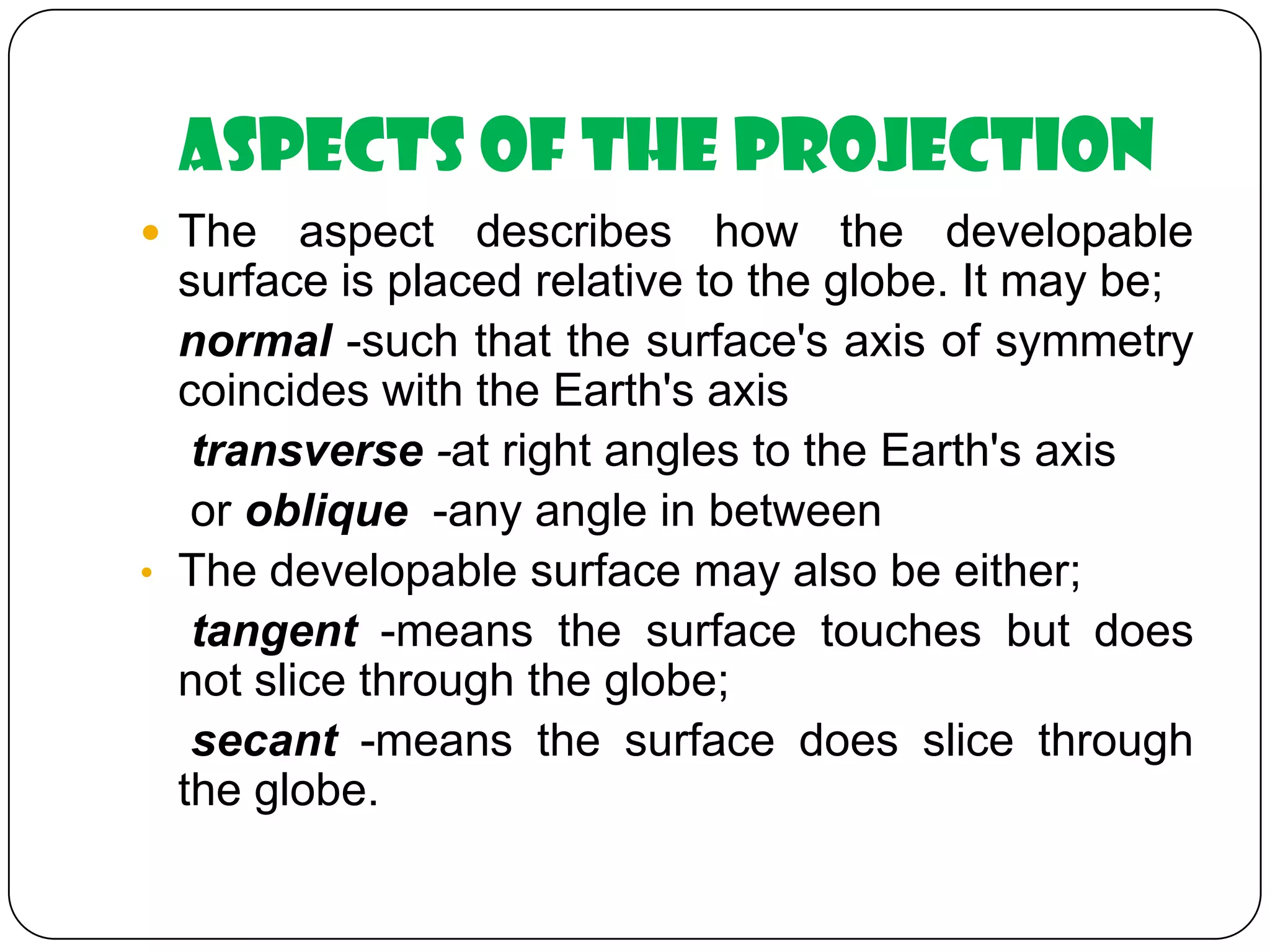
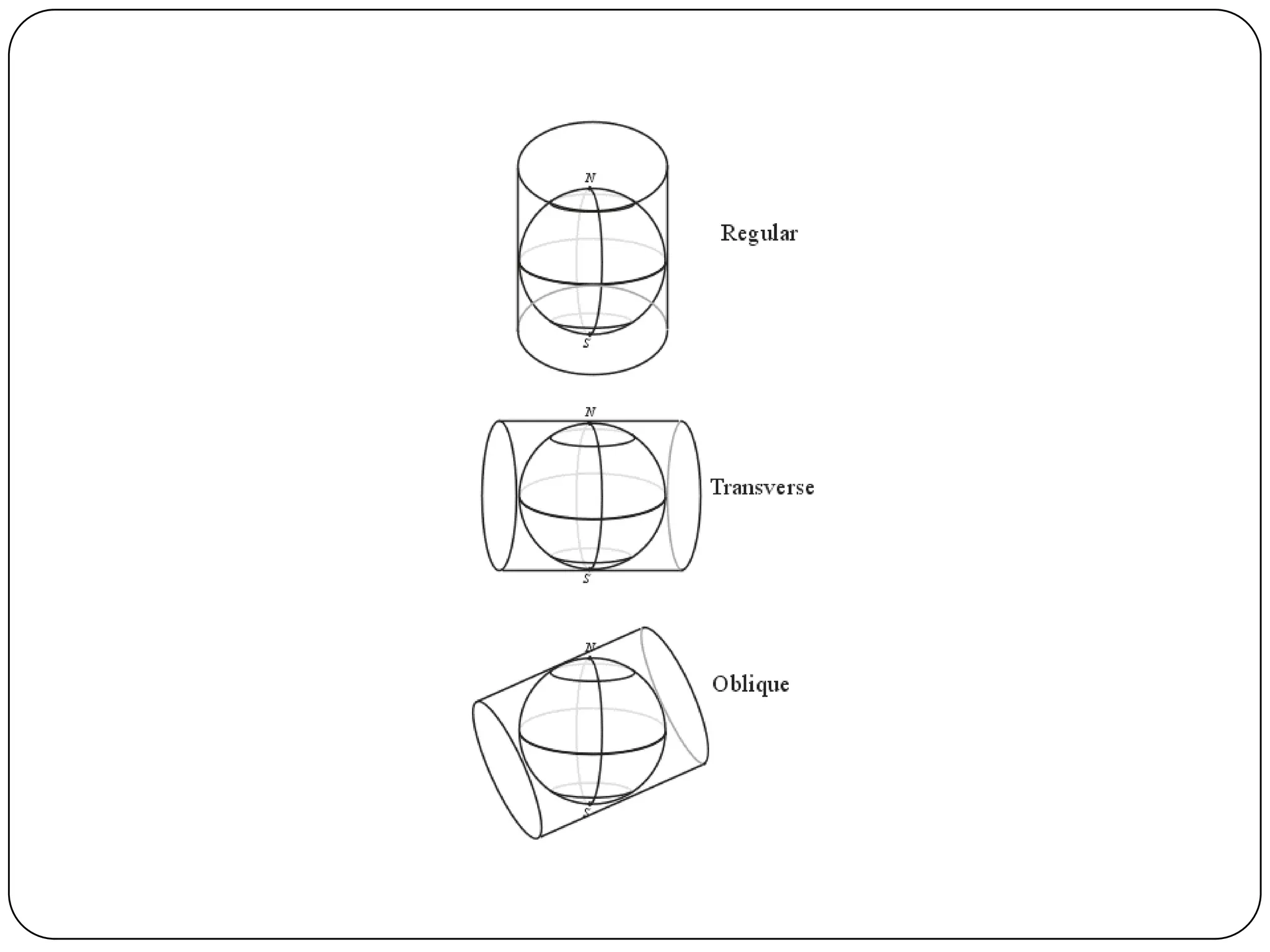
 The aspect describes how the developable
surface is placed relative to the globe. It may be;
normal -such that the surface's axis of symmetry
coincides with the Earth's axis
transverse -at right angles to the Earth's axis
or oblique -any angle in between
• The developable surface may also be either;
tangent -means the surface touches but does
not slice through the globe;
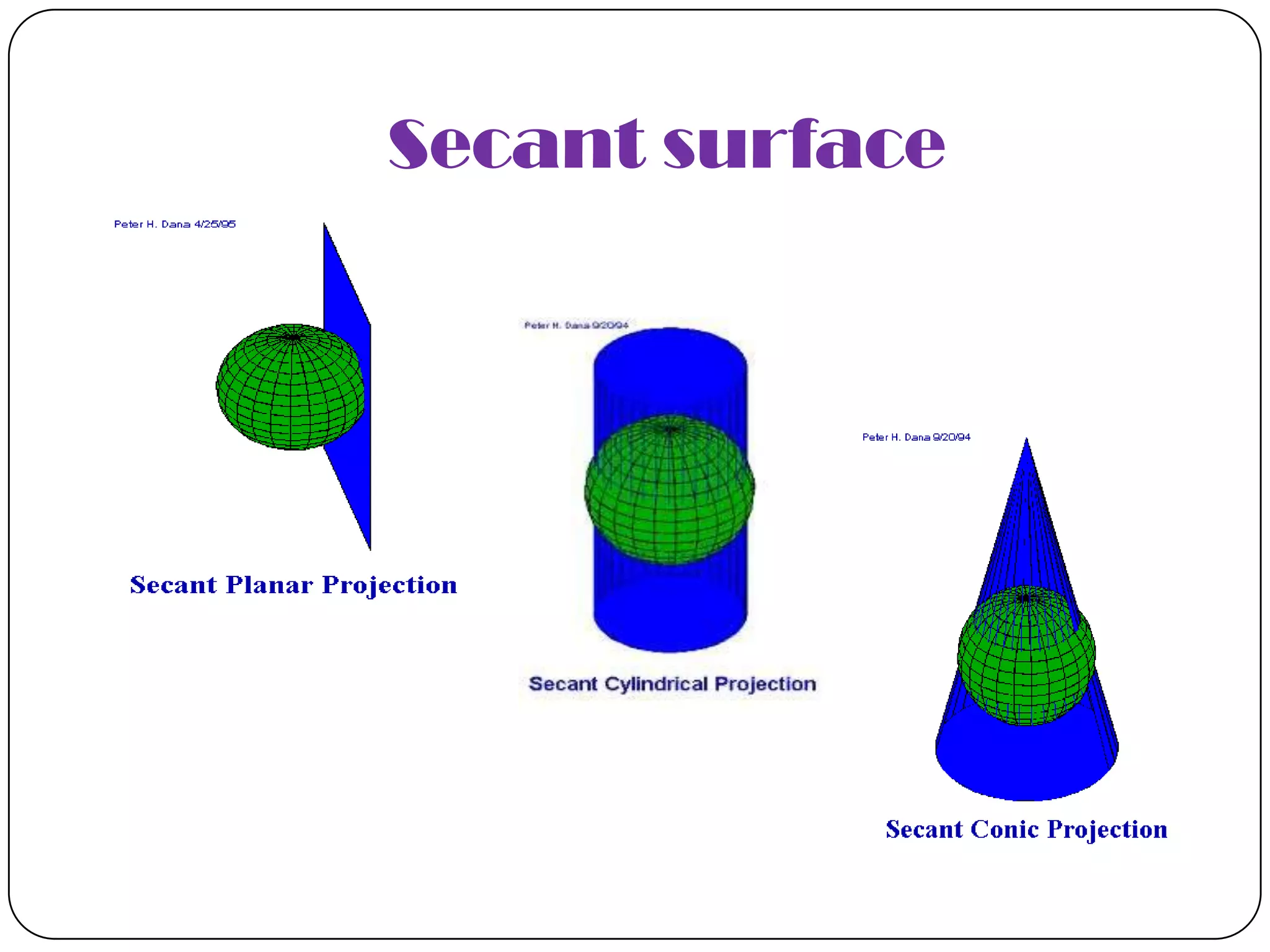
secant -means the surface does slice through
the globe.
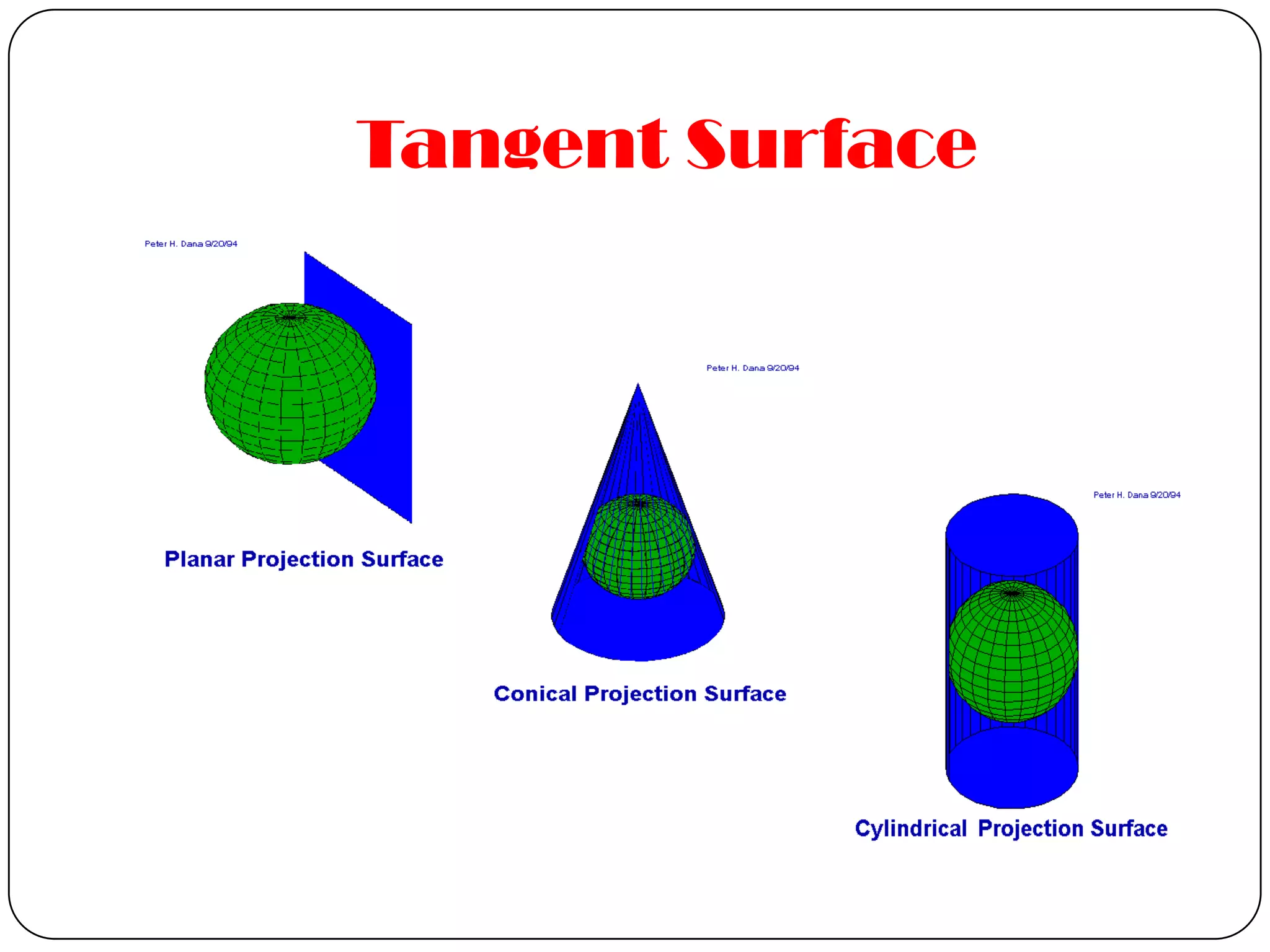
Tangent Surface
Secant surface
Projection Types
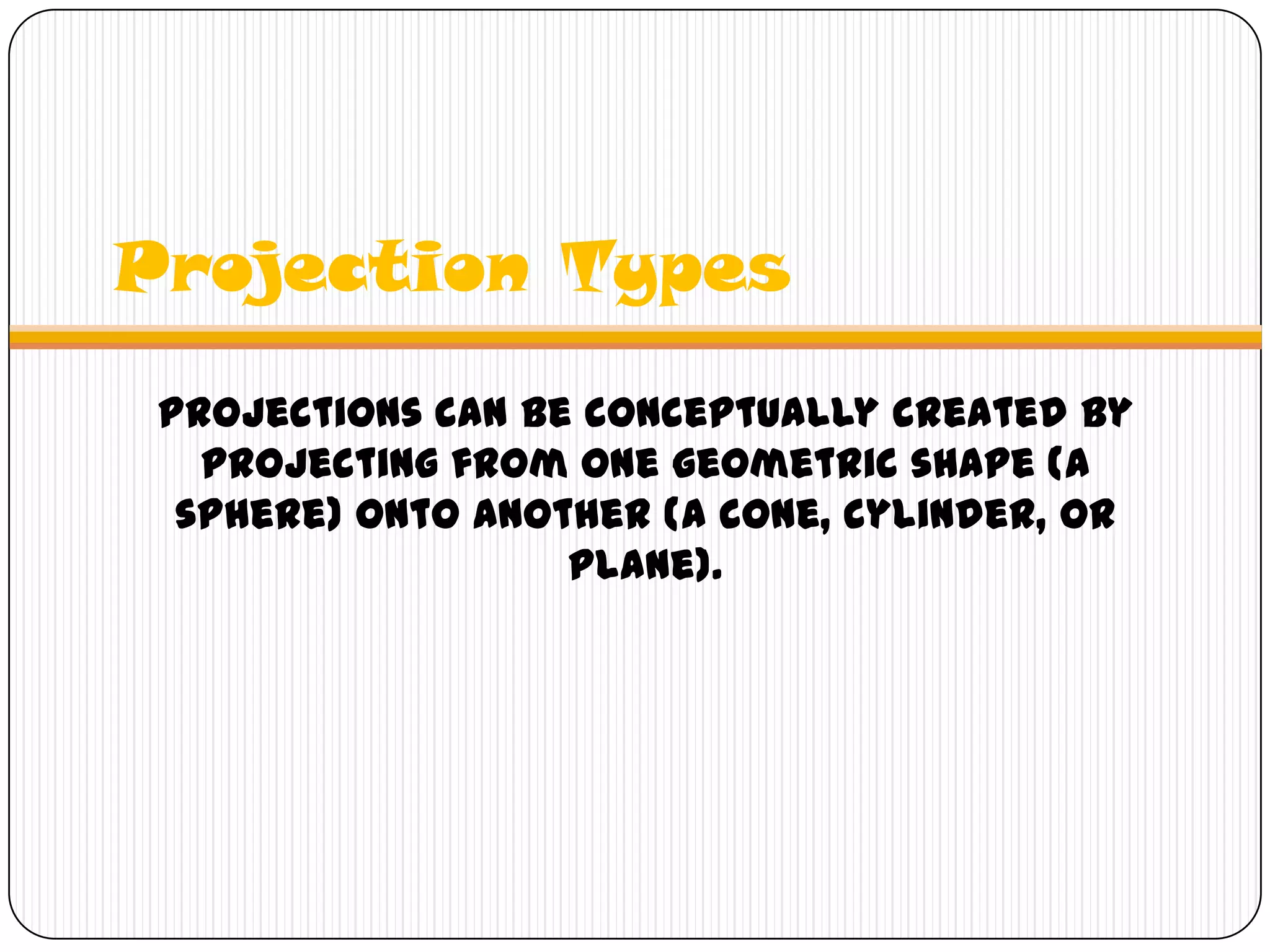
Projections can be conceptually created by
projecting from one geometric shape (a
sphere) onto another (a cone, cylinder, or
plane).
Cylindrical Projections
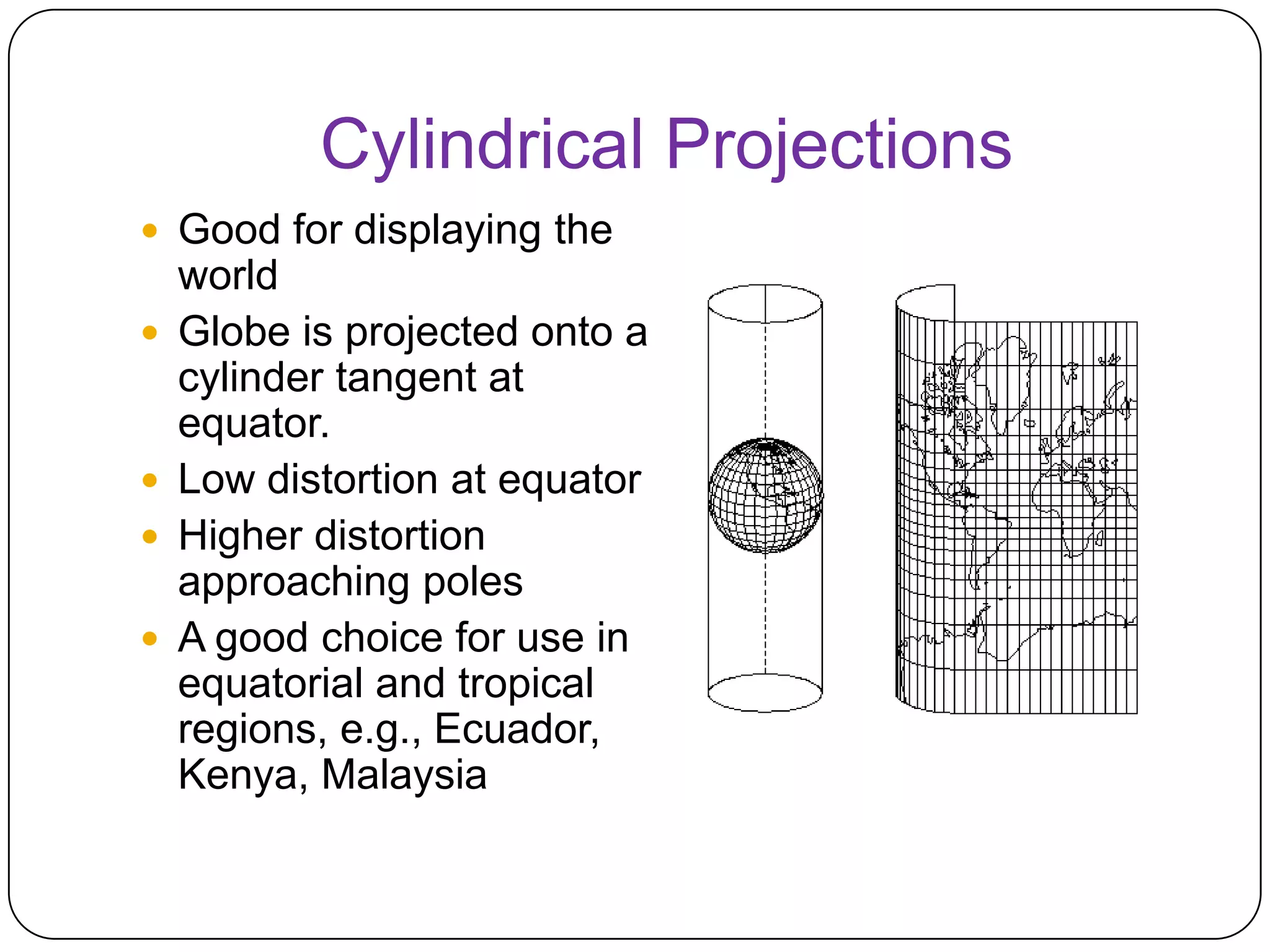
 Good for displaying the
world
 Globe is projected onto a
cylinder tangent at
equator.
 Low distortion at equator
 Higher distortion
approaching poles
 A good choice for use in
equatorial and tropical
regions, e.g., Ecuador,
Kenya, Malaysia
Example of a Cylindrical Projection:
Mercator
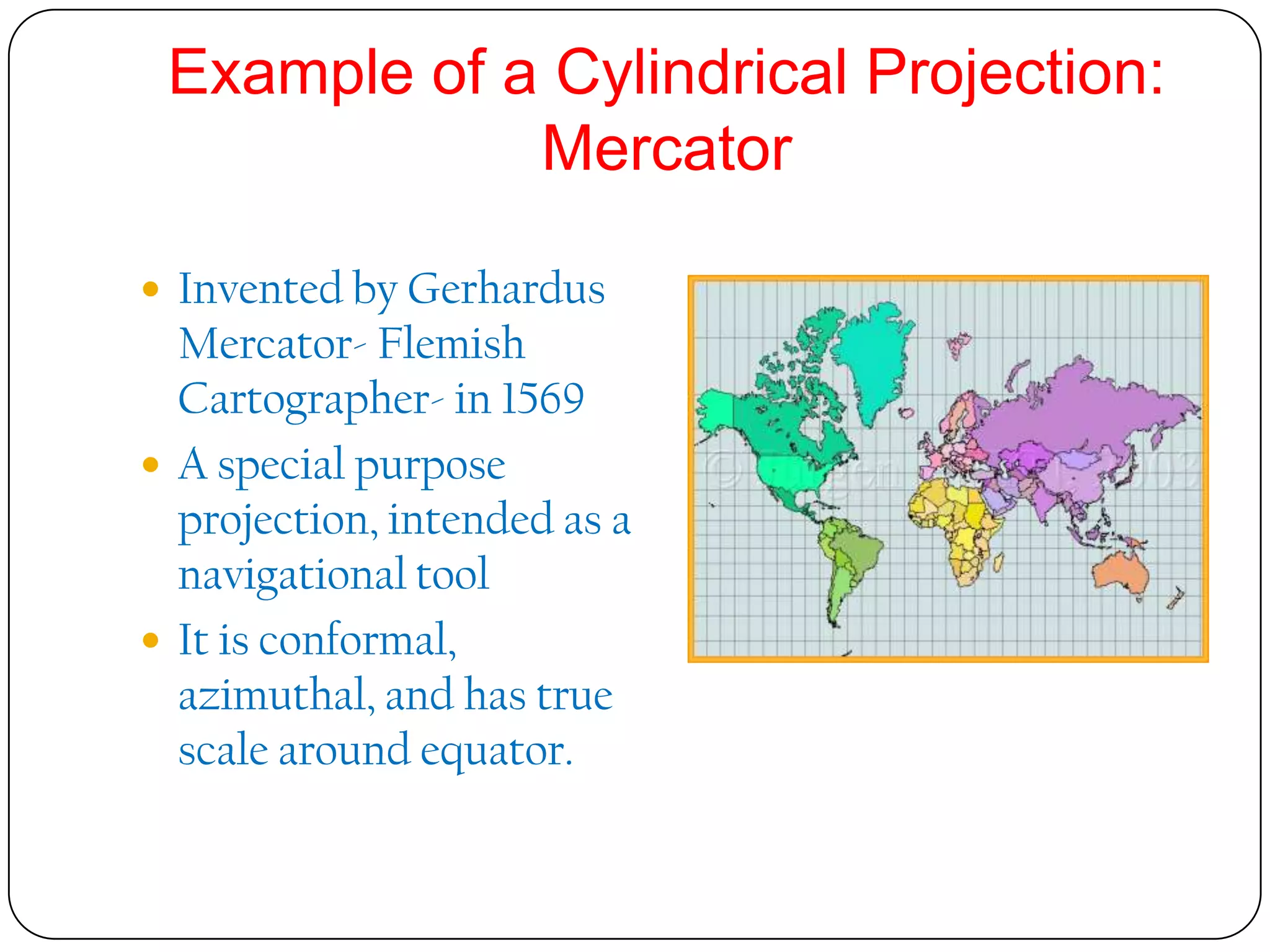
 Invented by Gerhardus
Mercator- Flemish
Cartographer- in 1569
 A special purpose
projection, intended as a
navigational tool
 It is conformal,
azimuthal, and has true
scale around equator.
Problems with Mercator
 Preserves shape (a
conformal type) but
distorts area
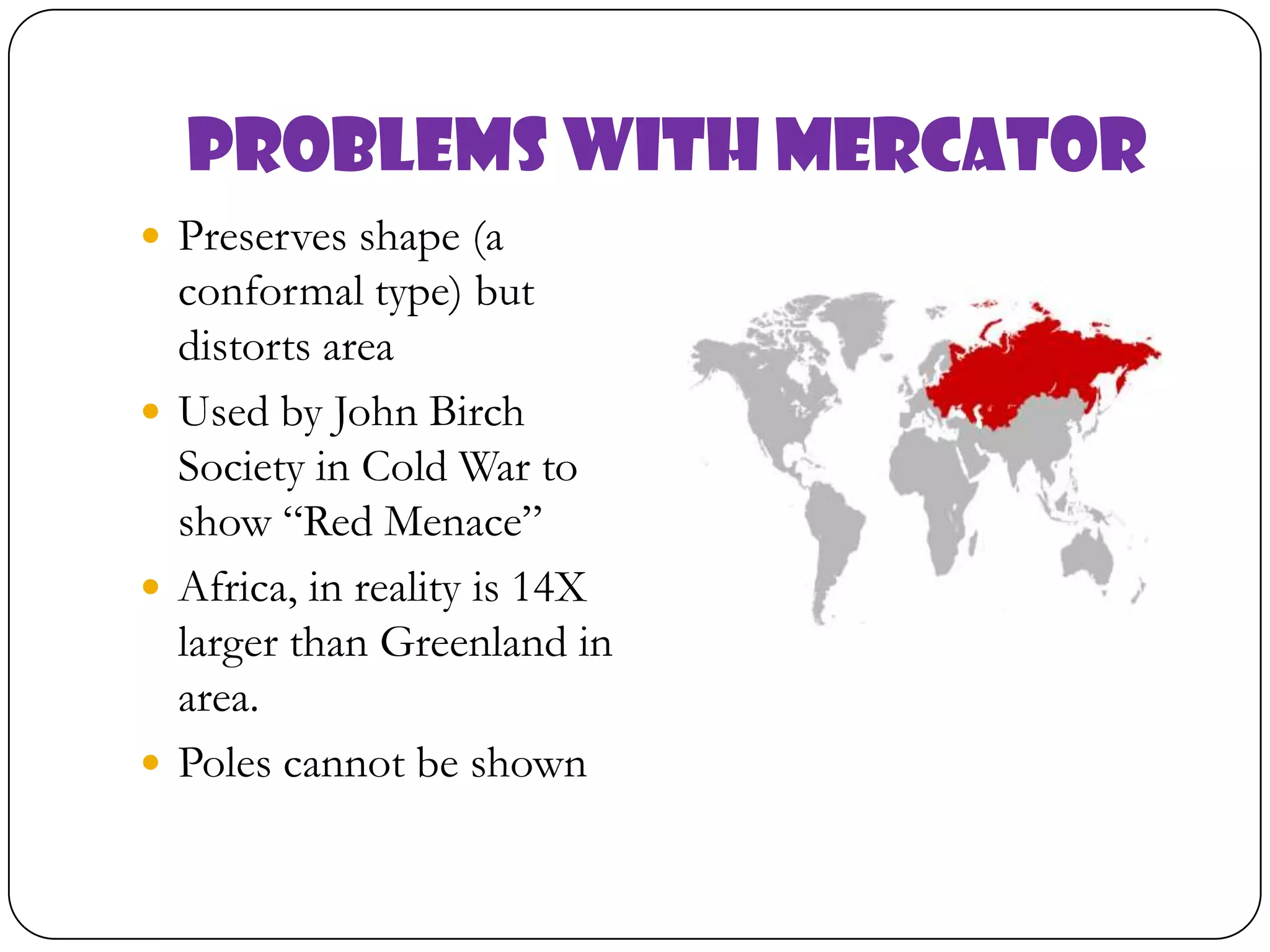
 Used by John Birch
Society in Cold War to
show “Red Menace”
 Africa, in reality is 14X
larger than Greenland in
area.
 Poles cannot be shown
Conic Projections
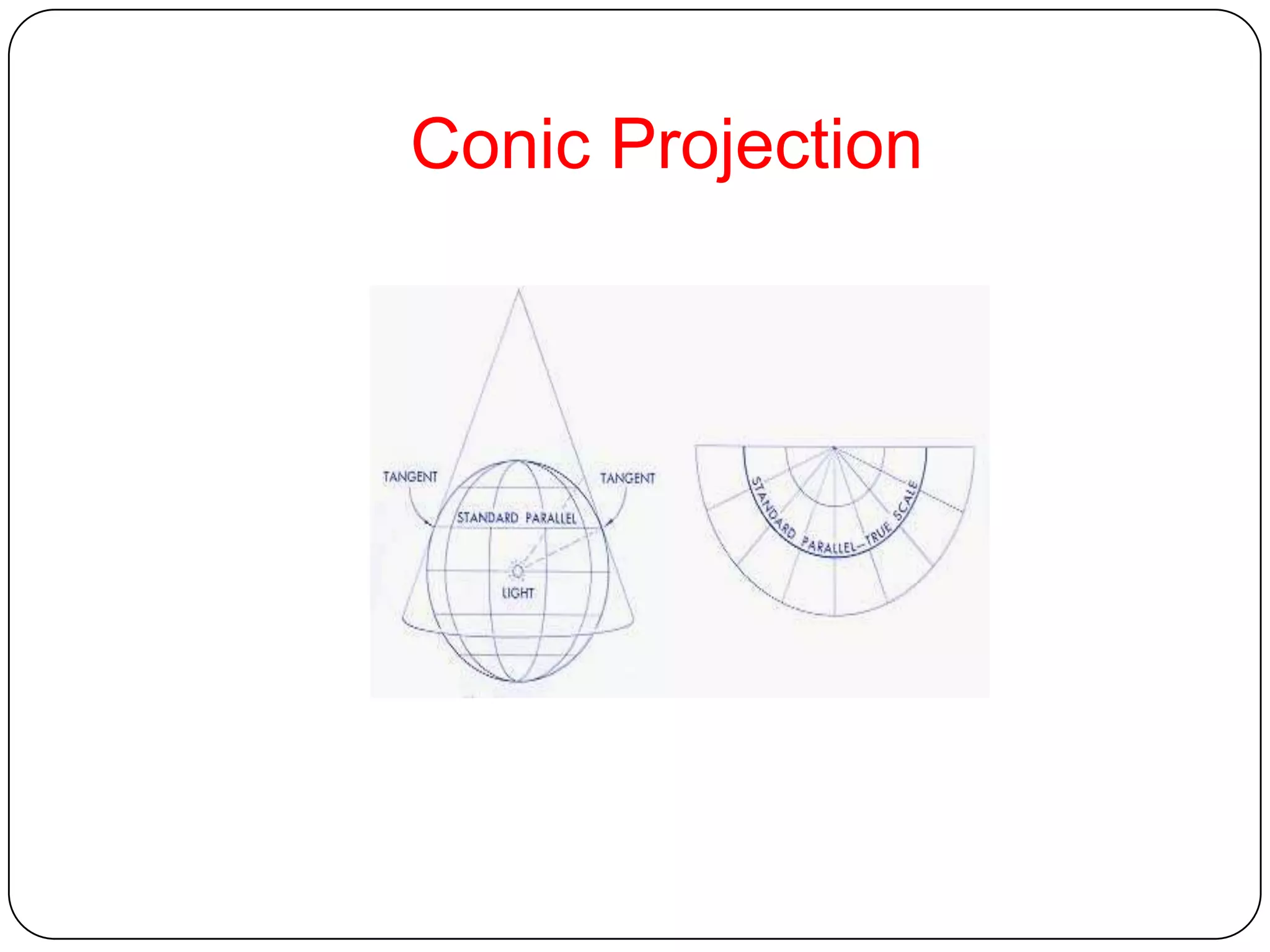
 Good for displaying mid- latitude area such as U.S.
 Surface of globe projected onto cone is tangent at
standard parallel.
 Distorts N & S of standard parallel(s)
 Normally shows just one semi hemisphere in middle
latitudes.
Conic Projection
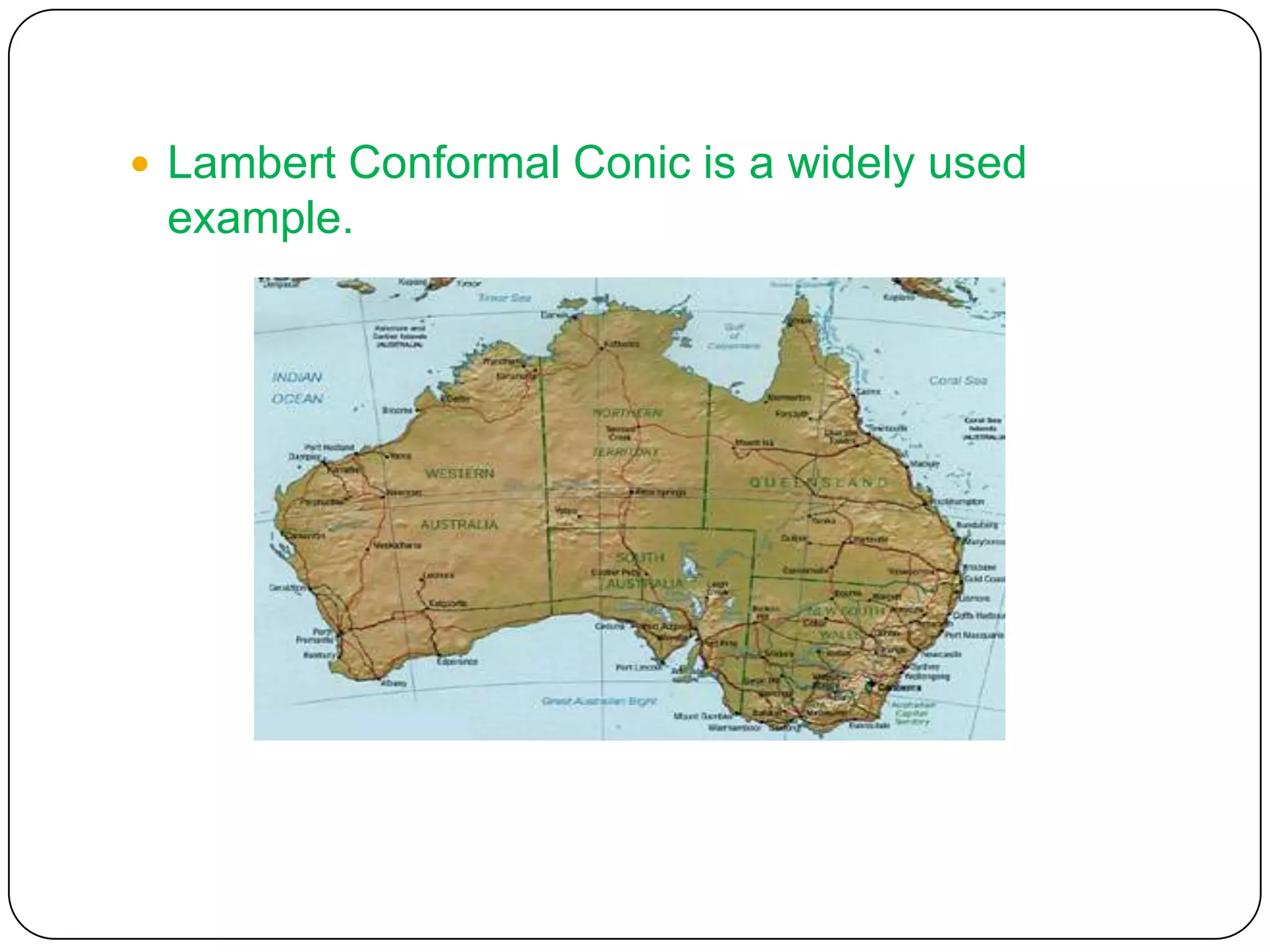
 Lambert Conformal Conic is a widely used
example.
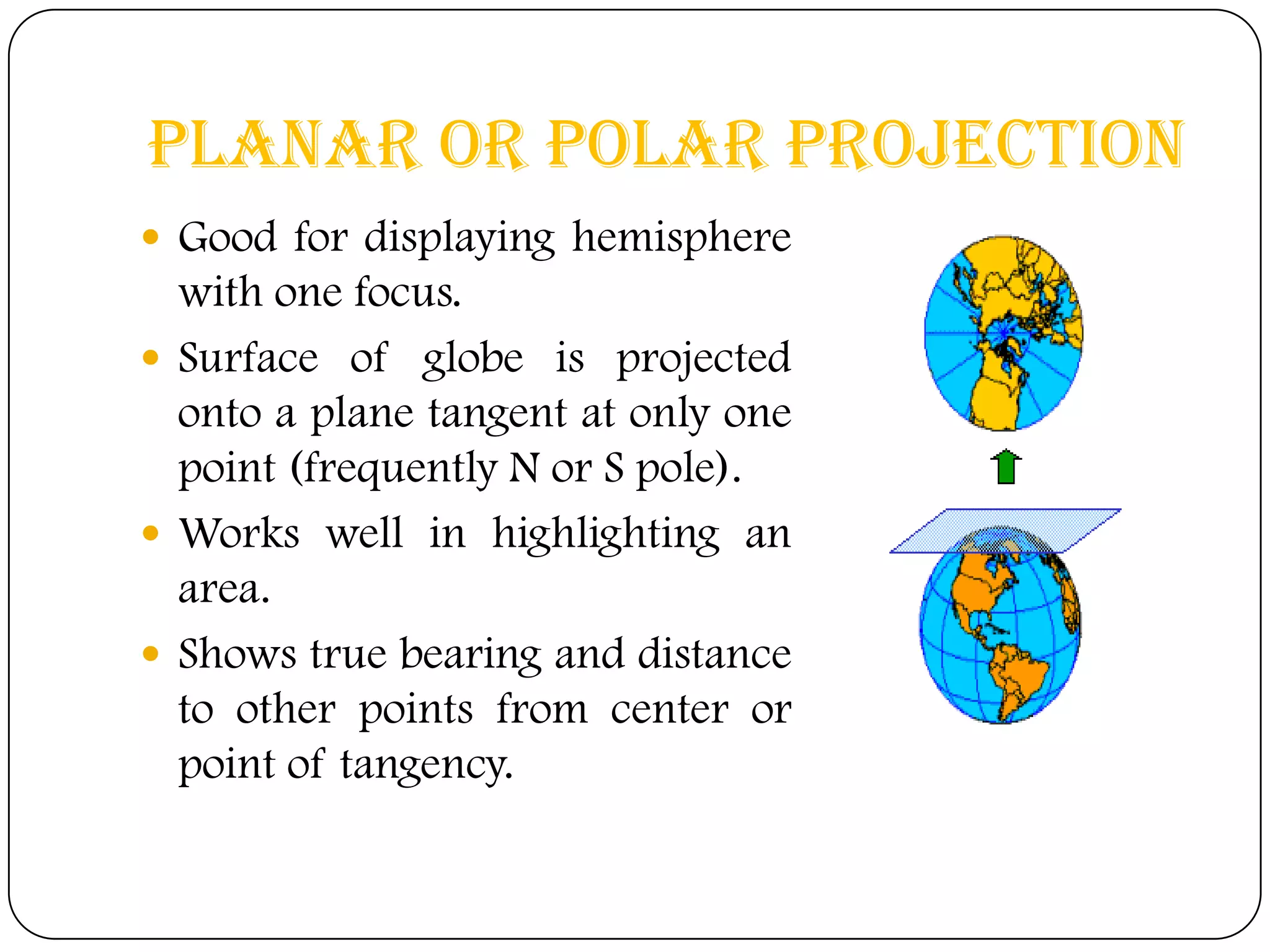
Planar or Polar Projection
 Good for displaying hemisphere
with one focus.
 Surface of globe is projected
onto a plane tangent at only one
point (frequently N or S pole).
 Works well in highlighting an
area.
 Shows true bearing and distance
to other points from center or
point of tangency.
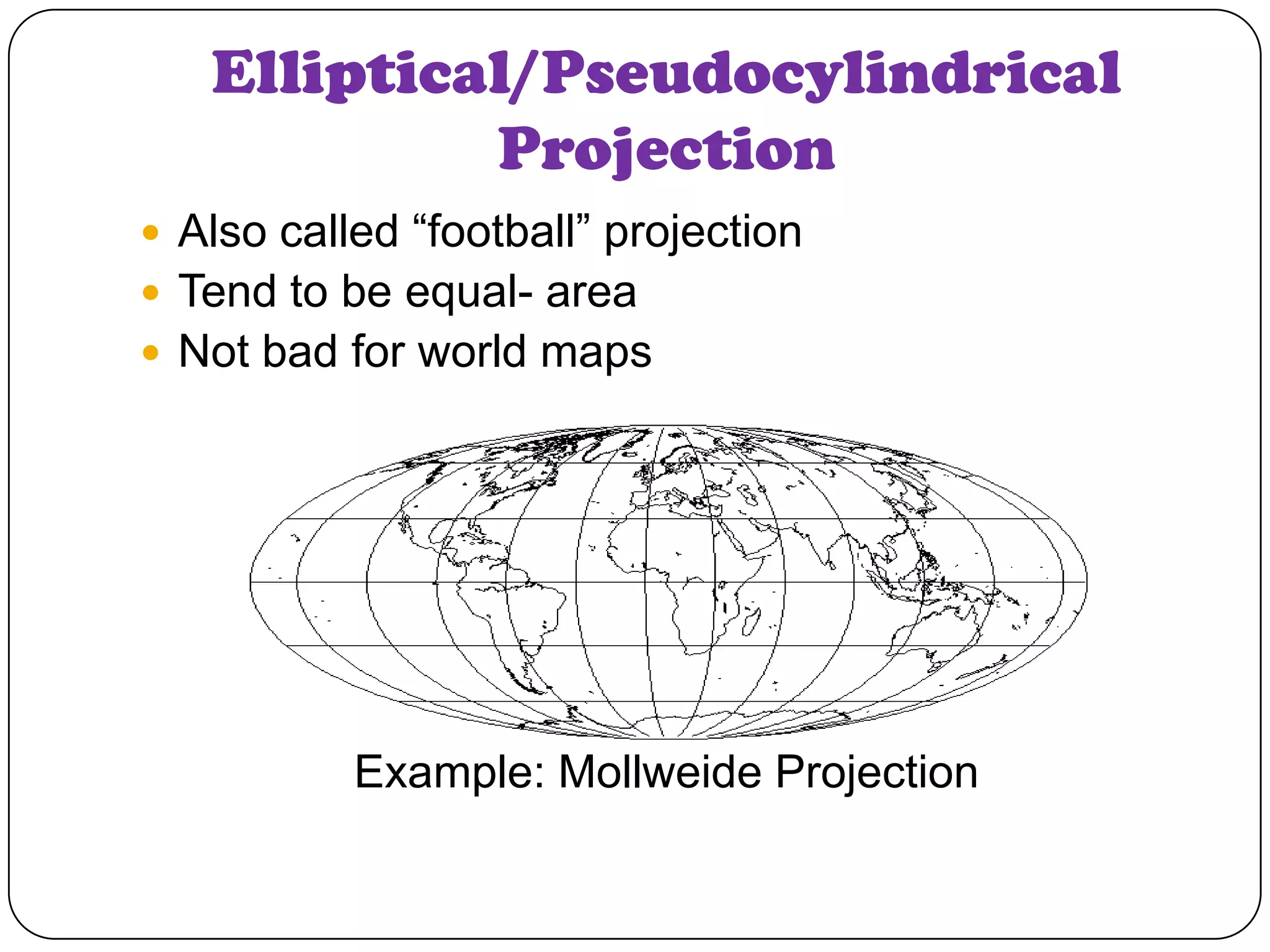
Elliptical/Pseudocylindrical
Projection
 Also called “football” projection
 Tend to be equal- area
 Not bad for world maps
Example: Mollweide Projection
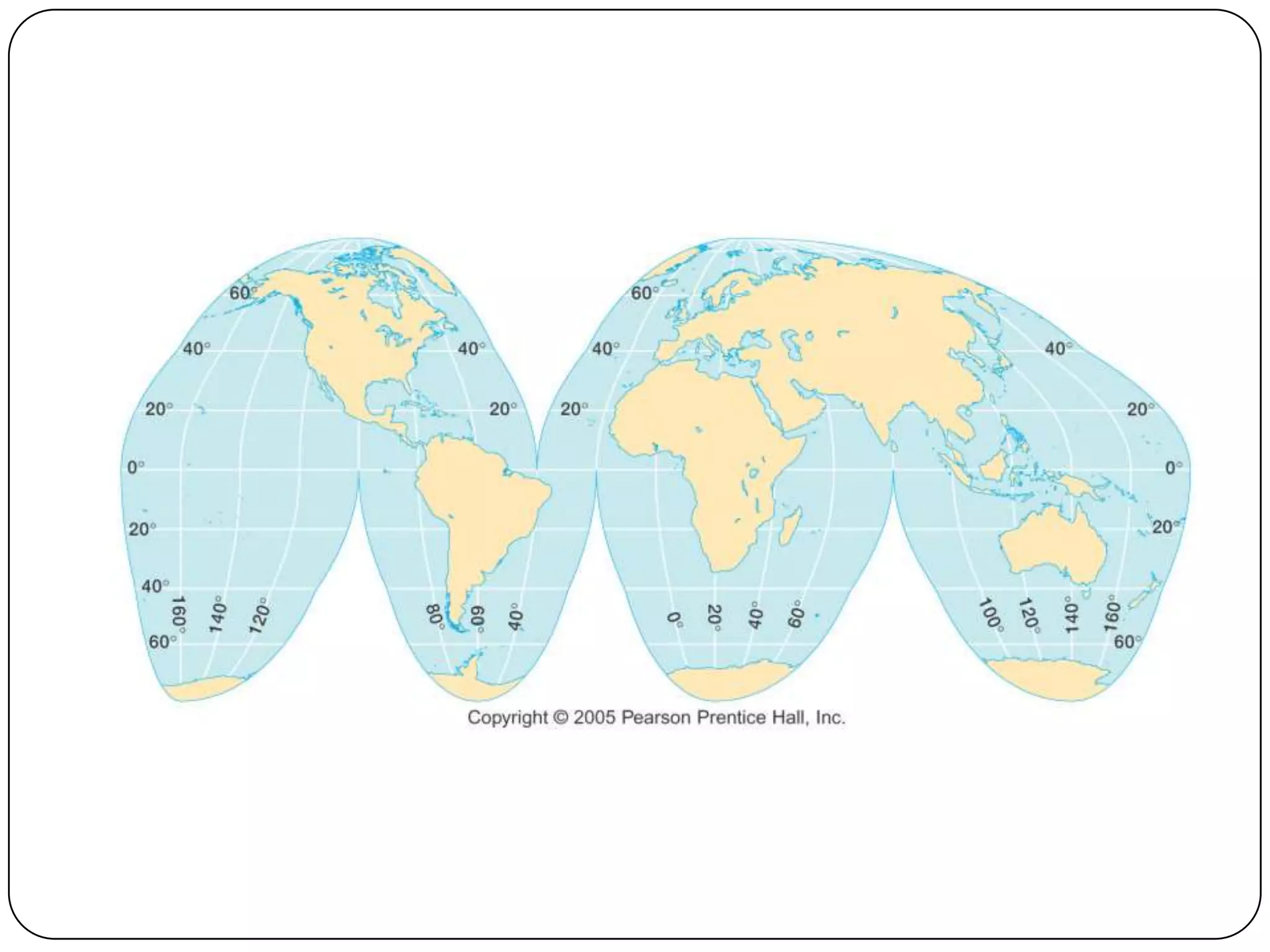
Goode’s Homosoline Interrupted
Elliptical Projection
 Equal-area
 Good for climate, soils, landcover – latitude and
area comparisons
 Mild distortion of shapes
 Interrupts areas- oceans, Greenland
Thank you for listening!
Credits to:
Chelsea P. del Rosario
Julian Philipp A. Soriano
Shaina Mavreen Villaroza

Map projections

  • 1.
    An important considerationin mapping our world Map Projections
  • 2.
    Map Projection  Transforming three- dimensionalspace onto a two dimensional map.  Define the spatial relationship between locations on Earth and their relative locations on a map.
  • 3.
    Why project data? Data often comes in geographic, or spherical coordinates (latitude and longitude) and cannot be used for area calculations.  Some projections work better for different parts of the globe giving more accurate calculations.
  • 4.
    “All maps lieflat, therefore all maps lie.”
  • 5.
    Issues and Limitations Mapprojections are attempts to portray the surface of the Earth or a portion of the Earth on a flat surface. Some distortions of different types always result from this process. Some projections minimize distortions in some of these properties at the expense of maximizing errors in others. Some projections are attempts to only moderately distort all of these properties.
  • 6.
    Thus, the bestprojection depends upon the use of the map.
  • 7.
    Choosing a MapProjection depends on • which region to display (e.g. world, north pole, equator, US) • Resolution of the region • Geometric properties of the region • Purpose of using maps such that distortion can be minimized
  • 8.
    Distortion Types  Conformality Whenthe scale of a map at any point is the same in any direction, the projection is conformal. Meridians (lines of longitude) and parallels (lines of latitude) intersect at right angles. Shape is preserved locally.  Distance A map is equidistant when its distance from a single location to all other locations are preserved.  Direction A map preserves directions when it is azimuthal, when direction from a single location to all other locations are preserved.
  • 9.
     Scale It isthe relationship between a distance portrayed on a map and the same distance on the Earth.  Area When a map portrays areas over the entire map so that all mapped areas have the same proportional relationship to the areas on the Earth that they represent, the map is an equal –area map.
  • 10.
    Aspects of theProjection  The aspect describes how the developable surface is placed relative to the globe. It may be; normal -such that the surface's axis of symmetry coincides with the Earth's axis transverse -at right angles to the Earth's axis or oblique -any angle in between • The developable surface may also be either; tangent -means the surface touches but does not slice through the globe; secant -means the surface does slice through the globe.
  • 12.
  • 13.
  • 14.
    Projection Types Projections canbe conceptually created by projecting from one geometric shape (a sphere) onto another (a cone, cylinder, or plane).
  • 15.
    Cylindrical Projections  Goodfor displaying the world  Globe is projected onto a cylinder tangent at equator.  Low distortion at equator  Higher distortion approaching poles  A good choice for use in equatorial and tropical regions, e.g., Ecuador, Kenya, Malaysia
  • 16.
    Example of aCylindrical Projection: Mercator  Invented by Gerhardus Mercator- Flemish Cartographer- in 1569  A special purpose projection, intended as a navigational tool  It is conformal, azimuthal, and has true scale around equator.
  • 17.
    Problems with Mercator Preserves shape (a conformal type) but distorts area  Used by John Birch Society in Cold War to show “Red Menace”  Africa, in reality is 14X larger than Greenland in area.  Poles cannot be shown
  • 18.
    Conic Projections  Goodfor displaying mid- latitude area such as U.S.  Surface of globe projected onto cone is tangent at standard parallel.  Distorts N & S of standard parallel(s)  Normally shows just one semi hemisphere in middle latitudes.
  • 19.
  • 20.
     Lambert ConformalConic is a widely used example.
  • 21.
    Planar or PolarProjection  Good for displaying hemisphere with one focus.  Surface of globe is projected onto a plane tangent at only one point (frequently N or S pole).  Works well in highlighting an area.  Shows true bearing and distance to other points from center or point of tangency.
  • 22.
    Elliptical/Pseudocylindrical Projection  Also called“football” projection  Tend to be equal- area  Not bad for world maps Example: Mollweide Projection
  • 23.
    Goode’s Homosoline Interrupted EllipticalProjection  Equal-area  Good for climate, soils, landcover – latitude and area comparisons  Mild distortion of shapes  Interrupts areas- oceans, Greenland
  • 25.
    Thank you forlistening! Credits to: Chelsea P. del Rosario Julian Philipp A. Soriano Shaina Mavreen Villaroza