


Project Surveying


              20/01/2013   1
Electronic Distance Measurement
(EDM)


                     20/01/2013   2
• 1950s.
• Large, heavy, complicated and expensive (old EDM).
• Lighter, simpler and less expensive (new EDM).
• EDM Instruments use infrared light, laser light or
microwaves.
• Receiver/Transmitter at one end and Prism at the other end.
• EDM Instruments come in long range (10 – 20) km, medium
range (3 – 10) km and short range (0.5 – 3) km.


• Some laser EDM Instruments measure short distances (100
– 350) m without reflecting prism.


•Microwave instruments are often used in hydrographic
surveys 50 km. Currently GPS.


                               20/01/2013                       3
Electronic Angle Measurement
             (Total Stations)
Combine the function of Theodolite and EDM


                    20/01/2013               4
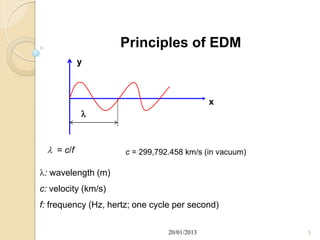
Principles of EDM
            y


                                              x
            


   = c/f             c = 299,792.458 km/s (in vacuum)

: wavelength (m)
c: velocity (km/s)
f: frequency (Hz, hertz; one cycle per second)


                                 20/01/2013              5
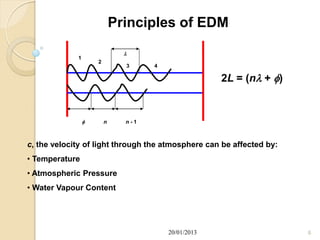
Principles of EDM

                               
             1
                     2
                               3     4

                                                      2L = (n + )


                        n     n-1


c, the velocity of light through the atmosphere can be affected by:
• Temperature
• Atmospheric Pressure
• Water Vapour Content


                                         20/01/2013                   6
EDM Characteristics
    • The more expensive EDM instruments have longer distance range
    and higher precision.


Distance Range:
•   800 m – 1 km (single prism).
•   Short-range EDM can be extended to 1,300 m using 3 prisms.
•   Long-range EDM can be extended to 15 km using 11 prisms.


Accuracy Range:
 (5 mm + 5 ppm) for short-range EDM.
 (2 mm + 1 ppm) for long-range EDM.


                                    20/01/2013                        7
EDM Characteristics

Measuring Time:
1.5 seconds for short-range EDM.
3.5 seconds for long-range EDM.

 Battery Capability:
 1,400 – 4200 measurements depending on the size and
 condition of battery and the temperature.

  Temperature Range:
  - 20c + 50c

  Non-prism measurements: 100 – 350 m

                                  20/01/2013           8
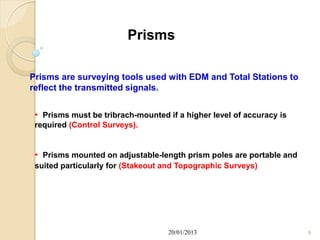
Prisms

Prisms are surveying tools used with EDM and Total Stations to
reflect the transmitted signals.


 • Prisms must be tribrach-mounted if a higher level of accuracy is
 required (Control Surveys).


 • Prisms mounted on adjustable-length prism poles are portable and
 suited particularly for (Stakeout and Topographic Surveys)


                                    20/01/2013                        9
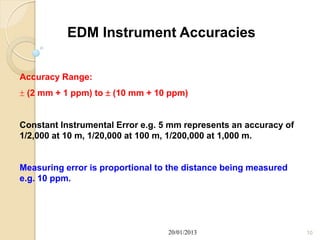
EDM Instrument Accuracies


Accuracy Range:
 (2 mm + 1 ppm) to  (10 mm + 10 ppm)


Constant Instrumental Error e.g. 5 mm represents an accuracy of
1/2,000 at 10 m, 1/20,000 at 100 m, 1/200,000 at 1,000 m.


Measuring error is proportional to the distance being measured
e.g. 10 ppm.


                                  20/01/2013                      10
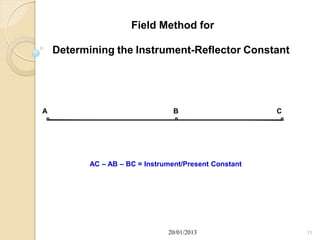
Field Method for

    Determining the Instrument-Reflector Constant


A                                 B                     C


           AC – AB – BC = Instrument/Present Constant


                                20/01/2013                  11
EDM Operation
• Set Up
• Aim
• Measure
• Record


               20/01/2013   12
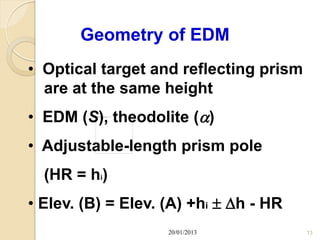
Geometry of EDM
• Optical target and reflecting prism
  are at the same height
• EDM (S), theodolite ()
• Adjustable-length prism pole
  (HR = hi)
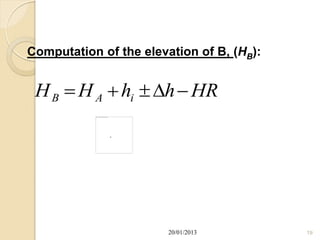
• Elev. (B) = Elev. (A) +hi  h - HR
                    20/01/2013          13
Problem 1
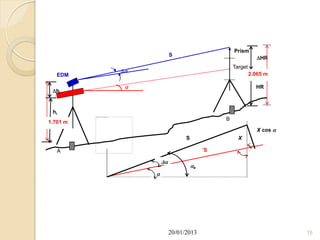
Refer to Figure below. A top-mounted EDM instrument
is set up at station A, its elevation, (HA = 650.000 m).
Using the following values, compute the horizontal
distance from A to B and the elevation of B, (HB). The
optical centre of the theodolite is hi = 1.601 m above
station and a vertical angle of + 4◦ 18 30 is measured
to the target, which is 1.915 m (HR) above station B.
The EDM instrument centre is 0.100 m (hi) above the
theodolite and the reflecting prism is 0.150 m (HR)
above the target. The slope distance is measured to
be 387.603 m.


                            20/01/2013                     14
Prism
                        S
                                                            HR
                                                Target
          
   EDM                                                   2.065 m

                                                          HR
 hi


 hi
                                            B
1.701 m
                                                            X cos 
                              S                   X

   A                                   S

                   
                                  k
               


                        20/01/2013                                    15
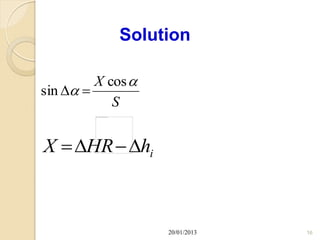
Solution

         X cos 
sin  
            S


X  HR  hi


                   20/01/2013   16
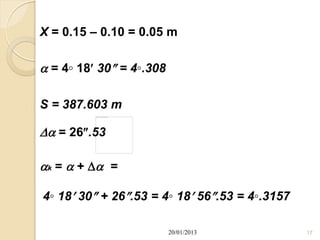
X = 0.15 – 0.10 = 0.05 m

 = 4◦ 18 30 = 4◦.308

S = 387.603 m

 = 26.53

k =  +   =

4◦ 18 30 + 26.53 = 4◦ 18 56.53 = 4◦.3157

                          20/01/2013            17
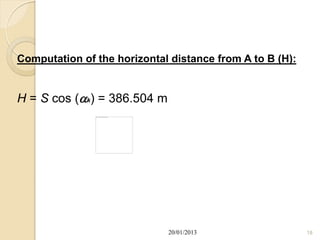
Computation of the horizontal distance from A to B (H):


H = S cos (k) = 386.504 m


                             20/01/2013                   18
Computation of the elevation of B, (HB):


 H B  H A  hi  h  HR

              ,


                        20/01/2013         19
HA = 650.000 m

h = S sin (k) = 29.168 m

HB = 650.000 + (1.601 + 0.10) + 29.168 – (1.915 + 0.15)

   = 678.804 m

HB = 678.804 m
                 ,


                               20/01/2013                 20
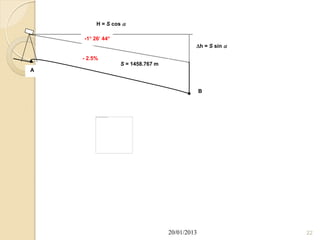
Problem 2
A line AB is measured at both ends as follows:
At A, slope distance = 1458.777 m,
zenith angle = 91 26 50.
At B, slope distance = 1458.757 m,
zenith angle = 88 33 22.
The heights of the instrument, reflector and target are
    equal for each observation.

•   Compute the horizontal distance AB.

•   If the elevation at A is 590.825 m, what is the
    elevation at B?

•   Calculate the gradient between A and B.

                            20/01/2013                    21
H = S cos 

    -1 26 44
                                            h = S sin 

    - 2.5%
                  S = 1458.767 m
A


                                                B


                                   20/01/2013              22
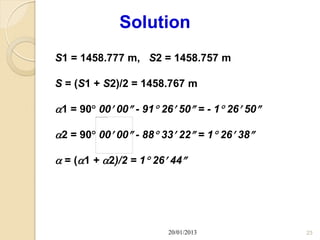
Solution
S1 = 1458.777 m, S2 = 1458.757 m

S = (S1 + S2)/2 = 1458.767 m

1 = 90 00 00 - 91 26 50 = - 1 26 50

2 = 90 00 00 - 88 33 22 = 1 26 38

 = (1 + 2)/2 = 1 26 44


                        20/01/2013              23
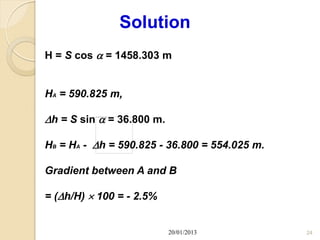
Solution
H = S cos  = 1458.303 m


HA = 590.825 m,

h = S sin  = 36.800 m.

HB = HA - h = 590.825 - 36.800 = 554.025 m.

Gradient between A and B

= (h/H)  100 = - 2.5%


                           20/01/2013          24
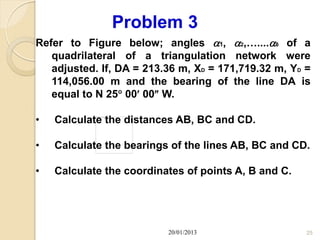
Problem 3
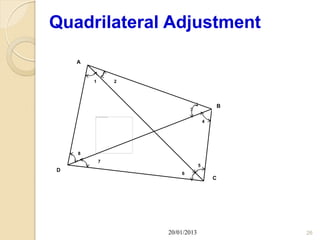
Refer to Figure below; angles 1, 2,…....8 of a
   quadrilateral of a triangulation network were
   adjusted. If, DA = 213.36 m, XD = 171,719.32 m, YD =
   114,056.00 m and the bearing of the line DA is
   equal to N 25 00 00 W.

•   Calculate the distances AB, BC and CD.

•   Calculate the bearings of the lines AB, BC and CD.

•   Calculate the coordinates of points A, B and C.


                          20/01/2013                  25
Quadrilateral Adjustment

    A


        1       2


                                             B
                            3

                                     4


    8
            7
                                 5
D
                        6
                                         C


                    20/01/2013                   26
Quadrilateral Adjustment

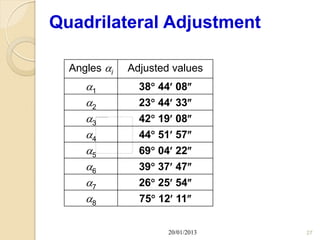
  Angles i   Adjusted values
     1         38 44 08
     2         23 44 33
     3         42 19 08
     4         44 51 57
     5         69 04 22
     6         39 37 47
     7         26 25 54
     8         75 12 11


                      20/01/2013   27
Solution

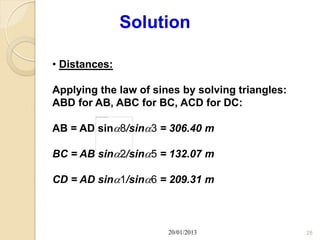
• Distances:

Applying the law of sines by solving triangles:
ABD for AB, ABC for BC, ACD for DC:

AB = AD sin8/sin3 = 306.40 m

BC = AB sin2/sin5 = 132.07 m

CD = AD sin1/sin6 = 209.31 m


                       20/01/2013                 28
Solution

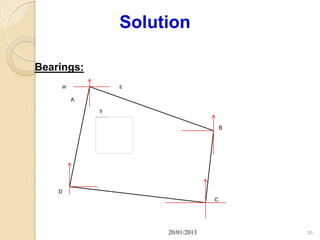
Bearings:

If you redraw the figure below, you can calculate
the bearings of the lines AB, BC and CD as follows:


                          20/01/2013                  29
Solution

Bearings:
    W           E

        A

            S


                                      B


    D
                                  C


                     20/01/2013           30
Solution
Bearings:

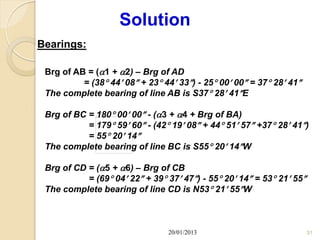
 Brg of AB = (1 + 2) – Brg of AD
          = (38 44 08 + 23 44 33) - 25 00 00 = 37 28 41
 The complete bearing of line AB is S37 28 41E

 Brg of BC = 180 00 00 - (3 + 4 + Brg of BA)
           = 179 59 60 - (42 19 08 + 44 51 57 +37 28 41)
           = 55 20 14
 The complete bearing of line BC is S55 20 14W

 Brg of CD = (5 + 6) – Brg of CB
           = (69 04 22 + 39 37 47) - 55 20 14 = 53 21 55
 The complete bearing of line CD is N53 21 55W


                                20/01/2013                             31
Coordinates:
                  Solution
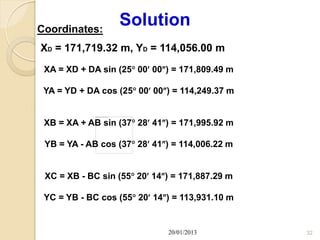
XD = 171,719.32 m, YD = 114,056.00 m
 XA = XD + DA sin (25 00 00) = 171,809.49 m

 YA = YD + DA cos (25 00 00) = 114,249.37 m


 XB = XA + AB sin (37 28 41) = 171,995.92 m

 YB = YA - AB cos (37 28 41) = 114,006.22 m


 XC = XB - BC sin (55 20 14) = 171,887.29 m

 YC = YB - BC cos (55 20 14) = 113,931.10 m


                              20/01/2013         32
Total Stations


• Background
• Main Characteristics
• Applications


                 20/01/2013   33
Main Characteristics
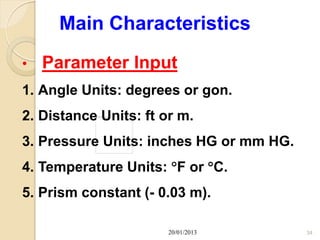
•   Parameter Input
1. Angle Units: degrees or gon.
2. Distance Units: ft or m.
3. Pressure Units: inches HG or mm HG.
4. Temperature Units: F or C.
5. Prism constant (- 0.03 m).

                       20/01/2013        34
Main Characteristics
•   Parameter Input
6. Offset distance.
7. Face 1 or face 2 selection.
8. Automatic point no. incrementation.
9. Hi
10. HR

                      20/01/2013         35
Main Characteristics
•   Parameter Input
11. Point numbers and code numbers
  for occupied and sighted stations.
12. Date and time settings.


                      20/01/2013       36
Main Characteristics
•   Capabilities
1. Monitor: battery status, signal attenuation,
   horizontal and vertical axes status, collimation
   factors.
2. Compute coordinates (N, E, Z).
3. Traverse closure and adjustment, and areas.
4. Topography reductions.
5. Object heights.
6. Distances between remote points.


                             20/01/2013               37
Main Characteristics
•   Capabilities
7. Inversing.
8. Resection.
9. Layout (Setting out).
10. Horizontal and vertical collimation corrections.
11. Vertical circle indexing.
12. Records search and review.
13. Loading external programmes.
14. Downloading and uploading.

                                20/01/2013             38
Applications
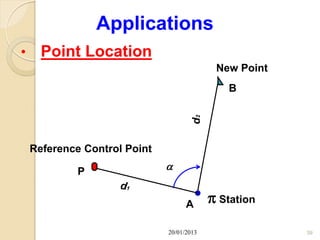
•     Point Location
                                            New Point
                                               B


                                      d2
    Reference Control Point

             P                


                                    A       Station
                              20/01/2013                39
Applications
•     Point Location

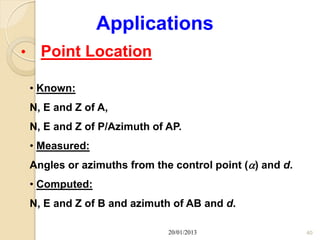
    • Known:
    N, E and Z of A,
    N, E and Z of P/Azimuth of AP.
    • Measured:
    Angles or azimuths from the control point () and d.
    • Computed:
    N, E and Z of B and azimuth of AB and d.

                               20/01/2013                  40

EDM and Total Stations

  • 1.
    Project Surveying 20/01/2013 1
  • 2.
  • 3.
    • 1950s. • Large,heavy, complicated and expensive (old EDM). • Lighter, simpler and less expensive (new EDM). • EDM Instruments use infrared light, laser light or microwaves. • Receiver/Transmitter at one end and Prism at the other end. • EDM Instruments come in long range (10 – 20) km, medium range (3 – 10) km and short range (0.5 – 3) km. • Some laser EDM Instruments measure short distances (100 – 350) m without reflecting prism. •Microwave instruments are often used in hydrographic surveys 50 km. Currently GPS. 20/01/2013 3
  • 4.
    Electronic Angle Measurement (Total Stations) Combine the function of Theodolite and EDM 20/01/2013 4
  • 5.
    Principles of EDM y x   = c/f c = 299,792.458 km/s (in vacuum) : wavelength (m) c: velocity (km/s) f: frequency (Hz, hertz; one cycle per second) 20/01/2013 5
  • 6.
    Principles of EDM  1 2 3 4 2L = (n + )  n n-1 c, the velocity of light through the atmosphere can be affected by: • Temperature • Atmospheric Pressure • Water Vapour Content 20/01/2013 6
  • 7.
    EDM Characteristics • The more expensive EDM instruments have longer distance range and higher precision. Distance Range: • 800 m – 1 km (single prism). • Short-range EDM can be extended to 1,300 m using 3 prisms. • Long-range EDM can be extended to 15 km using 11 prisms. Accuracy Range:  (5 mm + 5 ppm) for short-range EDM.  (2 mm + 1 ppm) for long-range EDM. 20/01/2013 7
  • 8.
    EDM Characteristics Measuring Time: 1.5seconds for short-range EDM. 3.5 seconds for long-range EDM. Battery Capability: 1,400 – 4200 measurements depending on the size and condition of battery and the temperature. Temperature Range: - 20c + 50c Non-prism measurements: 100 – 350 m 20/01/2013 8
  • 9.
    Prisms Prisms are surveyingtools used with EDM and Total Stations to reflect the transmitted signals. • Prisms must be tribrach-mounted if a higher level of accuracy is required (Control Surveys). • Prisms mounted on adjustable-length prism poles are portable and suited particularly for (Stakeout and Topographic Surveys) 20/01/2013 9
  • 10.
    EDM Instrument Accuracies AccuracyRange:  (2 mm + 1 ppm) to  (10 mm + 10 ppm) Constant Instrumental Error e.g. 5 mm represents an accuracy of 1/2,000 at 10 m, 1/20,000 at 100 m, 1/200,000 at 1,000 m. Measuring error is proportional to the distance being measured e.g. 10 ppm. 20/01/2013 10
  • 11.
    Field Method for Determining the Instrument-Reflector Constant A B C AC – AB – BC = Instrument/Present Constant 20/01/2013 11
  • 12.
    EDM Operation • SetUp • Aim • Measure • Record 20/01/2013 12
  • 13.
    Geometry of EDM •Optical target and reflecting prism are at the same height • EDM (S), theodolite () • Adjustable-length prism pole (HR = hi) • Elev. (B) = Elev. (A) +hi  h - HR 20/01/2013 13
  • 14.
    Problem 1 Refer toFigure below. A top-mounted EDM instrument is set up at station A, its elevation, (HA = 650.000 m). Using the following values, compute the horizontal distance from A to B and the elevation of B, (HB). The optical centre of the theodolite is hi = 1.601 m above station and a vertical angle of + 4◦ 18 30 is measured to the target, which is 1.915 m (HR) above station B. The EDM instrument centre is 0.100 m (hi) above the theodolite and the reflecting prism is 0.150 m (HR) above the target. The slope distance is measured to be 387.603 m. 20/01/2013 14
  • 15.
    Prism S HR Target  EDM 2.065 m  HR hi hi B 1.701 m X cos  S X A S  k  20/01/2013 15
  • 16.
    Solution X cos  sin   S X  HR  hi 20/01/2013 16
  • 17.
    X = 0.15– 0.10 = 0.05 m  = 4◦ 18 30 = 4◦.308 S = 387.603 m  = 26.53 k =  +   = 4◦ 18 30 + 26.53 = 4◦ 18 56.53 = 4◦.3157 20/01/2013 17
  • 18.
    Computation of thehorizontal distance from A to B (H): H = S cos (k) = 386.504 m 20/01/2013 18
  • 19.
    Computation of theelevation of B, (HB): H B  H A  hi  h  HR , 20/01/2013 19
  • 20.
    HA = 650.000m h = S sin (k) = 29.168 m HB = 650.000 + (1.601 + 0.10) + 29.168 – (1.915 + 0.15) = 678.804 m HB = 678.804 m , 20/01/2013 20
  • 21.
    Problem 2 A lineAB is measured at both ends as follows: At A, slope distance = 1458.777 m, zenith angle = 91 26 50. At B, slope distance = 1458.757 m, zenith angle = 88 33 22. The heights of the instrument, reflector and target are equal for each observation. • Compute the horizontal distance AB. • If the elevation at A is 590.825 m, what is the elevation at B? • Calculate the gradient between A and B. 20/01/2013 21
  • 22.
    H = Scos  -1 26 44 h = S sin  - 2.5% S = 1458.767 m A B 20/01/2013 22
  • 23.
    Solution S1 = 1458.777m, S2 = 1458.757 m S = (S1 + S2)/2 = 1458.767 m 1 = 90 00 00 - 91 26 50 = - 1 26 50 2 = 90 00 00 - 88 33 22 = 1 26 38  = (1 + 2)/2 = 1 26 44 20/01/2013 23
  • 24.
    Solution H = Scos  = 1458.303 m HA = 590.825 m, h = S sin  = 36.800 m. HB = HA - h = 590.825 - 36.800 = 554.025 m. Gradient between A and B = (h/H)  100 = - 2.5% 20/01/2013 24
  • 25.
    Problem 3 Refer toFigure below; angles 1, 2,…....8 of a quadrilateral of a triangulation network were adjusted. If, DA = 213.36 m, XD = 171,719.32 m, YD = 114,056.00 m and the bearing of the line DA is equal to N 25 00 00 W. • Calculate the distances AB, BC and CD. • Calculate the bearings of the lines AB, BC and CD. • Calculate the coordinates of points A, B and C. 20/01/2013 25
  • 26.
    Quadrilateral Adjustment A 1 2 B 3 4 8 7 5 D 6 C 20/01/2013 26
  • 27.
    Quadrilateral Adjustment Angles i Adjusted values 1 38 44 08 2 23 44 33 3 42 19 08 4 44 51 57 5 69 04 22 6 39 37 47 7 26 25 54 8 75 12 11 20/01/2013 27
  • 28.
    Solution • Distances: Applying thelaw of sines by solving triangles: ABD for AB, ABC for BC, ACD for DC: AB = AD sin8/sin3 = 306.40 m BC = AB sin2/sin5 = 132.07 m CD = AD sin1/sin6 = 209.31 m 20/01/2013 28
  • 29.
    Solution Bearings: If you redrawthe figure below, you can calculate the bearings of the lines AB, BC and CD as follows: 20/01/2013 29
  • 30.
    Solution Bearings: W E A S B D C 20/01/2013 30
  • 31.
    Solution Bearings: Brg ofAB = (1 + 2) – Brg of AD = (38 44 08 + 23 44 33) - 25 00 00 = 37 28 41 The complete bearing of line AB is S37 28 41E Brg of BC = 180 00 00 - (3 + 4 + Brg of BA) = 179 59 60 - (42 19 08 + 44 51 57 +37 28 41) = 55 20 14 The complete bearing of line BC is S55 20 14W Brg of CD = (5 + 6) – Brg of CB = (69 04 22 + 39 37 47) - 55 20 14 = 53 21 55 The complete bearing of line CD is N53 21 55W 20/01/2013 31
  • 32.
    Coordinates: Solution XD = 171,719.32 m, YD = 114,056.00 m XA = XD + DA sin (25 00 00) = 171,809.49 m YA = YD + DA cos (25 00 00) = 114,249.37 m XB = XA + AB sin (37 28 41) = 171,995.92 m YB = YA - AB cos (37 28 41) = 114,006.22 m XC = XB - BC sin (55 20 14) = 171,887.29 m YC = YB - BC cos (55 20 14) = 113,931.10 m 20/01/2013 32
  • 33.
    Total Stations • Background •Main Characteristics • Applications 20/01/2013 33
  • 34.
    Main Characteristics • Parameter Input 1. Angle Units: degrees or gon. 2. Distance Units: ft or m. 3. Pressure Units: inches HG or mm HG. 4. Temperature Units: F or C. 5. Prism constant (- 0.03 m). 20/01/2013 34
  • 35.
    Main Characteristics • Parameter Input 6. Offset distance. 7. Face 1 or face 2 selection. 8. Automatic point no. incrementation. 9. Hi 10. HR 20/01/2013 35
  • 36.
    Main Characteristics • Parameter Input 11. Point numbers and code numbers for occupied and sighted stations. 12. Date and time settings. 20/01/2013 36
  • 37.
    Main Characteristics • Capabilities 1. Monitor: battery status, signal attenuation, horizontal and vertical axes status, collimation factors. 2. Compute coordinates (N, E, Z). 3. Traverse closure and adjustment, and areas. 4. Topography reductions. 5. Object heights. 6. Distances between remote points. 20/01/2013 37
  • 38.
    Main Characteristics • Capabilities 7. Inversing. 8. Resection. 9. Layout (Setting out). 10. Horizontal and vertical collimation corrections. 11. Vertical circle indexing. 12. Records search and review. 13. Loading external programmes. 14. Downloading and uploading. 20/01/2013 38
  • 39.
    Applications • Point Location New Point B d2 Reference Control Point P  A  Station 20/01/2013 39
  • 40.
    Applications • Point Location • Known: N, E and Z of A, N, E and Z of P/Azimuth of AP. • Measured: Angles or azimuths from the control point () and d. • Computed: N, E and Z of B and azimuth of AB and d. 20/01/2013 40