29 October, 2020 1
Lecture 10 & 11 - GIS
Coordinate Systems
Lecture # 10 & 11 Dated:29/10/2020
Course(502) Introduction to GIS and RS
Topic
Presented by
Rehana Jamal (Geometiciation, GIS Specialist & Geographer)
Visiting lecturer/GIS Trainer
studentsdatafiles@gmail.com
Faculty of Agricultural Engineering, Arid Agriculture University,
Rawalpindi
Coordinate Systems
used in GIS
29 October, 2020 2
Coordinate Systems
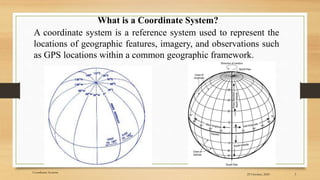
A coordinate system is a reference system used to represent the
locations of geographic features, imagery, and observations such
as GPS locations within a common geographic framework.
What is a Coordinate System?
29 October, 2020 3
Coordinate Systems
29 October, 2020 4
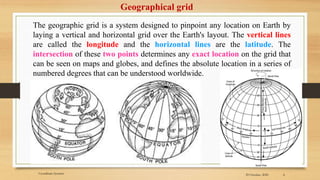
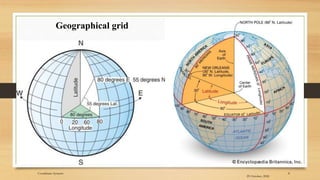
Geographical grid
The geographic grid is a system designed to pinpoint any location on Earth by
laying a vertical and horizontal grid over the Earth's layout. The vertical lines
are called the longitude and the horizontal lines are the latitude. The
intersection of these two points determines any exact location on the grid that
can be seen on maps and globes, and defines the absolute location in a series of
numbered degrees that can be understood worldwide.
Coordinate Systems
29 October, 2020
Coordinate Systems 5
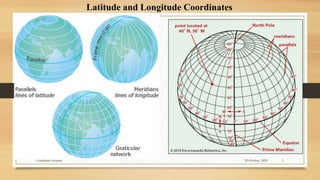
Latitude and Longitude Coordinates
29 October, 2020
Coordinate Systems 6
29 October, 2020
Coordinate Systems 7
29 October, 2020
8
Geographical grid
Coordinate Systems
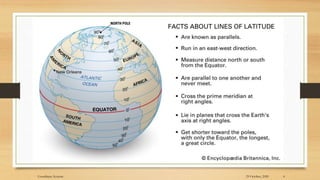
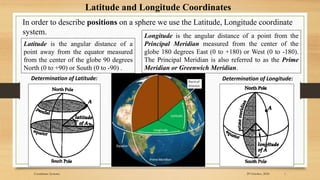
Latitude is the angular distance of a
point away from the equator measured
from the center of the globe 90 degrees
North (0 to +90) or South (0 to -90) .
Latitude and Longitude Coordinates
In order to describe positions on a sphere we use the Latitude, Longitude coordinate
system.
Determination of Latitude:
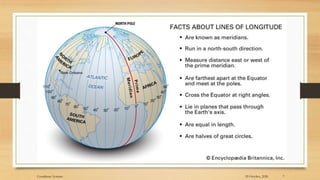
Longitude is the angular distance of a point from the
Principal Meridian measured from the center of the
globe 180 degrees East (0 to +180) or West (0 to -180).
The Principal Meridian is also referred to as the Prime
Meridian or Greenwich Meridian.
Determination of Longitude:
9
29 October, 2020
Coordinate Systems
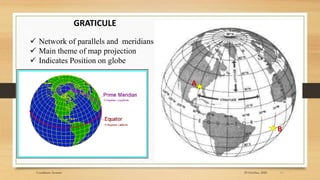
GRATICULE
A
B
 Network of parallels and meridians
 Main theme of map projection
 Indicates Position on globe
10
29 October, 2020
Coordinate Systems
29 October, 2020
Coordinate Systems 11
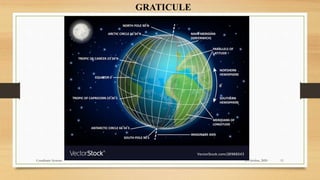
GRATICULE
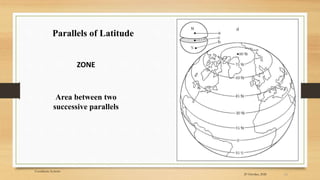
Parallels of Latitude
Area between two
successive parallels
ZONE
12
29 October, 2020
Coordinate Systems
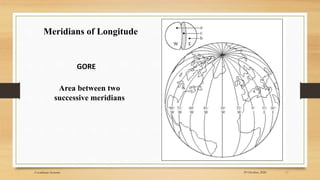
GORE
Area between two
successive meridians
Meridians of Longitude
13
29 October, 2020
Coordinate Systems
Coordinate Systems
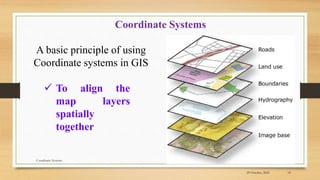
A basic principle of using
Coordinate systems in GIS
 To align the
map layers
spatially
together
29 October, 2020 14
Coordinate Systems
Coordinate Systems
 Locations of Map features are based on plane coordinate
system
 Locations of spatial features on the earth surface are based
on geographic coordinate system(Lat.& Long.)
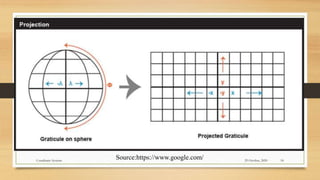
Process of projection transformation from the
Earth surface to a Plane is called Map Projection.
29 October, 2020 15
Coordinate Systems
29 October, 2020
Coordinate Systems 16
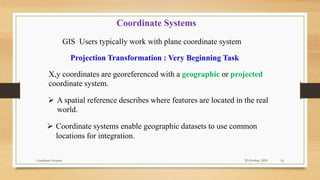
 A spatial reference describes where features are located in the real
world.
Coordinate Systems
X,y coordinates are georeferenced with a geographic or projected
coordinate system.
GIS Users typically work with plane coordinate system
Projection Transformation : Very Beginning Task
 Coordinate systems enable geographic datasets to use common
locations for integration.
29 October, 2020
Coordinate Systems 17
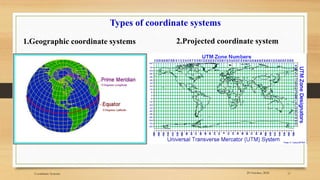
2.Projected coordinate system
Types of coordinate systems
1.Geographic coordinate systems
29 October, 2020
Coordinate Systems 18
Source:https://www.google.com/
29 October, 2020
Coordinate Systems 19
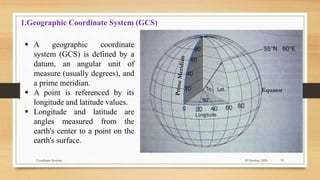
Equator
 A geographic coordinate
system (GCS) is defined by a
datum, an angular unit of
measure (usually degrees), and
a prime meridian.
 A point is referenced by its
longitude and latitude values.
 Longitude and latitude are
angles measured from the
earth's center to a point on the
earth's surface.
1.Geographic Coordinate System (GCS)
 A projected coordinate system is defined on a flat, two-dimensional
surface.
 Unlike a Geographic Coordinate System (GCS, a projected
coordinate system has constant lengths, angles, and areas across the
two dimensions.
 A projected coordinate system is always based on a geographic
coordinate system that is based on a sphere or spheroid.
2.Projected coordinate system
29 October, 2020 20
Coordinate Systems
The ellipsoidal form of the Transverse Mercator projection was developed by Carl Friedrich
Gauss in 1825.It has become the most used because it allows precise measurements in meters
to within 1 meter.
It was further analyzed by Johann Heinrich Louis Krüger in 1912. The projection is
known by several names:
Gauss Conformal or Gauss-Krüger in Europe;
Transverse Mercator in the US; or Gauss-Krüger Transverse Mercator generally
The projection is conformal with a constant scale on the central meridian.
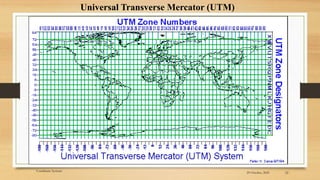
Universal Transverse Mercator (UTM)
The Universal Transverse Mercator coordinate system was developed by the United States
Army Corps of Engineers in the 1940s.The system was based on an ellipsoidal model of
Earth. For areas within the conterminous United States, the Clarke 1866 ellipsoid was used.
For the remaining areas of Earth, including Hawaii, the International Ellipsoid was used.
Currently, the WGS 84 ellipsoid is used as the underlying model of Earth in the UTM
coordinate system.
29 October, 2020 21
Coordinate Systems
Universal Transverse Mercator (UTM)
29 October, 2020 22
Coordinate Systems
Universal Transverse Mercator (UTM)
Universal North Polar(UNP)
Universal South Polar(USP)
29 October, 2020 23
Coordinate Systems
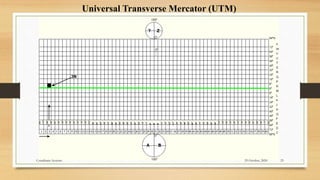
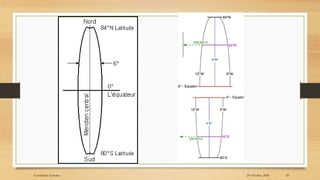
Universal Transverse Mercator (UTM)
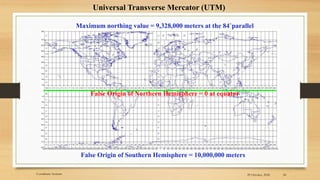
False Origin of Southern Hemisphere = 10,000,000 meters
False Origin of Northern Hemisphere = 0 at equator
Maximum northing value = 9,328,000 meters at the 84˚parallel
29 October, 2020 24
Coordinate Systems
UTM grid
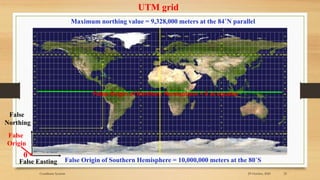
False Origin of Southern Hemisphere = 10,000,000 meters at the 80˚S
Maximum northing value = 9,328,000 meters at the 84˚N parallel
False Origin of Northern Hemisphere = 0 at equator
29 October, 2020 25
Coordinate Systems
False
Northing
False Easting
False
Origin
0
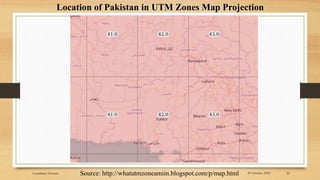
Location of Pakistan in UTM Zones Map Projection
Source: http://whatutmzoneamiin.blogspot.com/p/map.html 29 October, 2020 26
Coordinate Systems
29 October, 2020
Coordinate Systems 27
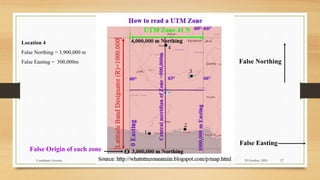
False Northing
False Easting
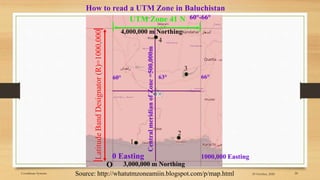
False Origin of each zone
Location 4
False Northing = 3,900,000 m
False Easting = 500,000m
Source: http://whatutmzoneamiin.blogspot.com/p/map.html
Latitude
Band
Designator
(R)=1000,000
UTM Zone 41 N 60°-66°
63°
60° 66°
3,000,000 m Northing
0 Easting
Central
meridian
of
Zone
=500,000m
How to read a UTM Zone in Baluchistan
O
29 October, 2020 28
Coordinate Systems
4,000,000 m Northing
1000,000 Easting
1
2
3
4
29 October, 2020 29
Coordinate Systems
29 October, 2020
Coordinate Systems 30
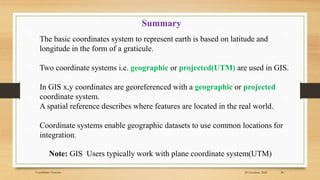
Summary
The basic coordinates system to represent earth is based on latitude and
longitude in the form of a graticule.
Two coordinate systems i.e. geographic or projected(UTM) are used in GIS.
In GIS x,y coordinates are georeferenced with a geographic or projected
coordinate system.
A spatial reference describes where features are located in the real world.
Coordinate systems enable geographic datasets to use common locations for
integration.
Note: GIS Users typically work with plane coordinate system(UTM)
References:
 http://geology.isu.edu/geostac/Field_Exercise/topomaps/utm.htm for UTM Projection
 http://geokov.com/education/utm.aspx (Good description for UTM Projection)
 http://geology.isu.edu/geostac/Field_Exercise/topomaps/utm.htm
 http://www.progonos.com/furuti/MapProj/Dither/ProjTbl/Img/tn-Sinusoidal.png
 http://earth.rice.edu/mtpe/geo/geosphere/topics/projections.jpg
 http://en.wikipedia.org/wiki/Map_projection
 http://vterrain.org/Projections/UTM.html (Consult this site for the notes)
 http://geography.about.com/library/weekly/aa031599.htm
 Practical Geography for B.A. B.Sc. by Mian Mohammad Anwar
29 October, 2020 31
Coordinate Systems

Lect 10 & 11 coordinate systems

  • 1.
    29 October, 20201 Lecture 10 & 11 - GIS Coordinate Systems
  • 2.
    Lecture # 10& 11 Dated:29/10/2020 Course(502) Introduction to GIS and RS Topic Presented by Rehana Jamal (Geometiciation, GIS Specialist & Geographer) Visiting lecturer/GIS Trainer studentsdatafiles@gmail.com Faculty of Agricultural Engineering, Arid Agriculture University, Rawalpindi Coordinate Systems used in GIS 29 October, 2020 2 Coordinate Systems
  • 3.
    A coordinate systemis a reference system used to represent the locations of geographic features, imagery, and observations such as GPS locations within a common geographic framework. What is a Coordinate System? 29 October, 2020 3 Coordinate Systems
  • 4.
    29 October, 20204 Geographical grid The geographic grid is a system designed to pinpoint any location on Earth by laying a vertical and horizontal grid over the Earth's layout. The vertical lines are called the longitude and the horizontal lines are the latitude. The intersection of these two points determines any exact location on the grid that can be seen on maps and globes, and defines the absolute location in a series of numbered degrees that can be understood worldwide. Coordinate Systems
  • 5.
    29 October, 2020 CoordinateSystems 5 Latitude and Longitude Coordinates
  • 6.
  • 7.
  • 8.
    29 October, 2020 8 Geographicalgrid Coordinate Systems
  • 9.
    Latitude is theangular distance of a point away from the equator measured from the center of the globe 90 degrees North (0 to +90) or South (0 to -90) . Latitude and Longitude Coordinates In order to describe positions on a sphere we use the Latitude, Longitude coordinate system. Determination of Latitude: Longitude is the angular distance of a point from the Principal Meridian measured from the center of the globe 180 degrees East (0 to +180) or West (0 to -180). The Principal Meridian is also referred to as the Prime Meridian or Greenwich Meridian. Determination of Longitude: 9 29 October, 2020 Coordinate Systems
  • 10.
    GRATICULE A B  Network ofparallels and meridians  Main theme of map projection  Indicates Position on globe 10 29 October, 2020 Coordinate Systems
  • 11.
    29 October, 2020 CoordinateSystems 11 GRATICULE
  • 12.
    Parallels of Latitude Areabetween two successive parallels ZONE 12 29 October, 2020 Coordinate Systems
  • 13.
    GORE Area between two successivemeridians Meridians of Longitude 13 29 October, 2020 Coordinate Systems
  • 14.
    Coordinate Systems A basicprinciple of using Coordinate systems in GIS  To align the map layers spatially together 29 October, 2020 14 Coordinate Systems
  • 15.
    Coordinate Systems  Locationsof Map features are based on plane coordinate system  Locations of spatial features on the earth surface are based on geographic coordinate system(Lat.& Long.) Process of projection transformation from the Earth surface to a Plane is called Map Projection. 29 October, 2020 15 Coordinate Systems
  • 16.
    29 October, 2020 CoordinateSystems 16  A spatial reference describes where features are located in the real world. Coordinate Systems X,y coordinates are georeferenced with a geographic or projected coordinate system. GIS Users typically work with plane coordinate system Projection Transformation : Very Beginning Task  Coordinate systems enable geographic datasets to use common locations for integration.
  • 17.
    29 October, 2020 CoordinateSystems 17 2.Projected coordinate system Types of coordinate systems 1.Geographic coordinate systems
  • 18.
    29 October, 2020 CoordinateSystems 18 Source:https://www.google.com/
  • 19.
    29 October, 2020 CoordinateSystems 19 Equator  A geographic coordinate system (GCS) is defined by a datum, an angular unit of measure (usually degrees), and a prime meridian.  A point is referenced by its longitude and latitude values.  Longitude and latitude are angles measured from the earth's center to a point on the earth's surface. 1.Geographic Coordinate System (GCS)
  • 20.
     A projectedcoordinate system is defined on a flat, two-dimensional surface.  Unlike a Geographic Coordinate System (GCS, a projected coordinate system has constant lengths, angles, and areas across the two dimensions.  A projected coordinate system is always based on a geographic coordinate system that is based on a sphere or spheroid. 2.Projected coordinate system 29 October, 2020 20 Coordinate Systems
  • 21.
    The ellipsoidal formof the Transverse Mercator projection was developed by Carl Friedrich Gauss in 1825.It has become the most used because it allows precise measurements in meters to within 1 meter. It was further analyzed by Johann Heinrich Louis Krüger in 1912. The projection is known by several names: Gauss Conformal or Gauss-Krüger in Europe; Transverse Mercator in the US; or Gauss-Krüger Transverse Mercator generally The projection is conformal with a constant scale on the central meridian. Universal Transverse Mercator (UTM) The Universal Transverse Mercator coordinate system was developed by the United States Army Corps of Engineers in the 1940s.The system was based on an ellipsoidal model of Earth. For areas within the conterminous United States, the Clarke 1866 ellipsoid was used. For the remaining areas of Earth, including Hawaii, the International Ellipsoid was used. Currently, the WGS 84 ellipsoid is used as the underlying model of Earth in the UTM coordinate system. 29 October, 2020 21 Coordinate Systems
  • 22.
    Universal Transverse Mercator(UTM) 29 October, 2020 22 Coordinate Systems
  • 23.
    Universal Transverse Mercator(UTM) Universal North Polar(UNP) Universal South Polar(USP) 29 October, 2020 23 Coordinate Systems
  • 24.
    Universal Transverse Mercator(UTM) False Origin of Southern Hemisphere = 10,000,000 meters False Origin of Northern Hemisphere = 0 at equator Maximum northing value = 9,328,000 meters at the 84˚parallel 29 October, 2020 24 Coordinate Systems
  • 25.
    UTM grid False Originof Southern Hemisphere = 10,000,000 meters at the 80˚S Maximum northing value = 9,328,000 meters at the 84˚N parallel False Origin of Northern Hemisphere = 0 at equator 29 October, 2020 25 Coordinate Systems False Northing False Easting False Origin 0
  • 26.
    Location of Pakistanin UTM Zones Map Projection Source: http://whatutmzoneamiin.blogspot.com/p/map.html 29 October, 2020 26 Coordinate Systems
  • 27.
    29 October, 2020 CoordinateSystems 27 False Northing False Easting False Origin of each zone Location 4 False Northing = 3,900,000 m False Easting = 500,000m
  • 28.
    Source: http://whatutmzoneamiin.blogspot.com/p/map.html Latitude Band Designator (R)=1000,000 UTM Zone41 N 60°-66° 63° 60° 66° 3,000,000 m Northing 0 Easting Central meridian of Zone =500,000m How to read a UTM Zone in Baluchistan O 29 October, 2020 28 Coordinate Systems 4,000,000 m Northing 1000,000 Easting 1 2 3 4
  • 29.
    29 October, 202029 Coordinate Systems
  • 30.
    29 October, 2020 CoordinateSystems 30 Summary The basic coordinates system to represent earth is based on latitude and longitude in the form of a graticule. Two coordinate systems i.e. geographic or projected(UTM) are used in GIS. In GIS x,y coordinates are georeferenced with a geographic or projected coordinate system. A spatial reference describes where features are located in the real world. Coordinate systems enable geographic datasets to use common locations for integration. Note: GIS Users typically work with plane coordinate system(UTM)
  • 31.
    References:  http://geology.isu.edu/geostac/Field_Exercise/topomaps/utm.htm forUTM Projection  http://geokov.com/education/utm.aspx (Good description for UTM Projection)  http://geology.isu.edu/geostac/Field_Exercise/topomaps/utm.htm  http://geology.isu.edu/geostac/Field_Exercise/topomaps/utm.htm  http://www.progonos.com/furuti/MapProj/Dither/ProjTbl/Img/tn-Sinusoidal.png  http://earth.rice.edu/mtpe/geo/geosphere/topics/projections.jpg  http://en.wikipedia.org/wiki/Map_projection  http://vterrain.org/Projections/UTM.html (Consult this site for the notes)  http://geography.about.com/library/weekly/aa031599.htm  Practical Geography for B.A. B.Sc. by Mian Mohammad Anwar 29 October, 2020 31 Coordinate Systems