1
Soran University
Faculty of Engineering - Civil Engineering Department
Electronic Distance
Measurement
Student: Sarchia Khursheed
Group: 2nd
Date: 29.3.2016
Supervisor: Eng. Anwar Jabbar
Introduction
2
The electronic distance-measuring system is now incorporated in
various present-day surveying practices, including traverse and
triangulation network. In traverse measurements, accurate
distances are directly measured in a straight line and with
minimum instrument setups. In triangulation, the system is used to
conduct baseline measurements that are precise enough to
maintain the accuracy of the survey.
An Electronic Distance Measurer (EDM) can be used to place objects or
points in three dimensions in relation to the unit. The EDM emits a
beam of infrared light that is modulated at a controlled rate. During
use, the light beam is emitted from the EDM, reflected off a prism or
target held at a point to be mapped, and bounced back to the
EDM. The phase of the returning beam is shifted from that of the
emitted beam, and the shift is directly related to the amount of time it
takes for the light to return to the EDM. This shift is what allows the
unit to determine the distance traveled by the light. The comparison
of the returning signal to that emitted by the EDM allows the unit to
determine the distance between the unit and the target surface with
an accuracy of approximately 1/8 inch in ¼ mile. Additionally, the
EDM also measures the azimuth, or angle from north, and elevation of
a point. The data obtained from the EDM is stored in a data collector
and later downloaded for processing using computer drawing software.
Equipment
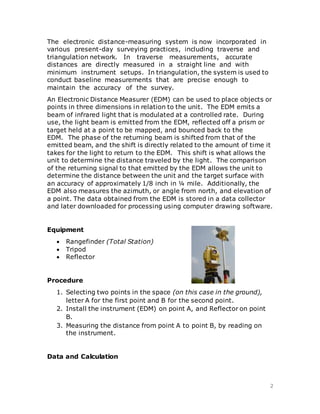
 Rangefinder (Total Station)
 Tripod
 Reflector
Procedure
1. Selecting two points in the space (on this case in the ground),
letter A for the first point and B for the second point.
2. Install the instrument (EDM) on point A, and Reflector on point
B.
3. Measuring the distance from point A to point B, by reading on
the instrument.
Data and Calculation
3
Reader Reading (m)
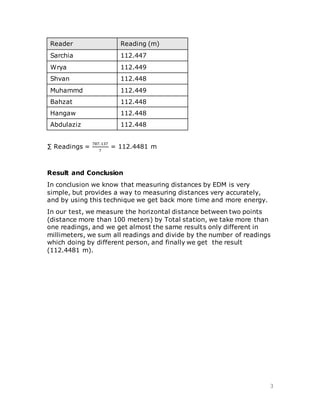
Sarchia 112.447
Wrya 112.449
Shvan 112.448
Muhammd 112.449
Bahzat 112.448
Hangaw 112.448
Abdulaziz 112.448
∑ Readings =
787.137
7
= 112.4481 m
Result and Conclusion
In conclusion we know that measuring distances by EDM is very
simple, but provides a way to measuring distances very accurately,
and by using this technique we get back more time and more energy.
In our test, we measure the horizontal distance between two points
(distance more than 100 meters) by Total station, we take more than
one readings, and we get almost the same results only different in
millimeters, we sum all readings and divide by the number of readings
which doing by different person, and finally we get the result
(112.4481 m).

Electronic Distance Measurement (EDM) - Report

  • 1.
    1 Soran University Faculty ofEngineering - Civil Engineering Department Electronic Distance Measurement Student: Sarchia Khursheed Group: 2nd Date: 29.3.2016 Supervisor: Eng. Anwar Jabbar Introduction
  • 2.
    2 The electronic distance-measuringsystem is now incorporated in various present-day surveying practices, including traverse and triangulation network. In traverse measurements, accurate distances are directly measured in a straight line and with minimum instrument setups. In triangulation, the system is used to conduct baseline measurements that are precise enough to maintain the accuracy of the survey. An Electronic Distance Measurer (EDM) can be used to place objects or points in three dimensions in relation to the unit. The EDM emits a beam of infrared light that is modulated at a controlled rate. During use, the light beam is emitted from the EDM, reflected off a prism or target held at a point to be mapped, and bounced back to the EDM. The phase of the returning beam is shifted from that of the emitted beam, and the shift is directly related to the amount of time it takes for the light to return to the EDM. This shift is what allows the unit to determine the distance traveled by the light. The comparison of the returning signal to that emitted by the EDM allows the unit to determine the distance between the unit and the target surface with an accuracy of approximately 1/8 inch in ¼ mile. Additionally, the EDM also measures the azimuth, or angle from north, and elevation of a point. The data obtained from the EDM is stored in a data collector and later downloaded for processing using computer drawing software. Equipment  Rangefinder (Total Station)  Tripod  Reflector Procedure 1. Selecting two points in the space (on this case in the ground), letter A for the first point and B for the second point. 2. Install the instrument (EDM) on point A, and Reflector on point B. 3. Measuring the distance from point A to point B, by reading on the instrument. Data and Calculation
  • 3.
    3 Reader Reading (m) Sarchia112.447 Wrya 112.449 Shvan 112.448 Muhammd 112.449 Bahzat 112.448 Hangaw 112.448 Abdulaziz 112.448 ∑ Readings = 787.137 7 = 112.4481 m Result and Conclusion In conclusion we know that measuring distances by EDM is very simple, but provides a way to measuring distances very accurately, and by using this technique we get back more time and more energy. In our test, we measure the horizontal distance between two points (distance more than 100 meters) by Total station, we take more than one readings, and we get almost the same results only different in millimeters, we sum all readings and divide by the number of readings which doing by different person, and finally we get the result (112.4481 m).