


Advantages and
Disadvantages of Concrete
Soran University
Faculty of Engineering
Civil Engineering Department
11 June, 2015
Welcome
• Abdulla Kawkas
• Abdulaziz Ibrahim
• Sarchia Khursheed
• Wrya Sharif
• Shaida Abdulraheem
• Nechirwan Sabah
• Ashna Kamil
2
Civil
1
Group
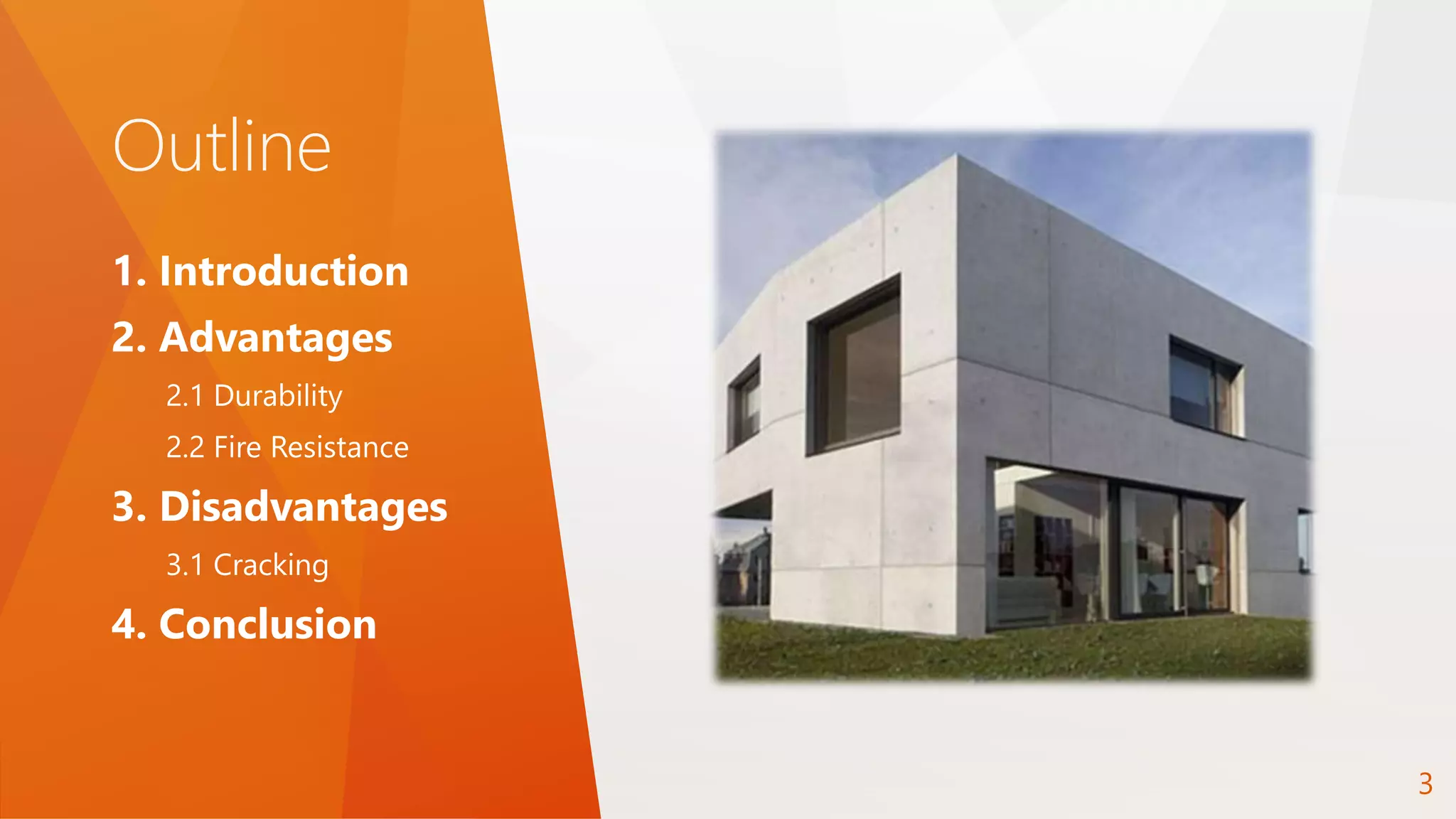
Outline
1. Introduction
2. Advantages
2.1 Durability
2.2 Fire Resistance
3. Disadvantages
3.1 Cracking
4. Conclusion
3
Introduction to Concrete
• Concrete is a major
materials that used for
various structural
purpose.
• Components of Concrete
• Uses of Concrete
• Types of Concrete
4
Advantages
5
Advantages of Concrete
• Concrete is economical.
• It is not as likely to rot, corrode, or decay as other
building materials.
• Concrete has the ability to be molded into any
desired shapes.
6
Advantages of Concrete (cont.)
• fire-safe and able to withstand high temperatures.
• casting can occur on the work-site which reduces
cost.
• resistant to wind, water, rodents, and insects.
7
Fire Resistance
• A fire-resistance rating typically
means the duration for which a
passivefire protection system can
withstand a standard fire
resistance test.
• The ability of a laboratory-
constructed assembly to contain
a fire in a carefully controlled test
setting for a specified period of
time.
8
Fire Resistance (Cont.)
9
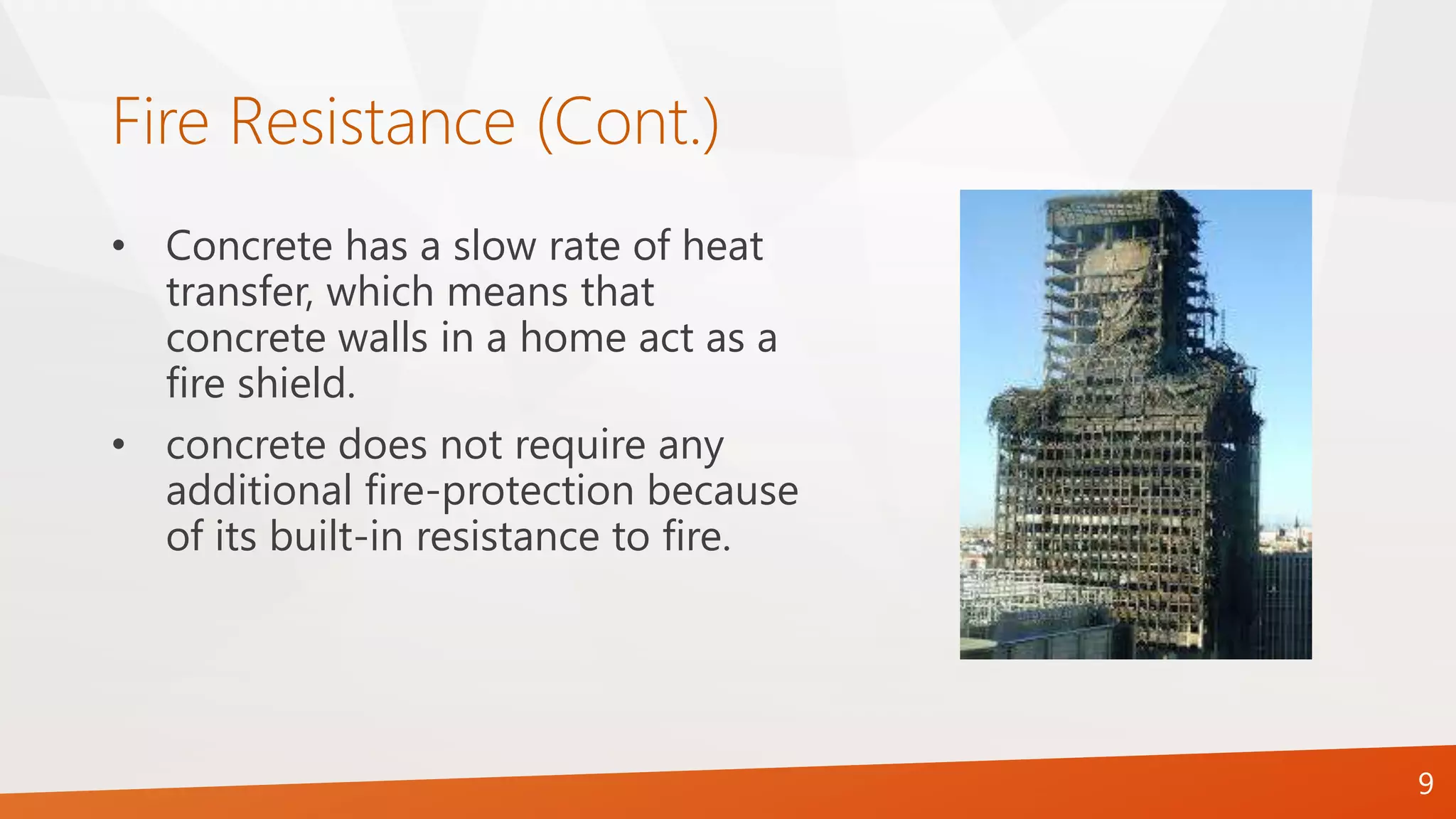
• Concrete has a slow rate of heat
transfer, which means that
concrete walls in a home act as a
fire shield.
• concrete does not require any
additional fire-protection because
of its built-in resistance to fire.
Durability
10
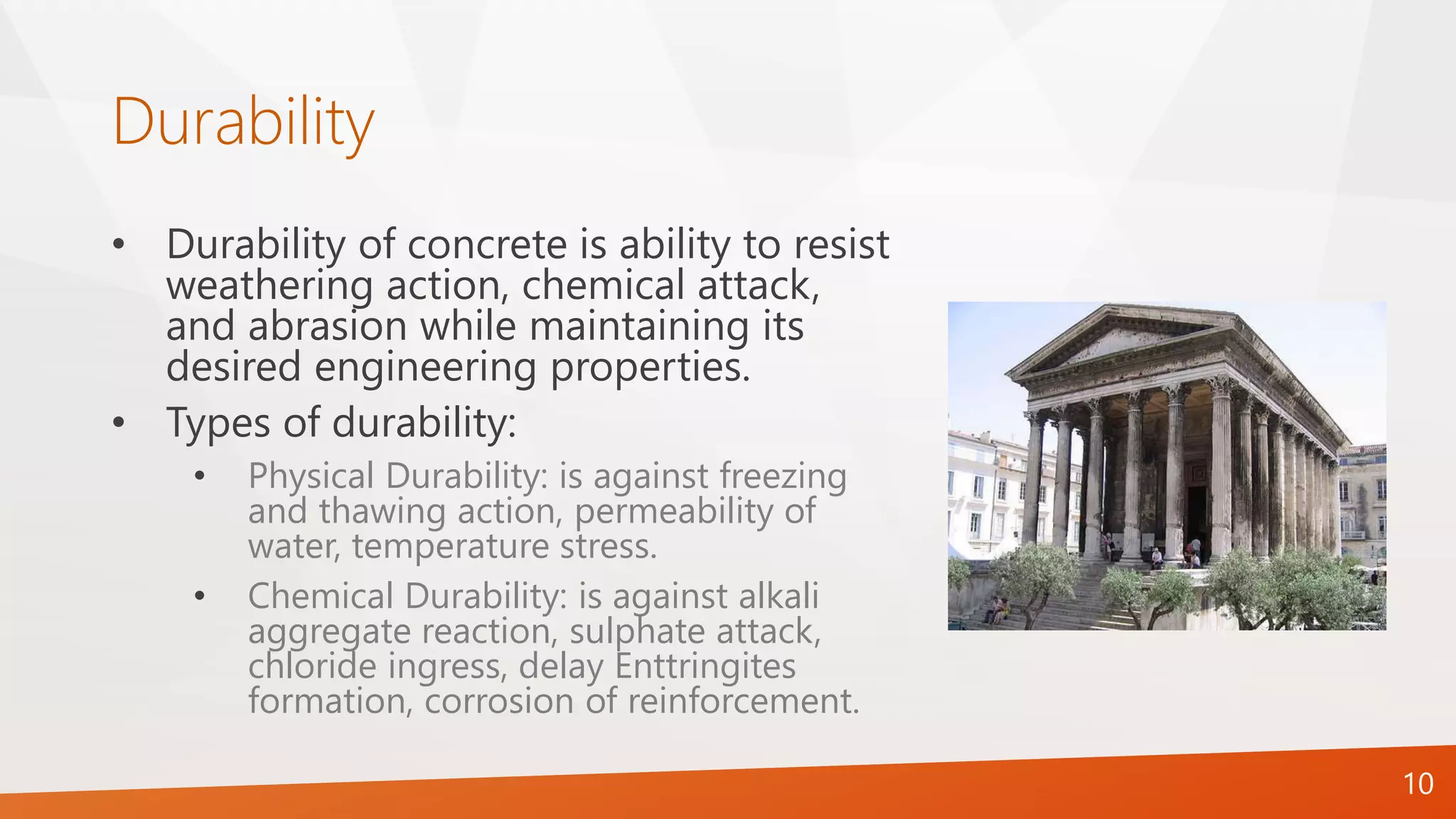
• Durability of concrete is ability to resist
weathering action, chemical attack,
and abrasion while maintaining its
desired engineering properties.
• Types of durability:
• Physical Durability: is against freezing
and thawing action, permeability of
water, temperature stress.
• Chemical Durability: is against alkali
aggregate reaction, sulphate attack,
chloride ingress, delay Enttringites
formation, corrosion of reinforcement.
• Factors that affect on the durability of concrete:
• Cement Content: Mix must be designed to ensure cohesion and prevent
segregation and bleeding.
• Compaction: The concrete as a whole contain voids can be caused by
inadequate compaction.
• Permeability: It can be noticed that higher permeability is usually caused by
higher porosity.
11
Durability
Disadvantages
12
Disadvantages of Concrete (cont.)
• Low tensile strength
• Low ductility
• Concrete is susceptible to cracking
13
Cracking
• Cracks can occur when provisions to accommodate these movements are
not made in design and construction.
• Concrete elements that affect cracking:
• More amount of water
• More amount of cement
• Mineral composition
• Shape
• Surface Texture
• Shape
• Surface Texture
• Some admixtures may also affects cracking
14
15
Conclusion
• Today concrete is the most used building material.
• Concrete has a good durability.
• Concrete has a high fire resistance.
• Concrete has some disadvantages.
• Cracking is one of the drawback of concrete.
16
Any Question!
Thank You!

Advantages and disadvantages of concrete

  • 1.
    Advantages and Disadvantages ofConcrete Soran University Faculty of Engineering Civil Engineering Department 11 June, 2015
  • 2.
    Welcome • Abdulla Kawkas •Abdulaziz Ibrahim • Sarchia Khursheed • Wrya Sharif • Shaida Abdulraheem • Nechirwan Sabah • Ashna Kamil 2 Civil 1 Group
  • 3.
    Outline 1. Introduction 2. Advantages 2.1Durability 2.2 Fire Resistance 3. Disadvantages 3.1 Cracking 4. Conclusion 3
  • 4.
    Introduction to Concrete •Concrete is a major materials that used for various structural purpose. • Components of Concrete • Uses of Concrete • Types of Concrete 4
  • 5.
  • 6.
    Advantages of Concrete •Concrete is economical. • It is not as likely to rot, corrode, or decay as other building materials. • Concrete has the ability to be molded into any desired shapes. 6
  • 7.
    Advantages of Concrete(cont.) • fire-safe and able to withstand high temperatures. • casting can occur on the work-site which reduces cost. • resistant to wind, water, rodents, and insects. 7
  • 8.
    Fire Resistance • Afire-resistance rating typically means the duration for which a passivefire protection system can withstand a standard fire resistance test. • The ability of a laboratory- constructed assembly to contain a fire in a carefully controlled test setting for a specified period of time. 8
  • 9.
    Fire Resistance (Cont.) 9 •Concrete has a slow rate of heat transfer, which means that concrete walls in a home act as a fire shield. • concrete does not require any additional fire-protection because of its built-in resistance to fire.
  • 10.
    Durability 10 • Durability ofconcrete is ability to resist weathering action, chemical attack, and abrasion while maintaining its desired engineering properties. • Types of durability: • Physical Durability: is against freezing and thawing action, permeability of water, temperature stress. • Chemical Durability: is against alkali aggregate reaction, sulphate attack, chloride ingress, delay Enttringites formation, corrosion of reinforcement.
  • 11.
    • Factors thataffect on the durability of concrete: • Cement Content: Mix must be designed to ensure cohesion and prevent segregation and bleeding. • Compaction: The concrete as a whole contain voids can be caused by inadequate compaction. • Permeability: It can be noticed that higher permeability is usually caused by higher porosity. 11 Durability
  • 12.
  • 13.
    Disadvantages of Concrete(cont.) • Low tensile strength • Low ductility • Concrete is susceptible to cracking 13
  • 14.
    Cracking • Cracks canoccur when provisions to accommodate these movements are not made in design and construction. • Concrete elements that affect cracking: • More amount of water • More amount of cement • Mineral composition • Shape • Surface Texture • Shape • Surface Texture • Some admixtures may also affects cracking 14
  • 15.
    15 Conclusion • Today concreteis the most used building material. • Concrete has a good durability. • Concrete has a high fire resistance. • Concrete has some disadvantages. • Cracking is one of the drawback of concrete.
  • 16.