GNSS data Processing
Kutubuddin ANSARI
kutubuddin.ansari@ikc.edu.tr
GNSS Surveying, GE 205
Lecture 8, May 17, 2016
GNSS data Processing Files
3
RINEX
• Receiver Independent Exchange Format
• Developed by the Astronomical Institute of the
University of Berne in 1989
• For the easy exchange of the GPS data to be collected
• For processing in various software
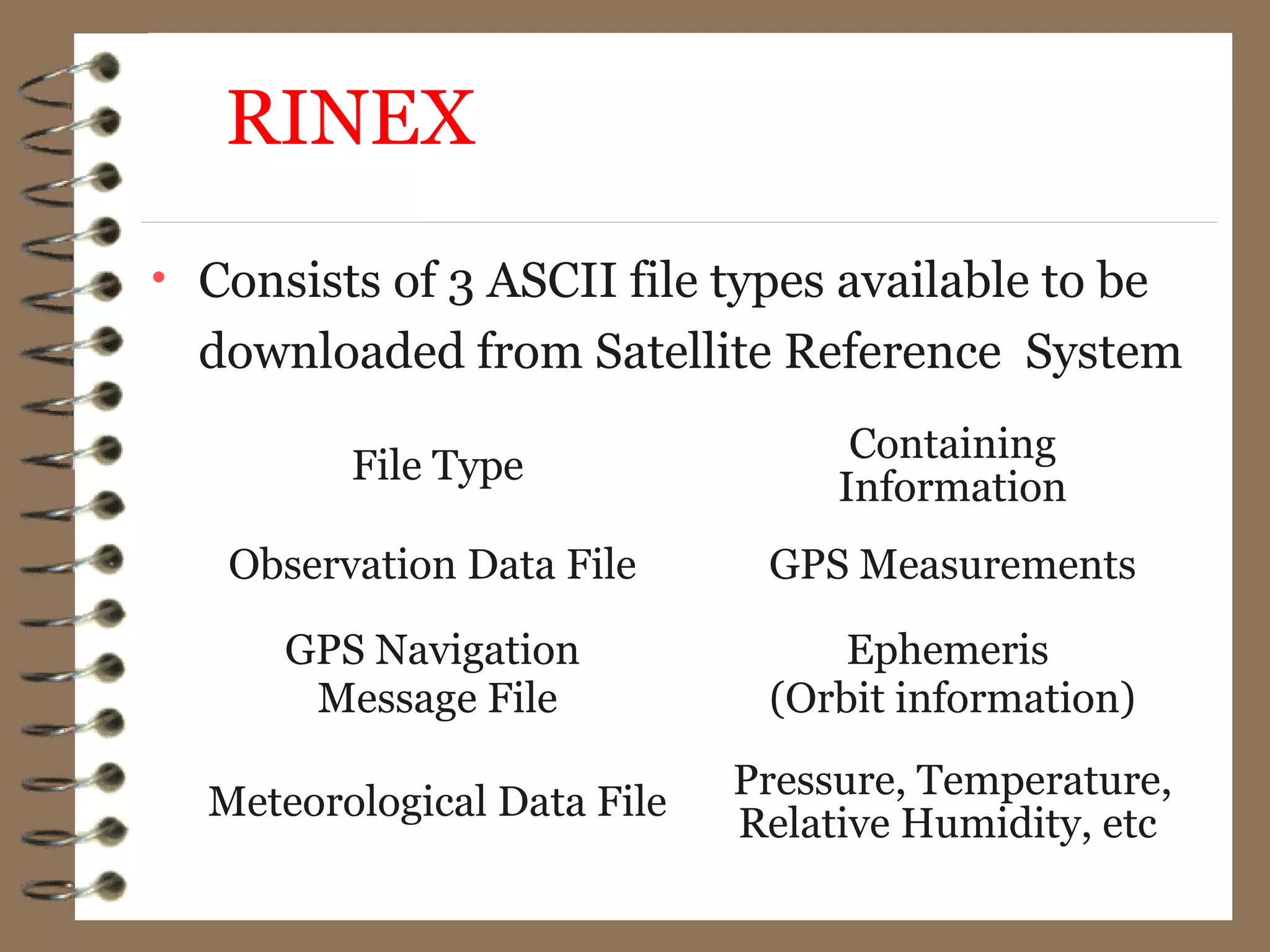
• Consists of 3 ASCII file types available to be
downloaded from Satellite Reference System
File Type
Containing
Information
Observation Data File GPS Measurements
GPS Navigation
Message File
Ephemeris
(Orbit information)
Meteorological Data File
Pressure, Temperature,
Relative Humidity, etc
RINEX
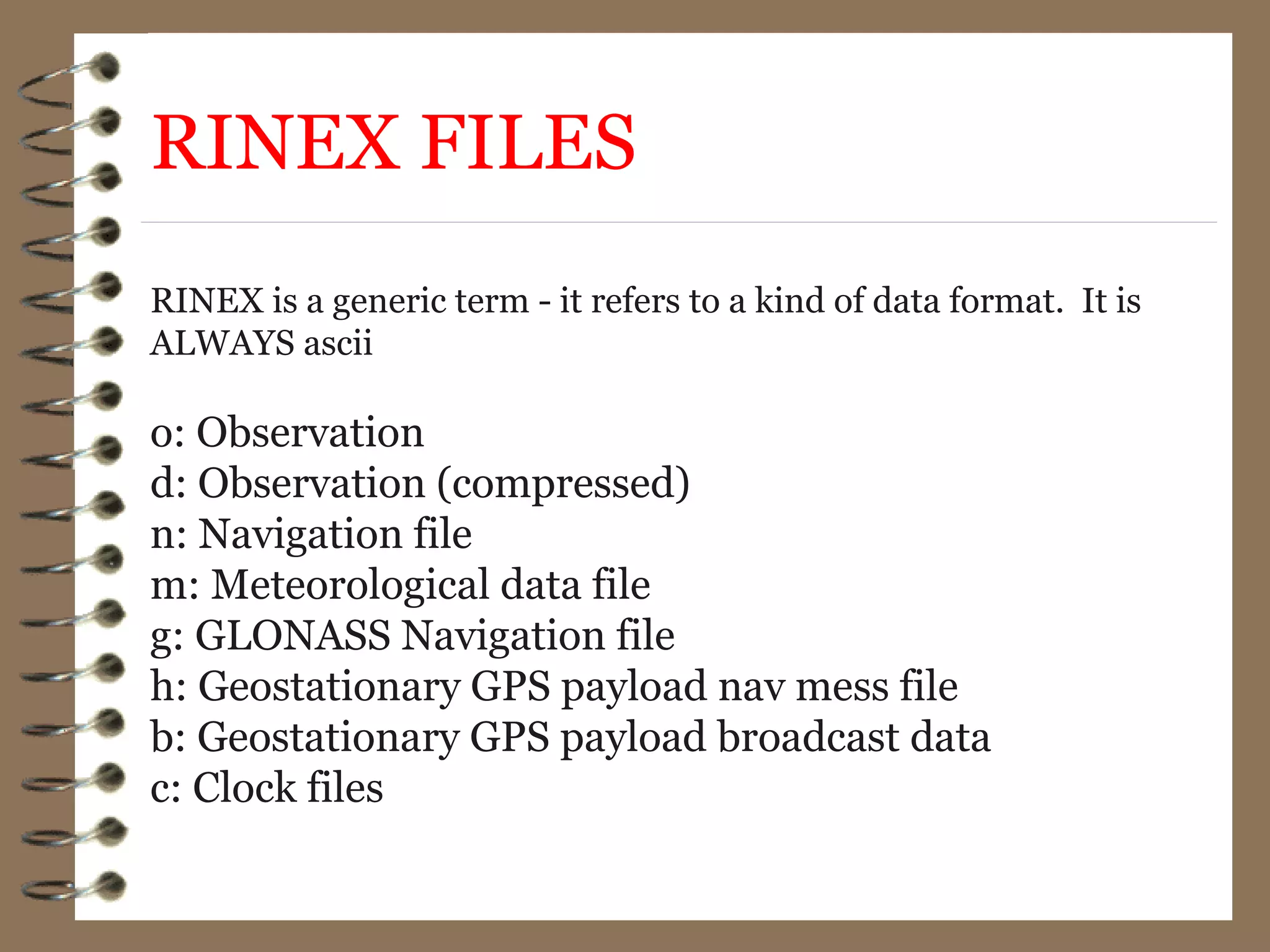
RINEX FILES
RINEX is a generic term - it refers to a kind of data format. It is
ALWAYS ascii
o: Observation
d: Observation (compressed)
n: Navigation file
m: Meteorological data file
g: GLONASS Navigation file
h: Geostationary GPS payload nav mess file
b: Geostationary GPS payload broadcast data
c: Clock files
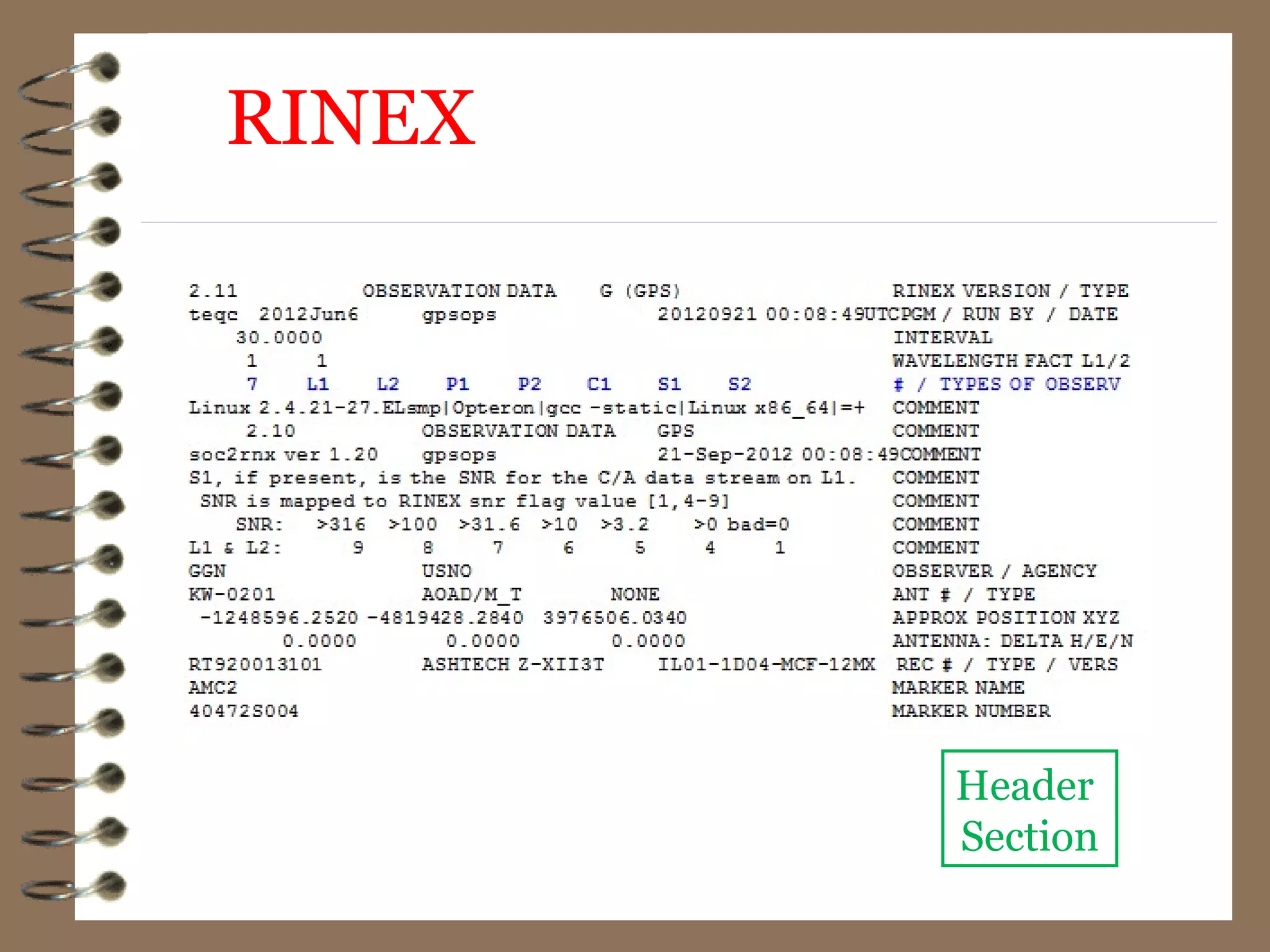
Header
Section
RINEX
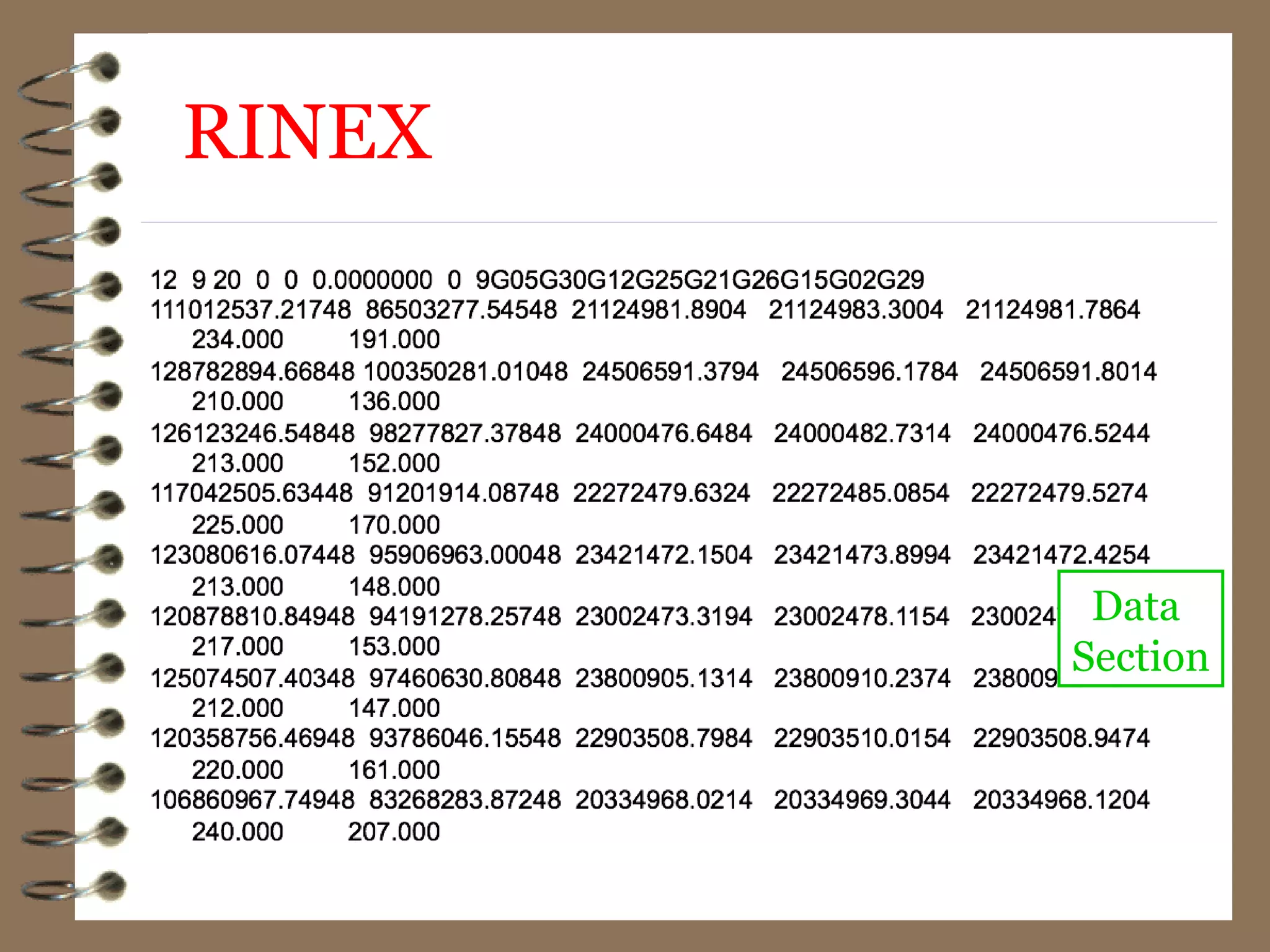
Data
Section
RINEX
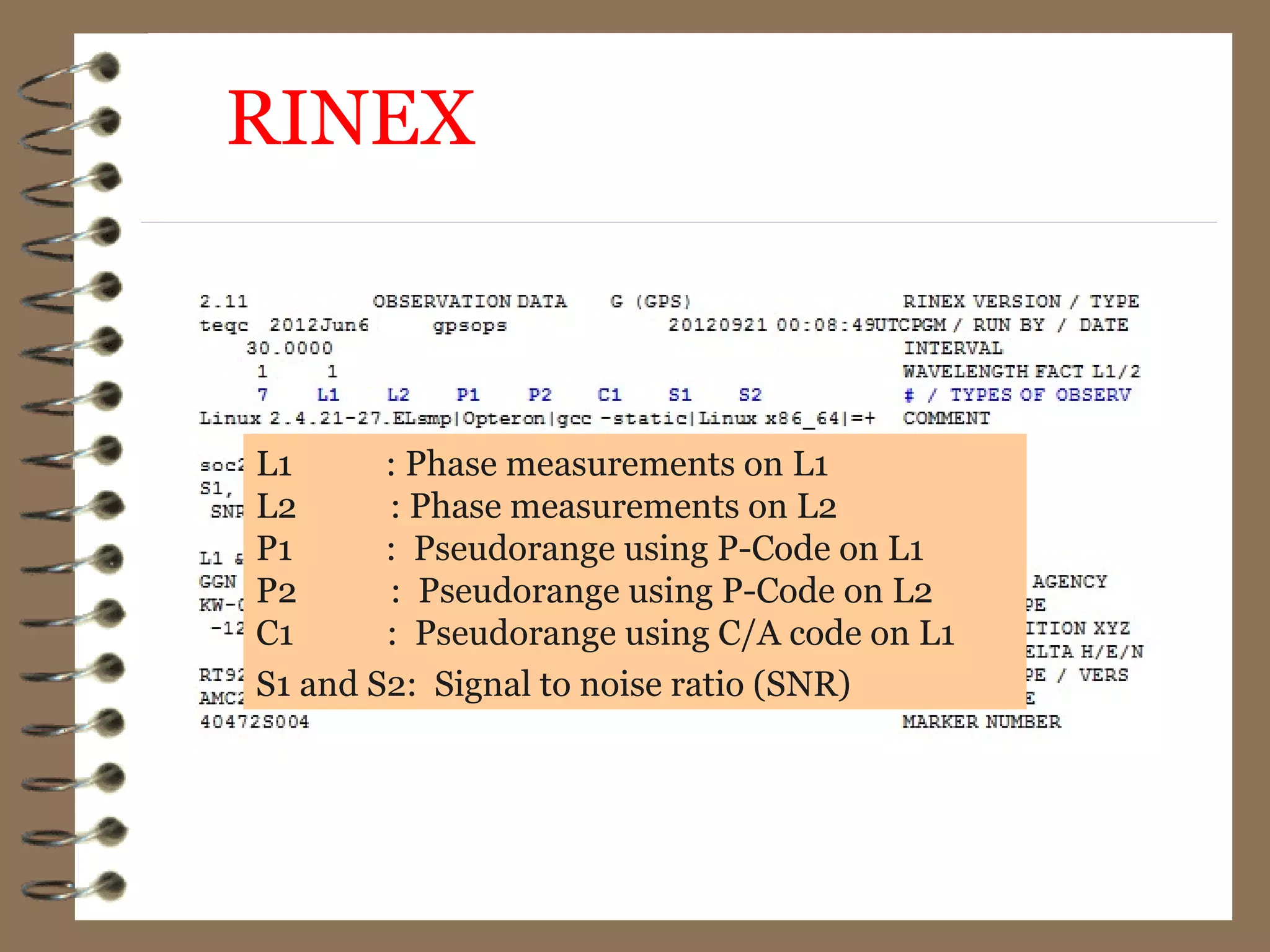
L1 : Phase measurements on L1
L2 : Phase measurements on L2
P1 : Pseudorange using P-Code on L1
P2 : Pseudorange using P-Code on L2
C1 : Pseudorange using C/A code on L1
S1 and S2: Signal to noise ratio (SNR)
RINEX
RINEX
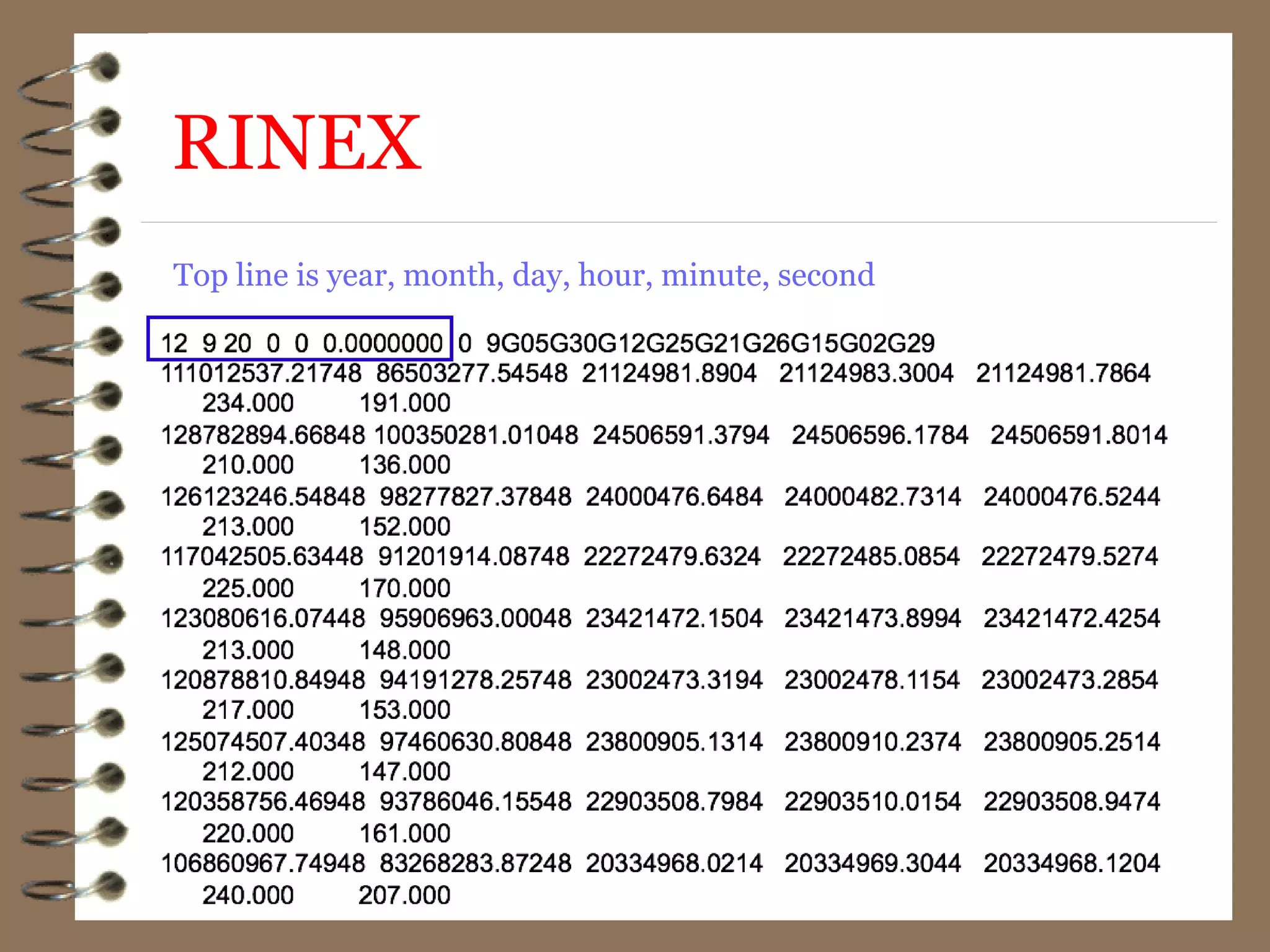
Top line is year, month, day, hour, minute, second
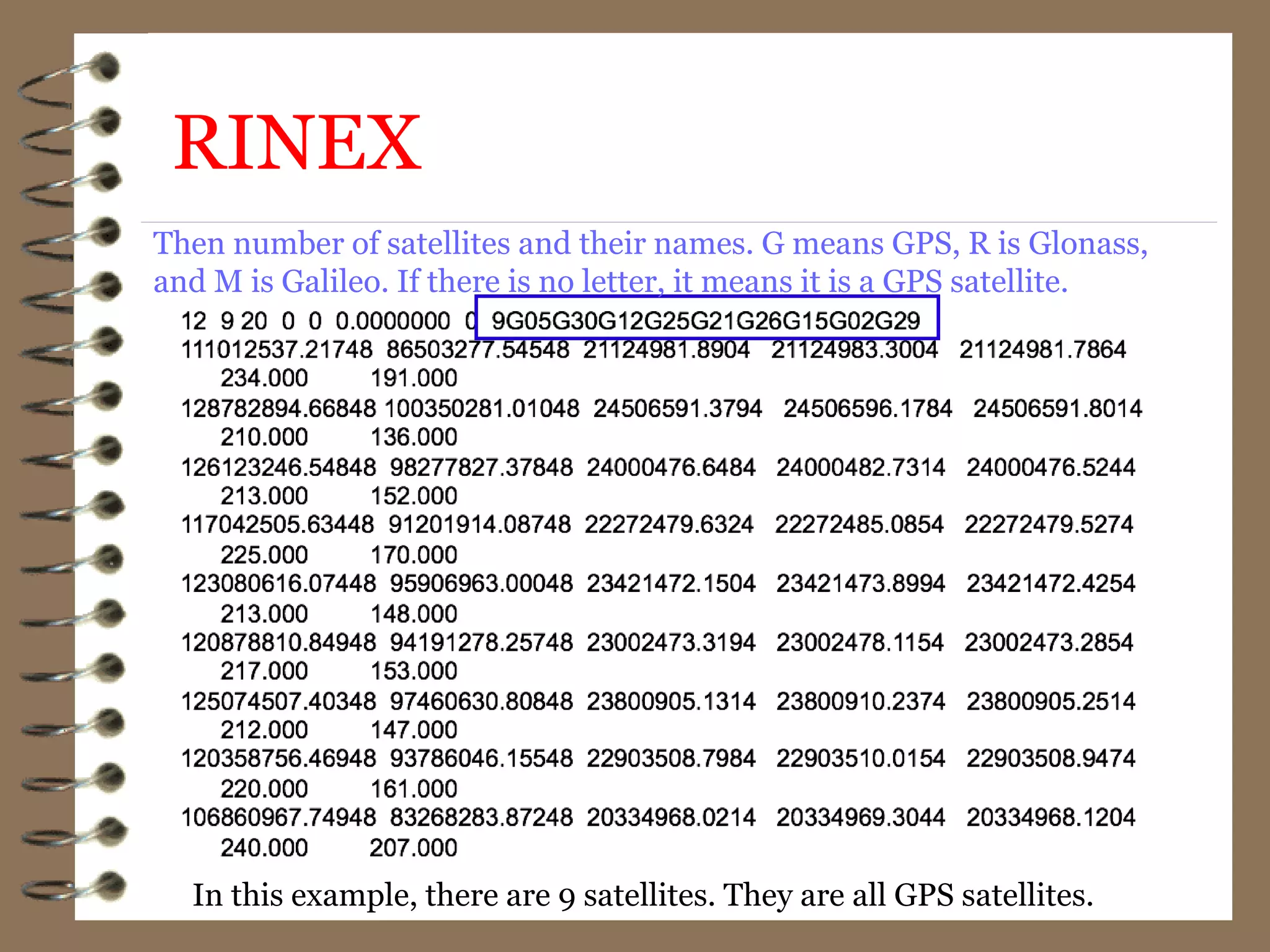
Then number of satellites and their names. G means GPS, R is Glonass,
and M is Galileo. If there is no letter, it means it is a GPS satellite.
In this example, there are 9 satellites. They are all GPS satellites.
RINEX
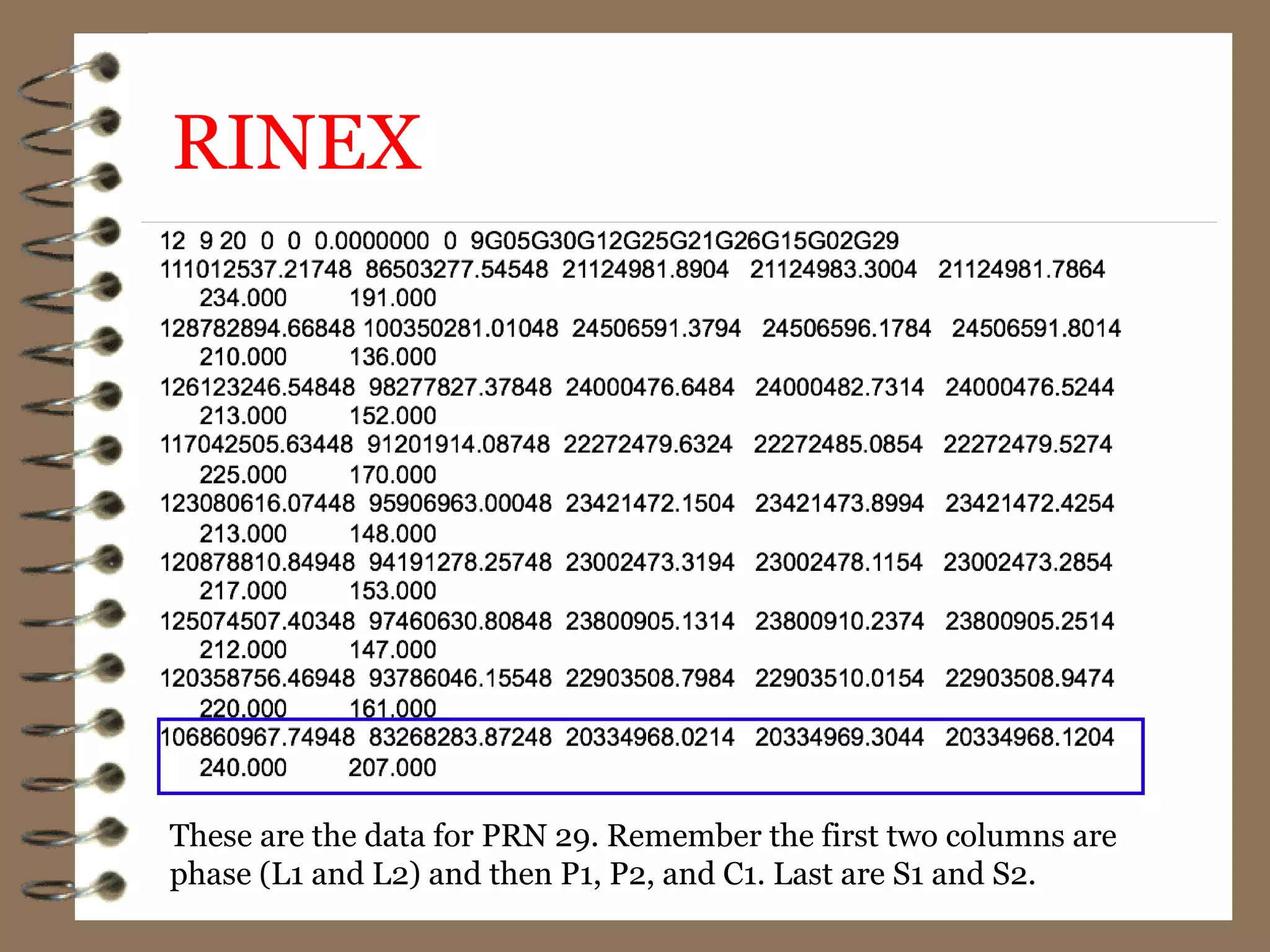
These are the data for PRN 29. Remember the first two columns are
phase (L1 and L2) and then P1, P2, and C1. Last are S1 and S2.
RINEX
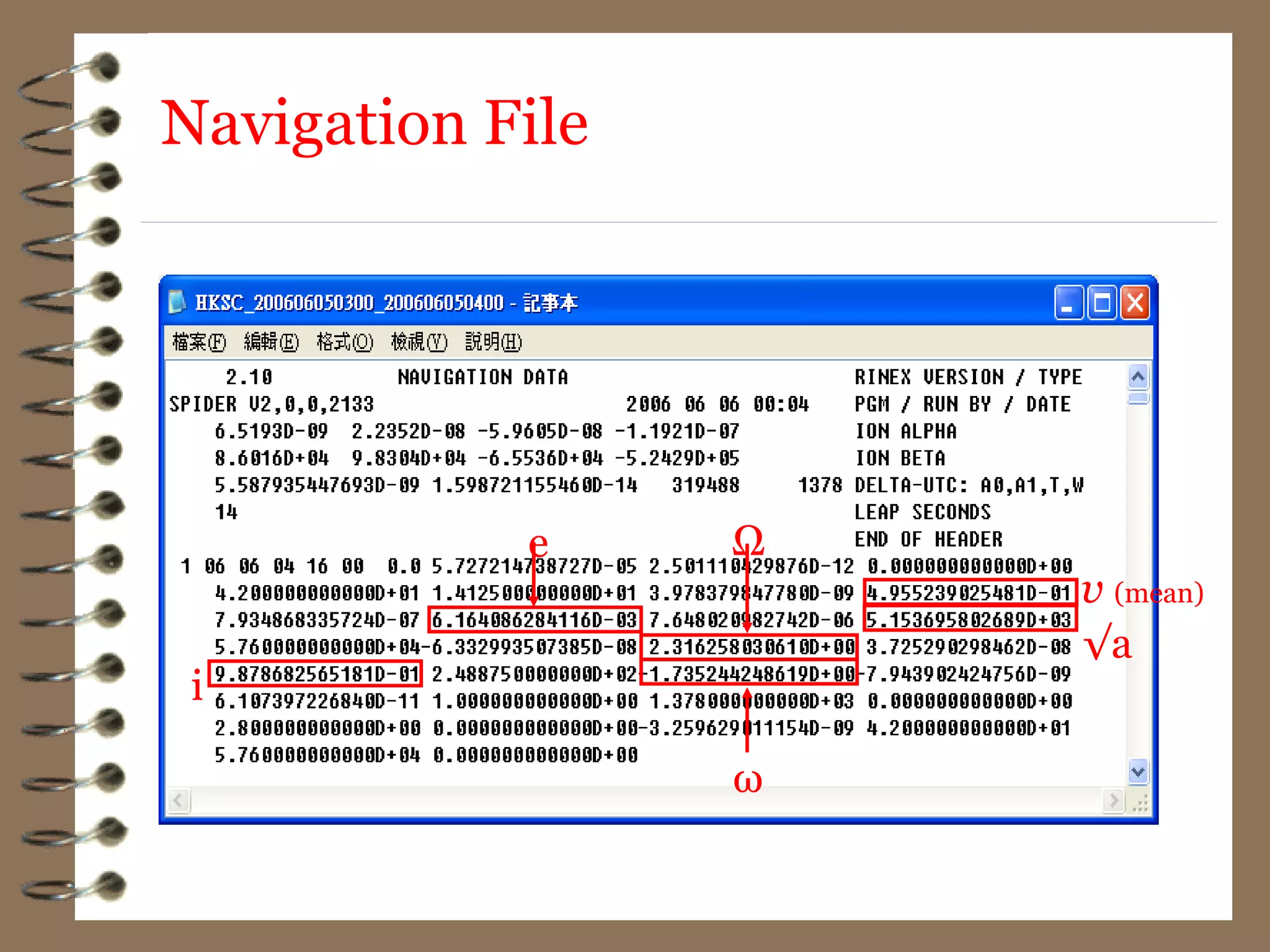
Navigation File
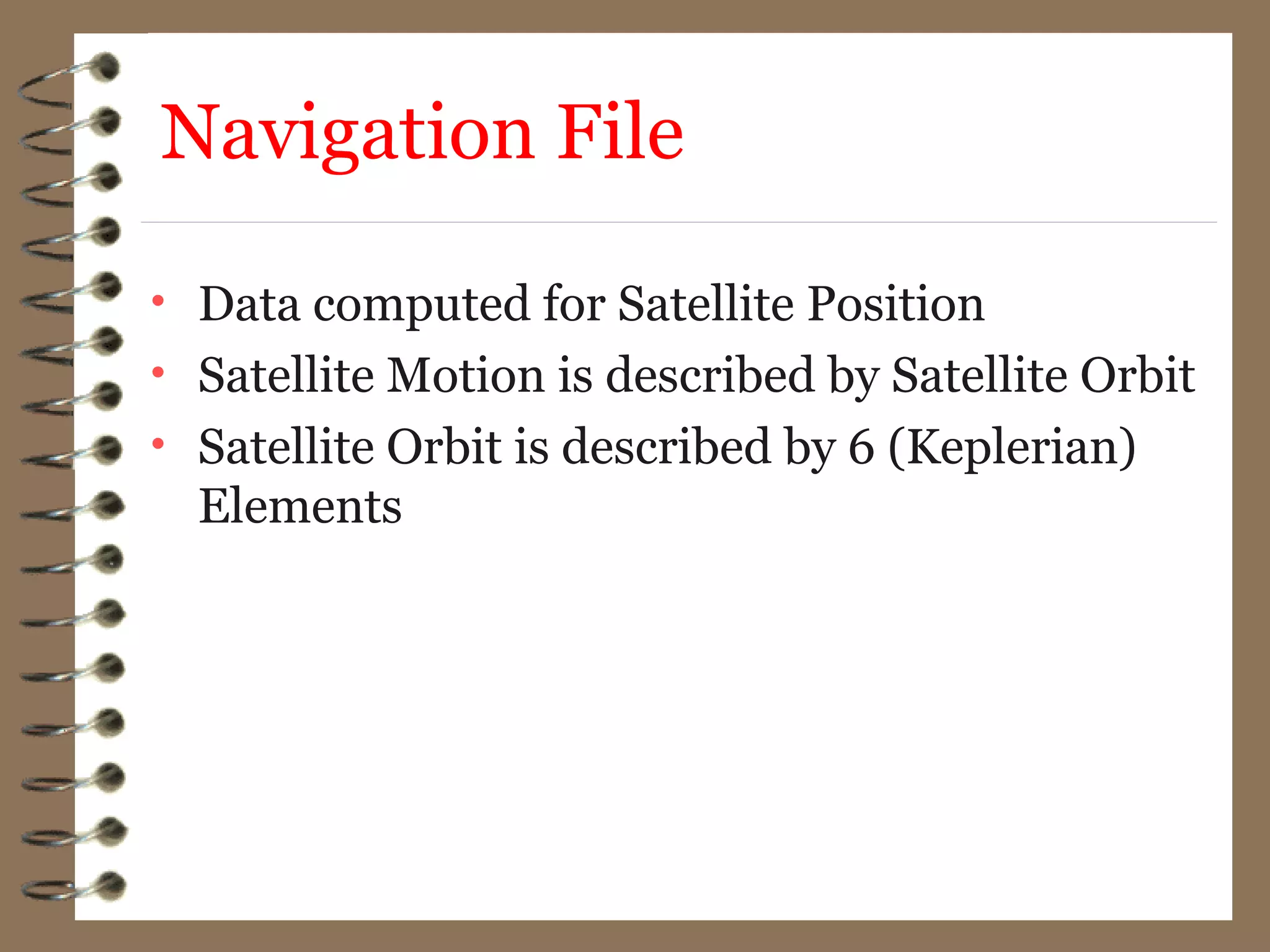
• Data computed for Satellite Position
• Satellite Motion is described by Satellite Orbit
• Satellite Orbit is described by 6 (Keplerian)
Elements
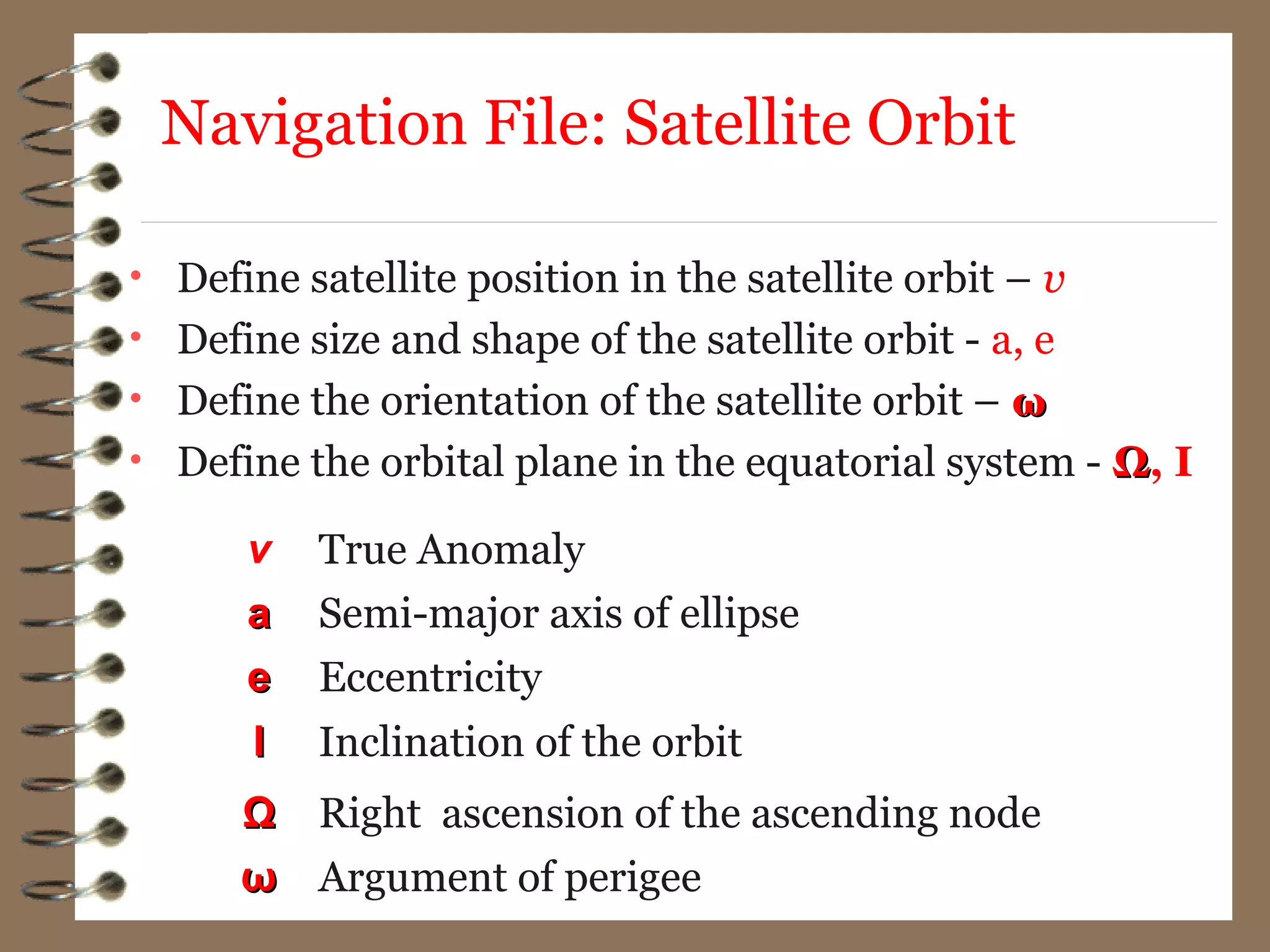
• Define satellite position in the satellite orbit – v
• Define size and shape of the satellite orbit - a, e
• Define the orientation of the satellite orbit – ωω
• Define the orbital plane in the equatorial system - ΩΩ, I
v True Anomaly
aa Semi-major axis of ellipse
ee Eccentricity
II Inclination of the orbit
ΩΩ Right ascension of the ascending node
ωω Argument of perigee
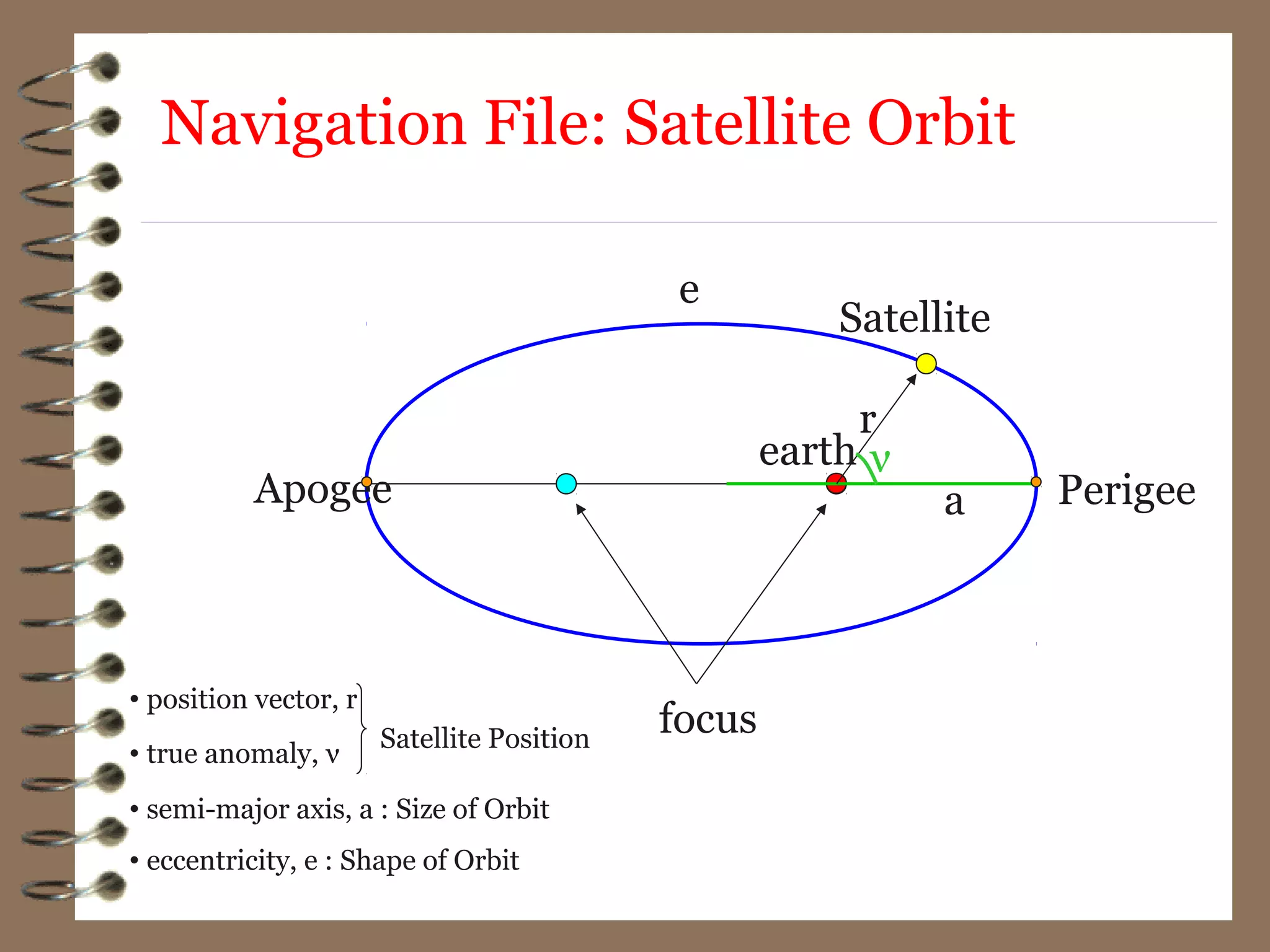
Navigation File: Satellite Orbit
Satellite
focus
earth
a
e
• semi-major axis, a : Size of Orbit
• eccentricity, e : Shape of Orbit
PerigeeApogee
• position vector, r
r
ν
• true anomaly, ν
Satellite Position
Navigation File: Satellite Orbit
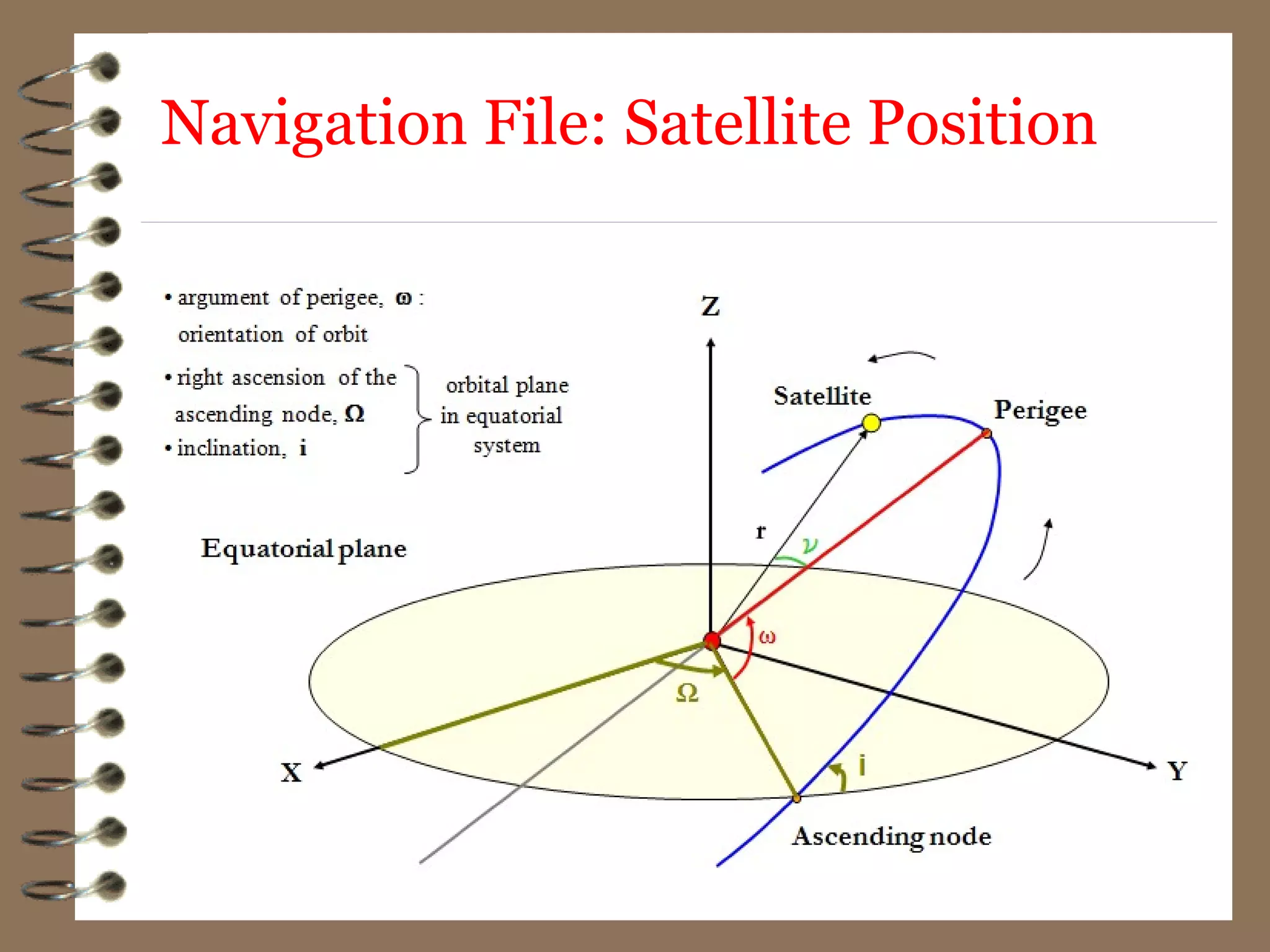
Navigation File: Satellite Position
i
e Ω
ω
v (mean)
√a
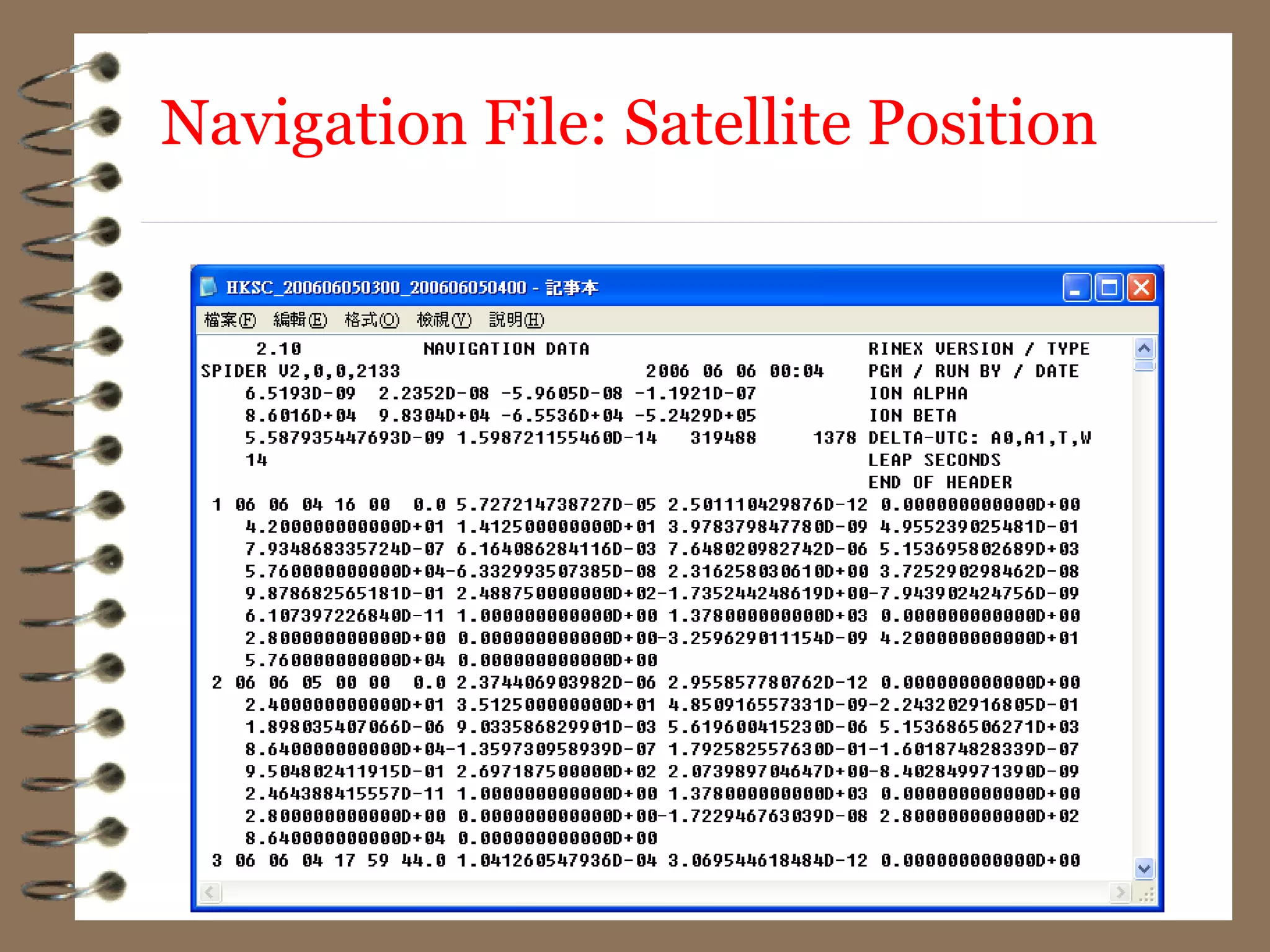
Navigation File
GNSS data Processing
Software
GAMIT
GPS Analysis at Massachusetts Institute
of Technology
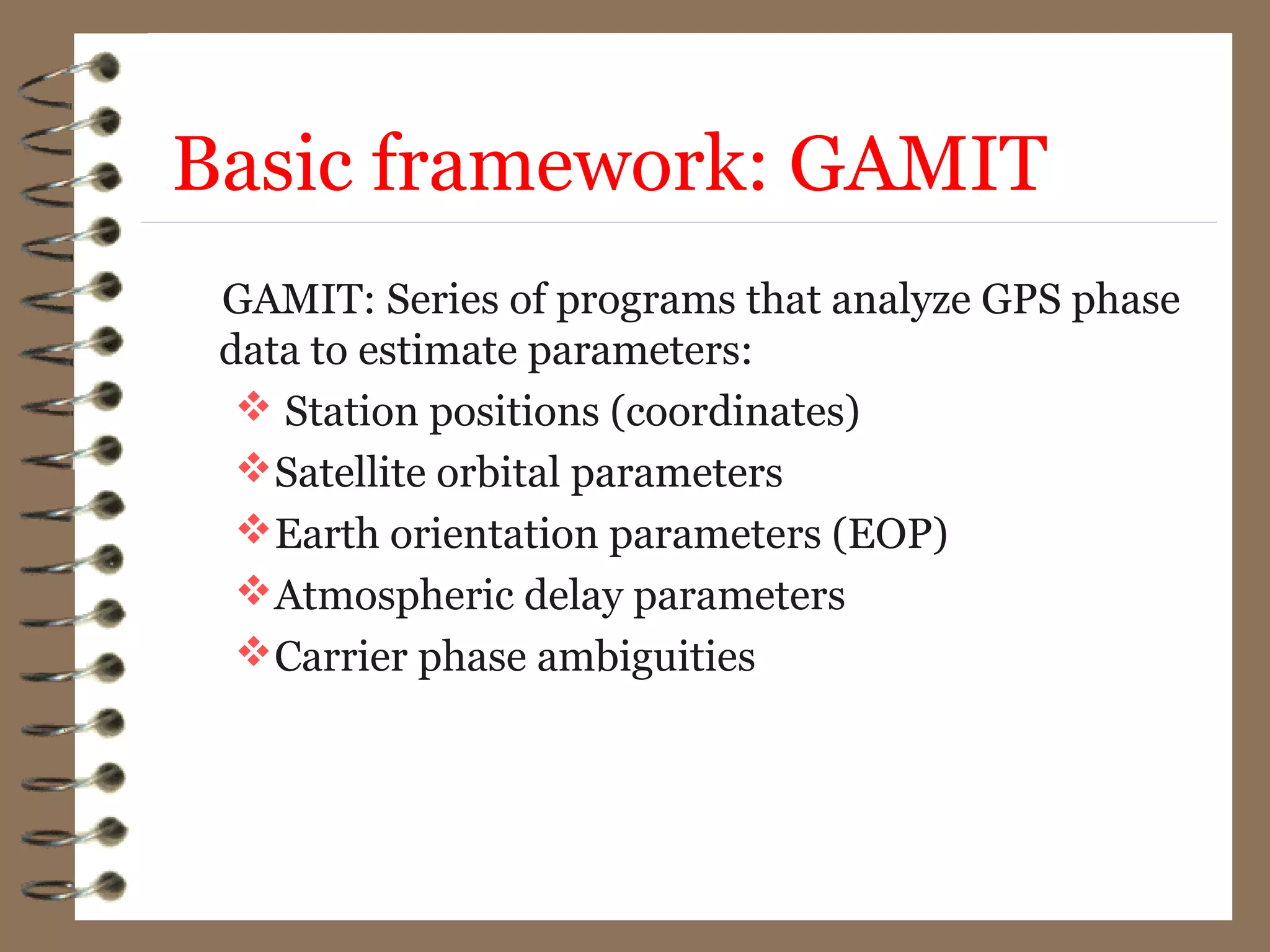
Basic framework: GAMIT
GAMIT: Series of programs that analyze GPS phase
data to estimate parameters:
 Station positions (coordinates)
Satellite orbital parameters
Earth orientation parameters (EOP)
Atmospheric delay parameters
Carrier phase ambiguities
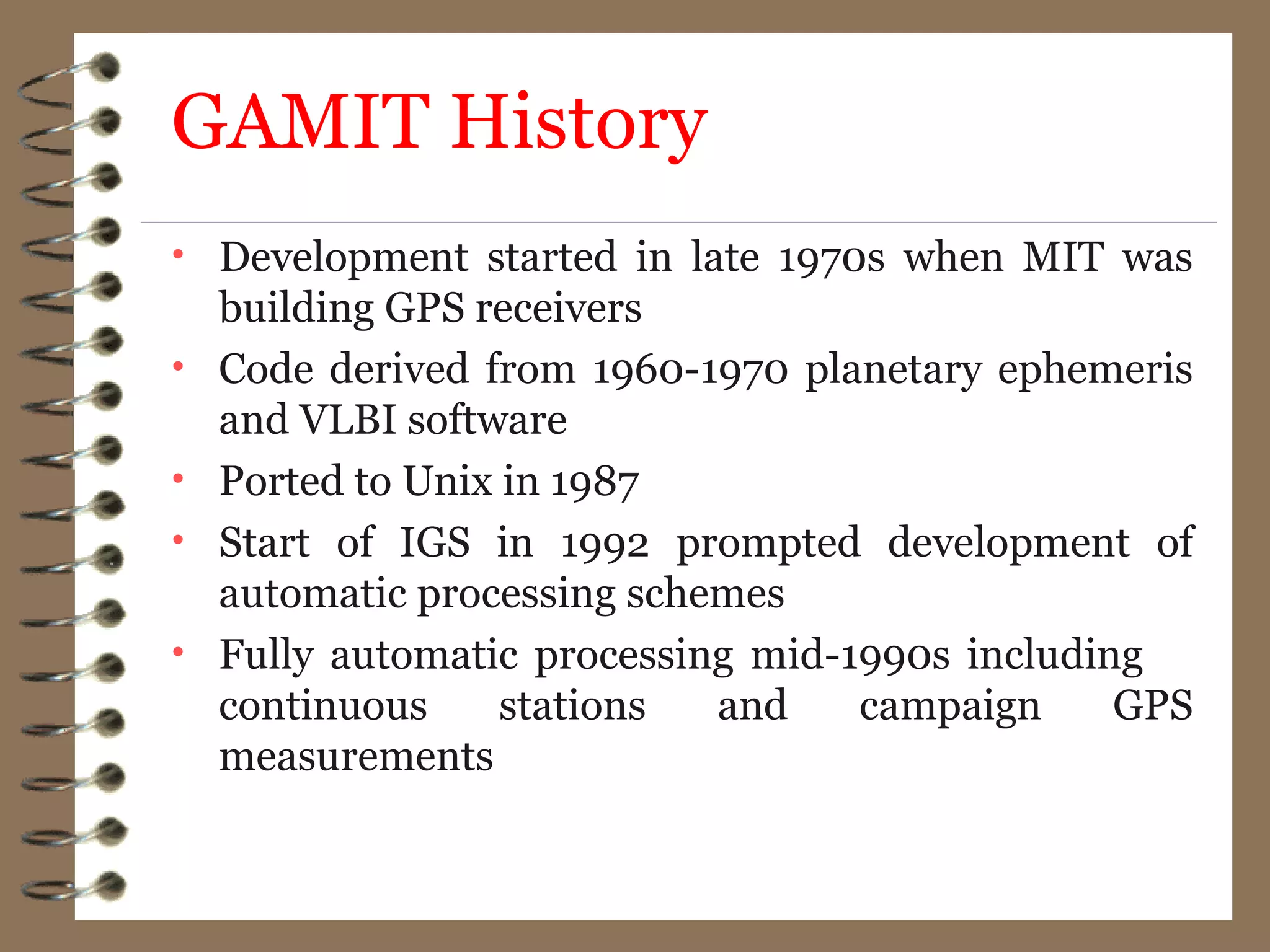
GAMIT History
• Development started in late 1970s when MIT was
building GPS receivers
• Code derived from 1960-1970 planetary ephemeris
and VLBI software
• Ported to Unix in 1987
• Start of IGS in 1992 prompted development of
automatic processing schemes
• Fully automatic processing mid-1990s including
continuous stations and campaign GPS
measurements
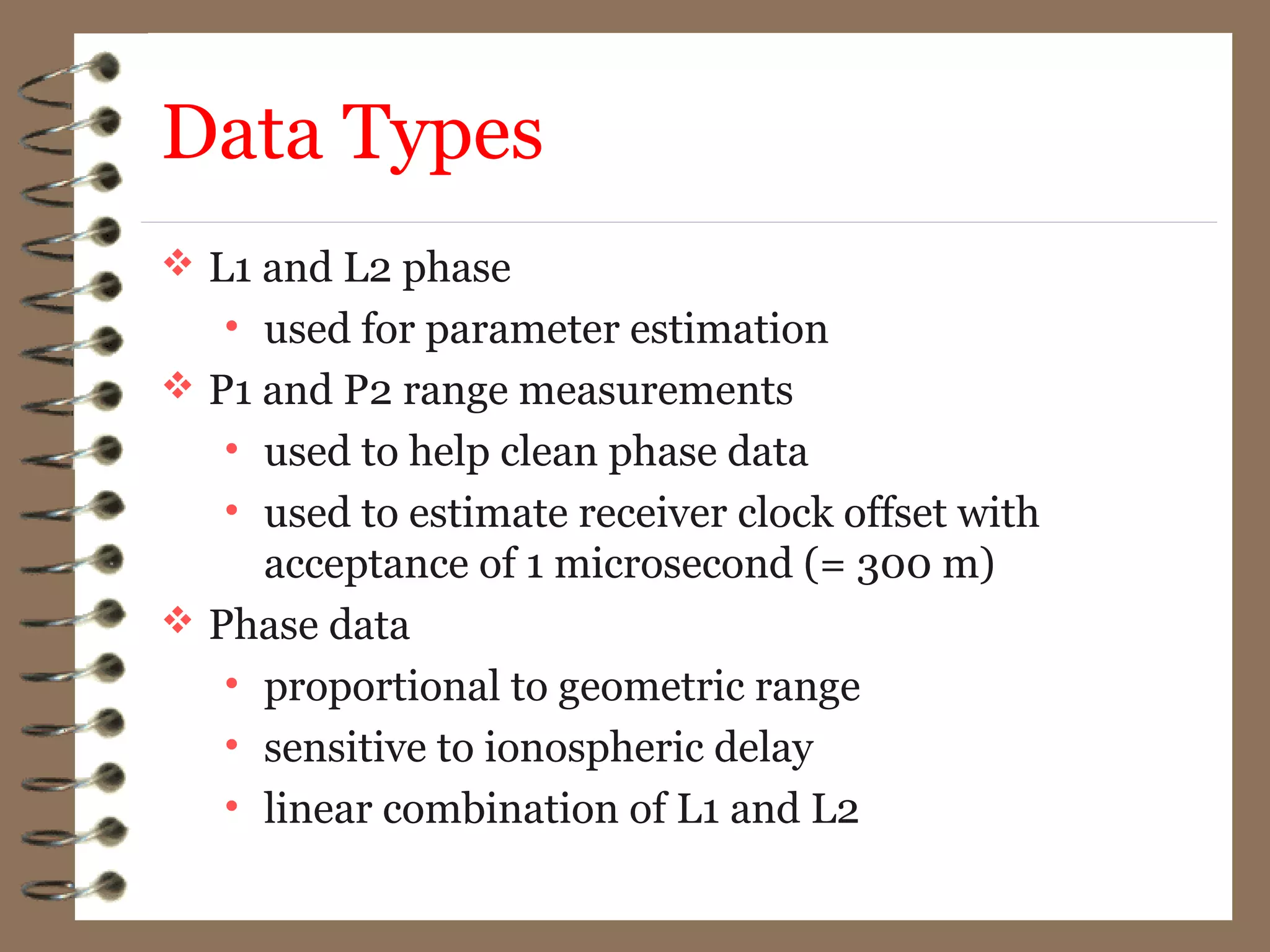
Data Types
 L1 and L2 phase
• used for parameter estimation
 P1 and P2 range measurements
• used to help clean phase data
• used to estimate receiver clock offset with
acceptance of 1 microsecond (= 300 m)
 Phase data
• proportional to geometric range
• sensitive to ionospheric delay
• linear combination of L1 and L2
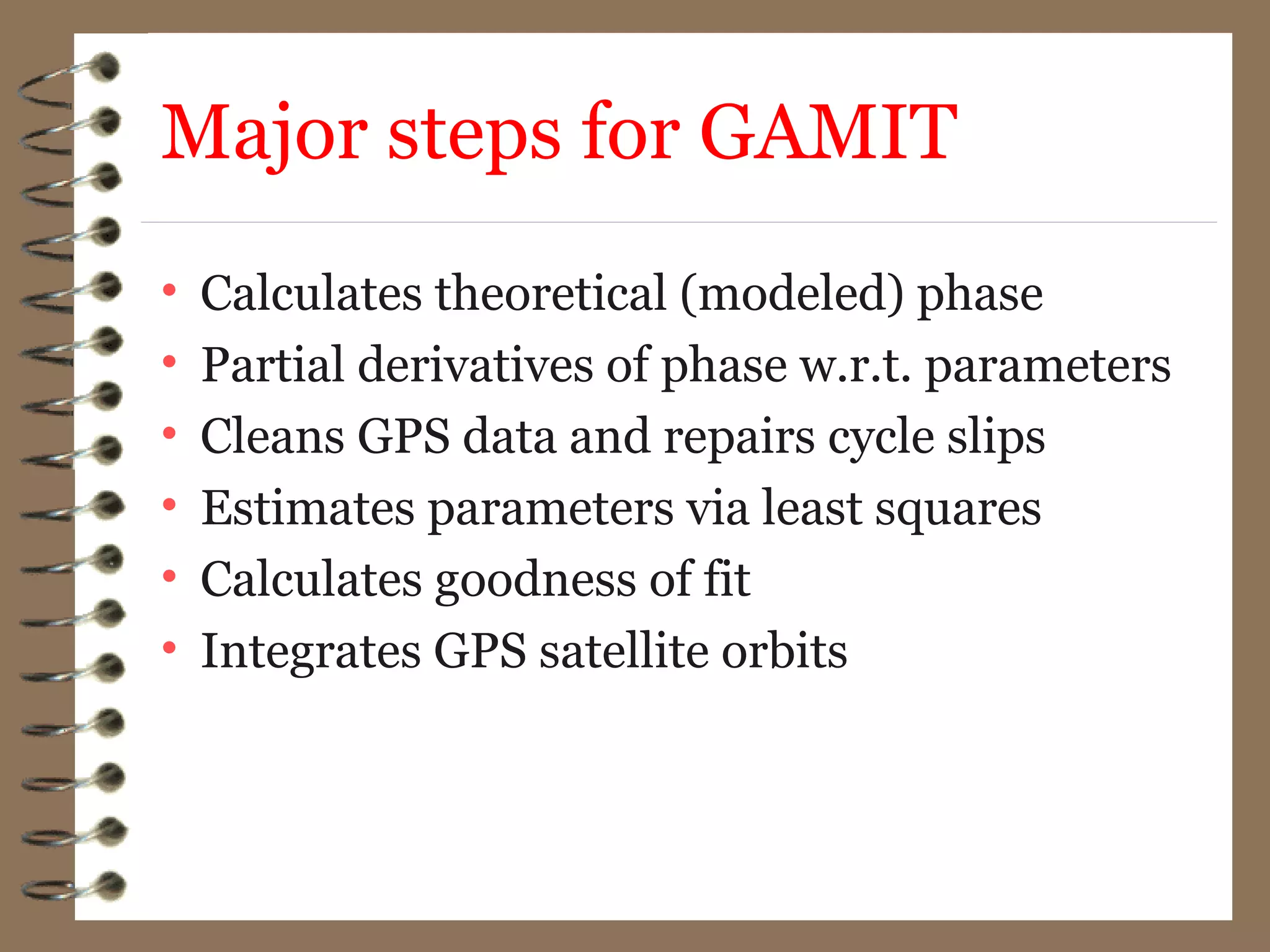
Major steps for GAMIT
• Calculates theoretical (modeled) phase
• Partial derivatives of phase w.r.t. parameters
• Cleans GPS data and repairs cycle slips
• Estimates parameters via least squares
• Calculates goodness of fit
• Integrates GPS satellite orbits
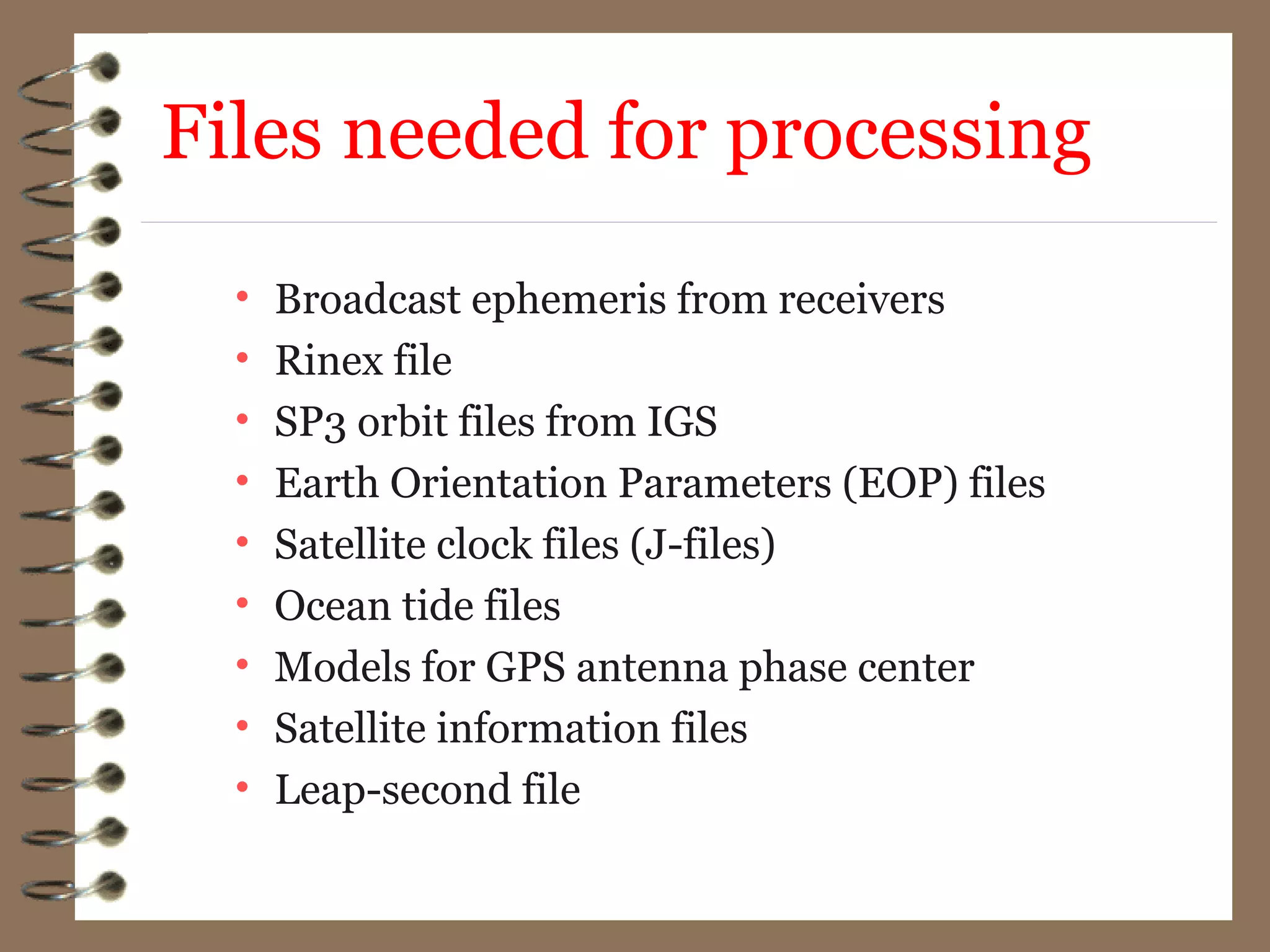
Files needed for processing
• Broadcast ephemeris from receivers
• Rinex file
• SP3 orbit files from IGS
• Earth Orientation Parameters (EOP) files
• Satellite clock files (J-files)
• Ocean tide files
• Models for GPS antenna phase center
• Satellite information files
• Leap-second file
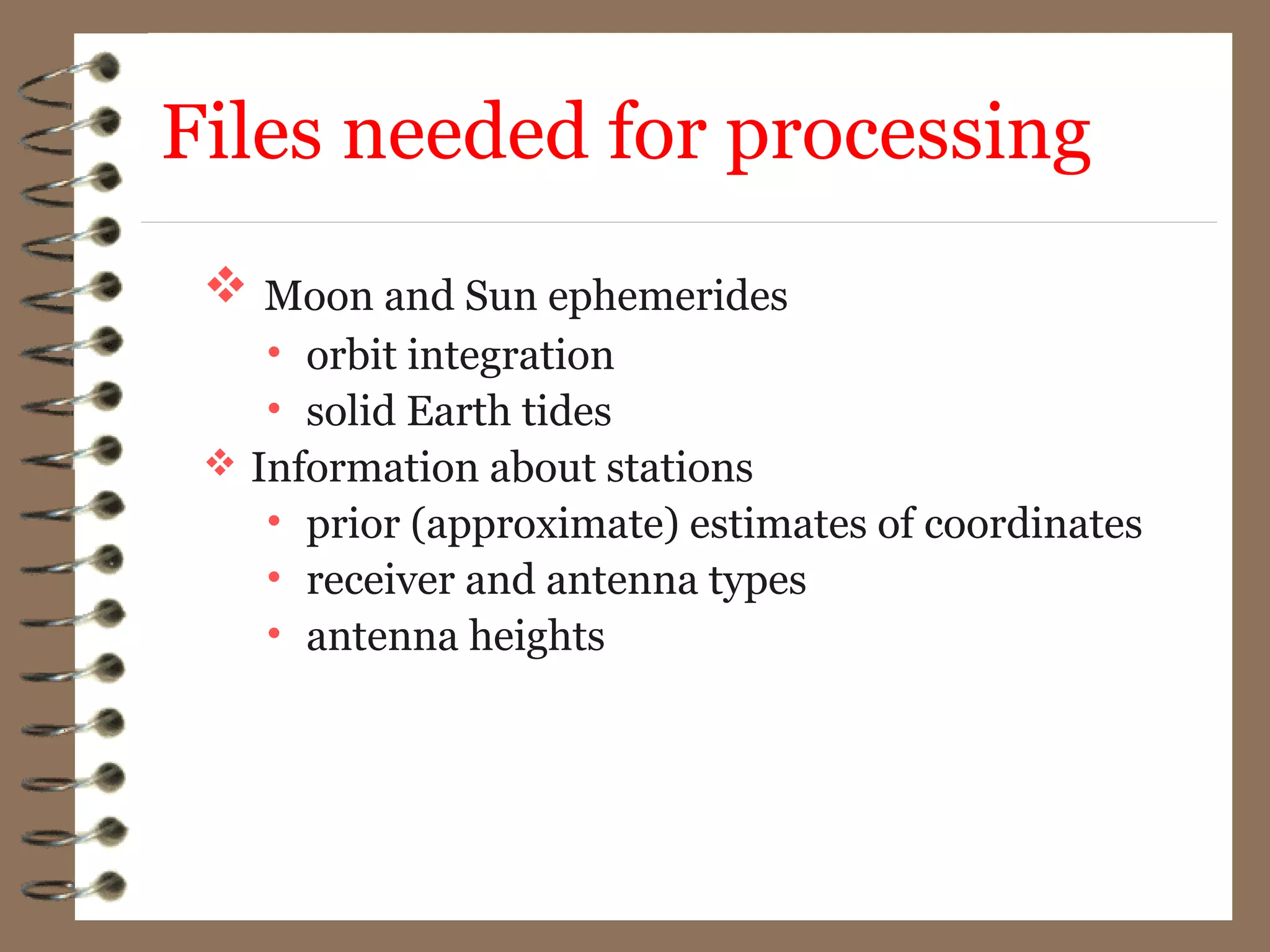
 Moon and Sun ephemerides
• orbit integration
• solid Earth tides
 Information about stations
• prior (approximate) estimates of coordinates
• receiver and antenna types
• antenna heights
Files needed for processing
GLOBK
(Global Kalman filtering software)
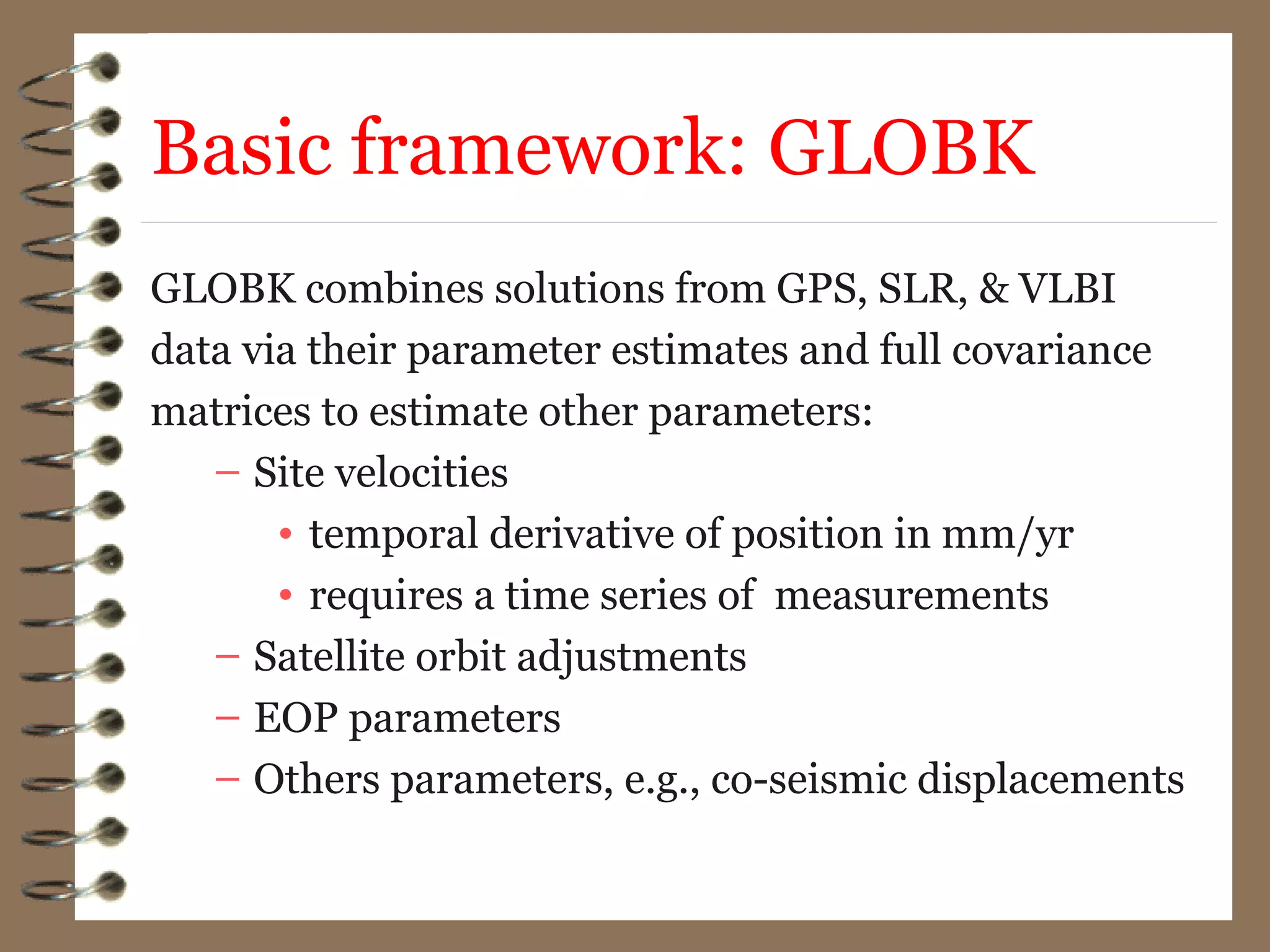
Basic framework: GLOBK
GLOBK combines solutions from GPS, SLR, & VLBI
data via their parameter estimates and full covariance
matrices to estimate other parameters:
– Site velocities
• temporal derivative of position in mm/yr
• requires a time series of measurements
– Satellite orbit adjustments
– EOP parameters
– Others parameters, e.g., co-seismic displacements
GLOBK History
• Suite of programs
• Written in mid-1980s to handle combination of VLBI
data
• Extended in 1989 to handle GPS results: GAMIT
modified to output needed files
• 1990's: Extensions to handle SLR data
Required files
• binary h-files generated by htoglb from:
– GAMIT h-files (ASCII),
• command files
– very flexible, key-word structure
Optional files
• Orbit files
• EOP
• Earthquake/rename definitions
• Apriori coordinate and motion files
GLOBK documentation
• Available as PDF, PS and RTF files
• Nearly all modules in GLOBK suite have up-to-date
documentation on-line
• To get help for a command, type its name alone on
the command line.
Differences between GAMIT and GLOBK
• GAMIT operations and files are rigid; GLOBK uses
flexible formats and is used in many different ways
• GAMIT tends to stop if a problem is encountered
(less so these days); GLOBK tries to continue as far
as it can by defaulting values
• Pros/Cons: GAMIT stops can be frustrating; GLOBK
may appear to work but might generate erroneous
results.
• Basic aim of GAMIT is to generate positions/orbits
for one day of data. Standard product of GAMIT is a
minimally constrained solution
• GLOBK flexibly combines minimally constrained
parameter estimates from one or more measurement
types (GPS, SLR, VLBI, DORIS)
Differences between GAMIT and GLOBK
Getting GAMIT/GLOBK
• Free for research/non-commercial license
• Fortran Source code
• Executables for HP, Solaris and Linux

Gnss data-processing

  • 1.
    GNSS data Processing KutubuddinANSARI kutubuddin.ansari@ikc.edu.tr GNSS Surveying, GE 205 Lecture 8, May 17, 2016
  • 2.
  • 3.
    3 RINEX • Receiver IndependentExchange Format • Developed by the Astronomical Institute of the University of Berne in 1989 • For the easy exchange of the GPS data to be collected • For processing in various software
  • 4.
    • Consists of3 ASCII file types available to be downloaded from Satellite Reference System File Type Containing Information Observation Data File GPS Measurements GPS Navigation Message File Ephemeris (Orbit information) Meteorological Data File Pressure, Temperature, Relative Humidity, etc RINEX
  • 5.
    RINEX FILES RINEX isa generic term - it refers to a kind of data format. It is ALWAYS ascii o: Observation d: Observation (compressed) n: Navigation file m: Meteorological data file g: GLONASS Navigation file h: Geostationary GPS payload nav mess file b: Geostationary GPS payload broadcast data c: Clock files
  • 6.
  • 7.
  • 8.
    L1 : Phasemeasurements on L1 L2 : Phase measurements on L2 P1 : Pseudorange using P-Code on L1 P2 : Pseudorange using P-Code on L2 C1 : Pseudorange using C/A code on L1 S1 and S2: Signal to noise ratio (SNR) RINEX
  • 9.
    RINEX Top line isyear, month, day, hour, minute, second
  • 10.
    Then number ofsatellites and their names. G means GPS, R is Glonass, and M is Galileo. If there is no letter, it means it is a GPS satellite. In this example, there are 9 satellites. They are all GPS satellites. RINEX
  • 11.
    These are thedata for PRN 29. Remember the first two columns are phase (L1 and L2) and then P1, P2, and C1. Last are S1 and S2. RINEX
  • 12.
    Navigation File • Datacomputed for Satellite Position • Satellite Motion is described by Satellite Orbit • Satellite Orbit is described by 6 (Keplerian) Elements
  • 13.
    • Define satelliteposition in the satellite orbit – v • Define size and shape of the satellite orbit - a, e • Define the orientation of the satellite orbit – ωω • Define the orbital plane in the equatorial system - ΩΩ, I v True Anomaly aa Semi-major axis of ellipse ee Eccentricity II Inclination of the orbit ΩΩ Right ascension of the ascending node ωω Argument of perigee Navigation File: Satellite Orbit
  • 14.
    Satellite focus earth a e • semi-major axis,a : Size of Orbit • eccentricity, e : Shape of Orbit PerigeeApogee • position vector, r r ν • true anomaly, ν Satellite Position Navigation File: Satellite Orbit
  • 15.
  • 16.
  • 17.
  • 18.
  • 19.
    GAMIT GPS Analysis atMassachusetts Institute of Technology
  • 20.
    Basic framework: GAMIT GAMIT:Series of programs that analyze GPS phase data to estimate parameters:  Station positions (coordinates) Satellite orbital parameters Earth orientation parameters (EOP) Atmospheric delay parameters Carrier phase ambiguities
  • 21.
    GAMIT History • Developmentstarted in late 1970s when MIT was building GPS receivers • Code derived from 1960-1970 planetary ephemeris and VLBI software • Ported to Unix in 1987 • Start of IGS in 1992 prompted development of automatic processing schemes • Fully automatic processing mid-1990s including continuous stations and campaign GPS measurements
  • 22.
    Data Types  L1and L2 phase • used for parameter estimation  P1 and P2 range measurements • used to help clean phase data • used to estimate receiver clock offset with acceptance of 1 microsecond (= 300 m)  Phase data • proportional to geometric range • sensitive to ionospheric delay • linear combination of L1 and L2
  • 23.
    Major steps forGAMIT • Calculates theoretical (modeled) phase • Partial derivatives of phase w.r.t. parameters • Cleans GPS data and repairs cycle slips • Estimates parameters via least squares • Calculates goodness of fit • Integrates GPS satellite orbits
  • 24.
    Files needed forprocessing • Broadcast ephemeris from receivers • Rinex file • SP3 orbit files from IGS • Earth Orientation Parameters (EOP) files • Satellite clock files (J-files) • Ocean tide files • Models for GPS antenna phase center • Satellite information files • Leap-second file
  • 25.
     Moon andSun ephemerides • orbit integration • solid Earth tides  Information about stations • prior (approximate) estimates of coordinates • receiver and antenna types • antenna heights Files needed for processing
  • 26.
  • 27.
    Basic framework: GLOBK GLOBKcombines solutions from GPS, SLR, & VLBI data via their parameter estimates and full covariance matrices to estimate other parameters: – Site velocities • temporal derivative of position in mm/yr • requires a time series of measurements – Satellite orbit adjustments – EOP parameters – Others parameters, e.g., co-seismic displacements
  • 28.
    GLOBK History • Suiteof programs • Written in mid-1980s to handle combination of VLBI data • Extended in 1989 to handle GPS results: GAMIT modified to output needed files • 1990's: Extensions to handle SLR data
  • 29.
    Required files • binaryh-files generated by htoglb from: – GAMIT h-files (ASCII), • command files – very flexible, key-word structure
  • 30.
    Optional files • Orbitfiles • EOP • Earthquake/rename definitions • Apriori coordinate and motion files
  • 31.
    GLOBK documentation • Availableas PDF, PS and RTF files • Nearly all modules in GLOBK suite have up-to-date documentation on-line • To get help for a command, type its name alone on the command line.
  • 32.
    Differences between GAMITand GLOBK • GAMIT operations and files are rigid; GLOBK uses flexible formats and is used in many different ways • GAMIT tends to stop if a problem is encountered (less so these days); GLOBK tries to continue as far as it can by defaulting values • Pros/Cons: GAMIT stops can be frustrating; GLOBK may appear to work but might generate erroneous results.
  • 33.
    • Basic aimof GAMIT is to generate positions/orbits for one day of data. Standard product of GAMIT is a minimally constrained solution • GLOBK flexibly combines minimally constrained parameter estimates from one or more measurement types (GPS, SLR, VLBI, DORIS) Differences between GAMIT and GLOBK
  • 34.
    Getting GAMIT/GLOBK • Freefor research/non-commercial license • Fortran Source code • Executables for HP, Solaris and Linux