ROAD CONSTRUCTION
AND SURVEYING
Hello!
▪ Amin Muhammad
▪ Nechirwan Sabah
▪ Sarchia Khursheed
▪ Shayda Abdulrahim
▪ Wrya Sharif
▪ Zahra Samad
Soran University
Faculty of Engineering
Civil Engineering Department
About
A Road in Soran city, Erbil province
Specifications of this road (our project):
▪ Type: Street (Paved)
▪ Length: 200 m
▪ Width: 8 m
▪ Shoulder: 2 x 1 m
▪ Sewage: 1.5 m depth
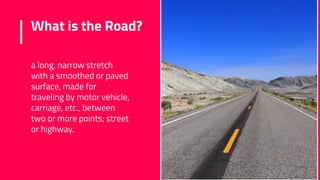
What is the Road?
a long, narrow stretch
with a smoothed or paved
surface, made for
traveling by motor vehicle,
carriage, etc., between
two or more points; street
or highway.
Introduction
Ancient Roads
In ancient times, river transport was much faster and
easier than road transport. The Romans were one of
the first to build stone paved roads in North Africa
and Europe to support their military operations. Later
the Arabs built roads that were covered with tar. The
roads were constructed by preparing earthworks and
lifting the road foundation at the center for water
drainage. Road construction techniques gradually
improved by the study of road traffic, stone
thickness, road alignment, and slope gradients. Initial
road construction materials were stones that were
laid in a regular, compact design, and covered with
smaller stones to produce a solid layer.
Introduction
Modern Roads
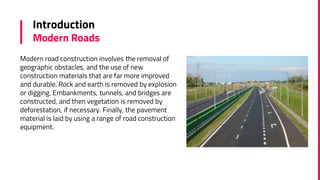
Modern road construction involves the removal of
geographic obstacles, and the use of new
construction materials that are far more improved
and durable. Rock and earth is removed by explosion
or digging. Embankments, tunnels, and bridges are
constructed, and then vegetation is removed by
deforestation, if necessary. Finally, the pavement
material is laid by using a range of road construction
equipment.
Introduction
Modern Roads
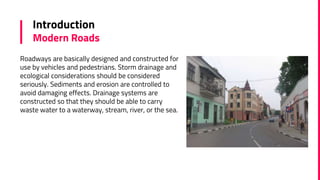
Roadways are basically designed and constructed for
use by vehicles and pedestrians. Storm drainage and
ecological considerations should be considered
seriously. Sediments and erosion are controlled to
avoid damaging effects. Drainage systems are
constructed so that they should be able to carry
waste water to a waterway, stream, river, or the sea.
Processof Road Construction
Process
Preparation of sub-grade
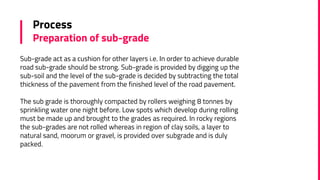
Sub-grade act as a cushion for other layers i.e. In order to achieve durable
road sub-grade should be strong. Sub-grade is provided by digging up the
sub-soil and the level of the sub-grade is decided by subtracting the total
thickness of the pavement from the finished level of the road pavement.
The sub grade is thoroughly compacted by rollers weighing 8 tonnes by
sprinkling water one night before. Low spots which develop during rolling
must be made up and brought to the grades as required. In rocky regions
the sub-grades are not rolled whereas in region of clay soils, a layer to
natural sand, moorum or gravel, is provided over subgrade and is duly
packed.
“
Sub grade preparation
Process
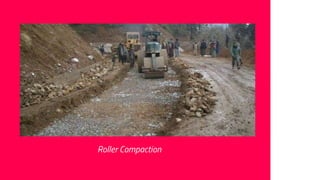
Preparation of sub-base
On a well compacted sub-grade, spread 10 to 20 cm size boulders
or broken stones, or over burnt bricks in layers of 15 cm thickness
and total width of the sub-base to be kept 60 cm wider than
pavement width, projecting 30 cm on each side. The sub-base
should be compacted by a roller to provide an even surface.
“
Roller Compaction
Process
Preparation of base
On the prepared sub-base or directly on the sub-grade, as the case
may be, the specified materials of the base course is spread and
proper grade, thickness and cross sections maintained as per
design shown on the supplied drawings.
Process
Preparation of wearing course
This course may be laid in one or two layers according to the total
designed thickness and the thickness of each layer should not
exceed 10 cm. this component being very important.
Process
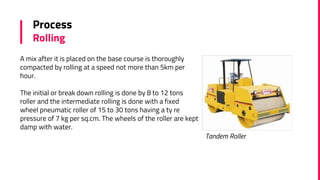
Rolling
A mix after it is placed on the base course is thoroughly
compacted by rolling at a speed not more than 5km per
hour.
The initial or break down rolling is done by 8 to 12 tons
roller and the intermediate rolling is done with a fixed
wheel pneumatic roller of 15 to 30 tons having a ty re
pressure of 7 kg per sq.cm. The wheels of the roller are kept
damp with water.
Tandem Roller
Process
Quality control of bituminous concrete construction
The routine checks are carried out at site to ensure the quality of
the resulting pavement mixture and the pavement surface.
Periodical checks are made for
a) Aggregate grading
b) Grade of bitumen
c) Temperature of aggregate
d) Temperature of paving mix during mixing and compaction.
Process
Quality control of bituminous concrete construction
At least one sample for every 100 tons of the mix discharged by
the hot mix plant is collected and tested for above requirements.
Marshall Tests are also conducted. For every 100 sq. m of the
compacted surface, one test of the field density is conducted to
check whether it is at least 95% of the density obtained in the
laboratory. The variation in the thickness allowed is 6mm per 4.5m
length of construction.
Process
Construction of shoulders
While curing the pavement surface, prepare the shoulders by filling
earth to the specified cross slope and compact them properly by
rolling or by tamping. Width and thickness of the shoulder should
be as per specification.
Map
Location
The project is construction
of 200 m street (8 m
width), into Soran
University campus,
Delizyan, Soran district.
Station BS IS FS HI RL
0+00 202 102.02 100
0+20 162 100.4
0+40 73.4 83.1 99.923 99.189
0+60 117.1 98.752
0+80 200.5 69 101.238 99.233
1+00 63.1 100.607
1+20 297.5 96.5 103.248 100.237
1+40 75.6 102.492
1+60 101.6 102.232
1+80 211.8 53.5 104.831 102.713
2+00 87.2 103.959
95
96
97
98
99
100
101
102
103
104
105
0+00 0+20 0+40 0+60 0+80 1+00 1+20 1+40 1+60 1+80 2+00
Plot of Road Profile
Elevations (Earth) Road line Sewerage
117,200,000 IQD
Cost of the project
Discussion and Conclusion
In conclusion we made a road with length of 200m, and width of 8m. The process
includes some various steps, at first surveying of the location of the road must be
done to determine the profile of the road, then from the data which obtained from
the profile we design the parts of the road. After designing the cost of the project
can be calculated. Next when the report of project is ready and accepted, the
project can go throw under-construction. During construction different processes
of the project must be carried one-by-one (Steps mentioned on process of road
construction). Finally the road can be open to people and can be used, if all
processes complete correctly and project suitable with international standards.
Thanks!
!
Any questions?

Road construction

  • 1.
  • 2.
    Hello! ▪ Amin Muhammad ▪Nechirwan Sabah ▪ Sarchia Khursheed ▪ Shayda Abdulrahim ▪ Wrya Sharif ▪ Zahra Samad Soran University Faculty of Engineering Civil Engineering Department
  • 3.
    About A Road inSoran city, Erbil province Specifications of this road (our project): ▪ Type: Street (Paved) ▪ Length: 200 m ▪ Width: 8 m ▪ Shoulder: 2 x 1 m ▪ Sewage: 1.5 m depth
  • 4.
    What is theRoad? a long, narrow stretch with a smoothed or paved surface, made for traveling by motor vehicle, carriage, etc., between two or more points; street or highway.
  • 5.
    Introduction Ancient Roads In ancienttimes, river transport was much faster and easier than road transport. The Romans were one of the first to build stone paved roads in North Africa and Europe to support their military operations. Later the Arabs built roads that were covered with tar. The roads were constructed by preparing earthworks and lifting the road foundation at the center for water drainage. Road construction techniques gradually improved by the study of road traffic, stone thickness, road alignment, and slope gradients. Initial road construction materials were stones that were laid in a regular, compact design, and covered with smaller stones to produce a solid layer.
  • 6.
    Introduction Modern Roads Modern roadconstruction involves the removal of geographic obstacles, and the use of new construction materials that are far more improved and durable. Rock and earth is removed by explosion or digging. Embankments, tunnels, and bridges are constructed, and then vegetation is removed by deforestation, if necessary. Finally, the pavement material is laid by using a range of road construction equipment.
  • 7.
    Introduction Modern Roads Roadways arebasically designed and constructed for use by vehicles and pedestrians. Storm drainage and ecological considerations should be considered seriously. Sediments and erosion are controlled to avoid damaging effects. Drainage systems are constructed so that they should be able to carry waste water to a waterway, stream, river, or the sea.
  • 8.
  • 9.
    Process Preparation of sub-grade Sub-gradeact as a cushion for other layers i.e. In order to achieve durable road sub-grade should be strong. Sub-grade is provided by digging up the sub-soil and the level of the sub-grade is decided by subtracting the total thickness of the pavement from the finished level of the road pavement. The sub grade is thoroughly compacted by rollers weighing 8 tonnes by sprinkling water one night before. Low spots which develop during rolling must be made up and brought to the grades as required. In rocky regions the sub-grades are not rolled whereas in region of clay soils, a layer to natural sand, moorum or gravel, is provided over subgrade and is duly packed.
  • 10.
  • 11.
    Process Preparation of sub-base Ona well compacted sub-grade, spread 10 to 20 cm size boulders or broken stones, or over burnt bricks in layers of 15 cm thickness and total width of the sub-base to be kept 60 cm wider than pavement width, projecting 30 cm on each side. The sub-base should be compacted by a roller to provide an even surface.
  • 12.
  • 13.
    Process Preparation of base Onthe prepared sub-base or directly on the sub-grade, as the case may be, the specified materials of the base course is spread and proper grade, thickness and cross sections maintained as per design shown on the supplied drawings.
  • 14.
    Process Preparation of wearingcourse This course may be laid in one or two layers according to the total designed thickness and the thickness of each layer should not exceed 10 cm. this component being very important.
  • 15.
    Process Rolling A mix afterit is placed on the base course is thoroughly compacted by rolling at a speed not more than 5km per hour. The initial or break down rolling is done by 8 to 12 tons roller and the intermediate rolling is done with a fixed wheel pneumatic roller of 15 to 30 tons having a ty re pressure of 7 kg per sq.cm. The wheels of the roller are kept damp with water. Tandem Roller
  • 16.
    Process Quality control ofbituminous concrete construction The routine checks are carried out at site to ensure the quality of the resulting pavement mixture and the pavement surface. Periodical checks are made for a) Aggregate grading b) Grade of bitumen c) Temperature of aggregate d) Temperature of paving mix during mixing and compaction.
  • 17.
    Process Quality control ofbituminous concrete construction At least one sample for every 100 tons of the mix discharged by the hot mix plant is collected and tested for above requirements. Marshall Tests are also conducted. For every 100 sq. m of the compacted surface, one test of the field density is conducted to check whether it is at least 95% of the density obtained in the laboratory. The variation in the thickness allowed is 6mm per 4.5m length of construction.
  • 18.
    Process Construction of shoulders Whilecuring the pavement surface, prepare the shoulders by filling earth to the specified cross slope and compact them properly by rolling or by tamping. Width and thickness of the shoulder should be as per specification.
  • 19.
    Map Location The project isconstruction of 200 m street (8 m width), into Soran University campus, Delizyan, Soran district.
  • 20.
    Station BS ISFS HI RL 0+00 202 102.02 100 0+20 162 100.4 0+40 73.4 83.1 99.923 99.189 0+60 117.1 98.752 0+80 200.5 69 101.238 99.233 1+00 63.1 100.607 1+20 297.5 96.5 103.248 100.237 1+40 75.6 102.492 1+60 101.6 102.232 1+80 211.8 53.5 104.831 102.713 2+00 87.2 103.959
  • 21.
    95 96 97 98 99 100 101 102 103 104 105 0+00 0+20 0+400+60 0+80 1+00 1+20 1+40 1+60 1+80 2+00 Plot of Road Profile Elevations (Earth) Road line Sewerage
  • 22.
  • 23.
    Discussion and Conclusion Inconclusion we made a road with length of 200m, and width of 8m. The process includes some various steps, at first surveying of the location of the road must be done to determine the profile of the road, then from the data which obtained from the profile we design the parts of the road. After designing the cost of the project can be calculated. Next when the report of project is ready and accepted, the project can go throw under-construction. During construction different processes of the project must be carried one-by-one (Steps mentioned on process of road construction). Finally the road can be open to people and can be used, if all processes complete correctly and project suitable with international standards.
  • 24.