1
Soran University
Faculty of Engineering - Civil Engineering Department
How to use GPS and GIS in
Surveying
Student: Sarchia Khursheed
Group:
Date: 16.2.2016
Supervisor: Eng. Anwar Jabbar
GPS
2
Global Positioning System (GPS) is a highly accurate
navigation system using signals from satellites to determine
a location on the earth's surface, irrespective of weather
conditions.
It is dependent on GPS satellites high above the Earth which
transmit signals containing the time and location of the
satellite. Any ground based receiver which receives signals
from four or more GPS satellites can use navigation
equations to calculate its location on the Earth’s surface.
Constant signaling can then update speed and direction
information for moving receivers.
GPS was originally developed for military use but since the
1990s has been open for civilian use and is now used in such
common applications as mobile phones, car navigation
systems, and of course surveying and mapping.
GPS is owned and operated by the US Department of
Defense. Access is free for all users and the service is
available 24 hours a day, 365 days a year. GPS is an all-
weather system that works anywhere in the world. GPS can
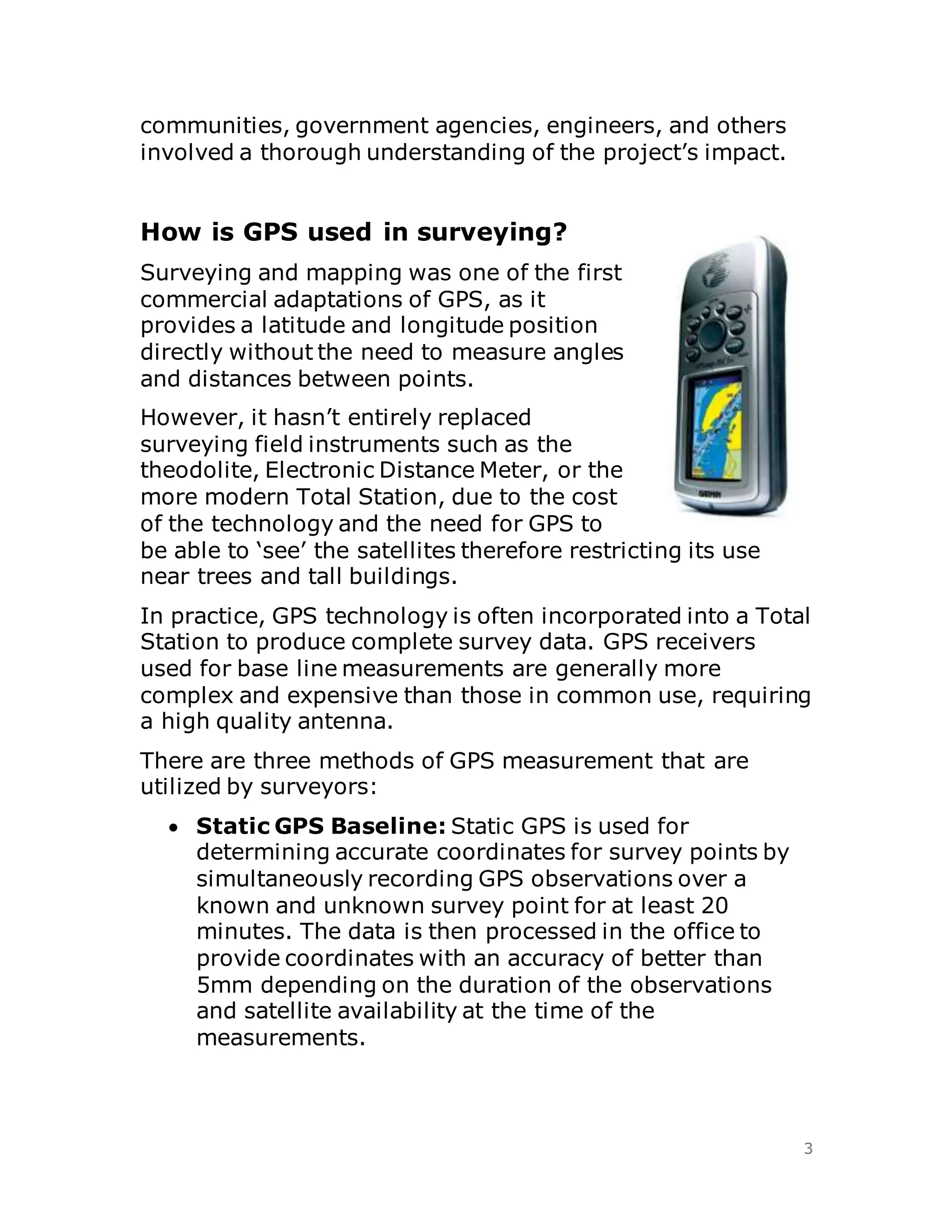
give an instantaneous, real-time position to within
approximately 10m using a single handheld receiver.
GIS
A GIS (Geographic Information System) is a system
designed to capture, store, manipulate, analyze, manage,
and present all types of spatial or geographical data. Also
GIS can be a simple desktop software package, running on a
standalone PC.
Surveyors use GIS to manage the entire planning aspect of
a surveying project. GIS provides the tools necessary to
research, develop, implement, and monitor the progress of a
project and manage site location, environmental impact
mitigation, economic analysis, and other critical facets.
Scenario-based analysis can then be conducted, giving
3
communities, government agencies, engineers, and others
involved a thorough understanding of the project’s impact.
How is GPS used in surveying?
Surveying and mapping was one of the first
commercial adaptations of GPS, as it
provides a latitude and longitude position
directly without the need to measure angles
and distances between points.
However, it hasn’t entirely replaced
surveying field instruments such as the
theodolite, Electronic Distance Meter, or the
more modern Total Station, due to the cost
of the technology and the need for GPS to
be able to ‘see’ the satellites therefore restricting its use
near trees and tall buildings.
In practice, GPS technology is often incorporated into a Total
Station to produce complete survey data. GPS receivers
used for base line measurements are generally more
complex and expensive than those in common use, requiring
a high quality antenna.
There are three methods of GPS measurement that are
utilized by surveyors:
 Static GPS Baseline: Static GPS is used for
determining accurate coordinates for survey points by
simultaneously recording GPS observations over a
known and unknown survey point for at least 20
minutes. The data is then processed in the office to
provide coordinates with an accuracy of better than
5mm depending on the duration of the observations
and satellite availability at the time of the
measurements.
4
 Real Time Kinematic (RTK) Observations: This is
where one receiver remains in one position over a
known point – the Base Station – and another receiver
moves between positions – the Rover Station. The
position of the Rover can be computed and stored
within a few seconds, using a radio link to provide a
coordinate correction. This method gives similar
accuracy to baseline measurements within 10km of the
base station.
 Continuously Operating Reference Stations
(CORS): This where a survey quality GPS receiver is
permanently installed in a location as a starting point
for any GPS measurements in the district. Common
users of CORS are mining sites, major engineering
projects and local governments. Surveyors’ GPS
receivers can then collect field data and combine it with
the CORS data to calculate positions. Many countries
have a CORS network that are used by many
industries. Australia’s CORS network is the Australian
Regional GPS Network, and uses an online processing
system to deliver data over the internet within 24
hours, and give positions within an accuracy of a few
centimeters. Local CORS networks are also used to
provide instant positions similar to the RTK method by
using a mobile phone data link to provide a coordinate
correction to the surveyor and their rover.

How to use GPS and GIS in Surveying - Report

  • 1.
    1 Soran University Faculty ofEngineering - Civil Engineering Department How to use GPS and GIS in Surveying Student: Sarchia Khursheed Group: Date: 16.2.2016 Supervisor: Eng. Anwar Jabbar GPS
  • 2.
    2 Global Positioning System(GPS) is a highly accurate navigation system using signals from satellites to determine a location on the earth's surface, irrespective of weather conditions. It is dependent on GPS satellites high above the Earth which transmit signals containing the time and location of the satellite. Any ground based receiver which receives signals from four or more GPS satellites can use navigation equations to calculate its location on the Earth’s surface. Constant signaling can then update speed and direction information for moving receivers. GPS was originally developed for military use but since the 1990s has been open for civilian use and is now used in such common applications as mobile phones, car navigation systems, and of course surveying and mapping. GPS is owned and operated by the US Department of Defense. Access is free for all users and the service is available 24 hours a day, 365 days a year. GPS is an all- weather system that works anywhere in the world. GPS can give an instantaneous, real-time position to within approximately 10m using a single handheld receiver. GIS A GIS (Geographic Information System) is a system designed to capture, store, manipulate, analyze, manage, and present all types of spatial or geographical data. Also GIS can be a simple desktop software package, running on a standalone PC. Surveyors use GIS to manage the entire planning aspect of a surveying project. GIS provides the tools necessary to research, develop, implement, and monitor the progress of a project and manage site location, environmental impact mitigation, economic analysis, and other critical facets. Scenario-based analysis can then be conducted, giving
  • 3.
    3 communities, government agencies,engineers, and others involved a thorough understanding of the project’s impact. How is GPS used in surveying? Surveying and mapping was one of the first commercial adaptations of GPS, as it provides a latitude and longitude position directly without the need to measure angles and distances between points. However, it hasn’t entirely replaced surveying field instruments such as the theodolite, Electronic Distance Meter, or the more modern Total Station, due to the cost of the technology and the need for GPS to be able to ‘see’ the satellites therefore restricting its use near trees and tall buildings. In practice, GPS technology is often incorporated into a Total Station to produce complete survey data. GPS receivers used for base line measurements are generally more complex and expensive than those in common use, requiring a high quality antenna. There are three methods of GPS measurement that are utilized by surveyors:  Static GPS Baseline: Static GPS is used for determining accurate coordinates for survey points by simultaneously recording GPS observations over a known and unknown survey point for at least 20 minutes. The data is then processed in the office to provide coordinates with an accuracy of better than 5mm depending on the duration of the observations and satellite availability at the time of the measurements.
  • 4.
    4  Real TimeKinematic (RTK) Observations: This is where one receiver remains in one position over a known point – the Base Station – and another receiver moves between positions – the Rover Station. The position of the Rover can be computed and stored within a few seconds, using a radio link to provide a coordinate correction. This method gives similar accuracy to baseline measurements within 10km of the base station.  Continuously Operating Reference Stations (CORS): This where a survey quality GPS receiver is permanently installed in a location as a starting point for any GPS measurements in the district. Common users of CORS are mining sites, major engineering projects and local governments. Surveyors’ GPS receivers can then collect field data and combine it with the CORS data to calculate positions. Many countries have a CORS network that are used by many industries. Australia’s CORS network is the Australian Regional GPS Network, and uses an online processing system to deliver data over the internet within 24 hours, and give positions within an accuracy of a few centimeters. Local CORS networks are also used to provide instant positions similar to the RTK method by using a mobile phone data link to provide a coordinate correction to the surveyor and their rover.