MODERN SURVEYING
TECHNIQUES

Sunil Kumar(111581)
Sunny Jaiswal(111582)
CONTENT
1. Basics of surveying
2. Modern surveying equipments
3. Remote sensing
BASICS OF THE SURVEYING
• Surveying is defined as the science of making
measurements especially of the earth surface. This is
being done by finding out the spatial
location(relative/absolute) of points on or near the
earth surface.
• Different method and instrument are being used to
facilitate the work of surveying.
OBJECTIVE OF SURVEYING
1. To collect field data.
2. To prepare plan or map of the area surveyed.
3. To analyze and calculate the field parameters
for setting out operation of acctual
engineering works .
4. To set out the field parameters at the site for further
engineering works.
MODERN SURVEYING
EQUIPMENT
• Revolutionary changes have taken place in last few
years in surveying instruments that are used for
measuring level differences, distances and angles.
• This has become possible because of introduction of
electronics in these measurements. With rapid
advancements in the technology and availability of
cheaper and innovative electronic components, these
instruments have become affordable and easy to use.
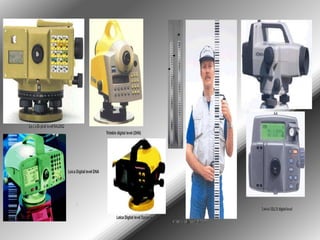
DIGITAL LEVEL
• Recently electronic digital levels have evolved as a
result of development in electronics and digital image
processing.
• Digital levels use electronic image processing to
evaluate the special bar-coded staff reading.
• This bar-coded pattern is converted into elevation and
distance values using a digital image matching
procedure within the instrument.
SALIENT FEATURES OF
DIGITAL LEVEL
• Fatigue-free observation as visual staff reading by the
observer is not required.
• User friendly menus with easy to read, digital display
of results.
• Measurement of consistent precision and reliability
due to automation.
• Automatic data storage eliminates booking and its
associated errors.
• Fast, economic surveys resulting in saving in time (up
to 50% less effort has been claimed by
manufacturers).
• Data on the storage medium of the level can be
downloaded to a computer enabling quick data
reduction for various purposes.
COMPONENTS OF DIGITAL
LEVEL
• The following discussion on digital levels has been
primarily taken from Schoffield (2002).
• Main components of digital level consist of two parts:
Hardware (Digital level and levelling staff) and
Software.
• Both digital level and associated staff are
manufactured so that they can be used for both
conventional and digital operations.
• Typically digital level has the same optical and
mechanical components as a normal automatic level.
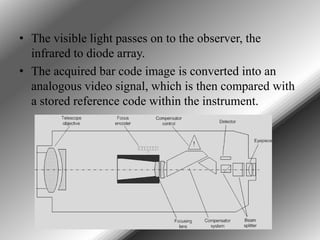
• However, for the purpose of electronic staff reading a
beam splitter is incorporated which transfers the bar
code image to a detector diode array.
• The light, reflected from the white elements only of
the bar code, is divided into infrared and visible light
components by the beam splitter.
• The visible light passes on to the observer, the
infrared to diode array.
• The acquired bar code image is converted into an
analogous video signal, which is then compared with
a stored reference code within the instrument.
• Various capabilities of digital levels are as follows:
1. measuring elevation.
2. measuring height difference.
3. measuring height difference with multiple
instrument positions.
4. levelling
6. setting out with horizontal distance
7. levelling of ceilings
PRINCIPLE OF EDMI
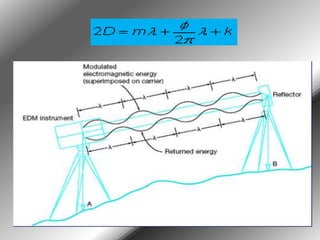
• The general principle involves sending a modulated
Electro-magnetic (EM) beam from one transmitter at
the master station to a reflector at the remote station
and receiving it back at the master station.
• The instrument measures slope distance between
transmitter and receiver by modulating the continuous
carrier wave at different frequencies, and then
measuring the phase difference at the master station
between the outgoing and the incoming signals. This
establishes the following relationship for a double
distance (2D):
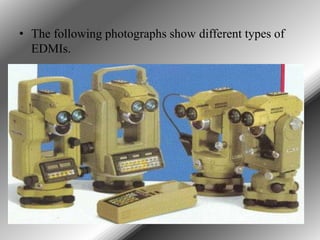
• The following photographs show different types of
EDMIs.
OPERATION WITH EDMI
• Measurement with EDMI involves four basic steps:
(a) Set up
(b) Aim
(c) Measure
(d) Record
• Setting up: The instrument is centered over a station
by means of tribrach. Reflector prisms are set over
the remote station on tribrach.
• Aiming: The instrument is aimed at prisms by using
sighting devices or theodolite telescope. Slow motion
screws are used to intersect the prism centre. Some kind
of electronic sound or beeping signal helps the user to
indicate the status of centering.
• Measurement: The operator presses the measure button
to record the slope distance which is displayed on LCD
panel.
• Recording: The information on LCD panel can be
recorded manually or automatically. All meteorological
parameters are also recorded.
ERROR IN MEASUREMENT
WITH EDMI
1. Instrument errors :
• centering at the master and slave station.
• pointing/sighting of reflector.
• entry of correct values of prevailing atmospheric
conditions.
2. Atmospheric errors :
Meteorological conditions
(temperature, pressure, humidity, etc.) have to be
taken into account to correct for the systematic error
arising due to this. These errors can be removed by
applying an appropriate atmospheric correction model
that takes care of different meteorological parameters
from the standard one.
3. Instrumental error :
Consists of three components - scale error, zero error
and cyclic error. These are systematic in nature
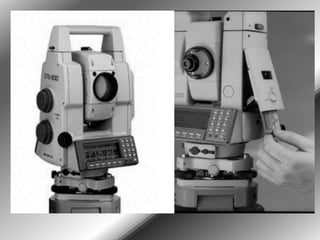
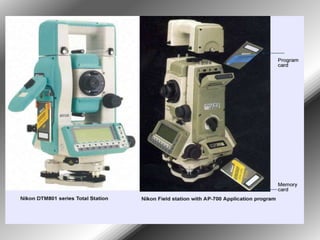
TOTAL STATION
• These instruments can record horizontal and vertical
angles together with slope distance and can be
considered as combined EDM plus electronic
theodolite.
• The microprocessor in TS can perform various
mathematical operations such as averaging, multiple
angle and distance measurements, horizontal and
vertical distances, X, Y, Z coordinates, distance
between observed points and corrections for
atmospheric and instrumental corrections.
• Due to the versatility and the lower cost of electronic
components, future field instruments will be more
like total stations that measure angle and distance
simultaneously having:
all capabilities of theodolites
electronic recording of horizontal and vertical
angles
storage capabilities of all relevant measurements
(spatial and non-spatial attribute data) for
manipulation with computer.
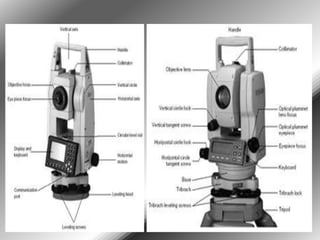
SALIENT FEATURES OF TS
• TS is a fully integrated equipment that captures all the
spatial data necessary for a three-dimensional
position fix.
• The angles and distances are displayed on a digital
readout and can be recorded at the press of a button.
Various components of a typical TS are shown in
Figure:
STORAGE
• Most TS have on-board storage of records using
PCMCIA memory cards of different capacity. The
card memory unit can be connected to any external
computer or to a special card reader for data transfer.
• The observations can also be downloaded directly
into intelligent electronic data loggers. Both systems
can be used in reverse to load information into the
instruments.
• Some instruments and/or data loggers can be
interfaced directly with a computer for immediate
processing and plotting of the data (Kavanagh, 2003).
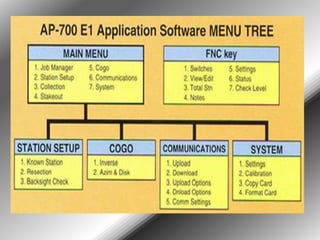
FIELD OPERATION WITH TS
• Various field operations in TS are in the form of wide
variety of programs integrated with microprocessor
and implemented with the help of data collector.
• All these programs need that the instrument station
and at least one reference station be identified so that
all subsequent stations can be identified in terms of
(X, Y, Z). Typical programs include the following
functions:
•
•
•
•
•
•
•
•

Point location
Missing line measurement (MLM)
Resection
Remote distance and elevation measurement
Offset measurements
Layout or setting out operation
Area computation
For details on above functions, one can refer to the
user manual of any TS.
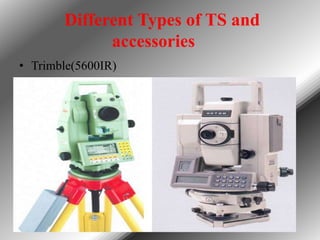
Different Types of TS and
accessories
• Trimble(5600IR)
REMOTE SENSING
• Science and art of obtaining information about an
object, area, or phenomenon through the analysis of
data acquired by a device that is not in contact with
the object, area, or phenomenon under investigation
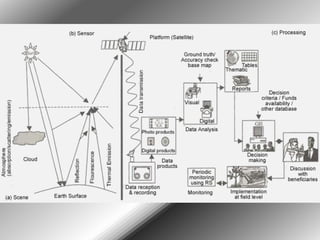
REMOTE SENSING SYESTEM
• A typical remote sensing system consists of the
following sub-systems:
(a) scene
(b) sensor
(c) processing (ground) segment
• Various stages in these sub-systems are indicated in
the next figure.
• The electro-magnetic (EM) energy forms the
fundamental component of a RS system
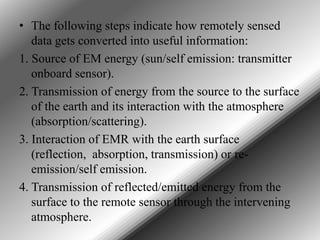
• The following steps indicate how remotely sensed
data gets converted into useful information:
1. Source of EM energy (sun/self emission: transmitter
onboard sensor).
2. Transmission of energy from the source to the surface
of the earth and its interaction with the atmosphere
(absorption/scattering).
3. Interaction of EMR with the earth surface
(reflection, absorption, transmission) or reemission/self emission.
4. Transmission of reflected/emitted energy from the
surface to the remote sensor through the intervening
atmosphere.
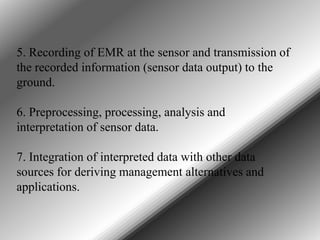
5. Recording of EMR at the sensor and transmission of
the recorded information (sensor data output) to the
ground.
6. Preprocessing, processing, analysis and
interpretation of sensor data.
7. Integration of interpreted data with other data
sources for deriving management alternatives and
applications.
APPLICATION OF REMOTE
SENSING
Agriculture:• Crop condition assessment.
• Crop yield estimation
Urban Planning:• Infrastructure mapping.
• Land use change detection.
• Future urban expansion planning
•
•
•
•

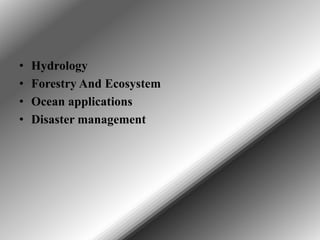
Hydrology
Forestry And Ecosystem
Ocean applications
Disaster management
IN

CYCLONE:

MITIGATION

PREPAREDNESS

RESCUE

RECOVERY

SATELLITES USED:

Risk modelling;
vulnerability analysis.

Early warning;
long-range climate
modelling

Identifying escape routes;
crisis mapping;
impact assessment;
cyclone monitoring;
storm surge predictions.

Damage assessment;
spatial planning.

KALPANA-1;
INSAT-3A; QuikScat
radar; Meteosat

Example:

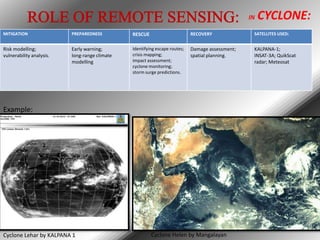
Cyclone Lehar by KALPANA 1

Cyclone Helen by Mangalayan
IN

EARTHQUAKES:

MITIGATION

PREPAREDNESS

RESCUE

RECOVERY

SATELLITES USED

Building stock assessment;
hazard mapping.

Measuring strain
accumulation.

Planning routes for search
and rescue;
damage assessment;
evacuation planning;
deformation mapping.

Damage assessment;
identifying sites for
rehabilitation.

PALSAR;
IKONOS 2;
InSAR; SPOT; IRS

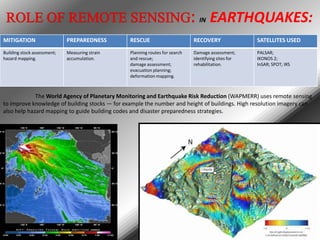
The World Agency of Planetary Monitoring and Earthquake Risk Reduction (WAPMERR) uses remote sensing
to improve knowledge of building stocks — for example the number and height of buildings. High resolution imagery can
also help hazard mapping to guide building codes and disaster preparedness strategies.
IN

FLOODS:

MITIGATION

PREPAREDNESS

RESCUE

RECOVERY

SATELLITES USED

Mapping flood-prone
areas;
delineating flood-plains;
land-use mapping.

Flood detection;
early warning;
rainfall mapping.

Flood mapping;
evacuation planning;
damage assessment.

Damage assessment;
spatial planning.

Tropical Rainfall
Monitoring Mission;
AMSR-E; KALPANA I;

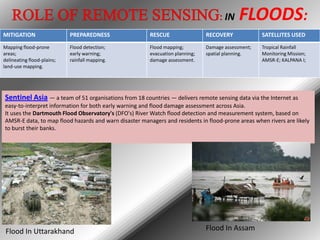
Sentinel Asia — a team of 51 organisations from 18 countries — delivers remote sensing data via the Internet as
easy-to-interpret information for both early warning and flood damage assessment across Asia.
It uses the Dartmouth Flood Observatory's (DFO's) River Watch flood detection and measurement system, based on
AMSR-E data, to map flood hazards and warn disaster managers and residents in flood-prone areas when rivers are likely
to burst their banks.

Flood In Uttarakhand

Flood In Assam
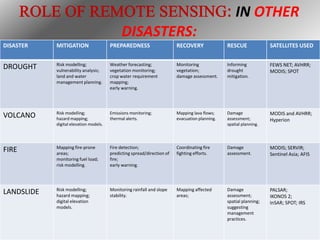
IN OTHER
DISASTERS:
DISASTER

MITIGATION

PREPAREDNESS

RECOVERY

RESCUE

SATELLITES USED

DROUGHT

Risk modelling;
vulnerability analysis;
land and water
management planning.

Weather forecasting;
vegetation monitoring;
crop water requirement
mapping;
early warning.

Monitoring
vegetation;
damage assessment.

Informing
drought
mitigation.

FEWS NET; AVHRR;
MODIS; SPOT

VOLCANO

Risk modelling;
hazard mapping;
digital elevation models.

Emissions monitoring;
thermal alerts.

Mapping lava flows;
evacuation planning.

Damage
assessment;
spatial planning.

MODIS and AVHRR;
Hyperion

FIRE

Mapping fire-prone
areas;
monitoring fuel load;
risk modelling.

Fire detection;
predicting spread/direction of
fire;
early warning.

Coordinating fire
fighting efforts.

Damage
assessment.

MODIS; SERVIR;
Sentinel Asia; AFIS

LANDSLIDE

Risk modelling;
hazard mapping;
digital elevation
models.

Monitoring rainfall and slope
stability.

Mapping affected
areas;

Damage
assessment;
spatial planning;
suggesting
management
practices.

PALSAR;
IKONOS 2;
InSAR; SPOT; IRS
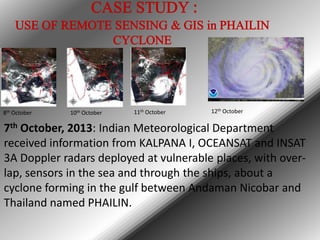
8th October

10th October

11th October

12th October

7th October, 2013: Indian Meteorological Department
received information from KALPANA I, OCEANSAT and INSAT
3A Doppler radars deployed at vulnerable places, with overlap, sensors in the sea and through the ships, about a
cyclone forming in the gulf between Andaman Nicobar and
Thailand named PHAILIN.
8th October, 2013: IMD confirmed cyclone formation and
predicted it as “severe cyclone” and its effects would be felt from
Kalingapatnam in Andhra Pradesh to Paradeep in Odisha, and
that it would probably first strikethe port of Gopalpur in Ganjam
district at about 5 pm on 12 October. The wind speed could touch
200(km/h).
10th October, 2013: IMD prediction of a severe cyclone was
converted to a “very severe cyclonic storm” with wind speeds up
to 220 kmph. the US Navy’s Joint Typhoon Warning Centre
predicted it would have wind speeds up to 315 km/h.
12th October, 2013: The “very severe” cyclonic storm had its
landfall at Gopalpur port at about 9 pm with a wind speed of 200
km/h.

Modern surveying techniques

  • 1.
  • 2.
    CONTENT 1. Basics ofsurveying 2. Modern surveying equipments 3. Remote sensing
  • 3.
    BASICS OF THESURVEYING • Surveying is defined as the science of making measurements especially of the earth surface. This is being done by finding out the spatial location(relative/absolute) of points on or near the earth surface. • Different method and instrument are being used to facilitate the work of surveying.
  • 4.
    OBJECTIVE OF SURVEYING 1.To collect field data. 2. To prepare plan or map of the area surveyed. 3. To analyze and calculate the field parameters for setting out operation of acctual engineering works . 4. To set out the field parameters at the site for further engineering works.
  • 5.
    MODERN SURVEYING EQUIPMENT • Revolutionarychanges have taken place in last few years in surveying instruments that are used for measuring level differences, distances and angles. • This has become possible because of introduction of electronics in these measurements. With rapid advancements in the technology and availability of cheaper and innovative electronic components, these instruments have become affordable and easy to use.
  • 6.
    DIGITAL LEVEL • Recentlyelectronic digital levels have evolved as a result of development in electronics and digital image processing. • Digital levels use electronic image processing to evaluate the special bar-coded staff reading. • This bar-coded pattern is converted into elevation and distance values using a digital image matching procedure within the instrument.
  • 7.
    SALIENT FEATURES OF DIGITALLEVEL • Fatigue-free observation as visual staff reading by the observer is not required. • User friendly menus with easy to read, digital display of results. • Measurement of consistent precision and reliability due to automation. • Automatic data storage eliminates booking and its associated errors.
  • 8.
    • Fast, economicsurveys resulting in saving in time (up to 50% less effort has been claimed by manufacturers). • Data on the storage medium of the level can be downloaded to a computer enabling quick data reduction for various purposes.
  • 9.
    COMPONENTS OF DIGITAL LEVEL •The following discussion on digital levels has been primarily taken from Schoffield (2002). • Main components of digital level consist of two parts: Hardware (Digital level and levelling staff) and Software. • Both digital level and associated staff are manufactured so that they can be used for both conventional and digital operations.
  • 10.
    • Typically digitallevel has the same optical and mechanical components as a normal automatic level. • However, for the purpose of electronic staff reading a beam splitter is incorporated which transfers the bar code image to a detector diode array. • The light, reflected from the white elements only of the bar code, is divided into infrared and visible light components by the beam splitter.
  • 11.
    • The visiblelight passes on to the observer, the infrared to diode array. • The acquired bar code image is converted into an analogous video signal, which is then compared with a stored reference code within the instrument.
  • 12.
    • Various capabilitiesof digital levels are as follows: 1. measuring elevation. 2. measuring height difference. 3. measuring height difference with multiple instrument positions. 4. levelling 6. setting out with horizontal distance 7. levelling of ceilings
  • 14.
    PRINCIPLE OF EDMI •The general principle involves sending a modulated Electro-magnetic (EM) beam from one transmitter at the master station to a reflector at the remote station and receiving it back at the master station. • The instrument measures slope distance between transmitter and receiver by modulating the continuous carrier wave at different frequencies, and then measuring the phase difference at the master station between the outgoing and the incoming signals. This establishes the following relationship for a double distance (2D):
  • 16.
    • The followingphotographs show different types of EDMIs.
  • 17.
    OPERATION WITH EDMI •Measurement with EDMI involves four basic steps: (a) Set up (b) Aim (c) Measure (d) Record • Setting up: The instrument is centered over a station by means of tribrach. Reflector prisms are set over the remote station on tribrach.
  • 18.
    • Aiming: Theinstrument is aimed at prisms by using sighting devices or theodolite telescope. Slow motion screws are used to intersect the prism centre. Some kind of electronic sound or beeping signal helps the user to indicate the status of centering. • Measurement: The operator presses the measure button to record the slope distance which is displayed on LCD panel. • Recording: The information on LCD panel can be recorded manually or automatically. All meteorological parameters are also recorded.
  • 19.
    ERROR IN MEASUREMENT WITHEDMI 1. Instrument errors : • centering at the master and slave station. • pointing/sighting of reflector. • entry of correct values of prevailing atmospheric conditions.
  • 20.
    2. Atmospheric errors: Meteorological conditions (temperature, pressure, humidity, etc.) have to be taken into account to correct for the systematic error arising due to this. These errors can be removed by applying an appropriate atmospheric correction model that takes care of different meteorological parameters from the standard one. 3. Instrumental error : Consists of three components - scale error, zero error and cyclic error. These are systematic in nature
  • 21.
    TOTAL STATION • Theseinstruments can record horizontal and vertical angles together with slope distance and can be considered as combined EDM plus electronic theodolite. • The microprocessor in TS can perform various mathematical operations such as averaging, multiple angle and distance measurements, horizontal and vertical distances, X, Y, Z coordinates, distance between observed points and corrections for atmospheric and instrumental corrections.
  • 22.
    • Due tothe versatility and the lower cost of electronic components, future field instruments will be more like total stations that measure angle and distance simultaneously having: all capabilities of theodolites electronic recording of horizontal and vertical angles storage capabilities of all relevant measurements (spatial and non-spatial attribute data) for manipulation with computer.
  • 23.
    SALIENT FEATURES OFTS • TS is a fully integrated equipment that captures all the spatial data necessary for a three-dimensional position fix. • The angles and distances are displayed on a digital readout and can be recorded at the press of a button. Various components of a typical TS are shown in Figure:
  • 25.
    STORAGE • Most TShave on-board storage of records using PCMCIA memory cards of different capacity. The card memory unit can be connected to any external computer or to a special card reader for data transfer. • The observations can also be downloaded directly into intelligent electronic data loggers. Both systems can be used in reverse to load information into the instruments. • Some instruments and/or data loggers can be interfaced directly with a computer for immediate processing and plotting of the data (Kavanagh, 2003).
  • 27.
    FIELD OPERATION WITHTS • Various field operations in TS are in the form of wide variety of programs integrated with microprocessor and implemented with the help of data collector. • All these programs need that the instrument station and at least one reference station be identified so that all subsequent stations can be identified in terms of (X, Y, Z). Typical programs include the following functions:
  • 28.
    • • • • • • • • Point location Missing linemeasurement (MLM) Resection Remote distance and elevation measurement Offset measurements Layout or setting out operation Area computation For details on above functions, one can refer to the user manual of any TS.
  • 29.
    Different Types ofTS and accessories • Trimble(5600IR)
  • 32.
    REMOTE SENSING • Scienceand art of obtaining information about an object, area, or phenomenon through the analysis of data acquired by a device that is not in contact with the object, area, or phenomenon under investigation
  • 33.
    REMOTE SENSING SYESTEM •A typical remote sensing system consists of the following sub-systems: (a) scene (b) sensor (c) processing (ground) segment • Various stages in these sub-systems are indicated in the next figure. • The electro-magnetic (EM) energy forms the fundamental component of a RS system
  • 35.
    • The followingsteps indicate how remotely sensed data gets converted into useful information: 1. Source of EM energy (sun/self emission: transmitter onboard sensor). 2. Transmission of energy from the source to the surface of the earth and its interaction with the atmosphere (absorption/scattering). 3. Interaction of EMR with the earth surface (reflection, absorption, transmission) or reemission/self emission. 4. Transmission of reflected/emitted energy from the surface to the remote sensor through the intervening atmosphere.
  • 36.
    5. Recording ofEMR at the sensor and transmission of the recorded information (sensor data output) to the ground. 6. Preprocessing, processing, analysis and interpretation of sensor data. 7. Integration of interpreted data with other data sources for deriving management alternatives and applications.
  • 37.
    APPLICATION OF REMOTE SENSING Agriculture:•Crop condition assessment. • Crop yield estimation Urban Planning:• Infrastructure mapping. • Land use change detection. • Future urban expansion planning
  • 38.
  • 39.
    IN CYCLONE: MITIGATION PREPAREDNESS RESCUE RECOVERY SATELLITES USED: Risk modelling; vulnerabilityanalysis. Early warning; long-range climate modelling Identifying escape routes; crisis mapping; impact assessment; cyclone monitoring; storm surge predictions. Damage assessment; spatial planning. KALPANA-1; INSAT-3A; QuikScat radar; Meteosat Example: Cyclone Lehar by KALPANA 1 Cyclone Helen by Mangalayan
  • 40.
    IN EARTHQUAKES: MITIGATION PREPAREDNESS RESCUE RECOVERY SATELLITES USED Building stockassessment; hazard mapping. Measuring strain accumulation. Planning routes for search and rescue; damage assessment; evacuation planning; deformation mapping. Damage assessment; identifying sites for rehabilitation. PALSAR; IKONOS 2; InSAR; SPOT; IRS The World Agency of Planetary Monitoring and Earthquake Risk Reduction (WAPMERR) uses remote sensing to improve knowledge of building stocks — for example the number and height of buildings. High resolution imagery can also help hazard mapping to guide building codes and disaster preparedness strategies.
  • 41.
    IN FLOODS: MITIGATION PREPAREDNESS RESCUE RECOVERY SATELLITES USED Mapping flood-prone areas; delineatingflood-plains; land-use mapping. Flood detection; early warning; rainfall mapping. Flood mapping; evacuation planning; damage assessment. Damage assessment; spatial planning. Tropical Rainfall Monitoring Mission; AMSR-E; KALPANA I; Sentinel Asia — a team of 51 organisations from 18 countries — delivers remote sensing data via the Internet as easy-to-interpret information for both early warning and flood damage assessment across Asia. It uses the Dartmouth Flood Observatory's (DFO's) River Watch flood detection and measurement system, based on AMSR-E data, to map flood hazards and warn disaster managers and residents in flood-prone areas when rivers are likely to burst their banks. Flood In Uttarakhand Flood In Assam
  • 42.
    IN OTHER DISASTERS: DISASTER MITIGATION PREPAREDNESS RECOVERY RESCUE SATELLITES USED DROUGHT Riskmodelling; vulnerability analysis; land and water management planning. Weather forecasting; vegetation monitoring; crop water requirement mapping; early warning. Monitoring vegetation; damage assessment. Informing drought mitigation. FEWS NET; AVHRR; MODIS; SPOT VOLCANO Risk modelling; hazard mapping; digital elevation models. Emissions monitoring; thermal alerts. Mapping lava flows; evacuation planning. Damage assessment; spatial planning. MODIS and AVHRR; Hyperion FIRE Mapping fire-prone areas; monitoring fuel load; risk modelling. Fire detection; predicting spread/direction of fire; early warning. Coordinating fire fighting efforts. Damage assessment. MODIS; SERVIR; Sentinel Asia; AFIS LANDSLIDE Risk modelling; hazard mapping; digital elevation models. Monitoring rainfall and slope stability. Mapping affected areas; Damage assessment; spatial planning; suggesting management practices. PALSAR; IKONOS 2; InSAR; SPOT; IRS
  • 43.
    8th October 10th October 11thOctober 12th October 7th October, 2013: Indian Meteorological Department received information from KALPANA I, OCEANSAT and INSAT 3A Doppler radars deployed at vulnerable places, with overlap, sensors in the sea and through the ships, about a cyclone forming in the gulf between Andaman Nicobar and Thailand named PHAILIN.
  • 44.
    8th October, 2013:IMD confirmed cyclone formation and predicted it as “severe cyclone” and its effects would be felt from Kalingapatnam in Andhra Pradesh to Paradeep in Odisha, and that it would probably first strikethe port of Gopalpur in Ganjam district at about 5 pm on 12 October. The wind speed could touch 200(km/h). 10th October, 2013: IMD prediction of a severe cyclone was converted to a “very severe cyclonic storm” with wind speeds up to 220 kmph. the US Navy’s Joint Typhoon Warning Centre predicted it would have wind speeds up to 315 km/h. 12th October, 2013: The “very severe” cyclonic storm had its landfall at Gopalpur port at about 9 pm with a wind speed of 200 km/h.

Editor's Notes

  • #40 Meteorologists have used satellite images to monitor storms for decades. For example, the World Meteorological Organization's Tropical Cyclone Programme uses satellite observations, together with meteorological measurements and modelling, to produce cyclone warnings. These estimate the storm's position, direction and speed, maximum wind speeds, areas likely to be affected, and likely storm surges. The programme issues these to government officials, river port authorities, the general public, coast guard, non-governmental organisations and cyclone preparedness programmes across the world.
  • #41 Acronyms: Satellite Pour l'Observation de la Terre (SPOT); Thematic Mapper (TM); Advanced Very High Resolution Radiometer (AVHRR); Moderate Resolution Imaging Spectroradiometer (MODIS); Advanced Spaceborne Thermal Emission and Reflection Radiometer (ASTER); Panchromatic Remote-sensing Instrument for Stereo Mapping (PRISM); Synthetic Aperture Radar (SAR); Phased Array type L-band SAR (PALSAR); Tropical Rainfall Measuring Mission (TRMM); Global Precipitation Measurement (GPM); Advanced Microwave Scanning Radiometer (AMSR-E); Atmospheric Infrared Sounder (AIRS)