Traverse Computations
Dr. Mahmood Arshad
Assistant Professor,
Dept. of Mining Engineering,
Faculty of Earth Sciences and
Engineering,
University of Engineering & Technology,
Lahore.
smarshad@uet.edu.pk
Min-E-240 Surveying
Lecture 11 – Week 6
INTRODUCTION
 Adjusting angles or directions to fixed geometric conditions,
 Determining preliminary azimuths (or bearings) of the
traverse lines,
 Calculating departures and latitudes and adjusting them for
misclosure,
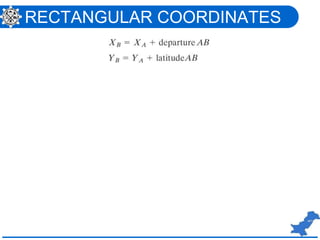
 Computing rectangular coordinates of the traverse stations,
and
 Calculating the lengths and azimuths (or bearings) of the
traverse lines after adjustment.
BALANCING ANGLES
 Method 1:
 Applying an average correction to each angle where
observing conditions were approximately the same at all
stations. The correction for each angle is found by dividing the
total angular misclosure by the number of angles.
 Method 2:
 Making larger corrections to angles where poor observing
conditions were present.
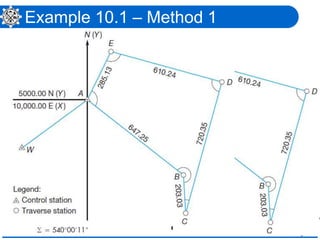
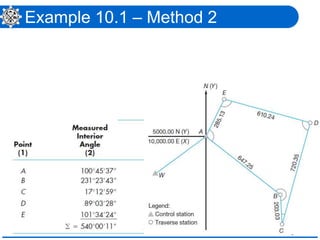
 Example 1:
 For the traverse of Figure (Next Slide), the observed interior
angles are given in Table (Next Slide). Compute the adjusted
angles using methods 1 and 2.
Example 10.1 – Method 1
Example 10.1 – Method 2
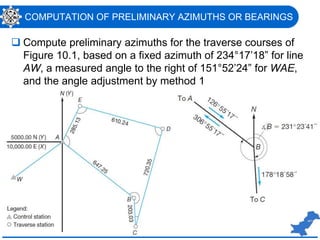
COMPUTATION OF PRELIMINARY AZIMUTHS OR BEARINGS
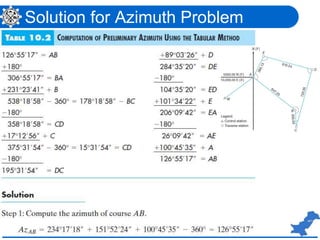
 Compute preliminary azimuths for the traverse courses of
Figure 10.1, based on a fixed azimuth of 234°17’18” for line
AW, a measured angle to the right of 151°52’24” for WAE,
and the angle adjustment by method 1
Solution for Azimuth Problem
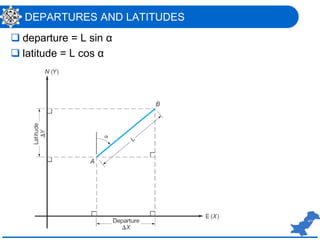
DEPARTURES AND LATITUDES
 departure = L sin α
 latitude = L cos α
DEPARTURE AND LATITUDE CLOSURE CONDITIONS
 Departure misclosure
 Latitude misclosure
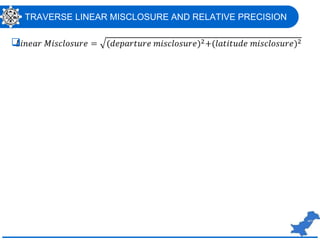
TRAVERSE LINEAR MISCLOSURE AND RELATIVE PRECISION

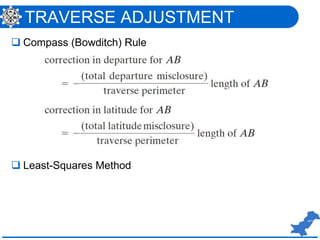
TRAVERSE ADJUSTMENT
 Compass (Bowditch) Rule
 Least-Squares Method
RECTANGULAR COORDINATES
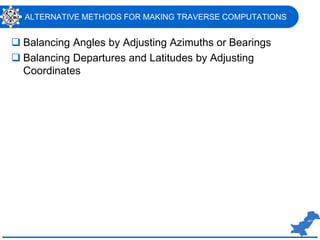
ALTERNATIVE METHODS FOR MAKING TRAVERSE COMPUTATIONS
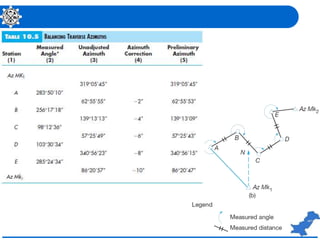
 Balancing Angles by Adjusting Azimuths or Bearings
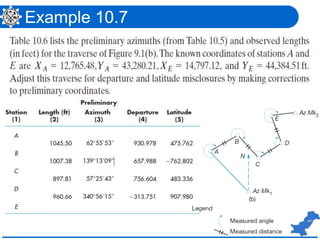
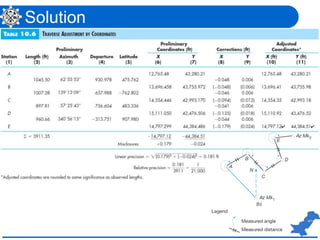
 Balancing Departures and Latitudes by Adjusting
Coordinates
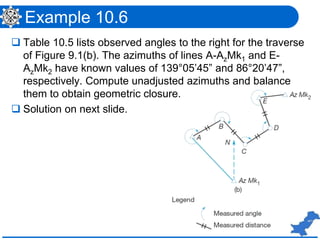
Example 10.6
 Table 10.5 lists observed angles to the right for the traverse
of Figure 9.1(b). The azimuths of lines A-AzMk1 and E-
AzMk2 have known values of 139°05’45” and 86°20’47”,
respectively. Compute unadjusted azimuths and balance
them to obtain geometric closure.
 Solution on next slide.
Example 10.7
Solution
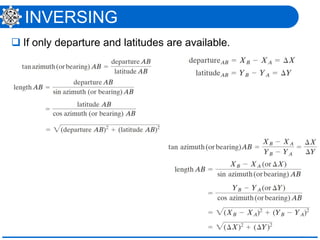
INVERSING
 If only departure and latitudes are available.
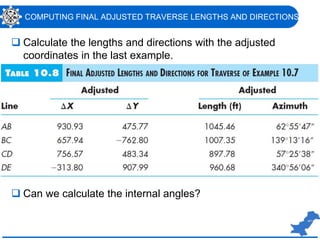
COMPUTING FINAL ADJUSTED TRAVERSE LENGTHS AND DIRECTIONS
 Calculate the lengths and directions with the adjusted
coordinates in the last example.
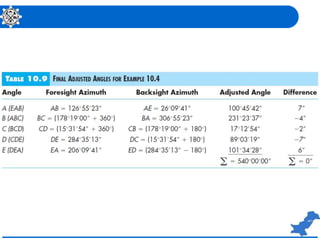
 Can we calculate the internal angles?
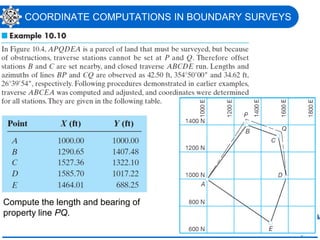
COORDINATE COMPUTATIONS IN BOUNDARY SURVEYS
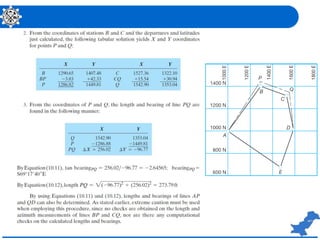
Compute the length and bearing of
property line PQ.
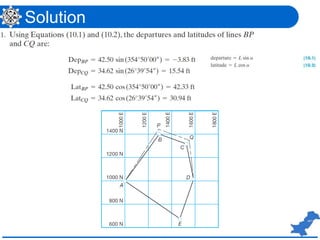
Solution
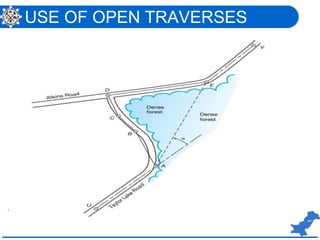
USE OF OPEN TRAVERSES
STATE PLANE COORDINATE SYSTEMS
 We’ll study Pakistan’s Coordinate System someday and
look in to Survey of Pakistan.
TRAVERSE COMPUTATIONS USING COMPUTERS
 We’ll get ourselves introduced with some software as well.

Lecture 11 traverse computations

  • 1.
    Traverse Computations Dr. MahmoodArshad Assistant Professor, Dept. of Mining Engineering, Faculty of Earth Sciences and Engineering, University of Engineering & Technology, Lahore. smarshad@uet.edu.pk Min-E-240 Surveying Lecture 11 – Week 6
  • 2.
    INTRODUCTION  Adjusting anglesor directions to fixed geometric conditions,  Determining preliminary azimuths (or bearings) of the traverse lines,  Calculating departures and latitudes and adjusting them for misclosure,  Computing rectangular coordinates of the traverse stations, and  Calculating the lengths and azimuths (or bearings) of the traverse lines after adjustment.
  • 3.
    BALANCING ANGLES  Method1:  Applying an average correction to each angle where observing conditions were approximately the same at all stations. The correction for each angle is found by dividing the total angular misclosure by the number of angles.  Method 2:  Making larger corrections to angles where poor observing conditions were present.  Example 1:  For the traverse of Figure (Next Slide), the observed interior angles are given in Table (Next Slide). Compute the adjusted angles using methods 1 and 2.
  • 4.
  • 5.
  • 6.
    COMPUTATION OF PRELIMINARYAZIMUTHS OR BEARINGS  Compute preliminary azimuths for the traverse courses of Figure 10.1, based on a fixed azimuth of 234°17’18” for line AW, a measured angle to the right of 151°52’24” for WAE, and the angle adjustment by method 1
  • 7.
  • 8.
    DEPARTURES AND LATITUDES departure = L sin α  latitude = L cos α
  • 9.
    DEPARTURE AND LATITUDECLOSURE CONDITIONS  Departure misclosure  Latitude misclosure
  • 10.
    TRAVERSE LINEAR MISCLOSUREAND RELATIVE PRECISION 
  • 11.
    TRAVERSE ADJUSTMENT  Compass(Bowditch) Rule  Least-Squares Method
  • 12.
  • 13.
    ALTERNATIVE METHODS FORMAKING TRAVERSE COMPUTATIONS  Balancing Angles by Adjusting Azimuths or Bearings  Balancing Departures and Latitudes by Adjusting Coordinates
  • 14.
    Example 10.6  Table10.5 lists observed angles to the right for the traverse of Figure 9.1(b). The azimuths of lines A-AzMk1 and E- AzMk2 have known values of 139°05’45” and 86°20’47”, respectively. Compute unadjusted azimuths and balance them to obtain geometric closure.  Solution on next slide.
  • 16.
  • 17.
  • 18.
    INVERSING  If onlydeparture and latitudes are available.
  • 19.
    COMPUTING FINAL ADJUSTEDTRAVERSE LENGTHS AND DIRECTIONS  Calculate the lengths and directions with the adjusted coordinates in the last example.  Can we calculate the internal angles?
  • 21.
    COORDINATE COMPUTATIONS INBOUNDARY SURVEYS Compute the length and bearing of property line PQ.
  • 22.
  • 24.
    USE OF OPENTRAVERSES
  • 25.
    STATE PLANE COORDINATESYSTEMS  We’ll study Pakistan’s Coordinate System someday and look in to Survey of Pakistan.
  • 26.
    TRAVERSE COMPUTATIONS USINGCOMPUTERS  We’ll get ourselves introduced with some software as well.