Bacteria – Morphology &
Classification

Dr. Ashish Jawarkar
Consultant Pathologist
Parul Sevashram Hospital
Learning Objectives


After completing this section you should be able to
perform the following objectives:


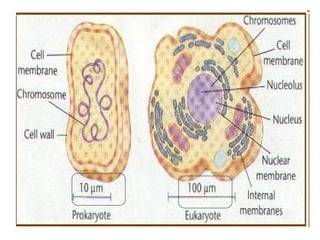
list the differences between prokaryotic and eukaryotic cell



Describe the structure of a bacterial cell and explain the
function of its components



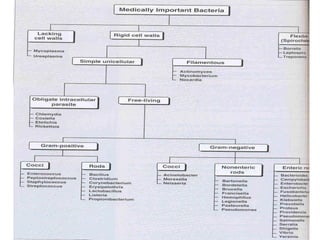
Explain why cell wall forms the basis for classification of
bacteria



Explain the structural modifications (flagella) of the cell and
their functional importance
Dr. Ashish Jawarkar

2
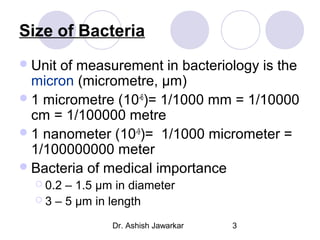
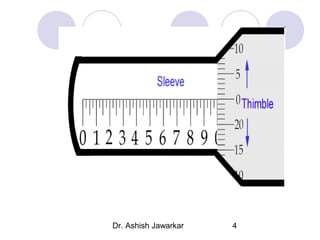
Size of Bacteria
 Unit

of measurement in bacteriology is the
micron (micrometre, µm)
 1 micrometre (10-6)= 1/1000 mm = 1/10000
cm = 1/100000 metre
 1 nanometer (10-9)= 1/1000 micrometer =
1/100000000 meter
 Bacteria of medical importance
 0.2

– 1.5 µm in diameter
 3 – 5 µm in length
Dr. Ashish Jawarkar

3
Dr. Ashish Jawarkar

4
Dr. Ashish Jawarkar

5
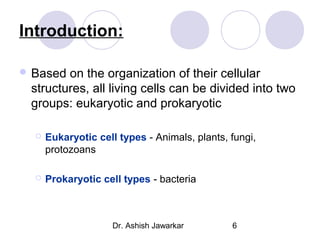
Introduction:
 Based

on the organization of their cellular
structures, all living cells can be divided into two
groups: eukaryotic and prokaryotic


Eukaryotic cell types - Animals, plants, fungi,
protozoans



Prokaryotic cell types - bacteria

Dr. Ashish Jawarkar

6
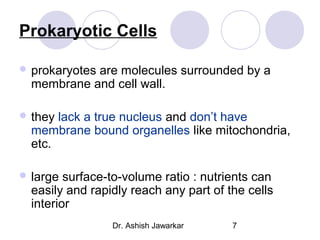
Prokaryotic Cells
 prokaryotes

are molecules surrounded by a
membrane and cell wall.

 they

lack a true nucleus and don’t have
membrane bound organelles like mitochondria,
etc.

 large

surface-to-volume ratio : nutrients can
easily and rapidly reach any part of the cells
interior
Dr. Ashish Jawarkar

7
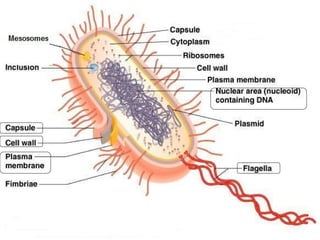
Anatomy of a Bacterial Cell

Dr. Ashish Jawarkar

8
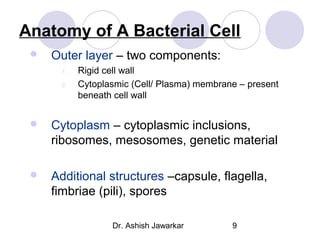
Anatomy of A Bacterial Cell


Outer layer – two components:
1.
2.

Rigid cell wall
Cytoplasmic (Cell/ Plasma) membrane – present
beneath cell wall



Cytoplasm – cytoplasmic inclusions,
ribosomes, mesosomes, genetic material



Additional structures –capsule, flagella,
fimbriae (pili), spores
Dr. Ashish Jawarkar

9
Structure & Function of Cell
Components
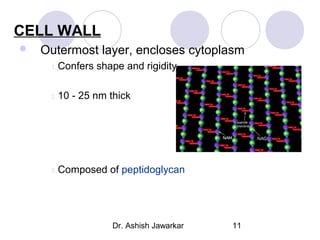
CELL WALL


Outermost layer, encloses cytoplasm
1. Confers

2. 10

shape and rigidity

- 25 nm thick

3. Composed

of peptidoglycan

Dr. Ashish Jawarkar

11
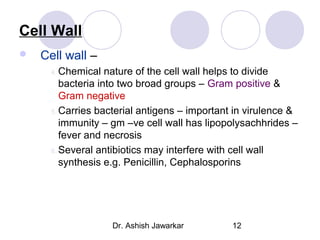
Cell Wall


Cell wall –
4. Chemical

nature of the cell wall helps to divide
bacteria into two broad groups – Gram positive &
Gram negative
5. Carries bacterial antigens – important in virulence &
immunity – gm –ve cell wall has lipopolysachhrides –
fever and necrosis
6. Several antibiotics may interfere with cell wall
synthesis e.g. Penicillin, Cephalosporins

Dr. Ashish Jawarkar

12
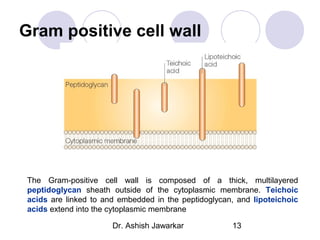
Gram positive cell wall

The Gram-positive cell wall is composed of a thick, multilayered
peptidoglycan sheath outside of the cytoplasmic membrane. Teichoic
acids are linked to and embedded in the peptidoglycan, and lipoteichoic
acids extend into the cytoplasmic membrane
Dr. Ashish Jawarkar

13
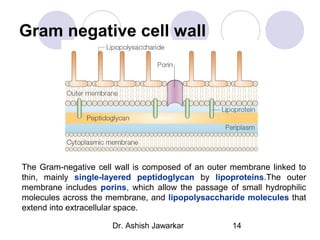
Gram negative cell wall

The Gram-negative cell wall is composed of an outer membrane linked to
thin, mainly single-layered peptidoglycan by lipoproteins.The outer
membrane includes porins, which allow the passage of small hydrophilic
molecules across the membrane, and lipopolysaccharide molecules that
extend into extracellular space.
Dr. Ashish Jawarkar

14
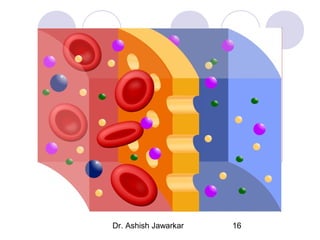
Cytoplasmic (Plasma) membrane


Thin layer 5-10 nm, separates cell wall from
cytoplasm



Acts as a semipermeable membrane: controls
the inflow and outflow of metabolites



Composed of lipoproteins with small amounts of
carbohydrates

Dr. Ashish Jawarkar

15
Dr. Ashish Jawarkar

16
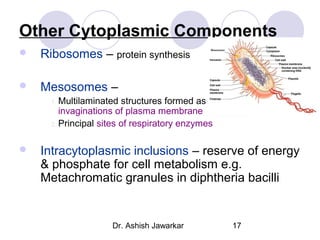
Other Cytoplasmic Components


Ribosomes – protein synthesis


Mesosomes –
Multilaminated structures formed as
invaginations of plasma membrane
2. Principal sites of respiratory enzymes
1.



Intracytoplasmic inclusions – reserve of energy
& phosphate for cell metabolism e.g.
Metachromatic granules in diphtheria bacilli

Dr. Ashish Jawarkar

17
Dr. Ashish Jawarkar

18
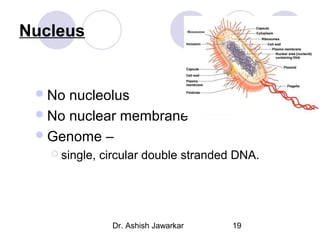
Nucleus

 No

nucleolus
 No nuclear membrane
 Genome –
 single,

circular double stranded DNA.

Dr. Ashish Jawarkar

19
Additional Organelles
1.

Plasmid –





Extranuclear genetic elements consisting of
DNA
Transmitted to daughter cells
Confer certain properties e.g. drug
resistance, toxicity

Dr. Ashish Jawarkar

20
Additional Organelles
2.

Capsule–




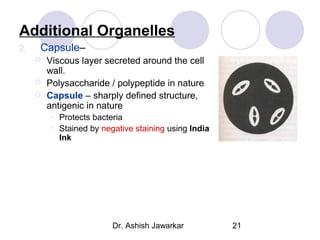
Viscous layer secreted around the cell
wall.
Polysaccharide / polypeptide in nature
Capsule – sharply defined structure,
antigenic in nature
•
•

Protects bacteria
Stained by negative staining using India
Ink

Dr. Ashish Jawarkar

21
Additional Organelles
3.

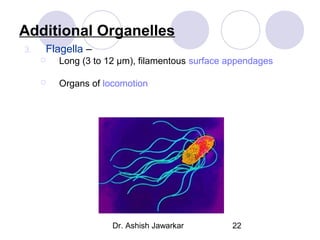
Flagella –


Long (3 to 12 µm), filamentous surface appendages



Organs of locomotion

Dr. Ashish Jawarkar

22
Types of flagellar arrangement
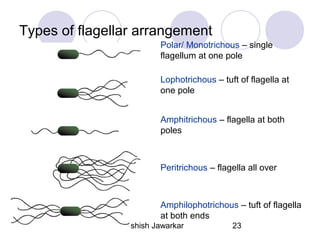
Polar/ Monotrichous – single
flagellum at one pole
Lophotrichous – tuft of flagella at
one pole
Amphitrichous – flagella at both
poles

Peritrichous – flagella all over

Amphilophotrichous – tuft of flagella
at both ends
Dr. Ashish Jawarkar

23
Additional Organelles
4.

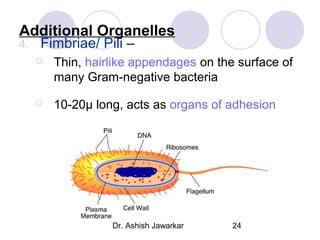
Fimbriae/ Pili –



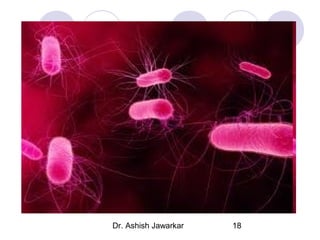
Thin, hairlike appendages on the surface of
many Gram-negative bacteria



10-20µ long, acts as organs of adhesion

Dr. Ashish Jawarkar

24
Additional Organelles
5.

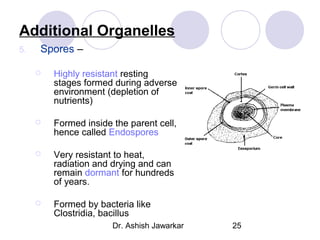
Spores –


Highly resistant resting
stages formed during adverse
environment (depletion of
nutrients)



Formed inside the parent cell,
hence called Endospores



Very resistant to heat,
radiation and drying and can
remain dormant for hundreds
of years.



Formed by bacteria like
Clostridia, bacillus
Dr. Ashish Jawarkar

25
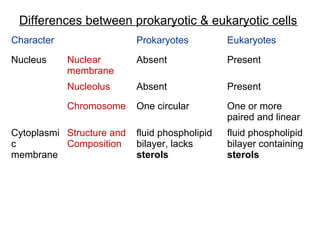
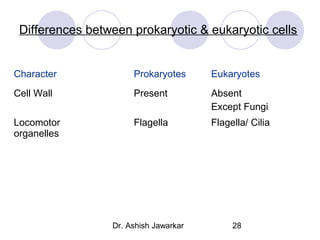
Differences between prokaryotic & eukaryotic cells
Character

Eukaryotes

Nuclear
membrane

Absent

Present

Nucleolus

Absent

Present

Chromosome

Nucleus

Prokaryotes

One circular

One or more
paired and linear

fluid phospholipid
bilayer, lacks
sterols

fluid phospholipid
bilayer containing
sterols

Cytoplasmi Structure and
c
Composition
membrane
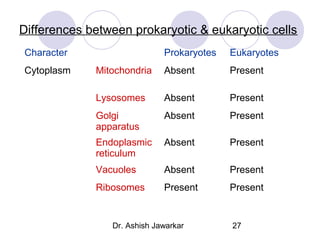
Differences between prokaryotic & eukaryotic cells
Character
Cytoplasm

Prokaryotes

Eukaryotes

Mitochondria

Absent

Present

Lysosomes

Absent

Present

Golgi
apparatus

Absent

Present

Endoplasmic
reticulum

Absent

Present

Vacuoles

Absent

Present

Ribosomes

Present

Present

Dr. Ashish Jawarkar

27
Differences between prokaryotic & eukaryotic cells

Character

Prokaryotes

Eukaryotes

Cell Wall

Present

Absent
Except Fungi

Locomotor
organelles

Flagella

Flagella/ Cilia

Dr. Ashish Jawarkar

28
Dr. Ashish Jawarkar

29
GROWTH AND MULTIPLICATION

Dr. Ashish Jawarkar

30
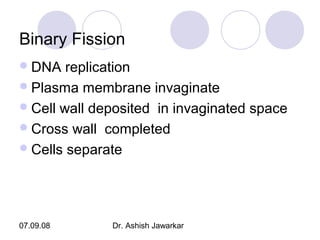
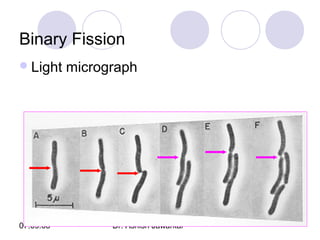
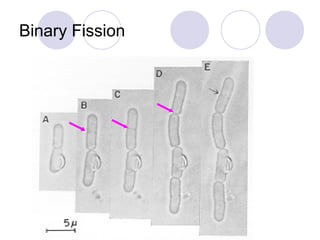
Binary Fission
 DNA

replication
 Plasma membrane invaginate
 Cell wall deposited in invaginated space
 Cross wall completed
 Cells separate

07.09.08

Dr. Ashish Jawarkar
Binary Fission
 Light

07.09.08

micrograph

Dr. Ashish Jawarkar
Binary Fission

Dr. Ashish Jawarkar

33
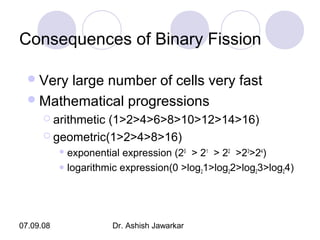
Consequences of Binary Fission
 Very

large number of cells very fast
 Mathematical progressions
 arithmetic

(1>2>4>6>8>10>12>14>16)
 geometric(1>2>4>8>16)
 exponential

expression (20 > 21 > 22 >23>24)
 logarithmic expression(0 >log 1>log 2>log 3>log 4)
2
2
2
2

07.09.08

Dr. Ashish Jawarkar
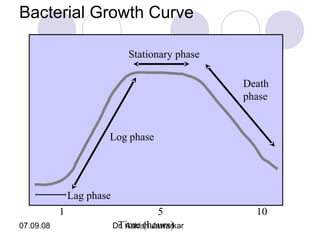
Bacterial Growth Curve
Stationary phase
Death
phase

Log phase

Lag phase
1
07.09.08

5
Time (hours)
Dr. Ashish Jawarkar

10
G: Generation time
Time in minutes or hours for a
population of bacteria to double in
number
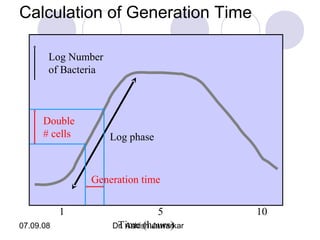
Calculation of Generation Time
Log Number
of Bacteria

Double
# cells

Log phase

Generation time
1
07.09.08

5
Time (hours)
Dr. Ashish Jawarkar

10
GENERATION TIME / population
doubling time
 E-coli

– 20 min
 MTb - 20 hours
 Mleprae - 20 days

Dr. Ashish Jawarkar

38
Minimum Growth requirements
 Water

as a source of carbon
 Nitrogen source
 Inorganic salts like phosphate, sulphate,
sodium, potassium, iron etc – need to be
supplied in culture media

Dr. Ashish Jawarkar

39
 Phototrophs

– derive energy from sunlight
 Chemotrophs – from chemical reactions
 Autotrophs – synthesize organic
compounds
 Heteretrophs – cannot synthesize, depend
on others

Dr. Ashish Jawarkar

40
Oxygen requirement
 Aerobic

– V. cholera
 Anaerobic - Clostridia

Dr. Ashish Jawarkar

41
Carbon dioxide
 All

require
 Some like Brucella, req 5-10% k/a
capnophilic

Dr. Ashish Jawarkar

42
Temperature
 Mesophilic

– 25-40
 Psychrophilc - <20
 Thermophilic – 55-80
 Except thermophilic, most die at 50-60, k/a
thermal death point

Dr. Ashish Jawarkar

43
Other factors
 Moisture
 pH

Dr. Ashish Jawarkar

44

bacterial morphology and classification

  • 1.
    Bacteria – Morphology& Classification Dr. Ashish Jawarkar Consultant Pathologist Parul Sevashram Hospital
  • 2.
    Learning Objectives  After completingthis section you should be able to perform the following objectives:  list the differences between prokaryotic and eukaryotic cell  Describe the structure of a bacterial cell and explain the function of its components  Explain why cell wall forms the basis for classification of bacteria  Explain the structural modifications (flagella) of the cell and their functional importance Dr. Ashish Jawarkar 2
  • 3.
    Size of Bacteria Unit of measurement in bacteriology is the micron (micrometre, µm)  1 micrometre (10-6)= 1/1000 mm = 1/10000 cm = 1/100000 metre  1 nanometer (10-9)= 1/1000 micrometer = 1/100000000 meter  Bacteria of medical importance  0.2 – 1.5 µm in diameter  3 – 5 µm in length Dr. Ashish Jawarkar 3
  • 4.
  • 5.
  • 6.
    Introduction:  Based on theorganization of their cellular structures, all living cells can be divided into two groups: eukaryotic and prokaryotic  Eukaryotic cell types - Animals, plants, fungi, protozoans  Prokaryotic cell types - bacteria Dr. Ashish Jawarkar 6
  • 7.
    Prokaryotic Cells  prokaryotes aremolecules surrounded by a membrane and cell wall.  they lack a true nucleus and don’t have membrane bound organelles like mitochondria, etc.  large surface-to-volume ratio : nutrients can easily and rapidly reach any part of the cells interior Dr. Ashish Jawarkar 7
  • 8.
    Anatomy of aBacterial Cell Dr. Ashish Jawarkar 8
  • 9.
    Anatomy of ABacterial Cell  Outer layer – two components: 1. 2. Rigid cell wall Cytoplasmic (Cell/ Plasma) membrane – present beneath cell wall  Cytoplasm – cytoplasmic inclusions, ribosomes, mesosomes, genetic material  Additional structures –capsule, flagella, fimbriae (pili), spores Dr. Ashish Jawarkar 9
  • 10.
    Structure & Functionof Cell Components
  • 11.
    CELL WALL  Outermost layer,encloses cytoplasm 1. Confers 2. 10 shape and rigidity - 25 nm thick 3. Composed of peptidoglycan Dr. Ashish Jawarkar 11
  • 12.
    Cell Wall  Cell wall– 4. Chemical nature of the cell wall helps to divide bacteria into two broad groups – Gram positive & Gram negative 5. Carries bacterial antigens – important in virulence & immunity – gm –ve cell wall has lipopolysachhrides – fever and necrosis 6. Several antibiotics may interfere with cell wall synthesis e.g. Penicillin, Cephalosporins Dr. Ashish Jawarkar 12
  • 13.
    Gram positive cellwall The Gram-positive cell wall is composed of a thick, multilayered peptidoglycan sheath outside of the cytoplasmic membrane. Teichoic acids are linked to and embedded in the peptidoglycan, and lipoteichoic acids extend into the cytoplasmic membrane Dr. Ashish Jawarkar 13
  • 14.
    Gram negative cellwall The Gram-negative cell wall is composed of an outer membrane linked to thin, mainly single-layered peptidoglycan by lipoproteins.The outer membrane includes porins, which allow the passage of small hydrophilic molecules across the membrane, and lipopolysaccharide molecules that extend into extracellular space. Dr. Ashish Jawarkar 14
  • 15.
    Cytoplasmic (Plasma) membrane  Thinlayer 5-10 nm, separates cell wall from cytoplasm  Acts as a semipermeable membrane: controls the inflow and outflow of metabolites  Composed of lipoproteins with small amounts of carbohydrates Dr. Ashish Jawarkar 15
  • 16.
  • 17.
    Other Cytoplasmic Components  Ribosomes– protein synthesis  Mesosomes – Multilaminated structures formed as invaginations of plasma membrane 2. Principal sites of respiratory enzymes 1.  Intracytoplasmic inclusions – reserve of energy & phosphate for cell metabolism e.g. Metachromatic granules in diphtheria bacilli Dr. Ashish Jawarkar 17
  • 18.
  • 19.
    Nucleus  No nucleolus  Nonuclear membrane  Genome –  single, circular double stranded DNA. Dr. Ashish Jawarkar 19
  • 20.
    Additional Organelles 1. Plasmid –    Extranucleargenetic elements consisting of DNA Transmitted to daughter cells Confer certain properties e.g. drug resistance, toxicity Dr. Ashish Jawarkar 20
  • 21.
    Additional Organelles 2. Capsule–    Viscous layersecreted around the cell wall. Polysaccharide / polypeptide in nature Capsule – sharply defined structure, antigenic in nature • • Protects bacteria Stained by negative staining using India Ink Dr. Ashish Jawarkar 21
  • 22.
    Additional Organelles 3. Flagella –  Long(3 to 12 µm), filamentous surface appendages  Organs of locomotion Dr. Ashish Jawarkar 22
  • 23.
    Types of flagellararrangement Polar/ Monotrichous – single flagellum at one pole Lophotrichous – tuft of flagella at one pole Amphitrichous – flagella at both poles Peritrichous – flagella all over Amphilophotrichous – tuft of flagella at both ends Dr. Ashish Jawarkar 23
  • 24.
    Additional Organelles 4. Fimbriae/ Pili–  Thin, hairlike appendages on the surface of many Gram-negative bacteria  10-20µ long, acts as organs of adhesion Dr. Ashish Jawarkar 24
  • 25.
    Additional Organelles 5. Spores –  Highlyresistant resting stages formed during adverse environment (depletion of nutrients)  Formed inside the parent cell, hence called Endospores  Very resistant to heat, radiation and drying and can remain dormant for hundreds of years.  Formed by bacteria like Clostridia, bacillus Dr. Ashish Jawarkar 25
  • 26.
    Differences between prokaryotic& eukaryotic cells Character Eukaryotes Nuclear membrane Absent Present Nucleolus Absent Present Chromosome Nucleus Prokaryotes One circular One or more paired and linear fluid phospholipid bilayer, lacks sterols fluid phospholipid bilayer containing sterols Cytoplasmi Structure and c Composition membrane
  • 27.
    Differences between prokaryotic& eukaryotic cells Character Cytoplasm Prokaryotes Eukaryotes Mitochondria Absent Present Lysosomes Absent Present Golgi apparatus Absent Present Endoplasmic reticulum Absent Present Vacuoles Absent Present Ribosomes Present Present Dr. Ashish Jawarkar 27
  • 28.
    Differences between prokaryotic& eukaryotic cells Character Prokaryotes Eukaryotes Cell Wall Present Absent Except Fungi Locomotor organelles Flagella Flagella/ Cilia Dr. Ashish Jawarkar 28
  • 29.
  • 30.
  • 31.
    Binary Fission  DNA replication Plasma membrane invaginate  Cell wall deposited in invaginated space  Cross wall completed  Cells separate 07.09.08 Dr. Ashish Jawarkar
  • 32.
  • 33.
  • 34.
    Consequences of BinaryFission  Very large number of cells very fast  Mathematical progressions  arithmetic (1>2>4>6>8>10>12>14>16)  geometric(1>2>4>8>16)  exponential expression (20 > 21 > 22 >23>24)  logarithmic expression(0 >log 1>log 2>log 3>log 4) 2 2 2 2 07.09.08 Dr. Ashish Jawarkar
  • 35.
    Bacterial Growth Curve Stationaryphase Death phase Log phase Lag phase 1 07.09.08 5 Time (hours) Dr. Ashish Jawarkar 10
  • 36.
    G: Generation time Timein minutes or hours for a population of bacteria to double in number
  • 37.
    Calculation of GenerationTime Log Number of Bacteria Double # cells Log phase Generation time 1 07.09.08 5 Time (hours) Dr. Ashish Jawarkar 10
  • 38.
    GENERATION TIME /population doubling time  E-coli – 20 min  MTb - 20 hours  Mleprae - 20 days Dr. Ashish Jawarkar 38
  • 39.
    Minimum Growth requirements Water as a source of carbon  Nitrogen source  Inorganic salts like phosphate, sulphate, sodium, potassium, iron etc – need to be supplied in culture media Dr. Ashish Jawarkar 39
  • 40.
     Phototrophs – deriveenergy from sunlight  Chemotrophs – from chemical reactions  Autotrophs – synthesize organic compounds  Heteretrophs – cannot synthesize, depend on others Dr. Ashish Jawarkar 40
  • 41.
    Oxygen requirement  Aerobic –V. cholera  Anaerobic - Clostridia Dr. Ashish Jawarkar 41
  • 42.
    Carbon dioxide  All require Some like Brucella, req 5-10% k/a capnophilic Dr. Ashish Jawarkar 42
  • 43.
    Temperature  Mesophilic – 25-40 Psychrophilc - <20  Thermophilic – 55-80  Except thermophilic, most die at 50-60, k/a thermal death point Dr. Ashish Jawarkar 43
  • 44.
    Other factors  Moisture pH Dr. Ashish Jawarkar 44

Editor's Notes