POXVIRUSES
Introduction
 Largest viruses that infect vertebrates
 Can be seen under light microscope
 Poxvirus diseases are characterized by skin lesions –
localized or generalized
 Important diseases caused by poxviruses are-
 Smallpox
 Monkeypox
 Cowpox
 Tanapox
 Molluscum contagiosum
Morphology
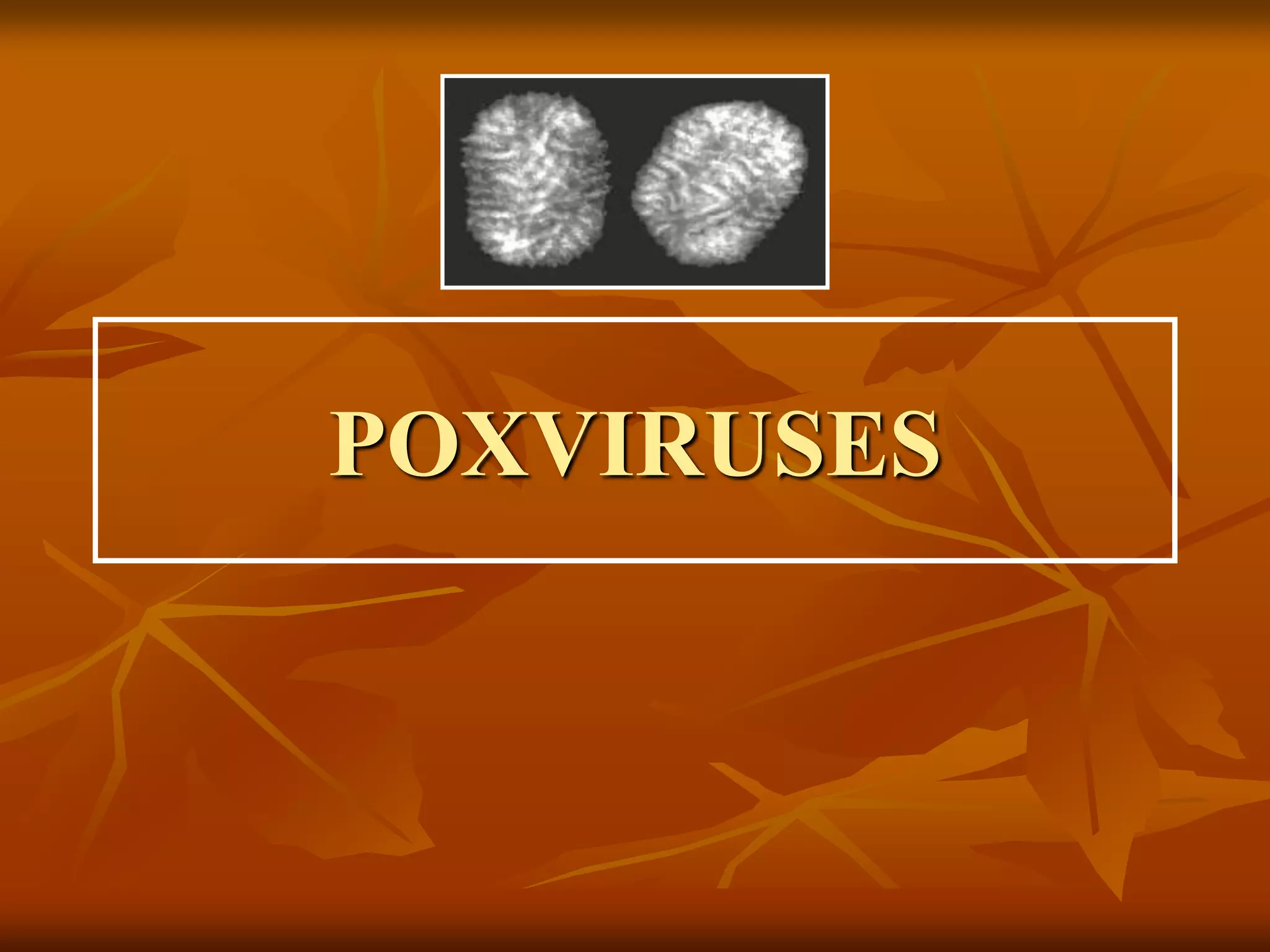
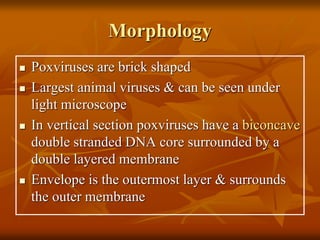
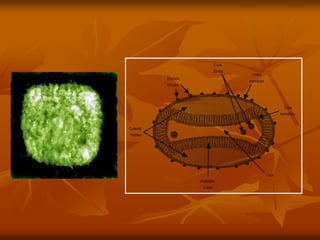
 Poxviruses are brick shaped
 Largest animal viruses & can be seen under
light microscope
 In vertical section poxviruses have a biconcave
double stranded DNA core surrounded by a
double layered membrane
 Envelope is the outermost layer & surrounds
the outer membrane
Resistance
 May remain viable for months at room temp.
 Survive for years in freeze dried form
 They are susceptible to UV light & are
 Resistant to 1% phenol but readily inactivated
by formalin
 Though poxviruses are enveloped, they are not
inactivated by ether
Antigenic Structure
 All poxviruses share a common nucleoprotein
(NP) antigen
 Other antigens include –
• LS antigen - a complex of the heat labile (L)
and the heat stable (S) antigens
• Agglutinogen
• Haemagglutinin
Cultivation
 They grow in chorioallantoic membrane
(CAM) of chick embryo and in tissue culture
 Variola and vaccinia viruses produce pocks on
the CAM in 48-72 hours
 Variola pocks are small, shiny ,white, convex,
non-necrotic & non-hemorrhagic
 Vaccinia pocks are larger, irregular, grayish,
flat, necrotic & sometimes hemorrhagic

Cultivation………
 Tissue culture of monkey kidneys
 HeLa & chick embryo cells can be used
 Cytopathic effects are produced by vaccinia in
24-48hrs but variola takes longer time to
produce these changes
 Eosinophilic inclusion bodies (Guarnieri
bodies) can be seen in stained preparations
Diseases caused by Pox Viruses
 Small Pox
 Vaccinia
 Monkeypox
 Cow Pox
 Milker’s Node
 Molluscum Contagiosum
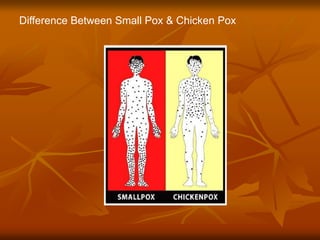
Difference Between Small Pox & Chicken Pox
Small Pox
 An infectious disease unique to humans, caused by
either of two virus variants, Variola major and
Variola minor.
 localizes in small blood vessels of the skin and in
the mouth and throat.
 in the skin, this results in a characteristic
maculopapular rash, and later, raised fluid-filled
blisters. V. major produces a more serious disease
and has an overall mortality rate of 30–35%. V.
minor causes a milder form of disease
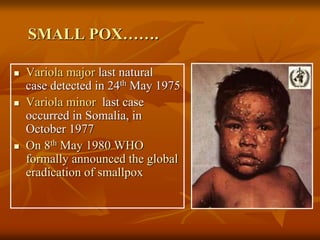
SMALL POX…….
 Variola major last natural
case detected in 24th May 1975
 Variola minor last case
occurred in Somalia, in
October 1977
 On 8th May 1980 WHO
formally announced the global
eradication of smallpox
Eradication achieved because of -
 No sub-clinical infection or carrier state
 An effective vaccine – originally discovered
by Jenner in 1796
 No animal reservoir
 Aggressive surveillance-containment measures
 Two laboratories still hold the stock of variola
virus – WHO Collaboration Centre in Atlanta,
USA & Koltsovo, Russian Federation
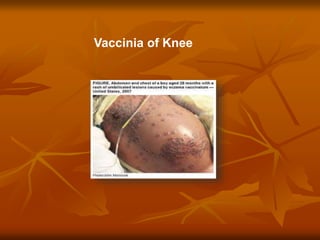
Vaccinia of Knee
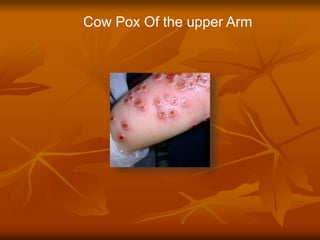
Cow Pox Of the upper Arm
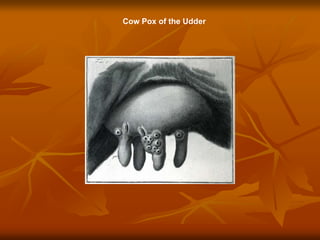
Cow Pox of the Udder
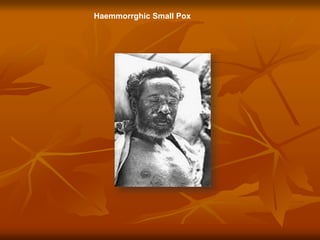
Haemmorrghic Small Pox
VACCINIA VIRUS
 Vccinia virus was used for small pox
vaccination
 It may have evolved from cowpox or smallpox
virus
 It causes a localized skin infection
 Employed as a vector for the development of
recombinant vaccines
Prophylaxis of Smallpox
 Both variola & vaccinia viruses can be grown
on CAM of chick embryo
 Vaccination with vaccinia induces protection
against smallpox for about five years
 Natural infection of smallpox gives complete
protection against re-infection
Cowpox
 Produces ulcers on the teats & udders
 Human infection acquired by the process of
milking
 Localized lesions on the hands of man
 Undergo changes from macules to pustules
 Rodents are the reservoir hosts of cowpox
virus
Human Monkeypox
 Infection acquired by handling infected
animals
 Resembles mild smallpox
Human MonkeyPox
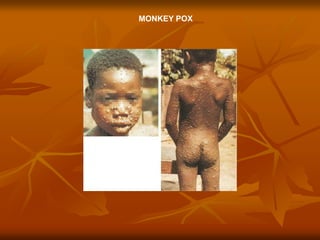
 Monkey pox - is a rare smallpox like disease
of children in central Africa. It is acquired
from monkeys but does occasionally spread
from man to man in unvaccinated
communities. Antigenically it cross-reacts
with other poxviruses.
MONKEY POX
Orf
 It is a contagious pustular dermatitis of sheep
& goats
 In man , disease occurs as a single lesion on
finger or hand or occasionally on the face
ORF
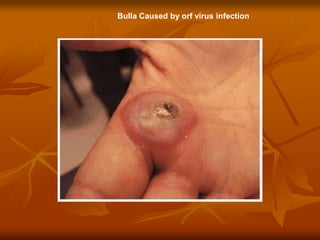
 ORF - a worldwide occupational disease
associated with handling sheep and goats
afflicted ". In humans it manifests as a single
painless, papulo-vesicular lesion on the hand,
forearm or face.
Bulla Caused by orf virus infection
Milker Node
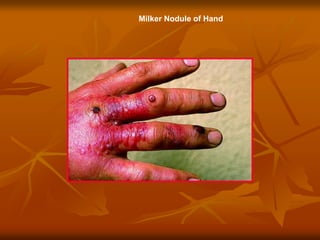
 Pseudocowpox - occurs worldwide and is a
disease primarily of cattle. In humans it
causes non-ulcerating "milker's nodes".
Milker Nodule of Hand
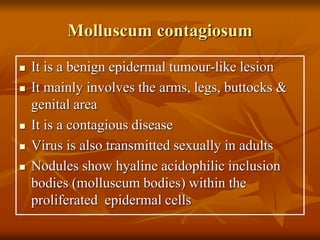
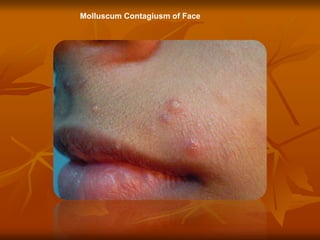
Molluscum contagiosum
 It is a benign epidermal tumour-like lesion
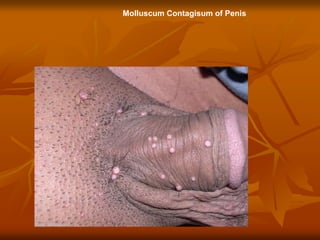
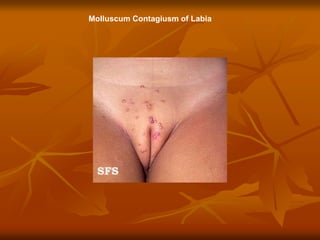
 It mainly involves the arms, legs, buttocks &
genital area
 It is a contagious disease
 Virus is also transmitted sexually in adults
 Nodules show hyaline acidophilic inclusion
bodies (molluscum bodies) within the
proliferated epidermal cells
Molluscum Contagiusm of Face
Molluscum Contagisum of Penis
Molluscum Contagiusm of Labia
Prophylaxis
 Vaccination with vaccinia induces protection
against small pox .
POXVIRUSES.ppt

POXVIRUSES.ppt

  • 1.
  • 2.
    Introduction  Largest virusesthat infect vertebrates  Can be seen under light microscope  Poxvirus diseases are characterized by skin lesions – localized or generalized  Important diseases caused by poxviruses are-  Smallpox  Monkeypox  Cowpox  Tanapox  Molluscum contagiosum
  • 3.
    Morphology  Poxviruses arebrick shaped  Largest animal viruses & can be seen under light microscope  In vertical section poxviruses have a biconcave double stranded DNA core surrounded by a double layered membrane  Envelope is the outermost layer & surrounds the outer membrane
  • 5.
    Resistance  May remainviable for months at room temp.  Survive for years in freeze dried form  They are susceptible to UV light & are  Resistant to 1% phenol but readily inactivated by formalin  Though poxviruses are enveloped, they are not inactivated by ether
  • 6.
    Antigenic Structure  Allpoxviruses share a common nucleoprotein (NP) antigen  Other antigens include – • LS antigen - a complex of the heat labile (L) and the heat stable (S) antigens • Agglutinogen • Haemagglutinin
  • 7.
    Cultivation  They growin chorioallantoic membrane (CAM) of chick embryo and in tissue culture  Variola and vaccinia viruses produce pocks on the CAM in 48-72 hours  Variola pocks are small, shiny ,white, convex, non-necrotic & non-hemorrhagic  Vaccinia pocks are larger, irregular, grayish, flat, necrotic & sometimes hemorrhagic
  • 8.
    Cultivation………  Tissue cultureof monkey kidneys  HeLa & chick embryo cells can be used  Cytopathic effects are produced by vaccinia in 24-48hrs but variola takes longer time to produce these changes  Eosinophilic inclusion bodies (Guarnieri bodies) can be seen in stained preparations
  • 9.
    Diseases caused byPox Viruses  Small Pox  Vaccinia  Monkeypox  Cow Pox  Milker’s Node  Molluscum Contagiosum
  • 10.
    Difference Between SmallPox & Chicken Pox
  • 11.
    Small Pox  Aninfectious disease unique to humans, caused by either of two virus variants, Variola major and Variola minor.  localizes in small blood vessels of the skin and in the mouth and throat.  in the skin, this results in a characteristic maculopapular rash, and later, raised fluid-filled blisters. V. major produces a more serious disease and has an overall mortality rate of 30–35%. V. minor causes a milder form of disease
  • 12.
    SMALL POX…….  Variolamajor last natural case detected in 24th May 1975  Variola minor last case occurred in Somalia, in October 1977  On 8th May 1980 WHO formally announced the global eradication of smallpox
  • 13.
    Eradication achieved becauseof -  No sub-clinical infection or carrier state  An effective vaccine – originally discovered by Jenner in 1796  No animal reservoir  Aggressive surveillance-containment measures  Two laboratories still hold the stock of variola virus – WHO Collaboration Centre in Atlanta, USA & Koltsovo, Russian Federation
  • 14.
  • 15.
    Cow Pox Ofthe upper Arm
  • 16.
    Cow Pox ofthe Udder
  • 17.
  • 18.
    VACCINIA VIRUS  Vcciniavirus was used for small pox vaccination  It may have evolved from cowpox or smallpox virus  It causes a localized skin infection  Employed as a vector for the development of recombinant vaccines
  • 19.
    Prophylaxis of Smallpox Both variola & vaccinia viruses can be grown on CAM of chick embryo  Vaccination with vaccinia induces protection against smallpox for about five years  Natural infection of smallpox gives complete protection against re-infection
  • 20.
    Cowpox  Produces ulcerson the teats & udders  Human infection acquired by the process of milking  Localized lesions on the hands of man  Undergo changes from macules to pustules  Rodents are the reservoir hosts of cowpox virus
  • 21.
    Human Monkeypox  Infectionacquired by handling infected animals  Resembles mild smallpox
  • 22.
    Human MonkeyPox  Monkeypox - is a rare smallpox like disease of children in central Africa. It is acquired from monkeys but does occasionally spread from man to man in unvaccinated communities. Antigenically it cross-reacts with other poxviruses.
  • 23.
  • 24.
    Orf  It isa contagious pustular dermatitis of sheep & goats  In man , disease occurs as a single lesion on finger or hand or occasionally on the face
  • 25.
    ORF  ORF -a worldwide occupational disease associated with handling sheep and goats afflicted ". In humans it manifests as a single painless, papulo-vesicular lesion on the hand, forearm or face.
  • 26.
    Bulla Caused byorf virus infection
  • 27.
    Milker Node  Pseudocowpox- occurs worldwide and is a disease primarily of cattle. In humans it causes non-ulcerating "milker's nodes".
  • 28.
  • 29.
    Molluscum contagiosum  Itis a benign epidermal tumour-like lesion  It mainly involves the arms, legs, buttocks & genital area  It is a contagious disease  Virus is also transmitted sexually in adults  Nodules show hyaline acidophilic inclusion bodies (molluscum bodies) within the proliferated epidermal cells
  • 30.
  • 31.
  • 32.
  • 33.
    Prophylaxis  Vaccination withvaccinia induces protection against small pox .