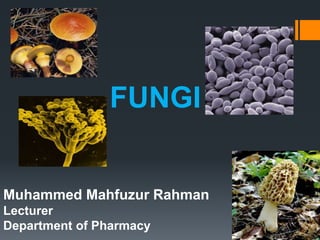
FUNGI 
Muhammed Mahfuzur Rahman 
Lecturer 
Department of Pharmacy
Introduction 
 Fungi is the plural of fungus. 
 A member of a large group of eukaryotic organisms. 
 Familiar as mushrooms. 
 These organisms are classified as a kingdom, Fungi, which is separate from 
plants, animals, protists and bacteria. 
 One major difference is that fungal cells have cell walls that contain chitin, unlike 
the cell walls of plants and some protists, which contain cellulose, and unlike the 
cell walls of bacteria. 
 The study of fungi is known as MYCOLOGY. Mycology has often been regarded 
as a branch of botany, even though it is a separate kingdom in biological 
taxonomy. 
 Genetic studies have shown that fungi are more closely related to animals than 
to plants.
Intro... Contd. 
 However, little is known of the true biodiversity of Kingdom Fungi, which has been 
estimated at 1.5 million to 5 million species, with about 5% of these having been 
formally classified. 
 Ever since the pioneering 18th and 19th century taxonomical works of Carl Linnaeus, 
Christian Hendrik Persoon, and Elias Magnus Fries, fungi have been classified 
according to their morphology or physiology. 
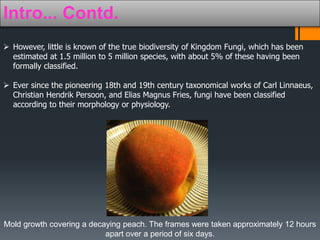
Mold growth covering a decaying peach. The frames were taken approximately 12 hours 
apart over a period of six days.
Morphological Characteristics of Fungi 
 Non-motile eukaryotic organisms which exists as saprophytes, parasites. 
 Posses differentiated nuclei surrounded by a nuclear membrane. 
 Reproduce either by budding or by forming spores. 
 Nonphotosynthetic (heterotrophic). 
 Morphologically may be either simple oval cells or long tubular septate hyphae showing true 
lateral branching. 
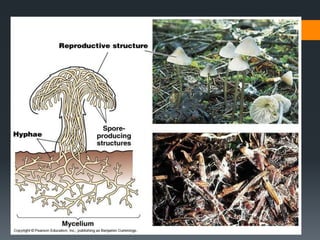
 Most fungi grow as thread-like filamentous microscopic structures called hyphae (which are 
microscopic filaments between 2–10 μm in diameter and up to several centimeters in length) 
and which collectively form the mycelium (aggregates of hyphae). 
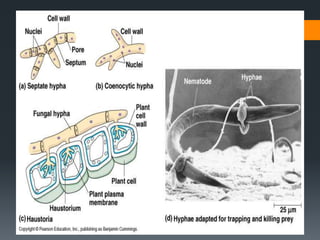
 Hyphae can be septate, i.e., divided into compartments separated by a septum, each 
compartment containing one or more nuclei, or can be coenocytic, i.e., lacking hyphal 
compartmentalization. 
 May be unicellular or multicellular. 
 Most are microscopic molds or yeasts.
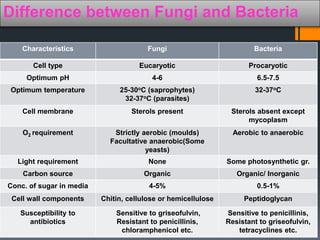
Difference between Fungi and Bacteria 
Characteristics Fungi Bacteria 
Cell type Eucaryotic Procaryotic 
Optimum pH 4-6 6.5-7.5 
Optimum temperature 25-30oC (saprophytes) 
32-37oC (parasites) 
32-37oC 
Cell membrane Sterols present Sterols absent except 
mycoplasm 
O2 requirement Strictly aerobic (moulds) 
Facultative anaerobic(Some 
yeasts) 
Aerobic to anaerobic 
Light requirement None Some photosynthetic gr. 
Carbon source Organic Organic/ Inorganic 
Conc. of sugar in media 4-5% 0.5-1% 
Cell wall components Chitin, cellulose or hemicellulose Peptidoglycan 
Susceptibility to 
antibiotics 
Sensitive to griseofulvin, 
Resistant to penicillinis, 
chloramphenicol etc. 
Sensitive to penicillinis, 
Resistant to griseofulvin, 
tetracyclines etc.
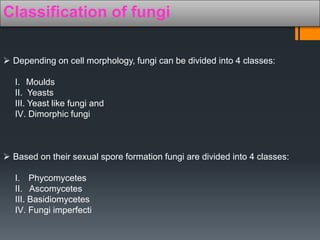
Classification of fungi 
 Depending on cell morphology, fungi can be divided into 4 classes: 
I. Moulds 
II. Yeasts 
III. Yeast like fungi and 
IV. Dimorphic fungi 
 Based on their sexual spore formation fungi are divided into 4 classes: 
I. Phycomycetes 
II. Ascomycetes 
III. Basidiomycetes 
IV. Fungi imperfecti
1. Moulds 
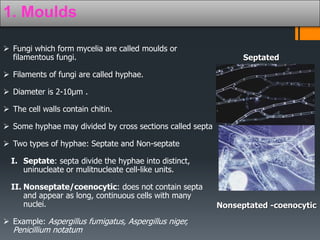
 Fungi which form mycelia are called moulds or 
filamentous fungi. 
 Filaments of fungi are called hyphae. 
 Diameter is 2-10μm . 
 The cell walls contain chitin. 
 Some hyphae may divided by cross sections called septa 
 Two types of hyphae: Septate and Non-septate 
I. Septate: septa divide the hyphae into distinct, 
uninucleate or mulitnucleate cell-like units. 
II. Nonseptate/coenocytic: does not contain septa 
and appear as long, continuous cells with many 
nuclei. 
 Example: Aspergillus fumigatus, Aspergillus niger, 
Penicillium notatum 
Septated 
Nonseptated -coenocytic
2. Yeasts 
 Round, oval or elongated, unicellular 
fungi 
 Reproduce by an asexual process 
called budding in which the cell 
develops a protuberance which 
enlarges and eventually separates 
from the parent cell 
 On culture they form smooth, creamy 
colonies 
 Example: Saccharomyces cerevisae, 
Cryptococcus neoformans
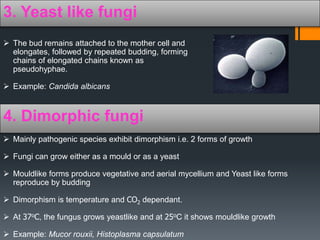
3. Yeast like fungi 
 The bud remains attached to the mother cell and 
elongates, followed by repeated budding, forming 
chains of elongated chains known as 
pseudohyphae. 
 Example: Candida albicans 
4. Dimorphic fungi 
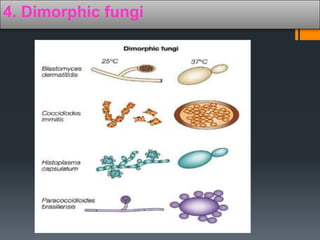
 Mainly pathogenic species exhibit dimorphism i.e. 2 forms of growth 
 Fungi can grow either as a mould or as a yeast 
 Mouldlike forms produce vegetative and aerial mycellium and Yeast like forms 
reproduce by budding 
 Dimorphism is temperature and CO2 dependant. 
 At 37oC, the fungus grows yeastlike and at 25oC it shows mouldlike growth 
 Example: Mucor rouxii, Histoplasma capsulatum
4. Dimorphic fungi
1. Phycomycetes 
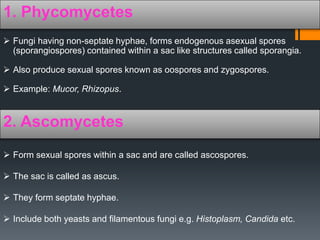
 Fungi having non-septate hyphae, forms endogenous asexual spores 
(sporangiospores) contained within a sac like structures called sporangia. 
 Also produce sexual spores known as oospores and zygospores. 
 Example: Mucor, Rhizopus. 
2. Ascomycetes 
 Form sexual spores within a sac and are called ascospores. 
 The sac is called as ascus. 
 They form septate hyphae. 
 Include both yeasts and filamentous fungi e.g. Histoplasm, Candida etc.
3. Basidiomycetes 
 Reproduce sexually and form septate hyphae. 
 These basidiospores are borne at the tip of the basidium 
 Example: Cryptococcus neoformans 
4. Fungi imperfecti 
 Also called as Deuteromycetes or Hyphomycetes. 
 Consist of group of fungi whose sexual phases have not been 
identified and they form septate hyphae and asexual conidia. 
 Majority of the pathogenic moulds, yeasts, yeasts like fungi and 
dimorphic fungi. 
 Example: Trichophyton, Epidermophyton
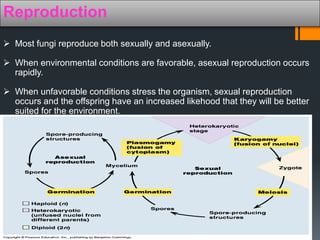
Reproduction 
 Most fungi reproduce both sexually and asexually. 
 When environmental conditions are favorable, asexual reproduction occurs 
rapidly. 
 When unfavorable conditions stress the organism, sexual reproduction 
occurs and the offspring have an increased likehood that they will be better 
suited for the environment.
Asexual Reproduction 
 Production of various types of spores 
 Sporangiophores 
 Upright stalk with an enclosed sac (bread mold) 
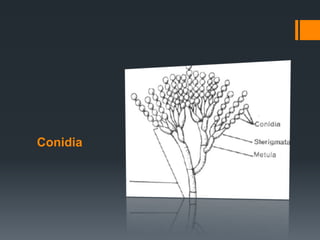
 Conidia 
 Upright stalk with no enclosed sac (penicillin) 
 Fragmentation 
 Hyphae dry out and shatter releasing individual cells that 
act like spores (athlete’s foot) 
 Budding 
 Small offspring
Sporangiophores
Conidia
Budding
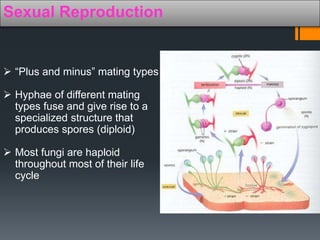
Sexual Reproduction 
 “Plus and minus” mating types 
 Hyphae of different mating 
types fuse and give rise to a 
specialized structure that 
produces spores (diploid) 
 Most fungi are haploid 
throughout most of their life 
cycle
Classification of Fungal Infections 
 When fungi do pass the resistance barriers of the human body 
and establish infections, the infections are classified according 
to the tissue levels initially colonized. 
 Systemic mycoses 
 Opportunistic mycoses 
 Superficial mycoses 
 Cutaneous mycoses 
 Sub-cutaneous mycoses
Systemic Mycoses 
 Fungal infections that enter into the body and invade internal 
organs are called systemic mycoses. 
 Infection can arise from inhalation of fungal spores, although 
such cases are not usually life threatening. 
 Most people that suffer from a systemic fungal infection are 
usually sick already. 
 The fungus is said to be ‘opportunistic’ because if the person 
was healthy the fungus would not usually cause any serious 
harm. 
 If someone is sick the body is less able to defend itself against 
pathogenic organisms, they therefore have an increased risk of 
susceptibility to infectious fungi.
Mycoses by Aspergillus 
 Bronchopulmonary aspergillosis, the fungus grows within the 
lumen of the bronchiloes. 
 Colonising aspergillosis developes in pre-existing pulmonary 
cavities such as TB or cystic disease. 
 If they remains in these cavities it grows into a huge mass of 
mycelium in the form of fungus ball, may be needed to removed 
surgically. 
 Treatment 
 Amphotericin B 
 Importance 
 Used in industries for the production of citric acid and 
gluconic acid
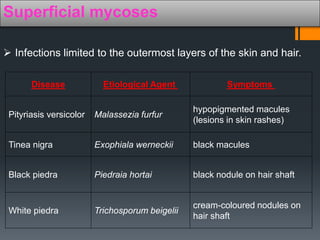
Superficial mycoses 
 Infections limited to the outermost layers of the skin and hair. 
Disease Etiological Agent Symptoms 
Pityriasis versicolor Malassezia furfur 
hypopigmented macules 
(lesions in skin rashes) 
Tinea nigra Exophiala werneckii black macules 
Black piedra Piedraia hortai black nodule on hair shaft 
White piedra Trichosporum beigelii 
cream-coloured nodules on 
hair shaft
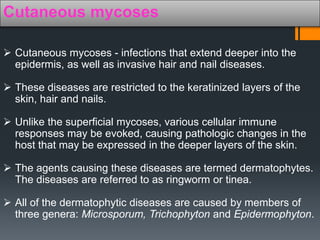
Cutaneous mycoses 
 Cutaneous mycoses - infections that extend deeper into the 
epidermis, as well as invasive hair and nail diseases. 
 These diseases are restricted to the keratinized layers of the 
skin, hair and nails. 
 Unlike the superficial mycoses, various cellular immune 
responses may be evoked, causing pathologic changes in the 
host that may be expressed in the deeper layers of the skin. 
 The agents causing these diseases are termed dermatophytes. 
The diseases are referred to as ringworm or tinea. 
 All of the dermatophytic diseases are caused by members of 
three genera: Microsporum, Trichophyton and Epidermophyton.
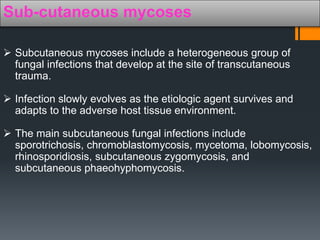
Sub-cutaneous mycoses 
 Subcutaneous mycoses include a heterogeneous group of 
fungal infections that develop at the site of transcutaneous 
trauma. 
 Infection slowly evolves as the etiologic agent survives and 
adapts to the adverse host tissue environment. 
 The main subcutaneous fungal infections include 
sporotrichosis, chromoblastomycosis, mycetoma, lobomycosis, 
rhinosporidiosis, subcutaneous zygomycosis, and 
subcutaneous phaeohyphomycosis.
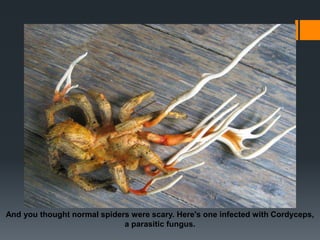
And you thought normal spiders were scary. Here's one infected with Cordyceps, 
a parasitic fungus.
Anyone!!??

Fungi

  • 1.
    FUNGI Muhammed MahfuzurRahman Lecturer Department of Pharmacy
  • 2.
    Introduction  Fungiis the plural of fungus.  A member of a large group of eukaryotic organisms.  Familiar as mushrooms.  These organisms are classified as a kingdom, Fungi, which is separate from plants, animals, protists and bacteria.  One major difference is that fungal cells have cell walls that contain chitin, unlike the cell walls of plants and some protists, which contain cellulose, and unlike the cell walls of bacteria.  The study of fungi is known as MYCOLOGY. Mycology has often been regarded as a branch of botany, even though it is a separate kingdom in biological taxonomy.  Genetic studies have shown that fungi are more closely related to animals than to plants.
  • 3.
    Intro... Contd. However, little is known of the true biodiversity of Kingdom Fungi, which has been estimated at 1.5 million to 5 million species, with about 5% of these having been formally classified.  Ever since the pioneering 18th and 19th century taxonomical works of Carl Linnaeus, Christian Hendrik Persoon, and Elias Magnus Fries, fungi have been classified according to their morphology or physiology. Mold growth covering a decaying peach. The frames were taken approximately 12 hours apart over a period of six days.
  • 4.
    Morphological Characteristics ofFungi  Non-motile eukaryotic organisms which exists as saprophytes, parasites.  Posses differentiated nuclei surrounded by a nuclear membrane.  Reproduce either by budding or by forming spores.  Nonphotosynthetic (heterotrophic).  Morphologically may be either simple oval cells or long tubular septate hyphae showing true lateral branching.  Most fungi grow as thread-like filamentous microscopic structures called hyphae (which are microscopic filaments between 2–10 μm in diameter and up to several centimeters in length) and which collectively form the mycelium (aggregates of hyphae).  Hyphae can be septate, i.e., divided into compartments separated by a septum, each compartment containing one or more nuclei, or can be coenocytic, i.e., lacking hyphal compartmentalization.  May be unicellular or multicellular.  Most are microscopic molds or yeasts.
  • 6.
    Difference between Fungiand Bacteria Characteristics Fungi Bacteria Cell type Eucaryotic Procaryotic Optimum pH 4-6 6.5-7.5 Optimum temperature 25-30oC (saprophytes) 32-37oC (parasites) 32-37oC Cell membrane Sterols present Sterols absent except mycoplasm O2 requirement Strictly aerobic (moulds) Facultative anaerobic(Some yeasts) Aerobic to anaerobic Light requirement None Some photosynthetic gr. Carbon source Organic Organic/ Inorganic Conc. of sugar in media 4-5% 0.5-1% Cell wall components Chitin, cellulose or hemicellulose Peptidoglycan Susceptibility to antibiotics Sensitive to griseofulvin, Resistant to penicillinis, chloramphenicol etc. Sensitive to penicillinis, Resistant to griseofulvin, tetracyclines etc.
  • 7.
    Classification of fungi  Depending on cell morphology, fungi can be divided into 4 classes: I. Moulds II. Yeasts III. Yeast like fungi and IV. Dimorphic fungi  Based on their sexual spore formation fungi are divided into 4 classes: I. Phycomycetes II. Ascomycetes III. Basidiomycetes IV. Fungi imperfecti
  • 8.
    1. Moulds Fungi which form mycelia are called moulds or filamentous fungi.  Filaments of fungi are called hyphae.  Diameter is 2-10μm .  The cell walls contain chitin.  Some hyphae may divided by cross sections called septa  Two types of hyphae: Septate and Non-septate I. Septate: septa divide the hyphae into distinct, uninucleate or mulitnucleate cell-like units. II. Nonseptate/coenocytic: does not contain septa and appear as long, continuous cells with many nuclei.  Example: Aspergillus fumigatus, Aspergillus niger, Penicillium notatum Septated Nonseptated -coenocytic
  • 10.
    2. Yeasts Round, oval or elongated, unicellular fungi  Reproduce by an asexual process called budding in which the cell develops a protuberance which enlarges and eventually separates from the parent cell  On culture they form smooth, creamy colonies  Example: Saccharomyces cerevisae, Cryptococcus neoformans
  • 11.
    3. Yeast likefungi  The bud remains attached to the mother cell and elongates, followed by repeated budding, forming chains of elongated chains known as pseudohyphae.  Example: Candida albicans 4. Dimorphic fungi  Mainly pathogenic species exhibit dimorphism i.e. 2 forms of growth  Fungi can grow either as a mould or as a yeast  Mouldlike forms produce vegetative and aerial mycellium and Yeast like forms reproduce by budding  Dimorphism is temperature and CO2 dependant.  At 37oC, the fungus grows yeastlike and at 25oC it shows mouldlike growth  Example: Mucor rouxii, Histoplasma capsulatum
  • 12.
  • 13.
    1. Phycomycetes Fungi having non-septate hyphae, forms endogenous asexual spores (sporangiospores) contained within a sac like structures called sporangia.  Also produce sexual spores known as oospores and zygospores.  Example: Mucor, Rhizopus. 2. Ascomycetes  Form sexual spores within a sac and are called ascospores.  The sac is called as ascus.  They form septate hyphae.  Include both yeasts and filamentous fungi e.g. Histoplasm, Candida etc.
  • 14.
    3. Basidiomycetes Reproduce sexually and form septate hyphae.  These basidiospores are borne at the tip of the basidium  Example: Cryptococcus neoformans 4. Fungi imperfecti  Also called as Deuteromycetes or Hyphomycetes.  Consist of group of fungi whose sexual phases have not been identified and they form septate hyphae and asexual conidia.  Majority of the pathogenic moulds, yeasts, yeasts like fungi and dimorphic fungi.  Example: Trichophyton, Epidermophyton
  • 16.
    Reproduction  Mostfungi reproduce both sexually and asexually.  When environmental conditions are favorable, asexual reproduction occurs rapidly.  When unfavorable conditions stress the organism, sexual reproduction occurs and the offspring have an increased likehood that they will be better suited for the environment.
  • 17.
    Asexual Reproduction Production of various types of spores  Sporangiophores  Upright stalk with an enclosed sac (bread mold)  Conidia  Upright stalk with no enclosed sac (penicillin)  Fragmentation  Hyphae dry out and shatter releasing individual cells that act like spores (athlete’s foot)  Budding  Small offspring
  • 18.
  • 19.
  • 20.
  • 21.
    Sexual Reproduction “Plus and minus” mating types  Hyphae of different mating types fuse and give rise to a specialized structure that produces spores (diploid)  Most fungi are haploid throughout most of their life cycle
  • 22.
    Classification of FungalInfections  When fungi do pass the resistance barriers of the human body and establish infections, the infections are classified according to the tissue levels initially colonized.  Systemic mycoses  Opportunistic mycoses  Superficial mycoses  Cutaneous mycoses  Sub-cutaneous mycoses
  • 23.
    Systemic Mycoses Fungal infections that enter into the body and invade internal organs are called systemic mycoses.  Infection can arise from inhalation of fungal spores, although such cases are not usually life threatening.  Most people that suffer from a systemic fungal infection are usually sick already.  The fungus is said to be ‘opportunistic’ because if the person was healthy the fungus would not usually cause any serious harm.  If someone is sick the body is less able to defend itself against pathogenic organisms, they therefore have an increased risk of susceptibility to infectious fungi.
  • 24.
    Mycoses by Aspergillus  Bronchopulmonary aspergillosis, the fungus grows within the lumen of the bronchiloes.  Colonising aspergillosis developes in pre-existing pulmonary cavities such as TB or cystic disease.  If they remains in these cavities it grows into a huge mass of mycelium in the form of fungus ball, may be needed to removed surgically.  Treatment  Amphotericin B  Importance  Used in industries for the production of citric acid and gluconic acid
  • 25.
    Superficial mycoses Infections limited to the outermost layers of the skin and hair. Disease Etiological Agent Symptoms Pityriasis versicolor Malassezia furfur hypopigmented macules (lesions in skin rashes) Tinea nigra Exophiala werneckii black macules Black piedra Piedraia hortai black nodule on hair shaft White piedra Trichosporum beigelii cream-coloured nodules on hair shaft
  • 26.
    Cutaneous mycoses Cutaneous mycoses - infections that extend deeper into the epidermis, as well as invasive hair and nail diseases.  These diseases are restricted to the keratinized layers of the skin, hair and nails.  Unlike the superficial mycoses, various cellular immune responses may be evoked, causing pathologic changes in the host that may be expressed in the deeper layers of the skin.  The agents causing these diseases are termed dermatophytes. The diseases are referred to as ringworm or tinea.  All of the dermatophytic diseases are caused by members of three genera: Microsporum, Trichophyton and Epidermophyton.
  • 27.
    Sub-cutaneous mycoses Subcutaneous mycoses include a heterogeneous group of fungal infections that develop at the site of transcutaneous trauma.  Infection slowly evolves as the etiologic agent survives and adapts to the adverse host tissue environment.  The main subcutaneous fungal infections include sporotrichosis, chromoblastomycosis, mycetoma, lobomycosis, rhinosporidiosis, subcutaneous zygomycosis, and subcutaneous phaeohyphomycosis.
  • 28.
    And you thoughtnormal spiders were scary. Here's one infected with Cordyceps, a parasitic fungus.
  • 29.