Introduction to
Mycology
Dr. Dinesh Jain
Assistant Professor
Deptt. of Microbiology
SMS MC Jaipur
HISTORY
 Fungi were recognized as causative agents of
human disease earlier than bacteria (1839)
 They received scanty importance due to their
benign nature of the diseases caused.
 Fungal infections are however very common,
serious and even fatal.
 Modern advances in treatment such as
antibiotics, steroids& immunosuppressive drugs
have led to an increase in opportunistic
pathogenic infections.
Introduction
 Fungi are eukaryotic protista; differ from
bacteria and other prokaryotes.
1. Cell walls containing chitin (rigidity & support),
mannan & other polysaccharides
2. Cytoplasmic membrane contains ergosterols
3. Possess true nuclei with nuclear membrane &
paired chromosomes.
4. Divide asexually, sexually or by both
5. Unicellular or multicellular
Introduction
 Simplest fungus :- Unicellular budding
yeast
 Hypha :- Elongation of apical cell
produces a tubular, thread like structure
called hypha
 Mycelium :- Tangled mass of hyphae is
called mycelium. Fungi producing
mycelia are called molds or filamentous
fungi.
 Hyphae may be septate or non-septate
Classification
 Fungi can be classified
 Depending on cell morphology :4
types
 Based on sexual spore formation: 4
classes
CLASSIFICATION
 Depending on cell morphology
1. Yeasts
2. Yeast like fungi
3. Molds
4. Dimorphic fungi
1. Yeasts
 Unicellular fungi which
reproduce by budding
 On culture - produce
smooth, creamy colonies
e. g Cryptococcus
neoformans (capsulated
yeast)
2. Yeast like fungi
 Grow partly as yeasts and partly as
elongated cells resembling hyphae which
are called pseudohyphae.
 e.g. Candida albicans
3. Molds/ Filamentous fungi
 Form true mycelia &
reproduce by formation
of different types of
spores.
 Vegetative/ aerial
hyphae
e.g. Rhizopus, mucor
4. Dimorphic fungi
 Occur in 2 forms
Molds (Filaments) – 25C (soil)
Yeasts – 37C (in host tissue)
Most fungi causing systemic infections
are dimorphic:
 Histoplasma capsulatum
 Blastomyces dermatidis
 Paracoccidioides brasiliensis
 Coccidioides immitis
 Penicillium marneffei
 Sporothrix schenkii
Systematic classification
 Based on sexual spore formation: 4
classes
1. Zygomycetes
2. Ascomycetes reproduce sexually
3. Basidiomycetes
4. Deuteromycetes (fungi imperfectii)
1. Zygomycetes
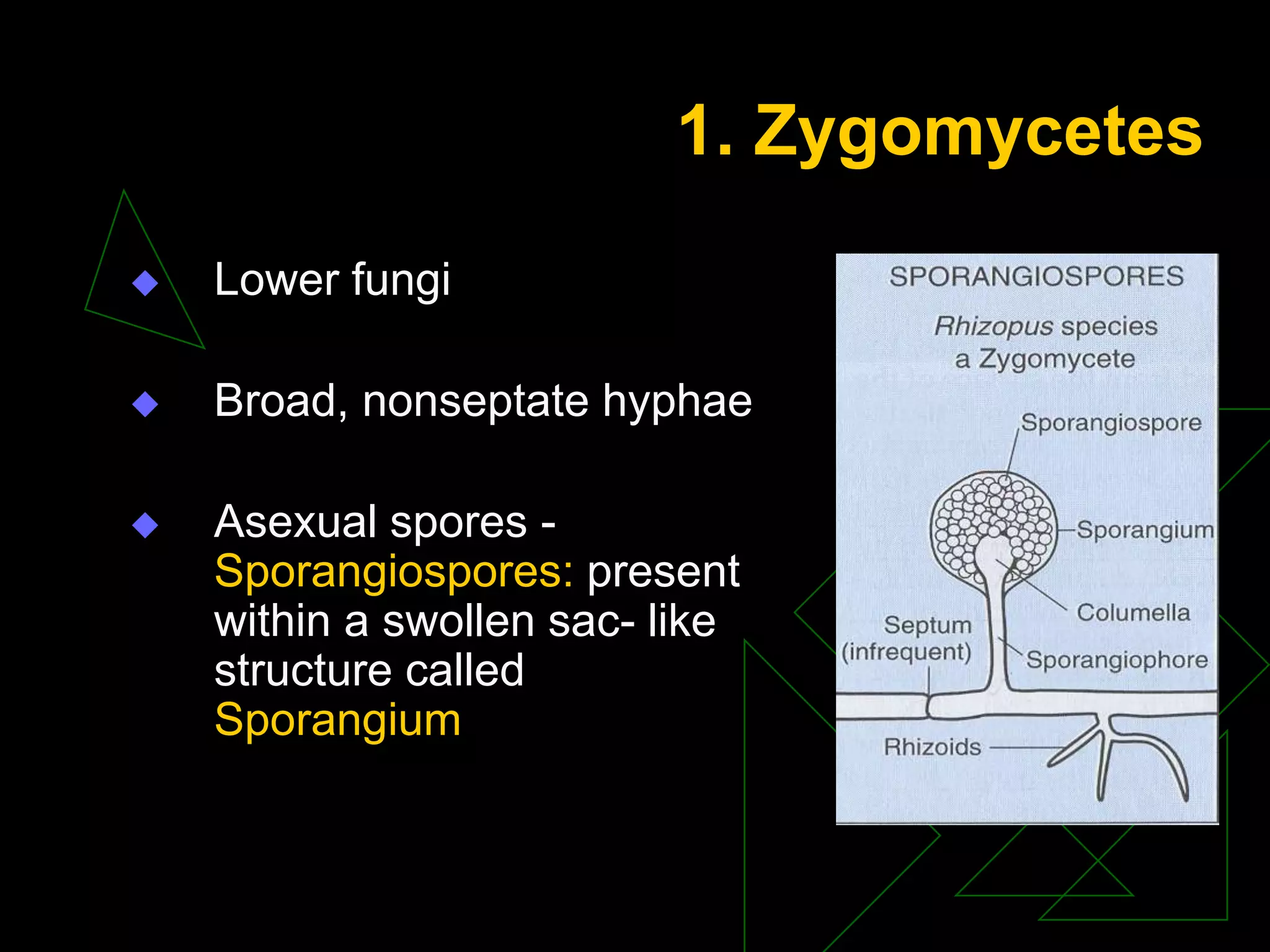
 Lower fungi
 Broad, nonseptate hyphae
 Asexual spores -
Sporangiospores: present
within a swollen sac- like
structure called
Sporangium
1. Zygomycetes
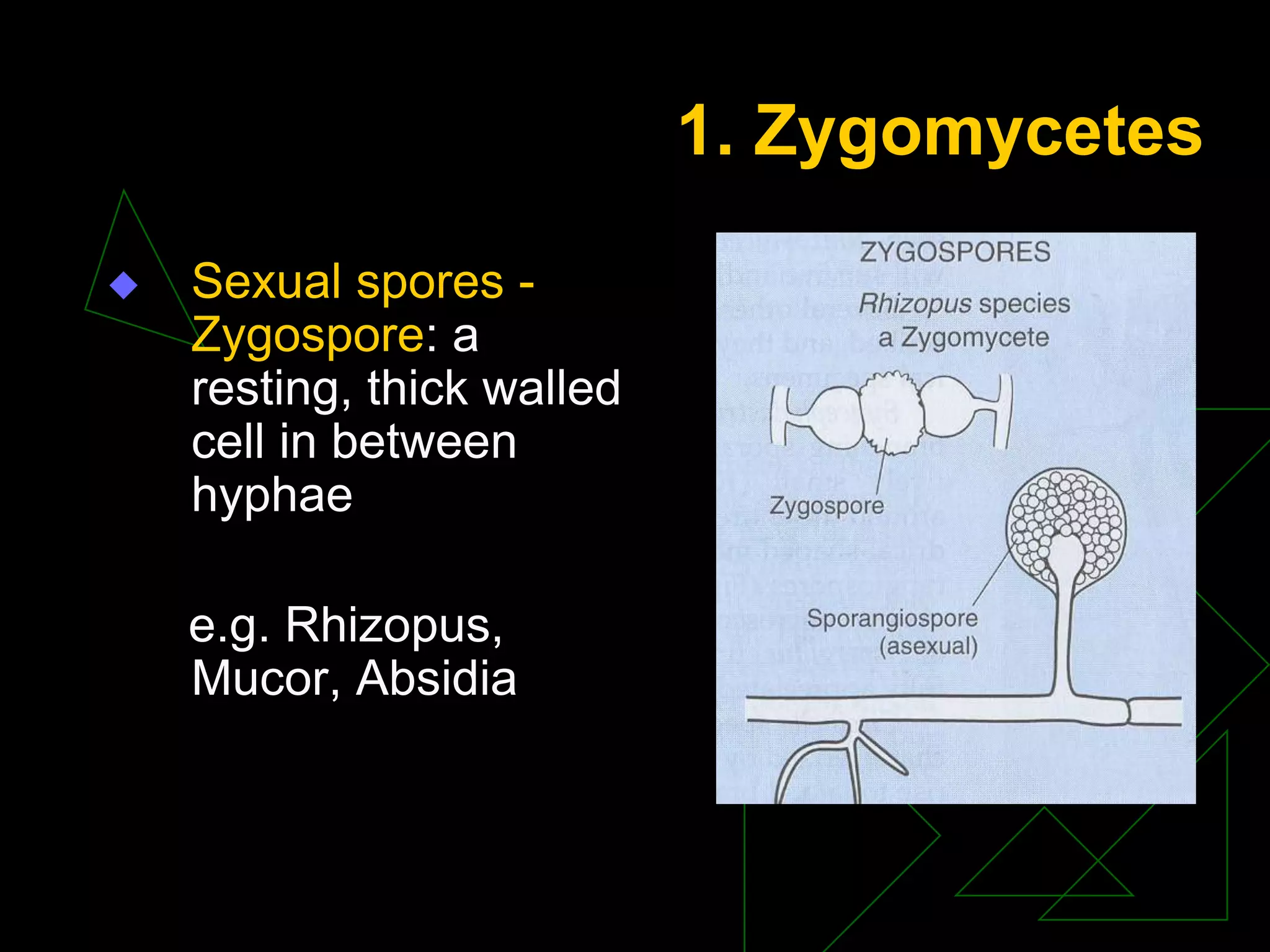
 Sexual spores -
Zygospore: a
resting, thick walled
cell in between
hyphae
e.g. Rhizopus,
Mucor, Absidia
2. Ascomycetes
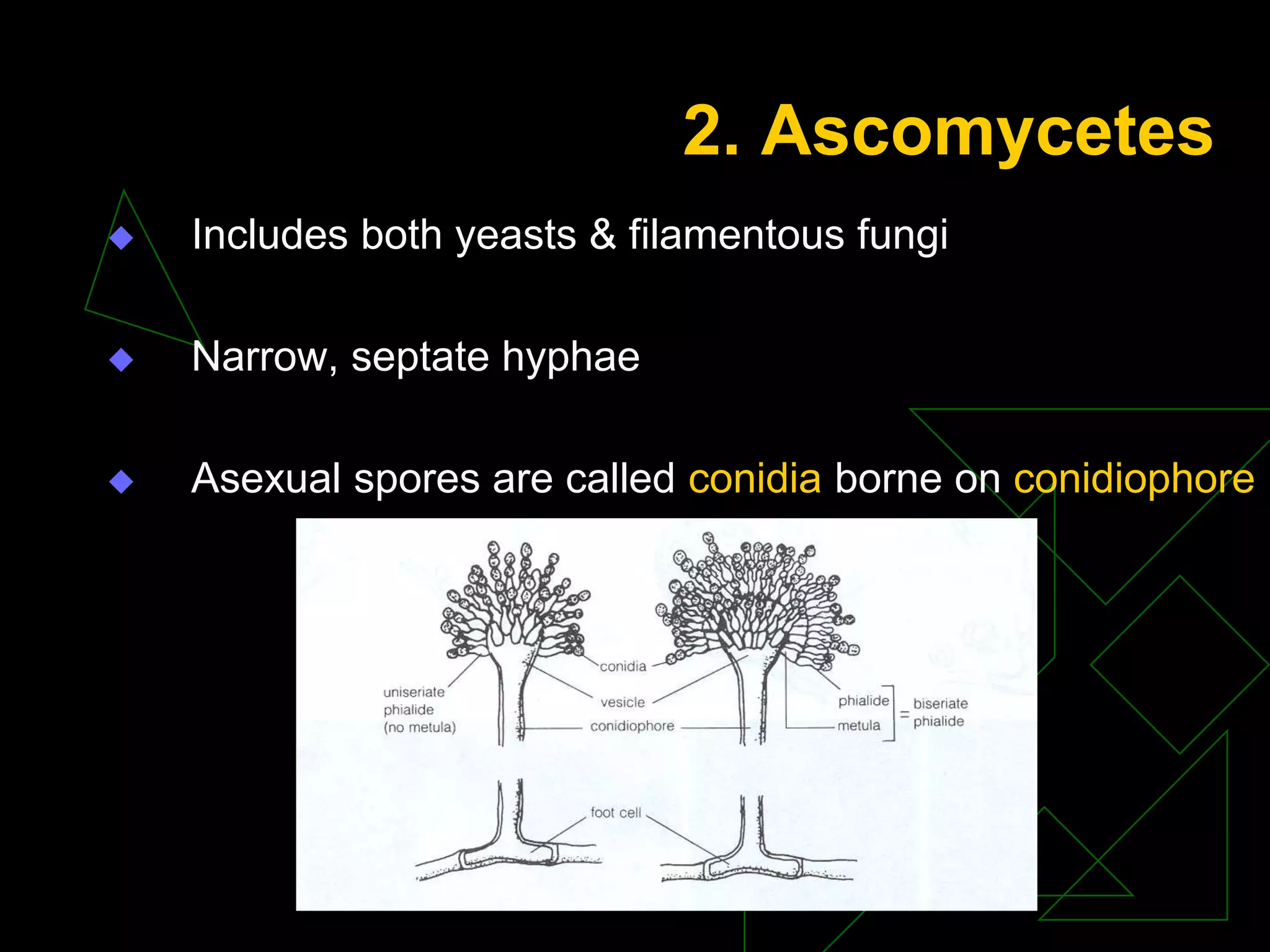
 Includes both yeasts & filamentous fungi
 Narrow, septate hyphae
 Asexual spores are called conidia borne on conidiophore
2. Ascomycetes
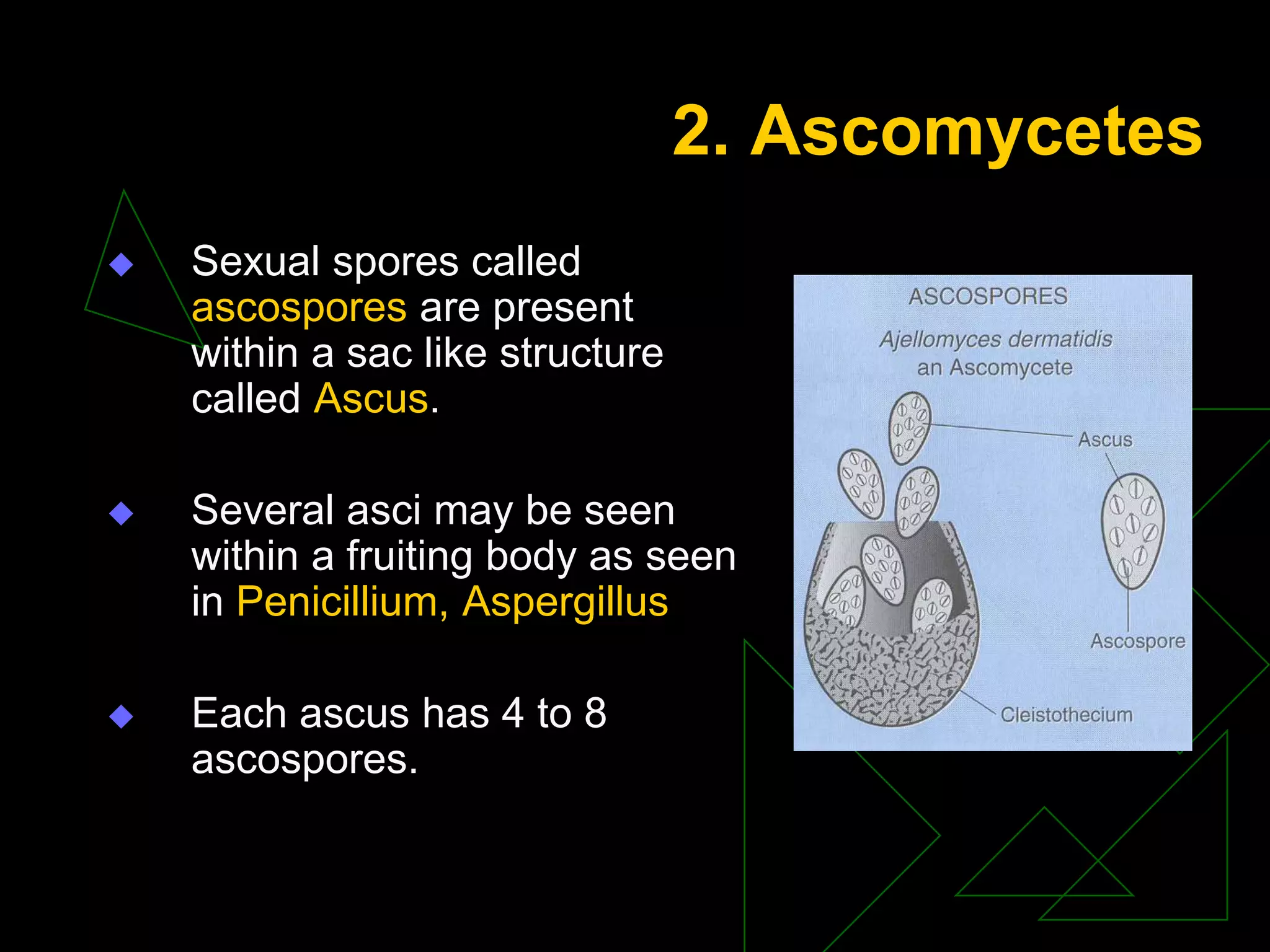
 Sexual spores called
ascospores are present
within a sac like structure
called Ascus.
 Several asci may be seen
within a fruiting body as seen
in Penicillium, Aspergillus
 Each ascus has 4 to 8
ascospores.
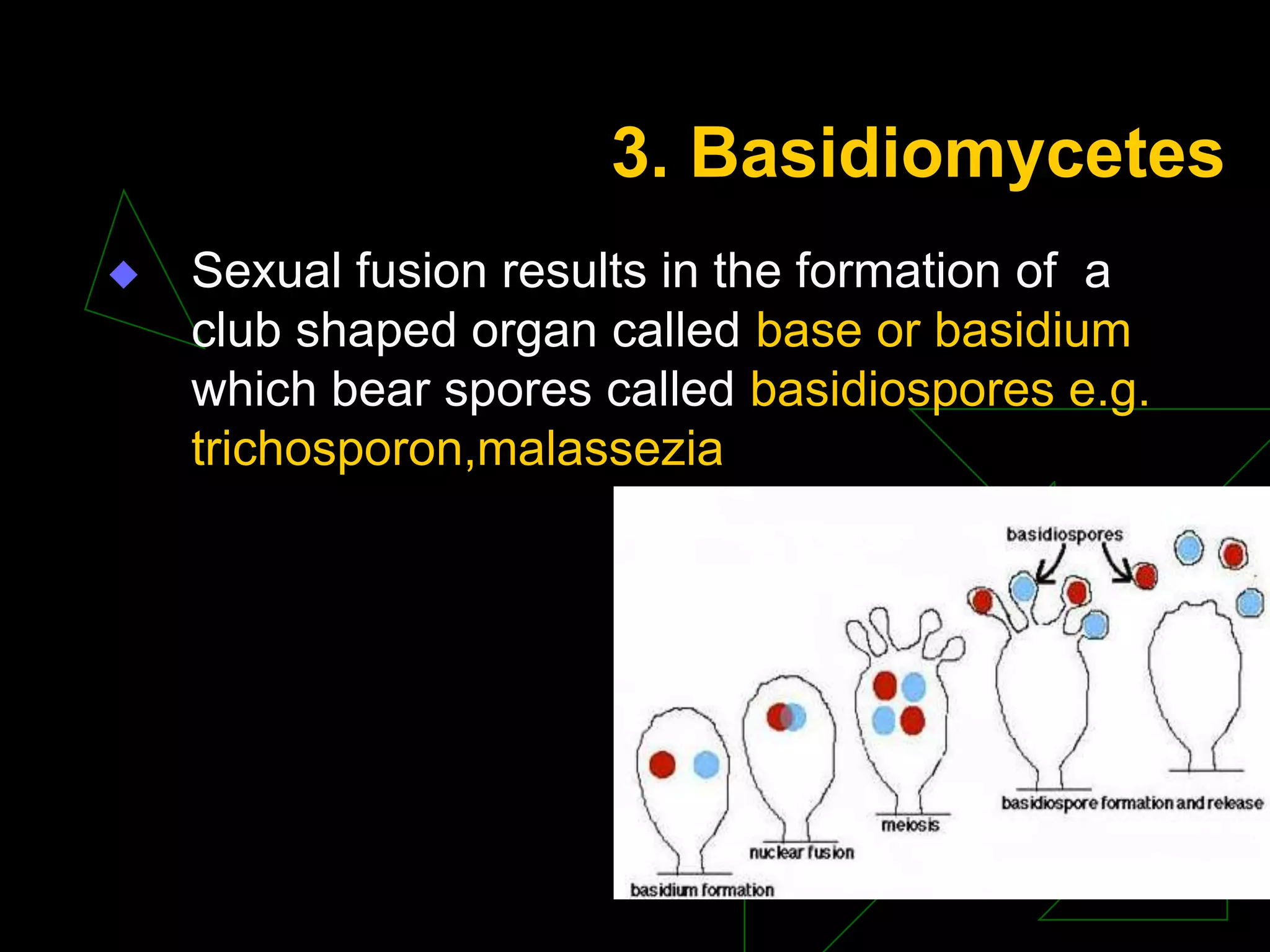
3. Basidiomycetes
 Sexual fusion results in the formation of a
club shaped organ called base or basidium
which bear spores called basidiospores e.g.
trichosporon,malassezia
4. Deuteromycetes
or Fungi imperfectii
 Group of fungi whose sexual phases are
not identified.
 Grow as molds as well as yeasts.
 Asexual stage – conidia
e.g. Candida, Cryptococcus
Vegetative Structures of Fungi
 Formed by the vegetative mycelia
(modification of single vegetative cells or
hyphae)
 Have no reproductive value
 Important in the differentiation/
identification of clinically significant fungi.
Spiral hyphae in
T.Mentagrophytes
Vegetative Structures of
Fungi
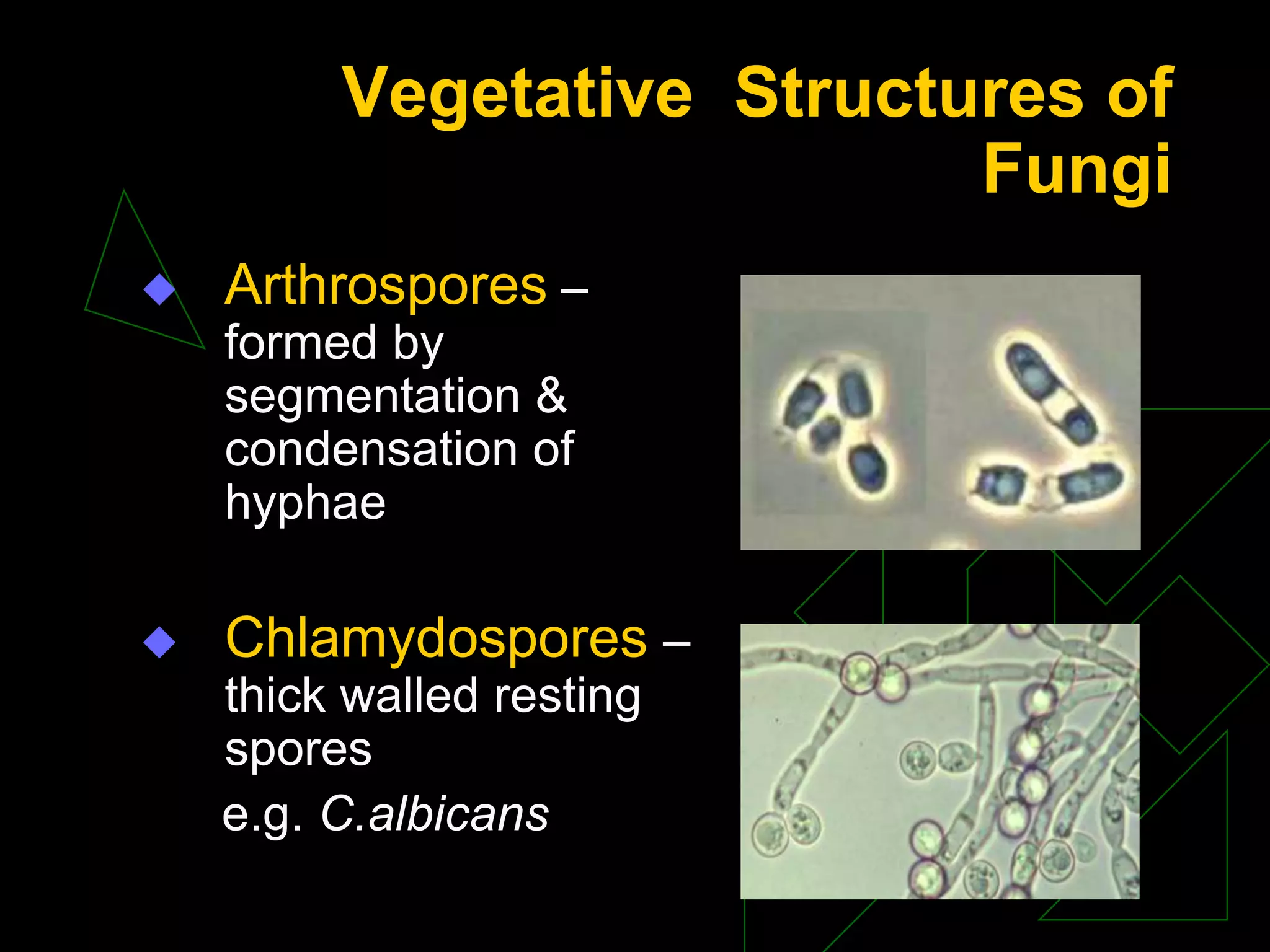
 Arthrospores –
formed by
segmentation &
condensation of
hyphae
 Chlamydospores –
thick walled resting
spores
e.g. C.albicans
Reproduction in fungi
 Sexual - formation of zygospores,
ascospores or basidiospores
 Asexual reproduction – budding or fission
 Asexual spores are formed on or in
specialized structures.
 Vary in size, shape & colour but these
characteristics are constant for a particular
species.
Reproduction in fungi
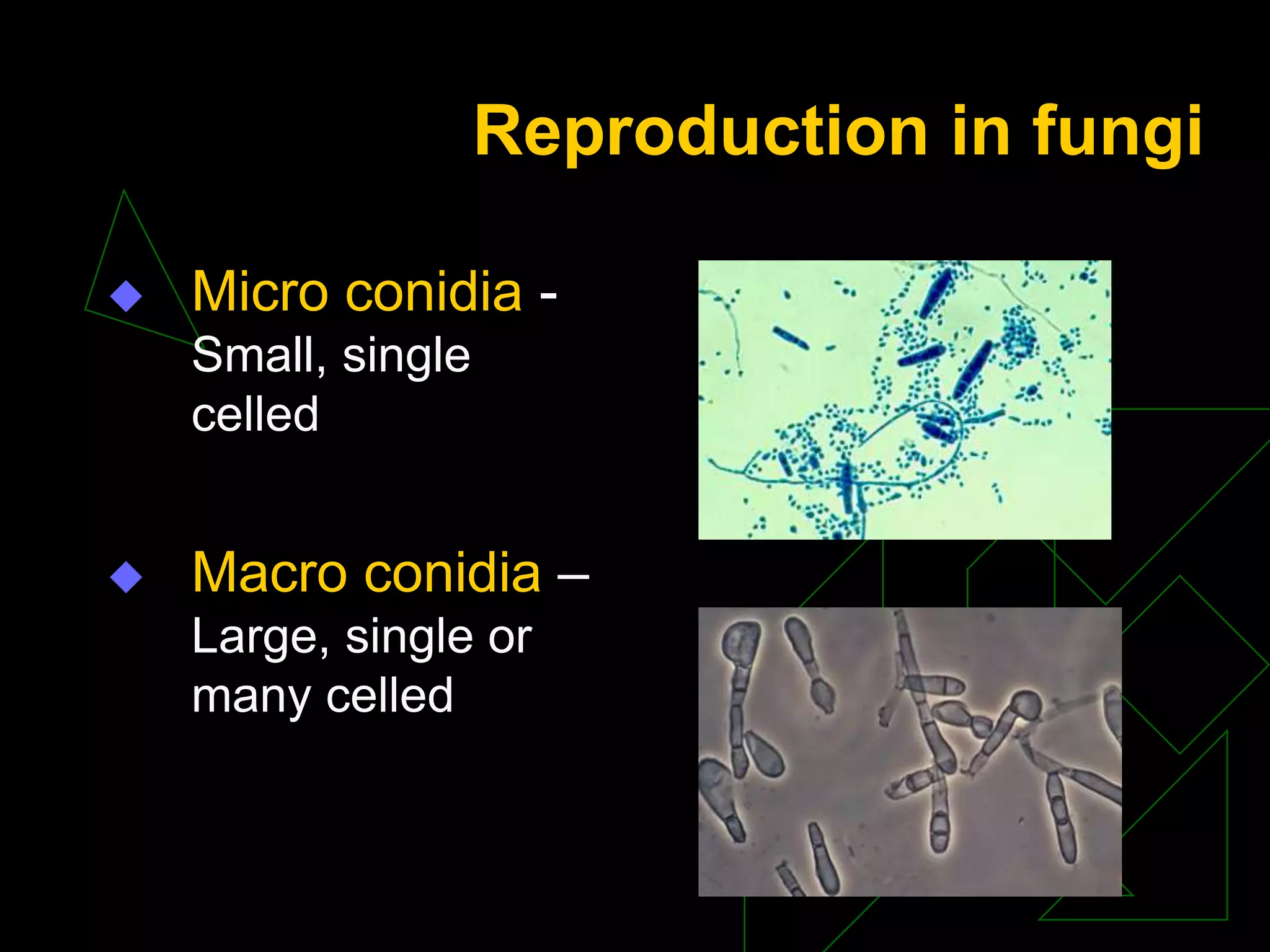
 Micro conidia -
Small, single
celled
 Macro conidia –
Large, single or
many celled
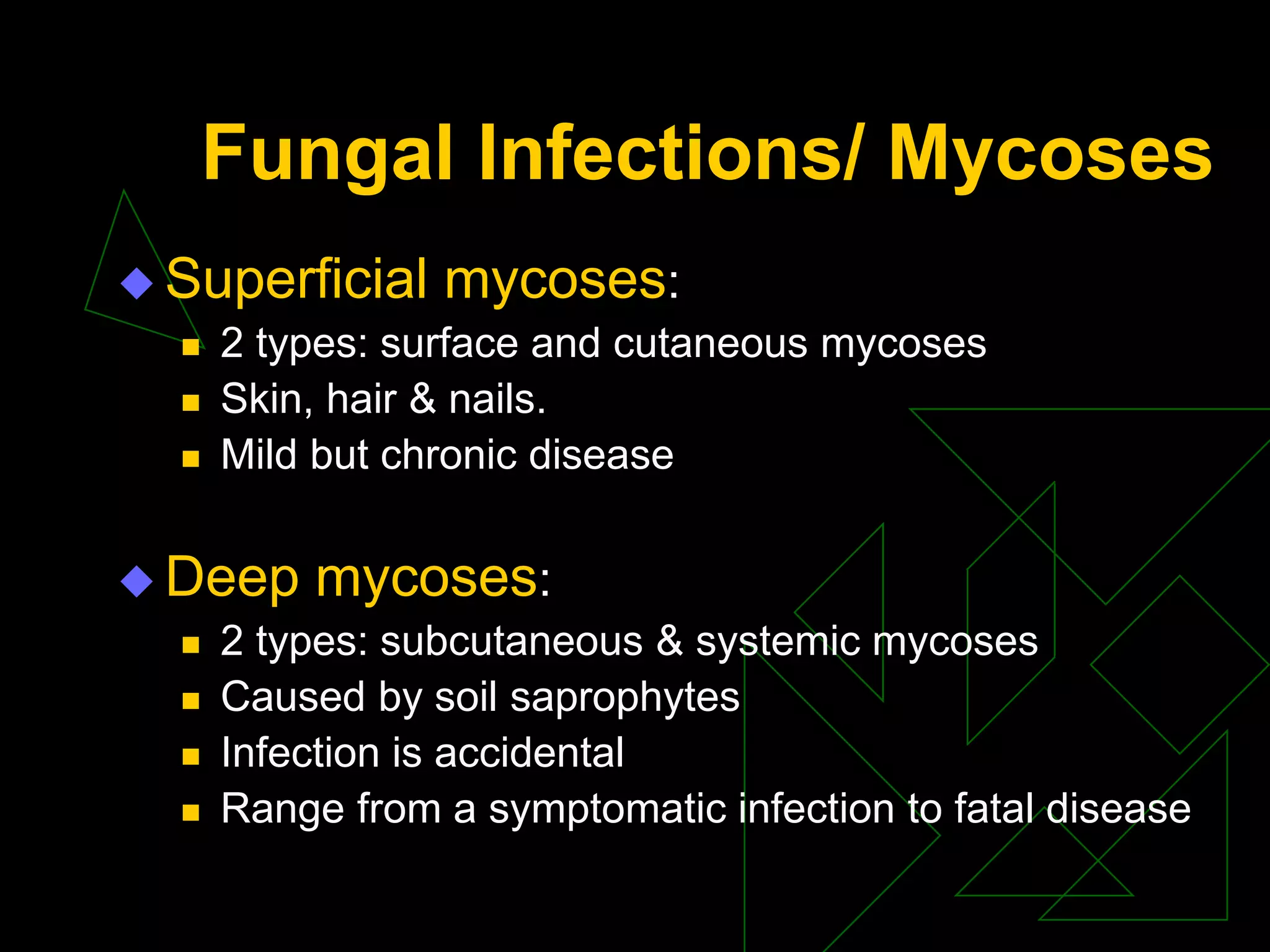
Fungal Infections/ Mycoses
 Superficial mycoses:
 2 types: surface and cutaneous mycoses
 Skin, hair & nails.
 Mild but chronic disease
 Deep mycoses:
 2 types: subcutaneous & systemic mycoses
 Caused by soil saprophytes
 Infection is accidental
 Range from a symptomatic infection to fatal disease
Superficial: Surface mycoses
 Live exclusively on dead surfaces of
skin and its appendages
 No contact with living tissue, hence no
inflammatory response
1. Tinea versicolor
2. Tinea nigra
3. Piedra
Superficial: Cutaneous mycoses
 Cornified layer of skin & its appendages
 Contact with living tissue, hence
inflammatory & allergic responses seen
1. Dermatophytes – skin, hair & nails
2. 3 genera - Trichophyton
Microsporum
Epidermophyton
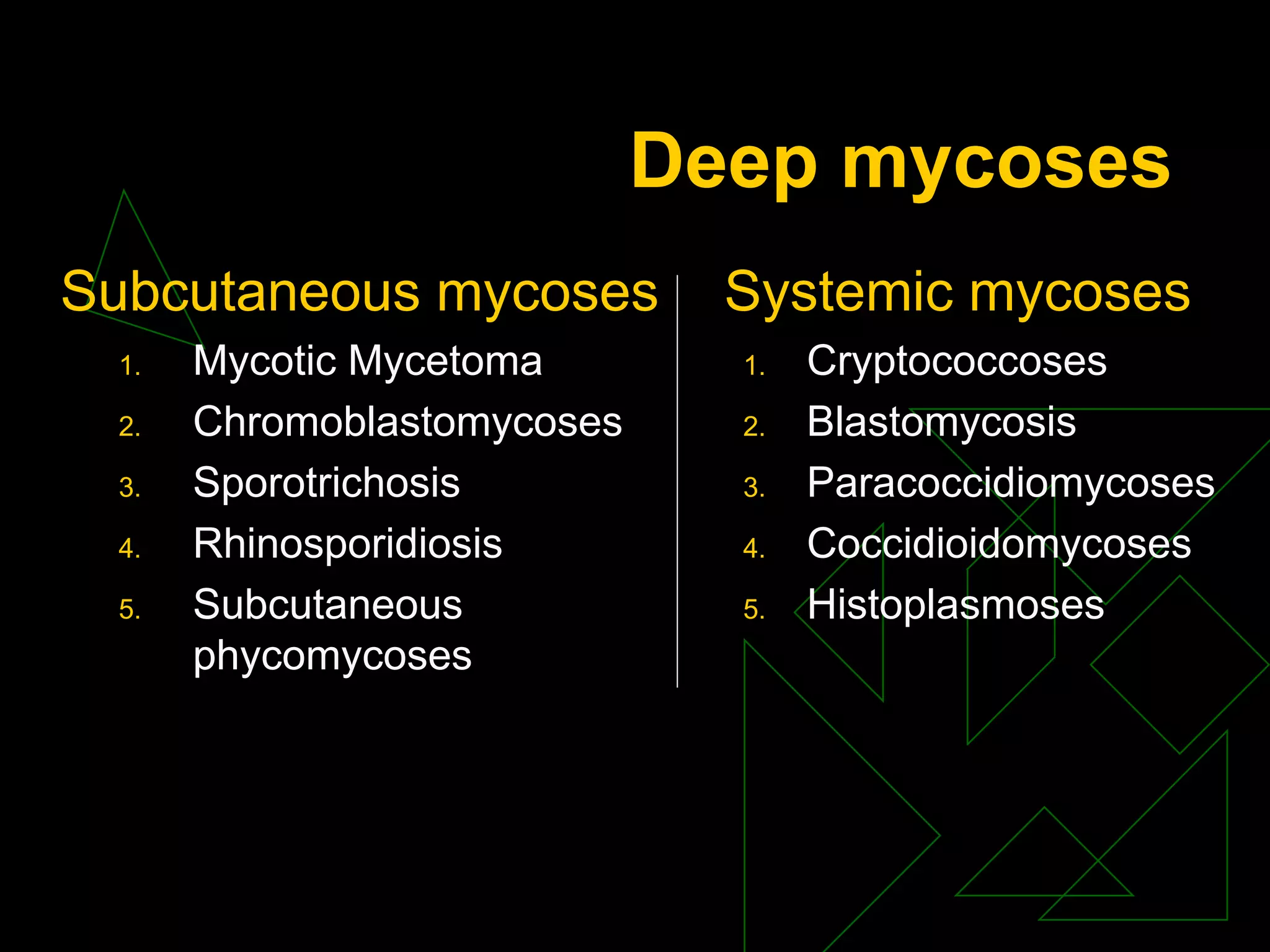
Deep mycoses
Subcutaneous mycoses
1. Mycotic Mycetoma
2. Chromoblastomycoses
3. Sporotrichosis
4. Rhinosporidiosis
5. Subcutaneous
phycomycoses
Systemic mycoses
1. Cryptococcoses
2. Blastomycosis
3. Paracoccidiomycoses
4. Coccidioidomycoses
5. Histoplasmoses
Candidiasis
 Caused by candida sps, forms a bridge
between superficial & deep mycoses as
it can cause cutaneous as well as
systemic infections
 Can also cause opportunistic infections
Opportunistic infections
 Pts with debilitating disease, altered
physiological state
 Mainly caused by fungi which are common lab
contaminant on culture media
 Aspergillus
 Pencillium
 Mucor
 Rhizopus
 Produce serious & fatal infections
Useful Properties of Fungi
Source of food
e.g. mushrooms
Fermentation - Production of
alcohol, bread
e.g. Sacchromyces spps
Antibiotic production
e.g. Penicillin from
Penicillium notatum
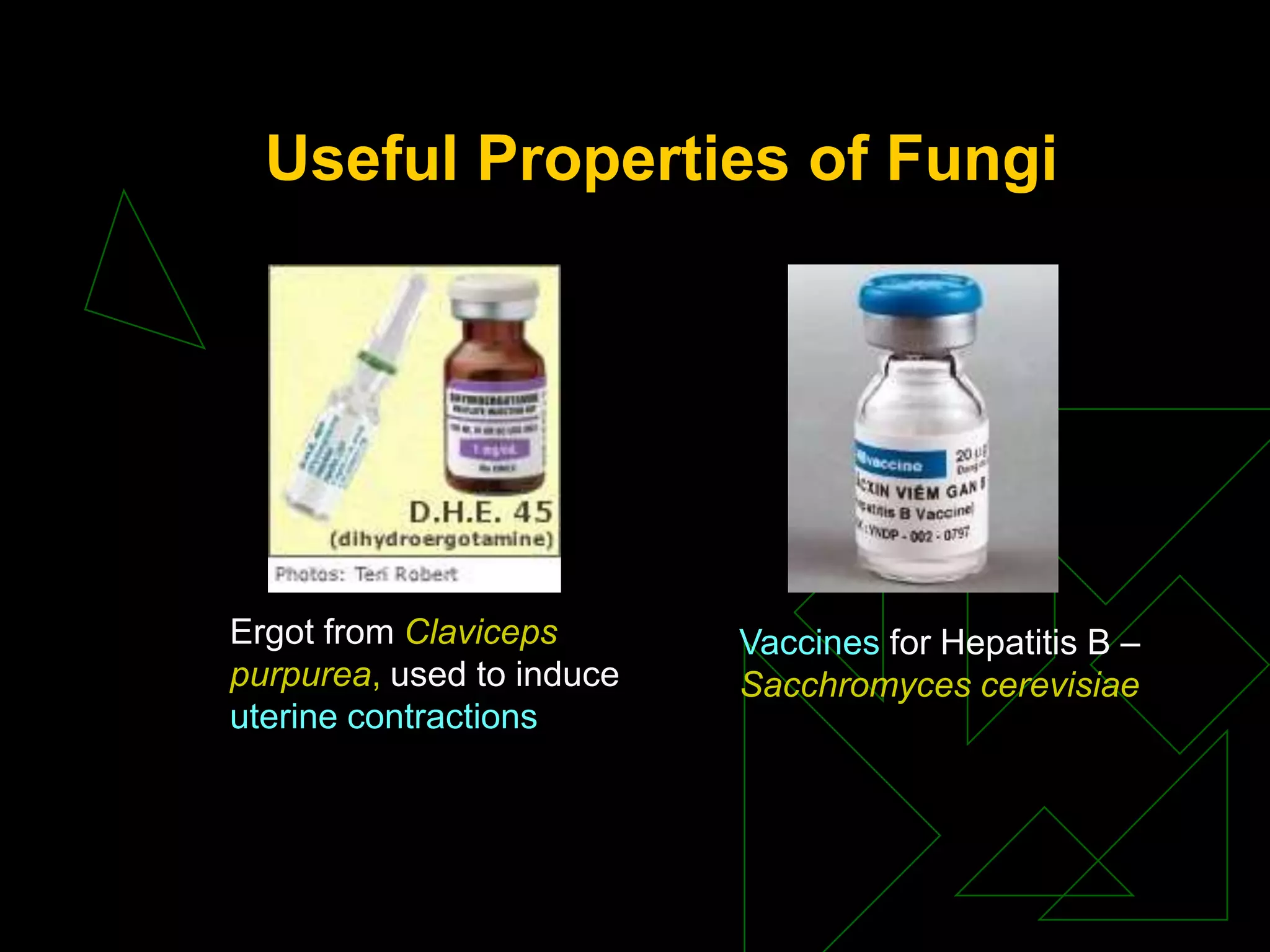
Useful Properties of Fungi
Ergot from Claviceps
purpurea, used to induce
uterine contractions
Vaccines for Hepatitis B –
Sacchromyces cerevisiae

Introduction mycology

  • 1.
    Introduction to Mycology Dr. DineshJain Assistant Professor Deptt. of Microbiology SMS MC Jaipur
  • 2.
    HISTORY  Fungi wererecognized as causative agents of human disease earlier than bacteria (1839)  They received scanty importance due to their benign nature of the diseases caused.  Fungal infections are however very common, serious and even fatal.  Modern advances in treatment such as antibiotics, steroids& immunosuppressive drugs have led to an increase in opportunistic pathogenic infections.
  • 3.
    Introduction  Fungi areeukaryotic protista; differ from bacteria and other prokaryotes. 1. Cell walls containing chitin (rigidity & support), mannan & other polysaccharides 2. Cytoplasmic membrane contains ergosterols 3. Possess true nuclei with nuclear membrane & paired chromosomes. 4. Divide asexually, sexually or by both 5. Unicellular or multicellular
  • 4.
    Introduction  Simplest fungus:- Unicellular budding yeast  Hypha :- Elongation of apical cell produces a tubular, thread like structure called hypha  Mycelium :- Tangled mass of hyphae is called mycelium. Fungi producing mycelia are called molds or filamentous fungi.  Hyphae may be septate or non-septate
  • 5.
    Classification  Fungi canbe classified  Depending on cell morphology :4 types  Based on sexual spore formation: 4 classes
  • 6.
    CLASSIFICATION  Depending oncell morphology 1. Yeasts 2. Yeast like fungi 3. Molds 4. Dimorphic fungi
  • 7.
    1. Yeasts  Unicellularfungi which reproduce by budding  On culture - produce smooth, creamy colonies e. g Cryptococcus neoformans (capsulated yeast)
  • 8.
    2. Yeast likefungi  Grow partly as yeasts and partly as elongated cells resembling hyphae which are called pseudohyphae.  e.g. Candida albicans
  • 9.
    3. Molds/ Filamentousfungi  Form true mycelia & reproduce by formation of different types of spores.  Vegetative/ aerial hyphae e.g. Rhizopus, mucor
  • 10.
    4. Dimorphic fungi Occur in 2 forms Molds (Filaments) – 25C (soil) Yeasts – 37C (in host tissue) Most fungi causing systemic infections are dimorphic:  Histoplasma capsulatum  Blastomyces dermatidis  Paracoccidioides brasiliensis  Coccidioides immitis  Penicillium marneffei  Sporothrix schenkii
  • 11.
    Systematic classification  Basedon sexual spore formation: 4 classes 1. Zygomycetes 2. Ascomycetes reproduce sexually 3. Basidiomycetes 4. Deuteromycetes (fungi imperfectii)
  • 12.
    1. Zygomycetes  Lowerfungi  Broad, nonseptate hyphae  Asexual spores - Sporangiospores: present within a swollen sac- like structure called Sporangium
  • 13.
    1. Zygomycetes  Sexualspores - Zygospore: a resting, thick walled cell in between hyphae e.g. Rhizopus, Mucor, Absidia
  • 14.
    2. Ascomycetes  Includesboth yeasts & filamentous fungi  Narrow, septate hyphae  Asexual spores are called conidia borne on conidiophore
  • 15.
    2. Ascomycetes  Sexualspores called ascospores are present within a sac like structure called Ascus.  Several asci may be seen within a fruiting body as seen in Penicillium, Aspergillus  Each ascus has 4 to 8 ascospores.
  • 16.
    3. Basidiomycetes  Sexualfusion results in the formation of a club shaped organ called base or basidium which bear spores called basidiospores e.g. trichosporon,malassezia
  • 17.
    4. Deuteromycetes or Fungiimperfectii  Group of fungi whose sexual phases are not identified.  Grow as molds as well as yeasts.  Asexual stage – conidia e.g. Candida, Cryptococcus
  • 18.
    Vegetative Structures ofFungi  Formed by the vegetative mycelia (modification of single vegetative cells or hyphae)  Have no reproductive value  Important in the differentiation/ identification of clinically significant fungi.
  • 19.
  • 20.
    Vegetative Structures of Fungi Arthrospores – formed by segmentation & condensation of hyphae  Chlamydospores – thick walled resting spores e.g. C.albicans
  • 21.
    Reproduction in fungi Sexual - formation of zygospores, ascospores or basidiospores  Asexual reproduction – budding or fission  Asexual spores are formed on or in specialized structures.  Vary in size, shape & colour but these characteristics are constant for a particular species.
  • 22.
    Reproduction in fungi Micro conidia - Small, single celled  Macro conidia – Large, single or many celled
  • 23.
    Fungal Infections/ Mycoses Superficial mycoses:  2 types: surface and cutaneous mycoses  Skin, hair & nails.  Mild but chronic disease  Deep mycoses:  2 types: subcutaneous & systemic mycoses  Caused by soil saprophytes  Infection is accidental  Range from a symptomatic infection to fatal disease
  • 24.
    Superficial: Surface mycoses Live exclusively on dead surfaces of skin and its appendages  No contact with living tissue, hence no inflammatory response 1. Tinea versicolor 2. Tinea nigra 3. Piedra
  • 25.
    Superficial: Cutaneous mycoses Cornified layer of skin & its appendages  Contact with living tissue, hence inflammatory & allergic responses seen 1. Dermatophytes – skin, hair & nails 2. 3 genera - Trichophyton Microsporum Epidermophyton
  • 26.
    Deep mycoses Subcutaneous mycoses 1.Mycotic Mycetoma 2. Chromoblastomycoses 3. Sporotrichosis 4. Rhinosporidiosis 5. Subcutaneous phycomycoses Systemic mycoses 1. Cryptococcoses 2. Blastomycosis 3. Paracoccidiomycoses 4. Coccidioidomycoses 5. Histoplasmoses
  • 27.
    Candidiasis  Caused bycandida sps, forms a bridge between superficial & deep mycoses as it can cause cutaneous as well as systemic infections  Can also cause opportunistic infections
  • 28.
    Opportunistic infections  Ptswith debilitating disease, altered physiological state  Mainly caused by fungi which are common lab contaminant on culture media  Aspergillus  Pencillium  Mucor  Rhizopus  Produce serious & fatal infections
  • 29.
    Useful Properties ofFungi Source of food e.g. mushrooms Fermentation - Production of alcohol, bread e.g. Sacchromyces spps Antibiotic production e.g. Penicillin from Penicillium notatum
  • 30.
    Useful Properties ofFungi Ergot from Claviceps purpurea, used to induce uterine contractions Vaccines for Hepatitis B – Sacchromyces cerevisiae