Classifying Matter Basic Chemistry Heartlife Physical Science
Matter - What is it? Matter  is anything that: has mass takes up space All matter is made up of  atoms more than 100 different kinds  two or more combined (joined) atoms make a  molecule Elements  are substances made from only  one type of atom i.e. gold, carbon, helium, neon, sulfur Compounds  are substances made from two or more different combined elements ratios remain constant (there will always be twice as much Helium as Oxygen in water) i.e. carbon dioxide, sodium chloride (salt), iron oxide (rust), ammonia, water, chalk Oxygen Molecule O 2 Water Molecule H 2 O Oxygen atom O
Mixtures  A  mixture  is made of different substances (elements or compounds) that can be physically separated  contain different ratios of substances examples:  some fruit salad might have more grapes than bananas some granite has more feldspar in with the mica than others  Granite How can substances be separated out of mixtures? by hand or with tweezers evaporation or distillation filtering settling in layers (centrifuge) magnets
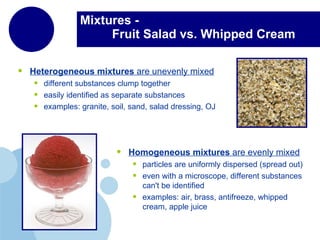
Mixtures -  Fruit Salad vs. Whipped Cream Heterogeneous mixtures  are unevenly mixed different substances clump together easily identified as separate substances examples: granite, soil, sand, salad dressing, OJ Homogeneous mixtures  are evenly mixed particles are uniformly dispersed (spread out)  even with a microscope, different substances can't be identified examples: air, brass, antifreeze, whipped cream, apple juice
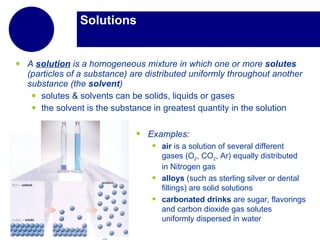
Solutions A  solution  is a homogeneous mixture in which one or more  solutes  (particles of a substance) are distributed uniformly throughout another substance (the  solvent ) solutes & solvents can be solids, liquids or gases the solvent is the substance in greatest quantity in the solution Examples: air  is a solution of several different gases (O 2 , CO 2 , Ar) equally distributed in Nitrogen gas alloys  (such as sterling silver or dental fillings) are solid solutions carbonated drinks  are sugar, flavorings and carbon dioxide gas solutes uniformly dispersed in water
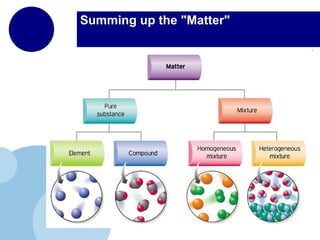
Summing up the "Matter"
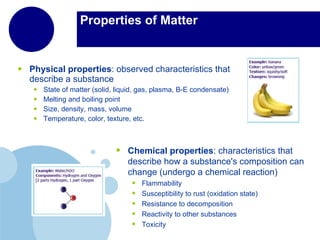
Properties of Matter Physical properties : observed characteristics that describe a substance  State of matter (solid, liquid, gas, plasma, B-E condensate) Melting and boiling point Size, density, mass, volume Temperature,  color , texture, etc. Chemical properties : characteristics that describe how a substance's composition can change (undergo a chemical reaction) Flammability Susceptibility to rust (oxidation state) Resistance to decomposition Reactivity to other substances Toxicity
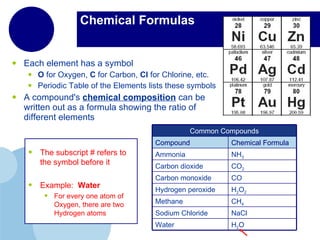
Chemical Formulas Each element has a symbol O  for Oxygen,  C  for Carbon,  Cl  for Chlorine, etc. Periodic Table of the Elements lists these symbols A compound's  chemical composition  can be written out as a formula showing the ratio of different elements The subscript # refers to the symbol before it Example:  Water For every one atom of Oxygen, there are two Hydrogen atoms H 2 O Water NaCl Sodium Chloride CH 4 Methane H 2 O 2 Hydrogen peroxide CO Carbon monoxide CO 2 Carbon dioxide NH 3 Ammonia Chemical Formula Compound Common Compounds
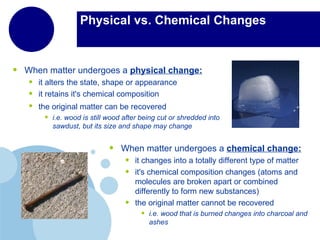
Physical vs. Chemical Changes When matter undergoes a  physical change: it alters the state, shape or appearance  it retains it's chemical composition the original matter can be recovered   i.e. wood is still wood after being cut or shredded into sawdust, but its size and shape may change   When matter undergoes a  chemical change: it changes into a totally different type of matter it's chemical composition changes (atoms and molecules are broken apart or combined differently to form new substances) the original matter cannot be recovered i.e. wood that is burned changes into charcoal and ashes
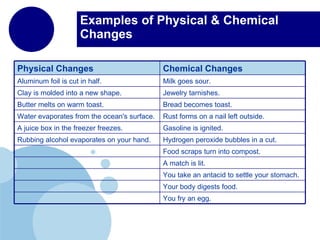
Examples of Physical & Chemical Changes You fry an egg.  Your body digests food.  You take an antacid to settle your stomach.  A match is lit. Food scraps turn into compost.   Hydrogen peroxide bubbles in a cut.  Rubbing alcohol evaporates on your hand.  Gasoline is ignited.  A juice box in the freezer freezes.  Rust forms on a nail left outside.  Water evaporates from the ocean's surface.  Bread becomes toast.  Butter melts on warm toast.  Jewelry tarnishes.  Clay is molded into a new shape.  Milk goes sour.  Aluminum foil is cut in half.  Chemical Changes  Physical Changes
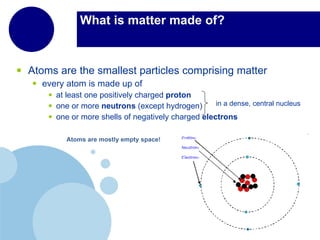
Atoms are the smallest particles comprising matter every atom is made up of at least one positively charged  proton one or more  neutrons  (except hydrogen) one or more shells of negatively charged  electrons   What is matter made of? in a dense, central nucleus Atoms are mostly empty space!
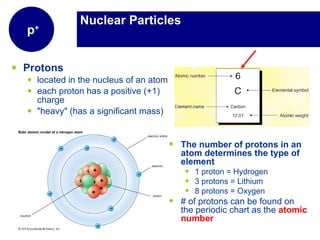
Nuclear Particles Protons located in the nucleus of an atom each proton has a positive (+1) charge "heavy" (has a significant mass) The number of protons in an atom determines the type of element  1 proton = Hydrogen 3 protons = Lithium 8 protons = Oxygen # of protons can be found on the periodic chart as the  atomic number p +
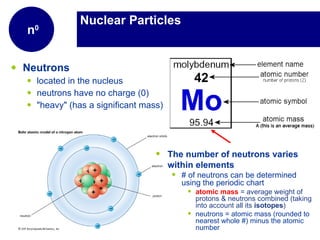
Nuclear Particles Neutrons located in the nucleus neutrons have no charge (0) "heavy" (has a significant mass) n 0 The number of neutrons varies within elements # of neutrons can be determined using the periodic chart  atomic mass   = average weight of protons & neutrons combined (taking into account all its  isotopes ) neutrons = atomic mass (rounded to nearest whole #) minus the atomic number
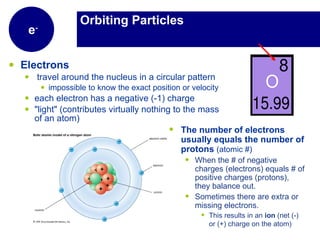
Orbiting Particles Electrons   travel around the nucleus in a circular pattern impossible to know the exact position or velocity each electron has a negative (-1) charge "light" (contributes virtually nothing to the mass of an atom)  e - The number of electrons usually equals the number of protons  (atomic #) When the # of negative charges (electrons) equals # of positive charges (protons), they balance out. Sometimes there are extra or missing electrons. This results in an  ion  (net (-) or (+) charge on the atom)
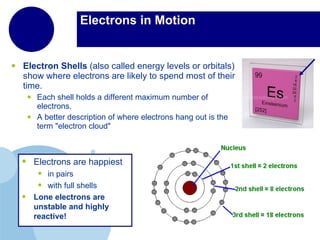
Electrons in Motion Electron Shells  (also called energy levels or orbitals) show where electrons are likely to spend most of their time.   Each shell holds a different maximum number of electrons. A better description of where electrons hang out is the term "electron cloud" Electrons are happiest  in pairs with full shells Lone electrons are unstable and highly reactive!

Classifying Matter

  • 1.
    Classifying Matter BasicChemistry Heartlife Physical Science
  • 2.
    Matter - Whatis it? Matter is anything that: has mass takes up space All matter is made up of atoms more than 100 different kinds two or more combined (joined) atoms make a molecule Elements are substances made from only one type of atom i.e. gold, carbon, helium, neon, sulfur Compounds are substances made from two or more different combined elements ratios remain constant (there will always be twice as much Helium as Oxygen in water) i.e. carbon dioxide, sodium chloride (salt), iron oxide (rust), ammonia, water, chalk Oxygen Molecule O 2 Water Molecule H 2 O Oxygen atom O
  • 3.
    Mixtures A mixture is made of different substances (elements or compounds) that can be physically separated contain different ratios of substances examples: some fruit salad might have more grapes than bananas some granite has more feldspar in with the mica than others Granite How can substances be separated out of mixtures? by hand or with tweezers evaporation or distillation filtering settling in layers (centrifuge) magnets
  • 4.
    Mixtures - Fruit Salad vs. Whipped Cream Heterogeneous mixtures are unevenly mixed different substances clump together easily identified as separate substances examples: granite, soil, sand, salad dressing, OJ Homogeneous mixtures are evenly mixed particles are uniformly dispersed (spread out) even with a microscope, different substances can't be identified examples: air, brass, antifreeze, whipped cream, apple juice
  • 5.
    Solutions A solution is a homogeneous mixture in which one or more solutes (particles of a substance) are distributed uniformly throughout another substance (the solvent ) solutes & solvents can be solids, liquids or gases the solvent is the substance in greatest quantity in the solution Examples: air is a solution of several different gases (O 2 , CO 2 , Ar) equally distributed in Nitrogen gas alloys (such as sterling silver or dental fillings) are solid solutions carbonated drinks are sugar, flavorings and carbon dioxide gas solutes uniformly dispersed in water
  • 6.
    Summing up the"Matter"
  • 7.
    Properties of MatterPhysical properties : observed characteristics that describe a substance State of matter (solid, liquid, gas, plasma, B-E condensate) Melting and boiling point Size, density, mass, volume Temperature, color , texture, etc. Chemical properties : characteristics that describe how a substance's composition can change (undergo a chemical reaction) Flammability Susceptibility to rust (oxidation state) Resistance to decomposition Reactivity to other substances Toxicity
  • 8.
    Chemical Formulas Eachelement has a symbol O for Oxygen, C for Carbon, Cl for Chlorine, etc. Periodic Table of the Elements lists these symbols A compound's chemical composition can be written out as a formula showing the ratio of different elements The subscript # refers to the symbol before it Example: Water For every one atom of Oxygen, there are two Hydrogen atoms H 2 O Water NaCl Sodium Chloride CH 4 Methane H 2 O 2 Hydrogen peroxide CO Carbon monoxide CO 2 Carbon dioxide NH 3 Ammonia Chemical Formula Compound Common Compounds
  • 9.
    Physical vs. ChemicalChanges When matter undergoes a physical change: it alters the state, shape or appearance it retains it's chemical composition the original matter can be recovered i.e. wood is still wood after being cut or shredded into sawdust, but its size and shape may change When matter undergoes a chemical change: it changes into a totally different type of matter it's chemical composition changes (atoms and molecules are broken apart or combined differently to form new substances) the original matter cannot be recovered i.e. wood that is burned changes into charcoal and ashes
  • 10.
    Examples of Physical& Chemical Changes You fry an egg. Your body digests food.  You take an antacid to settle your stomach.  A match is lit. Food scraps turn into compost.   Hydrogen peroxide bubbles in a cut.  Rubbing alcohol evaporates on your hand. Gasoline is ignited. A juice box in the freezer freezes. Rust forms on a nail left outside. Water evaporates from the ocean's surface. Bread becomes toast. Butter melts on warm toast. Jewelry tarnishes. Clay is molded into a new shape. Milk goes sour. Aluminum foil is cut in half. Chemical Changes Physical Changes
  • 11.
    Atoms are thesmallest particles comprising matter every atom is made up of at least one positively charged proton one or more neutrons (except hydrogen) one or more shells of negatively charged electrons What is matter made of? in a dense, central nucleus Atoms are mostly empty space!
  • 12.
    Nuclear Particles Protonslocated in the nucleus of an atom each proton has a positive (+1) charge "heavy" (has a significant mass) The number of protons in an atom determines the type of element 1 proton = Hydrogen 3 protons = Lithium 8 protons = Oxygen # of protons can be found on the periodic chart as the atomic number p +
  • 13.
    Nuclear Particles Neutronslocated in the nucleus neutrons have no charge (0) "heavy" (has a significant mass) n 0 The number of neutrons varies within elements # of neutrons can be determined using the periodic chart atomic mass = average weight of protons & neutrons combined (taking into account all its isotopes ) neutrons = atomic mass (rounded to nearest whole #) minus the atomic number
  • 14.
    Orbiting Particles Electrons travel around the nucleus in a circular pattern impossible to know the exact position or velocity each electron has a negative (-1) charge "light" (contributes virtually nothing to the mass of an atom) e - The number of electrons usually equals the number of protons (atomic #) When the # of negative charges (electrons) equals # of positive charges (protons), they balance out. Sometimes there are extra or missing electrons. This results in an ion (net (-) or (+) charge on the atom)
  • 15.
    Electrons in MotionElectron Shells (also called energy levels or orbitals) show where electrons are likely to spend most of their time. Each shell holds a different maximum number of electrons. A better description of where electrons hang out is the term "electron cloud" Electrons are happiest in pairs with full shells Lone electrons are unstable and highly reactive!

Editor's Notes

  • #3 chalk = calcium carbonite (CaCH3) ammonia = NH3
  • #4 Jell-O is a colloid: a heterogeneous mixture with particles larger than those in a solution, but not large enough to settle out. Milk, paint, and mayo are, too (and aerosols).
  • #5 brass = copper + zinc vinegar = acetic acid and water.
  • #6 CuSO4 = copper sulfate
  • #14 Quick review on rounding to a whole number: Jeanne's method: circle the one's place number draw arrow to number on the right if it's 5 or above, the circled number is raised one digit if it's 4 or below, the circled number STAYS THE SAME In the example here, round the mass to 96. Neutrons = 96-42 = 54 Isotopes: One of two or more atoms that have the same atomic number (the same number of protons) but a different number of neutrons. Carbon 12, the most common form of carbon, has six  protons and six neutrons, whereas carbon 14 has six protons and eight neutrons. Isotopes of a given element typically behave alike chemically. With the exception of hydrogen, elements found on Earth generally have the same number of protons and neutrons; heavier and lighter isotopes (with more or fewer neutrons) are often unstable and undergo radioactive decay .
  • #16 Don't go into too much detail at this point about valence electrons and reactivity.