Miss Reaves Matter  Study Guide
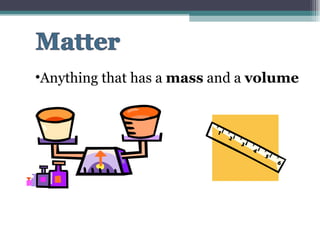
Anything that has a  mass  and a  volume
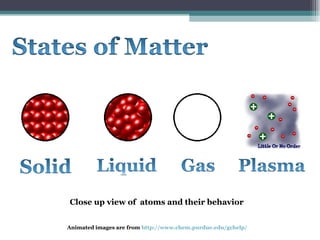
Close up view of  atoms and their behavior Animated images are from  http://www.chem.purdue.edu/gchelp/
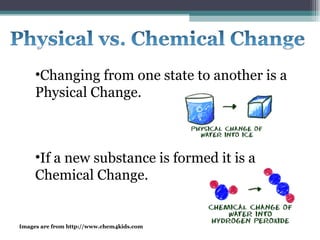
Changing from one state to another is a  Physical Change. If a new substance is formed it is a  Chemical Change. Images are from http://www.chem4kids.com
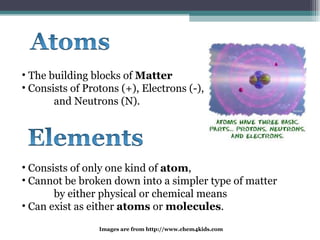
The building blocks of  Matter Consists of Protons (+), Electrons (-),  and Neutrons (N). Consists of only one kind of  atom ,  Cannot be broken down into a simpler type of matter  by either physical or chemical means Can exist as either  atoms  or  molecules .  Images are from http://www.chem4kids.com
A  molecule  consists of  two or more atoms  of the  same  element, or  different  elements, that are chemically bound together.  In the animation above, two nitrogen atoms  (N + N = N2) make one  Nitrogen molecule  .
Animated images and notes from  http://www.chem.purdue.edu/gchelp/atoms/elements.html   Atoms of two or more  different  elements  bound together . Can be separated into elements  chemically ,  but not physically. In the animation above, water (H 2 0) is a compound made of Hydrogen and  Oxygen .
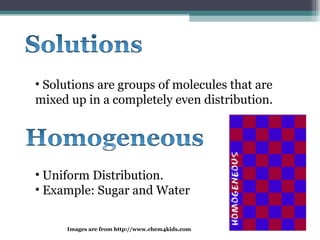
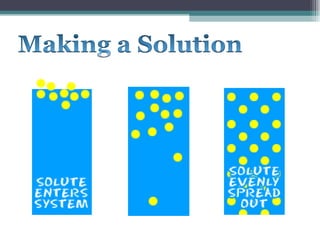
Solutions are groups of molecules that are mixed up in a completely even distribution. Uniform Distribution. Example: Sugar and Water Images are from http://www.chem4kids.com
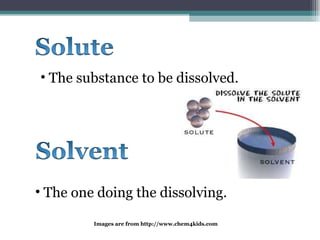
The substance to be dissolved. The one doing the dissolving. Images are from http://www.chem4kids.com
 
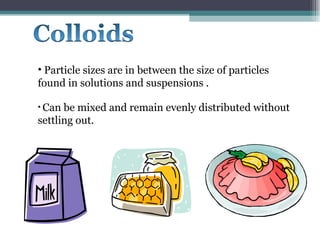
Particle sizes are in between the size of particles found in solutions and suspensions . Can be mixed and remain evenly distributed without settling out.
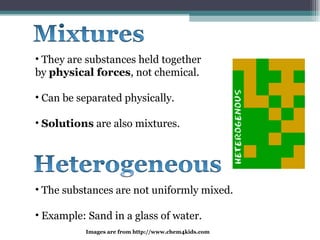
They are substances held together by  physical forces , not chemical. Can be separated physically. Solutions  are also mixtures. The substances are not uniformly mixed. Example: Sand in a glass of water. Images are from http://www.chem4kids.com
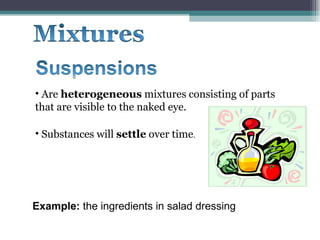
Are  heterogeneous  mixtures consisting of parts  that are visible to the naked eye.  Example:  the ingredients in salad dressing Substances will  settle  over time .


Matter study-guide

  • 1.
    Miss Reaves Matter Study Guide
  • 2.
    Anything that hasa mass and a volume
  • 3.
    Close up viewof atoms and their behavior Animated images are from http://www.chem.purdue.edu/gchelp/
  • 4.
    Changing from onestate to another is a Physical Change. If a new substance is formed it is a Chemical Change. Images are from http://www.chem4kids.com
  • 5.
    The building blocksof Matter Consists of Protons (+), Electrons (-), and Neutrons (N). Consists of only one kind of atom , Cannot be broken down into a simpler type of matter by either physical or chemical means Can exist as either atoms or molecules . Images are from http://www.chem4kids.com
  • 6.
    A molecule consists of two or more atoms of the same element, or different elements, that are chemically bound together. In the animation above, two nitrogen atoms (N + N = N2) make one Nitrogen molecule .
  • 7.
    Animated images andnotes from http://www.chem.purdue.edu/gchelp/atoms/elements.html Atoms of two or more different elements bound together . Can be separated into elements chemically , but not physically. In the animation above, water (H 2 0) is a compound made of Hydrogen and Oxygen .
  • 8.
    Solutions are groupsof molecules that are mixed up in a completely even distribution. Uniform Distribution. Example: Sugar and Water Images are from http://www.chem4kids.com
  • 9.
    The substance tobe dissolved. The one doing the dissolving. Images are from http://www.chem4kids.com
  • 10.
  • 11.
    Particle sizes arein between the size of particles found in solutions and suspensions . Can be mixed and remain evenly distributed without settling out.
  • 12.
    They are substancesheld together by physical forces , not chemical. Can be separated physically. Solutions are also mixtures. The substances are not uniformly mixed. Example: Sand in a glass of water. Images are from http://www.chem4kids.com
  • 13.
    Are heterogeneous mixtures consisting of parts that are visible to the naked eye. Example: the ingredients in salad dressing Substances will settle over time .
  • 14.
  • 15.