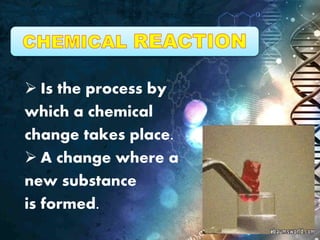
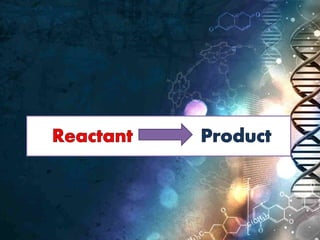
 Is the process by
which a chemical
change takes place.
 A change where a
new substance
is formed.
 Is the shorthand way of
expressing chemical reaction
using numbers, symbols
and formula.
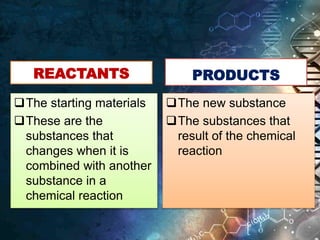
REACTANTS
The starting materials
These are the
substances that
changes when it is
combined with another
substance in a
chemical reaction
PRODUCTS
The new substance
The substances that
result of the chemical
reaction
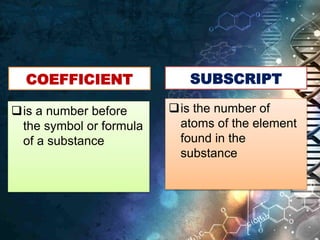
COEFFICIENT SUBSCRIPT
is a number before
the symbol or formula
of a substance
is the number of
atoms of the element
found in the
substance
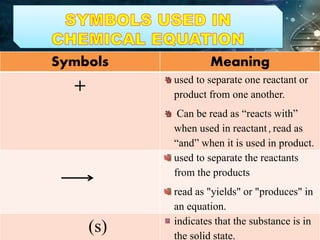
Symbols Meaning
+ used to separate one reactant or
product from one another.
Can be read as “reacts with”
when used in reactant , read as
“and” when it is used in product.
used to separate the reactants
from the products
read as "yields" or "produces" in
an equation.
(s) indicates that the substance is in
the solid state.
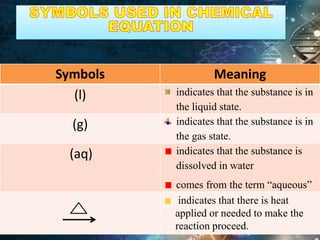
Symbols Meaning
(l) indicates that the substance is in
the liquid state.
(g) indicates that the substance is in
the gas state.
(aq) indicates that the substance is
dissolved in water
comes from the term “aqueous”
indicates that there is heat
applied or needed to make the
reaction proceed.
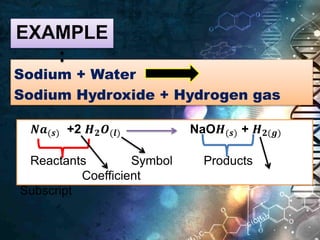
Sodium + Water
Sodium Hydroxide + Hydrogen gas
EXAMPLE
:
𝑵𝒂(𝒔) +2 𝑯 𝟐 𝑶(𝒍) NaO𝑯(𝒔) + 𝑯 𝟐(𝒈)
Reactants Symbol Products
Coefficient
Subscript
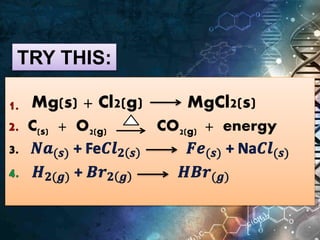
C(s) + O2(g) CO2(g) + energy
Mg(s) + Cl2(g) MgCl2(s)
TRY THIS:
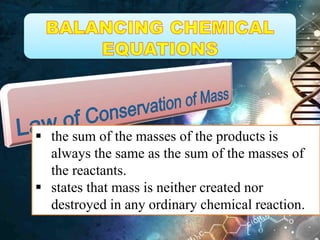
 the sum of the masses of the products is
always the same as the sum of the masses of
the reactants.
 states that mass is neither created nor
destroyed in any ordinary chemical reaction.
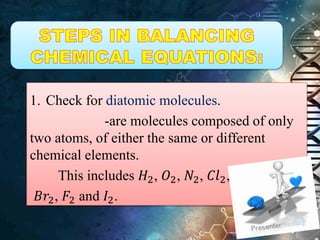
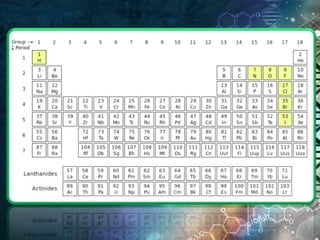
1. Check for diatomic molecules.
-are molecules composed of only
two atoms, of either the same or different
chemical elements.
This includes 𝐻2, 𝑂2, 𝑁2, 𝐶𝑙2,
𝐵𝑟2, 𝐹2 and 𝐼2.
2. Check whether the chemical formulas of all
the reactants and products are correct. Check
the total number of atoms of each element on
each side of the equation.
3. A polyatomic ion appearing unchanged on
both sides of the equation is counted as a single
unit.
4. Balance the elements one at a time by using
coefficients. Must not attempt to the balance the
equation by changing the subscripts in the
chemical formula of a substance.
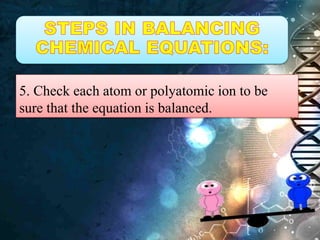
5. Check each atom or polyatomic ion to be
sure that the equation is balanced.
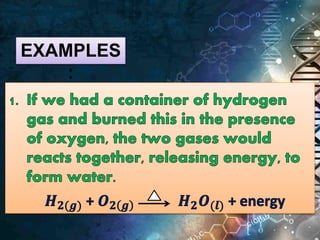
EXAMPLES
:
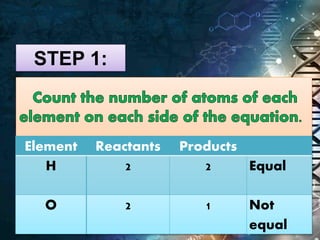
STEP 1:
Element Reactants Products
H 2 2 Equal
O 2 1 Not
equal
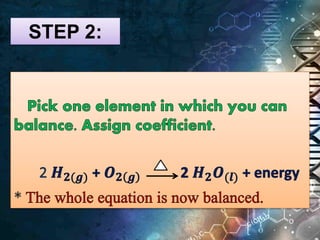
STEP 2:
Element Reactants Products
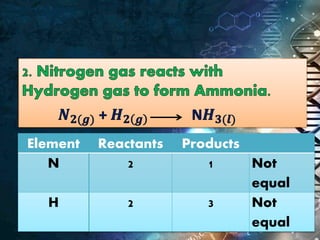
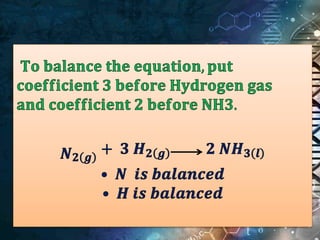
N 2 1 Not
equal
H 2 3 Not
equal
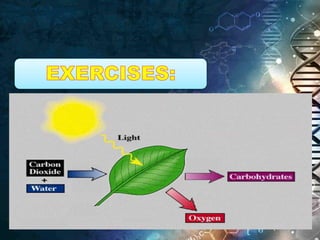
Chemical Equation during Photosynthesis:
CO2(g) + H2 𝑶(𝒍) → C6H12O6(s) + O2(g)
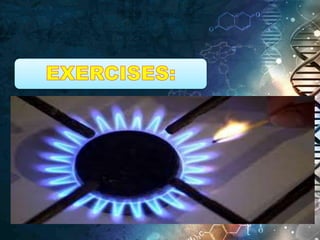
Chemical Equation when cooking in the
gas stove:
CH4(g) + O2(g) → CO2(g) + H2 𝑶(𝒍)
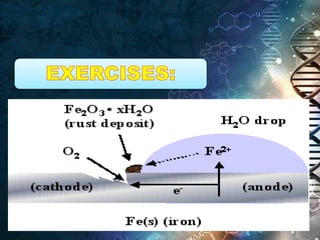
Chemical Equation in the Formation of Rust:
Fe(s) + O2(g) → Fe2O3(s)
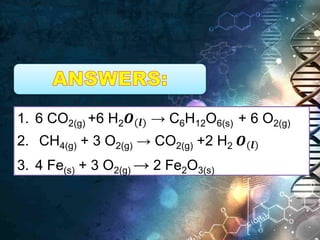
1. 6 CO2(g) +6 H2 𝑶(𝒍) → C6H12O6(s) + 6 O2(g)
2. CH4(g) + 3 O2(g) → CO2(g) +2 H2 𝑶(𝒍)
3. 4 Fe(s) + 3 O2(g) → 2 Fe2O3(s)
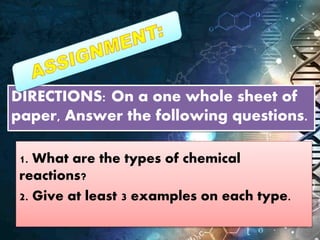
DIRECTIONS: On a one whole sheet of
paper, Answer the following questions.
1. What are the types of chemical
reactions?
2. Give at least 3 examples on each type.
 Davis, Raymond E. et.al.(2010). Modern
Chemistry. (USA: Holl, Rinehart, Winston).
 de Borja, Rebecca S.(2011).Chemistry.
(Philippines: Books Atbp. Publishing Corp.)
 Hill, John W. (2010). Chemistry for Changing
Times. (Singapore: Prentice Hall Companies).
Writing and Balancing Chemical Equation

Writing and Balancing Chemical Equation

  • 2.
     Is theprocess by which a chemical change takes place.  A change where a new substance is formed.
  • 3.
     Is theshorthand way of expressing chemical reaction using numbers, symbols and formula.
  • 4.
    REACTANTS The starting materials Theseare the substances that changes when it is combined with another substance in a chemical reaction PRODUCTS The new substance The substances that result of the chemical reaction
  • 6.
    COEFFICIENT SUBSCRIPT is anumber before the symbol or formula of a substance is the number of atoms of the element found in the substance
  • 7.
    Symbols Meaning + usedto separate one reactant or product from one another. Can be read as “reacts with” when used in reactant , read as “and” when it is used in product. used to separate the reactants from the products read as "yields" or "produces" in an equation. (s) indicates that the substance is in the solid state.
  • 8.
    Symbols Meaning (l) indicatesthat the substance is in the liquid state. (g) indicates that the substance is in the gas state. (aq) indicates that the substance is dissolved in water comes from the term “aqueous” indicates that there is heat applied or needed to make the reaction proceed.
  • 9.
    Sodium + Water SodiumHydroxide + Hydrogen gas EXAMPLE : 𝑵𝒂(𝒔) +2 𝑯 𝟐 𝑶(𝒍) NaO𝑯(𝒔) + 𝑯 𝟐(𝒈) Reactants Symbol Products Coefficient Subscript
  • 10.
    C(s) + O2(g)CO2(g) + energy Mg(s) + Cl2(g) MgCl2(s) TRY THIS:
  • 11.
     the sumof the masses of the products is always the same as the sum of the masses of the reactants.  states that mass is neither created nor destroyed in any ordinary chemical reaction.
  • 12.
    1. Check fordiatomic molecules. -are molecules composed of only two atoms, of either the same or different chemical elements. This includes 𝐻2, 𝑂2, 𝑁2, 𝐶𝑙2, 𝐵𝑟2, 𝐹2 and 𝐼2.
  • 14.
    2. Check whetherthe chemical formulas of all the reactants and products are correct. Check the total number of atoms of each element on each side of the equation. 3. A polyatomic ion appearing unchanged on both sides of the equation is counted as a single unit.
  • 15.
    4. Balance theelements one at a time by using coefficients. Must not attempt to the balance the equation by changing the subscripts in the chemical formula of a substance.
  • 16.
    5. Check eachatom or polyatomic ion to be sure that the equation is balanced.
  • 17.
  • 18.
    STEP 1: Element ReactantsProducts H 2 2 Equal O 2 1 Not equal
  • 19.
  • 20.
    Element Reactants Products N2 1 Not equal H 2 3 Not equal
  • 25.
    Chemical Equation duringPhotosynthesis: CO2(g) + H2 𝑶(𝒍) → C6H12O6(s) + O2(g)
  • 26.
    Chemical Equation whencooking in the gas stove: CH4(g) + O2(g) → CO2(g) + H2 𝑶(𝒍)
  • 27.
    Chemical Equation inthe Formation of Rust: Fe(s) + O2(g) → Fe2O3(s)
  • 28.
    1. 6 CO2(g)+6 H2 𝑶(𝒍) → C6H12O6(s) + 6 O2(g) 2. CH4(g) + 3 O2(g) → CO2(g) +2 H2 𝑶(𝒍) 3. 4 Fe(s) + 3 O2(g) → 2 Fe2O3(s)
  • 29.
    DIRECTIONS: On aone whole sheet of paper, Answer the following questions. 1. What are the types of chemical reactions? 2. Give at least 3 examples on each type.
  • 30.
     Davis, RaymondE. et.al.(2010). Modern Chemistry. (USA: Holl, Rinehart, Winston).  de Borja, Rebecca S.(2011).Chemistry. (Philippines: Books Atbp. Publishing Corp.)  Hill, John W. (2010). Chemistry for Changing Times. (Singapore: Prentice Hall Companies).