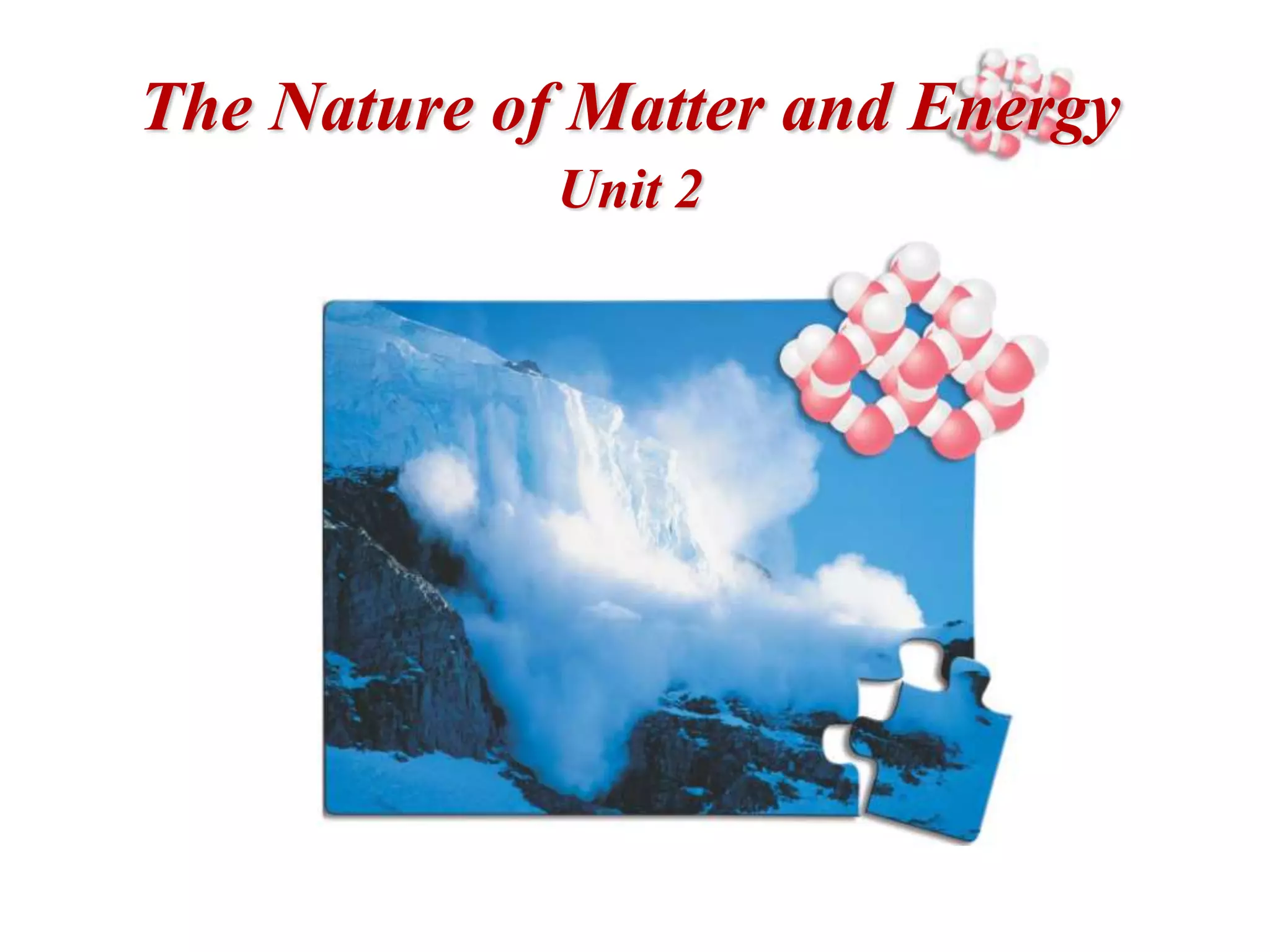
The Nature of Matter and Energy
Unit 2
Matter
• Anything that has mass and takes up
space
• Everything you “see” around you is
composed of matter
ENERGY
• Work, or capacity/potential to do work
• Work = mass moving (moved)
– kinetic energy
– heat
– light
– electricity
– chemical potential
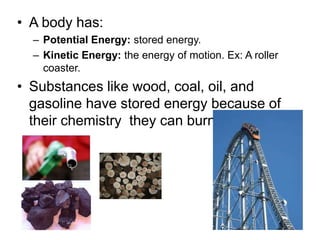
• A body has:
– Potential Energy: stored energy.
– Kinetic Energy: the energy of motion. Ex: A roller
coaster.
• Substances like wood, coal, oil, and
gasoline have stored energy because of
their chemistry they can burn.
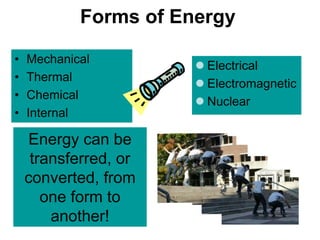
Forms of Energy
• Mechanical
• Thermal
• Chemical
• Internal
 Electrical
 Electromagnetic
 Nuclear
Energy can be
transferred, or
converted, from
one form to
another!
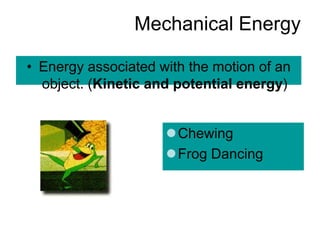
Mechanical Energy
• Energy associated with the motion of an
object. (Kinetic and potential energy)
Chewing
Frog Dancing
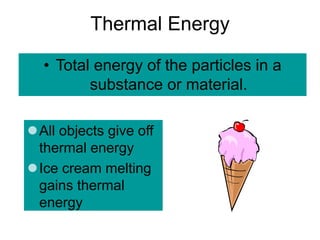
Thermal Energy
• Total energy of the particles in a
substance or material.
All objects give off
thermal energy
Ice cream melting
gains thermal
energy
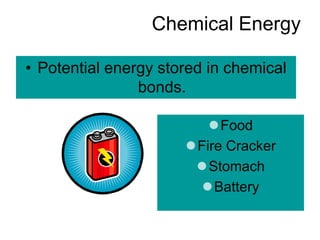
Chemical Energy
• Potential energy stored in chemical
bonds.
Food
Fire Cracker
Stomach
Battery
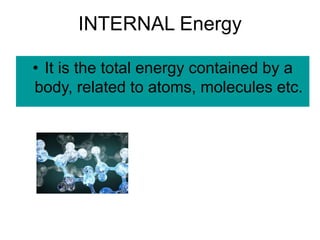
INTERNAL Energy
• It is the total energy contained by a
body, related to atoms, molecules etc.
Electrical Energy
• Moving electrical charges that produce
electricity and energy.
Lightening
Batteries
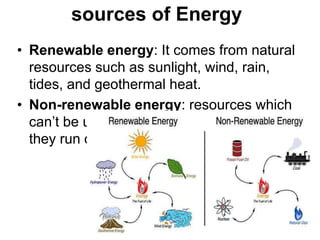
• Renewable energy: It comes from natural
resources such as sunlight, wind, rain,
tides, and geothermal heat.
• Non-renewable energy: resources which
can’t be used again and again because
they run out. Ex: Fossil fuels.
sources of Energy
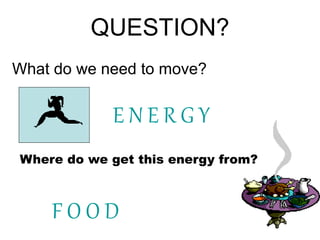
QUESTION?
What do we need to move?
E N E R G Y
Where do we get this energy from?
F O O D
would happen
without
In fact …..
NOTHING
ENERGY
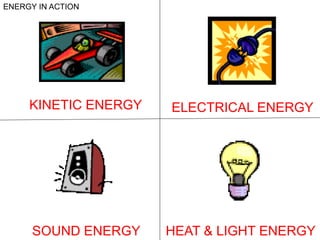
KINETIC ENERGY ELECTRICAL ENERGY
SOUND ENERGY HEAT & LIGHT ENERGY
ENERGY IN ACTION
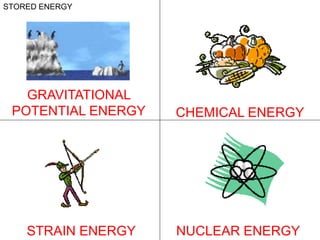
STORED ENERGY
GRAVITATIONAL
POTENTIAL ENERGY CHEMICAL ENERGY
STRAIN ENERGY NUCLEAR ENERGY
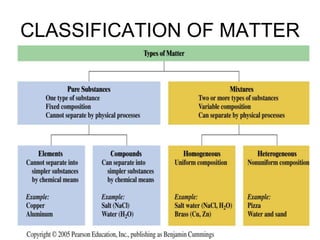
CLASSIFICATION OF MATTER
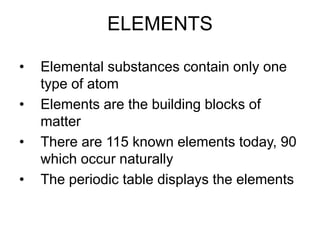
ELEMENTS
• Elemental substances contain only one
type of atom
• Elements are the building blocks of
matter
• There are 115 known elements today, 90
which occur naturally
• The periodic table displays the elements
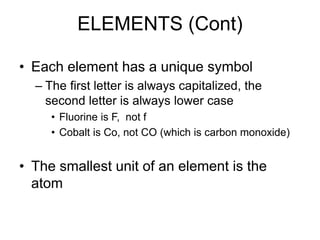
ELEMENTS (Cont)
• Each element has a unique symbol
– The first letter is always capitalized, the
second letter is always lower case
• Fluorine is F, not f
• Cobalt is Co, not CO (which is carbon monoxide)
• The smallest unit of an element is the
atom
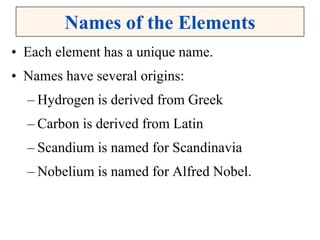
Names of the Elements
• Each element has a unique name.
• Names have several origins:
– Hydrogen is derived from Greek
– Carbon is derived from Latin
– Scandium is named for Scandinavia
– Nobelium is named for Alfred Nobel.
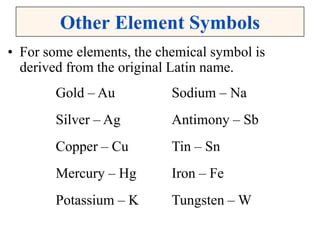
Other Element Symbols
• For some elements, the chemical symbol is
derived from the original Latin name.
Gold – Au Sodium – Na
Silver – Ag Antimony – Sb
Copper – Cu Tin – Sn
Mercury – Hg Iron – Fe
Potassium – K Tungsten – W
Types of Elements
• Elements can be divided into three classes:
– Metals
– Nonmetals
– Semimetals or metalloids
• Semimetals have properties midway
between those of metals and nonmetals
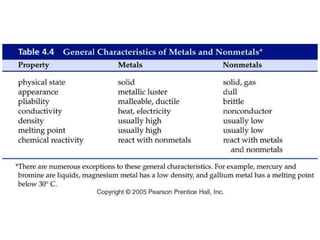
Metals vs. Nonmetals
• Metals
– Solid at room temperature
– Conduct heat and electricity well
– Malleable (sheets)
– Ductile (wires)
– Lustrous (shiny)
– High melting/boiling points
• Nonmetals
– Opposite of metals
• Metalloids
– Some qualities of both metals and nonmetals
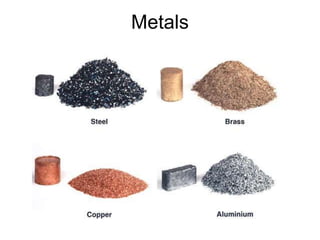
Metals
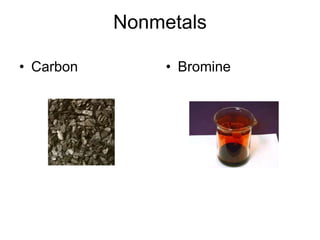
Nonmetals
• Carbon • Bromine
COMPOUNDS
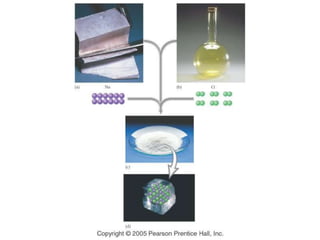
• Pure substances containing more than one
different element.
– NaCl (table salt)
• Contains sodium (Na) and chlorine (Cl)
• NaCl is the chemical formula
– H2O (water)
• Contains 2 atoms of hydrogen (H) and 1 atom of oxygen (O)
• H2O is the chemical formula
• Elements in compounds are combined in a
definite ratio
– H2O is water but H2O2 is hydrogen peroxide
Mixtures
• There are two types of mixtures:
– Homogeneous Mixtures
– Heterogeneous Mixtures
• Homogeneous mixtures have uniform properties
throughout
– Wine, vinegar, air, bronze, sea water
• Heterogeneous mixtures do not have uniform
properties throughout
– Sand and water, concrete, halo-halo, milk, clouds
Types of Heterogeneous mixture
Colloids – recognizable ingredients using
light (tyndall effect)
ex. Sol (solid in liquid) – dyes, paints, blood
gel (liquid in solid) jellies
aerosol (liquid/solid in gas) smoke, volcanic dust,
fog, clouds
foam (gas in liquid/solid) soap suds, beer froth,
marshmallow
emulsion (liquid in liquid) milk, mayonnaise
Types of Heterogeneous mixture
Suspension – parts may be distinguished since
they are heavy enough to settle down like muddy
water
Coarse mixture – parts are very large
COMPOUNDS (cont)
• Are H2 and O3 considered elements or
compounds? Why?
CLASSIFICATION OF MATTER
Classify the following as an element,
compound, homogeneous mixture, or
heterogeneous mixture.
a. Fog
b. Gasoline
c. Helium
d. Sulfuric acid (H2SO4)
e. Orange juice from squeezed oranges
PROPERTIES AND CHANGES
OF MATTER
Extensive Properties
• Substances depend on the quantity of the
sample and include measurements of
mass and volume
• Relate to the amount of substance present
• Describe the characteristic properties of a
substance that is inherent to the material
alone.
– Physical Properties
– Chemical Properties
– Physiologic Properties
Intensive Properties
• Describes the stability of nucleus of the
given material
• Describes whether a material is
radioactive or not
Nuclear Properties
PHYSICAL PROPERTIES
• Characterize the physical state and
physical behavior of a substance
• Each substance has unique physical
properties
• Examples
– Sulfur appears as a yellow powder
– The boiling point of water is 100 oC
– Carbon monoxide is odorless
PHYSICAL CHANGES
• Do not alter the chemical identity of the
substance
– Examples include:
• Any change in the state of matter (e.g. freezing or
boiling water)
• Sawing wood
• Crushing a tablet
• Bending a wire
• Dissolving salt in water
CHEMICAL PROPERTIES
• Describe ways pure substances behave
when interacting with other pure
substances.
• Examples
– Iron reacts with oxygen to form rust.
– Platinum does not react with oxygen at room
temperature.
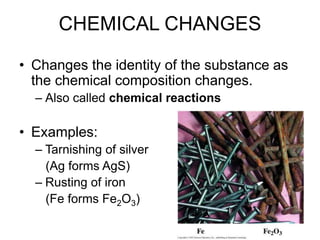
CHEMICAL CHANGES
• Changes the identity of the substance as
the chemical composition changes.
– Also called chemical reactions
• Examples:
– Tarnishing of silver
(Ag forms AgS)
– Rusting of iron
(Fe forms Fe2O3)
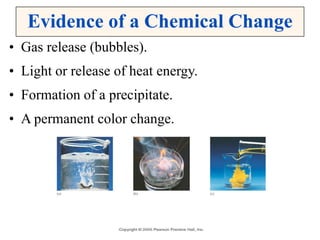
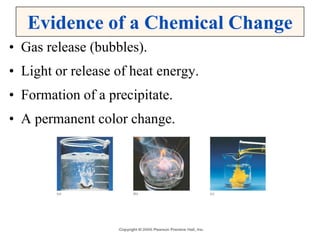
Evidence of a Chemical Change
• Gas release (bubbles).
• Light or release of heat energy.
• Formation of a precipitate.
• A permanent color change.
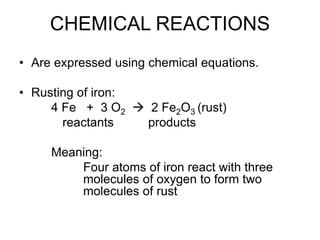
CHEMICAL REACTIONS
• Are expressed using chemical equations.
• Rusting of iron:
4 Fe + 3 O2  2 Fe2O3 (rust)
reactants products
Meaning:
Four atoms of iron react with three
molecules of oxygen to form two
molecules of rust
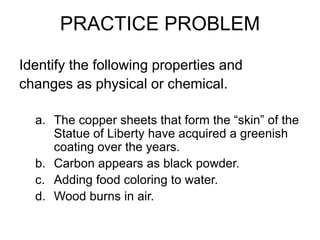
PRACTICE PROBLEM
Identify the following properties and
changes as physical or chemical.
a. The copper sheets that form the “skin” of the
Statue of Liberty have acquired a greenish
coating over the years.
b. Carbon appears as black powder.
c. Adding food coloring to water.
d. Wood burns in air.
THE PERIODIC TABLE
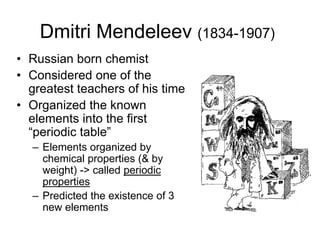
Dmitri Mendeleev (1834-1907)
• Russian born chemist
• Considered one of the
greatest teachers of his time
• Organized the known
elements into the first
“periodic table”
– Elements organized by
chemical properties (& by
weight) -> called periodic
properties
– Predicted the existence of 3
new elements
Periodic Table of the Elements
• All of the known elements are arranged in a
chart called the Periodic Table
• The elements are arranged by similarity of
chemical properties
• Each element is identified by its Atomic
Number
• The elements are organized left-to-right and
top-to-bottom by their Atomic Number
• The columns are called Groups
– Elements of each group have similar properties
• The rows are called Periods
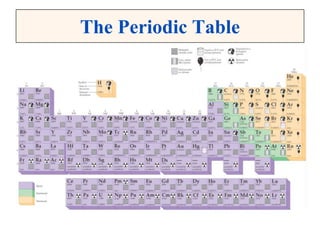
The Periodic Table
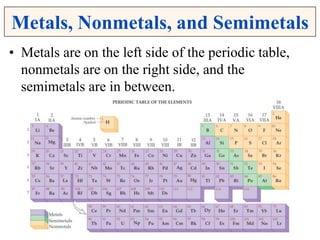
Metals, Nonmetals, and Semimetals
• Metals are on the left side of the periodic table,
nonmetals are on the right side, and the
semimetals are in between.
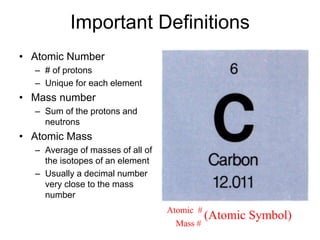
Important Definitions
• Atomic Number
– # of protons
– Unique for each element
• Mass number
– Sum of the protons and
neutrons
• Atomic Mass
– Average of masses of all of
the isotopes of an element
– Usually a decimal number
very close to the mass
number
(Atomic Symbol)
Atomic #
Mass #
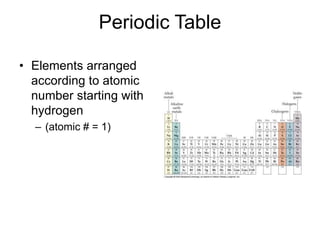
Periodic Table
• Elements arranged
according to atomic
number starting with
hydrogen
– (atomic # = 1)
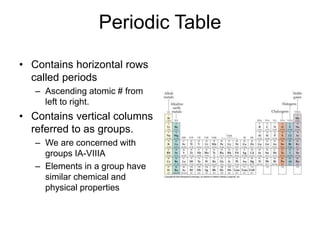
Periodic Table
• Contains horizontal rows
called periods
– Ascending atomic # from
left to right.
• Contains vertical columns
referred to as groups.
– We are concerned with
groups IA-VIIIA
– Elements in a group have
similar chemical and
physical properties
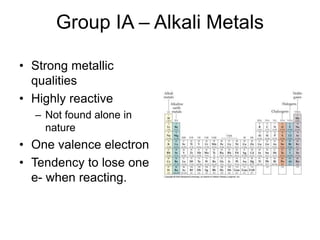
Group IA – Alkali Metals
• Strong metallic
qualities
• Highly reactive
– Not found alone in
nature
• One valence electron
• Tendency to lose one
e- when reacting.
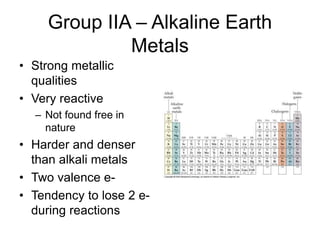
Group IIA – Alkaline Earth
Metals
• Strong metallic
qualities
• Very reactive
– Not found free in
nature
• Harder and denser
than alkali metals
• Two valence e-
• Tendency to lose 2 e-
during reactions
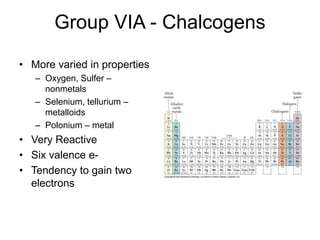
Group VIA - Chalcogens
• More varied in properties
– Oxygen, Sulfer –
nonmetals
– Selenium, tellurium –
metalloids
– Polonium – metal
• Very Reactive
• Six valence e-
• Tendency to gain two
electrons
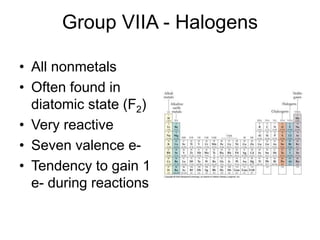
Group VIIA - Halogens
• All nonmetals
• Often found in
diatomic state (F2)
• Very reactive
• Seven valence e-
• Tendency to gain 1
e- during reactions
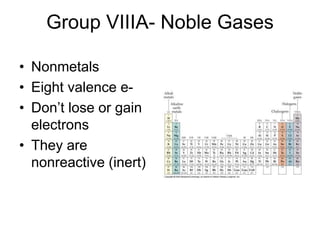
Group VIIIA- Noble Gases
• Nonmetals
• Eight valence e-
• Don’t lose or gain
electrons
• They are
nonreactive (inert)
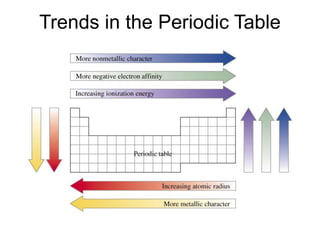
Trends in the Periodic Table
Separation of
Mixtures
Separation of Mixtures
• A pure substance cannot be broken down into its
component substances by physical means only by a
chemical process
– The breakdown of a pure substance results in formation of
new substances (i.e. chemical change)
– For a pure substance there is nothing to separate (its only 1
substance to begin with)
• Mixtures can be separated by physical means (and
also by chemical methods, as well)
• There are 2 general methods of separation
– Physical separation
– Chemical separation
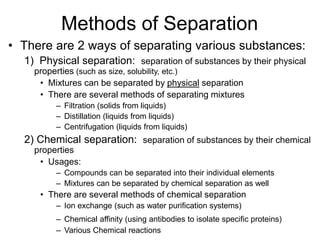
Methods of Separation
• There are 2 ways of separating various substances:
1) Physical separation: separation of substances by their physical
properties (such as size, solubility, etc.)
• Mixtures can be separated by physical separation
• There are several methods of separating mixtures
– Filtration (solids from liquids)
– Distillation (liquids from liquids)
– Centrifugation (liquids from liquids)
2) Chemical separation: separation of substances by their chemical
properties
• Usages:
– Compounds can be separated into their individual elements
– Mixtures can be separated by chemical separation as well
• There are several methods of chemical separation
– Ion exchange (such as water purification systems)
– Chemical affinity (using antibodies to isolate specific proteins)
– Various Chemical reactions
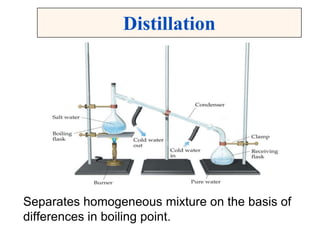
Separates homogeneous mixture on the basis of
differences in boiling point.
Distillation
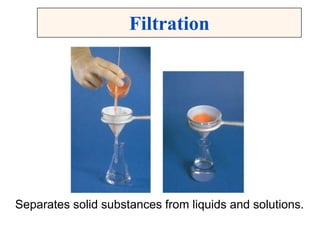
Separates solid substances from liquids and solutions.
Filtration
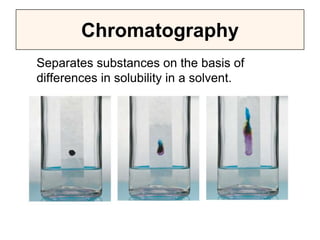
Separates substances on the basis of
differences in solubility in a solvent.
Chromatography
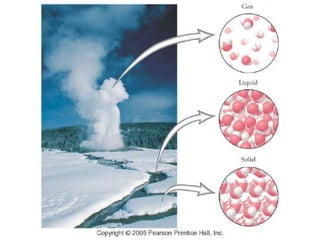
Gaseous State
• In a gas, the particles of matter are far apart and
uniformly distributed throughout the container.
• Gases have an indefinite shape and assume the
shape of their container.
• Gases can be compressed and have an indefinite
volume.
• Gases have the most energy of the three states of
matter.
Liquid State
• In a liquid, the particles of matter are loosely
packed and are free to move past one another.
• Liquids have an indefinite shape and assume the
shape of their container.
• Liquids cannot be compressed and have a definite
volume.
• Liquids have less energy than gases but more
energy than solids.
Solid State
• In a solid, the particles of matter are tightly
packed together.
• Solids have a definite, fixed shape.
• Solids cannot be compressed and have a definite
volume.
• Solids have the least energy of the three states of
matter.
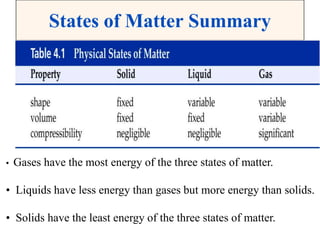
States of Matter Summary
• Gases have the most energy of the three states of matter.
• Liquids have less energy than gases but more energy than solids.
• Solids have the least energy of the three states of matter.
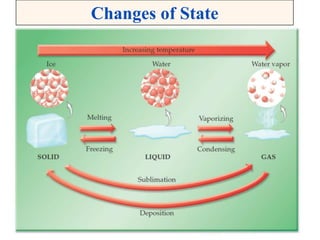
Changes of State
• Most substances can exist as either a solid, liquid,
or gas.
• Water exists as a solid below 0°C; as a liquid
between 0°C and 100°C; and as a gas above
100°C.
• A substance can change physical states as the
temperature changes.
Solid/Liquid Phase Changes
• When a solid changes to a liquid, the phase
change is called melting.
• A substance melts as the temperature increases.
• When a liquid changes to a solid, the phase
change is called freezing.
• A substance freezes as the temperature decreases.
Liquid/Gas Phase Changes
• When a liquid changes to a gas, the phase change
is called vaporization.
• A substance vaporizes as the temperature
increases.
• When a gas changes to a liquid, the phase change
is called condensation.
• A substance condenses as the temperature
decreases.
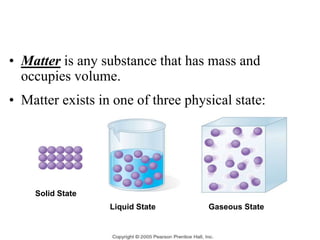
• Matter is any substance that has mass and
occupies volume.
• Matter exists in one of three physical state:
Solid State
Liquid State Gaseous State
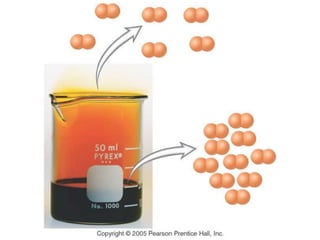
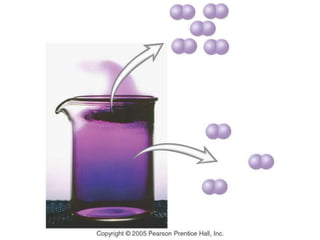
Solid/Gas Phase Changes
• When a solid changes directly to a gas, the phase
change is called sublimation.
• A substance sublimes as the temperature
increases.
• When a gas changes directly to a solid, the phase
change is called deposition.
• A substance undergoes deposition as the
temperature decreases.
Changes of State
Physical & Chemical Properties
• A physical property is a characteristic of a pure
substance that we can observe without changing
its composition.
• Physical properties include appearance, melting
and boiling point, density, conductivity, and
physical state
• A chemical property describes the chemical
reactions of a pure substance.
Chemical & Physical Changes
• A physical change is a change where the
chemical composition of the substance is not
changed.
• These include changes in physical state or shape
of a pure substance.
• A chemical change is a chemical reaction.
• The composition of the substances changes during
a chemical change.
Evidence of a Chemical Change
• Gas release (bubbles).
• Light or release of heat energy.
• Formation of a precipitate.
• A permanent color change.
Conservation of Mass
• Antoine Lavoisier found that the mass of
substances before a chemical change was always
equal to the mass of substances after a chemical
change.
• This is the law of conservation of mass.
• Matter is not created or destroyed in physical or
chemical processes.
Potential and Kinetic Energy
• Potential energy, PE, is stored energy; it results
from position or composition.
• Kinetic energy, KE, is the energy matter has as a
result of motion.
• Energy can be converted between the two types.
• A boulder at the top of the hill has potential
energy; if you push it down the hill, the potential
energy is converted to kinetic energy.
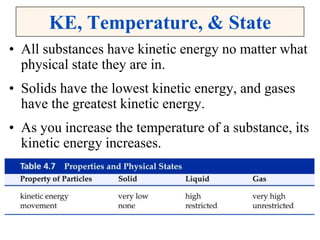
KE, Temperature, & State
• All substances have kinetic energy no matter what
physical state they are in.
• Solids have the lowest kinetic energy, and gases
have the greatest kinetic energy.
• As you increase the temperature of a substance, its
kinetic energy increases.
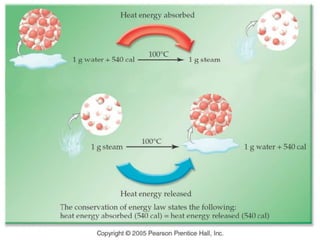
Conservation of Energy
• Just like matter, energy cannot be created or
destroyed but it can converted from one form to
another.
• This is the law of conservation of energy.
• There are six forms of energy: heat, light,
electrical, mechanical, chemical, and nuclear.
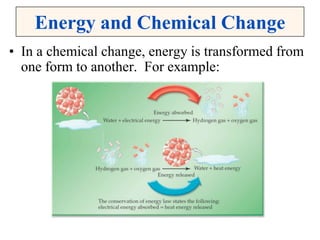
Energy and Chemical Change
• In a chemical change, energy is transformed from
one form to another. For example:
Law of Conservation of
Mass and Energy
• Mass and energy are related by Einstein’s theory
of relativity, E = mc2.
• Mass and energy can be interchanged.
• The law of conservation of mass and energy
states that the total mass and energy of the
universe is constant.
Conclusions
• Matter exists in three physical states:
– Solid
– Liquid
– Gas
• Substances can be converted between the three
states.
• Substances can be mixtures or pure substances.
Conclusions Continued
• Pure substances can be either compounds or
elements.
• The elements are arranged in the periodic table.
• Each element has a name and a 1 or 2 letter
symbol.
• Elements are classified as either metals,
nonmetals, or semimetals.
Conclusions Continued
• A physical change is a change in physical state or
shape.
• A chemical change is a change in the chemical
composition of a substance.
• Both mass and energy are conserved in chemical
and physical changes.

Chem 11 Unit 2 FINAL.ppt

  • 1.
    The Nature ofMatter and Energy Unit 2
  • 2.
    Matter • Anything thathas mass and takes up space • Everything you “see” around you is composed of matter
  • 3.
    ENERGY • Work, orcapacity/potential to do work • Work = mass moving (moved) – kinetic energy – heat – light – electricity – chemical potential
  • 4.
    • A bodyhas: – Potential Energy: stored energy. – Kinetic Energy: the energy of motion. Ex: A roller coaster. • Substances like wood, coal, oil, and gasoline have stored energy because of their chemistry they can burn.
  • 5.
    Forms of Energy •Mechanical • Thermal • Chemical • Internal  Electrical  Electromagnetic  Nuclear Energy can be transferred, or converted, from one form to another!
  • 6.
    Mechanical Energy • Energyassociated with the motion of an object. (Kinetic and potential energy) Chewing Frog Dancing
  • 7.
    Thermal Energy • Totalenergy of the particles in a substance or material. All objects give off thermal energy Ice cream melting gains thermal energy
  • 8.
    Chemical Energy • Potentialenergy stored in chemical bonds. Food Fire Cracker Stomach Battery
  • 9.
    INTERNAL Energy • Itis the total energy contained by a body, related to atoms, molecules etc.
  • 10.
    Electrical Energy • Movingelectrical charges that produce electricity and energy. Lightening Batteries
  • 11.
    • Renewable energy:It comes from natural resources such as sunlight, wind, rain, tides, and geothermal heat. • Non-renewable energy: resources which can’t be used again and again because they run out. Ex: Fossil fuels. sources of Energy
  • 12.
    QUESTION? What do weneed to move? E N E R G Y Where do we get this energy from? F O O D
  • 13.
    would happen without In fact….. NOTHING ENERGY
  • 14.
    KINETIC ENERGY ELECTRICALENERGY SOUND ENERGY HEAT & LIGHT ENERGY ENERGY IN ACTION
  • 15.
    STORED ENERGY GRAVITATIONAL POTENTIAL ENERGYCHEMICAL ENERGY STRAIN ENERGY NUCLEAR ENERGY
  • 16.
  • 17.
    ELEMENTS • Elemental substancescontain only one type of atom • Elements are the building blocks of matter • There are 115 known elements today, 90 which occur naturally • The periodic table displays the elements
  • 18.
    ELEMENTS (Cont) • Eachelement has a unique symbol – The first letter is always capitalized, the second letter is always lower case • Fluorine is F, not f • Cobalt is Co, not CO (which is carbon monoxide) • The smallest unit of an element is the atom
  • 19.
    Names of theElements • Each element has a unique name. • Names have several origins: – Hydrogen is derived from Greek – Carbon is derived from Latin – Scandium is named for Scandinavia – Nobelium is named for Alfred Nobel.
  • 20.
    Other Element Symbols •For some elements, the chemical symbol is derived from the original Latin name. Gold – Au Sodium – Na Silver – Ag Antimony – Sb Copper – Cu Tin – Sn Mercury – Hg Iron – Fe Potassium – K Tungsten – W
  • 21.
    Types of Elements •Elements can be divided into three classes: – Metals – Nonmetals – Semimetals or metalloids • Semimetals have properties midway between those of metals and nonmetals
  • 22.
    Metals vs. Nonmetals •Metals – Solid at room temperature – Conduct heat and electricity well – Malleable (sheets) – Ductile (wires) – Lustrous (shiny) – High melting/boiling points • Nonmetals – Opposite of metals • Metalloids – Some qualities of both metals and nonmetals
  • 23.
  • 24.
  • 26.
    COMPOUNDS • Pure substancescontaining more than one different element. – NaCl (table salt) • Contains sodium (Na) and chlorine (Cl) • NaCl is the chemical formula – H2O (water) • Contains 2 atoms of hydrogen (H) and 1 atom of oxygen (O) • H2O is the chemical formula • Elements in compounds are combined in a definite ratio – H2O is water but H2O2 is hydrogen peroxide
  • 27.
    Mixtures • There aretwo types of mixtures: – Homogeneous Mixtures – Heterogeneous Mixtures • Homogeneous mixtures have uniform properties throughout – Wine, vinegar, air, bronze, sea water • Heterogeneous mixtures do not have uniform properties throughout – Sand and water, concrete, halo-halo, milk, clouds
  • 28.
    Types of Heterogeneousmixture Colloids – recognizable ingredients using light (tyndall effect) ex. Sol (solid in liquid) – dyes, paints, blood gel (liquid in solid) jellies aerosol (liquid/solid in gas) smoke, volcanic dust, fog, clouds foam (gas in liquid/solid) soap suds, beer froth, marshmallow emulsion (liquid in liquid) milk, mayonnaise
  • 29.
    Types of Heterogeneousmixture Suspension – parts may be distinguished since they are heavy enough to settle down like muddy water Coarse mixture – parts are very large
  • 30.
    COMPOUNDS (cont) • AreH2 and O3 considered elements or compounds? Why?
  • 31.
    CLASSIFICATION OF MATTER Classifythe following as an element, compound, homogeneous mixture, or heterogeneous mixture. a. Fog b. Gasoline c. Helium d. Sulfuric acid (H2SO4) e. Orange juice from squeezed oranges
  • 32.
  • 33.
    Extensive Properties • Substancesdepend on the quantity of the sample and include measurements of mass and volume • Relate to the amount of substance present
  • 34.
    • Describe thecharacteristic properties of a substance that is inherent to the material alone. – Physical Properties – Chemical Properties – Physiologic Properties Intensive Properties
  • 35.
    • Describes thestability of nucleus of the given material • Describes whether a material is radioactive or not Nuclear Properties
  • 36.
    PHYSICAL PROPERTIES • Characterizethe physical state and physical behavior of a substance • Each substance has unique physical properties • Examples – Sulfur appears as a yellow powder – The boiling point of water is 100 oC – Carbon monoxide is odorless
  • 37.
    PHYSICAL CHANGES • Donot alter the chemical identity of the substance – Examples include: • Any change in the state of matter (e.g. freezing or boiling water) • Sawing wood • Crushing a tablet • Bending a wire • Dissolving salt in water
  • 38.
    CHEMICAL PROPERTIES • Describeways pure substances behave when interacting with other pure substances. • Examples – Iron reacts with oxygen to form rust. – Platinum does not react with oxygen at room temperature.
  • 39.
    CHEMICAL CHANGES • Changesthe identity of the substance as the chemical composition changes. – Also called chemical reactions • Examples: – Tarnishing of silver (Ag forms AgS) – Rusting of iron (Fe forms Fe2O3)
  • 40.
    Evidence of aChemical Change • Gas release (bubbles). • Light or release of heat energy. • Formation of a precipitate. • A permanent color change.
  • 41.
    CHEMICAL REACTIONS • Areexpressed using chemical equations. • Rusting of iron: 4 Fe + 3 O2  2 Fe2O3 (rust) reactants products Meaning: Four atoms of iron react with three molecules of oxygen to form two molecules of rust
  • 42.
    PRACTICE PROBLEM Identify thefollowing properties and changes as physical or chemical. a. The copper sheets that form the “skin” of the Statue of Liberty have acquired a greenish coating over the years. b. Carbon appears as black powder. c. Adding food coloring to water. d. Wood burns in air.
  • 43.
  • 44.
    Dmitri Mendeleev (1834-1907) •Russian born chemist • Considered one of the greatest teachers of his time • Organized the known elements into the first “periodic table” – Elements organized by chemical properties (& by weight) -> called periodic properties – Predicted the existence of 3 new elements
  • 45.
    Periodic Table ofthe Elements • All of the known elements are arranged in a chart called the Periodic Table • The elements are arranged by similarity of chemical properties • Each element is identified by its Atomic Number • The elements are organized left-to-right and top-to-bottom by their Atomic Number • The columns are called Groups – Elements of each group have similar properties • The rows are called Periods
  • 46.
  • 47.
    Metals, Nonmetals, andSemimetals • Metals are on the left side of the periodic table, nonmetals are on the right side, and the semimetals are in between.
  • 48.
    Important Definitions • AtomicNumber – # of protons – Unique for each element • Mass number – Sum of the protons and neutrons • Atomic Mass – Average of masses of all of the isotopes of an element – Usually a decimal number very close to the mass number (Atomic Symbol) Atomic # Mass #
  • 49.
    Periodic Table • Elementsarranged according to atomic number starting with hydrogen – (atomic # = 1)
  • 50.
    Periodic Table • Containshorizontal rows called periods – Ascending atomic # from left to right. • Contains vertical columns referred to as groups. – We are concerned with groups IA-VIIIA – Elements in a group have similar chemical and physical properties
  • 51.
    Group IA –Alkali Metals • Strong metallic qualities • Highly reactive – Not found alone in nature • One valence electron • Tendency to lose one e- when reacting.
  • 52.
    Group IIA –Alkaline Earth Metals • Strong metallic qualities • Very reactive – Not found free in nature • Harder and denser than alkali metals • Two valence e- • Tendency to lose 2 e- during reactions
  • 53.
    Group VIA -Chalcogens • More varied in properties – Oxygen, Sulfer – nonmetals – Selenium, tellurium – metalloids – Polonium – metal • Very Reactive • Six valence e- • Tendency to gain two electrons
  • 54.
    Group VIIA -Halogens • All nonmetals • Often found in diatomic state (F2) • Very reactive • Seven valence e- • Tendency to gain 1 e- during reactions
  • 55.
    Group VIIIA- NobleGases • Nonmetals • Eight valence e- • Don’t lose or gain electrons • They are nonreactive (inert)
  • 56.
    Trends in thePeriodic Table
  • 57.
  • 58.
    Separation of Mixtures •A pure substance cannot be broken down into its component substances by physical means only by a chemical process – The breakdown of a pure substance results in formation of new substances (i.e. chemical change) – For a pure substance there is nothing to separate (its only 1 substance to begin with) • Mixtures can be separated by physical means (and also by chemical methods, as well) • There are 2 general methods of separation – Physical separation – Chemical separation
  • 59.
    Methods of Separation •There are 2 ways of separating various substances: 1) Physical separation: separation of substances by their physical properties (such as size, solubility, etc.) • Mixtures can be separated by physical separation • There are several methods of separating mixtures – Filtration (solids from liquids) – Distillation (liquids from liquids) – Centrifugation (liquids from liquids) 2) Chemical separation: separation of substances by their chemical properties • Usages: – Compounds can be separated into their individual elements – Mixtures can be separated by chemical separation as well • There are several methods of chemical separation – Ion exchange (such as water purification systems) – Chemical affinity (using antibodies to isolate specific proteins) – Various Chemical reactions
  • 60.
    Separates homogeneous mixtureon the basis of differences in boiling point. Distillation
  • 61.
    Separates solid substancesfrom liquids and solutions. Filtration
  • 62.
    Separates substances onthe basis of differences in solubility in a solvent. Chromatography
  • 64.
    Gaseous State • Ina gas, the particles of matter are far apart and uniformly distributed throughout the container. • Gases have an indefinite shape and assume the shape of their container. • Gases can be compressed and have an indefinite volume. • Gases have the most energy of the three states of matter.
  • 65.
    Liquid State • Ina liquid, the particles of matter are loosely packed and are free to move past one another. • Liquids have an indefinite shape and assume the shape of their container. • Liquids cannot be compressed and have a definite volume. • Liquids have less energy than gases but more energy than solids.
  • 66.
    Solid State • Ina solid, the particles of matter are tightly packed together. • Solids have a definite, fixed shape. • Solids cannot be compressed and have a definite volume. • Solids have the least energy of the three states of matter.
  • 67.
    States of MatterSummary • Gases have the most energy of the three states of matter. • Liquids have less energy than gases but more energy than solids. • Solids have the least energy of the three states of matter.
  • 68.
    Changes of State •Most substances can exist as either a solid, liquid, or gas. • Water exists as a solid below 0°C; as a liquid between 0°C and 100°C; and as a gas above 100°C. • A substance can change physical states as the temperature changes.
  • 69.
    Solid/Liquid Phase Changes •When a solid changes to a liquid, the phase change is called melting. • A substance melts as the temperature increases. • When a liquid changes to a solid, the phase change is called freezing. • A substance freezes as the temperature decreases.
  • 70.
    Liquid/Gas Phase Changes •When a liquid changes to a gas, the phase change is called vaporization. • A substance vaporizes as the temperature increases. • When a gas changes to a liquid, the phase change is called condensation. • A substance condenses as the temperature decreases.
  • 71.
    • Matter isany substance that has mass and occupies volume. • Matter exists in one of three physical state: Solid State Liquid State Gaseous State
  • 73.
    Solid/Gas Phase Changes •When a solid changes directly to a gas, the phase change is called sublimation. • A substance sublimes as the temperature increases. • When a gas changes directly to a solid, the phase change is called deposition. • A substance undergoes deposition as the temperature decreases.
  • 75.
  • 76.
    Physical & ChemicalProperties • A physical property is a characteristic of a pure substance that we can observe without changing its composition. • Physical properties include appearance, melting and boiling point, density, conductivity, and physical state • A chemical property describes the chemical reactions of a pure substance.
  • 77.
    Chemical & PhysicalChanges • A physical change is a change where the chemical composition of the substance is not changed. • These include changes in physical state or shape of a pure substance. • A chemical change is a chemical reaction. • The composition of the substances changes during a chemical change.
  • 78.
    Evidence of aChemical Change • Gas release (bubbles). • Light or release of heat energy. • Formation of a precipitate. • A permanent color change.
  • 79.
    Conservation of Mass •Antoine Lavoisier found that the mass of substances before a chemical change was always equal to the mass of substances after a chemical change. • This is the law of conservation of mass. • Matter is not created or destroyed in physical or chemical processes.
  • 81.
    Potential and KineticEnergy • Potential energy, PE, is stored energy; it results from position or composition. • Kinetic energy, KE, is the energy matter has as a result of motion. • Energy can be converted between the two types. • A boulder at the top of the hill has potential energy; if you push it down the hill, the potential energy is converted to kinetic energy.
  • 82.
    KE, Temperature, &State • All substances have kinetic energy no matter what physical state they are in. • Solids have the lowest kinetic energy, and gases have the greatest kinetic energy. • As you increase the temperature of a substance, its kinetic energy increases.
  • 85.
    Conservation of Energy •Just like matter, energy cannot be created or destroyed but it can converted from one form to another. • This is the law of conservation of energy. • There are six forms of energy: heat, light, electrical, mechanical, chemical, and nuclear.
  • 86.
    Energy and ChemicalChange • In a chemical change, energy is transformed from one form to another. For example:
  • 87.
    Law of Conservationof Mass and Energy • Mass and energy are related by Einstein’s theory of relativity, E = mc2. • Mass and energy can be interchanged. • The law of conservation of mass and energy states that the total mass and energy of the universe is constant.
  • 88.
    Conclusions • Matter existsin three physical states: – Solid – Liquid – Gas • Substances can be converted between the three states. • Substances can be mixtures or pure substances.
  • 89.
    Conclusions Continued • Puresubstances can be either compounds or elements. • The elements are arranged in the periodic table. • Each element has a name and a 1 or 2 letter symbol. • Elements are classified as either metals, nonmetals, or semimetals.
  • 90.
    Conclusions Continued • Aphysical change is a change in physical state or shape. • A chemical change is a change in the chemical composition of a substance. • Both mass and energy are conserved in chemical and physical changes.