© 2018 Pearson Education, Inc.
Lecture Presentation
Chapter 3
Matter and
Energy
Dr. Sylvia Esjornson
Southwestern Oklahoma State
University
Weatherford, OK
© 2018 Pearson Education, Inc.
Defining Matter
• Matter is defined as anything that occupies
space and has mass.
• Some types of matter, such as steel, water,
wood, and plastic, are easily visible to our
eyes.
• Other types of matter, such as air or
microscopic dust, are impossible to see
without magnification.
© 2018 Pearson Education, Inc.
Matter Is Composed of Atoms and
Molecules
• Matter may appear smooth and continuous, but
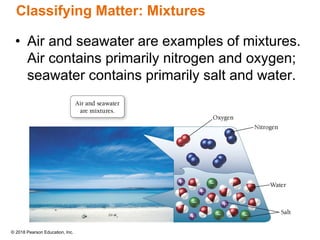
actually it is not.
• Matter is ultimately composed of atoms,
submicroscopic particles that are the fundamental
building blocks of matter.
• In many cases, these atoms are bonded together
to form molecules, two or more atoms joined to
one another in specific geometric arrangements.
© 2018 Pearson Education, Inc.
Independent Atomic Particles in Aluminum
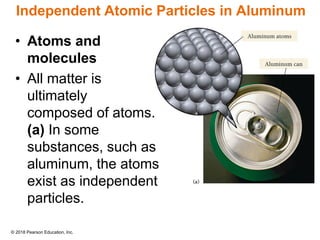
• Atoms and
molecules
• All matter is
ultimately
composed of atoms.
(a) In some
substances, such as
aluminum, the atoms
exist as independent
particles.
© 2018 Pearson Education, Inc.
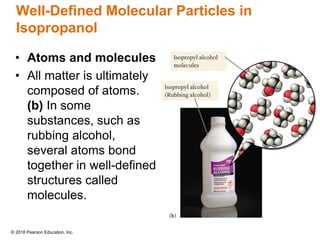
Well-Defined Molecular Particles in
Isopropanol
• Atoms and molecules
• All matter is ultimately
composed of atoms.
(b) In some
substances, such as
rubbing alcohol,
several atoms bond
together in well-defined
structures called
molecules.
© 2018 Pearson Education, Inc.
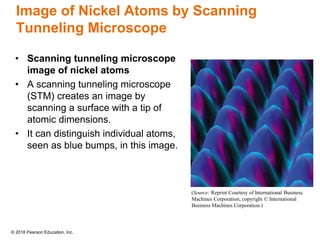
Image of Nickel Atoms by Scanning
Tunneling Microscope
• Scanning tunneling microscope
image of nickel atoms
• A scanning tunneling microscope
(STM) creates an image by
scanning a surface with a tip of
atomic dimensions.
• It can distinguish individual atoms,
seen as blue bumps, in this image.
(Source: Reprint Courtesy of International Business
Machines Corporation, copyright © International
Business Machines Corporation.)
© 2018 Pearson Education, Inc.
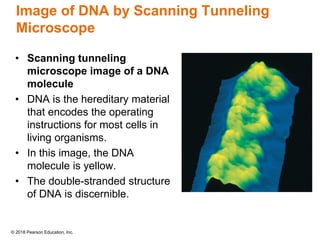
Image of DNA by Scanning Tunneling
Microscope
• Scanning tunneling
microscope image of a DNA
molecule
• DNA is the hereditary material
that encodes the operating
instructions for most cells in
living organisms.
• In this image, the DNA
molecule is yellow.
• The double-stranded structure
of DNA is discernible.
© 2018 Pearson Education, Inc.
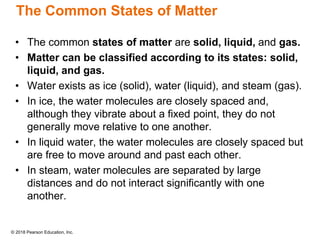
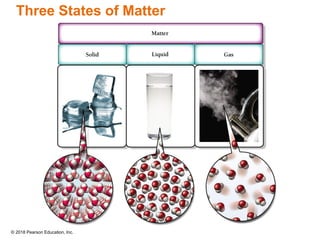
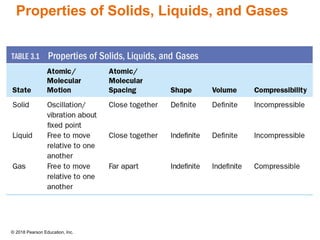
The Common States of Matter
• The common states of matter are solid, liquid, and gas.
• Matter can be classified according to its states: solid,
liquid, and gas.
• Water exists as ice (solid), water (liquid), and steam (gas).
• In ice, the water molecules are closely spaced and,
although they vibrate about a fixed point, they do not
generally move relative to one another.
• In liquid water, the water molecules are closely spaced but
are free to move around and past each other.
• In steam, water molecules are separated by large
distances and do not interact significantly with one
another.
© 2018 Pearson Education, Inc.
Three States of Matter
© 2018 Pearson Education, Inc.
States of Matter: Solid
• In solid matter, atoms or molecules pack
close to each other in fixed locations.
• Neighboring atoms or molecules in a solid
may vibrate or oscillate, but they do not
move around each other.
• Solids have fixed volume and rigid shape.
• Ice, diamond, quartz, and iron are
examples of solid matter.
© 2018 Pearson Education, Inc.
States of Matter: Types of Solids
• Crystalline solid: Atoms or molecules are arranged in
geometric patterns with long-range, repeating order.
• Amorphous solid: Atoms or molecules do not have
long-range order.
• Examples of crystalline solids include salt and
diamond.
• The well-ordered, geometric shapes of salt and
diamond crystals reflect the well-ordered geometric
arrangement of their atoms.
• Examples of amorphous solids include glass, rubber,
and plastic.
© 2018 Pearson Education, Inc.
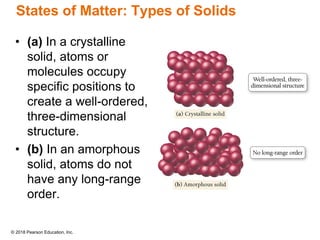
States of Matter: Types of Solids
• (a) In a crystalline
solid, atoms or
molecules occupy
specific positions to
create a well-ordered,
three-dimensional
structure.
• (b) In an amorphous
solid, atoms do not
have any long-range
order.
© 2018 Pearson Education, Inc.
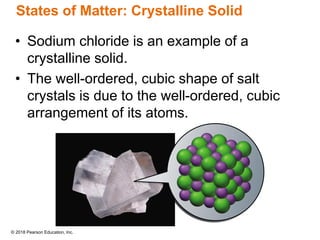
States of Matter: Crystalline Solid
• Sodium chloride is an example of a
crystalline solid.
• The well-ordered, cubic shape of salt
crystals is due to the well-ordered, cubic
arrangement of its atoms.
© 2018 Pearson Education, Inc.
States of Matter: Liquid
• In liquid matter, atoms or molecules are
close to each other but are free to move
around and by each other.
• Liquids have a fixed volume because their
atoms or molecules are in close contact.
• Liquids assume the shape of their containers
because the atoms or molecules are free to
move relative to one another.
• Water, gasoline, alcohol, and mercury are all
examples of liquid matter.
© 2018 Pearson Education, Inc.
States of Matter: Gas
• In gaseous matter, atoms or molecules are
separated by large distances and are free to
move relative to one another.
• Since the atoms or molecules that compose
gases are not in contact with one another,
gases are compressible.
• Gases always assume the shape and
volume of their containers.
• Oxygen, helium, and carbon dioxide are
examples of gases.
© 2018 Pearson Education, Inc.
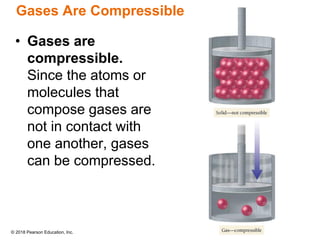
Gases Are Compressible
• Gases are
compressible.
Since the atoms or
molecules that
compose gases are
not in contact with
one another, gases
can be compressed.
© 2018 Pearson Education, Inc.
Properties of Solids, Liquids, and Gases
© 2018 Pearson Education, Inc.
Classifying Matter According to Its
Composition
• A pure substance is composed of only one
type of atom or molecule.
• A mixture is composed of two or more
different types of atoms or molecules
combined in variable proportions.
© 2018 Pearson Education, Inc.
Classifying Matter: Composition of
Elements
• Element: A pure substance that cannot be
broken down into simpler substances
• No chemical transformation can decompose
an element into simpler substances.
• All known elements are listed in the
periodic table.
© 2018 Pearson Education, Inc.
Classifying Matter: Composition of the
Element Helium
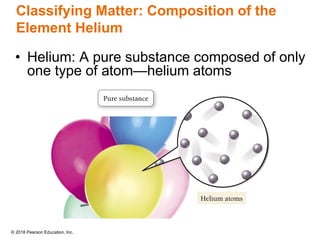
• Helium: A pure substance composed of only
one type of atom—helium atoms
© 2018 Pearson Education, Inc.
Classifying Matter: Composition of
Compounds
• Compound: A pure substance composed of two
or more elements in fixed definite proportions
• Compounds are more common than pure
elements.
• Most elements are chemically reactive and
combine with other elements to form compounds.
• Water, table salt, and sugar are examples of
compounds.
• Compounds can be decomposed into simpler
substances.
© 2018 Pearson Education, Inc.
Classifying Matter: Compounds and
Mixtures
• When matter contains two types of atoms, it
may be a pure substance or a mixture.
• A compound is a pure substance
composed of different atoms that are
chemically united (bonded) in fixed definite
proportions.
• A mixture is composed of different
substances that are not chemically united
but simply mixed together.
© 2018 Pearson Education, Inc.
Classifying Matter: Mixtures
• Air and seawater are examples of mixtures.
Air contains primarily nitrogen and oxygen;
seawater contains primarily salt and water.
© 2018 Pearson Education, Inc.
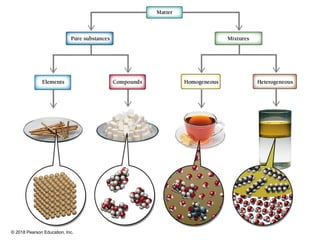
Classification of Matter
• A pure substance may be either an element
(such as copper) or a compound (such as
sugar).
• A mixture may be either a homogeneous
mixture (such as sweetened tea) or a
heterogeneous mixture (such as
hydrocarbon and water).
© 2018 Pearson Education, Inc.
Different Kinds of Matter Have Different
Properties
• A physical property is one that a
substance displays without changing its
composition.
• A chemical property is one that a
substance displays only through changing
its composition.
© 2018 Pearson Education, Inc.
Difference in Physical and Chemical
Properties
• The characteristic odor of gasoline is a
physical property; gasoline does not
change its composition when it exhibits
its odor.
• The flammability of gasoline is a chemical
property; gasoline does change its
composition when it burns.
© 2018 Pearson Education, Inc.
Physical Change of Water
• The atomic or molecular composition of a
substance does not change when the
substance displays its physical properties.
• The boiling point of water—a physical
property—is 100 °C.
• When water boils, it changes from a liquid to
a gas, but the gas is still water.
© 2018 Pearson Education, Inc.
Changes of State Are Physical Changes
• State changes—transformations from one
state of matter to another, such as from solid
to liquid—are always physical changes.
© 2018 Pearson Education, Inc.
Matter Changes Composition in Chemical
Changes
• In a physical change, matter changes its
appearance but not its composition.
• When ice melts, it looks different but its composition
is the same. Solid ice and liquid water are both
composed of water molecules, so melting is a
physical change.
• In a chemical change, matter does change its
composition.
• For example, copper turns green upon continued
exposure to air because it reacts with gases in air
to form new compounds. This is a chemical
change.
© 2018 Pearson Education, Inc.
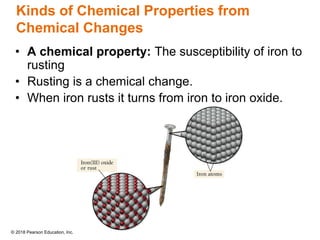
Kinds of Chemical Properties from
Chemical Changes
• A chemical property: The susceptibility of iron to
rusting
• Rusting is a chemical change.
• When iron rusts it turns from iron to iron oxide.
© 2018 Pearson Education, Inc.
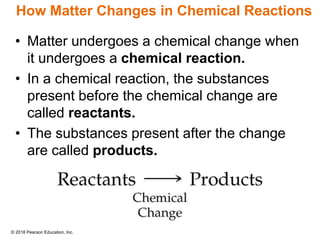
How Matter Changes in Chemical Reactions
• Matter undergoes a chemical change when
it undergoes a chemical reaction.
• In a chemical reaction, the substances
present before the chemical change are
called reactants.
• The substances present after the change
are called products.
© 2018 Pearson Education, Inc.
The Difference Between Physical and
Chemical Changes
• The difference between chemical and physical changes is
seen at the molecular and atomic level.
• In physical changes, the atoms that compose the matter
do not change their fundamental associations, even
though the matter may change its appearance.
• In chemical changes, atoms do change their fundamental
associations, resulting in matter with a new identity.
• A physical change results in a different form of the same
substance.
• A chemical change results in a completely new
substance.
© 2018 Pearson Education, Inc.
Vaporization: A Physical Change
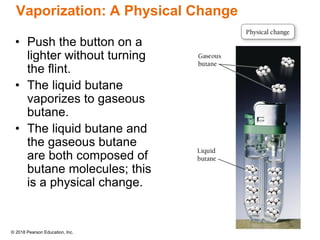
• Push the button on a
lighter without turning
the flint.
• The liquid butane
vaporizes to gaseous
butane.
• The liquid butane and
the gaseous butane
are both composed of
butane molecules; this
is a physical change.
© 2018 Pearson Education, Inc.
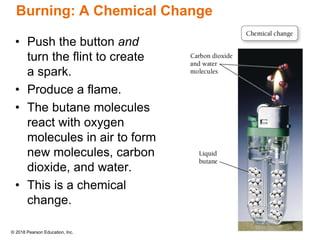
Burning: A Chemical Change
• Push the button and
turn the flint to create
a spark.
• Produce a flame.
• The butane molecules
react with oxygen
molecules in air to form
new molecules, carbon
dioxide, and water.
• This is a chemical
change.
© 2018 Pearson Education, Inc.
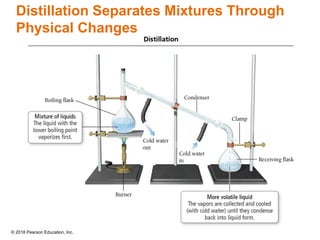
Distillation Separates Mixtures Through
Physical Changes
© 2018 Pearson Education, Inc.
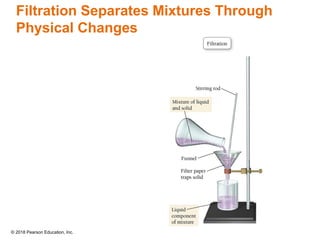
Filtration Separates Mixtures Through
Physical Changes
© 2018 Pearson Education, Inc.
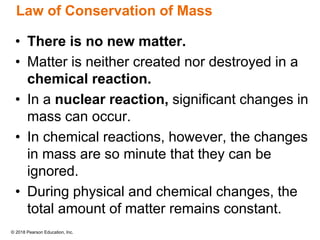
Law of Conservation of Mass
• There is no new matter.
• Matter is neither created nor destroyed in a
chemical reaction.
• In a nuclear reaction, significant changes in
mass can occur.
• In chemical reactions, however, the changes
in mass are so minute that they can be
ignored.
• During physical and chemical changes, the
total amount of matter remains constant.
© 2018 Pearson Education, Inc.
Law of Conservation of Mass
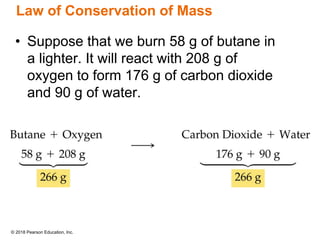
• Suppose that we burn 58 g of butane in
a lighter. It will react with 208 g of
oxygen to form 176 g of carbon dioxide
and 90 g of water.
© 2018 Pearson Education, Inc.
The Behavior of Matter Is Driven by Energy
• Energy is a major component of our
universe.
• Energy is the capacity to do work.
• Work is defined as the result of a force
acting on a distance.
• The behavior of matter is driven by energy.
• Understanding energy is critical to
understanding chemistry.
© 2018 Pearson Education, Inc.
Law of Conservation of Energy
• Like matter, energy is conserved.
• The law of conservation of energy states
that energy is neither created nor destroyed.
• The total amount of energy is constant.
• Energy can be changed from one form to
another.
• Energy can be transferred from one object
to another.
• Energy cannot be created out of nothing, and
it does not vanish into nothing.
© 2018 Pearson Education, Inc.
There Are Different Forms of Energy
• The total energy of a sample of matter is the sum
of its kinetic energy, the energy associated with its
motion, and its potential energy, the energy
associated with its position or composition.
• Electrical energy: The energy associated with the
flow of electrical charge
• Thermal energy: The energy associated with the
random motions of atoms and molecules in matter
• Chemical energy: A form of potential energy
associated with the positions of the particles that
compose a chemical system
© 2018 Pearson Education, Inc.
Units of Energy
• The SI unit of energy is the joule (J), named after the
English scientist James Joule (1818–1889), who
demonstrated that energy could be converted from one type
to another as long as the total energy was conserved.
• A second unit of energy is the calorie (cal), the amount of
energy required to raise the temperature of 1 g of water by
1 °C. A calorie is a larger unit than a joule.
• A related energy unit is the nutritional or capital C Calorie
(Cal), equivalent to 1000 little c calories.
• The kilowatt-hour (kWh) is 1 kJ per second times
3600 seconds in an hour.
• The average cost of residential electricity in the United
States is about $0.12 per kilowatt-hour.
© 2018 Pearson Education, Inc.
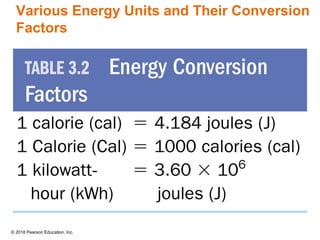
Various Energy Units and Their Conversion
Factors
© 2018 Pearson Education, Inc.
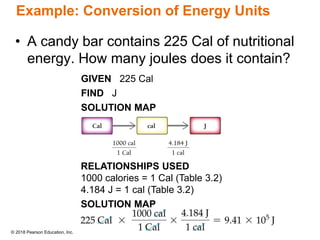
Example: Conversion of Energy Units
• A candy bar contains 225 Cal of nutritional
energy. How many joules does it contain?
GIVEN 225 Cal
FIND J
SOLUTION MAP
RELATIONSHIPS USED
1000 calories = 1 Cal (Table 3.2)
4.184 J = 1 cal (Table 3.2)
SOLUTION MAP
© 2018 Pearson Education, Inc.
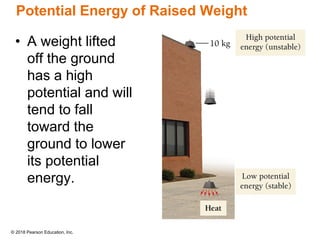
Potential Energy of Raised Weight
• A weight lifted
off the ground
has a high
potential and will
tend to fall
toward the
ground to lower
its potential
energy.
© 2018 Pearson Education, Inc.
Chemical Changes Change Potential Energy
• Systems with high potential energy have a
tendency to change in a way that lowers their
potential energy.
• Objects or systems with high potential energy tend
to be unstable.
• Some chemical substances, such as the molecules
that compose TNT (trinitrotoluene), have a
relatively high potential energy—energy is
concentrated in them.
• TNT molecules tend to undergo rapid chemical
changes that lower their potential energy, which is
why TNT is explosive.
© 2018 Pearson Education, Inc.
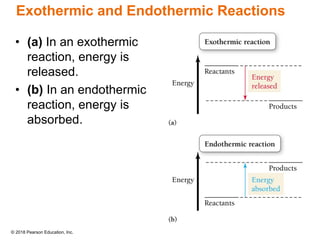
Exothermic and Endothermic Reactions
• (a) In an exothermic
reaction, energy is
released.
• (b) In an endothermic
reaction, energy is
absorbed.
© 2018 Pearson Education, Inc.
Thermal Energy: Constant Random Motion
of Matter
• The atoms and molecules that compose
matter are in constant random motion—they
contain thermal energy.
• The temperature of a substance is a
measure of its thermal energy.
• The hotter an object, the greater the random
motion of the atoms and molecules that
compose it, and the higher its temperature.
© 2018 Pearson Education, Inc.
Do Not Confuse Temperature with Heat
• Heat, which has units of energy, is the
transfer or exchange of thermal energy
caused by a temperature difference.
• For example, when a piece of cold ice is
dropped into a cup of warm water, heat
(thermal energy) is transferred from the
water to the ice.
• Temperature, by contrast, is a measure of
the thermal energy of matter (not the
exchange of thermal energy).
© 2018 Pearson Education, Inc.
Background of the Fahrenheit
Temperature Scale
The Fahrenheit scale assigns
• 0 °F to the freezing point of a concentrated
saltwater solution; and
• 96 °F to normal body temperature.
On the Fahrenheit (°F) scale,
• water freezes at 32 °F; and
• water boils at 212 °F.
Room temperature is approximately 72 °F.
© 2018 Pearson Education, Inc.
Different Temperature Scales:
Celsius, Kelvin
On the Celsius (°C) scale,
• water freezes at 0 °C; and
• water boils at 100 °C.
Room temperature is approximately 22 °C.
The Kelvin (K) scale avoids negative temperatures by
assigning 0 K to the coldest temperature possible,
absolute zero.
• Absolute zero is the temperature at which molecular motion
virtually stops.
On the Kelvin (K) scale,
• water freezes at 273 K; and
• water boils at 373 K.
Room temperature is approximately 295 K.
© 2018 Pearson Education, Inc.
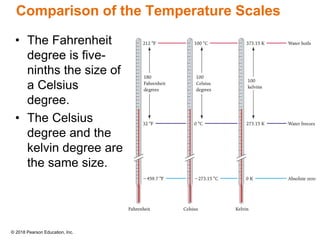
Comparison of the Temperature Scales
• The Fahrenheit
degree is five-
ninths the size of
a Celsius
degree.
• The Celsius
degree and the
kelvin degree are
the same size.
© 2018 Pearson Education, Inc.
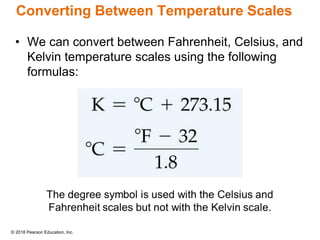
Converting Between Temperature Scales
• We can convert between Fahrenheit, Celsius, and
Kelvin temperature scales using the following
formulas:
© 2018 Pearson Education, Inc.
Temperature Changes: Heat Capacity
• Heat capacity: The quantity of heat (usually in
joules) required to change the temperature of a
given amount of the substance by 1 °C (also in
kelvins)
• When the amount of the substance is expressed in
grams, the heat capacity is called the specific
heat capacity (or the specific heat) and has units
of joules per gram per degree Celsius, J/g °C (also
in kelvins).
© 2018 Pearson Education, Inc.
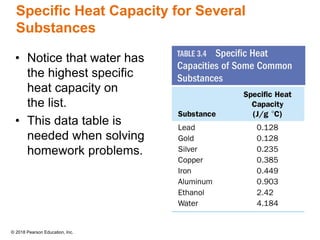
Specific Heat Capacity for Several
Substances
• Notice that water has
the highest specific
heat capacity on
the list.
• This data table is
needed when solving
homework problems.
© 2018 Pearson Education, Inc.
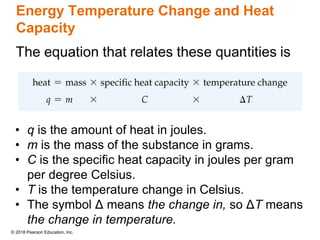
Energy Temperature Change and Heat
Capacity
• q is the amount of heat in joules.
• m is the mass of the substance in grams.
• C is the specific heat capacity in joules per gram
per degree Celsius.
• T is the temperature change in Celsius.
• The symbol Δ means the change in, so ΔT means
the change in temperature.
© 2018 Pearson Education, Inc.
Example: Relating Heat Energy to
Temperature Changes
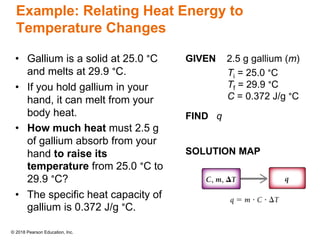
• Gallium is a solid at 25.0 °C
and melts at 29.9 °C.
• If you hold gallium in your
hand, it can melt from your
body heat.
• How much heat must 2.5 g
of gallium absorb from your
hand to raise its
temperature from 25.0 °C to
29.9 °C?
• The specific heat capacity of
gallium is 0.372 J/g °C.
GIVEN 2.5 g gallium (m)
Ti = 25.0 °C
Tf = 29.9 °C
C = 0.372 J/g °C
FIND q
SOLUTION MAP
© 2018 Pearson Education, Inc.
Relating Heat Energy to Temperature
Changes
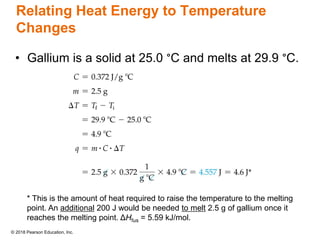
• Gallium is a solid at 25.0 °C and melts at 29.9 °C.
* This is the amount of heat required to raise the temperature to the melting
point. An additional 200 J would be needed to melt 2.5 g of gallium once it
reaches the melting point. ΔHfus = 5.59 kJ/mol.

Lecture_03.pdf......................................................

  • 1.
    © 2018 PearsonEducation, Inc. Lecture Presentation Chapter 3 Matter and Energy Dr. Sylvia Esjornson Southwestern Oklahoma State University Weatherford, OK
  • 2.
    © 2018 PearsonEducation, Inc. Defining Matter • Matter is defined as anything that occupies space and has mass. • Some types of matter, such as steel, water, wood, and plastic, are easily visible to our eyes. • Other types of matter, such as air or microscopic dust, are impossible to see without magnification.
  • 3.
    © 2018 PearsonEducation, Inc. Matter Is Composed of Atoms and Molecules • Matter may appear smooth and continuous, but actually it is not. • Matter is ultimately composed of atoms, submicroscopic particles that are the fundamental building blocks of matter. • In many cases, these atoms are bonded together to form molecules, two or more atoms joined to one another in specific geometric arrangements.
  • 4.
    © 2018 PearsonEducation, Inc. Independent Atomic Particles in Aluminum • Atoms and molecules • All matter is ultimately composed of atoms. (a) In some substances, such as aluminum, the atoms exist as independent particles.
  • 5.
    © 2018 PearsonEducation, Inc. Well-Defined Molecular Particles in Isopropanol • Atoms and molecules • All matter is ultimately composed of atoms. (b) In some substances, such as rubbing alcohol, several atoms bond together in well-defined structures called molecules.
  • 6.
    © 2018 PearsonEducation, Inc. Image of Nickel Atoms by Scanning Tunneling Microscope • Scanning tunneling microscope image of nickel atoms • A scanning tunneling microscope (STM) creates an image by scanning a surface with a tip of atomic dimensions. • It can distinguish individual atoms, seen as blue bumps, in this image. (Source: Reprint Courtesy of International Business Machines Corporation, copyright © International Business Machines Corporation.)
  • 7.
    © 2018 PearsonEducation, Inc. Image of DNA by Scanning Tunneling Microscope • Scanning tunneling microscope image of a DNA molecule • DNA is the hereditary material that encodes the operating instructions for most cells in living organisms. • In this image, the DNA molecule is yellow. • The double-stranded structure of DNA is discernible.
  • 8.
    © 2018 PearsonEducation, Inc. The Common States of Matter • The common states of matter are solid, liquid, and gas. • Matter can be classified according to its states: solid, liquid, and gas. • Water exists as ice (solid), water (liquid), and steam (gas). • In ice, the water molecules are closely spaced and, although they vibrate about a fixed point, they do not generally move relative to one another. • In liquid water, the water molecules are closely spaced but are free to move around and past each other. • In steam, water molecules are separated by large distances and do not interact significantly with one another.
  • 9.
    © 2018 PearsonEducation, Inc. Three States of Matter
  • 10.
    © 2018 PearsonEducation, Inc. States of Matter: Solid • In solid matter, atoms or molecules pack close to each other in fixed locations. • Neighboring atoms or molecules in a solid may vibrate or oscillate, but they do not move around each other. • Solids have fixed volume and rigid shape. • Ice, diamond, quartz, and iron are examples of solid matter.
  • 11.
    © 2018 PearsonEducation, Inc. States of Matter: Types of Solids • Crystalline solid: Atoms or molecules are arranged in geometric patterns with long-range, repeating order. • Amorphous solid: Atoms or molecules do not have long-range order. • Examples of crystalline solids include salt and diamond. • The well-ordered, geometric shapes of salt and diamond crystals reflect the well-ordered geometric arrangement of their atoms. • Examples of amorphous solids include glass, rubber, and plastic.
  • 12.
    © 2018 PearsonEducation, Inc. States of Matter: Types of Solids • (a) In a crystalline solid, atoms or molecules occupy specific positions to create a well-ordered, three-dimensional structure. • (b) In an amorphous solid, atoms do not have any long-range order.
  • 13.
    © 2018 PearsonEducation, Inc. States of Matter: Crystalline Solid • Sodium chloride is an example of a crystalline solid. • The well-ordered, cubic shape of salt crystals is due to the well-ordered, cubic arrangement of its atoms.
  • 14.
    © 2018 PearsonEducation, Inc. States of Matter: Liquid • In liquid matter, atoms or molecules are close to each other but are free to move around and by each other. • Liquids have a fixed volume because their atoms or molecules are in close contact. • Liquids assume the shape of their containers because the atoms or molecules are free to move relative to one another. • Water, gasoline, alcohol, and mercury are all examples of liquid matter.
  • 15.
    © 2018 PearsonEducation, Inc. States of Matter: Gas • In gaseous matter, atoms or molecules are separated by large distances and are free to move relative to one another. • Since the atoms or molecules that compose gases are not in contact with one another, gases are compressible. • Gases always assume the shape and volume of their containers. • Oxygen, helium, and carbon dioxide are examples of gases.
  • 16.
    © 2018 PearsonEducation, Inc. Gases Are Compressible • Gases are compressible. Since the atoms or molecules that compose gases are not in contact with one another, gases can be compressed.
  • 17.
    © 2018 PearsonEducation, Inc. Properties of Solids, Liquids, and Gases
  • 18.
    © 2018 PearsonEducation, Inc. Classifying Matter According to Its Composition • A pure substance is composed of only one type of atom or molecule. • A mixture is composed of two or more different types of atoms or molecules combined in variable proportions.
  • 19.
    © 2018 PearsonEducation, Inc. Classifying Matter: Composition of Elements • Element: A pure substance that cannot be broken down into simpler substances • No chemical transformation can decompose an element into simpler substances. • All known elements are listed in the periodic table.
  • 20.
    © 2018 PearsonEducation, Inc. Classifying Matter: Composition of the Element Helium • Helium: A pure substance composed of only one type of atom—helium atoms
  • 21.
    © 2018 PearsonEducation, Inc. Classifying Matter: Composition of Compounds • Compound: A pure substance composed of two or more elements in fixed definite proportions • Compounds are more common than pure elements. • Most elements are chemically reactive and combine with other elements to form compounds. • Water, table salt, and sugar are examples of compounds. • Compounds can be decomposed into simpler substances.
  • 22.
    © 2018 PearsonEducation, Inc. Classifying Matter: Compounds and Mixtures • When matter contains two types of atoms, it may be a pure substance or a mixture. • A compound is a pure substance composed of different atoms that are chemically united (bonded) in fixed definite proportions. • A mixture is composed of different substances that are not chemically united but simply mixed together.
  • 23.
    © 2018 PearsonEducation, Inc. Classifying Matter: Mixtures • Air and seawater are examples of mixtures. Air contains primarily nitrogen and oxygen; seawater contains primarily salt and water.
  • 24.
    © 2018 PearsonEducation, Inc. Classification of Matter • A pure substance may be either an element (such as copper) or a compound (such as sugar). • A mixture may be either a homogeneous mixture (such as sweetened tea) or a heterogeneous mixture (such as hydrocarbon and water).
  • 25.
    © 2018 PearsonEducation, Inc.
  • 26.
    © 2018 PearsonEducation, Inc. Different Kinds of Matter Have Different Properties • A physical property is one that a substance displays without changing its composition. • A chemical property is one that a substance displays only through changing its composition.
  • 27.
    © 2018 PearsonEducation, Inc. Difference in Physical and Chemical Properties • The characteristic odor of gasoline is a physical property; gasoline does not change its composition when it exhibits its odor. • The flammability of gasoline is a chemical property; gasoline does change its composition when it burns.
  • 28.
    © 2018 PearsonEducation, Inc. Physical Change of Water • The atomic or molecular composition of a substance does not change when the substance displays its physical properties. • The boiling point of water—a physical property—is 100 °C. • When water boils, it changes from a liquid to a gas, but the gas is still water.
  • 29.
    © 2018 PearsonEducation, Inc. Changes of State Are Physical Changes • State changes—transformations from one state of matter to another, such as from solid to liquid—are always physical changes.
  • 30.
    © 2018 PearsonEducation, Inc. Matter Changes Composition in Chemical Changes • In a physical change, matter changes its appearance but not its composition. • When ice melts, it looks different but its composition is the same. Solid ice and liquid water are both composed of water molecules, so melting is a physical change. • In a chemical change, matter does change its composition. • For example, copper turns green upon continued exposure to air because it reacts with gases in air to form new compounds. This is a chemical change.
  • 31.
    © 2018 PearsonEducation, Inc. Kinds of Chemical Properties from Chemical Changes • A chemical property: The susceptibility of iron to rusting • Rusting is a chemical change. • When iron rusts it turns from iron to iron oxide.
  • 32.
    © 2018 PearsonEducation, Inc. How Matter Changes in Chemical Reactions • Matter undergoes a chemical change when it undergoes a chemical reaction. • In a chemical reaction, the substances present before the chemical change are called reactants. • The substances present after the change are called products.
  • 33.
    © 2018 PearsonEducation, Inc. The Difference Between Physical and Chemical Changes • The difference between chemical and physical changes is seen at the molecular and atomic level. • In physical changes, the atoms that compose the matter do not change their fundamental associations, even though the matter may change its appearance. • In chemical changes, atoms do change their fundamental associations, resulting in matter with a new identity. • A physical change results in a different form of the same substance. • A chemical change results in a completely new substance.
  • 34.
    © 2018 PearsonEducation, Inc. Vaporization: A Physical Change • Push the button on a lighter without turning the flint. • The liquid butane vaporizes to gaseous butane. • The liquid butane and the gaseous butane are both composed of butane molecules; this is a physical change.
  • 35.
    © 2018 PearsonEducation, Inc. Burning: A Chemical Change • Push the button and turn the flint to create a spark. • Produce a flame. • The butane molecules react with oxygen molecules in air to form new molecules, carbon dioxide, and water. • This is a chemical change.
  • 36.
    © 2018 PearsonEducation, Inc. Distillation Separates Mixtures Through Physical Changes
  • 37.
    © 2018 PearsonEducation, Inc. Filtration Separates Mixtures Through Physical Changes
  • 38.
    © 2018 PearsonEducation, Inc. Law of Conservation of Mass • There is no new matter. • Matter is neither created nor destroyed in a chemical reaction. • In a nuclear reaction, significant changes in mass can occur. • In chemical reactions, however, the changes in mass are so minute that they can be ignored. • During physical and chemical changes, the total amount of matter remains constant.
  • 39.
    © 2018 PearsonEducation, Inc. Law of Conservation of Mass • Suppose that we burn 58 g of butane in a lighter. It will react with 208 g of oxygen to form 176 g of carbon dioxide and 90 g of water.
  • 40.
    © 2018 PearsonEducation, Inc. The Behavior of Matter Is Driven by Energy • Energy is a major component of our universe. • Energy is the capacity to do work. • Work is defined as the result of a force acting on a distance. • The behavior of matter is driven by energy. • Understanding energy is critical to understanding chemistry.
  • 41.
    © 2018 PearsonEducation, Inc. Law of Conservation of Energy • Like matter, energy is conserved. • The law of conservation of energy states that energy is neither created nor destroyed. • The total amount of energy is constant. • Energy can be changed from one form to another. • Energy can be transferred from one object to another. • Energy cannot be created out of nothing, and it does not vanish into nothing.
  • 42.
    © 2018 PearsonEducation, Inc. There Are Different Forms of Energy • The total energy of a sample of matter is the sum of its kinetic energy, the energy associated with its motion, and its potential energy, the energy associated with its position or composition. • Electrical energy: The energy associated with the flow of electrical charge • Thermal energy: The energy associated with the random motions of atoms and molecules in matter • Chemical energy: A form of potential energy associated with the positions of the particles that compose a chemical system
  • 43.
    © 2018 PearsonEducation, Inc. Units of Energy • The SI unit of energy is the joule (J), named after the English scientist James Joule (1818–1889), who demonstrated that energy could be converted from one type to another as long as the total energy was conserved. • A second unit of energy is the calorie (cal), the amount of energy required to raise the temperature of 1 g of water by 1 °C. A calorie is a larger unit than a joule. • A related energy unit is the nutritional or capital C Calorie (Cal), equivalent to 1000 little c calories. • The kilowatt-hour (kWh) is 1 kJ per second times 3600 seconds in an hour. • The average cost of residential electricity in the United States is about $0.12 per kilowatt-hour.
  • 44.
    © 2018 PearsonEducation, Inc. Various Energy Units and Their Conversion Factors
  • 45.
    © 2018 PearsonEducation, Inc. Example: Conversion of Energy Units • A candy bar contains 225 Cal of nutritional energy. How many joules does it contain? GIVEN 225 Cal FIND J SOLUTION MAP RELATIONSHIPS USED 1000 calories = 1 Cal (Table 3.2) 4.184 J = 1 cal (Table 3.2) SOLUTION MAP
  • 46.
    © 2018 PearsonEducation, Inc. Potential Energy of Raised Weight • A weight lifted off the ground has a high potential and will tend to fall toward the ground to lower its potential energy.
  • 47.
    © 2018 PearsonEducation, Inc. Chemical Changes Change Potential Energy • Systems with high potential energy have a tendency to change in a way that lowers their potential energy. • Objects or systems with high potential energy tend to be unstable. • Some chemical substances, such as the molecules that compose TNT (trinitrotoluene), have a relatively high potential energy—energy is concentrated in them. • TNT molecules tend to undergo rapid chemical changes that lower their potential energy, which is why TNT is explosive.
  • 48.
    © 2018 PearsonEducation, Inc. Exothermic and Endothermic Reactions • (a) In an exothermic reaction, energy is released. • (b) In an endothermic reaction, energy is absorbed.
  • 49.
    © 2018 PearsonEducation, Inc. Thermal Energy: Constant Random Motion of Matter • The atoms and molecules that compose matter are in constant random motion—they contain thermal energy. • The temperature of a substance is a measure of its thermal energy. • The hotter an object, the greater the random motion of the atoms and molecules that compose it, and the higher its temperature.
  • 50.
    © 2018 PearsonEducation, Inc. Do Not Confuse Temperature with Heat • Heat, which has units of energy, is the transfer or exchange of thermal energy caused by a temperature difference. • For example, when a piece of cold ice is dropped into a cup of warm water, heat (thermal energy) is transferred from the water to the ice. • Temperature, by contrast, is a measure of the thermal energy of matter (not the exchange of thermal energy).
  • 51.
    © 2018 PearsonEducation, Inc. Background of the Fahrenheit Temperature Scale The Fahrenheit scale assigns • 0 °F to the freezing point of a concentrated saltwater solution; and • 96 °F to normal body temperature. On the Fahrenheit (°F) scale, • water freezes at 32 °F; and • water boils at 212 °F. Room temperature is approximately 72 °F.
  • 52.
    © 2018 PearsonEducation, Inc. Different Temperature Scales: Celsius, Kelvin On the Celsius (°C) scale, • water freezes at 0 °C; and • water boils at 100 °C. Room temperature is approximately 22 °C. The Kelvin (K) scale avoids negative temperatures by assigning 0 K to the coldest temperature possible, absolute zero. • Absolute zero is the temperature at which molecular motion virtually stops. On the Kelvin (K) scale, • water freezes at 273 K; and • water boils at 373 K. Room temperature is approximately 295 K.
  • 53.
    © 2018 PearsonEducation, Inc. Comparison of the Temperature Scales • The Fahrenheit degree is five- ninths the size of a Celsius degree. • The Celsius degree and the kelvin degree are the same size.
  • 54.
    © 2018 PearsonEducation, Inc. Converting Between Temperature Scales • We can convert between Fahrenheit, Celsius, and Kelvin temperature scales using the following formulas:
  • 55.
    © 2018 PearsonEducation, Inc. Temperature Changes: Heat Capacity • Heat capacity: The quantity of heat (usually in joules) required to change the temperature of a given amount of the substance by 1 °C (also in kelvins) • When the amount of the substance is expressed in grams, the heat capacity is called the specific heat capacity (or the specific heat) and has units of joules per gram per degree Celsius, J/g °C (also in kelvins).
  • 56.
    © 2018 PearsonEducation, Inc. Specific Heat Capacity for Several Substances • Notice that water has the highest specific heat capacity on the list. • This data table is needed when solving homework problems.
  • 57.
    © 2018 PearsonEducation, Inc. Energy Temperature Change and Heat Capacity • q is the amount of heat in joules. • m is the mass of the substance in grams. • C is the specific heat capacity in joules per gram per degree Celsius. • T is the temperature change in Celsius. • The symbol Δ means the change in, so ΔT means the change in temperature.
  • 58.
    © 2018 PearsonEducation, Inc. Example: Relating Heat Energy to Temperature Changes • Gallium is a solid at 25.0 °C and melts at 29.9 °C. • If you hold gallium in your hand, it can melt from your body heat. • How much heat must 2.5 g of gallium absorb from your hand to raise its temperature from 25.0 °C to 29.9 °C? • The specific heat capacity of gallium is 0.372 J/g °C. GIVEN 2.5 g gallium (m) Ti = 25.0 °C Tf = 29.9 °C C = 0.372 J/g °C FIND q SOLUTION MAP
  • 59.
    © 2018 PearsonEducation, Inc. Relating Heat Energy to Temperature Changes • Gallium is a solid at 25.0 °C and melts at 29.9 °C. * This is the amount of heat required to raise the temperature to the melting point. An additional 200 J would be needed to melt 2.5 g of gallium once it reaches the melting point. ΔHfus = 5.59 kJ/mol.