Classification of
Horticultural Crops
Muhammad Zeeshan Nazar
M.Phil Agriculture Entomology
mzeeshan_93@yahoo.com
Classification of Hort. Crops
 Types of classification
 Horticultural
 Botanical
 Horticultural Classification
 Logically conceived systems
 description
 nomenclature and
 identification of plants
Ways and Means of
Classification
 Growth habit and physiological characteristics
 Life span
 Flowering Habits
 Temp. relation
 Uses
 Morphology
 Cultural requirements
A. Growth habit & physiological
characteristics
 Succulents:
 Plants with tender and watery stem & leaves
 Foliage plants
 Herbacious:
 Herb self supporting succulent
 tender stem either drooping or self supporting
 Most of vegetables
 Woody:
 self supporting woody plants
 Trees and shrubs
A. Growth habit & physiological
characteristics
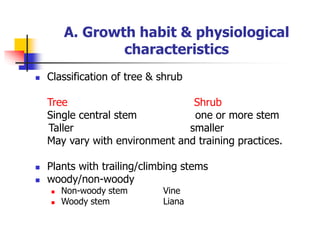
 Classification of tree & shrub
Tree Shrub
Single central stem one or more stem
Taller smaller
May vary with environment and training practices.
 Plants with trailing/climbing stems
 woody/non-woody
 Non-woody stem Vine
 Woody stem Liana
 Evergreen
 Plants with persistent leaves
 Tropical in origin
 E.g., Citrus, mango, date, guava, litchi, coconut,
olive, ber, banana, chiku, pineapple, fig and
papaya etc.
 Deciduous
 Plant shedding their leaves in winter
 Eg., Apple, pear, peach, plum, apricot, almond,
cherry, strawberry, grapes, walnut, pistachio,
pomegranate and falsa
A. Growth habit & physiological
characteristics
B. Classification based on
life span
 Annuals
 complete life cycle in one growing season.
 many vegetables and seasonal flowers.
 Biennials
 complete life cycle in two growing seasons.
 Ist season
 vegetative with short internodes and rosettes
 IInd season
 bolting (sends up flowering stalk with long internodes bearing
flowers and fruits)
 root vegetables (Carrot, beet, radish)
 leafy vegetables (Lettuce and cabbage)
 & onion.
Climate is critical factor in determination of the life cycle
Most of the above vegetables are treated as annuals ?
B. Classification based on
life span
 Perennials
 Grow for years and woody.
 Growth
 Juvenile (vegetative for several yrs.)
 Mature (veg. + reproductive)
 all fruit and ornamental trees and shrubs.
 Herbaceous plants like asparagus, potato &
bulbs
Perennials
 Winter Killing
 Above ground parts killed
 Underground storage structures survive
 Brinjal and tomato
 perennial in tropical climate
 annual in temperate climate
C. Classification based on
flowering habits
Acc. to functionality of parts
 Unisexual/imperfect
 Having one of the male/female floral parts on the flower
 Bisexual/hermaphrodite/perfect
 Both male and female parts present on same flower e.g.
peas.
Acc. to presence/absence of floral parts
 Complete flower.
 All four whorls present.
 Incomplete flower.
 Anyone absent.
C. Classification based on
flowering habits
Acc. to availability of male/female parts on the plant
 Monoecious:
 Male and female parts on the same flower/plant.
 e.g., mango, citrus, cucurbits and walnuts.
 Dioecious:
 only one sex present on one plant.
 e.g., Date and papaya, spinach, asparagus, beet
 Polygamous
 having all male, female and hermaphrodite flowers on the
same plant
 Watermelon, fig, mango
D. Classification based on
temperature relations
 Temp. requirements for growth and tolerance
to low temperature
Acc. To growing season (Vegetables)
 Summer
 grown year round in entire lower sindh-frost free
area
 Winter
 Grown in plains of Punjab
 Easily cultivated in summer at high altitudes
D. Classification based on
temperature relations
Acc. To growing season (Vegetables)
 Cool season crops
 Max. 80-85°F
 Min. 35-40°F
 Opt. 65°F
 Warm season crops
 Opt. above 80°F
 Min. below 50°F (can’t grow)
 Frost sensitive
D. Classification based on
temperature relations
Acc. To growing season (Fruits)
 Temperate:
 Mostly deciduous.
 Required chilling to flower
 e.g., apple, pear, plum and peaches.
 Sub tropical:
 Can tolerate frost
 e.g., citrus, guava and grapes.
 Tropical:
 More sensitive to low temp.
 e.g., banana, papaya and mango.
D. Classification based on
temperature relations
Acc. To growing season (Fruits)
 Both tropical and sub tropical are
 native to warmer climate,
 frost sensitive,
 needs hardening in late summer.
According to ability to withstand low winter
temperature.
 tender not resistant
 hardy resistant
 Soft fruit:
 Born on low growing plants like shrubs and vines
 grapes, falsa, strawberry
 Nuts
 edible seeds
 almond, walnut, pecans etc.
 Fleshy fruit
 soft flesh opposite to seed
 mango
D. Fruit Classification based on
Uses & cultural requirements
D. Fruit Classification based on
Uses & cultural requirements
 Pome/False fruits
 edible part thalamus
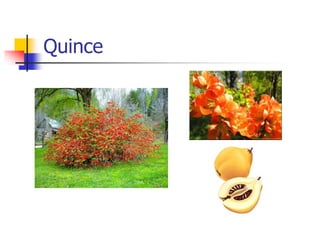
 apple, pear, quince.
 Berries
 develop from ovary walls
 grapes, banana, citrus, tomato.
 Stone/drupe fruit
 fruits have stony endocarp.
 peach, plum, apricot, mango, cherry.
Quince
D. Fruit Classification based on
Uses & cultural requirements
 Multiple fruits
 develop from many separate but closely clustered
flowers
 pineapple.
 Aggregate fruits
 derived from a flower with more pistils on a
common receptacle
 Individual fruit
 drupe (blackberry)
 Achene strawberry
 Small one seeded indehiscent fruit developed from a single
carpel
D. Vegetable classification based
on uses & cultural requirements
 Root crops
 with underground edible part
 carrot, radish, turnip, beet, potato.
 Leafy vegetables
 lettuce, cabbage, celery, spinach
 Vine crops
 Most of cucurbits
D. Vegetable classification based
on uses & cultural requirements
 Solanaceous fruits
 Tomato, eggplant & bell pepper
 Flower crops
 Cauliflower & broccoli
 Seed
 Peas & beans
D. Ornamental plant
classification based on uses &
cultural requirements
 Flowering plants
 Annuals,
 perennials and
 bulbs with underground storage organs.
 Landscape plants
 Foliage plants, ground covers, lawn
grasses, hedges, trees and shrubs
 Indoor plants with persistent evergreen
foliage
D. Hort. plant classification
based on uses & cultural
requirements
Others:
 Beverage plants:
 for flower and aroma
 Industrial plants:
 e.g jojoba (oilseed), rubber,
drugs/medicinal plants.
B. Botanical classification
 Scientific plant classification based on
phylogenetic relationships of organisms.
 Taxonomy
 Taxon group/category
 Science of classification
 Class. On the basis of diff. and similarities
 Mid 18th Century, C. Linnaeus used
 morphology of sexual/reproductive parts as basis
for taxonomy b/c
 these organs are less influenced by env.
B. Botanical classification
 Plant Kingdom
 Includes a dozen major phyla/divisions
 Tracheophyta is more developed
 Have vascular/treachery system (common in all higher plants)
 All hort. crops except mushrooms
 Several classes
 Hort. Important classes
 Filicinae (ferns)
 Angiospermae (flowering plants)
 Gymnospermae (conifers)
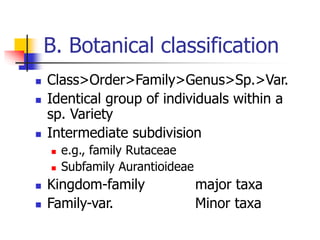
B. Botanical classification
 Class>Order>Family>Genus>Sp.>Var.
 Identical group of individuals within a
sp. Variety
 Intermediate subdivision
 e.g., family Rutaceae
 Subfamily Aurantioideae
 Kingdom-family major taxa
 Family-var. Minor taxa
B. Botanical classification
 Genetic diversity
 Genus > Var.
 Gymnosperms
 Naked Seeds
 Small group (~700 living sp.)
 Mostly evergreen with needle shaped leaves.
 Belong to temperate zone.
 Sources of timber, wood pulp, turpentine, resins,
edible seeds and high value ornamental plants.
B. Botanical classification
 Angiosperms
 Seed enclosed in fruit
 Large group of plants (> 25000 sp.)
 Broad leaves
 Primary source of food, fiber & shelter
 Sub-classes
 Dicotyledonae
 Monocotyledonae
B. Botanical classification
 Dicots (200,000 sp.)
 2 cotyledon
 floral parts in 4/5 multiples.
 Leaf venation reticulate
 Presence of vascular cambium
 Monocots (50, 000 sp.)
 single cotyledon
 Floral parts 3 or multiple
 Both classes have several orders and
families
 Vascular cambium is absent
B. Botanical classification
 Identification and description
 Based on two parts,
 Generic (capital letter)
 Specific (small)
 Genus
 group of species with common morphological, genetic
and cytogenetic features.
 Specie
 Plants morphologically same and produce like progeny
 Normally inter-breeding population.
B. Botanical classification
 Varietal name follows the specific name.
 Brassica oleraceaea botrytis (cauliflower)
 Brassica oleraceaea capitata (cabbage)
 Cultivar
 Group of plants within cultivated specie that
maintain the identity when propagated sexually or
asexually.
 Sexually propagated cultivar categories:
 Pure line or self-pollinated
 Open-pollinated (OP’s)
 Hybrids
THANKS
ANY QUESTIONS

Classification of Horticultural Crops

  • 1.
    Classification of Horticultural Crops MuhammadZeeshan Nazar M.Phil Agriculture Entomology mzeeshan_93@yahoo.com
  • 2.
    Classification of Hort.Crops  Types of classification  Horticultural  Botanical  Horticultural Classification  Logically conceived systems  description  nomenclature and  identification of plants
  • 3.
    Ways and Meansof Classification  Growth habit and physiological characteristics  Life span  Flowering Habits  Temp. relation  Uses  Morphology  Cultural requirements
  • 4.
    A. Growth habit& physiological characteristics  Succulents:  Plants with tender and watery stem & leaves  Foliage plants  Herbacious:  Herb self supporting succulent  tender stem either drooping or self supporting  Most of vegetables  Woody:  self supporting woody plants  Trees and shrubs
  • 5.
    A. Growth habit& physiological characteristics  Classification of tree & shrub Tree Shrub Single central stem one or more stem Taller smaller May vary with environment and training practices.  Plants with trailing/climbing stems  woody/non-woody  Non-woody stem Vine  Woody stem Liana
  • 6.
     Evergreen  Plantswith persistent leaves  Tropical in origin  E.g., Citrus, mango, date, guava, litchi, coconut, olive, ber, banana, chiku, pineapple, fig and papaya etc.  Deciduous  Plant shedding their leaves in winter  Eg., Apple, pear, peach, plum, apricot, almond, cherry, strawberry, grapes, walnut, pistachio, pomegranate and falsa A. Growth habit & physiological characteristics
  • 7.
    B. Classification basedon life span  Annuals  complete life cycle in one growing season.  many vegetables and seasonal flowers.  Biennials  complete life cycle in two growing seasons.  Ist season  vegetative with short internodes and rosettes  IInd season  bolting (sends up flowering stalk with long internodes bearing flowers and fruits)  root vegetables (Carrot, beet, radish)  leafy vegetables (Lettuce and cabbage)  & onion. Climate is critical factor in determination of the life cycle Most of the above vegetables are treated as annuals ?
  • 8.
    B. Classification basedon life span  Perennials  Grow for years and woody.  Growth  Juvenile (vegetative for several yrs.)  Mature (veg. + reproductive)  all fruit and ornamental trees and shrubs.  Herbaceous plants like asparagus, potato & bulbs
  • 9.
    Perennials  Winter Killing Above ground parts killed  Underground storage structures survive  Brinjal and tomato  perennial in tropical climate  annual in temperate climate
  • 10.
    C. Classification basedon flowering habits Acc. to functionality of parts  Unisexual/imperfect  Having one of the male/female floral parts on the flower  Bisexual/hermaphrodite/perfect  Both male and female parts present on same flower e.g. peas. Acc. to presence/absence of floral parts  Complete flower.  All four whorls present.  Incomplete flower.  Anyone absent.
  • 11.
    C. Classification basedon flowering habits Acc. to availability of male/female parts on the plant  Monoecious:  Male and female parts on the same flower/plant.  e.g., mango, citrus, cucurbits and walnuts.  Dioecious:  only one sex present on one plant.  e.g., Date and papaya, spinach, asparagus, beet  Polygamous  having all male, female and hermaphrodite flowers on the same plant  Watermelon, fig, mango
  • 12.
    D. Classification basedon temperature relations  Temp. requirements for growth and tolerance to low temperature Acc. To growing season (Vegetables)  Summer  grown year round in entire lower sindh-frost free area  Winter  Grown in plains of Punjab  Easily cultivated in summer at high altitudes
  • 13.
    D. Classification basedon temperature relations Acc. To growing season (Vegetables)  Cool season crops  Max. 80-85°F  Min. 35-40°F  Opt. 65°F  Warm season crops  Opt. above 80°F  Min. below 50°F (can’t grow)  Frost sensitive
  • 14.
    D. Classification basedon temperature relations Acc. To growing season (Fruits)  Temperate:  Mostly deciduous.  Required chilling to flower  e.g., apple, pear, plum and peaches.  Sub tropical:  Can tolerate frost  e.g., citrus, guava and grapes.  Tropical:  More sensitive to low temp.  e.g., banana, papaya and mango.
  • 15.
    D. Classification basedon temperature relations Acc. To growing season (Fruits)  Both tropical and sub tropical are  native to warmer climate,  frost sensitive,  needs hardening in late summer. According to ability to withstand low winter temperature.  tender not resistant  hardy resistant
  • 16.
     Soft fruit: Born on low growing plants like shrubs and vines  grapes, falsa, strawberry  Nuts  edible seeds  almond, walnut, pecans etc.  Fleshy fruit  soft flesh opposite to seed  mango D. Fruit Classification based on Uses & cultural requirements
  • 17.
    D. Fruit Classificationbased on Uses & cultural requirements  Pome/False fruits  edible part thalamus  apple, pear, quince.  Berries  develop from ovary walls  grapes, banana, citrus, tomato.  Stone/drupe fruit  fruits have stony endocarp.  peach, plum, apricot, mango, cherry.
  • 18.
  • 19.
    D. Fruit Classificationbased on Uses & cultural requirements  Multiple fruits  develop from many separate but closely clustered flowers  pineapple.  Aggregate fruits  derived from a flower with more pistils on a common receptacle  Individual fruit  drupe (blackberry)  Achene strawberry  Small one seeded indehiscent fruit developed from a single carpel
  • 20.
    D. Vegetable classificationbased on uses & cultural requirements  Root crops  with underground edible part  carrot, radish, turnip, beet, potato.  Leafy vegetables  lettuce, cabbage, celery, spinach  Vine crops  Most of cucurbits
  • 21.
    D. Vegetable classificationbased on uses & cultural requirements  Solanaceous fruits  Tomato, eggplant & bell pepper  Flower crops  Cauliflower & broccoli  Seed  Peas & beans
  • 22.
    D. Ornamental plant classificationbased on uses & cultural requirements  Flowering plants  Annuals,  perennials and  bulbs with underground storage organs.  Landscape plants  Foliage plants, ground covers, lawn grasses, hedges, trees and shrubs  Indoor plants with persistent evergreen foliage
  • 23.
    D. Hort. plantclassification based on uses & cultural requirements Others:  Beverage plants:  for flower and aroma  Industrial plants:  e.g jojoba (oilseed), rubber, drugs/medicinal plants.
  • 24.
    B. Botanical classification Scientific plant classification based on phylogenetic relationships of organisms.  Taxonomy  Taxon group/category  Science of classification  Class. On the basis of diff. and similarities  Mid 18th Century, C. Linnaeus used  morphology of sexual/reproductive parts as basis for taxonomy b/c  these organs are less influenced by env.
  • 25.
    B. Botanical classification Plant Kingdom  Includes a dozen major phyla/divisions  Tracheophyta is more developed  Have vascular/treachery system (common in all higher plants)  All hort. crops except mushrooms  Several classes  Hort. Important classes  Filicinae (ferns)  Angiospermae (flowering plants)  Gymnospermae (conifers)
  • 26.
    B. Botanical classification Class>Order>Family>Genus>Sp.>Var.  Identical group of individuals within a sp. Variety  Intermediate subdivision  e.g., family Rutaceae  Subfamily Aurantioideae  Kingdom-family major taxa  Family-var. Minor taxa
  • 27.
    B. Botanical classification Genetic diversity  Genus > Var.  Gymnosperms  Naked Seeds  Small group (~700 living sp.)  Mostly evergreen with needle shaped leaves.  Belong to temperate zone.  Sources of timber, wood pulp, turpentine, resins, edible seeds and high value ornamental plants.
  • 28.
    B. Botanical classification Angiosperms  Seed enclosed in fruit  Large group of plants (> 25000 sp.)  Broad leaves  Primary source of food, fiber & shelter  Sub-classes  Dicotyledonae  Monocotyledonae
  • 29.
    B. Botanical classification Dicots (200,000 sp.)  2 cotyledon  floral parts in 4/5 multiples.  Leaf venation reticulate  Presence of vascular cambium  Monocots (50, 000 sp.)  single cotyledon  Floral parts 3 or multiple  Both classes have several orders and families  Vascular cambium is absent
  • 30.
    B. Botanical classification Identification and description  Based on two parts,  Generic (capital letter)  Specific (small)  Genus  group of species with common morphological, genetic and cytogenetic features.  Specie  Plants morphologically same and produce like progeny  Normally inter-breeding population.
  • 31.
    B. Botanical classification Varietal name follows the specific name.  Brassica oleraceaea botrytis (cauliflower)  Brassica oleraceaea capitata (cabbage)  Cultivar  Group of plants within cultivated specie that maintain the identity when propagated sexually or asexually.  Sexually propagated cultivar categories:  Pure line or self-pollinated  Open-pollinated (OP’s)  Hybrids
  • 32.