Dr. M. Kumaresan
Assistant professor
Dept. of Horticulture
Adhiparasakthi Horticultural College
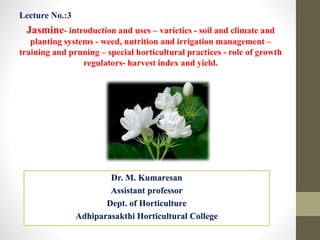
Jasmine- introduction and uses – varieties - soil and climate and
planting systems - weed, nutrition and irrigation management –
training and pruning – special horticultural practices - role of growth
regulators- harvest index and yield.
Lecture No.:3
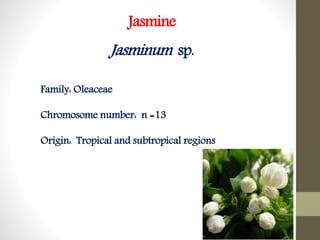
Jasmine
Jasminum sp.
Family: Oleaceae
Chromosome number: n =13
Origin: Tropical and subtropical regions
Importance
• One of the oldest fragrant flowers
• ‘Jasmine’ is derived from ‘Yasmyn’ (Persian name) meaning
fragrance
• Leading traditional loose flowers of India.
• India exports jasmine flowers to the neighbouring countries
like Sri Lanka, Singapore, Malaysia and the Gulf and US.
Uses
• Making garlands
• Adorning hair of women, religious and ceremonial
functions
• Essential oil
Species
More than 200 species (Dickey, 1970)
India: 42 species
Commercial cultivation: 4 species
Important species
• Jasminum sambac- Malligai/Arabian jasmine/ tuscan jasmine
• J. auriculatum - Mullai
• J. grandiflorum- Pitchi/ Spanish jasmine/ Royal Jasmine
• J. multiflorum- Star jasmine/ Kakada
Other species
• J. calophyllum- Flowering through out the year
• J. humile - Yellow jasmine
• J. beesianum- Rosy jasmine
• J. dicotomum- Gold coast jasmine, Buds-red colour
Jasminumsambac - Gundumalli / Malligai /
Arabian jasmine /Tuscan jasmine
J. sambac
• Arabian jasmine, Tuscan jasmine, Bela,
Belphool, Malliage and Mogra.
• It is the most common species in India.
• Its flower buds are white with single
or multi-whorled petals, used for
garland-making, adorning hair,
worshipping, decoration and
extraction of perfume.
• The leaves are simple, opposite, almost
smooth with prominent lateral veins.
• It is a bushy weak-stemmed shrub
with pubescent branches
• Flowers white, fragrant, usually in
small, three forked cymes.
.
Cultivar Characters
Gundumalli Round flowers with good fragrance
Ramanbanam Flower bud long
Madanban Long bold buds with short corolla tube
Single mogra Flowers with 3 or 4 rows of petals
Double mogra Flowers with good fragrance resembling white rose
Iruvatchi Flowers with short corolla tube with 3 or 4 rows of
petals
Kasthurimalli Flowers with medium corolla tube
Oosimalli Long slender buds
Ramanathapuram
gundumalli
Round flowers with good fragrance; yields 7 to 8 t/ha.
Khoya Bolder buds, less fragrant
J. sambac - Gundu malli
ArkaAradhana
• Developed by IIHR, Bangalore in 2000
• Good for extraction of oil as well as fresh flower
Yield (t/ ha) Concrete Yield (kg/ha)
8.0 14.95
Jasminum auriculatum –
Mullai
Jasminum auriculatum
• Juhi, Jui, Malle, Mokggu, Mullai and
Ambur Malliage, it is a scandent shrub
having shiny leaves with minute lateral
veins.
• Leaves are mostly simple, occasionally
trifoliate.
• The plants produce numerous star-
shaped, white scented blooms and are very
good as loose flowers.
• The flowers are borne in pubescent
compound many flowered flax cymes.
• Used for garlands, adorning hair, worship
and decoration.
• It bears flowers from spring to summer
and in rainy season. Flowers used for
perfumes
Species Varieties Genesis Characters
J. auriculatum
(Mullai)
CO.1 Selection Long Round type
Long corolla tube
Yield : 8 t/ha,
Concrete recovery : 0.34%
CO.2 Selection Long corolla tube
Flower buds bolder
Tolerant to phyllody
Yield : 10 t/ha, Concrete recovery
: 0.36%
VARIETIES
Parimullai
• Clonal selection from germplasm
clone (medium point)
• Exhibit resistance to gall mite
• Long flowering season – (9 months)
• Buds are white with moderate corolla
tube length 1.25 cm.
• 0.29 % - concrete
• Yield – 10 t/ ha
Jasminum grandiflorum- Jathimalli (or)
Pitchi (or) Spanish jasmine
J. grandifolium
• Syn. J. officinale var. grandiflorum
• Royal or Spanish jasmine, French or
Catalonian jasmine, Chameli, Jahi, Jathimalli,
and Pitchi, is a large shrub in striate branches
having pinnate leaves, compound with 7–9
leaflets of equal sizes.
• Flowers are white, often tinged with purple
outside, axillary or terminal and 5 petalled.
• Large single flowers are delightfully fragrant.
• Garlands, decorative bunches or veni.
• Suitable for planting in shrubbery, arches
and pergolas. Presently concrete is extracted
from its flowers. It flowers from March to
September.
J. grandiflorum (Pitchi)
CO – 1
• Secondary clonal selection from germplasm collection
(six clones – yield varies from 4.3 t – 10.14 t/ha/year)
• Buds are white with pink tinged with long corolla tube.
• Yield – 10.15 t/ha/year
• Concrete – 0.29 %
CO-2 Pitchi
• Known for their high yield
• Better floral traits
• It is mutant is characterized by bold pink buds,
• long flower bud (4.18 cm)
• High yielding (11,680 kg/ha)
• Concrete recovery of 0.30%
Arka Surabi
• Released by IIHR in 1993
• Clonal selection from local J. grandiflorum
• Yield
• 10 tonnes/ha
• Concrete yield- 0.35%
• Tolerant for drought condition
Jasminum pubescens - Kakada
ArkaArpan
• Developed from Jasminum puberscense, by IIHR in 1999
• Flowers- Aromatic and pink colour- consumer preference
• Yield- 6.1 t/ha
• It has attractive foliage and used as ornamental plant in
landscaping
• Tree jasmine
• Large shrub or shrubbery tree
• Flowers are fragrant with white in nature
J. arborescens
• Rosy jasmine
• Flowers – small, fragrant, pink to deep rose
J. calophyllum
• Profuse flowering species
• Flowers – scented, white
• Free from pest and disease
J. dichotomum
• Gold coast jasmine
• Vigorous climbing, woody vine
• Flowers – small, fragrant
• Unopened flower buds – tinted red on outside
• Open flowers – pure white on inside
J. flexile
• Profuse flowering
• Widely in home gardens for its scented flowers
• Free from insect pests and diseases
J. fruticans
• Evergreen shrub
• Flowers – yellow corolla, calyx with slender
lobes
J. humile
• Yellow jasmine, Italian jasmine
• Flowers – fragrant, yellow and borne in clusters
J. nitidum
• Woody vine
• Flowers –fragrant
• Buds – tinted pink on outside and white inside and about 4
cm across
J. nudiflorum
• Deciduous shrub
• Flowers – yellow, solitary
J. primulinum
• Evergreen rambling shrub
• Flowers – solitary
• Corolla – long and bright yellow
J. rex
• Kings jasmine
• Vigorous, scanted shrub
• Flowers – large about 5cm diameter, non-fragrant, pure
white, borne terminal cymes
Soil and climate
• Well drained rich sandy loam to clay soils
• Jasmine require temperature of 27–32°C during day
time and 21–27°C at night is ideal for flowering.
• Temperature between 15 and 17°C during night shuts
the flowering for a week (Leonhardt and Teves, 2002).
Propagation
Jasmine can be propagated by cuttings, layering, sucker, grafting,
budding and tissue culture
• J. auriculatum : Semi hard wood cuttings
• J. grandiflorum : Terminal cuttings
• J. sambac: Hard wood cuttings and semi hardwood cuttings
Growth regulators: Quick dip method
• IAA (or) IBA @ 1000 ppm for terminal cuttings and 2500
ppm for semi hard wood cuttings is done
• Best rooting medium: - sand: vermiculite: moss at 1:1:1 ratio
• Rooting media - Sand : FYM : Red earth (1:1:1)
• - Sand : Vermiculate : Moss at 1:1:1 ratio
• Propagation season - April to September
Planting
• The soil should be thoroughly prepared
• Kept free from weeds
• Pits of 45-90 cm3 are prepared depending on the type of
soil
• Exposed for a week
• The pit is filled with top soil after mixing with about 10-15
kg of well rotten cattle manure or compost
• Then irrigated to settle down the soil properly
Plant Spacing, density and season
Species Spacing
Density
(Plants/ha)
Season
J. auriculatum 1.5 x 1.5 m 4400
June to
November
J. grandiflorum 2.0 x 1.5 m 3350
J. sambac 1.25 x 1.25 m 6400
Nutritional requirement
Species
Quantity(g/plant)
N P2O5 K2O
Method
J. auriculatum 60 120 120 6 split doses at bimonthly
intervals
J. grandiflorum 100 150 100 2 split doses :
(1) June - July
(2) December - after pruning
J. sambac 60 120 120 2 split doses :
(1) June-July
(2) November - after pruning
Foliar Nutrition
Spraying of zinc 0.25% and magnesium 0.5% before flowering increases flower
yield.
For Fe deficiency, FeSO4 at 5g/lit. is sprayed at monthly intervals until the
chlorotic symptoms disappear.
Pruning
Species Time of pruning
J. auriculatum Last week of January
J. grandiflorum Last week of December
J. sambac Last week of November
In jasmine, flowering habit is terminal and axillary.
So increasing the number of shoots would increase the yield, for which
pruning is essential.
Pruning influences growth, flower bud initiation, differentiation and
ultimately the flower production.
Pruning height: 45-50 cm from the ground level.
Plant growth regulators
• Cycocel 1000 ppm: Increase vegetative growth and yield – J.
grandiflorum
• Cycocel 500 ppm : delay flowering and increase number of
harvesting in J. grandiflorum
• Cycocel 500 ppm: yield and quality - J. auriculatum
• GA3 100ppm: increase flowering in J. auriculatum
Plant Protection
• Budworm - Hendecasis duplifascialis - Thiochloprid (Alanto)
240SC 1 ml/litre or Spinosad (Tracer) @ 0.5 ml/lit
Blossom midge (Contarinia maculipennis): Novaluron 3ml/lit. of water.
Harvesting
Short distance market
• Fresh flowers- Fully developed and unopened at tight bud
stage
• 8-12 hours before opening
• Before 8 am in the morning hours is the right time
• Time increases  shelf life gets reduced
Long distance market
• Fresh flowers- Fully developed and unopened at tight bud
stage
• 10-12 hours before opening
Mature Unopened Flower Bud
Stage- Fresh Flower
FULLY OPENED – for
essential oil
Export markets
• Early morning form 5.30 to 6.30 am
• Fresh flowers- Fully developed and unopened at tight bud
stage
• 12 hours before opening
Concrete extraction
• Fully opened flowers
• Early hours of the day
• After 9.30 am the concrete recovery will be reduced
Flowering season
Peak flower production in Tamil Nadu
J. sambac : March - September
J. auriculatum : June - July
J. grandiflorum : July - October
Yield
Species
Flowers yield
(kg/ha)
Concrete
recovery (%)
Shelf life of
flowers
J. auriculatum 4733 to 9152 0.28 to 0.36 28 - 30 hrs
J. sambac 739 to 8129 0.14 to 0.19 28 - 30 hrs
J. grandiflorum 4329 to 10144 0.25 to 0.32 24 hrs
Major Jasmine Concrete Industries
in Tamil Nadu
• Pushpak Fragrance - Nilakottai
• Hindustan Essential oils - Nilakottai
• ENCEE Aromatics - Mettupalayam
• Flavors and Fragrances - Coimbatore
Post harvest handling
• Lesser shelf life- Problems faced by the farmers- during
the peak season of the flowering
• Fully developed flower buds soaked in the chemicals viz.,
• Sucrose 1%
• Boric acid 4%
• Copper sulphate 0.1%
• Silver Nitrate 0.01%
• Remain fresh for two days without
loosing its fragrance
Grading
• No standard grade
• Graded according to the corolla tube length, bud size,
shape and freshness
Packing
• Polyethylene bags with 200 guage
• Without ventilation
• Maintaining high quality and extending the shelf life of
flowers
• Storing the packed flowers in cool chamber (80C)
• Corrugated fibre board boxes are properly packed for long
distance market
• Farmers use gunny bags for the transport of the jasmines
• Gunny bags are stitched at the edges
Extraction of jasmine concrete
Concrete
It is a wax like substance containing the natural flower
perfume together with some plant waxes, albumin and
colouring matter.
Picking of flowers for extraction:
• Freshly picked fully opened flowers
• J. grandiflorum has the unique fragrance
• Picking of flowers is before 9.30 a.m next day, after 11.00
a.m. - reduce the yield and quality of concrete.
• Harvested flowers are stored in cool atmosphere and
processed within two hours after harvest.
Flowers are soaked in Food Grade Hexane (Having Boiling point
of 70 oC).
Mixing Hexane 2 litres / kg of flowers for 30 minutes.
Rotate the container slowly for 20 minutes in the rotary type of
extractor.
Perfume substance along with wax and pigments dissolved in
Hexane.
Perfume solvent is led into the evaporator
Evaporation at a constant temperature of 750C.
Vapour of the solvent condensed into liquid for recycling
Liquid (Perfume, wax & pigments) is distilled in a vacuum
distillation unit for complete removal of solvent in the still
Floral concrete settled in the still in the form of molten wax
Cooled and Stored in glass (or) aluminium containers
Species Concrete recovery
Jasminum sambac 0.14 to 0.19
Jasminum auriculatum 0.28 to 0.36
Jasminum grandiflorum 0.25 to 0.32
Extractor – Stainless
steel
Hexane storage
unit
Condenser cum
cooler
Purification
unit

Jasmine.pptx

  • 1.
    Dr. M. Kumaresan Assistantprofessor Dept. of Horticulture Adhiparasakthi Horticultural College Jasmine- introduction and uses – varieties - soil and climate and planting systems - weed, nutrition and irrigation management – training and pruning – special horticultural practices - role of growth regulators- harvest index and yield. Lecture No.:3
  • 2.
    Jasmine Jasminum sp. Family: Oleaceae Chromosomenumber: n =13 Origin: Tropical and subtropical regions
  • 3.
    Importance • One ofthe oldest fragrant flowers • ‘Jasmine’ is derived from ‘Yasmyn’ (Persian name) meaning fragrance • Leading traditional loose flowers of India. • India exports jasmine flowers to the neighbouring countries like Sri Lanka, Singapore, Malaysia and the Gulf and US.
  • 4.
    Uses • Making garlands •Adorning hair of women, religious and ceremonial functions • Essential oil
  • 5.
    Species More than 200species (Dickey, 1970) India: 42 species Commercial cultivation: 4 species Important species • Jasminum sambac- Malligai/Arabian jasmine/ tuscan jasmine • J. auriculatum - Mullai • J. grandiflorum- Pitchi/ Spanish jasmine/ Royal Jasmine • J. multiflorum- Star jasmine/ Kakada Other species • J. calophyllum- Flowering through out the year • J. humile - Yellow jasmine • J. beesianum- Rosy jasmine • J. dicotomum- Gold coast jasmine, Buds-red colour
  • 6.
    Jasminumsambac - Gundumalli/ Malligai / Arabian jasmine /Tuscan jasmine
  • 7.
    J. sambac • Arabianjasmine, Tuscan jasmine, Bela, Belphool, Malliage and Mogra. • It is the most common species in India. • Its flower buds are white with single or multi-whorled petals, used for garland-making, adorning hair, worshipping, decoration and extraction of perfume. • The leaves are simple, opposite, almost smooth with prominent lateral veins. • It is a bushy weak-stemmed shrub with pubescent branches • Flowers white, fragrant, usually in small, three forked cymes. .
  • 8.
    Cultivar Characters Gundumalli Roundflowers with good fragrance Ramanbanam Flower bud long Madanban Long bold buds with short corolla tube Single mogra Flowers with 3 or 4 rows of petals Double mogra Flowers with good fragrance resembling white rose Iruvatchi Flowers with short corolla tube with 3 or 4 rows of petals Kasthurimalli Flowers with medium corolla tube Oosimalli Long slender buds Ramanathapuram gundumalli Round flowers with good fragrance; yields 7 to 8 t/ha. Khoya Bolder buds, less fragrant J. sambac - Gundu malli
  • 9.
    ArkaAradhana • Developed byIIHR, Bangalore in 2000 • Good for extraction of oil as well as fresh flower Yield (t/ ha) Concrete Yield (kg/ha) 8.0 14.95
  • 10.
  • 11.
    Jasminum auriculatum • Juhi,Jui, Malle, Mokggu, Mullai and Ambur Malliage, it is a scandent shrub having shiny leaves with minute lateral veins. • Leaves are mostly simple, occasionally trifoliate. • The plants produce numerous star- shaped, white scented blooms and are very good as loose flowers. • The flowers are borne in pubescent compound many flowered flax cymes. • Used for garlands, adorning hair, worship and decoration. • It bears flowers from spring to summer and in rainy season. Flowers used for perfumes
  • 12.
    Species Varieties GenesisCharacters J. auriculatum (Mullai) CO.1 Selection Long Round type Long corolla tube Yield : 8 t/ha, Concrete recovery : 0.34% CO.2 Selection Long corolla tube Flower buds bolder Tolerant to phyllody Yield : 10 t/ha, Concrete recovery : 0.36% VARIETIES
  • 13.
    Parimullai • Clonal selectionfrom germplasm clone (medium point) • Exhibit resistance to gall mite • Long flowering season – (9 months) • Buds are white with moderate corolla tube length 1.25 cm. • 0.29 % - concrete • Yield – 10 t/ ha
  • 14.
    Jasminum grandiflorum- Jathimalli(or) Pitchi (or) Spanish jasmine
  • 15.
    J. grandifolium • Syn.J. officinale var. grandiflorum • Royal or Spanish jasmine, French or Catalonian jasmine, Chameli, Jahi, Jathimalli, and Pitchi, is a large shrub in striate branches having pinnate leaves, compound with 7–9 leaflets of equal sizes. • Flowers are white, often tinged with purple outside, axillary or terminal and 5 petalled. • Large single flowers are delightfully fragrant. • Garlands, decorative bunches or veni. • Suitable for planting in shrubbery, arches and pergolas. Presently concrete is extracted from its flowers. It flowers from March to September.
  • 16.
    J. grandiflorum (Pitchi) CO– 1 • Secondary clonal selection from germplasm collection (six clones – yield varies from 4.3 t – 10.14 t/ha/year) • Buds are white with pink tinged with long corolla tube. • Yield – 10.15 t/ha/year • Concrete – 0.29 %
  • 17.
    CO-2 Pitchi • Knownfor their high yield • Better floral traits • It is mutant is characterized by bold pink buds, • long flower bud (4.18 cm) • High yielding (11,680 kg/ha) • Concrete recovery of 0.30%
  • 18.
    Arka Surabi • Releasedby IIHR in 1993 • Clonal selection from local J. grandiflorum • Yield • 10 tonnes/ha • Concrete yield- 0.35% • Tolerant for drought condition
  • 19.
  • 20.
    ArkaArpan • Developed fromJasminum puberscense, by IIHR in 1999 • Flowers- Aromatic and pink colour- consumer preference • Yield- 6.1 t/ha • It has attractive foliage and used as ornamental plant in landscaping
  • 21.
    • Tree jasmine •Large shrub or shrubbery tree • Flowers are fragrant with white in nature J. arborescens
  • 22.
    • Rosy jasmine •Flowers – small, fragrant, pink to deep rose
  • 23.
    J. calophyllum • Profuseflowering species • Flowers – scented, white • Free from pest and disease
  • 24.
    J. dichotomum • Goldcoast jasmine • Vigorous climbing, woody vine • Flowers – small, fragrant • Unopened flower buds – tinted red on outside • Open flowers – pure white on inside
  • 25.
    J. flexile • Profuseflowering • Widely in home gardens for its scented flowers • Free from insect pests and diseases
  • 26.
    J. fruticans • Evergreenshrub • Flowers – yellow corolla, calyx with slender lobes
  • 27.
    J. humile • Yellowjasmine, Italian jasmine • Flowers – fragrant, yellow and borne in clusters
  • 28.
    J. nitidum • Woodyvine • Flowers –fragrant • Buds – tinted pink on outside and white inside and about 4 cm across
  • 29.
    J. nudiflorum • Deciduousshrub • Flowers – yellow, solitary
  • 30.
    J. primulinum • Evergreenrambling shrub • Flowers – solitary • Corolla – long and bright yellow
  • 31.
    J. rex • Kingsjasmine • Vigorous, scanted shrub • Flowers – large about 5cm diameter, non-fragrant, pure white, borne terminal cymes
  • 32.
    Soil and climate •Well drained rich sandy loam to clay soils • Jasmine require temperature of 27–32°C during day time and 21–27°C at night is ideal for flowering. • Temperature between 15 and 17°C during night shuts the flowering for a week (Leonhardt and Teves, 2002).
  • 33.
    Propagation Jasmine can bepropagated by cuttings, layering, sucker, grafting, budding and tissue culture • J. auriculatum : Semi hard wood cuttings • J. grandiflorum : Terminal cuttings • J. sambac: Hard wood cuttings and semi hardwood cuttings Growth regulators: Quick dip method • IAA (or) IBA @ 1000 ppm for terminal cuttings and 2500 ppm for semi hard wood cuttings is done • Best rooting medium: - sand: vermiculite: moss at 1:1:1 ratio • Rooting media - Sand : FYM : Red earth (1:1:1) • - Sand : Vermiculate : Moss at 1:1:1 ratio • Propagation season - April to September
  • 34.
    Planting • The soilshould be thoroughly prepared • Kept free from weeds • Pits of 45-90 cm3 are prepared depending on the type of soil • Exposed for a week • The pit is filled with top soil after mixing with about 10-15 kg of well rotten cattle manure or compost • Then irrigated to settle down the soil properly
  • 35.
    Plant Spacing, densityand season Species Spacing Density (Plants/ha) Season J. auriculatum 1.5 x 1.5 m 4400 June to November J. grandiflorum 2.0 x 1.5 m 3350 J. sambac 1.25 x 1.25 m 6400
  • 36.
    Nutritional requirement Species Quantity(g/plant) N P2O5K2O Method J. auriculatum 60 120 120 6 split doses at bimonthly intervals J. grandiflorum 100 150 100 2 split doses : (1) June - July (2) December - after pruning J. sambac 60 120 120 2 split doses : (1) June-July (2) November - after pruning Foliar Nutrition Spraying of zinc 0.25% and magnesium 0.5% before flowering increases flower yield. For Fe deficiency, FeSO4 at 5g/lit. is sprayed at monthly intervals until the chlorotic symptoms disappear.
  • 37.
    Pruning Species Time ofpruning J. auriculatum Last week of January J. grandiflorum Last week of December J. sambac Last week of November In jasmine, flowering habit is terminal and axillary. So increasing the number of shoots would increase the yield, for which pruning is essential. Pruning influences growth, flower bud initiation, differentiation and ultimately the flower production. Pruning height: 45-50 cm from the ground level.
  • 38.
    Plant growth regulators •Cycocel 1000 ppm: Increase vegetative growth and yield – J. grandiflorum • Cycocel 500 ppm : delay flowering and increase number of harvesting in J. grandiflorum • Cycocel 500 ppm: yield and quality - J. auriculatum • GA3 100ppm: increase flowering in J. auriculatum
  • 39.
    Plant Protection • Budworm- Hendecasis duplifascialis - Thiochloprid (Alanto) 240SC 1 ml/litre or Spinosad (Tracer) @ 0.5 ml/lit Blossom midge (Contarinia maculipennis): Novaluron 3ml/lit. of water.
  • 40.
    Harvesting Short distance market •Fresh flowers- Fully developed and unopened at tight bud stage • 8-12 hours before opening • Before 8 am in the morning hours is the right time • Time increases shelf life gets reduced Long distance market • Fresh flowers- Fully developed and unopened at tight bud stage • 10-12 hours before opening
  • 41.
    Mature Unopened FlowerBud Stage- Fresh Flower FULLY OPENED – for essential oil
  • 42.
    Export markets • Earlymorning form 5.30 to 6.30 am • Fresh flowers- Fully developed and unopened at tight bud stage • 12 hours before opening Concrete extraction • Fully opened flowers • Early hours of the day • After 9.30 am the concrete recovery will be reduced
  • 43.
    Flowering season Peak flowerproduction in Tamil Nadu J. sambac : March - September J. auriculatum : June - July J. grandiflorum : July - October
  • 44.
    Yield Species Flowers yield (kg/ha) Concrete recovery (%) Shelflife of flowers J. auriculatum 4733 to 9152 0.28 to 0.36 28 - 30 hrs J. sambac 739 to 8129 0.14 to 0.19 28 - 30 hrs J. grandiflorum 4329 to 10144 0.25 to 0.32 24 hrs
  • 45.
    Major Jasmine ConcreteIndustries in Tamil Nadu • Pushpak Fragrance - Nilakottai • Hindustan Essential oils - Nilakottai • ENCEE Aromatics - Mettupalayam • Flavors and Fragrances - Coimbatore
  • 46.
    Post harvest handling •Lesser shelf life- Problems faced by the farmers- during the peak season of the flowering • Fully developed flower buds soaked in the chemicals viz., • Sucrose 1% • Boric acid 4% • Copper sulphate 0.1% • Silver Nitrate 0.01% • Remain fresh for two days without loosing its fragrance
  • 47.
    Grading • No standardgrade • Graded according to the corolla tube length, bud size, shape and freshness
  • 48.
    Packing • Polyethylene bagswith 200 guage • Without ventilation • Maintaining high quality and extending the shelf life of flowers • Storing the packed flowers in cool chamber (80C)
  • 49.
    • Corrugated fibreboard boxes are properly packed for long distance market • Farmers use gunny bags for the transport of the jasmines • Gunny bags are stitched at the edges
  • 50.
    Extraction of jasmineconcrete Concrete It is a wax like substance containing the natural flower perfume together with some plant waxes, albumin and colouring matter.
  • 51.
    Picking of flowersfor extraction: • Freshly picked fully opened flowers • J. grandiflorum has the unique fragrance • Picking of flowers is before 9.30 a.m next day, after 11.00 a.m. - reduce the yield and quality of concrete. • Harvested flowers are stored in cool atmosphere and processed within two hours after harvest.
  • 52.
    Flowers are soakedin Food Grade Hexane (Having Boiling point of 70 oC). Mixing Hexane 2 litres / kg of flowers for 30 minutes. Rotate the container slowly for 20 minutes in the rotary type of extractor. Perfume substance along with wax and pigments dissolved in Hexane.
  • 53.
    Perfume solvent isled into the evaporator Evaporation at a constant temperature of 750C. Vapour of the solvent condensed into liquid for recycling Liquid (Perfume, wax & pigments) is distilled in a vacuum distillation unit for complete removal of solvent in the still Floral concrete settled in the still in the form of molten wax Cooled and Stored in glass (or) aluminium containers
  • 54.
    Species Concrete recovery Jasminumsambac 0.14 to 0.19 Jasminum auriculatum 0.28 to 0.36 Jasminum grandiflorum 0.25 to 0.32
  • 57.
    Extractor – Stainless steel Hexanestorage unit Condenser cum cooler Purification unit