Muhammad Zeeshan Nazar
Contact Email: mzeeshan_93@yahoo.com
Wild Locust
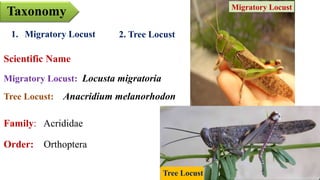
Taxonomy
Scientific Name
Migratory Locust: Locusta migratoria
Tree Locust: Anacridium melanorhodon
Family: Acrididae
Order: Orthoptera
2. Tree Locust1. Migratory Locust
Tree Locust
Migratory Locust
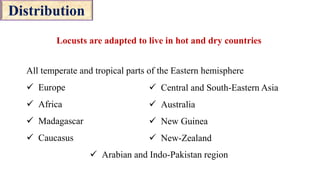
Distribution
All temperate and tropical parts of the Eastern hemisphere
 Europe
 Africa
 Madagascar
 Caucasus
 Arabian and Indo-Pakistan region
 Central and South-Eastern Asia
 Australia
 New Guinea
 New-Zealand
Locusts are adapted to live in hot and dry countries
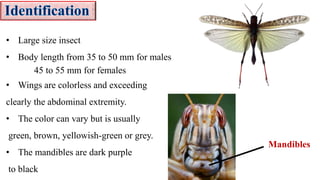
• Large size insect
• Body length from 35 to 50 mm for males
45 to 55 mm for females
• Wings are colorless and exceeding
clearly the abdominal extremity.
• The color can vary but is usually
green, brown, yellowish-green or grey.
• The mandibles are dark purple
to black
Mandibles
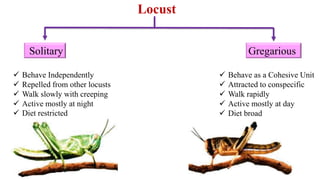
Locust
Solitary Gregarious
 Behave Independently
 Repelled from other locusts
 Walk slowly with creeping
 Active mostly at night
 Diet restricted
 Behave as a Cohesive Unit
 Attracted to conspecific
 Walk rapidly
 Active mostly at day
 Diet broad
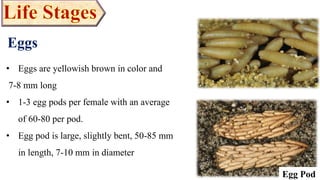
Eggs
• Eggs are yellowish brown in color and
7-8 mm long
• 1-3 egg pods per female with an average
of 60-80 per pod.
• Egg pod is large, slightly bent, 50-85 mm
in length, 7-10 mm in diameter
Egg Pod
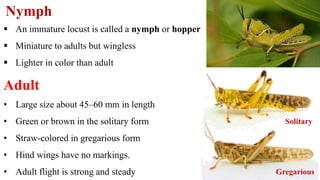
Nymph
 An immature locust is called a nymph or hopper
 Miniature to adults but wingless
 Lighter in color than adult
Adult
• Large size about 45–60 mm in length
• Green or brown in the solitary form
• Straw-colored in gregarious form
• Hind wings have no markings.
• Adult flight is strong and steady
Solitary
Gregarious
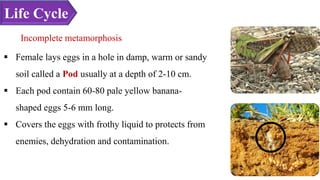
Incomplete metamorphosis
 Female lays eggs in a hole in damp, warm or sandy
soil called a Pod usually at a depth of 2-10 cm.
 Each pod contain 60-80 pale yellow banana-
shaped eggs 5-6 mm long.
 Covers the eggs with frothy liquid to protects from
enemies, dehydration and contamination.
Life Cycle
 Eggs hatch in 14-20 days
 Afterwards the nymphs move by crawling or hopping along the ground as
they have no wings.
 5 nymphal instars and nymphs take 4-8 weeks to complete development
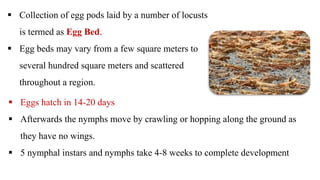
 Collection of egg pods laid by a number of locusts
is termed as Egg Bed.
 Egg beds may vary from a few square meters to
several hundred square meters and scattered
throughout a region.
Adult is the final stage
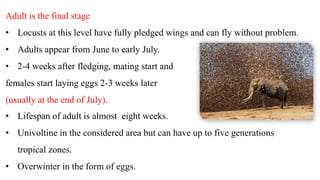
• Locusts at this level have fully pledged wings and can fly without problem.
• Adults appear from June to early July.
• 2-4 weeks after fledging, mating start and
females start laying eggs 2-3 weeks later
(usually at the end of July)..
• Lifespan of adult is almost eight weeks.
• Univoltine in the considered area but can have up to five generations
tropical zones.
• Overwinter in the form of eggs.
Damage
During outbreaks, swarms damage to
pasture, hayfields, cereal crops, various vegetable crops as well as plantations of
volatile oil bearing plants, many tree species, young plants of many fruit, vines,
fruit, forest and bush trees.
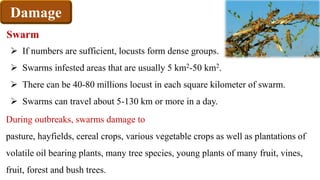
 If numbers are sufficient, locusts form dense groups.
 Swarms infested areas that are usually 5 km2-50 km2.
 There can be 40-80 millions locust in each square kilometer of swarm.
 Swarms can travel about 5-130 km or more in a day.
Swarm
Control
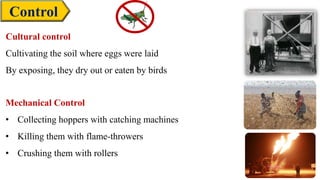
Cultural control
Cultivating the soil where eggs were laid
By exposing, they dry out or eaten by birds
Mechanical Control
• Collecting hoppers with catching machines
• Killing them with flame-throwers
• Crushing them with rollers
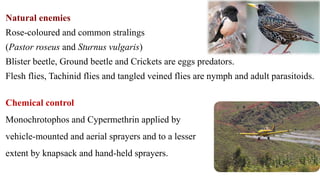
Chemical control
Monochrotophos and Cypermethrin applied by
vehicle-mounted and aerial sprayers and to a lesser
extent by knapsack and hand-held sprayers.
Natural enemies
Rose-coloured and common stralings
(Pastor roseus and Sturnus vulgaris)
Blister beetle, Ground beetle and Crickets are eggs predators.
Flesh flies, Tachinid flies and tangled veined flies are nymph and adult parasitoids.
Unit, 2015. Emergency Management, Locusts - egg laying and egg beds
Ellis, Peggy E., 1953. The Gregarious Behaviour of Marching Locusta Migratoria Migratorioides (R. & F.)
Hoppers. J. Exp. Biol. vol,30:2:214
Lockwood, Jeffrey, A., 2010. The fate of the Rocky Mountain locust, Melanoplus spretus Walsh: implications for
conservation biology., Terrestrial Arthropod Reviews 129-160
Simpson, S J, Despland, E. 2001. Gregarious behavior in desert locusts is evoked by touching their back legs.
Proceedings of the National Academy of Sciences of the United States of America, vol 98
References
Locust - Locusta migratoria

Locust - Locusta migratoria

  • 1.
    Muhammad Zeeshan Nazar ContactEmail: mzeeshan_93@yahoo.com
  • 2.
  • 3.
    Taxonomy Scientific Name Migratory Locust:Locusta migratoria Tree Locust: Anacridium melanorhodon Family: Acrididae Order: Orthoptera 2. Tree Locust1. Migratory Locust Tree Locust Migratory Locust
  • 4.
    Distribution All temperate andtropical parts of the Eastern hemisphere  Europe  Africa  Madagascar  Caucasus  Arabian and Indo-Pakistan region  Central and South-Eastern Asia  Australia  New Guinea  New-Zealand Locusts are adapted to live in hot and dry countries
  • 5.
    • Large sizeinsect • Body length from 35 to 50 mm for males 45 to 55 mm for females • Wings are colorless and exceeding clearly the abdominal extremity. • The color can vary but is usually green, brown, yellowish-green or grey. • The mandibles are dark purple to black Mandibles
  • 6.
    Locust Solitary Gregarious  BehaveIndependently  Repelled from other locusts  Walk slowly with creeping  Active mostly at night  Diet restricted  Behave as a Cohesive Unit  Attracted to conspecific  Walk rapidly  Active mostly at day  Diet broad
  • 7.
    Eggs • Eggs areyellowish brown in color and 7-8 mm long • 1-3 egg pods per female with an average of 60-80 per pod. • Egg pod is large, slightly bent, 50-85 mm in length, 7-10 mm in diameter Egg Pod
  • 8.
    Nymph  An immaturelocust is called a nymph or hopper  Miniature to adults but wingless  Lighter in color than adult Adult • Large size about 45–60 mm in length • Green or brown in the solitary form • Straw-colored in gregarious form • Hind wings have no markings. • Adult flight is strong and steady Solitary Gregarious
  • 9.
    Incomplete metamorphosis  Femalelays eggs in a hole in damp, warm or sandy soil called a Pod usually at a depth of 2-10 cm.  Each pod contain 60-80 pale yellow banana- shaped eggs 5-6 mm long.  Covers the eggs with frothy liquid to protects from enemies, dehydration and contamination. Life Cycle
  • 10.
     Eggs hatchin 14-20 days  Afterwards the nymphs move by crawling or hopping along the ground as they have no wings.  5 nymphal instars and nymphs take 4-8 weeks to complete development  Collection of egg pods laid by a number of locusts is termed as Egg Bed.  Egg beds may vary from a few square meters to several hundred square meters and scattered throughout a region.
  • 11.
    Adult is thefinal stage • Locusts at this level have fully pledged wings and can fly without problem. • Adults appear from June to early July. • 2-4 weeks after fledging, mating start and females start laying eggs 2-3 weeks later (usually at the end of July).. • Lifespan of adult is almost eight weeks. • Univoltine in the considered area but can have up to five generations tropical zones. • Overwinter in the form of eggs.
  • 12.
    Damage During outbreaks, swarmsdamage to pasture, hayfields, cereal crops, various vegetable crops as well as plantations of volatile oil bearing plants, many tree species, young plants of many fruit, vines, fruit, forest and bush trees.  If numbers are sufficient, locusts form dense groups.  Swarms infested areas that are usually 5 km2-50 km2.  There can be 40-80 millions locust in each square kilometer of swarm.  Swarms can travel about 5-130 km or more in a day. Swarm
  • 13.
    Control Cultural control Cultivating thesoil where eggs were laid By exposing, they dry out or eaten by birds Mechanical Control • Collecting hoppers with catching machines • Killing them with flame-throwers • Crushing them with rollers
  • 14.
    Chemical control Monochrotophos andCypermethrin applied by vehicle-mounted and aerial sprayers and to a lesser extent by knapsack and hand-held sprayers. Natural enemies Rose-coloured and common stralings (Pastor roseus and Sturnus vulgaris) Blister beetle, Ground beetle and Crickets are eggs predators. Flesh flies, Tachinid flies and tangled veined flies are nymph and adult parasitoids.
  • 15.
    Unit, 2015. EmergencyManagement, Locusts - egg laying and egg beds Ellis, Peggy E., 1953. The Gregarious Behaviour of Marching Locusta Migratoria Migratorioides (R. & F.) Hoppers. J. Exp. Biol. vol,30:2:214 Lockwood, Jeffrey, A., 2010. The fate of the Rocky Mountain locust, Melanoplus spretus Walsh: implications for conservation biology., Terrestrial Arthropod Reviews 129-160 Simpson, S J, Despland, E. 2001. Gregarious behavior in desert locusts is evoked by touching their back legs. Proceedings of the National Academy of Sciences of the United States of America, vol 98 References