Introduction to Horticulture
Horticulture
 Word first used in 1600’s
 Comes from two Latin words
 Hortus “Garden”
 Cultura “Cultivation”
 Horticulture means “cultivated garden”
or “culture of garden plants”
 NOW MUCH MORE…
Life Sciences
 Biology is the branch of science that
deals with both plant and animal
organisms and life processes.
 Zoology is the part of biology that deals
with animals.
 Botany is the part of biology that deals
with plants.
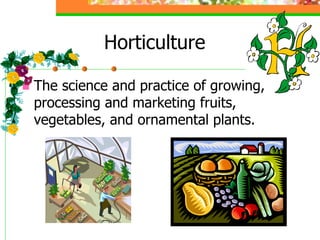
Horticulture
 The science and practice of growing,
processing and marketing fruits,
vegetables, and ornamental plants.
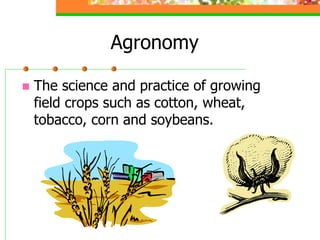
Agronomy
 The science and practice of growing
field crops such as cotton, wheat,
tobacco, corn and soybeans.
Branches of Horticulture
 Olericulture
 The growing and study of vegetables.
 Pomology
 The growing and study of fruits and nuts.
 Viticulture
 The growing and study of grapes or vines.
 Floriculture
 The growing and study of flowers.
Branches of Horticulture
 Greenhouse Management
 The growing and study of plants in
greenhouses.
 Turfgrass Management
 The growing and study of turfgrasses. This
includes home, municipal, and commercial
lawns; sports turf maintenance; highway
rights-of-way; and seed and sod
production.
Branches of Horticulture
 Nursery Management
 The growing and study of trees and shrubs
that are produced primarily for landscape
purposes.
 Arboriculture
 The growing and study of trees.
 Known as silviculture in forestry.
 Synonymous with urban forestry.
Branches of Horticulture
 Landscape Horticulture
 The application of design and horticultural
principles to placement and care of plants
in the landscape.
 Interiorscaping
 The application of design and horticultural
principles to placement and care of plants
in indoor environments.
Branches of Horticulture
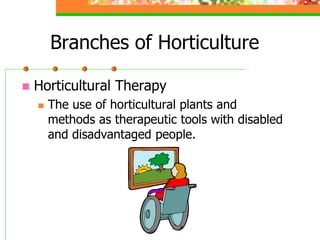
 Horticultural Therapy
 The use of horticultural plants and
methods as therapeutic tools with disabled
and disadvantaged people.
QUESTIONS?
Hypothesize - TPS
 Where did horticulture begin?
 Where will the history of horticulture
originate?
 Who invented it?
History of Horticulture
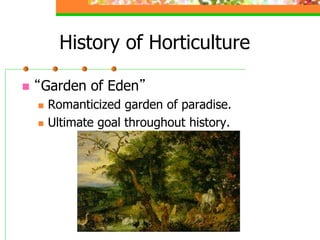
 “Garden of Eden”
 Romanticized garden of paradise.
 Ultimate goal throughout history.
History of Horticulture
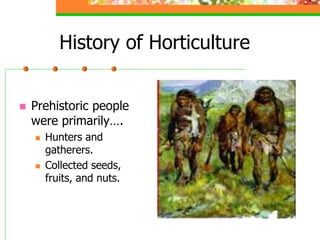
 Prehistoric people
were primarily….
 Hunters and
gatherers.
 Collected seeds,
fruits, and nuts.
History of Horticulture
 Primitive people began to study plants.
 Is it edible?
 Does eating it modify well-being?
 Does it taste good?
 Can it used to keep me warm? As fuel? As
clothing?
 Is it useful to combat pain? Disease?
History of Horticulture
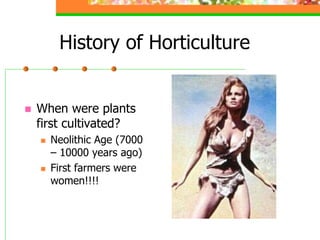
 When were plants
first cultivated?
 Neolithic Age (7000
– 10000 years ago)
 First farmers were
women!!!!
History of Horticulture
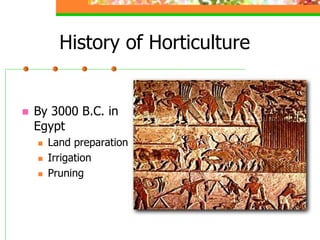
 By 3000 B.C. in
Egypt
 Land preparation
 Irrigation
 Pruning
History of Horticulture
 Meanwhile in Mesopotamia,
Babylonia, and Assyria…..
 Irrigation canals lined with burnt brick and sealed
with asphalt joints.
 This system kept 10,000 square miles under
cultivation…..
 Which fed 15,000,000 people
 Cultivated roses, figs, dates, grapes, and olives.
History of Horticulture
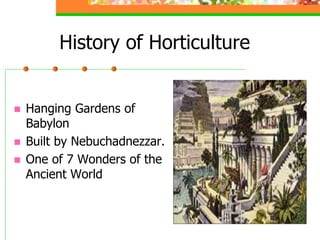
 Hanging Gardens of
Babylon
 Built by Nebuchadnezzar.
 One of 7 Wonders of the
Ancient World
History of Horticulture
 Eventually people began asking questions
such as…..
 How do they grow?
 How do they reproduce?
 How are they constructed?
 How are they nourished?
 How are they related to one another?
 How are traits passed from one
generation to the next?
History of Horticulture
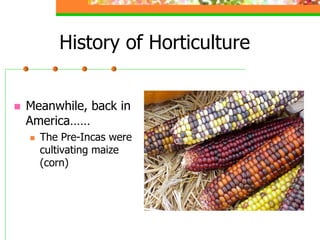
 Meanwhile, back in
America……
 The Pre-Incas were
cultivating maize
(corn)
Hypothesize - TPS
What other crops were
Native American’s
growing?
History of Horticulture
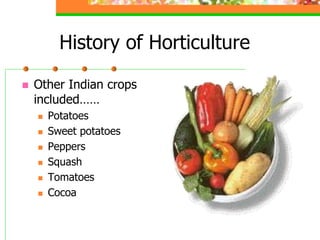
 Other Indian crops
included……
 Potatoes
 Sweet potatoes
 Peppers
 Squash
 Tomatoes
 Cocoa
History of Horticulture
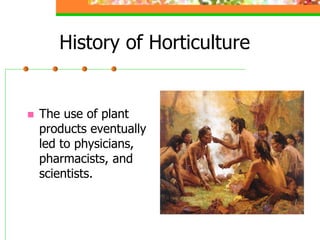
 The use of plant
products eventually
led to physicians,
pharmacists, and
scientists.
History of Horticulture
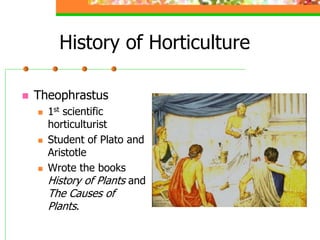
 Theophrastus
 1st scientific
horticulturist
 Student of Plato and
Aristotle
 Wrote the books
History of Plants and
The Causes of
Plants.
History of Horticulture
 History of Plants
 Morphology of roots, flowers, and leaves.
 Anatomical features such as bark, pith,
fibers, and vessels.
 The Causes of Plants
 Relationship of weather, soils, and agricultural practices.
 Importance of seeds
 Value of grafting
 Tastes and flagrances of plants
 Death of plants
History of Horticulture
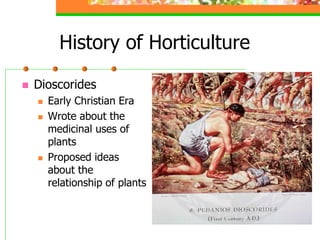
 Dioscorides
 Early Christian Era
 Wrote about the
medicinal uses of
plants
 Proposed ideas
about the
relationship of plants
History of Horticulture
 Middle Ages
 Little advancement in horticulture
 Arabs (established botanical gardens)
 Scientific advances of Greeks and Romans
were preserved in monasteries.
History of Horticulture
 Renaissance
 Rebirth of energetic attention to scientific
discovery.
 Taxonomy, morphology, and anatomy
branches of botany began to grow.
 More and more plants were discovered due
to exploration which required a system of
classification.
History of Horticulture
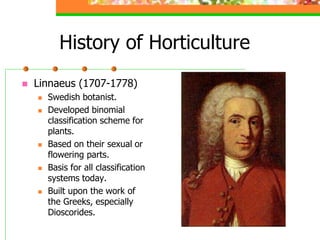
 Linnaeus (1707-1778)
 Swedish botanist.
 Developed binomial
classification scheme for
plants.
 Based on their sexual or
flowering parts.
 Basis for all classification
systems today.
 Built upon the work of
the Greeks, especially
Dioscorides.
History of Horticulture
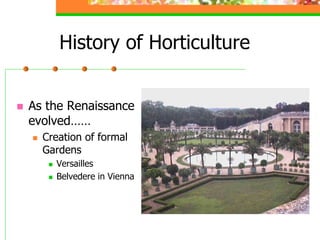
 As the Renaissance
evolved……
 Creation of formal
Gardens
 Versailles
 Belvedere in Vienna
History of Horticulture
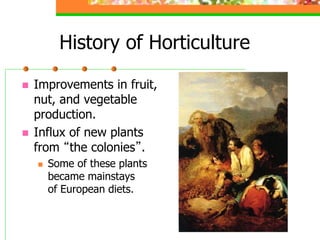
 Improvements in fruit,
nut, and vegetable
production.
 Influx of new plants
from “the colonies”.
 Some of these plants
became mainstays
of European diets.
Horticulture in America
 When the Europeans arrived they
brought seeds, cuttings, and plants.
 Orchards were established
 Crops brought to America
 Oranges
 Wheat
 Cabbage
Horticulture in America
 Early horticulturists in America
 John Bartram
 George Washington
 Thomas Jefferson
 John Chapman
 aka. Johnny Appleseed
Horticulture in America
 New life in horticulture
 Morrill Act of 1862.
 Established land-grant
universities.
 Encouraged the growth
of agricultural knowledge.
Horticulture in America
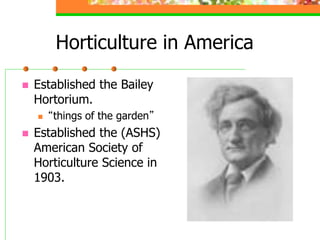
 Liberty Hyde Bailey (1858-1954)
 “Father of American Horticulture”
 Educated at Michigan Agricultural College
 Present Day Michigan State University
 Then was a professor at Michigan
Agricultural College and at Cornell
University.
Horticulture in America
 Established the 1st horticulture
department
 Prodigious Writer
 Hortus
 Taxonomic index of horticultural plants.
 Cyclopedia of Horticulture
 Cultural and taxonomic information of plants.
Horticulture in America
 Established the Bailey
Hortorium.
 “things of the garden”
 Established the (ASHS)
American Society of
Horticulture Science in
1903.
Modern Day Horticulture
 New Cultivars
 Plant-Water
Relationships
 Temperature
 Light
 Plant Nutrition
 The Rhizosphere
 Integrated Pest
Management
 Plant Growth Regulators
 Mechanization
 Post Harvest Factors

introduction_and_history_of_horticulture.ppt

  • 1.
  • 2.
    Horticulture  Word firstused in 1600’s  Comes from two Latin words  Hortus “Garden”  Cultura “Cultivation”  Horticulture means “cultivated garden” or “culture of garden plants”  NOW MUCH MORE…
  • 3.
    Life Sciences  Biologyis the branch of science that deals with both plant and animal organisms and life processes.  Zoology is the part of biology that deals with animals.  Botany is the part of biology that deals with plants.
  • 4.
    Horticulture  The scienceand practice of growing, processing and marketing fruits, vegetables, and ornamental plants.
  • 5.
    Agronomy  The scienceand practice of growing field crops such as cotton, wheat, tobacco, corn and soybeans.
  • 6.
    Branches of Horticulture Olericulture  The growing and study of vegetables.  Pomology  The growing and study of fruits and nuts.  Viticulture  The growing and study of grapes or vines.  Floriculture  The growing and study of flowers.
  • 7.
    Branches of Horticulture Greenhouse Management  The growing and study of plants in greenhouses.  Turfgrass Management  The growing and study of turfgrasses. This includes home, municipal, and commercial lawns; sports turf maintenance; highway rights-of-way; and seed and sod production.
  • 8.
    Branches of Horticulture Nursery Management  The growing and study of trees and shrubs that are produced primarily for landscape purposes.  Arboriculture  The growing and study of trees.  Known as silviculture in forestry.  Synonymous with urban forestry.
  • 9.
    Branches of Horticulture Landscape Horticulture  The application of design and horticultural principles to placement and care of plants in the landscape.  Interiorscaping  The application of design and horticultural principles to placement and care of plants in indoor environments.
  • 10.
    Branches of Horticulture Horticultural Therapy  The use of horticultural plants and methods as therapeutic tools with disabled and disadvantaged people.
  • 11.
  • 12.
    Hypothesize - TPS Where did horticulture begin?  Where will the history of horticulture originate?  Who invented it?
  • 13.
    History of Horticulture “Garden of Eden”  Romanticized garden of paradise.  Ultimate goal throughout history.
  • 14.
    History of Horticulture Prehistoric people were primarily….  Hunters and gatherers.  Collected seeds, fruits, and nuts.
  • 15.
    History of Horticulture Primitive people began to study plants.  Is it edible?  Does eating it modify well-being?  Does it taste good?  Can it used to keep me warm? As fuel? As clothing?  Is it useful to combat pain? Disease?
  • 16.
    History of Horticulture When were plants first cultivated?  Neolithic Age (7000 – 10000 years ago)  First farmers were women!!!!
  • 17.
    History of Horticulture By 3000 B.C. in Egypt  Land preparation  Irrigation  Pruning
  • 18.
    History of Horticulture Meanwhile in Mesopotamia, Babylonia, and Assyria…..  Irrigation canals lined with burnt brick and sealed with asphalt joints.  This system kept 10,000 square miles under cultivation…..  Which fed 15,000,000 people  Cultivated roses, figs, dates, grapes, and olives.
  • 19.
    History of Horticulture Hanging Gardens of Babylon  Built by Nebuchadnezzar.  One of 7 Wonders of the Ancient World
  • 20.
    History of Horticulture Eventually people began asking questions such as…..  How do they grow?  How do they reproduce?  How are they constructed?  How are they nourished?  How are they related to one another?  How are traits passed from one generation to the next?
  • 21.
    History of Horticulture Meanwhile, back in America……  The Pre-Incas were cultivating maize (corn)
  • 22.
    Hypothesize - TPS Whatother crops were Native American’s growing?
  • 23.
    History of Horticulture Other Indian crops included……  Potatoes  Sweet potatoes  Peppers  Squash  Tomatoes  Cocoa
  • 24.
    History of Horticulture The use of plant products eventually led to physicians, pharmacists, and scientists.
  • 25.
    History of Horticulture Theophrastus  1st scientific horticulturist  Student of Plato and Aristotle  Wrote the books History of Plants and The Causes of Plants.
  • 26.
    History of Horticulture History of Plants  Morphology of roots, flowers, and leaves.  Anatomical features such as bark, pith, fibers, and vessels.  The Causes of Plants  Relationship of weather, soils, and agricultural practices.  Importance of seeds  Value of grafting  Tastes and flagrances of plants  Death of plants
  • 27.
    History of Horticulture Dioscorides  Early Christian Era  Wrote about the medicinal uses of plants  Proposed ideas about the relationship of plants
  • 28.
    History of Horticulture Middle Ages  Little advancement in horticulture  Arabs (established botanical gardens)  Scientific advances of Greeks and Romans were preserved in monasteries.
  • 29.
    History of Horticulture Renaissance  Rebirth of energetic attention to scientific discovery.  Taxonomy, morphology, and anatomy branches of botany began to grow.  More and more plants were discovered due to exploration which required a system of classification.
  • 30.
    History of Horticulture Linnaeus (1707-1778)  Swedish botanist.  Developed binomial classification scheme for plants.  Based on their sexual or flowering parts.  Basis for all classification systems today.  Built upon the work of the Greeks, especially Dioscorides.
  • 31.
    History of Horticulture As the Renaissance evolved……  Creation of formal Gardens  Versailles  Belvedere in Vienna
  • 32.
    History of Horticulture Improvements in fruit, nut, and vegetable production.  Influx of new plants from “the colonies”.  Some of these plants became mainstays of European diets.
  • 33.
    Horticulture in America When the Europeans arrived they brought seeds, cuttings, and plants.  Orchards were established  Crops brought to America  Oranges  Wheat  Cabbage
  • 34.
    Horticulture in America Early horticulturists in America  John Bartram  George Washington  Thomas Jefferson  John Chapman  aka. Johnny Appleseed
  • 35.
    Horticulture in America New life in horticulture  Morrill Act of 1862.  Established land-grant universities.  Encouraged the growth of agricultural knowledge.
  • 36.
    Horticulture in America Liberty Hyde Bailey (1858-1954)  “Father of American Horticulture”  Educated at Michigan Agricultural College  Present Day Michigan State University  Then was a professor at Michigan Agricultural College and at Cornell University.
  • 37.
    Horticulture in America Established the 1st horticulture department  Prodigious Writer  Hortus  Taxonomic index of horticultural plants.  Cyclopedia of Horticulture  Cultural and taxonomic information of plants.
  • 38.
    Horticulture in America Established the Bailey Hortorium.  “things of the garden”  Established the (ASHS) American Society of Horticulture Science in 1903.
  • 39.
    Modern Day Horticulture New Cultivars  Plant-Water Relationships  Temperature  Light  Plant Nutrition  The Rhizosphere  Integrated Pest Management  Plant Growth Regulators  Mechanization  Post Harvest Factors