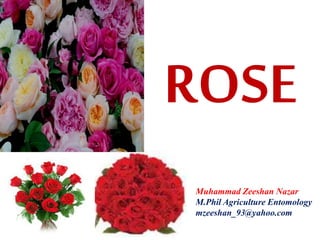
ROSE
Muhammad Zeeshan Nazar
M.Phil Agriculture Entomology
mzeeshan_93@yahoo.com
“He who appreciates the beauty of a flower and its colors appreciate
the beauty himself.”
INTRODUCTION
• Roses are symbol of beauty, love, affection,
romance etc.
• Besides their aesthetic value, they are important
for their economic uses, such as
– cut flowers
– essential oils & Essences for cosmetics
– rose petals
– rose dry buds
– rose water
– rose hips
– rose achenes (seeds of rose)
– rose nursery stock
Roses In The Landscape
These are used in today’s landscape as they have
many advantages over other shrubs.
• It blooms for long period and the effect and range
of the flower is remarkable. The autumn coloring
of the foliage, the shape and color of the hips
(fruits), sometime supplemented by decorative
thorns make the rose important to be used in the
landscape.
• In large parks, housing developments, city green
belts, along highways and in community gardens
the rose has a spiritual palace in formal beds.
Modern Roses
• Roses developed after 1867 are called “Modern Roses”.
• These are originated from nearly 10 Species Roses like
R. canina, R. chinensis, R. foetida, Rosa gallica, R. gigantea,
R. moschata, R. multiflora, Rosa phoenicia, R rugosa and
R. wichuraiana.
These are divided in further groups:
 Hybrid Tea: ( Tea roses x Hybrid perpatual)
Upright (1-2m tall), mostly single, well shaped flower with high spiralling
centres at the end of long stem.
Sturdy, often shiny petals, pointed buds, large glossy and semi glossy
leaves and strong stems.
• Colors include pure white and shades of red, lavender, orange, pink,
yellow, apricot, crimson, maroon and mauve.
• Most, but not all, hybrid teas have some fragrance
These are used as cut flower and for Landscape
Cv. Pefume Delight
Double
Delight
Cv. Alec’s Red
Hybrid Teas
Brandy
Modern Roses…..
 Floribunda ( Poliantha x Hybrid Tea)
These are shorter, more compact and have smaller canes
than hybrid teas.
Large clusters of small flowers are produced at the tips of the
canes.
Their showy masses of color and compact growth make them
most useful as a landscape rose for bed planting, grouping in
shrub borders, or as a hedge.
These are generally quite vigorous and perfuse bloomers.
They are generally more hardy and require less care than
hybrid teas. Mature plants range from 1 1⁄2 to 3 1⁄2 feet tall.
A broad range of colors is available in single, semi-double or
double flowers.
Floribunda group
Cv. Ice berg Cv. Angel
face
Cv. Simplicity Cv. Durban July
Floribundas
Bon Bon
Grandiflora (Floribunda x Hybrid Tea)
• These have some of the characteristics of both hybrid teas and
floribundas.
• Their flowers resemble hybrid teas but are smaller and are produced in
groups of 5 to 7 resembling the cluster effect of floribundas.
• They bloom more abundantly than hybrid teas, and their long stemmed
flowers are also good for cutting.
• These are the tallest of the bush roses, reaching a height of 5 to 6 feet.
• They require the same degree of winter protection as hybrid teas.
Grandiflora Roses
Cv. Gold
Medal
Cv. Queen
Elizabeth
Cv. Luck Lady Cv. Strike it
Rich
 Miniatures ( Polyantha x Rosa chinensis)
• Miniature roses have become popular in recent years.
• Their small size makes them useful for growing in
containers and small gardens.
• Flowers average about 1 inch in diameter in white and
shades of pink, red or yellow.
• The flowers can be used for miniature arrangements,
corsages and boutonnieres.
•Miniatures are not grafted and many varieties are quite
hardy.
Miniature Roses
Cv. 'Little Artist'
Cv.'Hot Tamale'
Roses as cut flowers
• Value of fresh cut flower trade amounts to
50% followed by live ornamental plants
(43%) and cut foliage (7%) of floriculture
trade.
• Out of all cut flowers, roses account for 50 % of
total exports in world trade.
ROSE GROWING AREAS OF
PAKISTAN
• Qasur (Pattoki)
• Lahore
• Sheikhupura
• Rawalpindi
• Faisalabad
• Hyderabad
Rose Cultivation in The green House
“A greenhouse is a structure which maintain the
environmental conditions, like temperature, humidity,
and air circulation inside it for crops”.
Components of Green House
1- Green House Framework and glass or polythene covering
2- Cooling Pad system including, Fans, pads, exhaust fans
and humidifier if we want to reduce the temperature and
heating system if we increase the temperature in cool areas.
3-Drip Irrigation System, including Water Reservoir, pump,
Fertilizer mixer, Main pipes, Laterals and Drips.
Soil Culture for Rose Cultivation in Green House
Advantages of Greenhouse Technology
• Controlled temperature and humidity that prevent pests and
diseases
• Standards are followed with more consistency
• Varieties achieve their maximum potential in terms of bud
size, color and other physical attributes
• Sizes vary from short to very long stems (reaching up to a
meter in length) and production may be programmed
depending on buyers' demand
Less thorns that makes handling easier
Clean petals and leaves, again for easier handling
Good vase life so consumers can enjoy the flowers
longer
Year round reliable supply of flowers
Layout and Fertigation
• If roses are to be grown in greenhouse, trenches should be
dug 4’ wide and 2’ deep which should be filled with sweet
sand after lining with polythene sheet.
• Plantation should be done at 1’ distance in 1’ apart rows with
total plantation of 15,000 plants per acre.
• Nutrition and irrigation is provided though drip irrigation
system daily during summer and at alternate day during
winter.
Fertilization
• Application of nutrients should be based on analysis of
soil and plant.
• General recommendation is application of 2 bags of N: P:
K (17:17:17) per acre per month.
• If soil is poor, then micronutrients and growth promoters
should also be used occasionally.
• If fertilizer is applied through fertigation, then split these
monthly doses into ten splits each of which should be
applied at 3 days interval.
Fertigation Unit
Commercial rose production farm
Temperature
Affects quality and quantity of plant and
flowers
Most of roses
Night temperature 60oF (15.5oC)
Optimum growing temperature 17-25oC
Not below 15oC ,above 27oC
Under high temperature
Flowers are small having few petals
Cool temperature
Bullheads are produced
Humidity
Roses required high humidity (65-75%)
By damping the paths
By Misting
Humidity helps in two ways
Reducing transpiration
Reduce incidence of red spider mite
Excessive Humidity
Foliage decrease
Downy mildew
black spots
Plants Management Practices.
• Pruning is an important step in regenerating the
growth and flowering of roses.
• Correct pruning is an essential factor for success in
rose growing and there fore, should be done with
precision and care.
• There is a marked difference in growth habit of
roses and each type has its own particular method
and season of pruning. the practice of rose pruning
consists of two operations.
Thining out : Comprises removal of old, weak, dry, diseased
stems.
Heading back/shortening of stems. Cutting down of last years
growth to desirable height
Objectives of pruning roses plants.
• To remove the unproductive growth
• To ensure production of large number of strong and
healthy shoots, which will bear flowers and improve
quality of blooms.
• Keep the rose bush in proper shape and size.
• To allow high and air to reach in centre of plant.
Disbudding
 Varieties produce some side buds below the center bud. These side
buds have to be removed or disbudded.
 The disbudding must be done regularly and also as soon as possible
in order to avoid large wounds in the upper leaf axil.
•Harvesting
•Grading
•Pulsing
•Bunching
•Sleeving
•Packing
•Pre-cooling
•Transportation
Mishandling of cut roses
Yield
The Hybrid Teas roses can yield about 70 – 80
stems/plant/year, while the Floribundas yield yields 80 -
90 stems/plant/year.

Rose

  • 1.
    ROSE Muhammad Zeeshan Nazar M.PhilAgriculture Entomology mzeeshan_93@yahoo.com
  • 2.
    “He who appreciatesthe beauty of a flower and its colors appreciate the beauty himself.”
  • 3.
    INTRODUCTION • Roses aresymbol of beauty, love, affection, romance etc. • Besides their aesthetic value, they are important for their economic uses, such as – cut flowers – essential oils & Essences for cosmetics – rose petals – rose dry buds – rose water – rose hips – rose achenes (seeds of rose) – rose nursery stock
  • 4.
    Roses In TheLandscape These are used in today’s landscape as they have many advantages over other shrubs. • It blooms for long period and the effect and range of the flower is remarkable. The autumn coloring of the foliage, the shape and color of the hips (fruits), sometime supplemented by decorative thorns make the rose important to be used in the landscape. • In large parks, housing developments, city green belts, along highways and in community gardens the rose has a spiritual palace in formal beds.
  • 5.
    Modern Roses • Rosesdeveloped after 1867 are called “Modern Roses”. • These are originated from nearly 10 Species Roses like R. canina, R. chinensis, R. foetida, Rosa gallica, R. gigantea, R. moschata, R. multiflora, Rosa phoenicia, R rugosa and R. wichuraiana. These are divided in further groups:  Hybrid Tea: ( Tea roses x Hybrid perpatual) Upright (1-2m tall), mostly single, well shaped flower with high spiralling centres at the end of long stem. Sturdy, often shiny petals, pointed buds, large glossy and semi glossy leaves and strong stems. • Colors include pure white and shades of red, lavender, orange, pink, yellow, apricot, crimson, maroon and mauve. • Most, but not all, hybrid teas have some fragrance These are used as cut flower and for Landscape
  • 6.
  • 7.
  • 8.
    Modern Roses…..  Floribunda( Poliantha x Hybrid Tea) These are shorter, more compact and have smaller canes than hybrid teas. Large clusters of small flowers are produced at the tips of the canes. Their showy masses of color and compact growth make them most useful as a landscape rose for bed planting, grouping in shrub borders, or as a hedge. These are generally quite vigorous and perfuse bloomers. They are generally more hardy and require less care than hybrid teas. Mature plants range from 1 1⁄2 to 3 1⁄2 feet tall. A broad range of colors is available in single, semi-double or double flowers.
  • 9.
    Floribunda group Cv. Iceberg Cv. Angel face Cv. Simplicity Cv. Durban July
  • 10.
  • 11.
    Grandiflora (Floribunda xHybrid Tea) • These have some of the characteristics of both hybrid teas and floribundas. • Their flowers resemble hybrid teas but are smaller and are produced in groups of 5 to 7 resembling the cluster effect of floribundas. • They bloom more abundantly than hybrid teas, and their long stemmed flowers are also good for cutting. • These are the tallest of the bush roses, reaching a height of 5 to 6 feet. • They require the same degree of winter protection as hybrid teas.
  • 12.
    Grandiflora Roses Cv. Gold Medal Cv.Queen Elizabeth Cv. Luck Lady Cv. Strike it Rich
  • 14.
     Miniatures (Polyantha x Rosa chinensis) • Miniature roses have become popular in recent years. • Their small size makes them useful for growing in containers and small gardens. • Flowers average about 1 inch in diameter in white and shades of pink, red or yellow. • The flowers can be used for miniature arrangements, corsages and boutonnieres. •Miniatures are not grafted and many varieties are quite hardy.
  • 15.
    Miniature Roses Cv. 'LittleArtist' Cv.'Hot Tamale'
  • 16.
    Roses as cutflowers • Value of fresh cut flower trade amounts to 50% followed by live ornamental plants (43%) and cut foliage (7%) of floriculture trade. • Out of all cut flowers, roses account for 50 % of total exports in world trade.
  • 17.
    ROSE GROWING AREASOF PAKISTAN • Qasur (Pattoki) • Lahore • Sheikhupura • Rawalpindi • Faisalabad • Hyderabad
  • 18.
    Rose Cultivation inThe green House “A greenhouse is a structure which maintain the environmental conditions, like temperature, humidity, and air circulation inside it for crops”. Components of Green House 1- Green House Framework and glass or polythene covering 2- Cooling Pad system including, Fans, pads, exhaust fans and humidifier if we want to reduce the temperature and heating system if we increase the temperature in cool areas. 3-Drip Irrigation System, including Water Reservoir, pump, Fertilizer mixer, Main pipes, Laterals and Drips.
  • 19.
    Soil Culture forRose Cultivation in Green House
  • 20.
    Advantages of GreenhouseTechnology • Controlled temperature and humidity that prevent pests and diseases • Standards are followed with more consistency • Varieties achieve their maximum potential in terms of bud size, color and other physical attributes • Sizes vary from short to very long stems (reaching up to a meter in length) and production may be programmed depending on buyers' demand
  • 21.
    Less thorns thatmakes handling easier Clean petals and leaves, again for easier handling Good vase life so consumers can enjoy the flowers longer Year round reliable supply of flowers
  • 22.
    Layout and Fertigation •If roses are to be grown in greenhouse, trenches should be dug 4’ wide and 2’ deep which should be filled with sweet sand after lining with polythene sheet. • Plantation should be done at 1’ distance in 1’ apart rows with total plantation of 15,000 plants per acre. • Nutrition and irrigation is provided though drip irrigation system daily during summer and at alternate day during winter.
  • 23.
    Fertilization • Application ofnutrients should be based on analysis of soil and plant. • General recommendation is application of 2 bags of N: P: K (17:17:17) per acre per month. • If soil is poor, then micronutrients and growth promoters should also be used occasionally. • If fertilizer is applied through fertigation, then split these monthly doses into ten splits each of which should be applied at 3 days interval.
  • 24.
  • 25.
  • 26.
    Temperature Affects quality andquantity of plant and flowers Most of roses Night temperature 60oF (15.5oC) Optimum growing temperature 17-25oC Not below 15oC ,above 27oC Under high temperature Flowers are small having few petals Cool temperature Bullheads are produced
  • 27.
    Humidity Roses required highhumidity (65-75%) By damping the paths By Misting Humidity helps in two ways Reducing transpiration Reduce incidence of red spider mite Excessive Humidity Foliage decrease Downy mildew black spots
  • 28.
    Plants Management Practices. •Pruning is an important step in regenerating the growth and flowering of roses. • Correct pruning is an essential factor for success in rose growing and there fore, should be done with precision and care. • There is a marked difference in growth habit of roses and each type has its own particular method and season of pruning. the practice of rose pruning consists of two operations.
  • 29.
    Thining out :Comprises removal of old, weak, dry, diseased stems. Heading back/shortening of stems. Cutting down of last years growth to desirable height
  • 30.
    Objectives of pruningroses plants. • To remove the unproductive growth • To ensure production of large number of strong and healthy shoots, which will bear flowers and improve quality of blooms. • Keep the rose bush in proper shape and size. • To allow high and air to reach in centre of plant.
  • 35.
    Disbudding  Varieties producesome side buds below the center bud. These side buds have to be removed or disbudded.  The disbudding must be done regularly and also as soon as possible in order to avoid large wounds in the upper leaf axil.
  • 36.
  • 37.
  • 38.
    Yield The Hybrid Teasroses can yield about 70 – 80 stems/plant/year, while the Floribundas yield yields 80 - 90 stems/plant/year.