CONTENT
Introduction
 Classification
Mechanism of Dormancy
Factors causing Dormancy
Methods to Overcome Dormancy
Biological Importance of Seed Dormancy
Endosperm
Aleurone
layer
Cotyledon
Epicotyl
Radical
Testa
Introduction
During the developmental cycle of the plant, at some phase
certain structures like buds, tubers, seeds, go through a
period of temporary suspension of growth activity, such a
state is called dormancy.
In plant physiology , dormancy is a period of arrested
plant growth .
It is an survival strategy exhibited by many plants under
unfavorable conditions.
To overcome unfavorable conditions , lower plants
produces Endospores,Zygospores,Auxospores,..etc
Seed dormancy:
Seed dormancy is defined as a state in which seeds are
unable to germinate even under environmental
conditions normally favorable for germination.
HORMONAL MECHANISM:
Studies with ABA and GA biosynthesis and signaling
pathway demonstrated that these two hormones have
important and antagonistic roles in germination and
dormancy respectively.
ABA induces and maintains seed dormancy during
embryo maturation. The key to ABA metabolism are some
specific genes encoding key enzymes are of NCED family
(NCED6 and NCED9).
( Nine-cis-epoxy carotenoid dioxygenase.)
 Embryonic identity protein (FUS3), which positively
regulates ABA synthesis.
Dormancy factor DOG1 transcription levels are enhanced
by low temperatures during seed maturation.
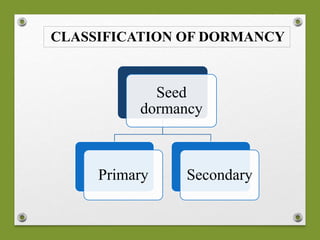
Seed
dormancy
Primary Secondary
CLASSIFICATION OF DORMANCY
Primary Dormancy: Due to internal causes even if all
external environmental conditions are duly present.
Ex:Hormonal factor (ABA-GA imbalance), Genetic factors
Secondary Dormancy: When dormancy caused due to
external factors like absence of sunlight, CO2 ,very high or
low temperature.
Ex: Nicotiana attenuata only germinate if there is presence
of smoke.
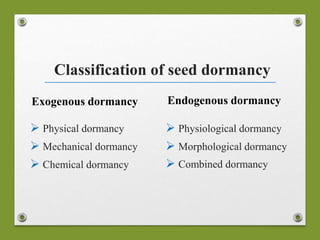
Classification of seed dormancy
Exogenous dormancy
 Physical dormancy
 Mechanical dormancy
 Chemical dormancy
Endogenous dormancy
 Physiological dormancy
 Morphological dormancy
 Combined dormancy
Physical dormancy :
Dormancy that is caused by an impermeable seed coat.
It is the result of impermeable layer that develops during
maturation and drying of the seed or fruit.
It prevents the seed from taking up water or gases.
As a result, the seed is prevented from germinating until
dormancy is broken.
Generally, physical dormancy is the result of one or more
palisade layers in the fruit or seed coat.
Mechanical dormancy:
Mechanical dormancy occurs when seed coats or other
coverings are too hard to allow the embryo to expand during
germination.
Chemical dormancy-
Presence of inhibitors within the seed (seed coat) can cause
dormancy.
E.g.: Cotton seed pericarp contains Abscisic acid
Coriander seed pericarp contains Coumarin
Paddy hull contain Abscisic acid
Physiological dormancy
Physiological dormancy prevents embryo growth and
seed germination until chemical changes occur.
Photo dormancy: light sensitivity affects germination of
some seeds. These photoblastic seeds need a period of
darkness or light to germinate.
Thermo dormancy : seed sensitivity to heat or cold.
Some seeds germinate only at high temperature.
like Amaranth.
Morphological dormancy
In morphological dormancy, the embryo is underdeveloped
or undifferentiated.
These seeds have both morphological and physiological
dormancy.
Combined dormancy
Mechanism of Dormancy
1. Hormonal control theory.
2. Temperature and gaseous exchange restriction theory.
3. Metabolic control theory.
Hormonal control theory
Dormancy causing hormones are ABA and ethylene.
Dormancy causing hormones and dormancy provoking
hormones (GA & Cytokinin) ratio determine the fate of
dormancy.
Chilling treatment, light exposure increases Gibberellin
level in seeds & causes germination.
Temperature and gaseous
exchange theory
Restricted oxygen uptake ( due to hard seed coat) and high
temperature induces dormancy in seeds.
Oxygen deficiency leads to inhibition of Cytochrome
oxidase activity which leads to dormancy.
Metabolic control theory
Dormancy in seed is controlled by metabolic energy
produced in seeds.
During dormancy
Respiratory system blocked ATP synthesis
blocked increase in AMP and ADP leads to increase
in the activity of Glycolytic pathway.
Production of growth inhibitors at lower concentration
of oxygen.
Factors causing dormancy of seeds
Hard seed coat
Dormancy due to temperature
Immature Embryo
Light Sensitive Seed
Dormancy due to growth inhibitory chemicals
Excessive Salts
Dormancy due to hard seed coat – Testa of some seeds
are hard and multilayered (Leguminaceae, Solonaceae).
Hard seed coat prevents germination due to following
reasons:
Hard seed coat prevents the entry of water into the seed.
Hard seed coat obstruct exchange of gases, especially
oxygen. Oxygen is necessary for respiration.
Hard seed coat causes mechanical resistance. Thus radicle
does not come out.
Dormancy due to temperature
Some seeds require chilling treatment for germination.
 Examples are apple, walnut, and Pinus. Such seeds need
chilling temperature (1 -5 ºC) for few weeks.
Immature Embryo
Embryo is not matured at the time of harvesting for
maturity of such embryo, resting period is required.
 Example: Caltha palustris.
Light Sensitive Seed
There two type of seeds for light sensitivity:
Positive photoblastic seeds: Seeds of some species like
lettuce remain dormant in the dark, they germinate when
they are exposed to light.
Negative photoblastic seeds: Seeds of some species like
Phlox, Nemophila and Silene remain dormant when
exposed to light. They germinate only in the dark.
Dormancy due to growth
inhibitory chemicals
There are several naturally occurring compounds which
inhibit germination of seeds, like Coumarin, Cyanides,
Ammonia, Dinitrophenols, Organic acid, Aldehydes,
Alkaloids, Fluorides.
 Example: Tomato fruit pulp – Caffeic acid and Ferulic
acid which induce dormancy.
METHODS TO OVERCOME SEED
DORMANCY
 Mechanical scarification
 Impaction
 Cold stratification
 Removal of inhibitors
 Treatment with growth hormones
Specific light requirement
Pressure
Scarification : Any treatment i.e. physical or chemical
that weakens the seed coat.
Rubbing or Puncturing : By rubbing them against rough
surface or puncturing the seed coat with pointed needle.
E.g. Coriander, Castor.
Chemical treatment includes treating seeds with strong acids
and organic solvents. E.g.Sulphuric acid.
2. Impaction: it is process of shaking of seeds to clear
blockage of testa pores. E.g. Seeds of Crotolaria egyptica
(legume)
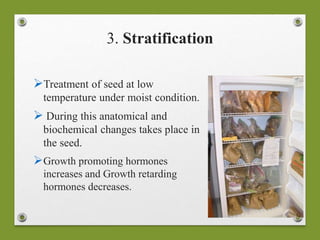
3. Stratification
Treatment of seed at low
temperature under moist condition.
 During this anatomical and
biochemical changes takes place in
the seed.
Growth promoting hormones
increases and Growth retarding
hormones decreases.
4. Removal of inhibitors: Growth inhibiting chemicals
removed by repeated washing with water.
5. Treatment with growth hormones: Gibberellins
substitute the cold treatment requirement in many seeds.
Cytokinin promotes germination of many seeds.
6. Pressure: Dormancy can be broken by exposing seeds
to high atmospheric pressure. E.g. Sweet Clover seeds
subjected to hydraulic pressure of 2000 atm favors the
increase in germination at 18 ºC.
7. Specific light requirement: Dormancy of Photoblastic
seeds can be overcome by light exposure.
Red light promotes germination in lettuce seeds.
Biological Importance of Seed Dormancy
1. Dormancy allows the seeds to remain in suspended animation
without any harm during drought, cold or high summer
temperature.
2. The dormant seeds can remain alive in the soil for several
years.
3. It helps the seed to get dispersed over long distances through
unfavorable environment or inhospitable area.
4. Dormancy induced by the inhibitors present in the seed coats
is highly useful to desert plants. The seeds germinate only after a
good rainfall which dissolves away the inhibitors.
5. It follows storage of seeds for later use by man.
REFERENCES
Modern plant physiology - R K Sinha
THANK YOU
NAVINKUMAR
Jr. M.Sc.(agri.)
PG18AGR10057

Seed dormancy

  • 3.
    CONTENT Introduction  Classification Mechanism ofDormancy Factors causing Dormancy Methods to Overcome Dormancy Biological Importance of Seed Dormancy
  • 4.
  • 5.
    Introduction During the developmentalcycle of the plant, at some phase certain structures like buds, tubers, seeds, go through a period of temporary suspension of growth activity, such a state is called dormancy. In plant physiology , dormancy is a period of arrested plant growth . It is an survival strategy exhibited by many plants under unfavorable conditions. To overcome unfavorable conditions , lower plants produces Endospores,Zygospores,Auxospores,..etc
  • 6.
    Seed dormancy: Seed dormancyis defined as a state in which seeds are unable to germinate even under environmental conditions normally favorable for germination.
  • 7.
    HORMONAL MECHANISM: Studies withABA and GA biosynthesis and signaling pathway demonstrated that these two hormones have important and antagonistic roles in germination and dormancy respectively. ABA induces and maintains seed dormancy during embryo maturation. The key to ABA metabolism are some specific genes encoding key enzymes are of NCED family (NCED6 and NCED9). ( Nine-cis-epoxy carotenoid dioxygenase.)  Embryonic identity protein (FUS3), which positively regulates ABA synthesis.
  • 9.
    Dormancy factor DOG1transcription levels are enhanced by low temperatures during seed maturation.
  • 10.
  • 11.
    Primary Dormancy: Dueto internal causes even if all external environmental conditions are duly present. Ex:Hormonal factor (ABA-GA imbalance), Genetic factors Secondary Dormancy: When dormancy caused due to external factors like absence of sunlight, CO2 ,very high or low temperature. Ex: Nicotiana attenuata only germinate if there is presence of smoke.
  • 12.
    Classification of seeddormancy Exogenous dormancy  Physical dormancy  Mechanical dormancy  Chemical dormancy Endogenous dormancy  Physiological dormancy  Morphological dormancy  Combined dormancy
  • 13.
    Physical dormancy : Dormancythat is caused by an impermeable seed coat. It is the result of impermeable layer that develops during maturation and drying of the seed or fruit. It prevents the seed from taking up water or gases. As a result, the seed is prevented from germinating until dormancy is broken. Generally, physical dormancy is the result of one or more palisade layers in the fruit or seed coat.
  • 14.
    Mechanical dormancy: Mechanical dormancyoccurs when seed coats or other coverings are too hard to allow the embryo to expand during germination. Chemical dormancy- Presence of inhibitors within the seed (seed coat) can cause dormancy. E.g.: Cotton seed pericarp contains Abscisic acid Coriander seed pericarp contains Coumarin Paddy hull contain Abscisic acid
  • 15.
    Physiological dormancy Physiological dormancyprevents embryo growth and seed germination until chemical changes occur. Photo dormancy: light sensitivity affects germination of some seeds. These photoblastic seeds need a period of darkness or light to germinate. Thermo dormancy : seed sensitivity to heat or cold. Some seeds germinate only at high temperature. like Amaranth.
  • 16.
    Morphological dormancy In morphologicaldormancy, the embryo is underdeveloped or undifferentiated. These seeds have both morphological and physiological dormancy. Combined dormancy
  • 17.
    Mechanism of Dormancy 1.Hormonal control theory. 2. Temperature and gaseous exchange restriction theory. 3. Metabolic control theory.
  • 18.
    Hormonal control theory Dormancycausing hormones are ABA and ethylene. Dormancy causing hormones and dormancy provoking hormones (GA & Cytokinin) ratio determine the fate of dormancy. Chilling treatment, light exposure increases Gibberellin level in seeds & causes germination.
  • 19.
    Temperature and gaseous exchangetheory Restricted oxygen uptake ( due to hard seed coat) and high temperature induces dormancy in seeds. Oxygen deficiency leads to inhibition of Cytochrome oxidase activity which leads to dormancy.
  • 20.
    Metabolic control theory Dormancyin seed is controlled by metabolic energy produced in seeds. During dormancy Respiratory system blocked ATP synthesis blocked increase in AMP and ADP leads to increase in the activity of Glycolytic pathway. Production of growth inhibitors at lower concentration of oxygen.
  • 21.
    Factors causing dormancyof seeds Hard seed coat Dormancy due to temperature Immature Embryo Light Sensitive Seed Dormancy due to growth inhibitory chemicals Excessive Salts
  • 22.
    Dormancy due tohard seed coat – Testa of some seeds are hard and multilayered (Leguminaceae, Solonaceae). Hard seed coat prevents germination due to following reasons: Hard seed coat prevents the entry of water into the seed. Hard seed coat obstruct exchange of gases, especially oxygen. Oxygen is necessary for respiration. Hard seed coat causes mechanical resistance. Thus radicle does not come out.
  • 23.
    Dormancy due totemperature Some seeds require chilling treatment for germination.  Examples are apple, walnut, and Pinus. Such seeds need chilling temperature (1 -5 ºC) for few weeks. Immature Embryo Embryo is not matured at the time of harvesting for maturity of such embryo, resting period is required.  Example: Caltha palustris.
  • 24.
    Light Sensitive Seed Theretwo type of seeds for light sensitivity: Positive photoblastic seeds: Seeds of some species like lettuce remain dormant in the dark, they germinate when they are exposed to light. Negative photoblastic seeds: Seeds of some species like Phlox, Nemophila and Silene remain dormant when exposed to light. They germinate only in the dark.
  • 25.
    Dormancy due togrowth inhibitory chemicals There are several naturally occurring compounds which inhibit germination of seeds, like Coumarin, Cyanides, Ammonia, Dinitrophenols, Organic acid, Aldehydes, Alkaloids, Fluorides.  Example: Tomato fruit pulp – Caffeic acid and Ferulic acid which induce dormancy.
  • 26.
    METHODS TO OVERCOMESEED DORMANCY  Mechanical scarification  Impaction  Cold stratification  Removal of inhibitors  Treatment with growth hormones Specific light requirement Pressure
  • 27.
    Scarification : Anytreatment i.e. physical or chemical that weakens the seed coat. Rubbing or Puncturing : By rubbing them against rough surface or puncturing the seed coat with pointed needle. E.g. Coriander, Castor. Chemical treatment includes treating seeds with strong acids and organic solvents. E.g.Sulphuric acid.
  • 28.
    2. Impaction: itis process of shaking of seeds to clear blockage of testa pores. E.g. Seeds of Crotolaria egyptica (legume)
  • 29.
    3. Stratification Treatment ofseed at low temperature under moist condition.  During this anatomical and biochemical changes takes place in the seed. Growth promoting hormones increases and Growth retarding hormones decreases.
  • 30.
    4. Removal ofinhibitors: Growth inhibiting chemicals removed by repeated washing with water. 5. Treatment with growth hormones: Gibberellins substitute the cold treatment requirement in many seeds. Cytokinin promotes germination of many seeds. 6. Pressure: Dormancy can be broken by exposing seeds to high atmospheric pressure. E.g. Sweet Clover seeds subjected to hydraulic pressure of 2000 atm favors the increase in germination at 18 ºC.
  • 31.
    7. Specific lightrequirement: Dormancy of Photoblastic seeds can be overcome by light exposure. Red light promotes germination in lettuce seeds.
  • 32.
    Biological Importance ofSeed Dormancy 1. Dormancy allows the seeds to remain in suspended animation without any harm during drought, cold or high summer temperature. 2. The dormant seeds can remain alive in the soil for several years. 3. It helps the seed to get dispersed over long distances through unfavorable environment or inhospitable area. 4. Dormancy induced by the inhibitors present in the seed coats is highly useful to desert plants. The seeds germinate only after a good rainfall which dissolves away the inhibitors. 5. It follows storage of seeds for later use by man.
  • 33.
  • 34.