Muhammad Zeeshan Nazar
M.Phil Agriculture Entomology
mzeeshan_93@yahoo.com
 Fruiting body is a multicellular structure in which
spores are produced.
 In fungi, the sporocarp (also known as fruiting body or
fruit body) is a multicellular structure on which spore
producing structures, such as asci, are borne.
 The fruiting body of an ascomycete is known as
ascocarp.
 In Ascomycota the asci are found protected inside the
fruit body known as ascocarp.
 The main body of fungus is made up of fine thread
like structures these thread like structures are
known as hyphae that group together to form
mycelium.
 In response to sexual act, the neighboring
vegetative hyphae and those growing from the sex
organs grow rapidly to become interwoven into a
plectenchymatous mass. This mass surrounds the
developing asci. The whole structure i.e. the asci
and the mass of protective vegetative hyphae
develops into an ascocarp.
 The fruiting body is part of the sexual phase of a
fungal life cycle, with the rest of the life cycle being
characterized by vegetative mycelial growth and
asexual spore production.
 Fruit bodies are just like the fruit of fungus as apples
are the fruits of apple tree.
 Spores produced inside the fruiting body are just like
the seeds.
 Fruiting bodies are termed as epigeous if they
grow on the ground. which grow underground
are hypogenous fruiting bodies.
 Some fungi produce club shaped some produce
ball shaped some produce brackets and some
produce star shaped fruiting body.
 Fruits bodies are also produced in different
colors.
 Spores are the reproductive unit of fungi, analogous
to plant seeds. Spores are often the dusty, colored part
of a fungus that is easily moved in the wind or in
water. Fruiting bodies are fungal structures that
contain spores.
 These basically protect the seed
 Spores are microscopic
 Spores are released from fungus body by air wind
and rain
 when spore falls on suitable surface it germinates
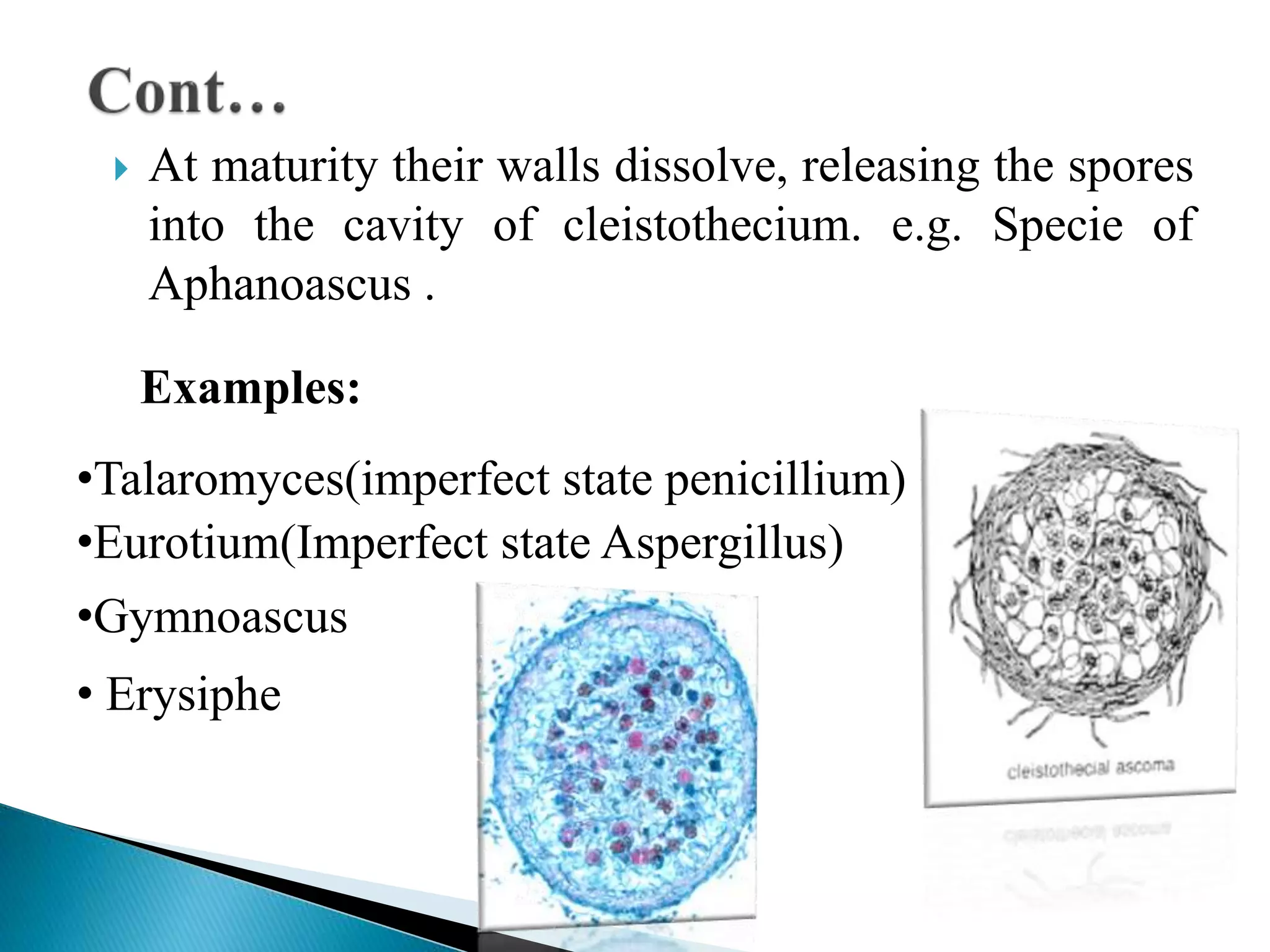
 A cleistothecium is a globose, completely closed fruit
body with no special opening to the outside.
 The asci found inside the ascocarp are found usually
scattered i.e. irregular as in Eurotium or arising in tufts
from the basal region of ascocarp as in Erysiphe.
 The asci are usually globose, broadly oval or pear
shaped and are nearly sessile i.e. without a distinct
stipe.
 Most clistothecia contain asci that are incapable of
shooting their ascospores, known as non-ballistic asci,
tightly enclose their ascospores and are club shaped to
spherical.
 At maturity their walls dissolve, releasing the spores
into the cavity of cleistothecium. e.g. Specie of
Aphanoascus .
•Gymnoascus
•Eurotium(Imperfect state Aspergillus)
•Talaromyces(imperfect state penicillium)
Examples:
• Erysiphe
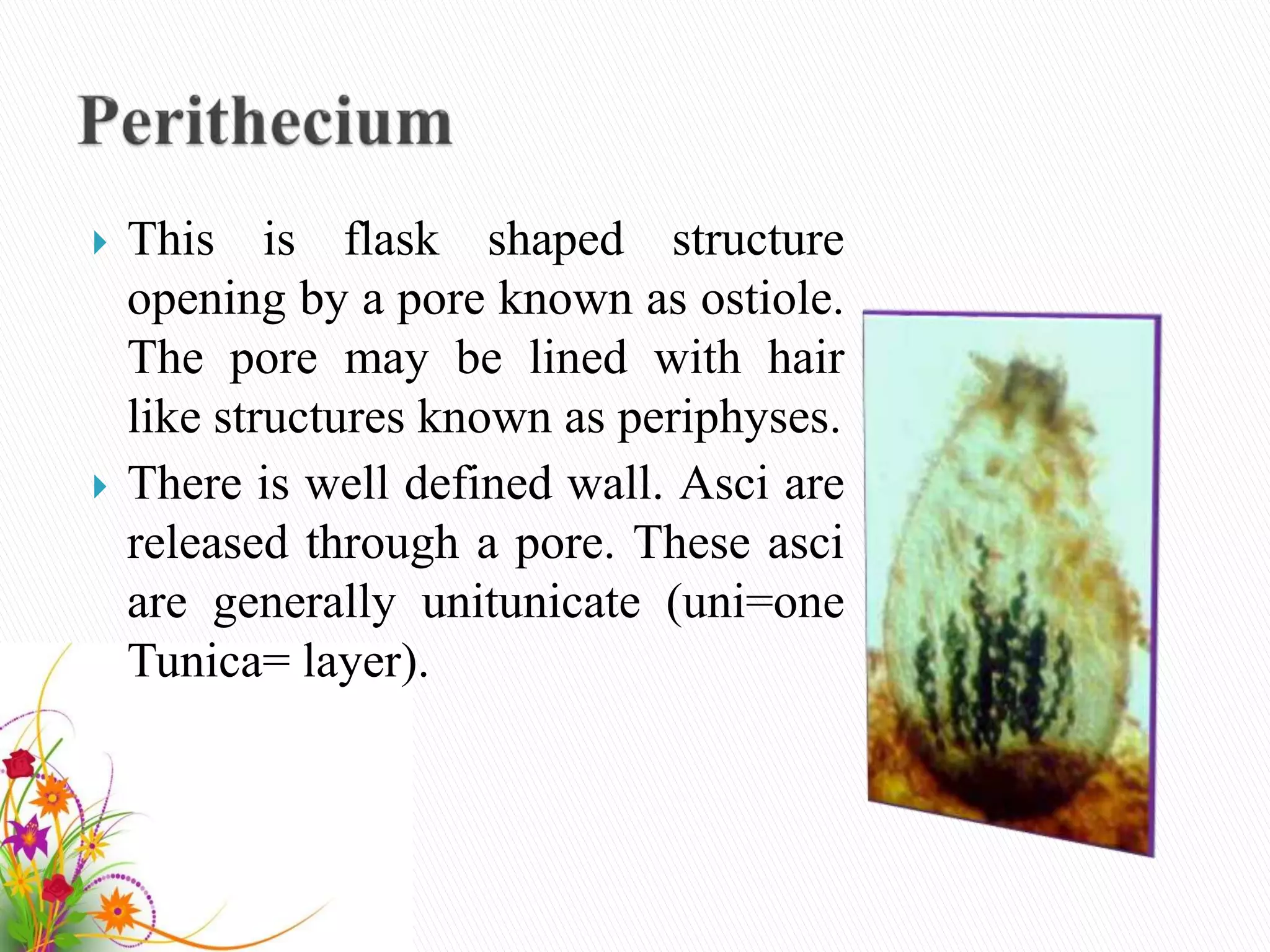
 This is flask shaped structure
opening by a pore known as ostiole.
The pore may be lined with hair
like structures known as periphyses.
 There is well defined wall. Asci are
released through a pore. These asci
are generally unitunicate (uni=one
Tunica= layer).
 In Sordaria humana specie the asci are
produced at the base of perithecium and are
oriented upward toward ostiole.
 In others perithecium is larger and the asci
line in the bottom and the sides of inner walls.
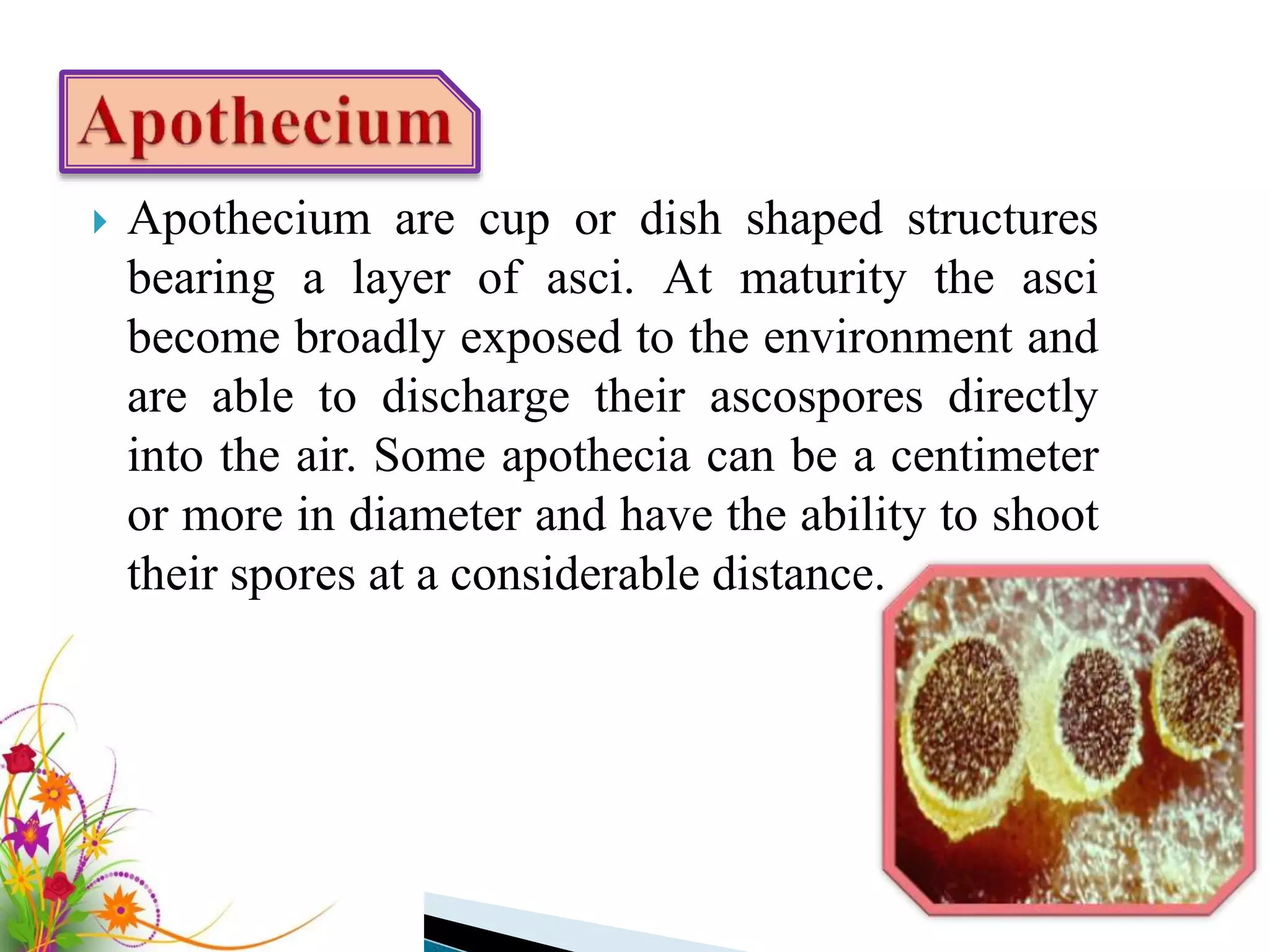
 Apothecium are cup or dish shaped structures
bearing a layer of asci. At maturity the asci
become broadly exposed to the environment and
are able to discharge their ascospores directly
into the air. Some apothecia can be a centimeter
or more in diameter and have the ability to shoot
their spores at a considerable distance.
 In some species a small burst of air such as
blowing gently to will cause a visible smoke of
ascospores to be released.
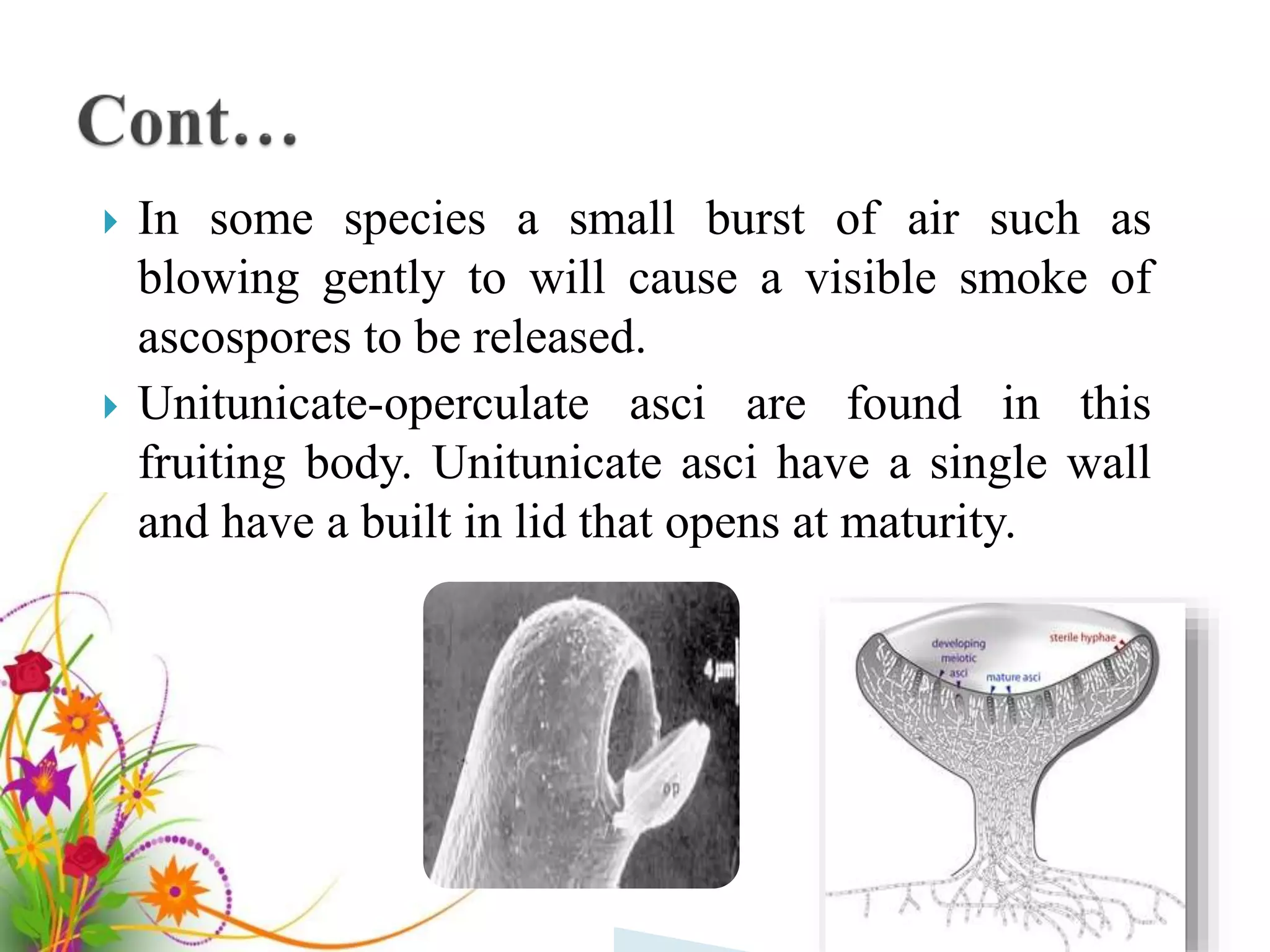
 Unitunicate-operculate asci are found in this
fruiting body. Unitunicate asci have a single wall
and have a built in lid that opens at maturity.
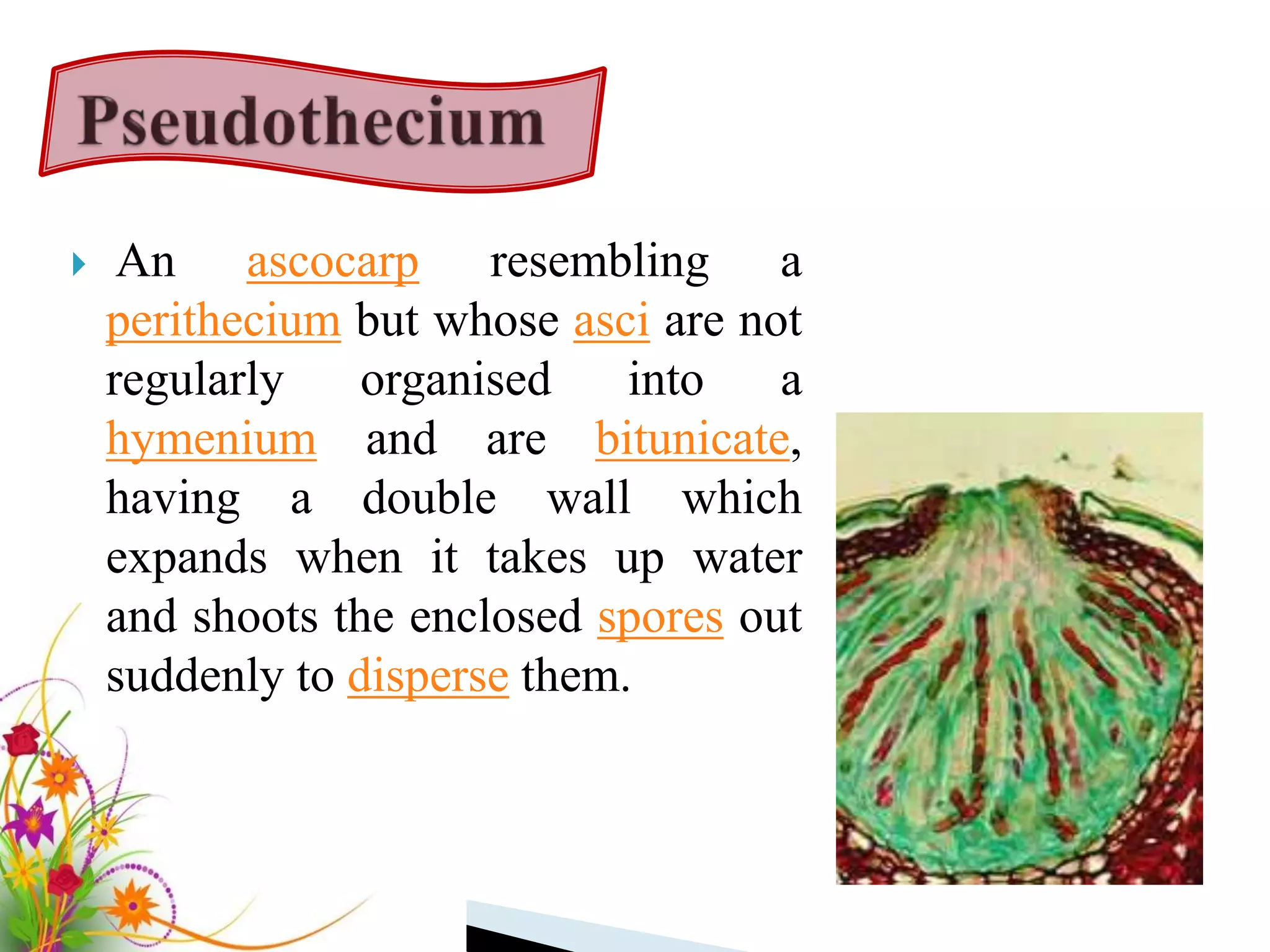
 An ascocarp resembling a
perithecium but whose asci are not
regularly organised into a
hymenium and are bitunicate,
having a double wall which
expands when it takes up water
and shoots the enclosed spores out
suddenly to disperse them.
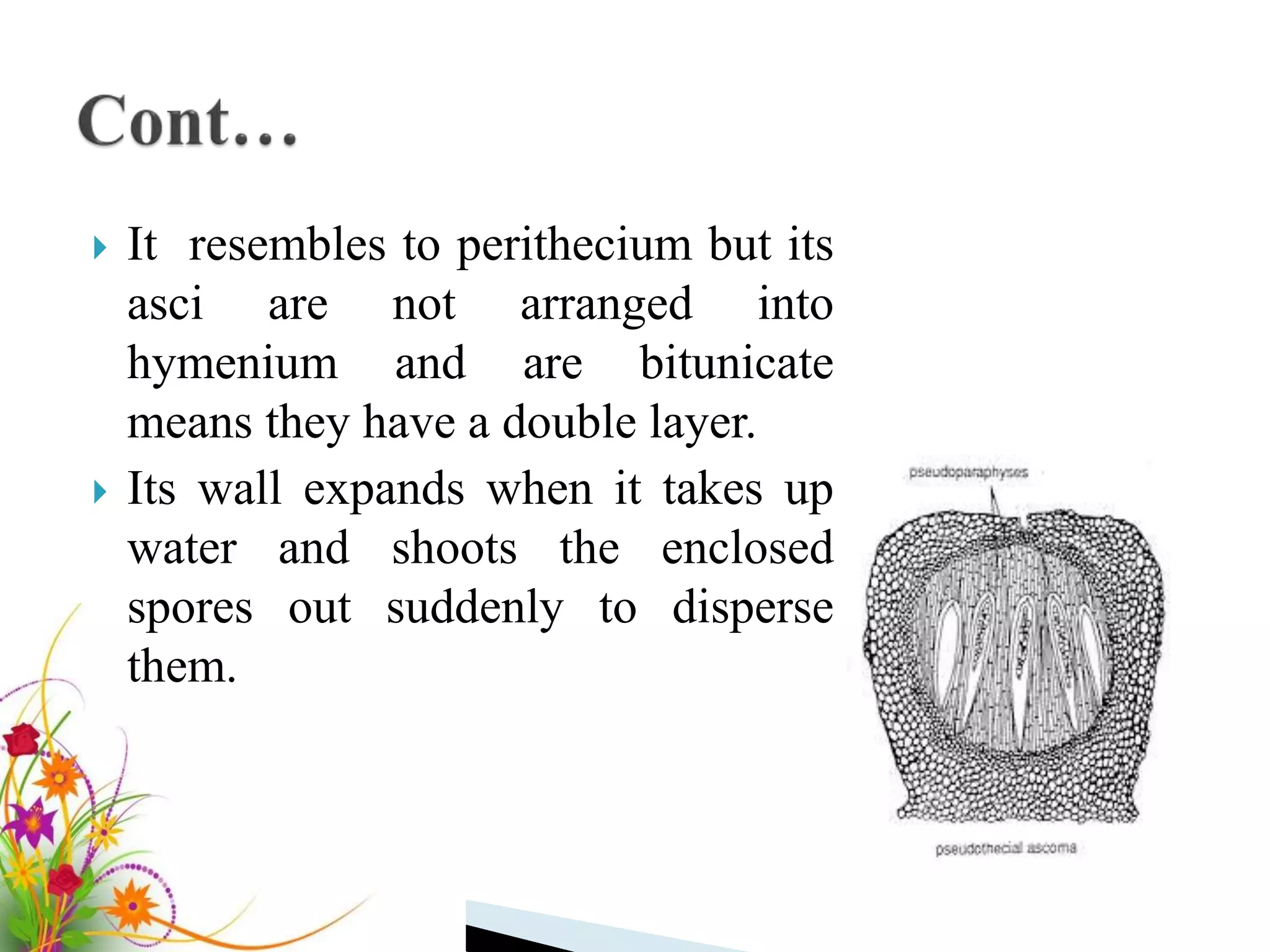
 It resembles to perithecium but its
asci are not arranged into
hymenium and are bitunicate
means they have a double layer.
 Its wall expands when it takes up
water and shoots the enclosed
spores out suddenly to disperse
them.
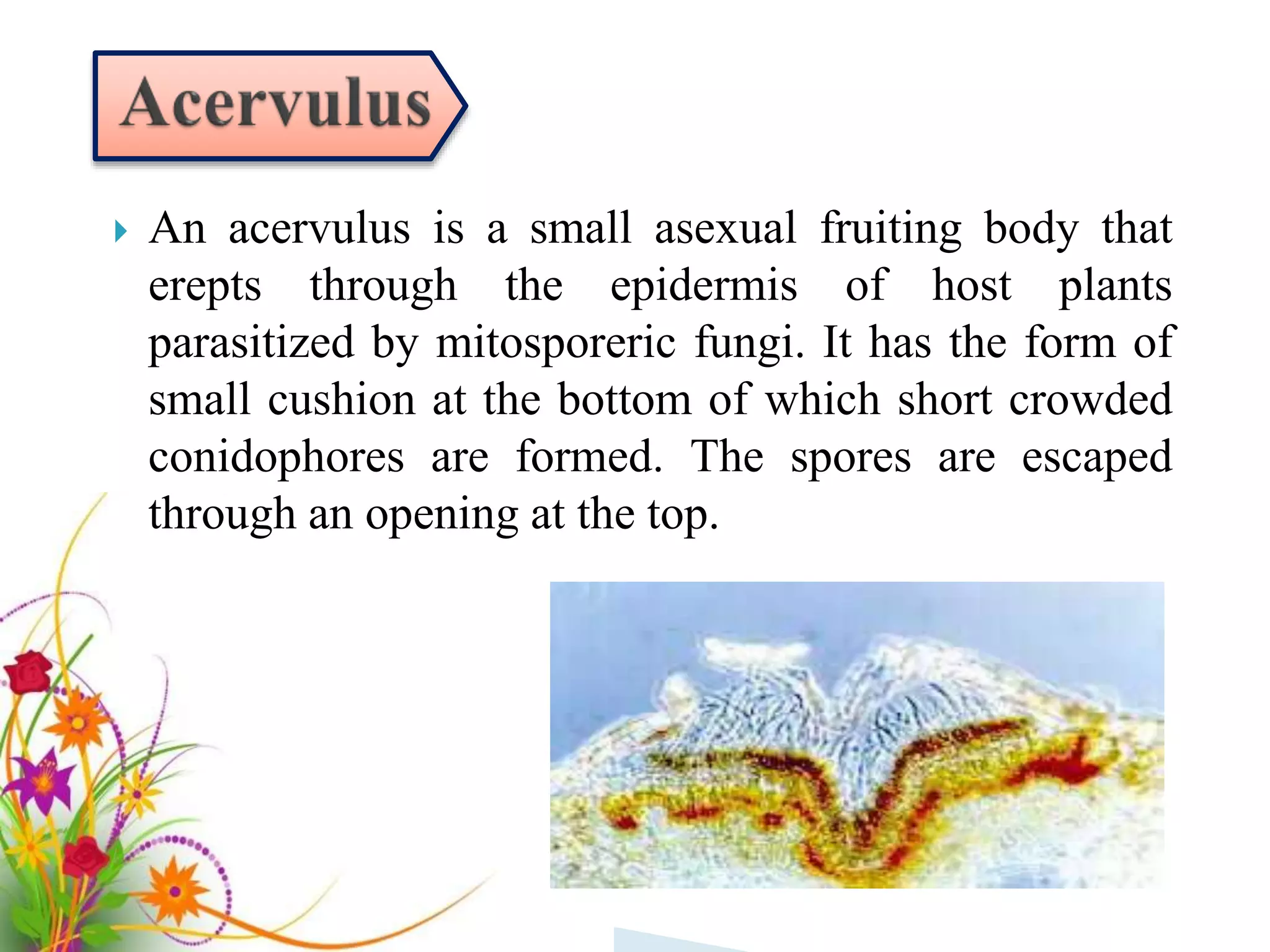
 An acervulus is a small asexual fruiting body that
erepts through the epidermis of host plants
parasitized by mitosporeric fungi. It has the form of
small cushion at the bottom of which short crowded
conidophores are formed. The spores are escaped
through an opening at the top.
 In this masses of conidia are formed under the
skin of host plant and then erupt through the
surface and allows the spores to be distributed
by wind and rain. Under this roof of host
material, fungal hyphae aggregate and form a
flat fertile layer of short conidiophores that
produce many conidia. The pressure of
accumulating conidia, and often of accessory
mucilage, eventually splits the host epidermis
and allows the conidia to escape.
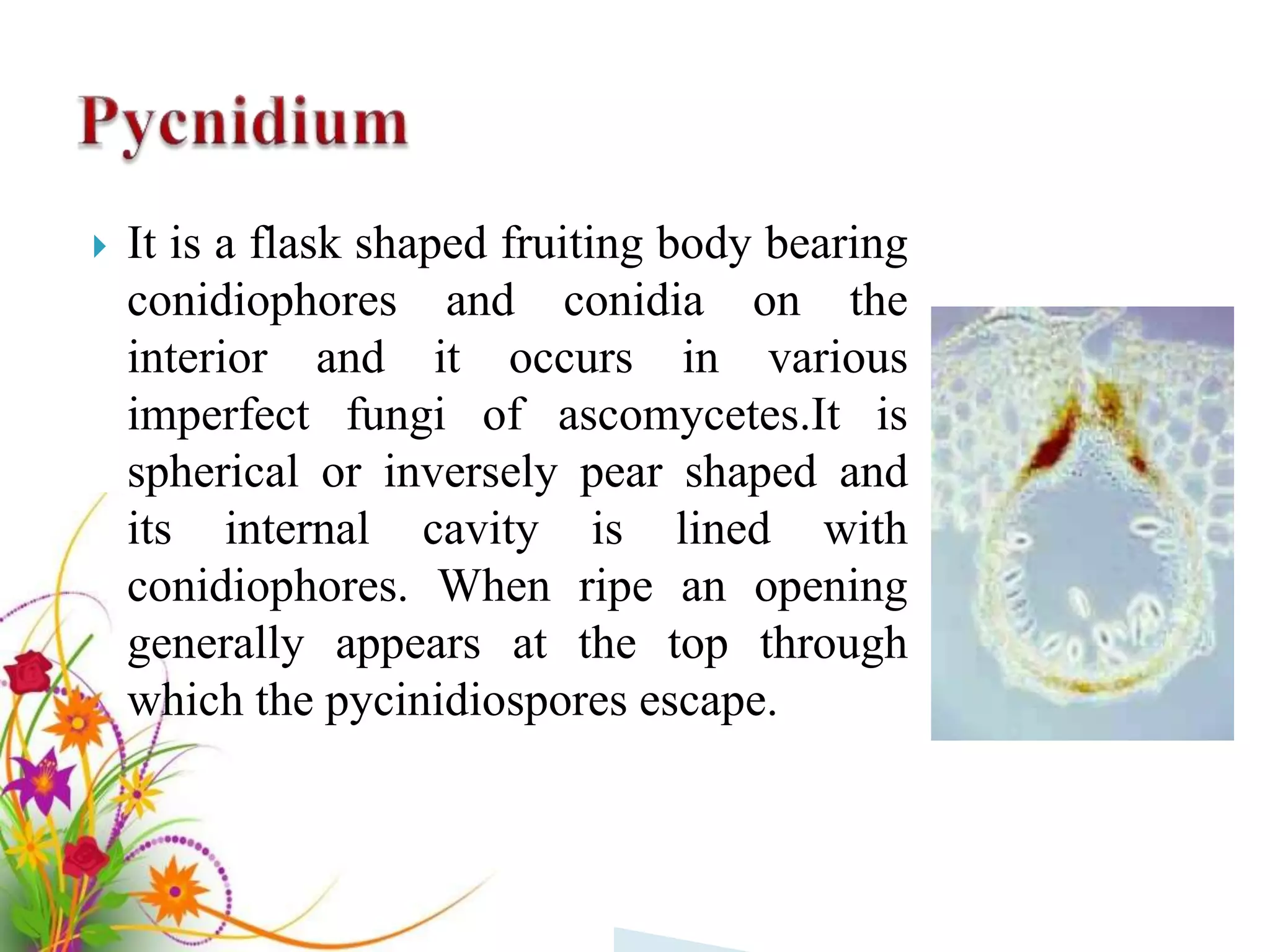
 It is a flask shaped fruiting body bearing
conidiophores and conidia on the
interior and it occurs in various
imperfect fungi of ascomycetes.It is
spherical or inversely pear shaped and
its internal cavity is lined with
conidiophores. When ripe an opening
generally appears at the top through
which the pycinidiospores escape.
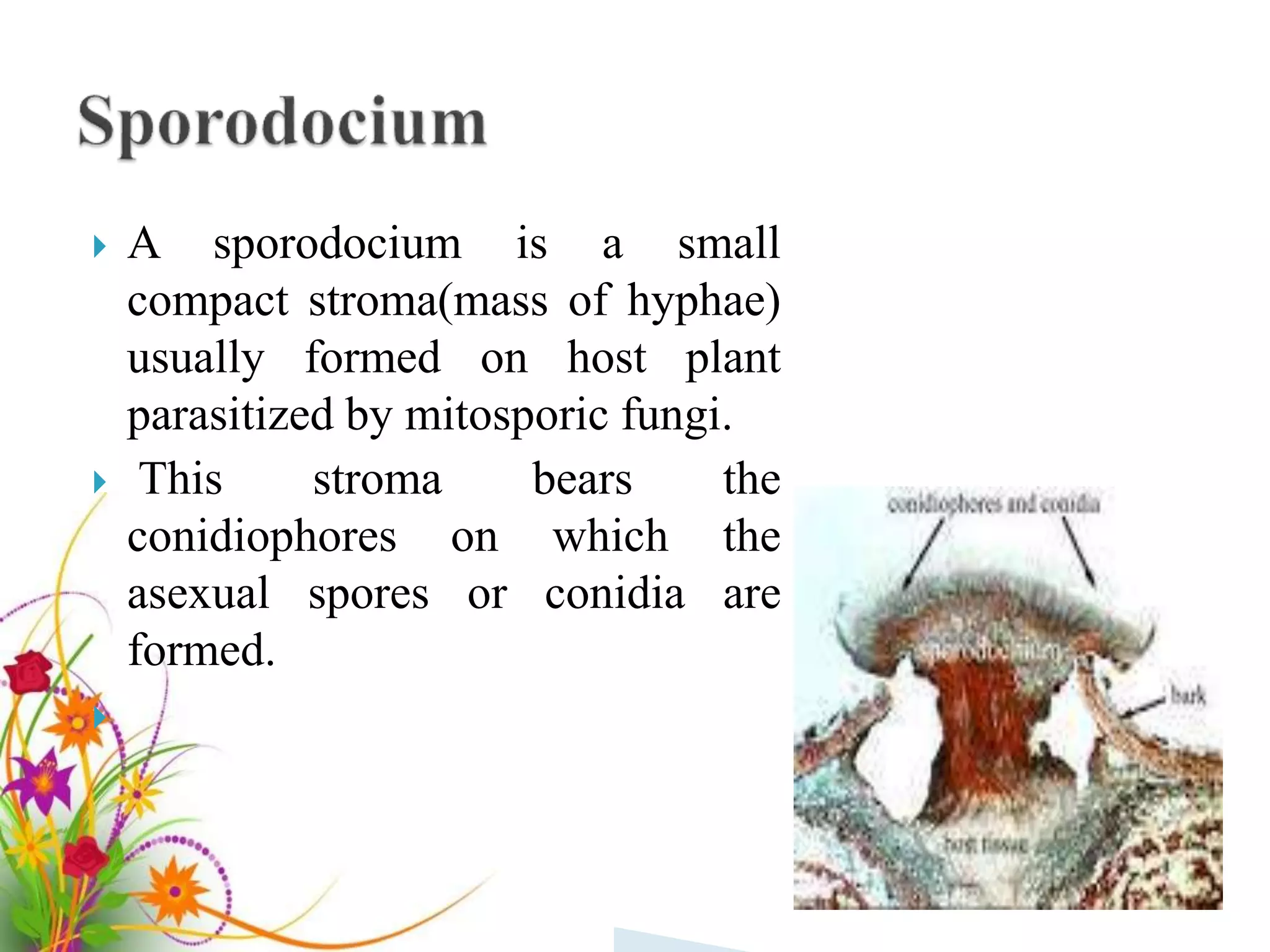
 A sporodocium is a small
compact stroma(mass of hyphae)
usually formed on host plant
parasitized by mitosporic fungi.
 This stroma bears the
conidiophores on which the
asexual spores or conidia are
formed.

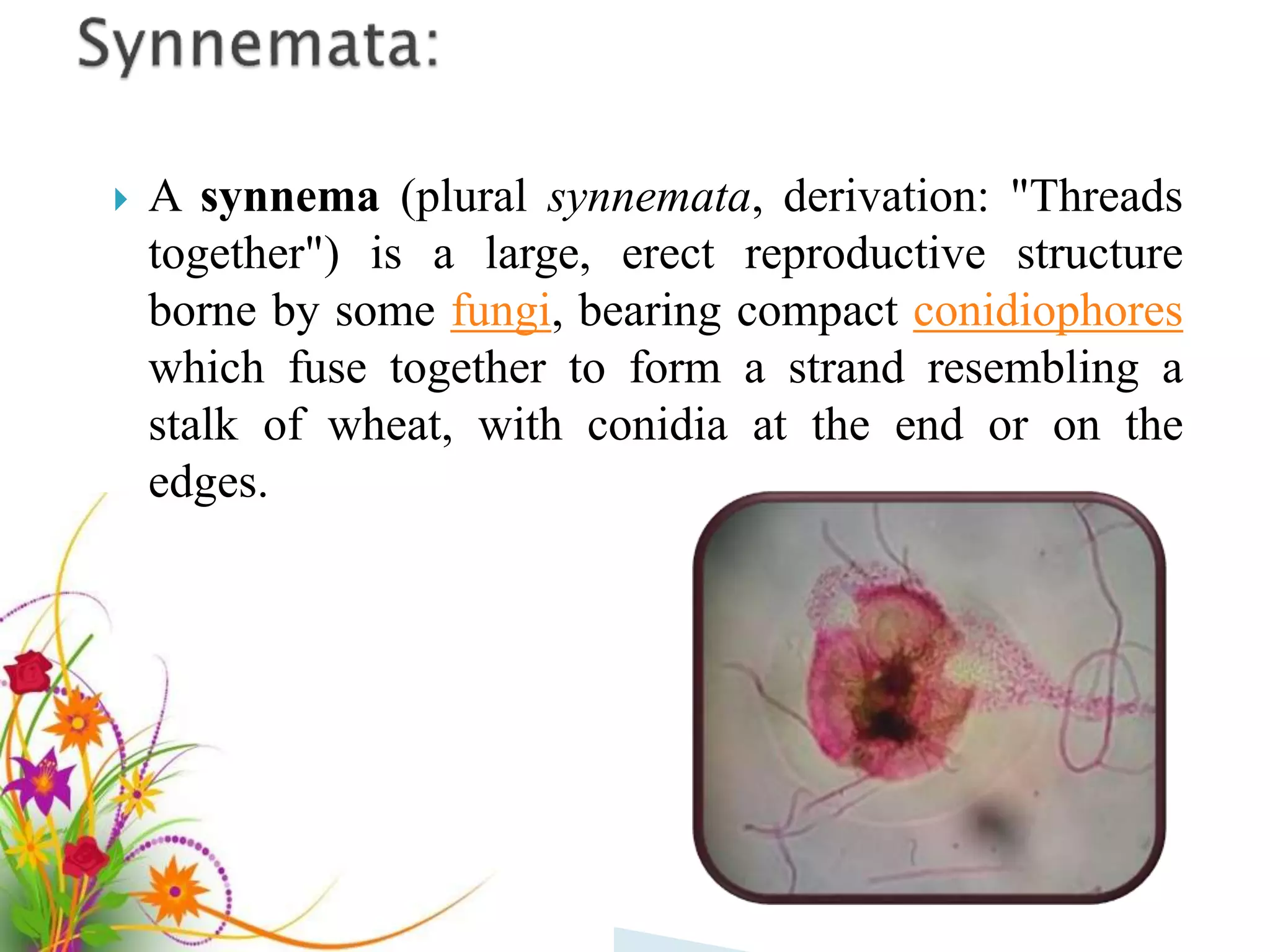
 A synnema (plural synnemata, derivation: "Threads
together") is a large, erect reproductive structure
borne by some fungi, bearing compact conidiophores
which fuse together to form a strand resembling a
stalk of wheat, with conidia at the end or on the
edges.
 The genus Graphium is characterized by the
formation of synnemata which consist of a more or
less compact group of erect conidiophores that are
cemented together, usually splaying out and bearing
conidia at the apex.
 Synnemata are darkly pigmented, erect and occur
solitary or in clusters.
Fruiting bodies of Ascomycota

Fruiting bodies of Ascomycota

  • 1.
    Muhammad Zeeshan Nazar M.PhilAgriculture Entomology mzeeshan_93@yahoo.com
  • 2.
     Fruiting bodyis a multicellular structure in which spores are produced.  In fungi, the sporocarp (also known as fruiting body or fruit body) is a multicellular structure on which spore producing structures, such as asci, are borne.  The fruiting body of an ascomycete is known as ascocarp.  In Ascomycota the asci are found protected inside the fruit body known as ascocarp.
  • 3.
     The mainbody of fungus is made up of fine thread like structures these thread like structures are known as hyphae that group together to form mycelium.  In response to sexual act, the neighboring vegetative hyphae and those growing from the sex organs grow rapidly to become interwoven into a plectenchymatous mass. This mass surrounds the developing asci. The whole structure i.e. the asci and the mass of protective vegetative hyphae develops into an ascocarp.
  • 4.
     The fruitingbody is part of the sexual phase of a fungal life cycle, with the rest of the life cycle being characterized by vegetative mycelial growth and asexual spore production.  Fruit bodies are just like the fruit of fungus as apples are the fruits of apple tree.  Spores produced inside the fruiting body are just like the seeds.
  • 5.
     Fruiting bodiesare termed as epigeous if they grow on the ground. which grow underground are hypogenous fruiting bodies.  Some fungi produce club shaped some produce ball shaped some produce brackets and some produce star shaped fruiting body.  Fruits bodies are also produced in different colors.
  • 6.
     Spores arethe reproductive unit of fungi, analogous to plant seeds. Spores are often the dusty, colored part of a fungus that is easily moved in the wind or in water. Fruiting bodies are fungal structures that contain spores.  These basically protect the seed  Spores are microscopic  Spores are released from fungus body by air wind and rain  when spore falls on suitable surface it germinates
  • 8.
     A cleistotheciumis a globose, completely closed fruit body with no special opening to the outside.  The asci found inside the ascocarp are found usually scattered i.e. irregular as in Eurotium or arising in tufts from the basal region of ascocarp as in Erysiphe.  The asci are usually globose, broadly oval or pear shaped and are nearly sessile i.e. without a distinct stipe.  Most clistothecia contain asci that are incapable of shooting their ascospores, known as non-ballistic asci, tightly enclose their ascospores and are club shaped to spherical.
  • 9.
     At maturitytheir walls dissolve, releasing the spores into the cavity of cleistothecium. e.g. Specie of Aphanoascus . •Gymnoascus •Eurotium(Imperfect state Aspergillus) •Talaromyces(imperfect state penicillium) Examples: • Erysiphe
  • 10.
     This isflask shaped structure opening by a pore known as ostiole. The pore may be lined with hair like structures known as periphyses.  There is well defined wall. Asci are released through a pore. These asci are generally unitunicate (uni=one Tunica= layer).
  • 11.
     In Sordariahumana specie the asci are produced at the base of perithecium and are oriented upward toward ostiole.  In others perithecium is larger and the asci line in the bottom and the sides of inner walls.
  • 12.
     Apothecium arecup or dish shaped structures bearing a layer of asci. At maturity the asci become broadly exposed to the environment and are able to discharge their ascospores directly into the air. Some apothecia can be a centimeter or more in diameter and have the ability to shoot their spores at a considerable distance.
  • 13.
     In somespecies a small burst of air such as blowing gently to will cause a visible smoke of ascospores to be released.  Unitunicate-operculate asci are found in this fruiting body. Unitunicate asci have a single wall and have a built in lid that opens at maturity.
  • 14.
     An ascocarpresembling a perithecium but whose asci are not regularly organised into a hymenium and are bitunicate, having a double wall which expands when it takes up water and shoots the enclosed spores out suddenly to disperse them.
  • 15.
     It resemblesto perithecium but its asci are not arranged into hymenium and are bitunicate means they have a double layer.  Its wall expands when it takes up water and shoots the enclosed spores out suddenly to disperse them.
  • 17.
     An acervulusis a small asexual fruiting body that erepts through the epidermis of host plants parasitized by mitosporeric fungi. It has the form of small cushion at the bottom of which short crowded conidophores are formed. The spores are escaped through an opening at the top.
  • 18.
     In thismasses of conidia are formed under the skin of host plant and then erupt through the surface and allows the spores to be distributed by wind and rain. Under this roof of host material, fungal hyphae aggregate and form a flat fertile layer of short conidiophores that produce many conidia. The pressure of accumulating conidia, and often of accessory mucilage, eventually splits the host epidermis and allows the conidia to escape.
  • 19.
     It isa flask shaped fruiting body bearing conidiophores and conidia on the interior and it occurs in various imperfect fungi of ascomycetes.It is spherical or inversely pear shaped and its internal cavity is lined with conidiophores. When ripe an opening generally appears at the top through which the pycinidiospores escape.
  • 20.
     A sporodociumis a small compact stroma(mass of hyphae) usually formed on host plant parasitized by mitosporic fungi.  This stroma bears the conidiophores on which the asexual spores or conidia are formed. 
  • 21.
     A synnema(plural synnemata, derivation: "Threads together") is a large, erect reproductive structure borne by some fungi, bearing compact conidiophores which fuse together to form a strand resembling a stalk of wheat, with conidia at the end or on the edges.
  • 22.
     The genusGraphium is characterized by the formation of synnemata which consist of a more or less compact group of erect conidiophores that are cemented together, usually splaying out and bearing conidia at the apex.  Synnemata are darkly pigmented, erect and occur solitary or in clusters.