Ecdysone Receptor Agonists
Department of Agriculture Entomology Bahauddin Zakariya University, Multan
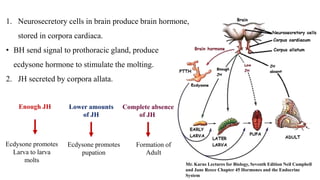
1. Neurosecretory cells in brain produce brain hormone,
stored in corpora cardiaca.
• BH send signal to prothoracic gland, produce
ecdysone hormone to stimulate the molting.
2. JH secreted by corpora allata.
Enough JH
Ecdysone promotes
Larva to larva
molts
Lower amounts
of JH
Ecdysone promotes
pupation
Complete absence
of JH
Formation of
Adult
Mr. Karns Lectures for Biology, Seventh Edition Neil Campbell
and Jane Reece Chapter 45 Hormones and the Endocrine
System
• 20-hydroxyecdysone is ecdysteroid hormone which controls the
ecdysis, insects reproduction, including ovarian development and
oogenesis .
• Synthesized from cholesterol or phytosteroids, obtain from its diet.
• The concentration of ecdysone in haemolymph increases at the time of
molting and then falls rapidly.
• 20-hydroxyecdysone bind to the ecdysteroid receptor.
Diacylhydrazines
 Tebufenozide
 Halofenozide
 Methoxyfenozide
• Methoxyfenozide selectively targets against lepidopterans pest.
• Halofenozide and tebufenozide effective against dipterans larvae.
• Stomach and contact poison.
• Low impact on most beneficial insects.
Examples
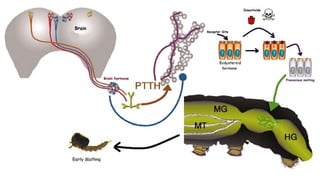
• Plays an important role in insects controlling development, metamorphosis,
reproduction and behavior.
• These agonist mimic the action of insect molting hormone 20E.
• Application of ecdysone agonists is effective only when concentration of
ecdysone in insects are low.
Mode of Action
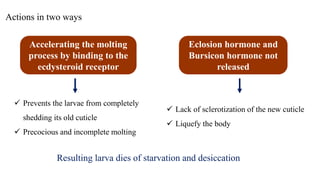
Accelerating the molting
process by binding to the
ecdysteroid receptor
Eclosion hormone and
Bursicon hormone not
released
 Lack of sclerotization of the new cuticle
 Liquefy the body
 Prevents the larvae from completely
shedding its old cuticle
 Precocious and incomplete molting
Resulting larva dies of starvation and desiccation
Actions in two ways
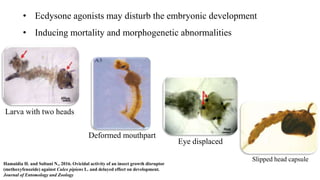
• Ecdysone agonists may disturb the embryonic development
• Inducing mortality and morphogenetic abnormalities
Larva with two heads
Eye displaced
Deformed mouthpart
Slipped head capsule
Hamaidia H. and Soltani N., 2016. Ovicidal activity of an insect growth disruptor
(methoxyfenozide) against Culex pipiens L. and delayed effect on development.
Journal of Entomology and Zoology
Ecdysone Receptor Agonists

Ecdysone Receptor Agonists

  • 1.
    Ecdysone Receptor Agonists Departmentof Agriculture Entomology Bahauddin Zakariya University, Multan
  • 2.
    1. Neurosecretory cellsin brain produce brain hormone, stored in corpora cardiaca. • BH send signal to prothoracic gland, produce ecdysone hormone to stimulate the molting. 2. JH secreted by corpora allata. Enough JH Ecdysone promotes Larva to larva molts Lower amounts of JH Ecdysone promotes pupation Complete absence of JH Formation of Adult Mr. Karns Lectures for Biology, Seventh Edition Neil Campbell and Jane Reece Chapter 45 Hormones and the Endocrine System
  • 3.
    • 20-hydroxyecdysone isecdysteroid hormone which controls the ecdysis, insects reproduction, including ovarian development and oogenesis . • Synthesized from cholesterol or phytosteroids, obtain from its diet. • The concentration of ecdysone in haemolymph increases at the time of molting and then falls rapidly. • 20-hydroxyecdysone bind to the ecdysteroid receptor.
  • 4.
    Diacylhydrazines  Tebufenozide  Halofenozide Methoxyfenozide • Methoxyfenozide selectively targets against lepidopterans pest. • Halofenozide and tebufenozide effective against dipterans larvae. • Stomach and contact poison. • Low impact on most beneficial insects. Examples
  • 5.
    • Plays animportant role in insects controlling development, metamorphosis, reproduction and behavior. • These agonist mimic the action of insect molting hormone 20E. • Application of ecdysone agonists is effective only when concentration of ecdysone in insects are low. Mode of Action
  • 7.
    Accelerating the molting processby binding to the ecdysteroid receptor Eclosion hormone and Bursicon hormone not released  Lack of sclerotization of the new cuticle  Liquefy the body  Prevents the larvae from completely shedding its old cuticle  Precocious and incomplete molting Resulting larva dies of starvation and desiccation Actions in two ways
  • 8.
    • Ecdysone agonistsmay disturb the embryonic development • Inducing mortality and morphogenetic abnormalities Larva with two heads Eye displaced Deformed mouthpart Slipped head capsule Hamaidia H. and Soltani N., 2016. Ovicidal activity of an insect growth disruptor (methoxyfenozide) against Culex pipiens L. and delayed effect on development. Journal of Entomology and Zoology