Propagation Methods in
Plants
• Plant Propagation:
Definition:
Plant propagation can be defined as controlled
reproduction of a plant by a man in order to
perpetuate a selected individuals, or group of
individuals which is having specific values to
him.
There are Two Method of Propagation:
• 1. Sexual Propagation
• 2. Asexual Propaga
Sexual Propagation in
Plants
• Multiplication of plants by using seed
is called as sexual propagation.
Advantages:
1. The plant raised by seed is planted lived.
2. They are hardy with deep root system. So they are vigorous in
growth.
3. The possibility is there to obtain change in seedling, the
performance of which are better than their parents. E.g. mango
variety.
4. The polyembryony. The phenomenon of propagation of more
than one seedling from a single seed, produce true to type,
nuclear embryonic seedling which could be used as rootstock for
uniform performance. E.g. Mango, varieties. It is also common in
citrus and jamun.
5. Seed propagation is necessary when vegetative
propagation is unsuccessful or expenses e.g.
papaya, coconut and Areca nut.
7. Roots stocks are usually raised by seed e.g.
8. When seedling is required in large number, seed
propagation is the only easy mean e.g. Dry land
fruit, and Forest spp.
Disadvantages:
1. When progenies are not true type and so they become
inferior because in the commercial orchard, it is
necessary to have uniform quality, growth and yielding
capacities.
2. Choice tree or any hybrid trees cannot be perpetuated true
to type by seed. (except in Apomixes )
3. Seedling has a long juvenile period. In crops like citrus,
coca, and rubber. The seeds must be sown afresh. i.e.
immediately after extraction. Many varieties are seedless.
4. Seeds loose its viability in short period
Seed Germination and Seed
Propagation:
• Seed propagation is necessary in the
following cases:
i) Where vegetative propagation is
unsuccessful or difficult or expensive.
• ii) It is necessary for raising rootstock
for grafting and budding.
• In all such cases rootstock plants have
to be raised through seeds mostly
Seed Formation and Maturity:
• Seed develops along with the fruit
and reaches, full size and maturity
when the fruit ripens. Hence seed
should be extracted only from ripe
fruit. Seeds gathered from immature
fruit may not germinate to under
favorable conditions and may loose
viability more quickly than fully
matured seeds
Dormancy:
• It is term used to describe a seed that
will not germinate because of any
condition associated either with the
seed itself or with existing
environmental factors such as
temperature and moisture.
• Some seeds may even germinate within
the fruit, e.g. Jack, avocado, chow-
chow, papaya, called as Viviparous
germination.
Seed viability and longevity:
• Viability means the presence of life in
the seed. Longevity refers to the
length of time that seeds will retain
their viability viability. Some seeds
are short lived. (Citrus).
Pre – germination Seed
Treatment:
1. Chemical (Acid scarification):
The purpose is to modify hard or important or
impermeable seed covering generally soaking
seed in concentrated sulphuric acid is an
effective method. The time of treatment may
vary from 10 minutes to 6 hour according to
species. After treatment seeds are thoroughly
washed in clean water to make them free of
acid and then re sown immediately. i.e. the
seeds of ber, cotton, Asparagus are treated with
50% concentrated H2so4. The seeds are
soaked in acid for 3 to 5 minutes.
2.Mechanical(Scarification):
• Seeds of a few species with
impermeable seed coat. i.e. hard
seed coat can be rendered
permeable to water and gases their
germination is greatly improved by
mechanical scarification in taking
care that seeds should be injured not
be injured heavily. This can be
achieved by
3. Seedling (Boiled Water
Treatment):
• Pouring boiling water over seeds and
getting it to cool gradually for about
12 to 24 Hour to soften dry
and hard shelled seeds. E.g. Coffee,
This will hasten the process of
germination.
4. Soaking in Water:
• The purpose of soaking seeds in
water is to modify hard seed coats,
to remove inhibitors to soften seed
and to reduce the time of
germination. The time of soaking
seeds in cold water depend upon the
hardness of the seed coat. E. g peas,
beans, acassia tree etc.
5. Stratification (Moist Chilling):
• Seed of many woody trees or shrubs
are exposed to low temperature to
bring about prompt and uniform
germination. Stratification.
Stratification has some benefit in
softening the seed coats. The seeds are
arranged in alternate layers of sand in
shallow boxes for pits or trenches. This
condition helps in rapid germination
peach cherry, plum, oat, grapes.
Asexual Propagation in Plants
• Asexual propagation or vegetative
propagation refers to the
multiplication or perpetuation of any
plant from any vegetative parts as
plant other then the seed.
Advantages of Vegetative Propagation:
• 1. The progenies are true to type like
mother plant.
• 2. Vegetative propagation is the only
alternate where no seed is formed or
germination of seed is very slow or
no viable seed is formed. (e.g.
Banana, Pine apple and roses,
seedless grape ).
• 3. Certain rootstock has the capacity
of resisting or tolerating the adverse
environment factors such as frost and
adverse soil factors like salinity or
alkalinity. E.g. frost resistance,
foncirus trifoliate (Trifoliate orange ).
Rangpur lime.
• 4. The ability of certain rootstock to
resistant pest and diseases can be
advantageously expected. An apple
when grafted on rootstock like Merton
778,793 is resistant for wholly aphid.
5. Vegative propagated plants are
generally dwarfed in nature than the
seedlings. Dwarf trees facilitate pruning
spraying and harvesting easy seedling.
Dwarf trees facilate pruning, spraying and
harvesting easy and more number of
plants can be accommodated in a unit
area.
6. To replant an undesirable existing tree
either with reference to its quality or
susceptibility to pests and diseases. The
defect can be overcome easily by
vegetative propagation through grafting
or budding of desirable scion to the
existence tree by top working technique.
7. Many plants are propagated by
vegetative means because of the
speedy easy of multiplication.
8. Novelty can be developed by grafting
or budding on single plant many
varieties. E.g. Roses.
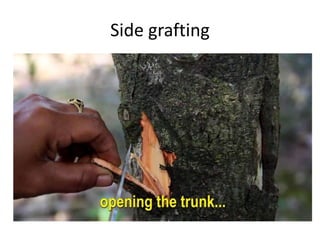
9. To convert inferior varieties in
superior, side grafting in mango.
Disadvantages:
• 1. Plant is not vigorous and long
lived.
• 2. No new varieties are evolved or
developed.
• 3. These methods are expensive and
labourious and time consuming.
Plant Propagation by Cottage
Definition:
“Cottage is a method of asexual propagation in which a portion
of any Vegegative part such as stem, leaf or root is cut from
the parent plant and is placed under favorable environmental
condition to form roots and shoots, thus producing a new
independent plant.”
A) Stem Cutting:
• This is the most important type of cutting and can be divide
into three types based on the nature of the wood used in
marketing the cutting.
i) Hard wood cutting
ii) Semi- hard wood cutting
iii) Soft- wood cutting.
In propagated by stem cuttings, segment of shoots containg
lateral or terminal buds handled under proper condition to
develop adventitious roots and form independent palnts.
Plant Propagation by Layering
Definition:
• Layering is the development of roots
on a stem while it is still attached to
the parent plant. The rooted stem is
stem is then detached to become a
new plant growing on its own roots.
Thus rooted stem stem is known as
layer.
Root Formation During Layering is
Stimulated by Various Stem
Treatments:
1. Bending of shoots to a sharp V
shape.
2. Giving a cut or incision of the lower
surface of the shoot.
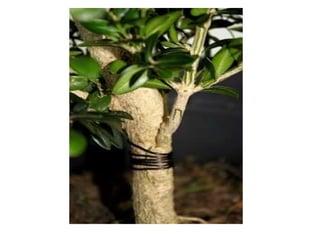
3. Girdling/ by removing a ring of bark
or by wrapping copper wire around
stem.
Methods:
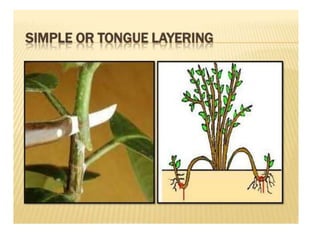
A) Simple Layering or Tongue Layering:
• In this method a branch is bent to the
ground and some portion of it, is
covered by soil leaving the terminal and
of the branch exposed. Root initiation
takes place at the buried portion. After
the root initiation. i.e. after allowing
sufficient time the layer is separated
from the mother plant by cutting the
layered shoot. E.g. Guava, jasmine,
etc.
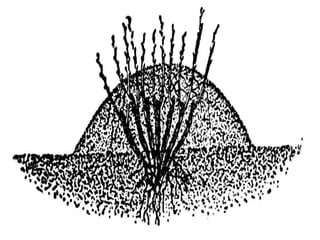
C) Mound Stool Layering:
• In this method a plant is cut back at
the ground during the dormant
season, and soil is covered at the
base of the newly developing shoots.
After allowing sufficient time for root
initiation, the rooted shoots are
separated and taken as individual
layers.
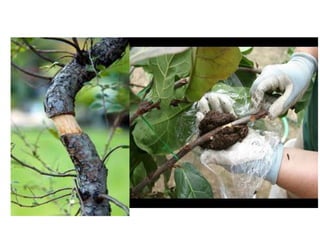
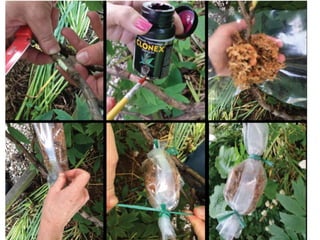
D) Air Layering:
• In air layering, roots, from on an
aerial shoots. The rooting medium
will be tied to the shoots for getting
root initiation. Best rooting medium
for air layering is sphagnum- moss
as it holds large amounts of water so
as to supply moisture to the layered
shoot till proper root initiation takes
place, (Pomegranate , fig )
Grafting
Definition:
• Grafting and budding is a art joining two
different plant parts together, in such a
manner that they unites and continues their
growth as simple plant. In case of building
single bud is inserted in to the stock, where
as in grafting a bud stick consisting two or
more buds is inserted in to the stock.
• Stock is a lower portion of the graft union,
where as, scion is the upper portion a place
at which both unites is termed as scion or
graft union.
Graft Incompatibility:
• The ability of two different plants
when grafted together to produce a
successful union and also to develop
satiory into one composted plant is
termed as ‘Compatibility’. The
inability of two different plants to do
so when grafted together as often
defined as ‘incompatibility” of graft
Symptoms of Incompatibility:
Graft union malformation resulting
incompatibility usually expresses the
following external symptoms viz.
1. Failure to from a successful graft or bud
union with a high percentage of success.
2. Yellowing of leaves in the latter part of
the growing season followed by early
defoliation accompanied by decline in
vegetative growth. Appearance of shoot
dies back and general in health of the tree.
3. Premature death of the trees which may live
only a year or two in the nursery.
4. Marked difference in the growth rate or
vigour of scion and stock.
5. over growth at, above or below the graft
union.
Incompatibility has been ensured in swat
oranges. Cv. Mosabi when grafted on trifoliate
orange. (Citrus maxima).
Methods of Grafting
• There are several techniques of
grafting followed in different plants,
suitable in different situation.
Adoption of any suitable technique
facilities, sources available etc.
A) Scion Attached Methods:
• These are the methods of grafting where in the
scion is kept attached to the mother plant till
the graft union takes place and then the graft is
separated in stage taking cuts on scion below
the graft union and on root stock above the
graft union. This principle is followed in
following methods:
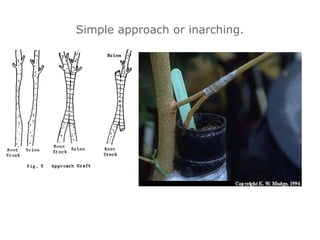
i) Simple approach or inarching.
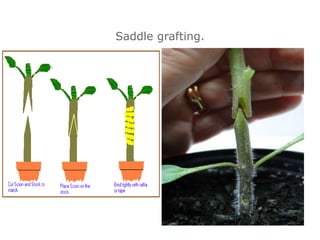
ii) Saddle grafting.
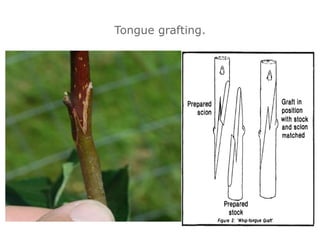
iii) Tongue grafting.
Simple approach or inarching.
Saddle grafting.
Tongue grafting.
B) Scion Detached Methods:
These are the grafting methods where in the
scion is first detached from mother plan then
inserted in to root stock so as the union takes
place and combination continues to grow.
These methods are:
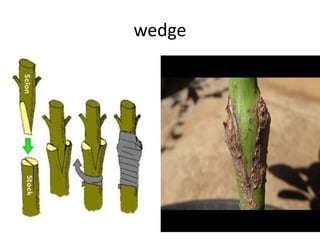
ii) Wedge grafting.
iii) Saddle grafting.
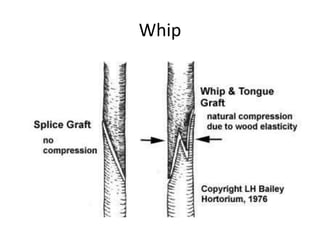
iv) Whip and tongue grafting.
v) Whip grafting.
Vi) Softwood grafting.
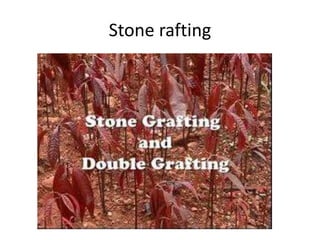
vi) Stone grafting.
wedge
Whip
Stone rafting
C) Methods of Grafting on Established
Trees:
• Methods which can be successfully
adopted to convert the inferior
established plants in to the superior
or desired one. These are
• i) Side grafting
ii) Crown grafting
iii) Top working.
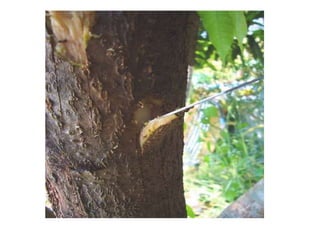
Side grafting
Budding
• Budding is the vegetative method of plant
propagation and can be defined as “ an art
of insertion of a single mature bud in to the
stem of the rootstock in such way that the
union takes place and the combination
continues to grow. It is grafting of a single
individual bud instead of whole bud stick on
scion as in done in case of grafting.
• There are several techniques or methods of
insertion of bud in to the root stock. The
adoption of any of the methods like grafting
depends upon the plants to be budded,
situation, facilities and source available etc.
Different Techniques of Methods of
Budding:
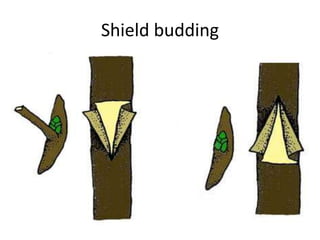
• I) Shield Budding:
• This is the methods of budding in
which a single bud with a little wood
or without wood is taken but from
the scion plant and is given a shape
of ‘shield ‘before it is inserted into
the root stock. It is done in following
three ways: shield budding by ‘ T’
methods
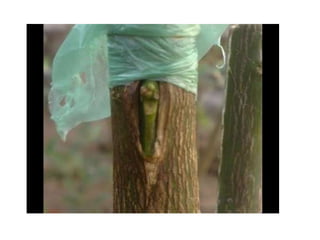
Shield budding
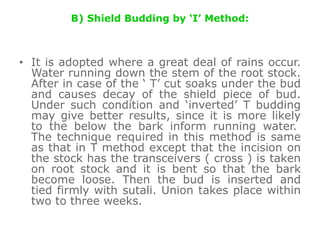
B) Shield Budding by ‘I’ Method:
• It is adopted where a great deal of rains occur.
Water running down the stem of the root stock.
After in case of the ‘ T’ cut soaks under the bud
and causes decay of the shield piece of bud.
Under such condition and ‘inverted’ T budding
may give better results, since it is more likely
to the below the bark inform running water.
The technique required in this method is same
as that in T method except that the incision on
the stock has the transceivers ( cross ) is taken
on root stock and it is bent so that the bark
become loose. Then the bud is inserted and
tied firmly with sutali. Union takes place within
two to three weeks.
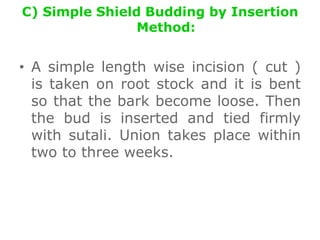
C) Simple Shield Budding by Insertion
Method:
• A simple length wise incision ( cut )
is taken on root stock and it is bent
so that the bark become loose. Then
the bud is inserted and tied firmly
with sutali. Union takes place within
two to three weeks.
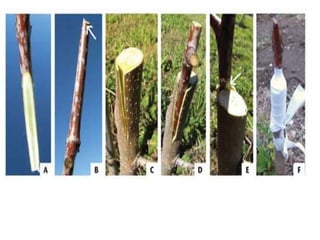
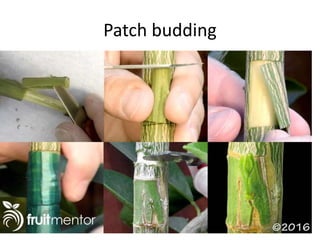
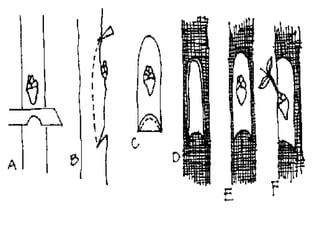
II) Patch Budding: (Mango):
• Patch budding is somewhat slower and
more difficult to perform than T budding.
But is widely and successfully used on the
plants which got thick bark. The patch of
bark is removed from the stem of the root
stock. Then the patch of bud of exactly the
same size is removed from the bud stock
taken from desired tree and fitted on the
root stock exposed area. Polythene film is
tied to protect same. Separating and
October are considerable to rather most
suitable months for patch budding in
mango.
Patch budding
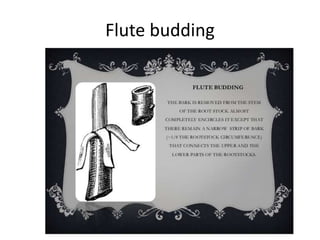
III) Flute Budding:
• This method makes use of the ring of tissues adjoin
the bud relatively thick barked tree thicker than 1 cm.
and in active stage of are commonly budded by this
method. It is successfully used in Cashew nut trees.
• On the bark of root stock two horizontal cuts about ‘1
½ to 2’ apart are made to the extent of about 3/ 4 of
the diameter of the stem. Vertical cuts connecting the
horizontals cuts at both the ends are mode and semi
circular bark is removed. The scion is prepared by
repeating the same methods on the bud stack and the
bud accompanying with flute of bark is placed against
the corresponding cut portion of the stock. After this
typing is attended in usual ways. All other operation
are also similar to those in shield budding.
Flute budding
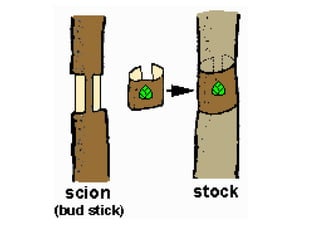
IV) Ring Budding:
• The nature and method rendered its usefulness only
to small stocks of not more than ¾ to 1 diameter. This
is more or less an extension of flute method. Budding
operation is performed when the plant is in sap
flowing condition. A complete (1 ½ to 2) ring of bark
is removed around the stem of the stock in order to
from matrix. A complete ring of bark of the same with
a prominent, plumy, healthy bud is removed from bud
stick when placed on stock; it extends all around the
stock. After placing the ring in position typing is done
in usual manner, failure of the bud to unite, result in
loss of terminal portion of stock above the ringed
portion.
Propagation methods in plants

Propagation methods in plants

  • 1.
  • 2.
    • Plant Propagation: Definition: Plantpropagation can be defined as controlled reproduction of a plant by a man in order to perpetuate a selected individuals, or group of individuals which is having specific values to him. There are Two Method of Propagation: • 1. Sexual Propagation • 2. Asexual Propaga
  • 3.
    Sexual Propagation in Plants •Multiplication of plants by using seed is called as sexual propagation.
  • 4.
    Advantages: 1. The plantraised by seed is planted lived. 2. They are hardy with deep root system. So they are vigorous in growth. 3. The possibility is there to obtain change in seedling, the performance of which are better than their parents. E.g. mango variety. 4. The polyembryony. The phenomenon of propagation of more than one seedling from a single seed, produce true to type, nuclear embryonic seedling which could be used as rootstock for uniform performance. E.g. Mango, varieties. It is also common in citrus and jamun.
  • 5.
    5. Seed propagationis necessary when vegetative propagation is unsuccessful or expenses e.g. papaya, coconut and Areca nut. 7. Roots stocks are usually raised by seed e.g. 8. When seedling is required in large number, seed propagation is the only easy mean e.g. Dry land fruit, and Forest spp.
  • 6.
    Disadvantages: 1. When progeniesare not true type and so they become inferior because in the commercial orchard, it is necessary to have uniform quality, growth and yielding capacities. 2. Choice tree or any hybrid trees cannot be perpetuated true to type by seed. (except in Apomixes ) 3. Seedling has a long juvenile period. In crops like citrus, coca, and rubber. The seeds must be sown afresh. i.e. immediately after extraction. Many varieties are seedless. 4. Seeds loose its viability in short period
  • 7.
    Seed Germination andSeed Propagation: • Seed propagation is necessary in the following cases: i) Where vegetative propagation is unsuccessful or difficult or expensive. • ii) It is necessary for raising rootstock for grafting and budding. • In all such cases rootstock plants have to be raised through seeds mostly
  • 8.
    Seed Formation andMaturity: • Seed develops along with the fruit and reaches, full size and maturity when the fruit ripens. Hence seed should be extracted only from ripe fruit. Seeds gathered from immature fruit may not germinate to under favorable conditions and may loose viability more quickly than fully matured seeds
  • 9.
    Dormancy: • It isterm used to describe a seed that will not germinate because of any condition associated either with the seed itself or with existing environmental factors such as temperature and moisture. • Some seeds may even germinate within the fruit, e.g. Jack, avocado, chow- chow, papaya, called as Viviparous germination.
  • 10.
    Seed viability andlongevity: • Viability means the presence of life in the seed. Longevity refers to the length of time that seeds will retain their viability viability. Some seeds are short lived. (Citrus).
  • 11.
    Pre – germinationSeed Treatment: 1. Chemical (Acid scarification): The purpose is to modify hard or important or impermeable seed covering generally soaking seed in concentrated sulphuric acid is an effective method. The time of treatment may vary from 10 minutes to 6 hour according to species. After treatment seeds are thoroughly washed in clean water to make them free of acid and then re sown immediately. i.e. the seeds of ber, cotton, Asparagus are treated with 50% concentrated H2so4. The seeds are soaked in acid for 3 to 5 minutes.
  • 12.
    2.Mechanical(Scarification): • Seeds ofa few species with impermeable seed coat. i.e. hard seed coat can be rendered permeable to water and gases their germination is greatly improved by mechanical scarification in taking care that seeds should be injured not be injured heavily. This can be achieved by
  • 13.
    3. Seedling (BoiledWater Treatment): • Pouring boiling water over seeds and getting it to cool gradually for about 12 to 24 Hour to soften dry and hard shelled seeds. E.g. Coffee, This will hasten the process of germination.
  • 14.
    4. Soaking inWater: • The purpose of soaking seeds in water is to modify hard seed coats, to remove inhibitors to soften seed and to reduce the time of germination. The time of soaking seeds in cold water depend upon the hardness of the seed coat. E. g peas, beans, acassia tree etc.
  • 15.
    5. Stratification (MoistChilling): • Seed of many woody trees or shrubs are exposed to low temperature to bring about prompt and uniform germination. Stratification. Stratification has some benefit in softening the seed coats. The seeds are arranged in alternate layers of sand in shallow boxes for pits or trenches. This condition helps in rapid germination peach cherry, plum, oat, grapes.
  • 16.
    Asexual Propagation inPlants • Asexual propagation or vegetative propagation refers to the multiplication or perpetuation of any plant from any vegetative parts as plant other then the seed.
  • 17.
    Advantages of VegetativePropagation: • 1. The progenies are true to type like mother plant. • 2. Vegetative propagation is the only alternate where no seed is formed or germination of seed is very slow or no viable seed is formed. (e.g. Banana, Pine apple and roses, seedless grape ).
  • 18.
    • 3. Certainrootstock has the capacity of resisting or tolerating the adverse environment factors such as frost and adverse soil factors like salinity or alkalinity. E.g. frost resistance, foncirus trifoliate (Trifoliate orange ). Rangpur lime. • 4. The ability of certain rootstock to resistant pest and diseases can be advantageously expected. An apple when grafted on rootstock like Merton 778,793 is resistant for wholly aphid.
  • 19.
    5. Vegative propagatedplants are generally dwarfed in nature than the seedlings. Dwarf trees facilitate pruning spraying and harvesting easy seedling. Dwarf trees facilate pruning, spraying and harvesting easy and more number of plants can be accommodated in a unit area. 6. To replant an undesirable existing tree either with reference to its quality or susceptibility to pests and diseases. The defect can be overcome easily by vegetative propagation through grafting or budding of desirable scion to the existence tree by top working technique.
  • 20.
    7. Many plantsare propagated by vegetative means because of the speedy easy of multiplication. 8. Novelty can be developed by grafting or budding on single plant many varieties. E.g. Roses. 9. To convert inferior varieties in superior, side grafting in mango.
  • 21.
    Disadvantages: • 1. Plantis not vigorous and long lived. • 2. No new varieties are evolved or developed. • 3. These methods are expensive and labourious and time consuming.
  • 22.
    Plant Propagation byCottage Definition: “Cottage is a method of asexual propagation in which a portion of any Vegegative part such as stem, leaf or root is cut from the parent plant and is placed under favorable environmental condition to form roots and shoots, thus producing a new independent plant.” A) Stem Cutting: • This is the most important type of cutting and can be divide into three types based on the nature of the wood used in marketing the cutting. i) Hard wood cutting ii) Semi- hard wood cutting iii) Soft- wood cutting. In propagated by stem cuttings, segment of shoots containg lateral or terminal buds handled under proper condition to develop adventitious roots and form independent palnts.
  • 23.
    Plant Propagation byLayering Definition: • Layering is the development of roots on a stem while it is still attached to the parent plant. The rooted stem is stem is then detached to become a new plant growing on its own roots. Thus rooted stem stem is known as layer.
  • 24.
    Root Formation DuringLayering is Stimulated by Various Stem Treatments: 1. Bending of shoots to a sharp V shape. 2. Giving a cut or incision of the lower surface of the shoot. 3. Girdling/ by removing a ring of bark or by wrapping copper wire around stem.
  • 25.
    Methods: A) Simple Layeringor Tongue Layering: • In this method a branch is bent to the ground and some portion of it, is covered by soil leaving the terminal and of the branch exposed. Root initiation takes place at the buried portion. After the root initiation. i.e. after allowing sufficient time the layer is separated from the mother plant by cutting the layered shoot. E.g. Guava, jasmine, etc.
  • 27.
    C) Mound StoolLayering: • In this method a plant is cut back at the ground during the dormant season, and soil is covered at the base of the newly developing shoots. After allowing sufficient time for root initiation, the rooted shoots are separated and taken as individual layers.
  • 29.
    D) Air Layering: •In air layering, roots, from on an aerial shoots. The rooting medium will be tied to the shoots for getting root initiation. Best rooting medium for air layering is sphagnum- moss as it holds large amounts of water so as to supply moisture to the layered shoot till proper root initiation takes place, (Pomegranate , fig )
  • 32.
    Grafting Definition: • Grafting andbudding is a art joining two different plant parts together, in such a manner that they unites and continues their growth as simple plant. In case of building single bud is inserted in to the stock, where as in grafting a bud stick consisting two or more buds is inserted in to the stock. • Stock is a lower portion of the graft union, where as, scion is the upper portion a place at which both unites is termed as scion or graft union.
  • 33.
    Graft Incompatibility: • Theability of two different plants when grafted together to produce a successful union and also to develop satiory into one composted plant is termed as ‘Compatibility’. The inability of two different plants to do so when grafted together as often defined as ‘incompatibility” of graft
  • 34.
    Symptoms of Incompatibility: Graftunion malformation resulting incompatibility usually expresses the following external symptoms viz. 1. Failure to from a successful graft or bud union with a high percentage of success. 2. Yellowing of leaves in the latter part of the growing season followed by early defoliation accompanied by decline in vegetative growth. Appearance of shoot dies back and general in health of the tree.
  • 35.
    3. Premature deathof the trees which may live only a year or two in the nursery. 4. Marked difference in the growth rate or vigour of scion and stock. 5. over growth at, above or below the graft union. Incompatibility has been ensured in swat oranges. Cv. Mosabi when grafted on trifoliate orange. (Citrus maxima).
  • 36.
    Methods of Grafting •There are several techniques of grafting followed in different plants, suitable in different situation. Adoption of any suitable technique facilities, sources available etc.
  • 37.
    A) Scion AttachedMethods: • These are the methods of grafting where in the scion is kept attached to the mother plant till the graft union takes place and then the graft is separated in stage taking cuts on scion below the graft union and on root stock above the graft union. This principle is followed in following methods: i) Simple approach or inarching. ii) Saddle grafting. iii) Tongue grafting.
  • 38.
  • 39.
  • 40.
  • 41.
    B) Scion DetachedMethods: These are the grafting methods where in the scion is first detached from mother plan then inserted in to root stock so as the union takes place and combination continues to grow. These methods are: ii) Wedge grafting. iii) Saddle grafting. iv) Whip and tongue grafting. v) Whip grafting. Vi) Softwood grafting. vi) Stone grafting.
  • 42.
  • 43.
  • 44.
  • 45.
    C) Methods ofGrafting on Established Trees: • Methods which can be successfully adopted to convert the inferior established plants in to the superior or desired one. These are • i) Side grafting ii) Crown grafting iii) Top working.
  • 46.
  • 50.
    Budding • Budding isthe vegetative method of plant propagation and can be defined as “ an art of insertion of a single mature bud in to the stem of the rootstock in such way that the union takes place and the combination continues to grow. It is grafting of a single individual bud instead of whole bud stick on scion as in done in case of grafting. • There are several techniques or methods of insertion of bud in to the root stock. The adoption of any of the methods like grafting depends upon the plants to be budded, situation, facilities and source available etc.
  • 51.
    Different Techniques ofMethods of Budding: • I) Shield Budding: • This is the methods of budding in which a single bud with a little wood or without wood is taken but from the scion plant and is given a shape of ‘shield ‘before it is inserted into the root stock. It is done in following three ways: shield budding by ‘ T’ methods
  • 52.
  • 54.
    B) Shield Buddingby ‘I’ Method: • It is adopted where a great deal of rains occur. Water running down the stem of the root stock. After in case of the ‘ T’ cut soaks under the bud and causes decay of the shield piece of bud. Under such condition and ‘inverted’ T budding may give better results, since it is more likely to the below the bark inform running water. The technique required in this method is same as that in T method except that the incision on the stock has the transceivers ( cross ) is taken on root stock and it is bent so that the bark become loose. Then the bud is inserted and tied firmly with sutali. Union takes place within two to three weeks.
  • 55.
    C) Simple ShieldBudding by Insertion Method: • A simple length wise incision ( cut ) is taken on root stock and it is bent so that the bark become loose. Then the bud is inserted and tied firmly with sutali. Union takes place within two to three weeks.
  • 56.
    II) Patch Budding:(Mango): • Patch budding is somewhat slower and more difficult to perform than T budding. But is widely and successfully used on the plants which got thick bark. The patch of bark is removed from the stem of the root stock. Then the patch of bud of exactly the same size is removed from the bud stock taken from desired tree and fitted on the root stock exposed area. Polythene film is tied to protect same. Separating and October are considerable to rather most suitable months for patch budding in mango.
  • 57.
  • 59.
    III) Flute Budding: •This method makes use of the ring of tissues adjoin the bud relatively thick barked tree thicker than 1 cm. and in active stage of are commonly budded by this method. It is successfully used in Cashew nut trees. • On the bark of root stock two horizontal cuts about ‘1 ½ to 2’ apart are made to the extent of about 3/ 4 of the diameter of the stem. Vertical cuts connecting the horizontals cuts at both the ends are mode and semi circular bark is removed. The scion is prepared by repeating the same methods on the bud stack and the bud accompanying with flute of bark is placed against the corresponding cut portion of the stock. After this typing is attended in usual ways. All other operation are also similar to those in shield budding.
  • 60.
  • 61.
    IV) Ring Budding: •The nature and method rendered its usefulness only to small stocks of not more than ¾ to 1 diameter. This is more or less an extension of flute method. Budding operation is performed when the plant is in sap flowing condition. A complete (1 ½ to 2) ring of bark is removed around the stem of the stock in order to from matrix. A complete ring of bark of the same with a prominent, plumy, healthy bud is removed from bud stick when placed on stock; it extends all around the stock. After placing the ring in position typing is done in usual manner, failure of the bud to unite, result in loss of terminal portion of stock above the ringed portion.