CLASSIFICATION OF
AGRICULTURAL CROPS
JENNIFER P. CELADES
CANR-Agriculture Department, BISU-Bilar
Agricultural Classification
A. Crop vs. Weed
1. Crop
any useful plant, or a plant which is grown for
any purpose
utilized by man directly or indirectly, raw or
processed
2. Weed
an unintended plant or any plant which grows where it
is not wanted.
Many have allelopathic effect on other plants, by
releasing harmful allelochemicals (plant-produced
herbicides).
Examples: Lantana camara and A. indica
hagonoy (Chromolaena odorata)
yellow nutsedge
B. Agronomic vs. Horticultural Crops
On the basis of tradition, extent of cultivation and
intensity of culture, agricultural crops are classified into
two main divisions:
1. Agronomic crops
also called “field crops”.
mostly annual herbaceous plants that are grown
under extensive or large-scale culture.
The usable products are usually in high dry matter
form.
Examples: cereals, seed legumes, root and tuber
crops, sugar crops, latex and rubber crops, pasture
and forage crops, and fiber crops
2. Horticultural crops
 referred to as “garden crops”.
 grown under any of the fields of horticulture such
as:
 olericulture or vegetable crops production
 pomology or fruit crops production, and
 ornamental horticulture (floriculture and landscape
horticulture)
 spices and medicinal plants
 Horticultural crops are annual and perennial plants
which are grown under an intensive system of
culture.
 utilized with high moisture content , highly
perishable
 are“intensively cultured plants directly used by man
for food, for medicinal purposes, or for esthetic
gratification”.
 Intensive culture means a large input of capital,
labor and technology per unit area of land.
Both agronomic and horticultural crops are
further subclassified into specific groups
according to the primary purpose of growing
them.
For example:
corn (maize)=of young corn or sweet corn
Pineapple =fruit crop =piña cloth.
Papaya =industrial product papain.
The basis of classification, should be “primary
usage,” disregarding the other minor uses.
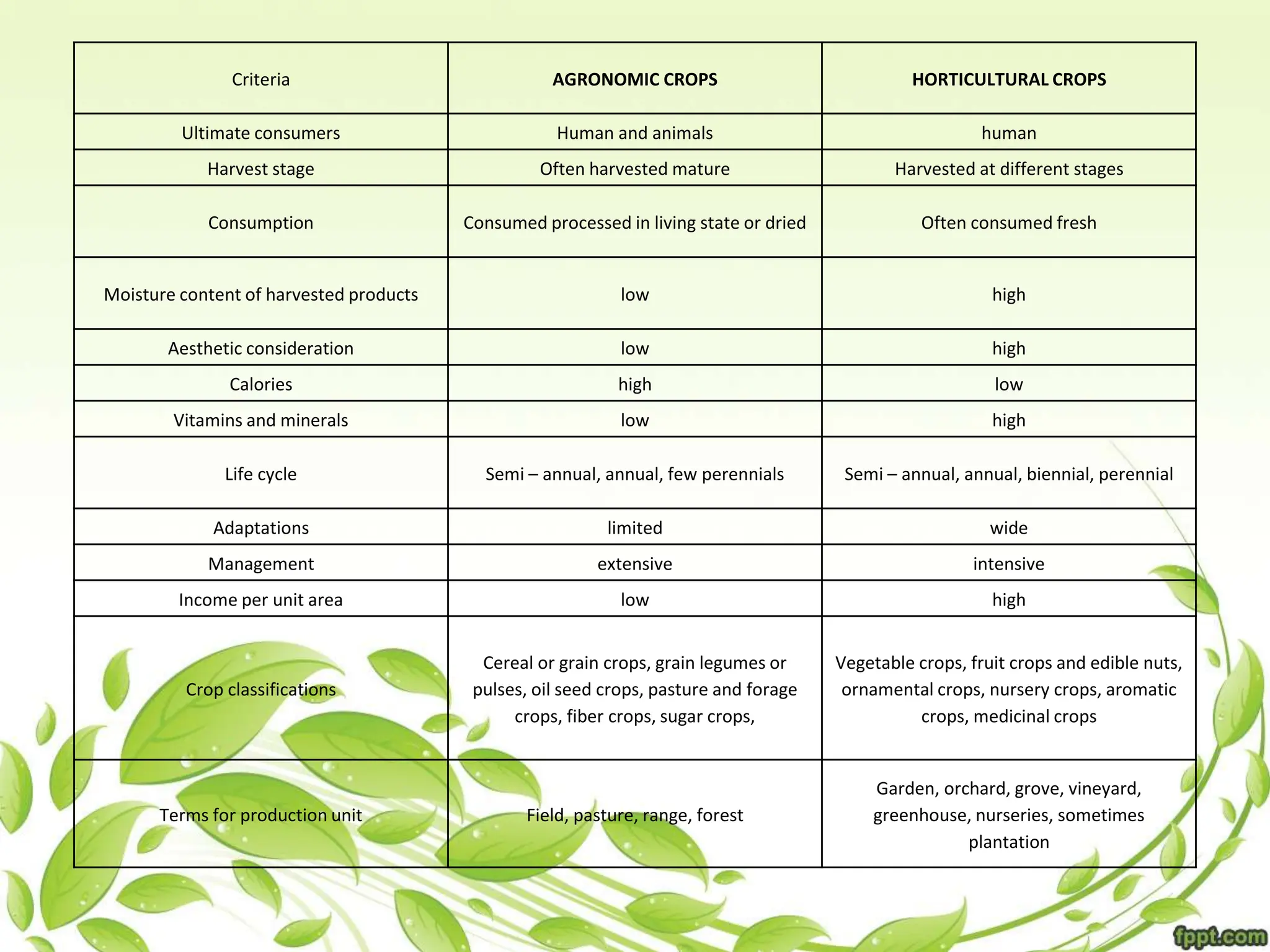
Criteria AGRONOMIC CROPS HORTICULTURAL CROPS
Ultimate consumers Human and animals human
Harvest stage Often harvested mature Harvested at different stages
Consumption Consumed processed in living state or dried Often consumed fresh
Moisture content of harvested products low high
Aesthetic consideration low high
Calories high low
Vitamins and minerals low high
Life cycle Semi – annual, annual, few perennials Semi – annual, annual, biennial, perennial
Adaptations limited wide
Management extensive intensive
Income per unit area low high
Crop classifications
Cereal or grain crops, grain legumes or
pulses, oil seed crops, pasture and forage
crops, fiber crops, sugar crops,
Vegetable crops, fruit crops and edible nuts,
ornamental crops, nursery crops, aromatic
crops, medicinal crops
Terms for production unit Field, pasture, range, forest
Garden, orchard, grove, vineyard,
greenhouse, nurseries, sometimes
plantation
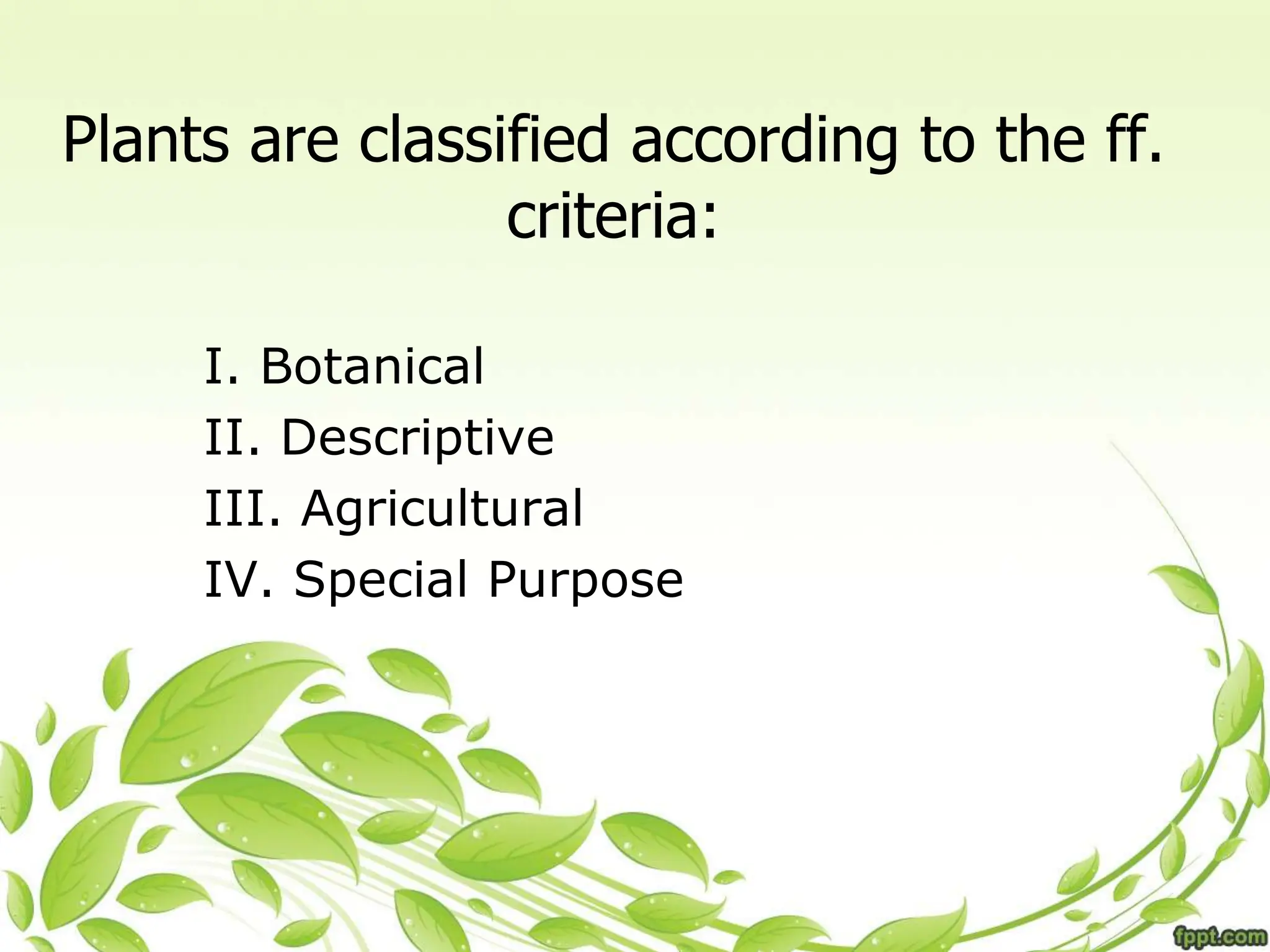
Plants are classified according to the ff.
criteria:
I. Botanical
II. Descriptive
III. Agricultural
IV. Special Purpose
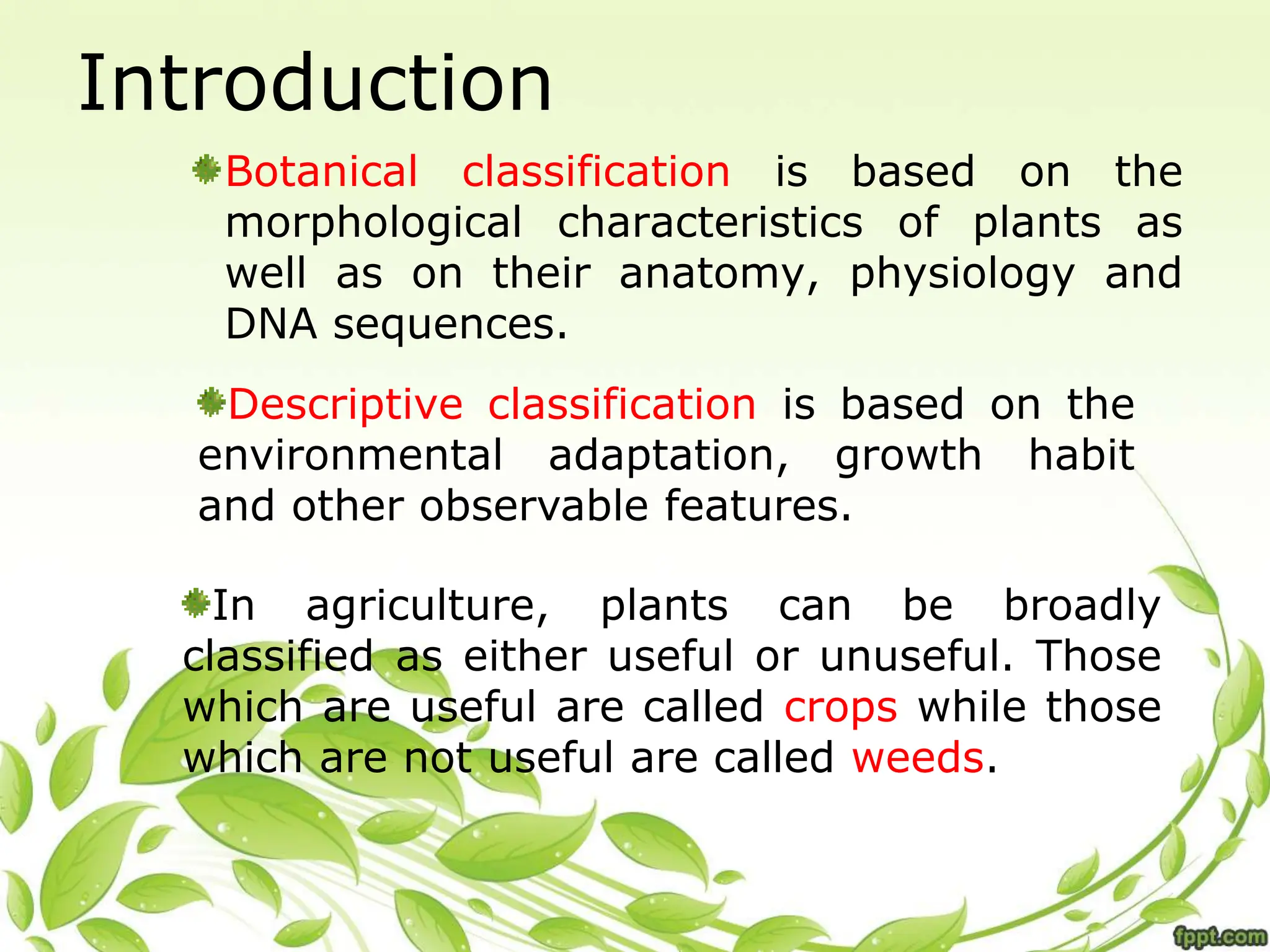
Introduction
Botanical classification is based on the
morphological characteristics of plants as
well as on their anatomy, physiology and
DNA sequences.
Descriptive classification is based on the
environmental adaptation, growth habit
and other observable features.
In agriculture, plants can be broadly
classified as either useful or unuseful. Those
which are useful are called crops while those
which are not useful are called weeds.
Why classify crops?
To simplify plant collection initiatives,
research, breeding and specialized
development efforts.
To facilitate efficient communication,
dissemination and retrieval of scientific
information.
the grouping of crops will indicate that these
crops may have similar uses, adaptation,
growth habits and methods of culture.
Why classify crops?
disease control and prevention, such
classification is important due to commonality
of some diseases.
To students of crop science, a list of crops
under the various agricultural classifications
will be a useful reference in crop names and
identification and as a review guide.
To the farm manager, the same list will offer
innumerable benefits in finding alternative
crops for specific uses.
Botanical Classification of Crops
During this meeting it was decided that Carl
Linnaeus' Species Plantarum, which was
published in 1753, would serve as the
starting point for priority of botanical
names.
Botanical Classification of Crops
The principal ranks of taxa in descending
sequence are:
1. kingdom
2. division /phylum
3. class
4. order
5. family
6. genus
7. species
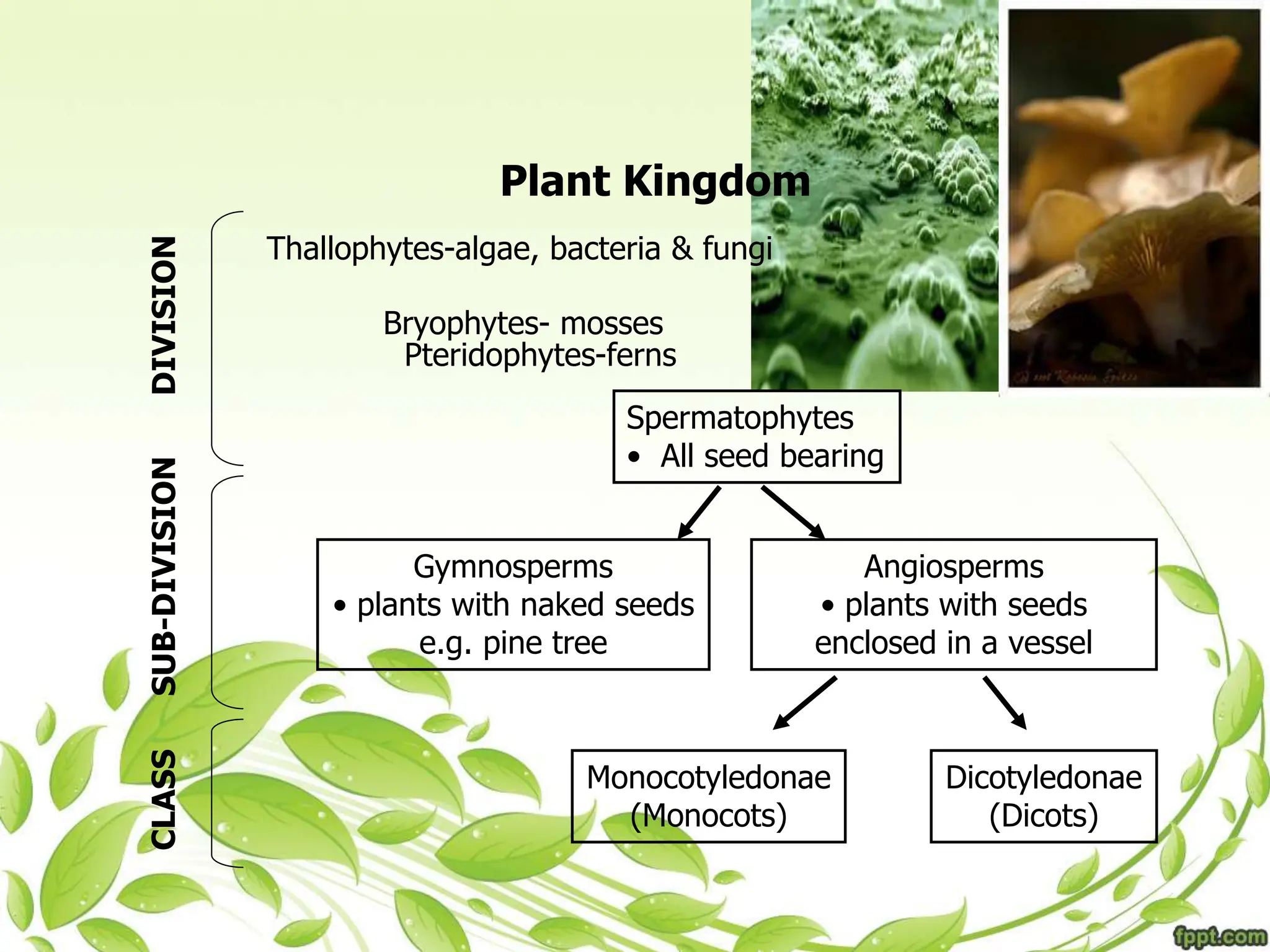
Plant Kingdom
Thallophytes-algae, bacteria & fungi
Bryophytes- mosses
Pteridophytes-ferns
Spermatophytes
• All seed bearing
Gymnosperms
• plants with naked seeds
e.g. pine tree
Angiosperms
• plants with seeds
enclosed in a vessel
Monocotyledonae
(Monocots)
Dicotyledonae
(Dicots)
DIVISION
SUB-DIVISION
CLASS
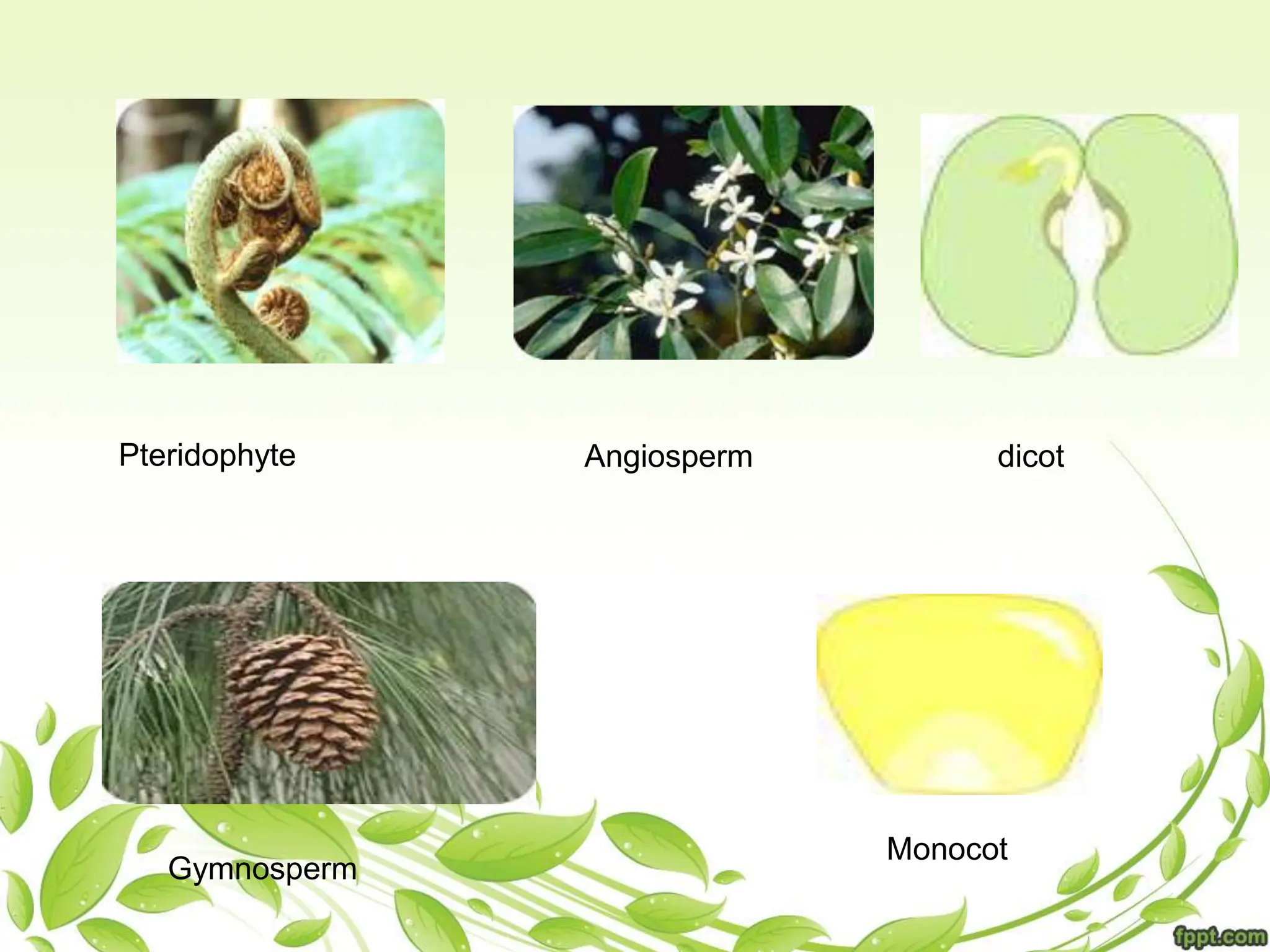
Pteridophyte Angiosperm
Gymnosperm
dicot
Monocot
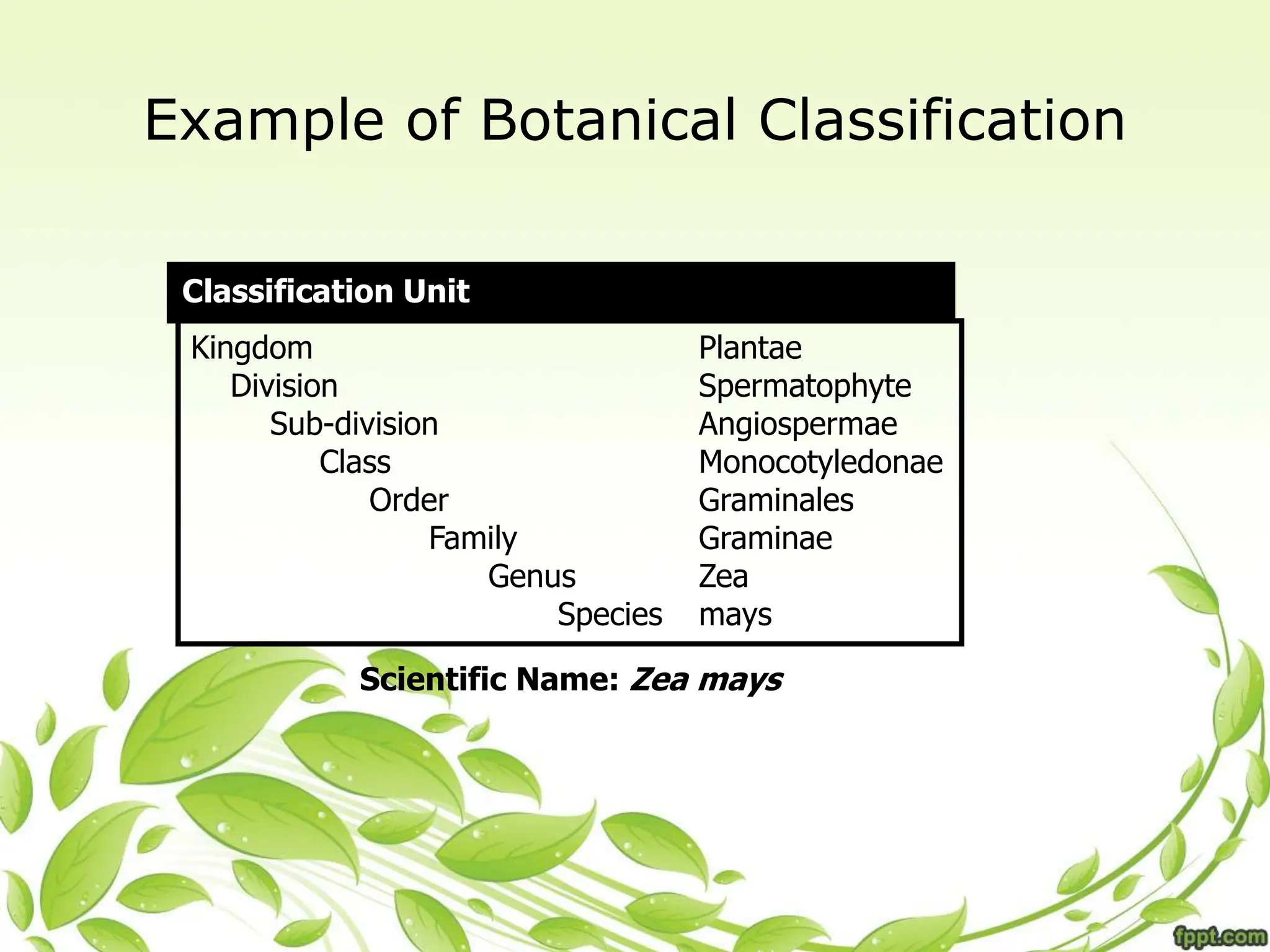
Kingdom Plantae
Division Spermatophyte
Sub-division Angiospermae
Class Monocotyledonae
Order Graminales
Family Graminae
Genus Zea
Species mays
Scientific Name: Zea mays
Classification Unit
Example of Botanical Classification
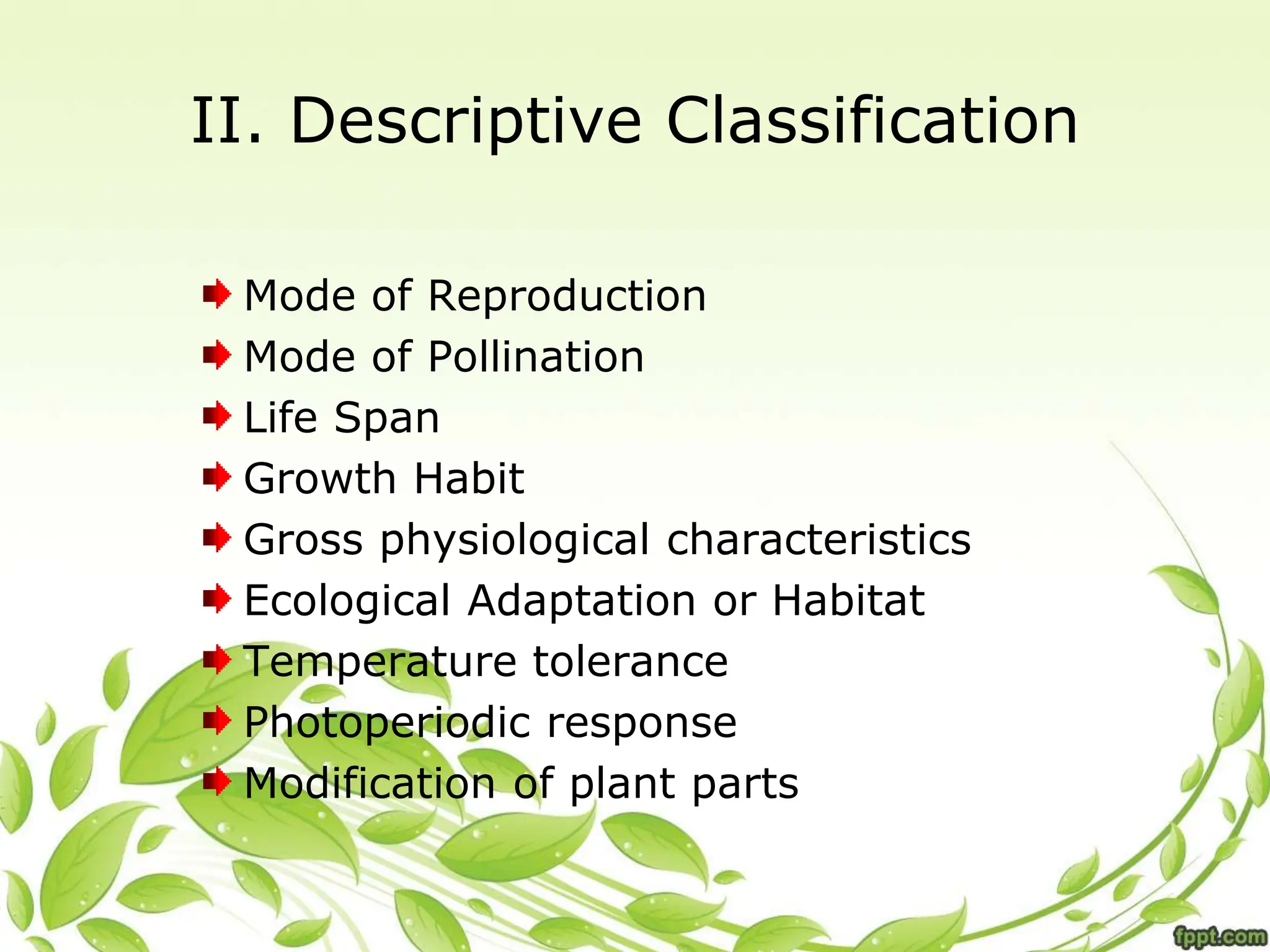
II. Descriptive Classification
Mode of Reproduction
Mode of Pollination
Life Span
Growth Habit
Gross physiological characteristics
Ecological Adaptation or Habitat
Temperature tolerance
Photoperiodic response
Modification of plant parts
Descriptive Classification
A.According to Mode of Reproduction
1. Sexual-develop from a seed
2. Asexual- reproduced by any
vegetative means without the union of
sexual gametes.
Descriptive Classification
B. Life Span
1.Annual- germinate, grow, flower, produce seed
and die in one season. (rice, corn, mungbean,
cowpea, squash)
2. Biennial- requires two growing seasons to
complete its life cycle, the first for vegetative
growth & accumulation of food reserves and
second for production of reproductive parts
(bulb onion, cabbage, celery, carrot, raddish)
Life Span
3. Perennial-including all trees and
shrubs and many herbaceous plants
with underground stems (e.g. corm,
rhizome, tuber) like banana and
clump-forming grasses.
continue growing and produce seeds
year after year
Descriptive Classification
D. Classification according to Leaf Retention/gross
physiological characteristics:
1. Deciduous- plants which naturally shed off or
lose leaves annually for extended periods.
Natural leaf shedding is pronounced in
deciduous trees of temperate regions.
In the Philippines, defoliation occurs during
summer months in Fire Tree (Delonix regia)
and red mombin or siniguelas, narra
Descriptive Classification
2. Evergreens- plants whose leaves persist the
year round.
Evergreens may lose their leaves annually,
but not until the new set of leaves has
developed.
Examples: pines, banana, papaya, palms
and most tropical plants.
Descriptive Classification
E. Ecological Adaptation or
Habitat
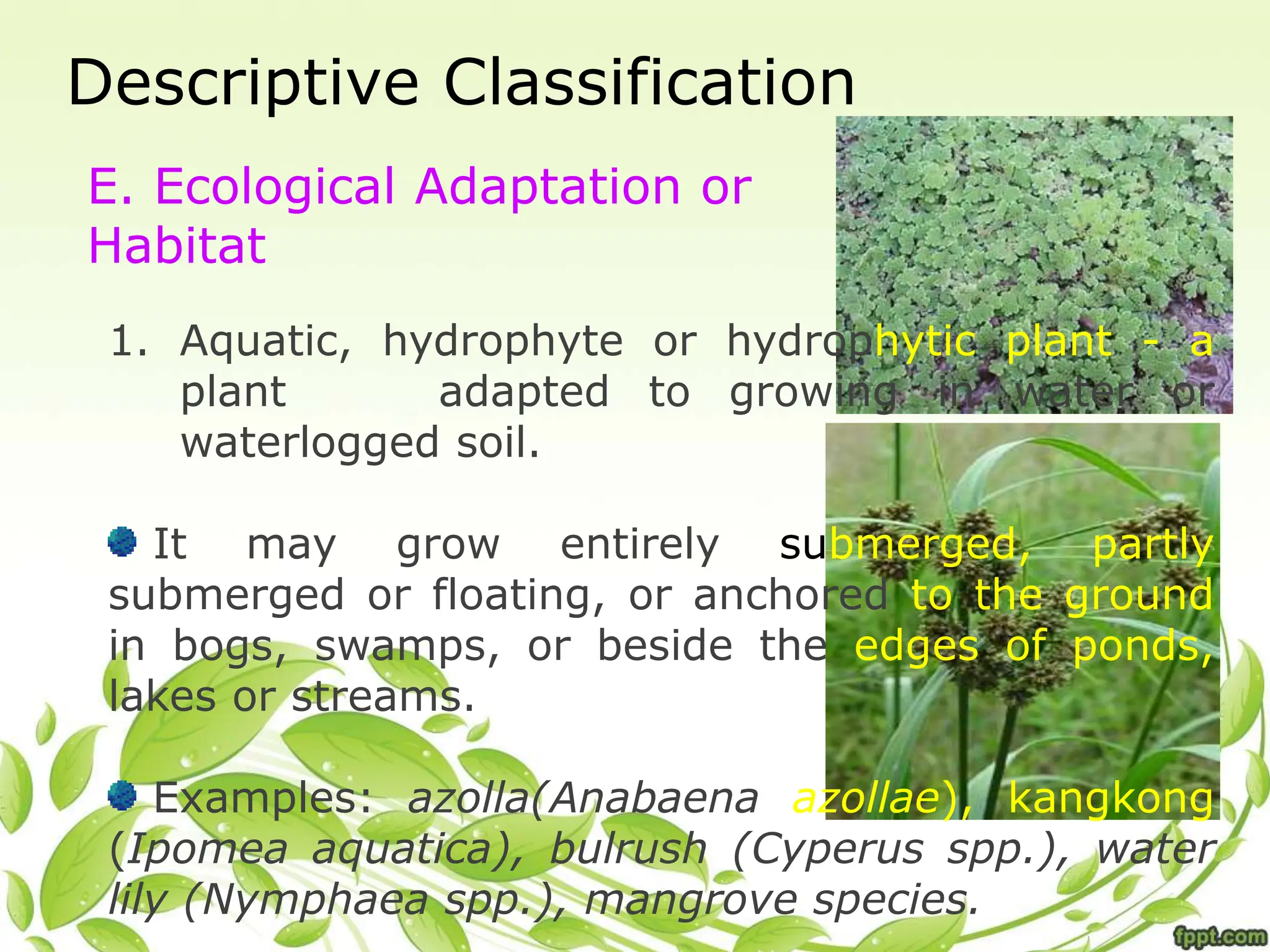
1. Aquatic, hydrophyte or hydrophytic plant - a
plant adapted to growing in water or
waterlogged soil.
It may grow entirely submerged, partly
submerged or floating, or anchored to the ground
in bogs, swamps, or beside the edges of ponds,
lakes or streams.
Examples: azolla(Anabaena azollae), kangkong
(Ipomea aquatica), bulrush (Cyperus spp.), water
lily (Nymphaea spp.), mangrove species.
Descriptive Classification
2. Epiphyte or epiphytic plant-
a plant that grows aboveground on
another plant but is not parasitic, usually
deriving only physical support from the host
and obtaining nourishment from the air and
other sources.
Examples: pineapple (bromyliad), orchid, and
fern families; also called air plant or tree dweller.
Where a plant, e.g. strangler fig (balete),
initially grows as an epiphyte but later
becomes rooted to the soil, it is especially
called a hemiepiphyte.
Descriptive Classification
3. Halophyte or halophytic plant-
a plant that is able to grow in habitats
excessively rich in salts or under saline
conditions.
Examples: nipa, talisay, bakawan
(Rhizophora mucronata) and other
mangrove species. Coconut, cashew and
tamarind have varying levels of tolerance
to saline conditions.
Descriptive Classification
4. Lithophyte or lithophytic plant
a plant adapted to growing on rocks or in
rocky terrain with little humus, absorbing
nutrients from the atmosphere, rain, and
decaying matter which accumulate on the
rocks.
Examples: Vanda, Dendrobium, other
orchids
Descriptive Classification
5. Mesophyte or mesophitic plant
terrestrial plant adapted to moderate conditions
for growth, i.e. not too dry and not too wet
Examples: corn and most commercially-grown
crops).
6. Parasite or parasitic plant
plant which grows on another plant from which
it takes part or all nourishment
Example: Loranthaceae (mistletoe family),
Rafflesia; Neottia and Corallorhiza orchids).
Descriptive Classification
7. Saprophyte or saprophytic crop- grows on
decaying organic matter and has no green tissue.
Example: mushrooms
8. Sciophyte or sciophytic plant- plant adapted to low
light intensity or shade,
e.g. most ferns and mosses, black pepper, cacao,
coffee, lanzones, mangosteen, hot pepper, gingers,
and many orchids can tolerate or require shade.
Descriptive Classification
9. Terrestrial or land plant- a plant
which grows on land, rooting in the
soil.
Most agricultural crops are terrestrial and
are further subclassified into various groups
such as halophytes, mesophytes, sciophytes
and xerophytes depending on climatic and
special adaptations.
Descriptive Classification
10. Xerophyte, xerophytic plant
a plant which is adapted to conditions with
little or no water.
Examples: bromyliads, euphorbias, cacti and
many succulents.
CLASSIFICATIONS OF
CROPS
Based on GROWTH HABIT
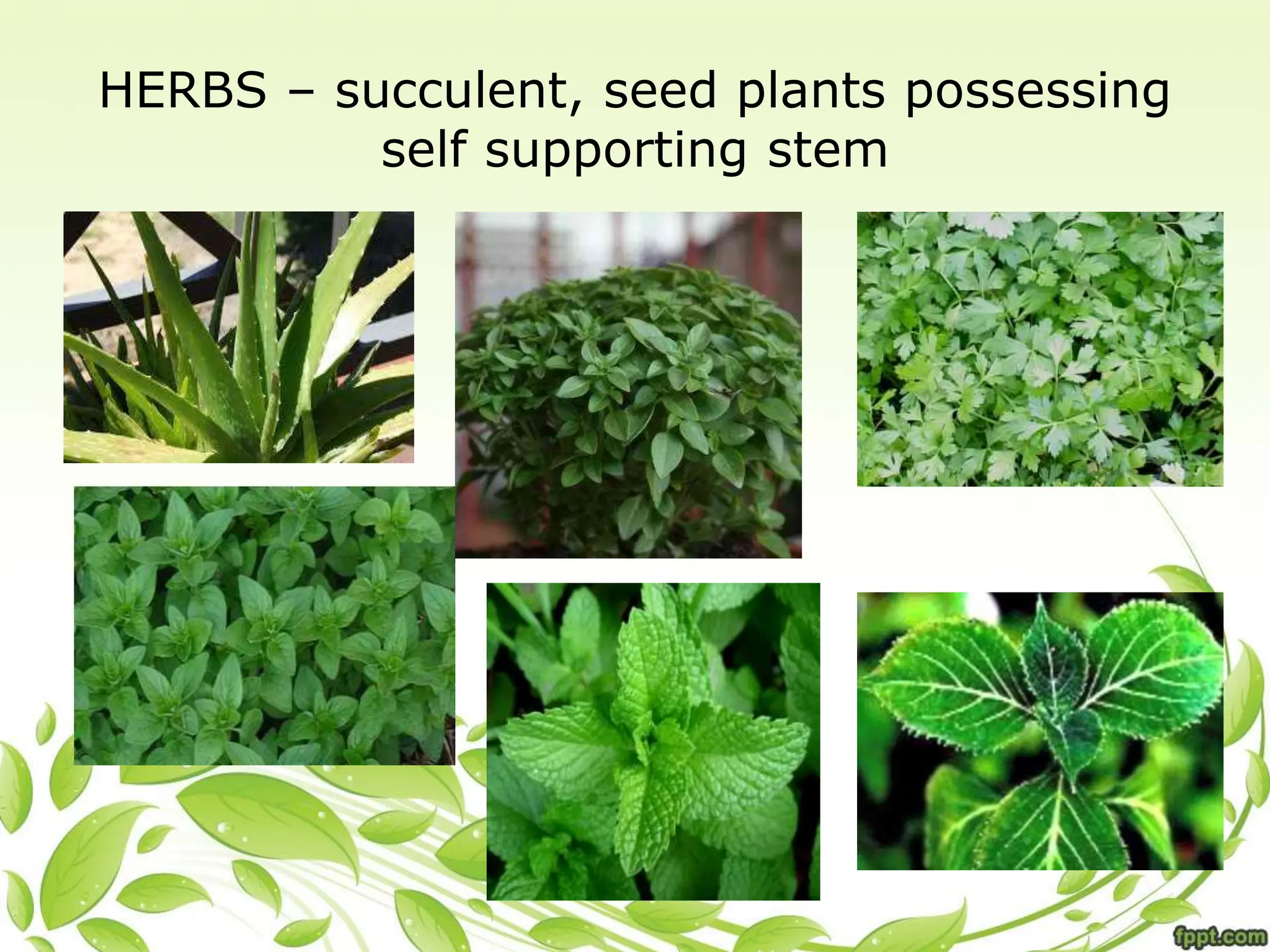
HERBS – succulent, seed plants possessing
self supporting stem
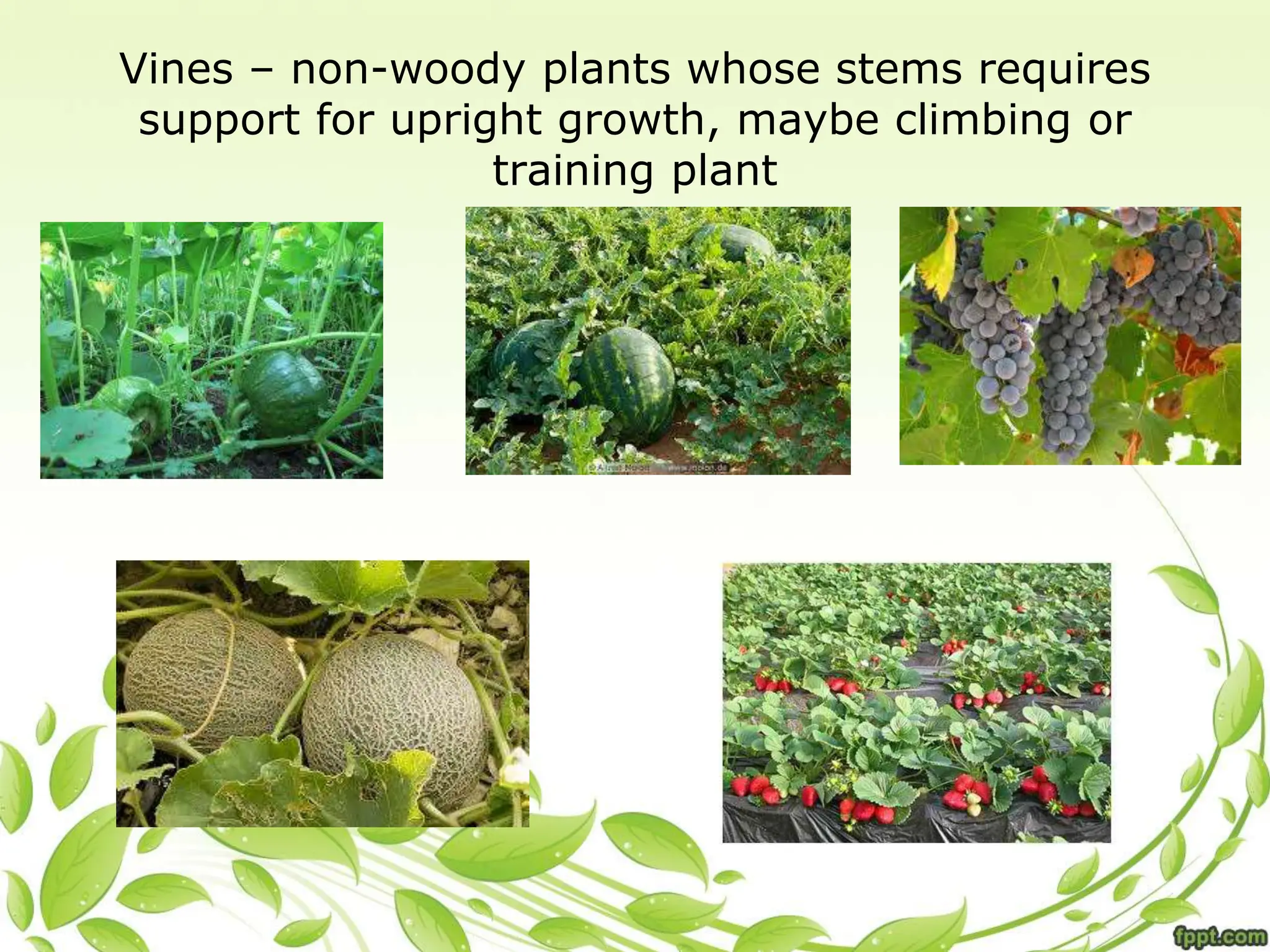
Vines – non-woody plants whose stems requires
support for upright growth, maybe climbing or
training plant
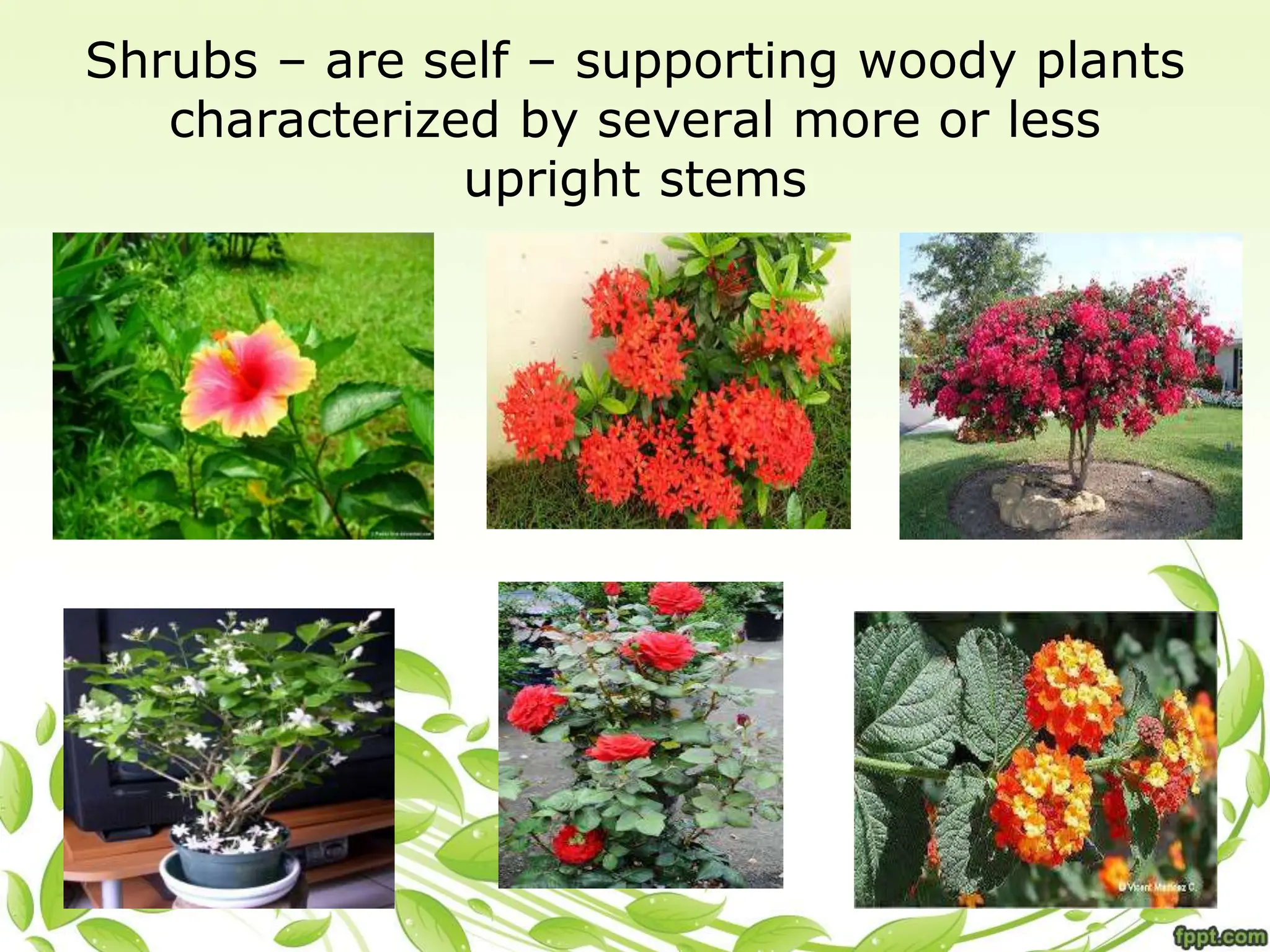
Shrubs – are self – supporting woody plants
characterized by several more or less
upright stems
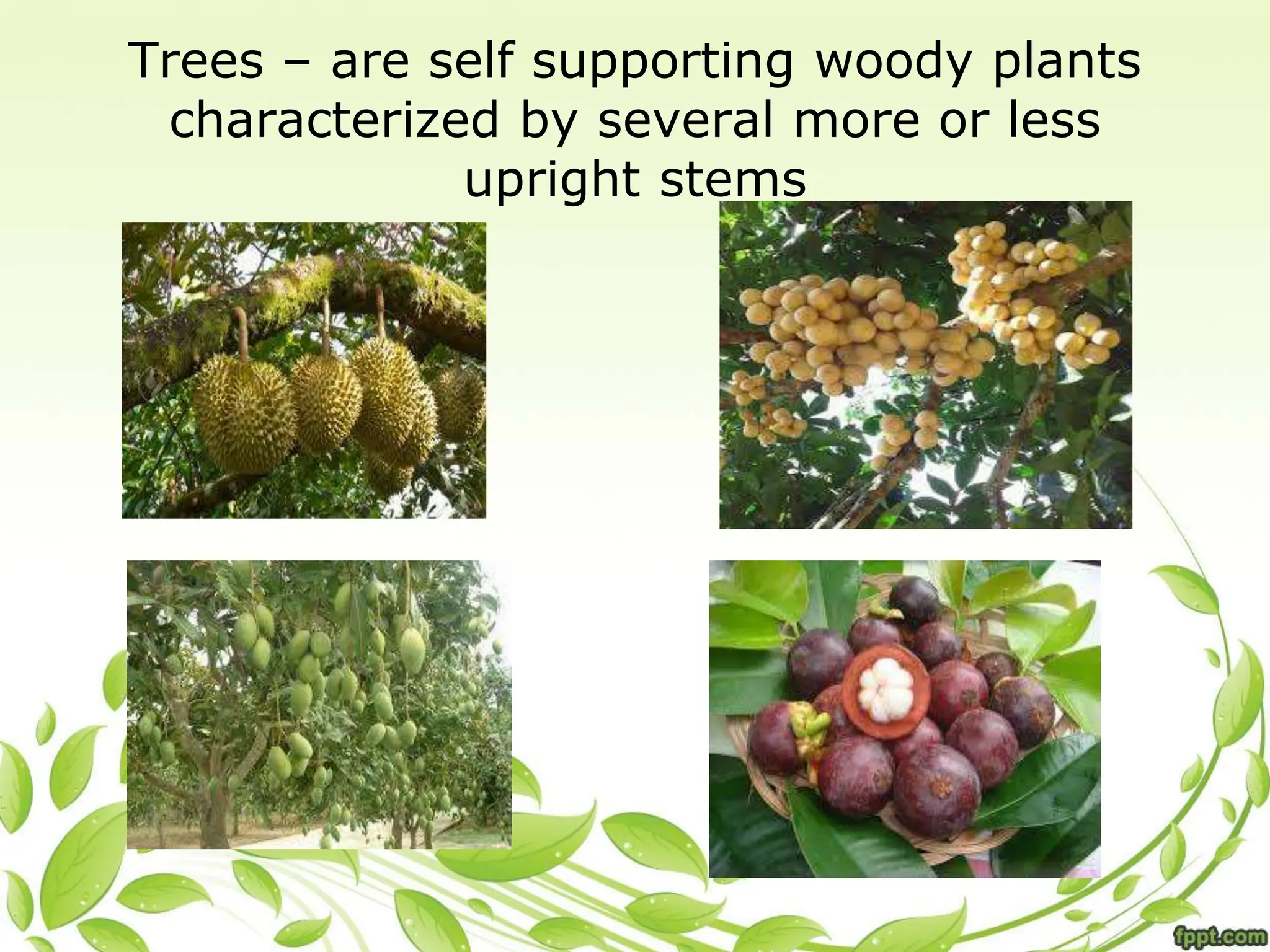
Trees – are self supporting woody plants
characterized by several more or less
upright stems
CLASSIFICATION OF
CROPS
Based on gross physiological
characteristics
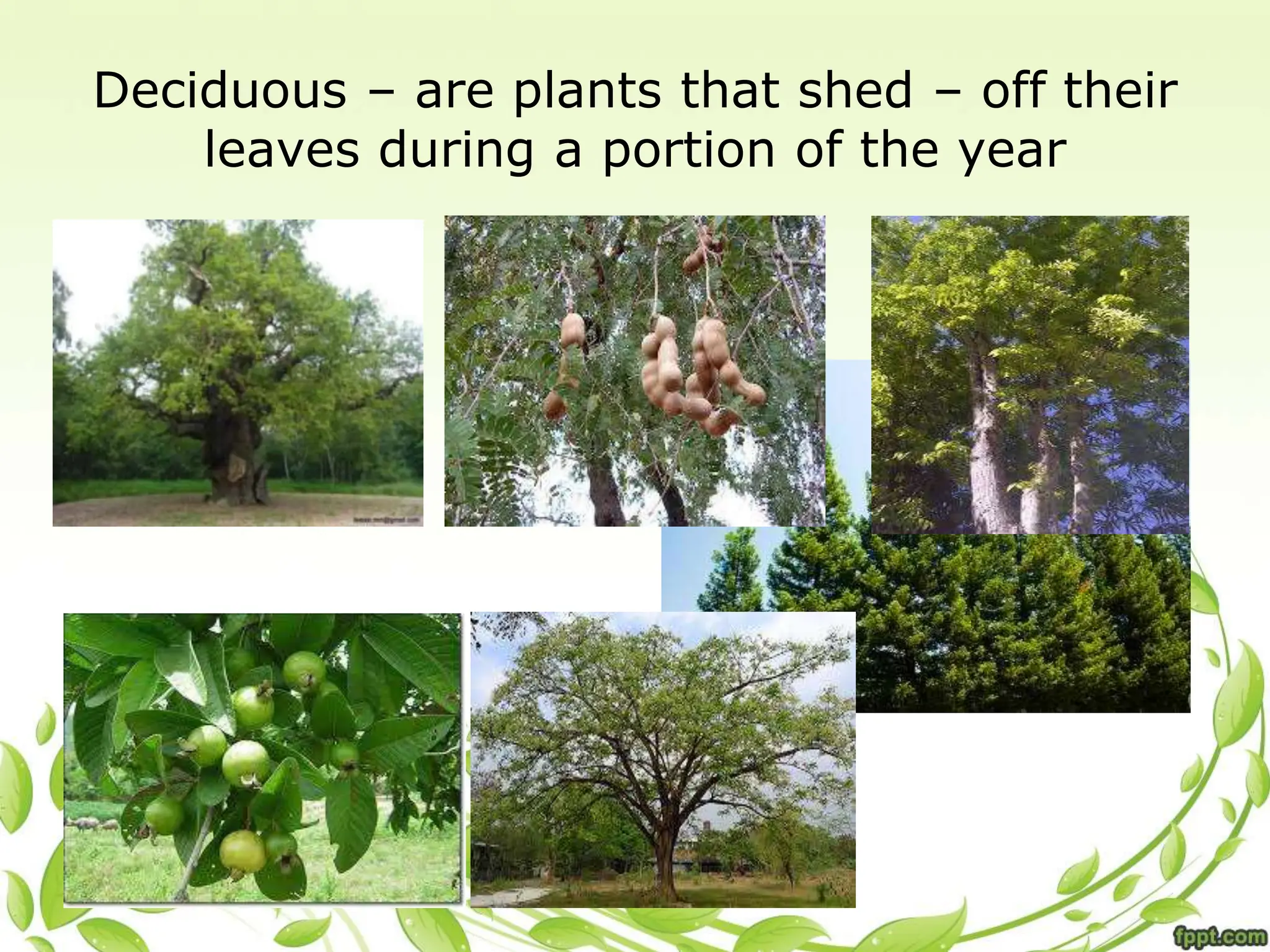
Deciduous – are plants that shed – off their
leaves during a portion of the year
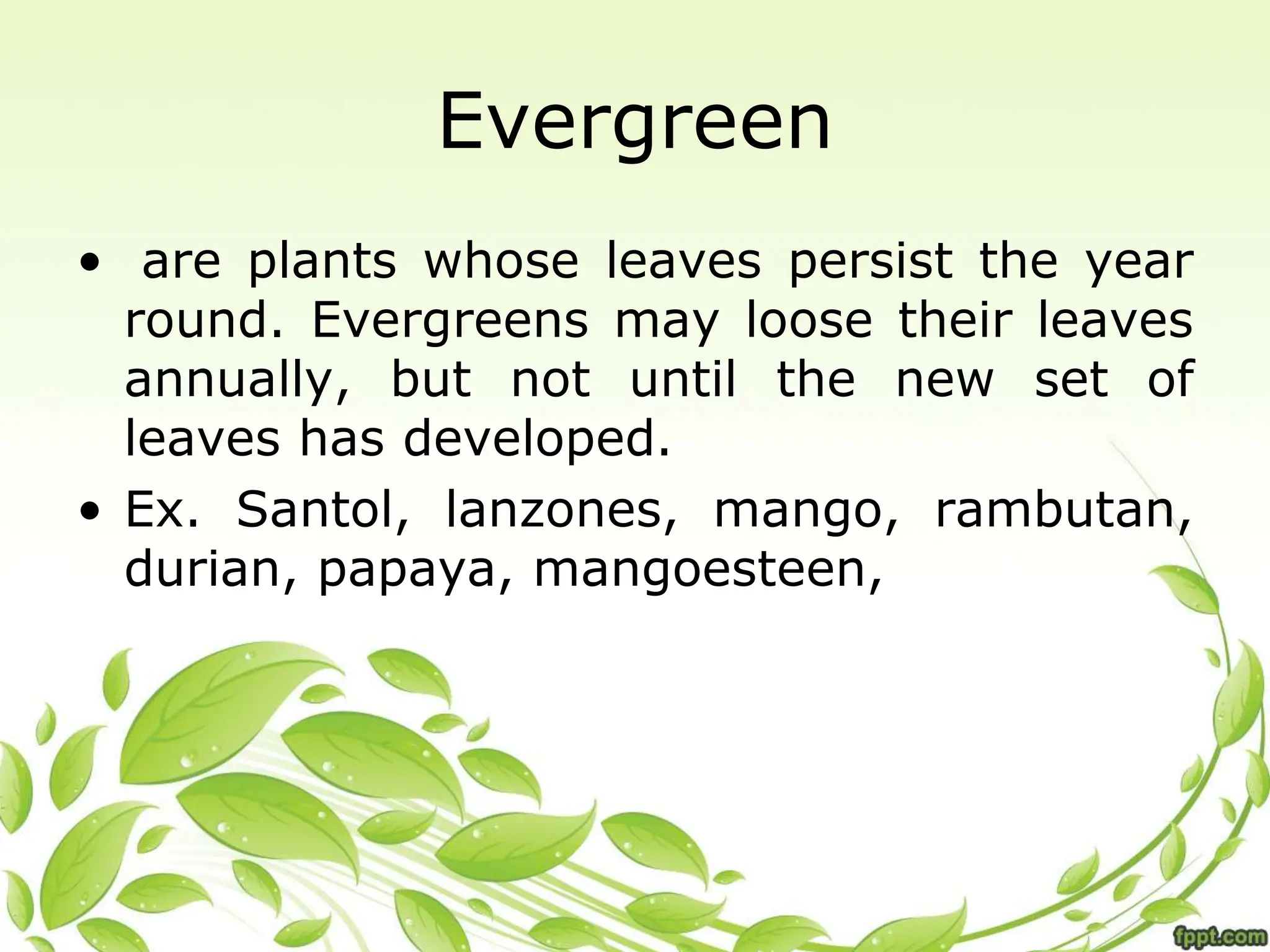
Evergreen
• are plants whose leaves persist the year
round. Evergreens may loose their leaves
annually, but not until the new set of
leaves has developed.
• Ex. Santol, lanzones, mango, rambutan,
durian, papaya, mangoesteen,
CLASSIFICATIONS OF
CROPS
Based on temperature tolerance
Tropical Crops
• those grown in the tropics and could not
withstand chilling.
• Most of our fruits belong in this category
Ex. Banana, mang0, papaya, guava, etc.
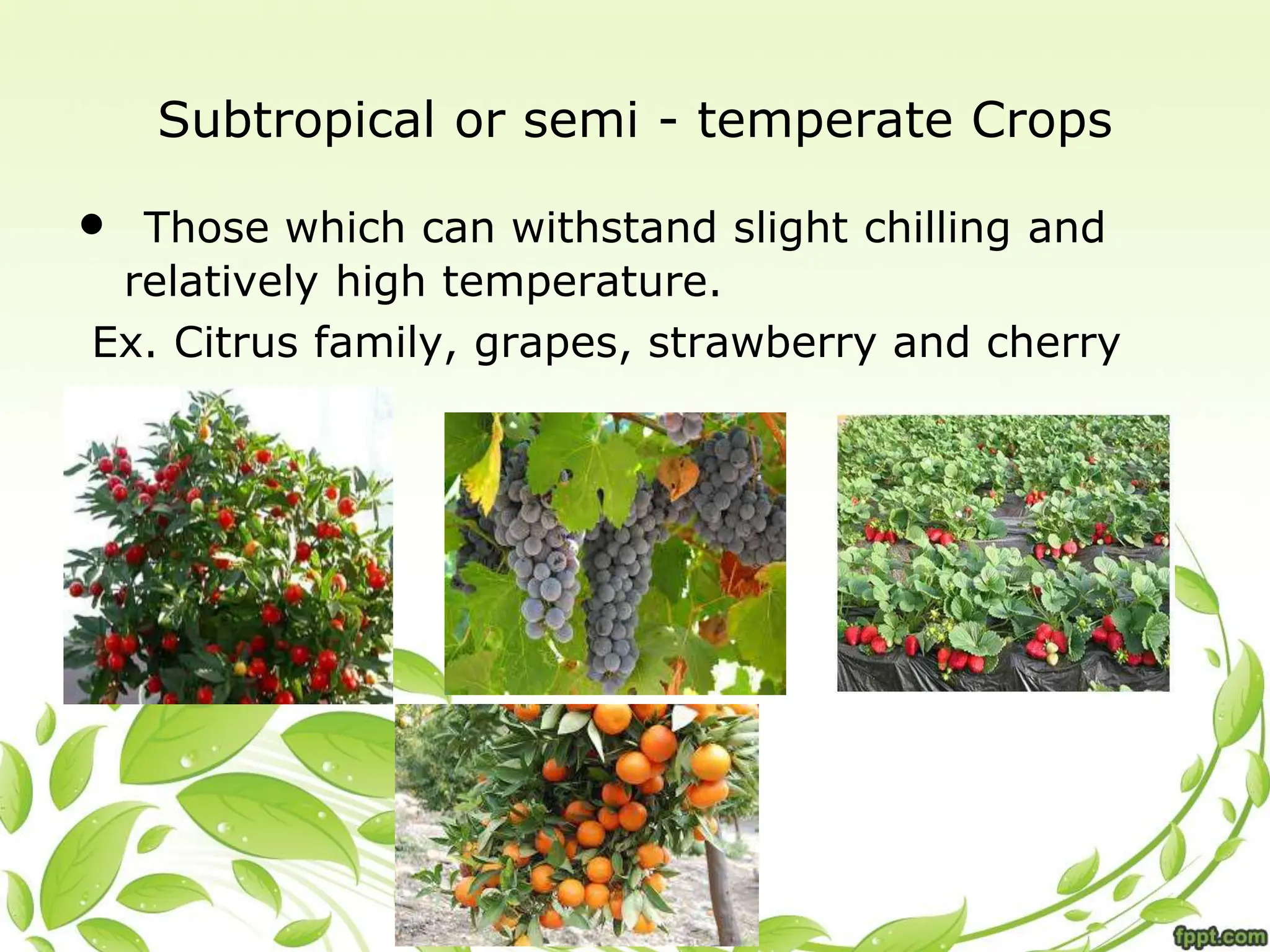
Subtropical or semi - temperate Crops
• Those which can withstand slight chilling and
relatively high temperature.
Ex. Citrus family, grapes, strawberry and cherry
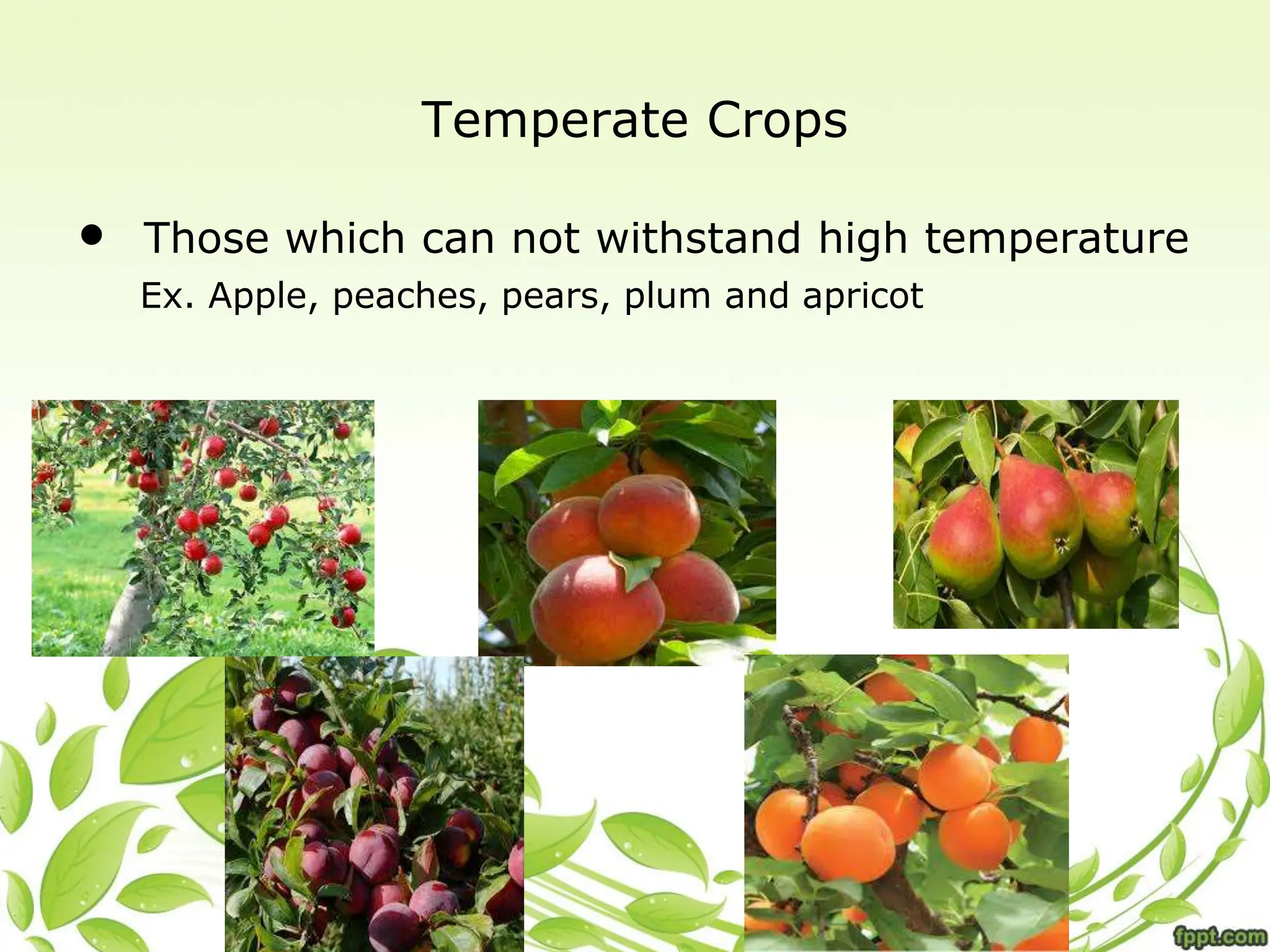
Temperate Crops
• Those which can not withstand high temperature
Ex. Apple, peaches, pears, plum and apricot
CLASSIFICATIONS OF
CROPS
Based on Photoperiodic Response
• Plants can be classified according how they react
and influenced by relative length of daylight and
darknesss.
A. Long day plants – They require long day (about
14 or more hours) for the formation of
inflorescence. If the daylight is shorter, these
crops remain in their vegetative stage.
Ex. Spinach, onion, lettuce, raddish, potato,
B. Short day plants – They require relatively short
day length (less than 14 hours to initiate
flowering.)
Ex. Cowpea, winged bean, sayote, soybean,
kamote, mungbean, chrysanthemum, cotton, rice,
poinsettia
C. Day-neutral plants – These crops that will flower
regardless of the length of photoperiod.
Ex. Corn, cucumber, tomato, eggplant,
pepper, sunflower.
AGRONOMIC CLASSIFICATION
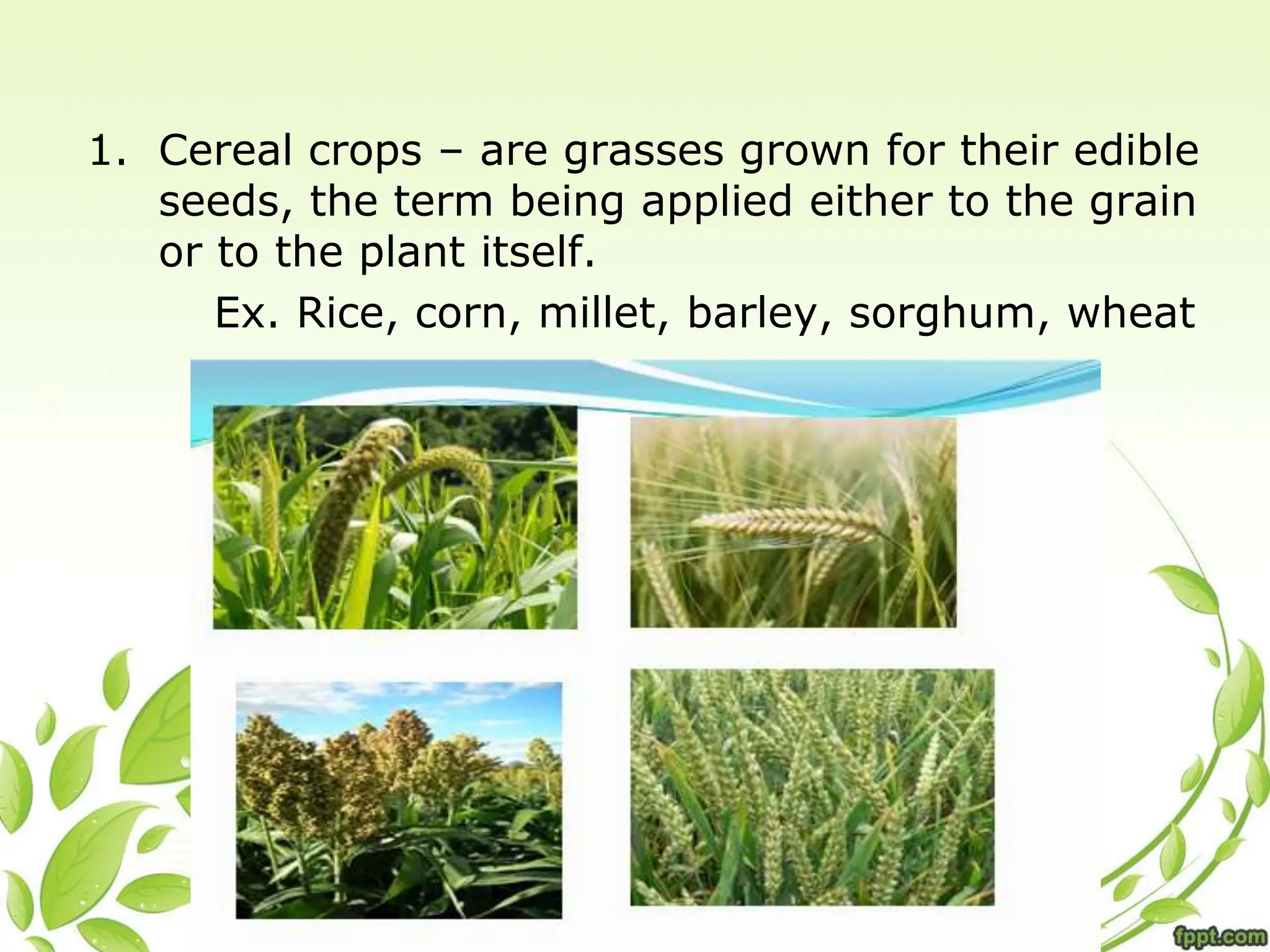
1. Cereal crops – are grasses grown for their edible
seeds, the term being applied either to the grain
or to the plant itself.
Ex. Rice, corn, millet, barley, sorghum, wheat
2. Legume or Pulse crops - are pod-bearing plants,
with root nodules and whose leaves are divided into
leaflets.
Ex. Mungbean, peanut, cowpea, soybean, etc.
3. Root crops – are plants grown for their edible
fleshy roots
Ex. Sweet potato, yam, gabi
4. Tuber crops –are plants grown for their short,
thickened underground stem.
Ex. Cassava, ginger, white potato
5. Sugarcane – is grown for its sweet juices from
which sugar is extracted and crystalized.
HORTICULTURAL
CLASSIFICATION
Division of Horticulture
1. Olericulture (vegetables)
2. Pomology (fruits)
3. Flowers and Ornamentals (Floriculture)
4. Plantation and Industrial crops
• Olericulture – is the study of vegetable
production. Person who are engage in the study
of vegetable crops with respect to culture and
production are called olericulturists. Vegetable
production may be categorized as follows:
a. Home gardening – the main intention of
the grower is to produce vegetable crops for home
consumption.
b. Market gardening – assorted vegetable
crops are grown to local and roadside markets.
c. Truck gardening – large-scale type of
vegetable production. Vegetable grown are
intended for wholesaler market, shipping to other
places or supplying a processing plant.
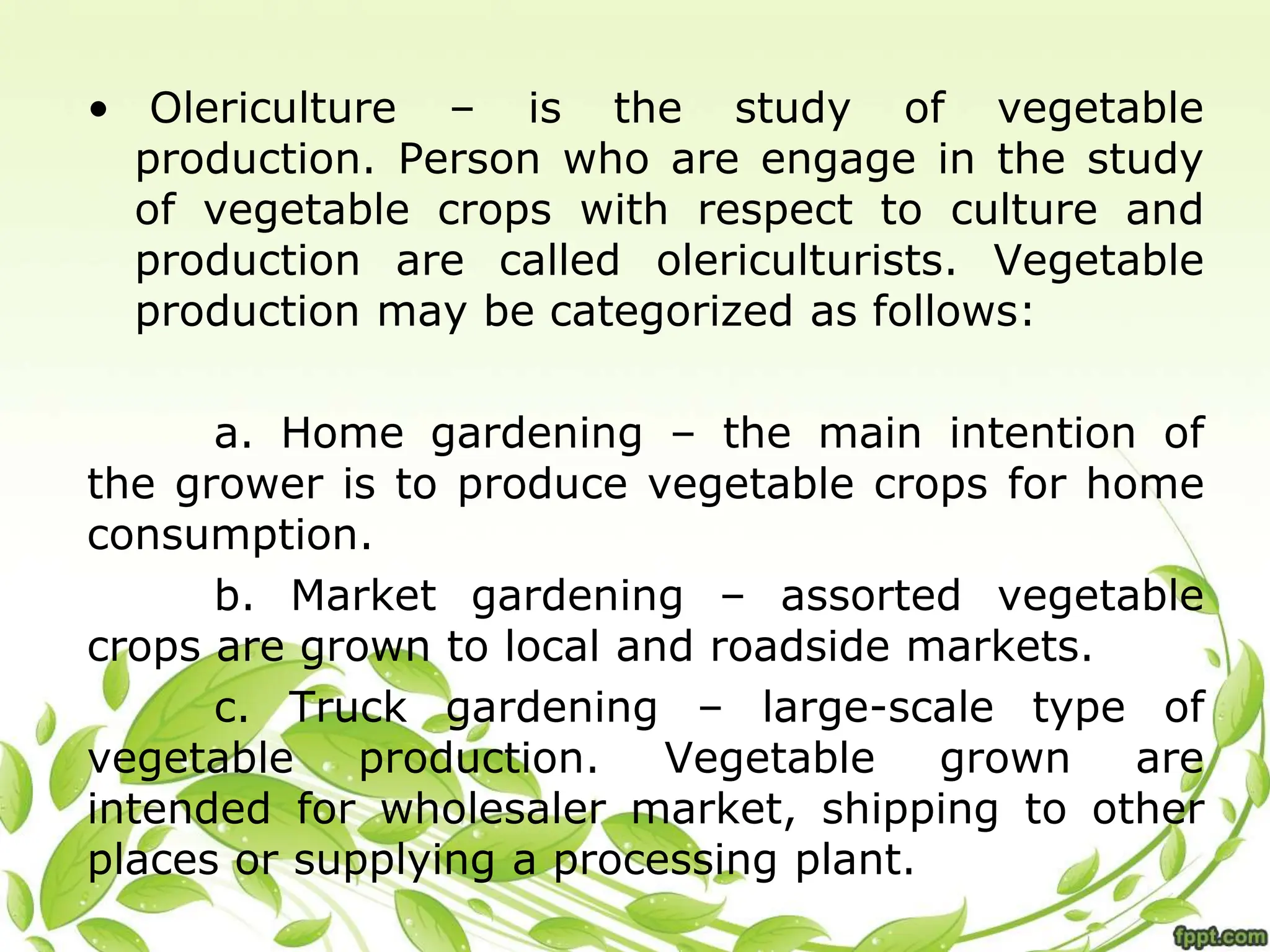
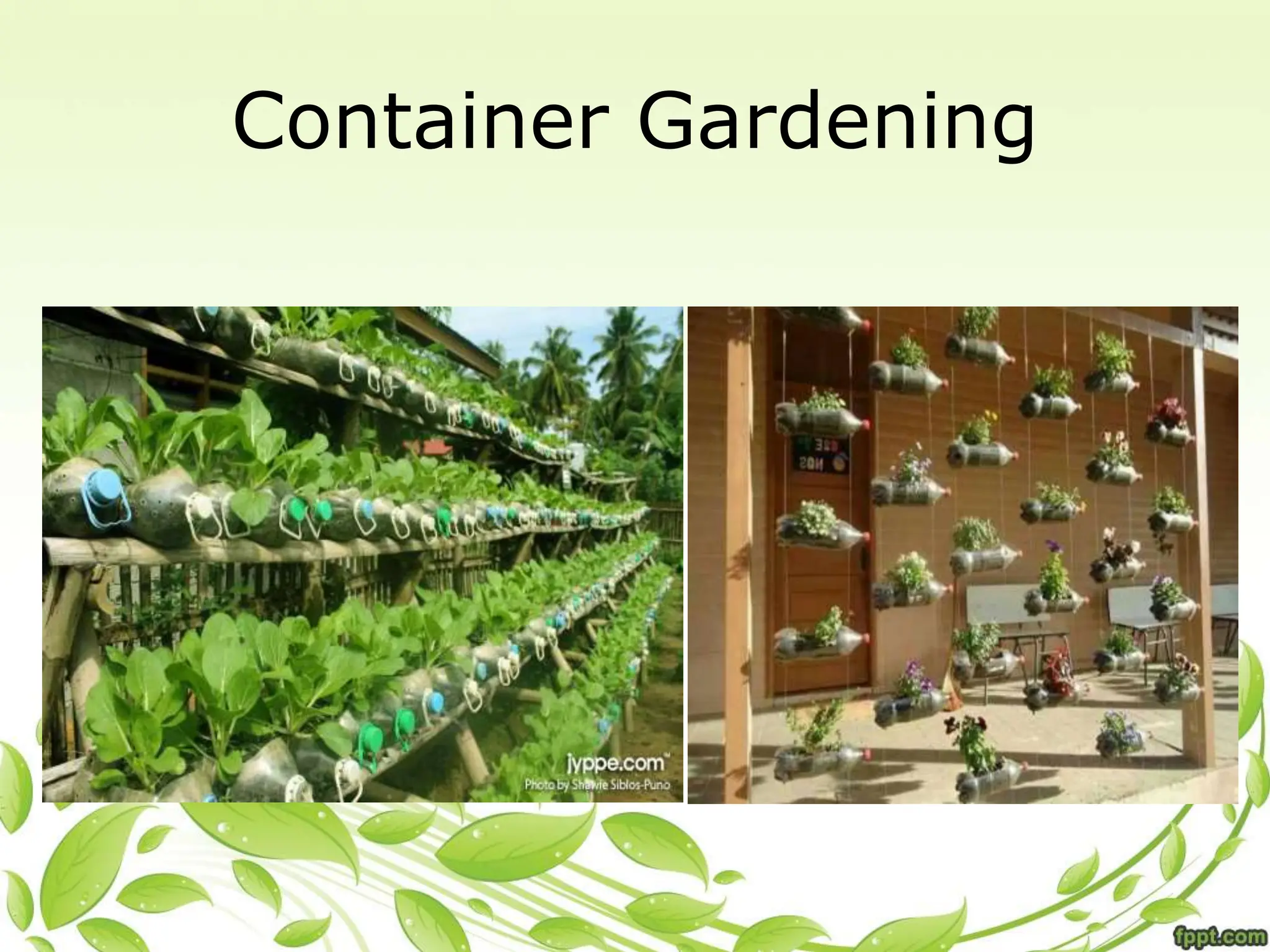
d. Hydroponics – is a subset
of hydroculture and is a method of growing
plants using mineral nutrient solutions, in
water, without soil.
•
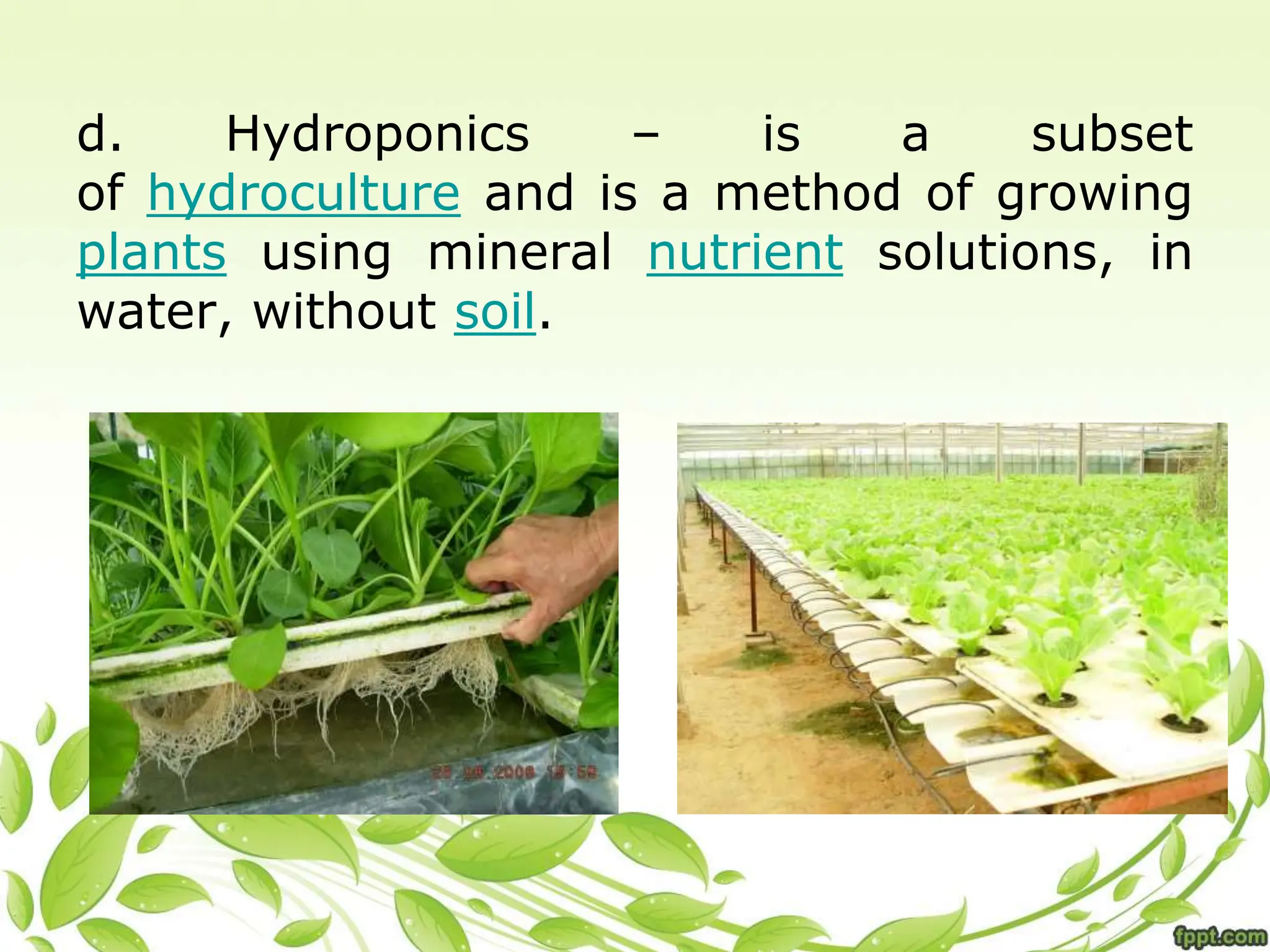
Greenhouse Cultivation
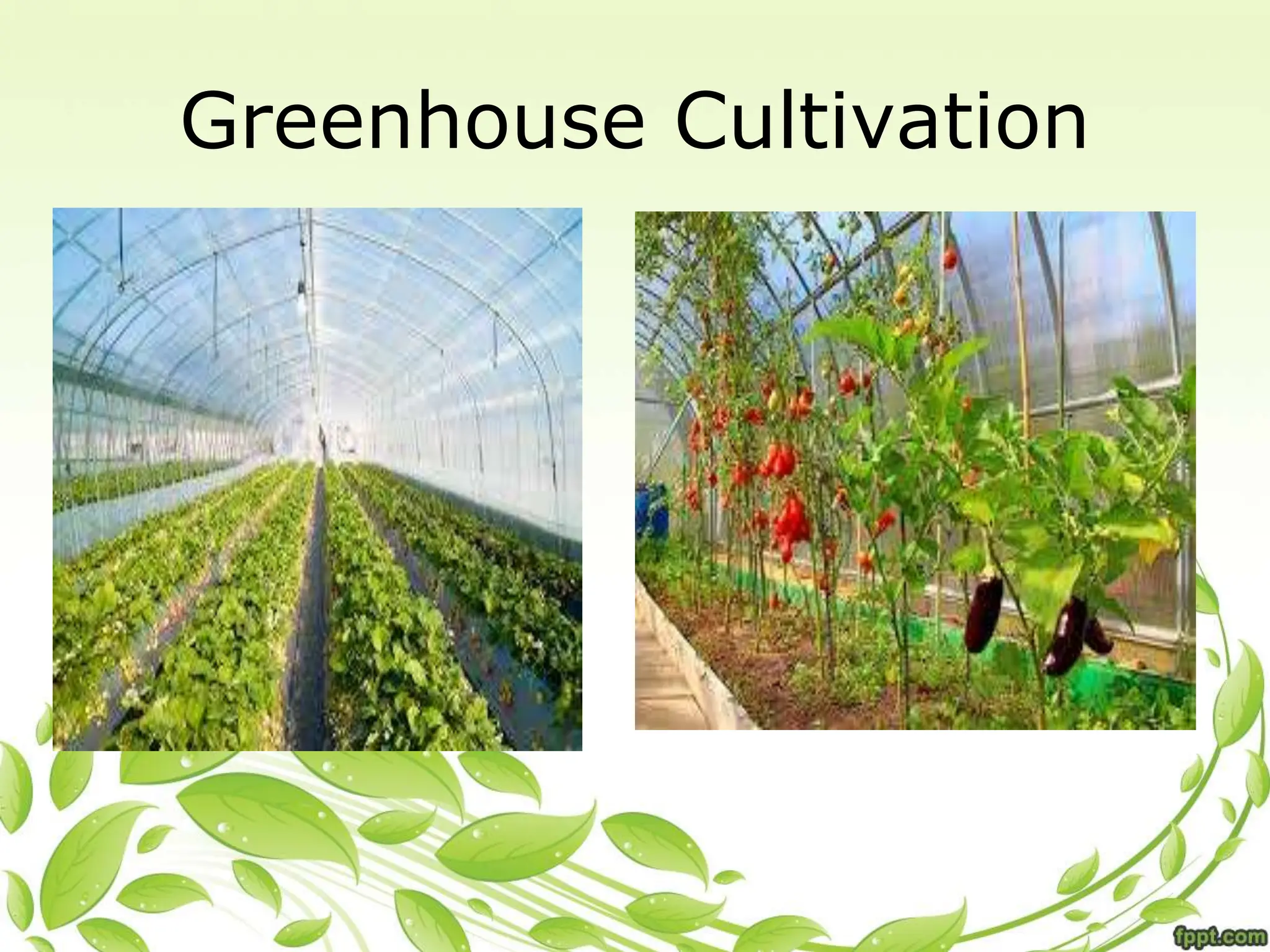
Container Gardening
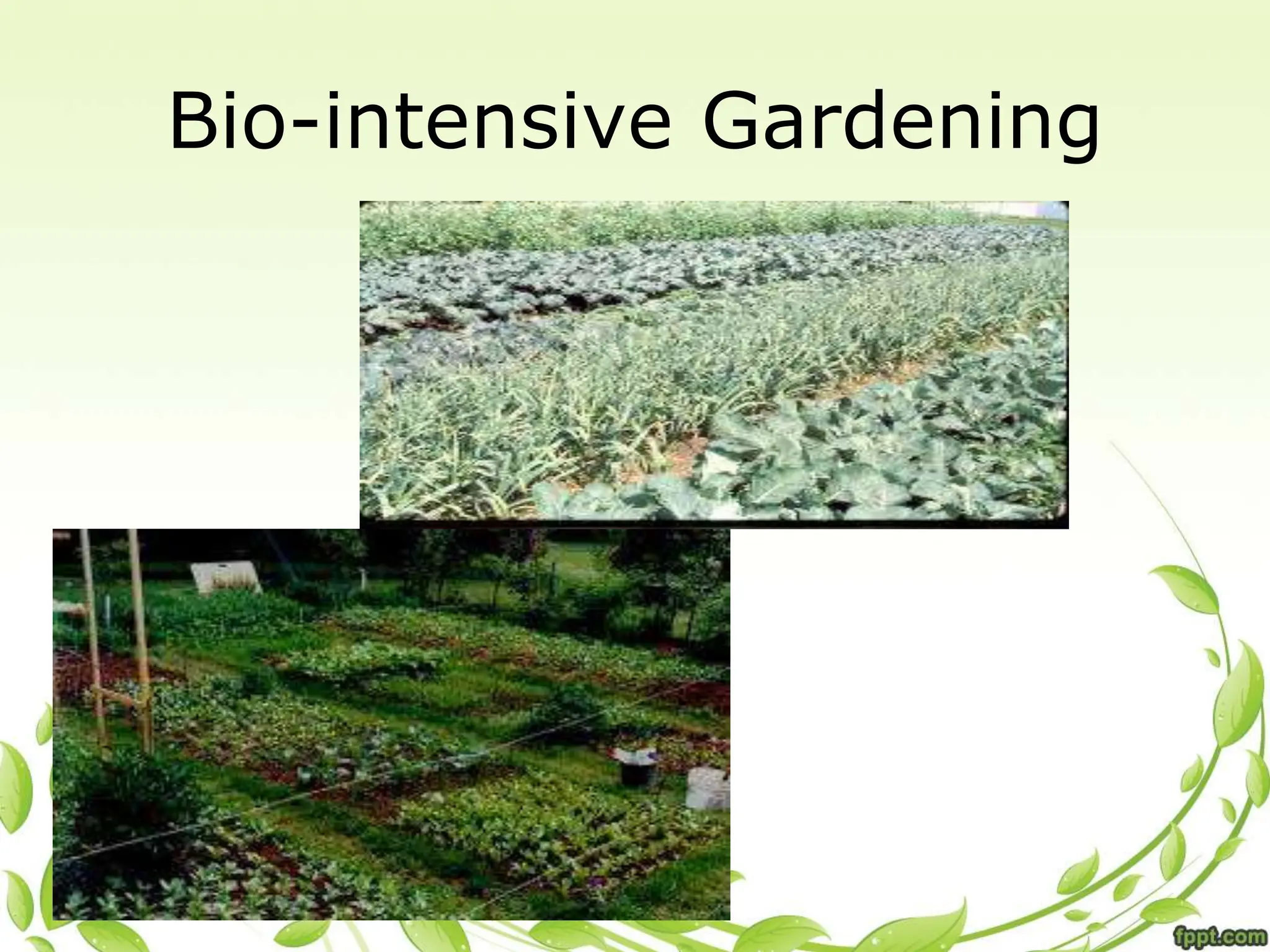
Bio-intensive Gardening
Classification of vegetable
crops
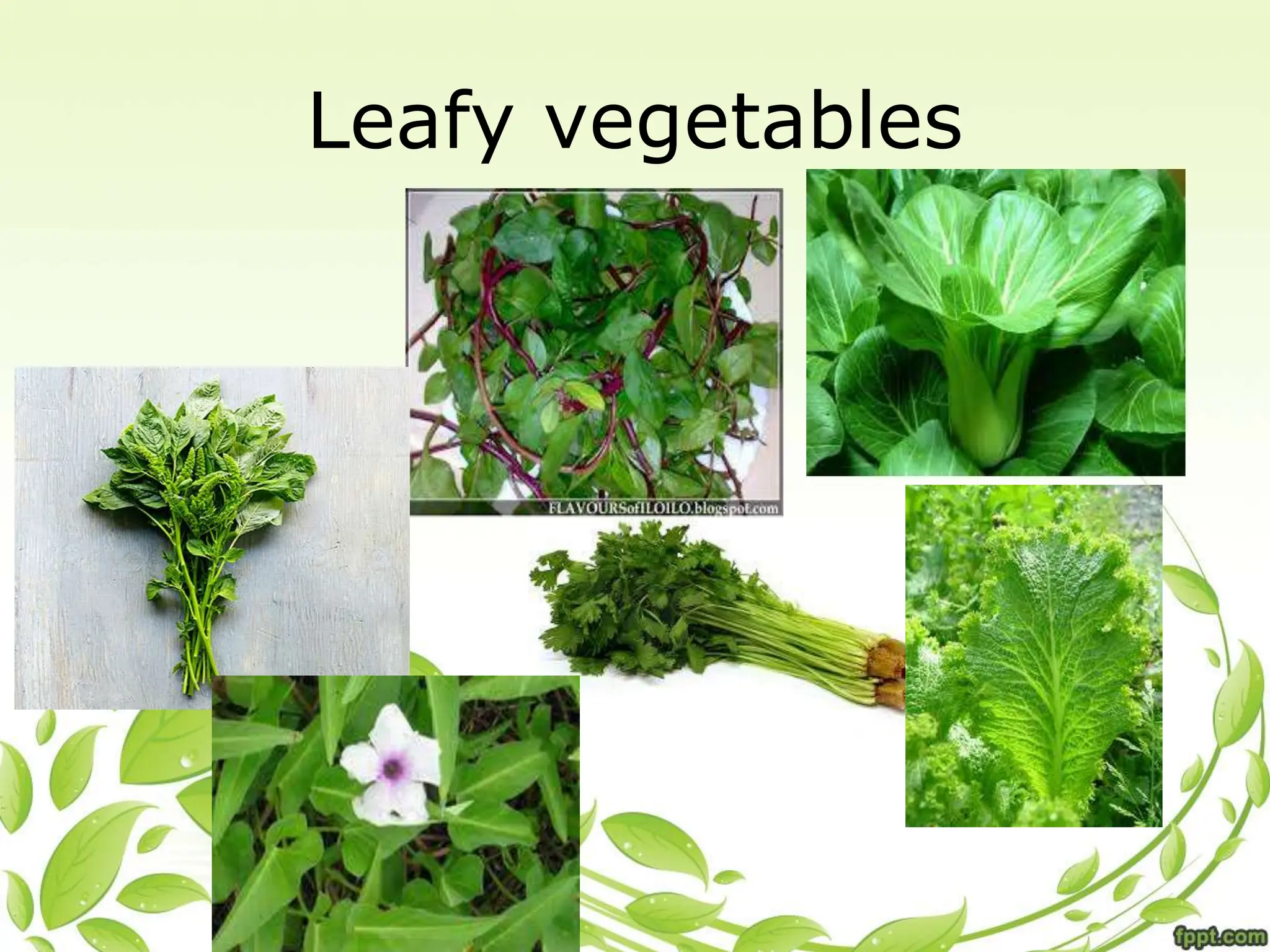
• crops grown mainly for their leaves
• Example: pechay, mustard,
kangkong (swamp cabbage),
alugbati, celery, kulitis (amaranth),
Leafy Vegetables
Leafy vegetables
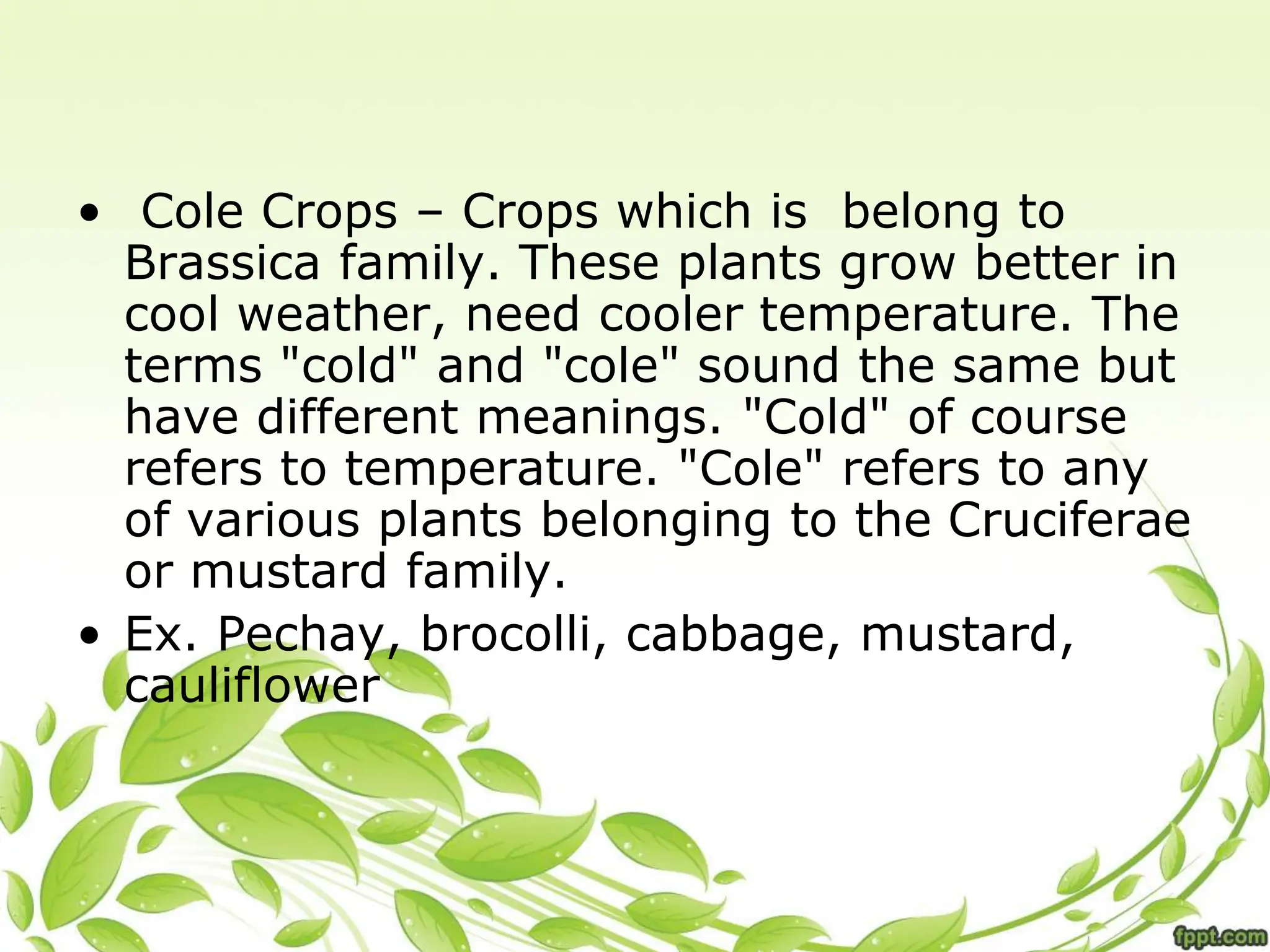
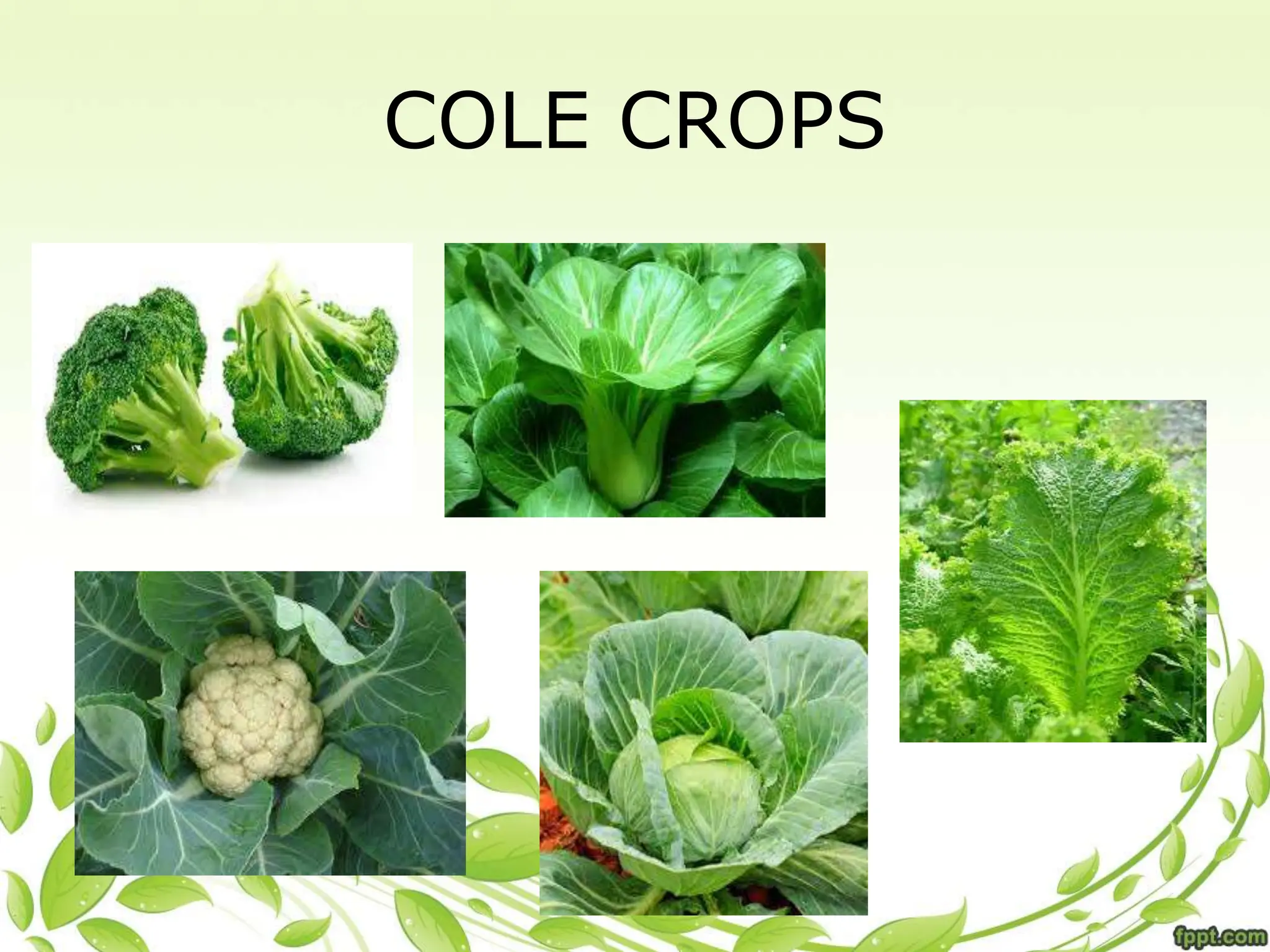
• Cole Crops – Crops which is belong to
Brassica family. These plants grow better in
cool weather, need cooler temperature. The
terms "cold" and "cole" sound the same but
have different meanings. "Cold" of course
refers to temperature. "Cole" refers to any
of various plants belonging to the Cruciferae
or mustard family.
• Ex. Pechay, brocolli, cabbage, mustard,
cauliflower
COLE CROPS
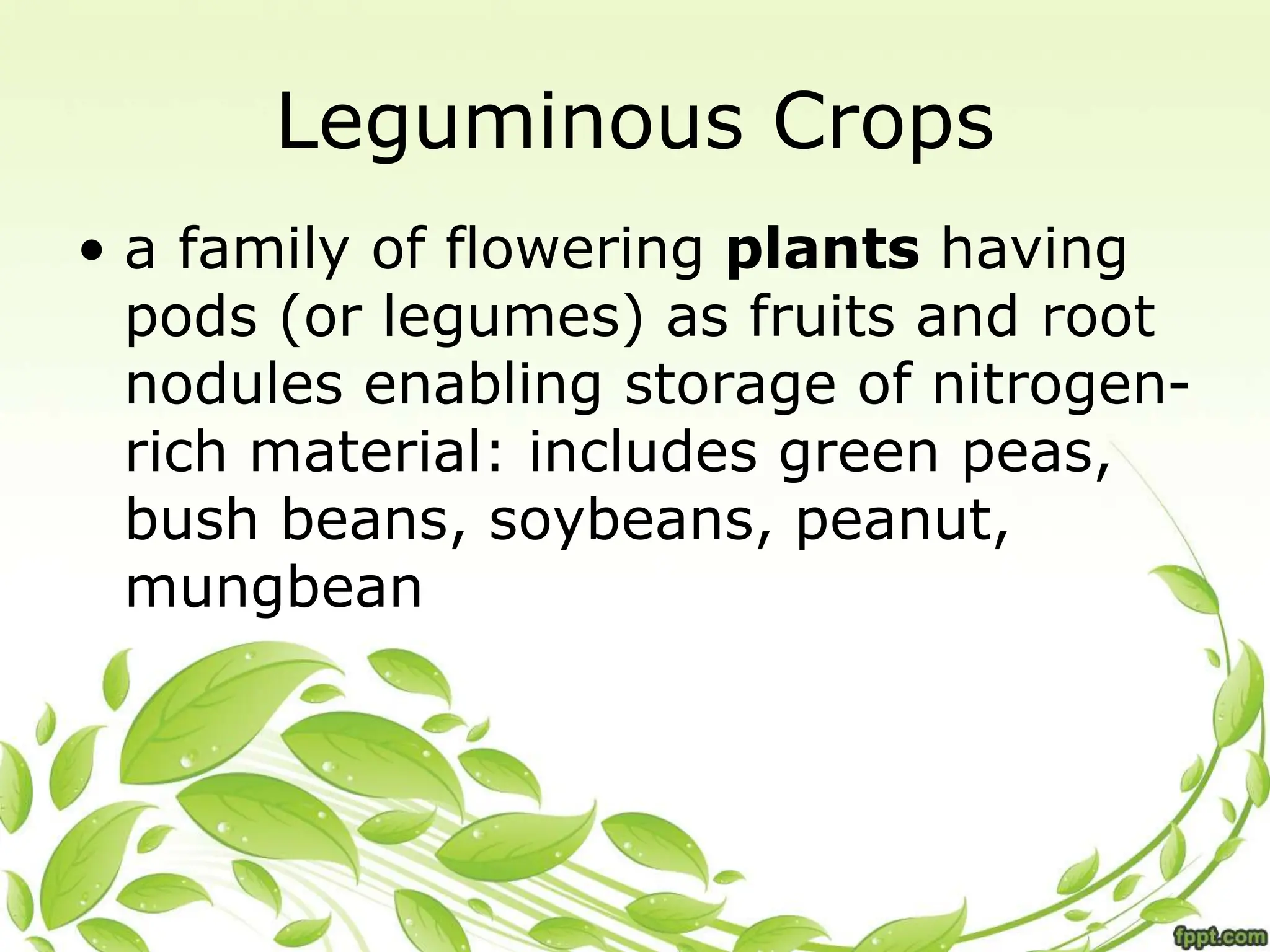
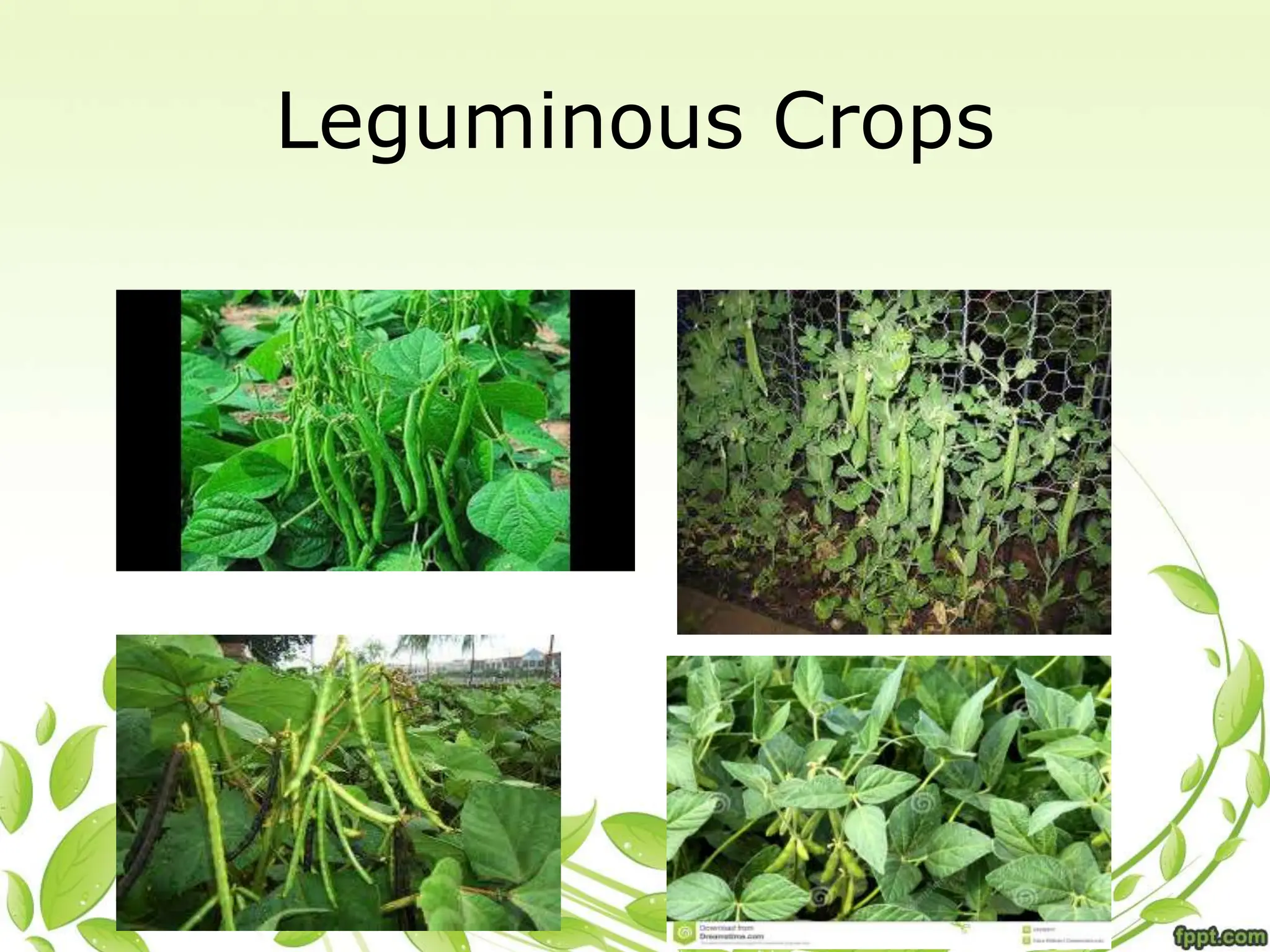
• a family of flowering plants having
pods (or legumes) as fruits and root
nodules enabling storage of nitrogen-
rich material: includes green peas,
bush beans, soybeans, peanut,
mungbean
Leguminous Crops
Leguminous Crops
• any of several fruits of plants of the
family solanaceae.
• Solanum means nightshade
• Solanaceous – nightshade family
flowering plants
Example : tomato, eggplant, pepper
and tobacco
Solanaceous Crops
• Any of various mostly climbing, traili
ng
and
creeping flowering plant of the family
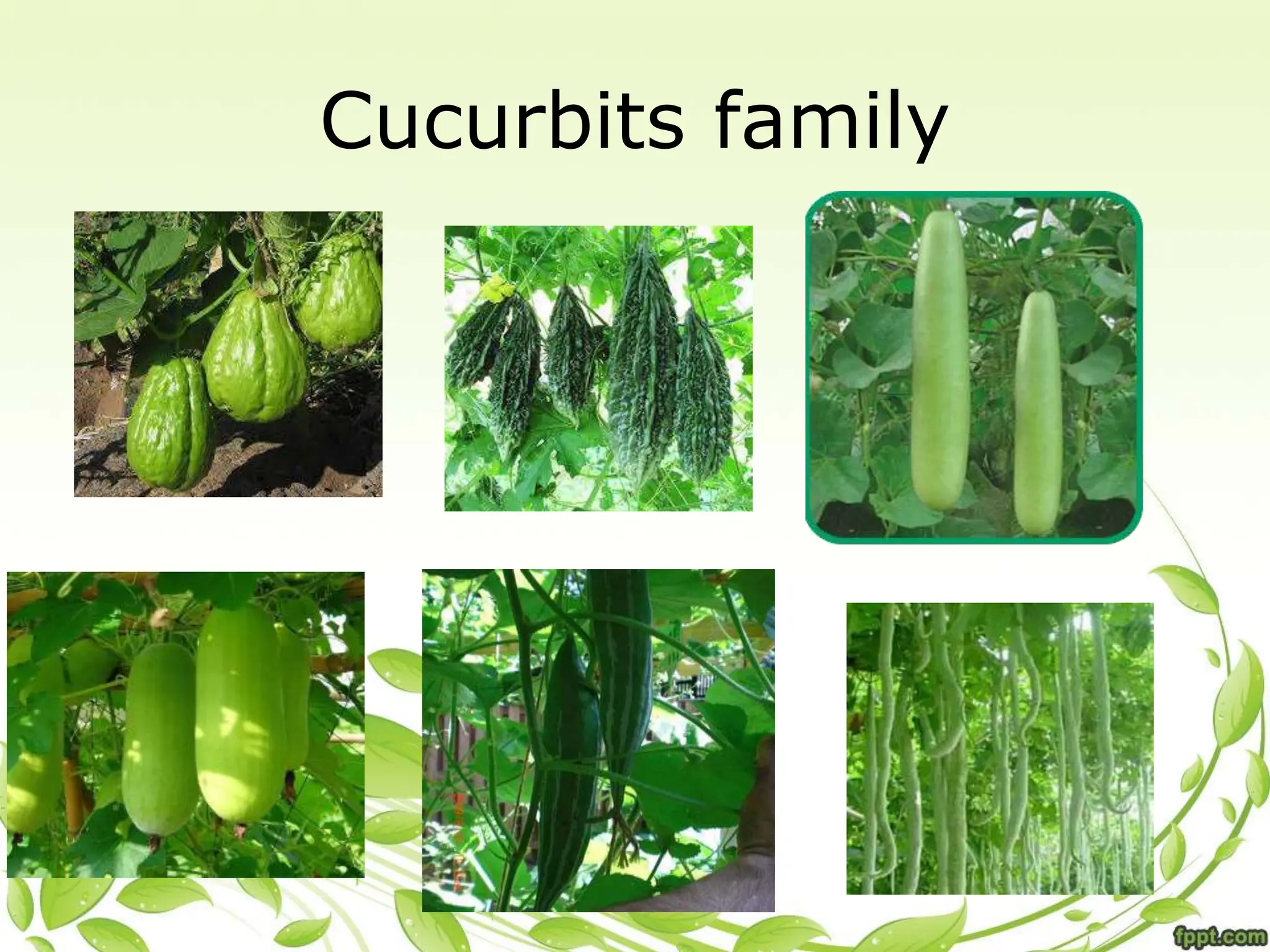
Cucurbitaceae
Ex. Squash, watermelon, cucumber,
bitter gourd, wax gourd, white gourd,
chayote
Cucurbits
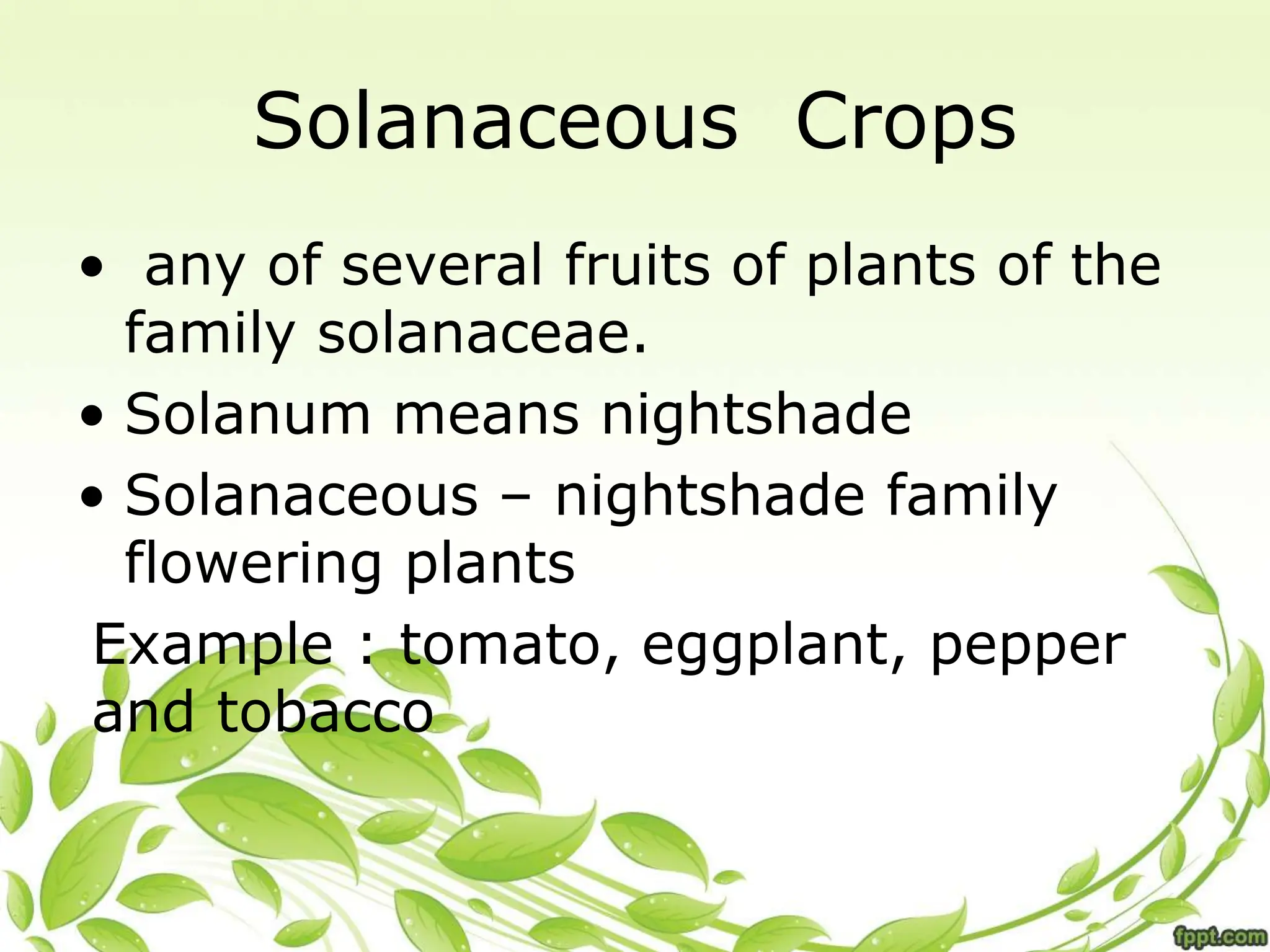
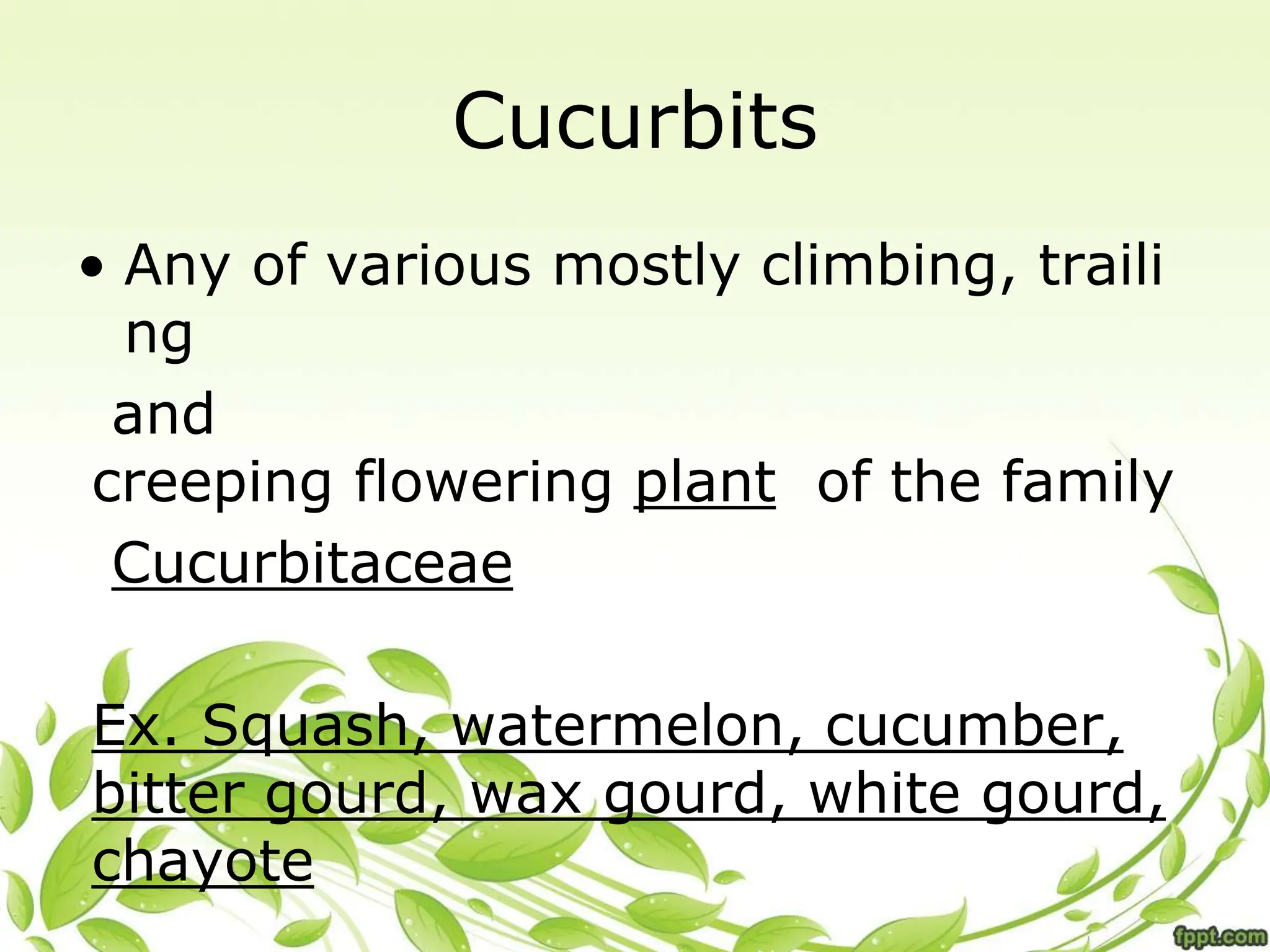
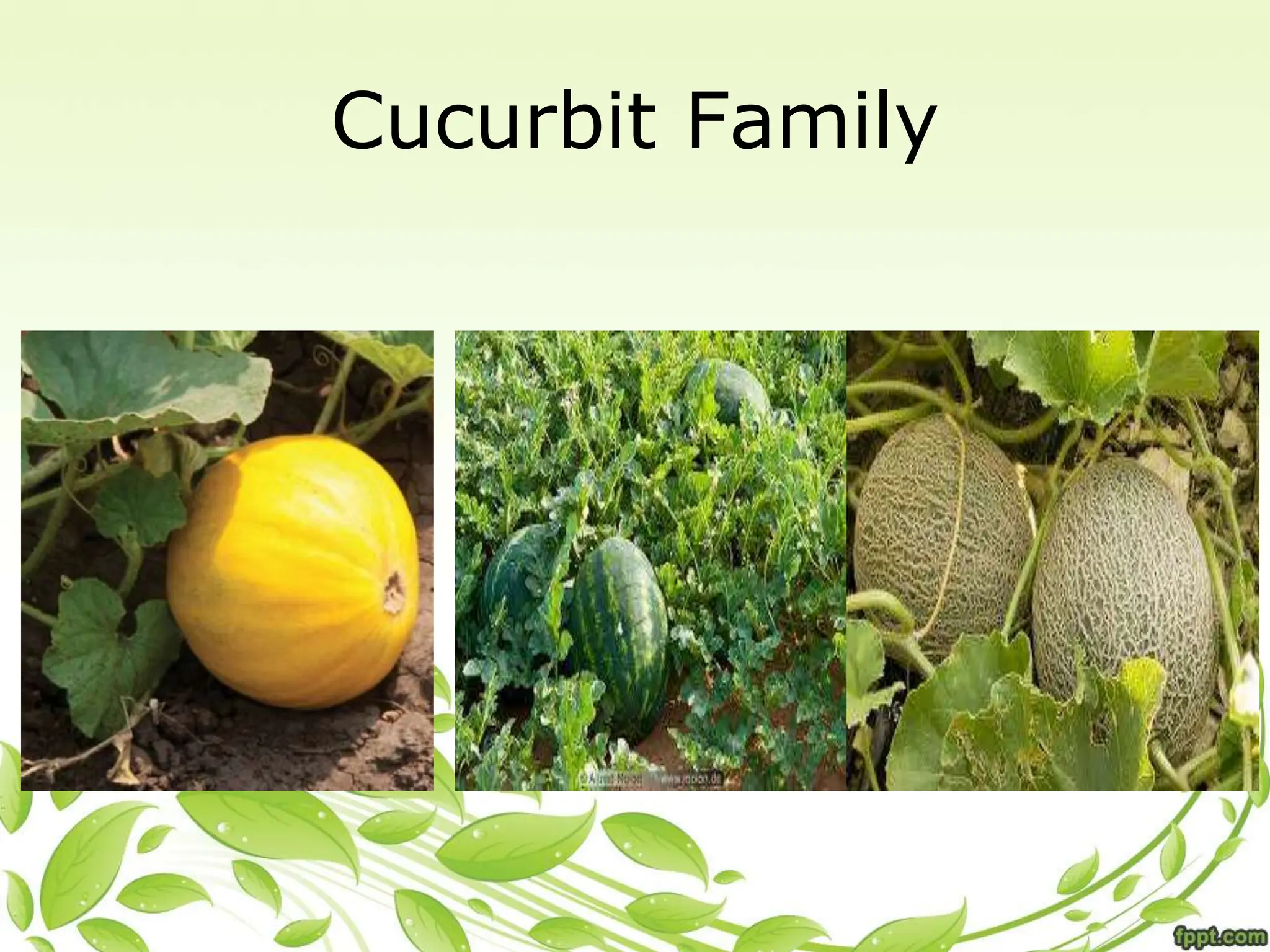
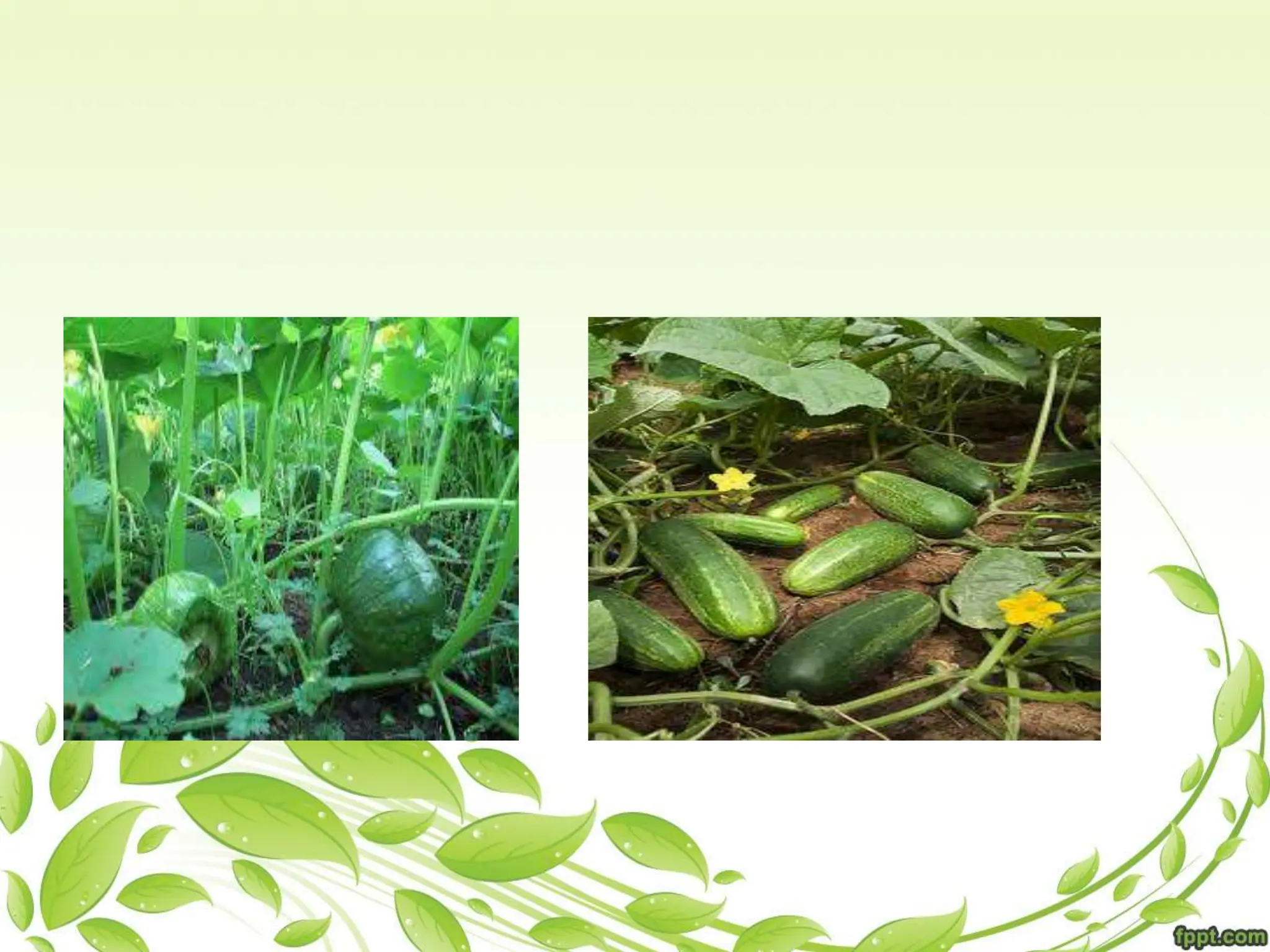
Cucurbit Family
Cucurbits family
Thank You & good luck!
III. AGRICULTURAL
CLASSIFICATION OF PLANTS
A. Crop vs. Weed
B. Agronomic vs. Horticultural Crops
C. Agricultural Classifications Based
on Primary Uses
D. Special Purpose Classifications of
Crops
C. Based on Primary Uses
1.Food Crops – plants grown primarily for the
harvesting of any part which is used by man as
food or processed into food product.
Examples: cereals, root and tuber crops, legume seed
crops, sugar crops, beverage crops, fruit crops and
vegetables.
2. Non-food Crops- plants grown for the
production of non-food products .
Examples: fiber, fodder, alcohol, tobacco, industrial oil,
rubber, latex & gums and resins, drugs, etc. or for
ornamentation, pasture and forage crops, dye and tannin
crops, biofuel crops, essential-oil crops, biocidal crops
and most industrial crops.
C. Based on Primary Uses
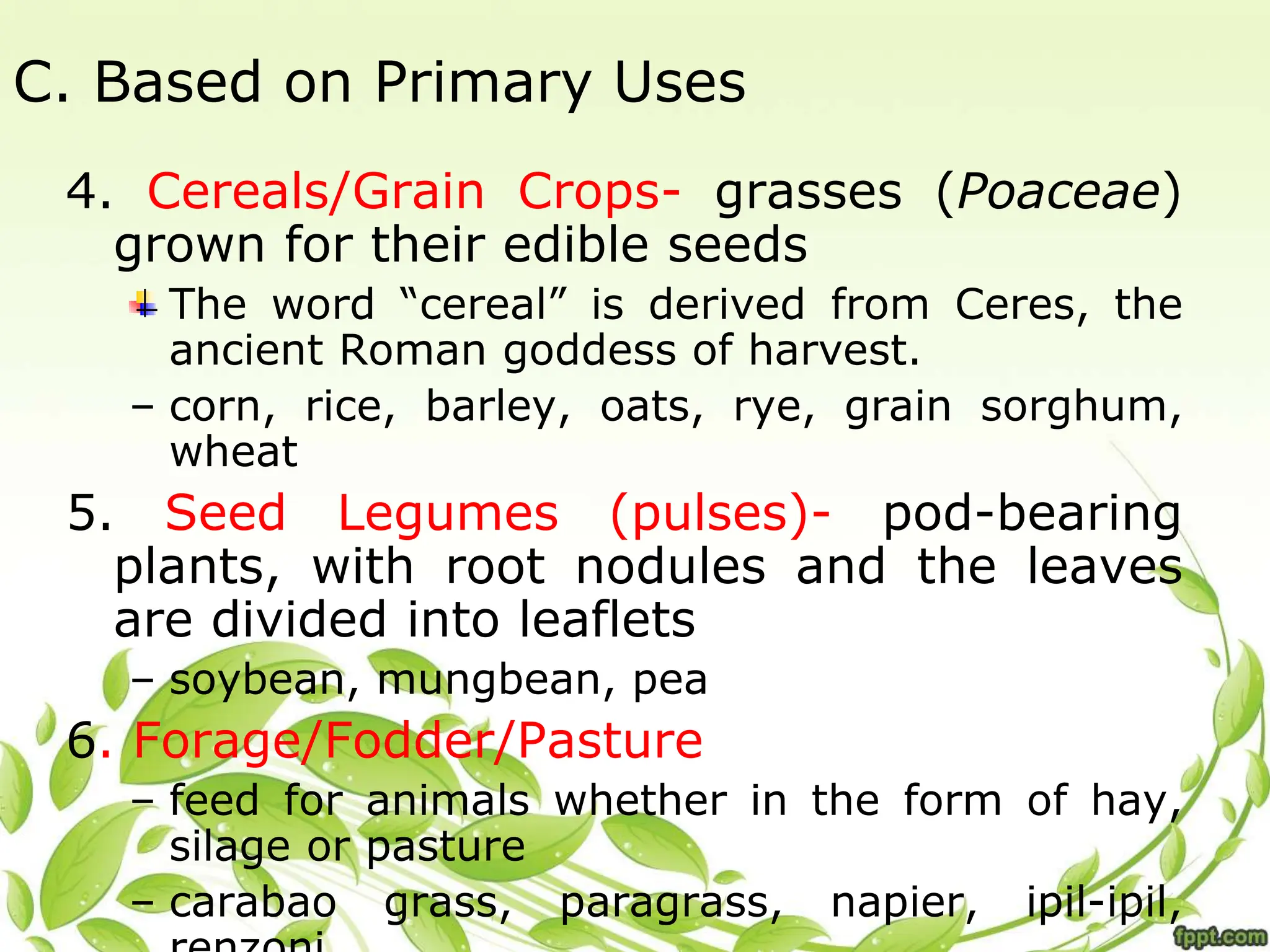
3. Staple Crops- plants grown for the
harvesting of parts which are used as
staple food.
In the Philippines, the top staple crop is rice
followed by corn.
Cassava is also consumed as staple by some
ethnic groups.
Examples of other staple crops: wheat,
breadfruit, millet, white potato, sweet potato,
yam.
C. Based on Primary Uses
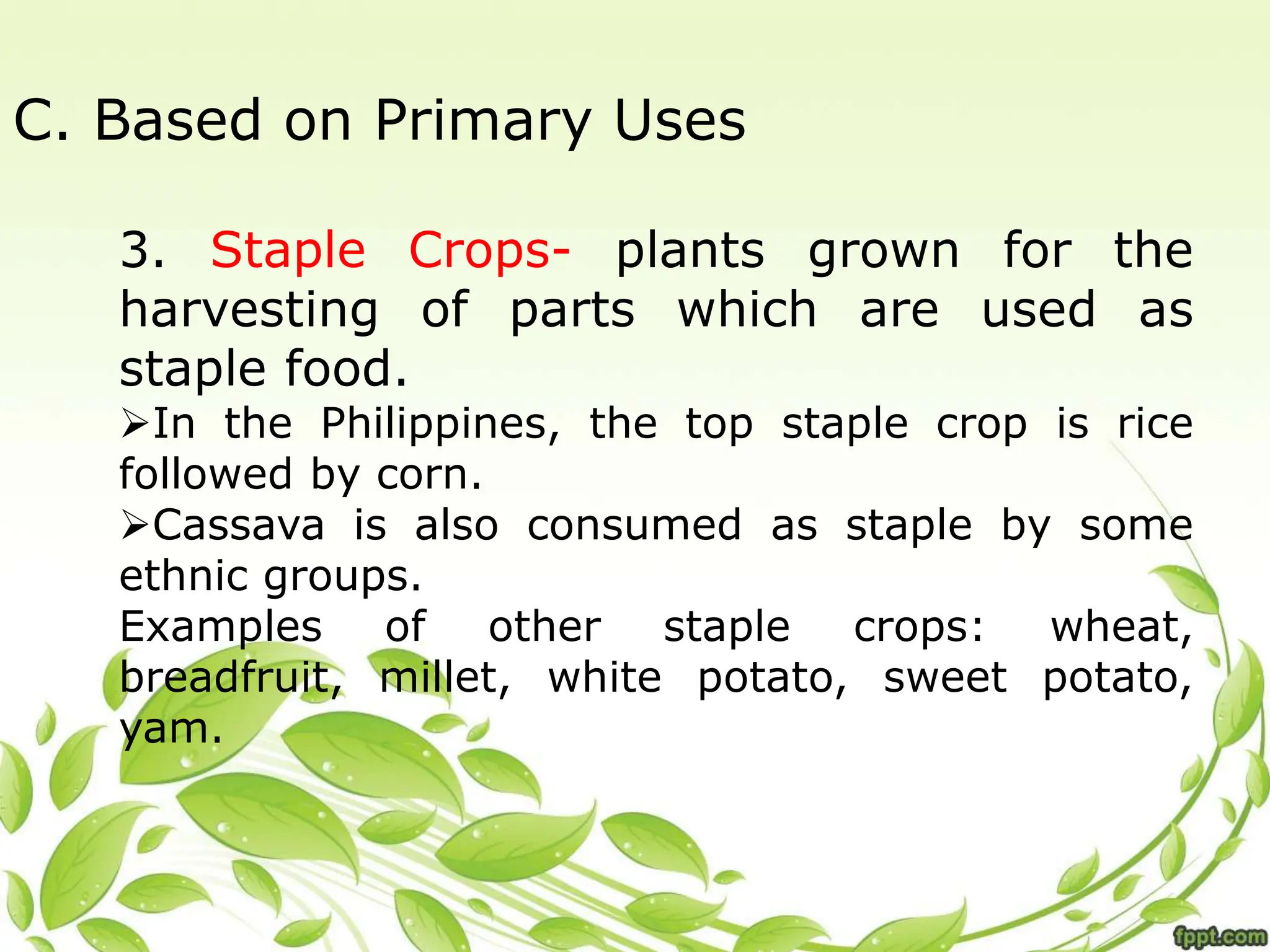
4. Cereals/Grain Crops- grasses (Poaceae)
grown for their edible seeds
The word “cereal” is derived from Ceres, the
ancient Roman goddess of harvest.
– corn, rice, barley, oats, rye, grain sorghum,
wheat
5. Seed Legumes (pulses)- pod-bearing
plants, with root nodules and the leaves
are divided into leaflets
– soybean, mungbean, pea
6. Forage/Fodder/Pasture
– feed for animals whether in the form of hay,
silage or pasture
– carabao grass, paragrass, napier, ipil-ipil,
C. Based on Primary Uses
7. Root and Tuber or Tuberous Crops- plants
with modified, swollen root or underground
stem.
– Crops with modified roots are distinct from
those having modified stems.
– Modified roots: arrowroot, cassava, sweet
potato and yam bean, carrot, ginseng (Panax
spp.) and sugar beet, raddish
– A tuber/modified stem: is an enlarged tip of an
underground stem.
– Examples: white potato and yam, gabi
C. Based on Primary Uses
8. Fiber
• plants grown as sources of fiber
• fiber is extracted from the bark, leaves, or other
organs including the husk of coconut.
• Examples: cotton, abaca, jute, kenaf, maguey,
ramie, flax
9. Beverage
• plants which are sources of various drinks
including fruit juices, tea, coffee, cocoa, toddy,
beer and wine.
• Examples: cacao, coconut, coffee, soursop, tea
Based on Primary Uses
10. Sugar & sweetener crops
– grown for their sweet syrup. ex.
sugarcane, sweet sorghum, sugar beets
, stevia, corn, sweet potato, cassava,
rice, many palms.
11. Oil- edible & industrial
– Coconut, flax, soybeans, sunflower
soybeans, peanut, sunflower, oil palm,
sesame and cotton =fiber & oil source,
kapok
Based on Primary Uses
• 12. Rubber Crops- source of latex
which is processed into industrial
product called rubber (for household
& transportation uses)
– Examples: rubber tree (Hevea brasiliensis),
Castilla rubber (Castilla elastica), Ceara rubber
(Manihot glaziovii), guayule (Parthenium
argentatum), Lagos Silk Rubber (Funtumia
elastica).
Based on Primary Uses
13. Latex and Gum Crops-
Plants grown for the collection of latex which is
processed into chewing gum, inelastic rubber and
other industrial products such as surgical tapes
and dental supplies, insulation, splints(support
broken bone), pipes, golf balls, waterproofing,
adhesives, etc.
Examples: chicle tree or chico (Manilkara zapota
Based on Primary Uses
14. Dye and Tannin Crops- plants grown as
sources of tannin and coloring substances.
– Tannin is an aromatic, phenolic substance
which is obtained from barks and other plant
organs and variously used in tanning,
medicines, dyeing, ink manufacture, etc.
Examples:anatto or achuete, Indian almond or
talisay, indigo (Indigofera tinctoria), bakawan
(Rhizophora and Bruguiera).
Based on Primary Uses
15. Biofuel Crops- plants grown for the
production of fuel that is used as additive or
replacement for petroleum products.
– The main biofuels are bioethanol, an alcohol
derived from fermented sugar or starch, and
biodiesel from vegetable oils.
– Examples: sugarcane, cassava, corn, coconut,
castor bean, Jatropha.
Based on Primary Uses
16. Olericultural or Vegetable Crops
– plants grown for their succulent and
edible parts such as the roots, stems,
leaves, young tops, fruits or seeds for
use in culinary preparations either fresh
or preserved in the fresh state.
Based on Primary Uses
Vgetable crops are classified according
to similarities:
– in edible parts,
– growth habits,
– methods of culture and
– botanical family. Melons are generally
included in this crop classification.
Vegetable Classifications Based on
Edible Part:
a. Leafy Vegetables
– Malabar nightshade (alugbate),
amaranth (kulitis), lettuce, jute
(saluyot), (horse raddish tree)
malunggay.
Based on Edible Part:
b. Shoot Vegetables
 asparagus, bamboo, celery.
c. Pod and Seed Vegetables- Generally members
of Leguminosae or Fabaceae family.
• snap bean, pole sitao, winged bean, okra, sweet
corn.
d. Root and Bulb Vegetables
– carrot, potato, onion, raddish
Based on Edible Part:
e. Flower Vegetables
– horse raddish tree (malunggay), katuray
(Sesbania grandiflora), squash, rose, sunflower
f. Fruit Vegetables
– ampalaya, eggplant, tomato, peppers, melons
Vegetable Classifications by Family
a. Cole Crops or Crucifers
– belong to Cruciferae or Brassicaceae
(Mustard) family, with edible leaves or
heads.
– cabbage, cauliflower, mustard, pechay,
Chinese cabbage, raddish.
Vegetable Classifications by Family
b. Cucurbits
– belong to the Cucurbitaceae (Gourd
and Squash) family.
– bottle gourd, charantia, cucumber, luffa,
melons, squash.
Vegetable Classifications by Family
c. Legume Vegetables
– members of the Leguminosae or
Fabaceae (Bean) family.
– bush sitao, katuray, pea, pole sitao.
d. Lilies- members of the Liliaceae
(Lily) family.
– asparagus, garlic, onion.
Vegetable Classifications by Family
e. Solanaceous Crops
– belong to the Solanaceae (Nightshade
or Eggplant) family and, with the
exception of white potato, are also
called Fruit Vegetables.
• eggplant, tomato, peppers, white potato.
Vegetable Classifications by Family
f. Mushrooms
– edible fungi belonging to the division
Basidiomycota (club fungi).
– straw mushroom, Shiitake mushroom,
puffball, termite mushroom, “kabuting-
higante”.
Based on Primary Uses
17. Pomological or Fruit Crops and
Nuts
– tree fruits=duhat, durian, jackfruit,
mango, mangosteen and papaya.
– small fruits (e.g. grape, passion fruit,
pineapple, strawberry).
– Nuts = cashew, pili.
Based on Primary Uses
18. Spice Crops
– black pepper, garlic, ginger, hot
pepper, onion, turmeric, vanilla,
cinnamon, anise
19. Essential-oil Crops- plants grown for
the extraction of essential oils which are
volatile, aromatic substances for
perfumery and other uses.
– citronella, eucalyptus, ilang-ilang,
peppermint, sampagita.
Based on Primary Uses
20. Ornamental Crops
further classified as:
– cutflowers specimen plants
– cut foliage avenue trees
– turfgrasses screens
– Groundcovers topiaries
– hedges fillers
– accents
Ornamental Crops
a. Lawn or Turf Grasses
– grasses grown for aesthetic purpose in the
landscape or for any outdoor recreational use.
– Bermuda grass, carabao grass
b. Cutflowers- plants grown for their attractive
flowers with long shelf life.
– anthurium, chrysanthemum, gladiolus,
orchids, rose.
Ornamental Crops
c. Cutfoliage
– plants grown for their attractive foliage which
are cut for floral decoration.
– ferns, fishtail palm, kamuning, Song of India,
Song of Jamaica.
d. Edge Crops- short statured plants grown to
serve as barrier between the lawn and garden,
to highlight gardens, or to create stand-alone
gardens; also called border plants.
– mondo grass, dwarf cucharita, dwarf
sansevieria.
Ornamental Crops
e. Groundcovers
– low-lying plants grown to suppress weed growth
and to control, retard or prevent soil erosion by
covering and binding loose, bare soil or produce
carpeting effect.
– cucharita (Alternanthera versicolor) , creeping
peanut (Arachis pentoi)
e. Hedges- plants grown at the edges of pathways or
boundaries and continuously pruned to knee-high
height or upper but below eye level.
– Duranta, hedge bamboo, Chinese holly, dwarf
santan, papua.
Ornamental Crops
f. Accents- plants with showy features distinct
from the rest of the other plants.
g. Specimens- plants having showy features, or
with unique characteristics which make them
pieces of conversation or botanical curiosity, or
otherwise desired as collector’s item.
– They are ideally planted in isolation rather than
massed with other plants
– queen of flowering trees (Amherstia nobilis),
palms, Mussaenda ‘Doña Eva’.
Ornamental Crops
h. Screens- plants grown to serve as barrier against
sun rays, to conceal certain parts of the landscape,
or to obstruct view.
– Indian tree, shrubs, trellised vines.
i. Shade crops- generally trees, shrubs, trellised
vines and lianas which are grown mainly to provide
shade singly or with supporting trellis.
j. Avenue Trees- trees and shrubs grown, more or less
equidistant, beside roads and streets. Palms are also
used.
– acacia (raintree), katuray, narra, date palm.
Based on Primary Uses
21. Biocidal Crops- plants containing organic
compounds with pesticidal properties.
– The effective parts are either directly applied
or seeped in water for foliar spray.
– chrysanthemum (Chrysanthemum
cineriaefolium), lagtang, makabuhay
(Tinospora crispa), tobacco, tubli (Derris
elliptica), neem (Azadirachta indica)
Based on Primary Uses
23. Industrial Crops
– plants grown to provide materials for
industrial processing and production of
non-food products such as:
• biofuel, sugar, rubber, starch, industrial oil,
aromatic compounds, steroids, medicinal
drugs, organic pesticides, tannins and dye.
Based on Primary Uses
24. Plantation Crops
– This classification is based on the
extensiveness of production, system of
culture required, and market location.
– requires plenty of labor and large
investment of capital.
– multinational companies like Dole
Philippines and Del Monte.
IV. Special Purpose Classification
• Intercrop- any crop which is planted
simultaneously with or before the
flowering season of the main crop in
intercropping.
• Filler Crop- any crop which is planted to fill
a gap.
• In quincunx system of planting
arrangement, the space at the center of
four hills of a main crop is commonly
intended for a filler crop which is of a
different variety or species.
IV. Special Purpose Classification
• Relay Crop- the crop which is planted
after the flowering period or harvest of the
main crop in relay cropping.
• Ratoon crop- the crop consisting of the
regrowth from shoots retained on the
plants after harvest or from cut stalks of
the previous crop
• (e.g. pineapple, sorghum, sugarcane).
IV. Special Purpose Classification
Cash crop- any crop grown to generate
cash rather than for subsistence.
Catch crop- any short maturing plant that is
grown simultaneously with, or between
successive plantings of a main crop to
utilize residual fertilizer and soil moisture.
• also called emergency crop.
IV. Special Purpose Classification
• Nurse crop- any crop which is grown to provide
shade and increase humidity for the benefit of
the main crop during its seedling and early
stages of growth.
• Companion crop- any crop which is planted
close to the main crop to complement the
latter’s growth and production, or to maximize
utilization of space because they do not
compete
Examples of companion crop
a. Black pepper is planted with live madre de cacao
(Gliricidia sepium) to serve as trellis.
b. Lettuce acts as a living mulch to keep the soil
moist while sunflowers to the south or west
provide shade for the vegetable.
c. Planting squash and onions will maximize
production per unit area of land.
IV. Special Purpose Classification
Cover crop- a crop grown mainly to control soil
erosion, regulate soil temperature, control weeds
and reduce evaporative losses.
Green manure crop- a leguminous crop grown to be
plowed under the soil to increase organic matter
and serve as organic fertilizer.
Agroforest Crop – any crop which is suited under a
cropping system consisting of mixed agricultural
and forest crops.
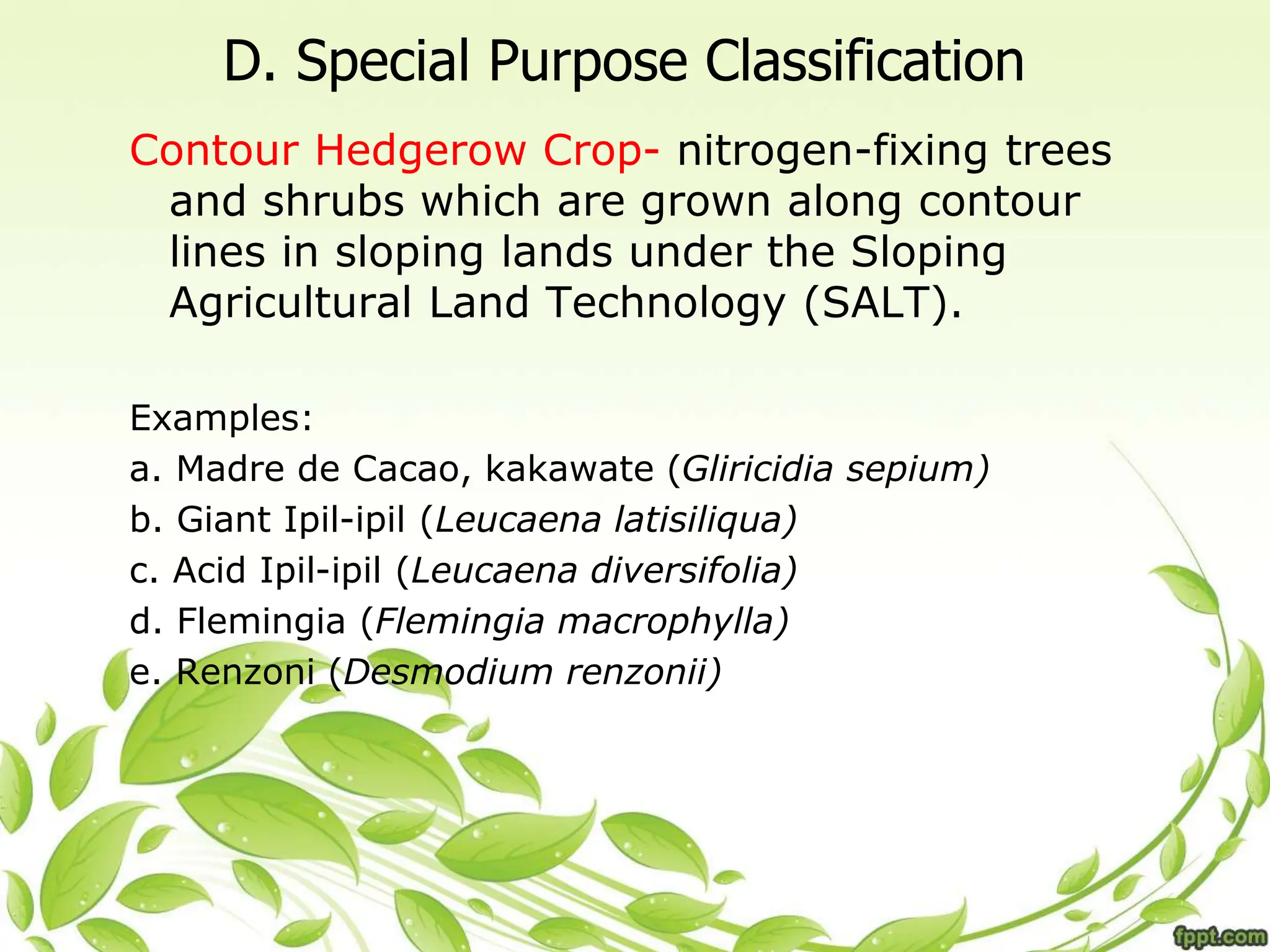
D. Special Purpose Classification
Contour Hedgerow Crop- nitrogen-fixing trees
and shrubs which are grown along contour
lines in sloping lands under the Sloping
Agricultural Land Technology (SALT).
Examples:
a. Madre de Cacao, kakawate (Gliricidia sepium)
b. Giant Ipil-ipil (Leucaena latisiliqua)
c. Acid Ipil-ipil (Leucaena diversifolia)
d. Flemingia (Flemingia macrophylla)
e. Renzoni (Desmodium renzonii)
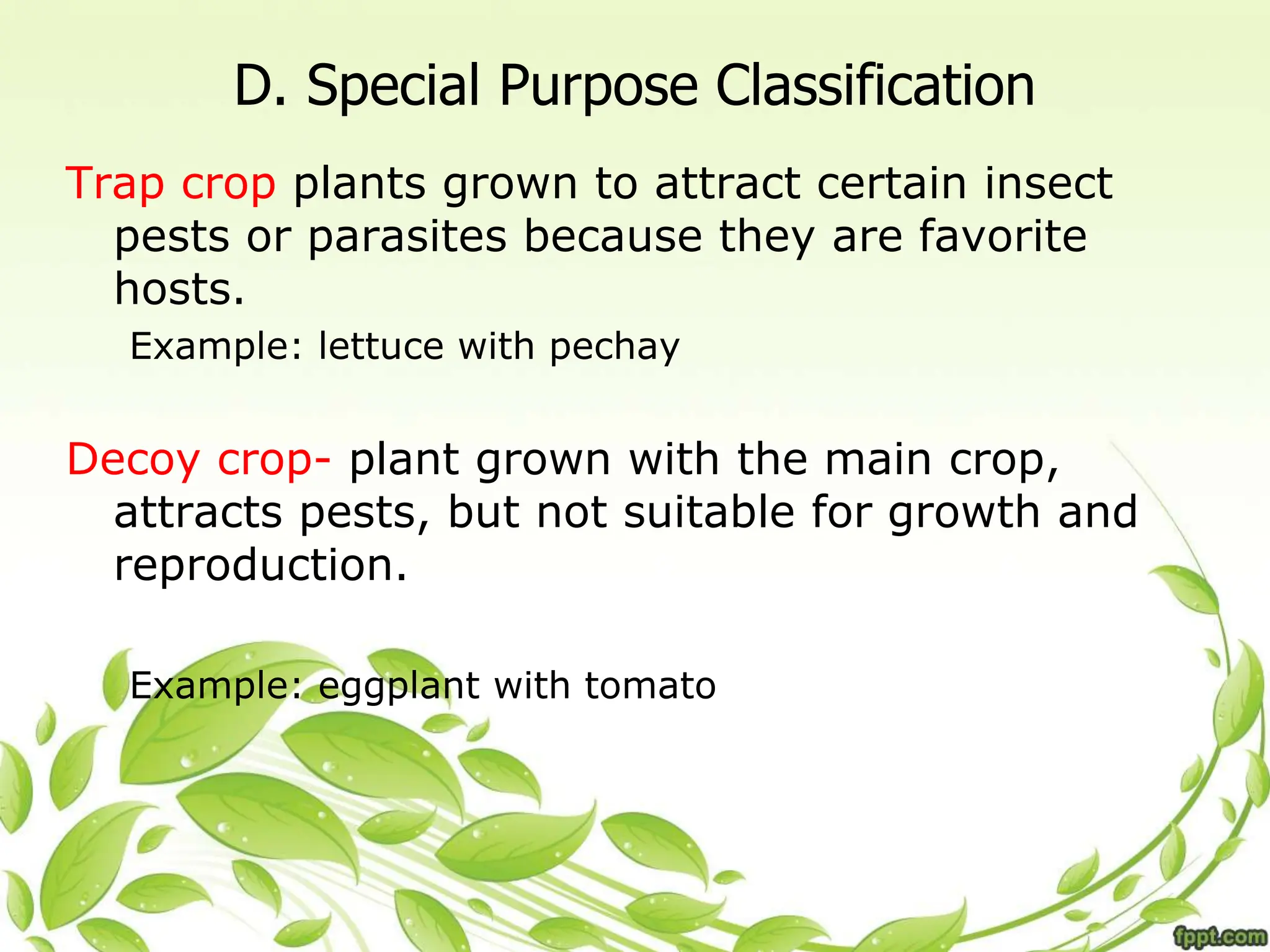
D. Special Purpose Classification
Trap crop plants grown to attract certain insect
pests or parasites because they are favorite
hosts.
Example: lettuce with pechay
Decoy crop- plant grown with the main crop,
attracts pests, but not suitable for growth and
reproduction.
Example: eggplant with tomato
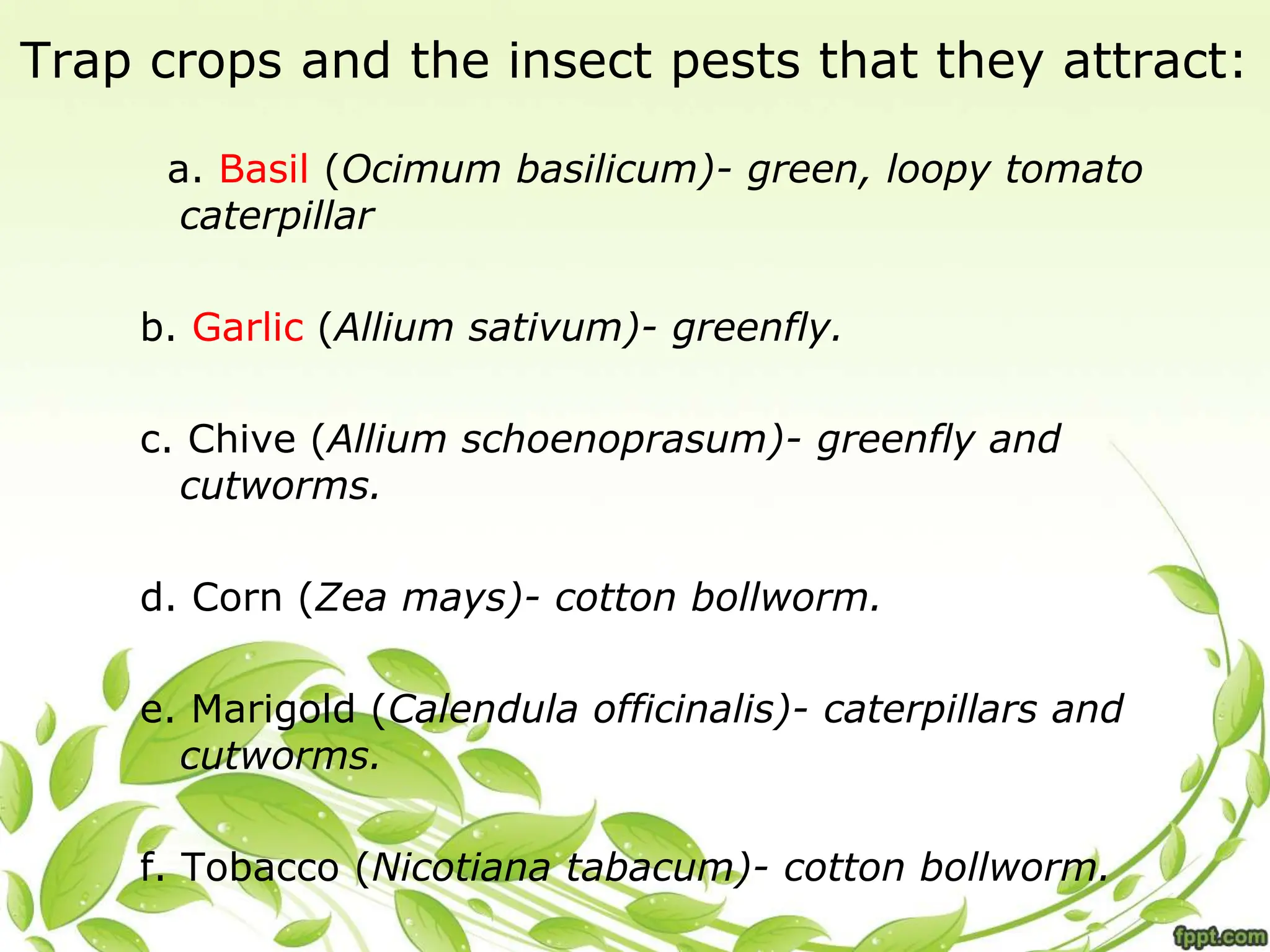
Trap crops and the insect pests that they attract:
a. Basil (Ocimum basilicum)- green, loopy tomato
caterpillar
b. Garlic (Allium sativum)- greenfly.
c. Chive (Allium schoenoprasum)- greenfly and
cutworms.
d. Corn (Zea mays)- cotton bollworm.
e. Marigold (Calendula officinalis)- caterpillars and
cutworms.
f. Tobacco (Nicotiana tabacum)- cotton bollworm.
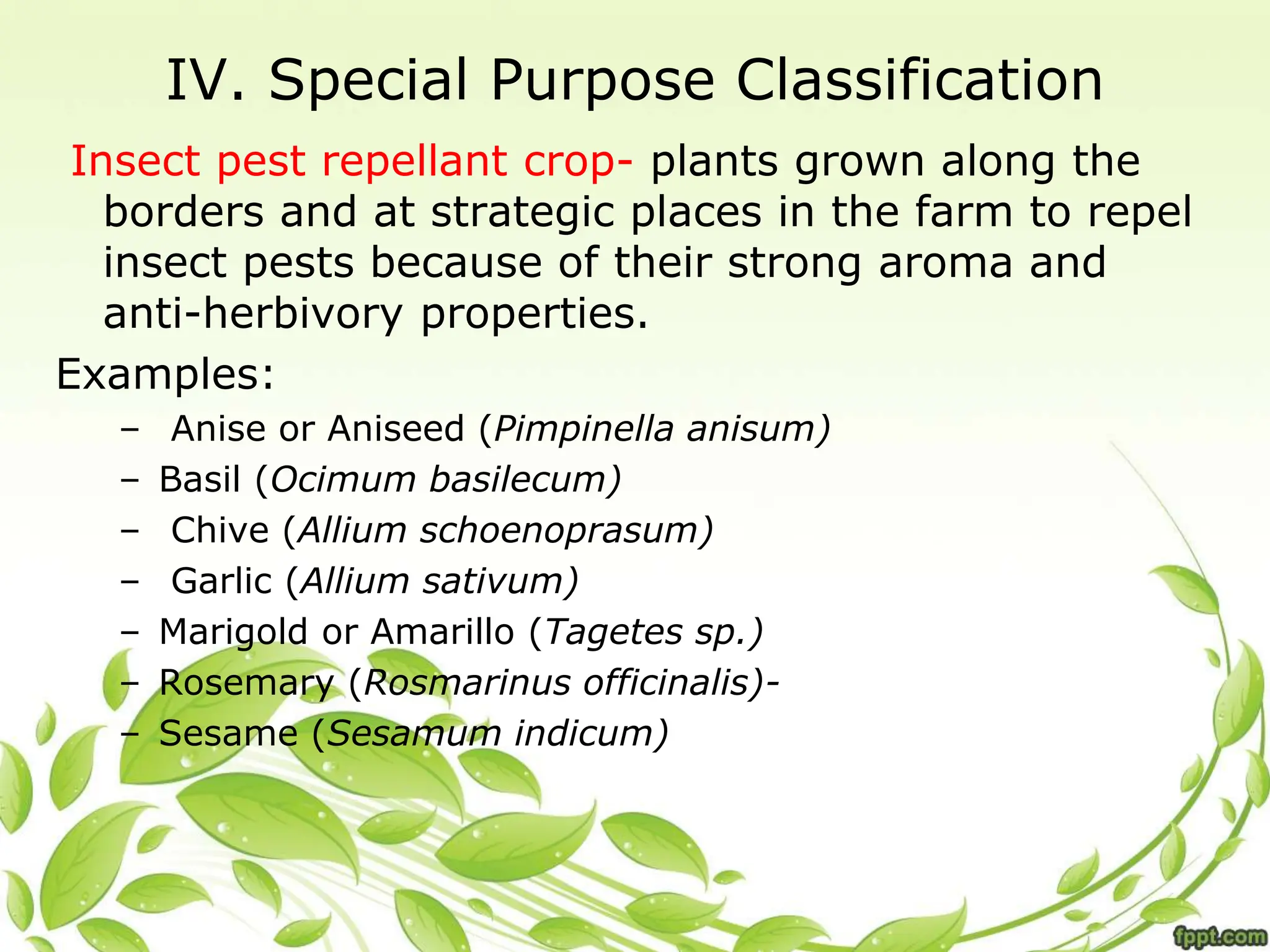
IV. Special Purpose Classification
Insect pest repellant crop- plants grown along the
borders and at strategic places in the farm to repel
insect pests because of their strong aroma and
anti-herbivory properties.
Examples:
– Anise or Aniseed (Pimpinella anisum)
– Basil (Ocimum basilecum)
– Chive (Allium schoenoprasum)
– Garlic (Allium sativum)
– Marigold or Amarillo (Tagetes sp.)
– Rosemary (Rosmarinus officinalis)-
– Sesame (Sesamum indicum)
IV. Special Purpose Classification
• Natural enemies attractant crop- flowering
plants grown at strategic places in the
farm to attract natural enemies of insect
pests.
Examples:
– Tagetes, - attract hoverflies whose larvae feed
on aphids.
– Legumes- attract spiders
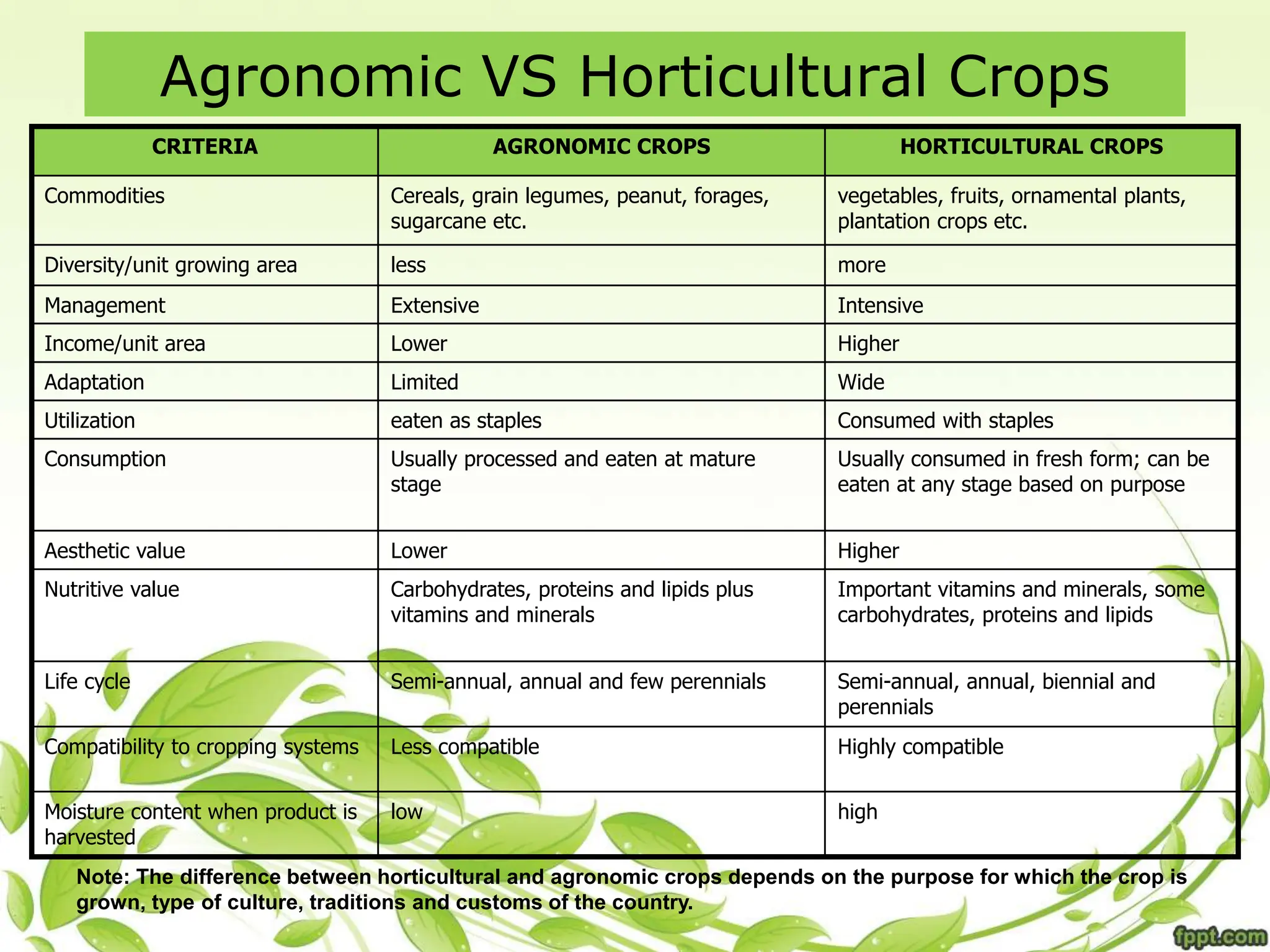
Agronomic VS Horticultural Crops
CRITERIA AGRONOMIC CROPS HORTICULTURAL CROPS
Commodities Cereals, grain legumes, peanut, forages,
sugarcane etc.
vegetables, fruits, ornamental plants,
plantation crops etc.
Diversity/unit growing area less more
Management Extensive Intensive
Income/unit area Lower Higher
Adaptation Limited Wide
Utilization eaten as staples Consumed with staples
Consumption Usually processed and eaten at mature
stage
Usually consumed in fresh form; can be
eaten at any stage based on purpose
Aesthetic value Lower Higher
Nutritive value Carbohydrates, proteins and lipids plus
vitamins and minerals
Important vitamins and minerals, some
carbohydrates, proteins and lipids
Life cycle Semi-annual, annual and few perennials Semi-annual, annual, biennial and
perennials
Compatibility to cropping systems Less compatible Highly compatible
Moisture content when product is
harvested
low high
Note: The difference between horticultural and agronomic crops depends on the purpose for which the crop is
grown, type of culture, traditions and customs of the country.
Prayer can move
mountains…
Thank You & good luck!

Classification of Agricultural Crops ppt

  • 1.
    CLASSIFICATION OF AGRICULTURAL CROPS JENNIFERP. CELADES CANR-Agriculture Department, BISU-Bilar
  • 2.
    Agricultural Classification A. Cropvs. Weed 1. Crop any useful plant, or a plant which is grown for any purpose utilized by man directly or indirectly, raw or processed 2. Weed an unintended plant or any plant which grows where it is not wanted. Many have allelopathic effect on other plants, by releasing harmful allelochemicals (plant-produced herbicides). Examples: Lantana camara and A. indica hagonoy (Chromolaena odorata) yellow nutsedge
  • 3.
    B. Agronomic vs.Horticultural Crops On the basis of tradition, extent of cultivation and intensity of culture, agricultural crops are classified into two main divisions: 1. Agronomic crops also called “field crops”. mostly annual herbaceous plants that are grown under extensive or large-scale culture. The usable products are usually in high dry matter form. Examples: cereals, seed legumes, root and tuber crops, sugar crops, latex and rubber crops, pasture and forage crops, and fiber crops
  • 4.
    2. Horticultural crops referred to as “garden crops”.  grown under any of the fields of horticulture such as:  olericulture or vegetable crops production  pomology or fruit crops production, and  ornamental horticulture (floriculture and landscape horticulture)  spices and medicinal plants  Horticultural crops are annual and perennial plants which are grown under an intensive system of culture.  utilized with high moisture content , highly perishable  are“intensively cultured plants directly used by man for food, for medicinal purposes, or for esthetic gratification”.  Intensive culture means a large input of capital, labor and technology per unit area of land.
  • 5.
    Both agronomic andhorticultural crops are further subclassified into specific groups according to the primary purpose of growing them. For example: corn (maize)=of young corn or sweet corn Pineapple =fruit crop =piña cloth. Papaya =industrial product papain. The basis of classification, should be “primary usage,” disregarding the other minor uses.
  • 6.
    Criteria AGRONOMIC CROPSHORTICULTURAL CROPS Ultimate consumers Human and animals human Harvest stage Often harvested mature Harvested at different stages Consumption Consumed processed in living state or dried Often consumed fresh Moisture content of harvested products low high Aesthetic consideration low high Calories high low Vitamins and minerals low high Life cycle Semi – annual, annual, few perennials Semi – annual, annual, biennial, perennial Adaptations limited wide Management extensive intensive Income per unit area low high Crop classifications Cereal or grain crops, grain legumes or pulses, oil seed crops, pasture and forage crops, fiber crops, sugar crops, Vegetable crops, fruit crops and edible nuts, ornamental crops, nursery crops, aromatic crops, medicinal crops Terms for production unit Field, pasture, range, forest Garden, orchard, grove, vineyard, greenhouse, nurseries, sometimes plantation
  • 7.
    Plants are classifiedaccording to the ff. criteria: I. Botanical II. Descriptive III. Agricultural IV. Special Purpose
  • 8.
    Introduction Botanical classification isbased on the morphological characteristics of plants as well as on their anatomy, physiology and DNA sequences. Descriptive classification is based on the environmental adaptation, growth habit and other observable features. In agriculture, plants can be broadly classified as either useful or unuseful. Those which are useful are called crops while those which are not useful are called weeds.
  • 9.
    Why classify crops? Tosimplify plant collection initiatives, research, breeding and specialized development efforts. To facilitate efficient communication, dissemination and retrieval of scientific information. the grouping of crops will indicate that these crops may have similar uses, adaptation, growth habits and methods of culture.
  • 10.
    Why classify crops? diseasecontrol and prevention, such classification is important due to commonality of some diseases. To students of crop science, a list of crops under the various agricultural classifications will be a useful reference in crop names and identification and as a review guide. To the farm manager, the same list will offer innumerable benefits in finding alternative crops for specific uses.
  • 11.
    Botanical Classification ofCrops During this meeting it was decided that Carl Linnaeus' Species Plantarum, which was published in 1753, would serve as the starting point for priority of botanical names.
  • 12.
    Botanical Classification ofCrops The principal ranks of taxa in descending sequence are: 1. kingdom 2. division /phylum 3. class 4. order 5. family 6. genus 7. species
  • 13.
    Plant Kingdom Thallophytes-algae, bacteria& fungi Bryophytes- mosses Pteridophytes-ferns Spermatophytes • All seed bearing Gymnosperms • plants with naked seeds e.g. pine tree Angiosperms • plants with seeds enclosed in a vessel Monocotyledonae (Monocots) Dicotyledonae (Dicots) DIVISION SUB-DIVISION CLASS
  • 14.
  • 15.
    Kingdom Plantae Division Spermatophyte Sub-divisionAngiospermae Class Monocotyledonae Order Graminales Family Graminae Genus Zea Species mays Scientific Name: Zea mays Classification Unit Example of Botanical Classification
  • 16.
    II. Descriptive Classification Modeof Reproduction Mode of Pollination Life Span Growth Habit Gross physiological characteristics Ecological Adaptation or Habitat Temperature tolerance Photoperiodic response Modification of plant parts
  • 17.
    Descriptive Classification A.According toMode of Reproduction 1. Sexual-develop from a seed 2. Asexual- reproduced by any vegetative means without the union of sexual gametes.
  • 18.
    Descriptive Classification B. LifeSpan 1.Annual- germinate, grow, flower, produce seed and die in one season. (rice, corn, mungbean, cowpea, squash) 2. Biennial- requires two growing seasons to complete its life cycle, the first for vegetative growth & accumulation of food reserves and second for production of reproductive parts (bulb onion, cabbage, celery, carrot, raddish)
  • 19.
    Life Span 3. Perennial-includingall trees and shrubs and many herbaceous plants with underground stems (e.g. corm, rhizome, tuber) like banana and clump-forming grasses. continue growing and produce seeds year after year
  • 20.
    Descriptive Classification D. Classificationaccording to Leaf Retention/gross physiological characteristics: 1. Deciduous- plants which naturally shed off or lose leaves annually for extended periods. Natural leaf shedding is pronounced in deciduous trees of temperate regions. In the Philippines, defoliation occurs during summer months in Fire Tree (Delonix regia) and red mombin or siniguelas, narra
  • 21.
    Descriptive Classification 2. Evergreens-plants whose leaves persist the year round. Evergreens may lose their leaves annually, but not until the new set of leaves has developed. Examples: pines, banana, papaya, palms and most tropical plants.
  • 22.
    Descriptive Classification E. EcologicalAdaptation or Habitat 1. Aquatic, hydrophyte or hydrophytic plant - a plant adapted to growing in water or waterlogged soil. It may grow entirely submerged, partly submerged or floating, or anchored to the ground in bogs, swamps, or beside the edges of ponds, lakes or streams. Examples: azolla(Anabaena azollae), kangkong (Ipomea aquatica), bulrush (Cyperus spp.), water lily (Nymphaea spp.), mangrove species.
  • 23.
    Descriptive Classification 2. Epiphyteor epiphytic plant- a plant that grows aboveground on another plant but is not parasitic, usually deriving only physical support from the host and obtaining nourishment from the air and other sources. Examples: pineapple (bromyliad), orchid, and fern families; also called air plant or tree dweller. Where a plant, e.g. strangler fig (balete), initially grows as an epiphyte but later becomes rooted to the soil, it is especially called a hemiepiphyte.
  • 24.
    Descriptive Classification 3. Halophyteor halophytic plant- a plant that is able to grow in habitats excessively rich in salts or under saline conditions. Examples: nipa, talisay, bakawan (Rhizophora mucronata) and other mangrove species. Coconut, cashew and tamarind have varying levels of tolerance to saline conditions.
  • 25.
    Descriptive Classification 4. Lithophyteor lithophytic plant a plant adapted to growing on rocks or in rocky terrain with little humus, absorbing nutrients from the atmosphere, rain, and decaying matter which accumulate on the rocks. Examples: Vanda, Dendrobium, other orchids
  • 26.
    Descriptive Classification 5. Mesophyteor mesophitic plant terrestrial plant adapted to moderate conditions for growth, i.e. not too dry and not too wet Examples: corn and most commercially-grown crops). 6. Parasite or parasitic plant plant which grows on another plant from which it takes part or all nourishment Example: Loranthaceae (mistletoe family), Rafflesia; Neottia and Corallorhiza orchids).
  • 27.
    Descriptive Classification 7. Saprophyteor saprophytic crop- grows on decaying organic matter and has no green tissue. Example: mushrooms 8. Sciophyte or sciophytic plant- plant adapted to low light intensity or shade, e.g. most ferns and mosses, black pepper, cacao, coffee, lanzones, mangosteen, hot pepper, gingers, and many orchids can tolerate or require shade.
  • 28.
    Descriptive Classification 9. Terrestrialor land plant- a plant which grows on land, rooting in the soil. Most agricultural crops are terrestrial and are further subclassified into various groups such as halophytes, mesophytes, sciophytes and xerophytes depending on climatic and special adaptations.
  • 29.
    Descriptive Classification 10. Xerophyte,xerophytic plant a plant which is adapted to conditions with little or no water. Examples: bromyliads, euphorbias, cacti and many succulents.
  • 30.
  • 31.
    HERBS – succulent,seed plants possessing self supporting stem
  • 32.
    Vines – non-woodyplants whose stems requires support for upright growth, maybe climbing or training plant
  • 33.
    Shrubs – areself – supporting woody plants characterized by several more or less upright stems
  • 34.
    Trees – areself supporting woody plants characterized by several more or less upright stems
  • 35.
    CLASSIFICATION OF CROPS Based ongross physiological characteristics
  • 36.
    Deciduous – areplants that shed – off their leaves during a portion of the year
  • 37.
    Evergreen • are plantswhose leaves persist the year round. Evergreens may loose their leaves annually, but not until the new set of leaves has developed. • Ex. Santol, lanzones, mango, rambutan, durian, papaya, mangoesteen,
  • 38.
    CLASSIFICATIONS OF CROPS Based ontemperature tolerance
  • 39.
    Tropical Crops • thosegrown in the tropics and could not withstand chilling. • Most of our fruits belong in this category Ex. Banana, mang0, papaya, guava, etc.
  • 40.
    Subtropical or semi- temperate Crops • Those which can withstand slight chilling and relatively high temperature. Ex. Citrus family, grapes, strawberry and cherry
  • 41.
    Temperate Crops • Thosewhich can not withstand high temperature Ex. Apple, peaches, pears, plum and apricot
  • 42.
    CLASSIFICATIONS OF CROPS Based onPhotoperiodic Response
  • 43.
    • Plants canbe classified according how they react and influenced by relative length of daylight and darknesss. A. Long day plants – They require long day (about 14 or more hours) for the formation of inflorescence. If the daylight is shorter, these crops remain in their vegetative stage. Ex. Spinach, onion, lettuce, raddish, potato,
  • 44.
    B. Short dayplants – They require relatively short day length (less than 14 hours to initiate flowering.) Ex. Cowpea, winged bean, sayote, soybean, kamote, mungbean, chrysanthemum, cotton, rice, poinsettia C. Day-neutral plants – These crops that will flower regardless of the length of photoperiod. Ex. Corn, cucumber, tomato, eggplant, pepper, sunflower.
  • 45.
  • 46.
    1. Cereal crops– are grasses grown for their edible seeds, the term being applied either to the grain or to the plant itself. Ex. Rice, corn, millet, barley, sorghum, wheat
  • 47.
    2. Legume orPulse crops - are pod-bearing plants, with root nodules and whose leaves are divided into leaflets. Ex. Mungbean, peanut, cowpea, soybean, etc. 3. Root crops – are plants grown for their edible fleshy roots Ex. Sweet potato, yam, gabi
  • 48.
    4. Tuber crops–are plants grown for their short, thickened underground stem. Ex. Cassava, ginger, white potato 5. Sugarcane – is grown for its sweet juices from which sugar is extracted and crystalized.
  • 49.
  • 50.
    Division of Horticulture 1.Olericulture (vegetables) 2. Pomology (fruits) 3. Flowers and Ornamentals (Floriculture) 4. Plantation and Industrial crops
  • 51.
    • Olericulture –is the study of vegetable production. Person who are engage in the study of vegetable crops with respect to culture and production are called olericulturists. Vegetable production may be categorized as follows: a. Home gardening – the main intention of the grower is to produce vegetable crops for home consumption. b. Market gardening – assorted vegetable crops are grown to local and roadside markets. c. Truck gardening – large-scale type of vegetable production. Vegetable grown are intended for wholesaler market, shipping to other places or supplying a processing plant.
  • 52.
    d. Hydroponics –is a subset of hydroculture and is a method of growing plants using mineral nutrient solutions, in water, without soil.
  • 53.
  • 54.
  • 55.
  • 56.
  • 57.
    • crops grownmainly for their leaves • Example: pechay, mustard, kangkong (swamp cabbage), alugbati, celery, kulitis (amaranth), Leafy Vegetables
  • 58.
  • 59.
    • Cole Crops– Crops which is belong to Brassica family. These plants grow better in cool weather, need cooler temperature. The terms "cold" and "cole" sound the same but have different meanings. "Cold" of course refers to temperature. "Cole" refers to any of various plants belonging to the Cruciferae or mustard family. • Ex. Pechay, brocolli, cabbage, mustard, cauliflower
  • 60.
  • 61.
    • a familyof flowering plants having pods (or legumes) as fruits and root nodules enabling storage of nitrogen- rich material: includes green peas, bush beans, soybeans, peanut, mungbean Leguminous Crops
  • 62.
  • 63.
    • any ofseveral fruits of plants of the family solanaceae. • Solanum means nightshade • Solanaceous – nightshade family flowering plants Example : tomato, eggplant, pepper and tobacco Solanaceous Crops
  • 64.
    • Any ofvarious mostly climbing, traili ng and creeping flowering plant of the family Cucurbitaceae Ex. Squash, watermelon, cucumber, bitter gourd, wax gourd, white gourd, chayote Cucurbits
  • 65.
  • 67.
  • 68.
    Thank You &good luck!
  • 70.
    III. AGRICULTURAL CLASSIFICATION OFPLANTS A. Crop vs. Weed B. Agronomic vs. Horticultural Crops C. Agricultural Classifications Based on Primary Uses D. Special Purpose Classifications of Crops
  • 71.
    C. Based onPrimary Uses 1.Food Crops – plants grown primarily for the harvesting of any part which is used by man as food or processed into food product. Examples: cereals, root and tuber crops, legume seed crops, sugar crops, beverage crops, fruit crops and vegetables. 2. Non-food Crops- plants grown for the production of non-food products . Examples: fiber, fodder, alcohol, tobacco, industrial oil, rubber, latex & gums and resins, drugs, etc. or for ornamentation, pasture and forage crops, dye and tannin crops, biofuel crops, essential-oil crops, biocidal crops and most industrial crops.
  • 72.
    C. Based onPrimary Uses 3. Staple Crops- plants grown for the harvesting of parts which are used as staple food. In the Philippines, the top staple crop is rice followed by corn. Cassava is also consumed as staple by some ethnic groups. Examples of other staple crops: wheat, breadfruit, millet, white potato, sweet potato, yam.
  • 73.
    C. Based onPrimary Uses 4. Cereals/Grain Crops- grasses (Poaceae) grown for their edible seeds The word “cereal” is derived from Ceres, the ancient Roman goddess of harvest. – corn, rice, barley, oats, rye, grain sorghum, wheat 5. Seed Legumes (pulses)- pod-bearing plants, with root nodules and the leaves are divided into leaflets – soybean, mungbean, pea 6. Forage/Fodder/Pasture – feed for animals whether in the form of hay, silage or pasture – carabao grass, paragrass, napier, ipil-ipil,
  • 74.
    C. Based onPrimary Uses 7. Root and Tuber or Tuberous Crops- plants with modified, swollen root or underground stem. – Crops with modified roots are distinct from those having modified stems. – Modified roots: arrowroot, cassava, sweet potato and yam bean, carrot, ginseng (Panax spp.) and sugar beet, raddish – A tuber/modified stem: is an enlarged tip of an underground stem. – Examples: white potato and yam, gabi
  • 75.
    C. Based onPrimary Uses 8. Fiber • plants grown as sources of fiber • fiber is extracted from the bark, leaves, or other organs including the husk of coconut. • Examples: cotton, abaca, jute, kenaf, maguey, ramie, flax 9. Beverage • plants which are sources of various drinks including fruit juices, tea, coffee, cocoa, toddy, beer and wine. • Examples: cacao, coconut, coffee, soursop, tea
  • 76.
    Based on PrimaryUses 10. Sugar & sweetener crops – grown for their sweet syrup. ex. sugarcane, sweet sorghum, sugar beets , stevia, corn, sweet potato, cassava, rice, many palms. 11. Oil- edible & industrial – Coconut, flax, soybeans, sunflower soybeans, peanut, sunflower, oil palm, sesame and cotton =fiber & oil source, kapok
  • 77.
    Based on PrimaryUses • 12. Rubber Crops- source of latex which is processed into industrial product called rubber (for household & transportation uses) – Examples: rubber tree (Hevea brasiliensis), Castilla rubber (Castilla elastica), Ceara rubber (Manihot glaziovii), guayule (Parthenium argentatum), Lagos Silk Rubber (Funtumia elastica).
  • 78.
    Based on PrimaryUses 13. Latex and Gum Crops- Plants grown for the collection of latex which is processed into chewing gum, inelastic rubber and other industrial products such as surgical tapes and dental supplies, insulation, splints(support broken bone), pipes, golf balls, waterproofing, adhesives, etc. Examples: chicle tree or chico (Manilkara zapota
  • 79.
    Based on PrimaryUses 14. Dye and Tannin Crops- plants grown as sources of tannin and coloring substances. – Tannin is an aromatic, phenolic substance which is obtained from barks and other plant organs and variously used in tanning, medicines, dyeing, ink manufacture, etc. Examples:anatto or achuete, Indian almond or talisay, indigo (Indigofera tinctoria), bakawan (Rhizophora and Bruguiera).
  • 80.
    Based on PrimaryUses 15. Biofuel Crops- plants grown for the production of fuel that is used as additive or replacement for petroleum products. – The main biofuels are bioethanol, an alcohol derived from fermented sugar or starch, and biodiesel from vegetable oils. – Examples: sugarcane, cassava, corn, coconut, castor bean, Jatropha.
  • 81.
    Based on PrimaryUses 16. Olericultural or Vegetable Crops – plants grown for their succulent and edible parts such as the roots, stems, leaves, young tops, fruits or seeds for use in culinary preparations either fresh or preserved in the fresh state.
  • 82.
    Based on PrimaryUses Vgetable crops are classified according to similarities: – in edible parts, – growth habits, – methods of culture and – botanical family. Melons are generally included in this crop classification.
  • 83.
    Vegetable Classifications Basedon Edible Part: a. Leafy Vegetables – Malabar nightshade (alugbate), amaranth (kulitis), lettuce, jute (saluyot), (horse raddish tree) malunggay.
  • 84.
    Based on EdiblePart: b. Shoot Vegetables  asparagus, bamboo, celery. c. Pod and Seed Vegetables- Generally members of Leguminosae or Fabaceae family. • snap bean, pole sitao, winged bean, okra, sweet corn. d. Root and Bulb Vegetables – carrot, potato, onion, raddish
  • 85.
    Based on EdiblePart: e. Flower Vegetables – horse raddish tree (malunggay), katuray (Sesbania grandiflora), squash, rose, sunflower f. Fruit Vegetables – ampalaya, eggplant, tomato, peppers, melons
  • 86.
    Vegetable Classifications byFamily a. Cole Crops or Crucifers – belong to Cruciferae or Brassicaceae (Mustard) family, with edible leaves or heads. – cabbage, cauliflower, mustard, pechay, Chinese cabbage, raddish.
  • 87.
    Vegetable Classifications byFamily b. Cucurbits – belong to the Cucurbitaceae (Gourd and Squash) family. – bottle gourd, charantia, cucumber, luffa, melons, squash.
  • 88.
    Vegetable Classifications byFamily c. Legume Vegetables – members of the Leguminosae or Fabaceae (Bean) family. – bush sitao, katuray, pea, pole sitao. d. Lilies- members of the Liliaceae (Lily) family. – asparagus, garlic, onion.
  • 89.
    Vegetable Classifications byFamily e. Solanaceous Crops – belong to the Solanaceae (Nightshade or Eggplant) family and, with the exception of white potato, are also called Fruit Vegetables. • eggplant, tomato, peppers, white potato.
  • 90.
    Vegetable Classifications byFamily f. Mushrooms – edible fungi belonging to the division Basidiomycota (club fungi). – straw mushroom, Shiitake mushroom, puffball, termite mushroom, “kabuting- higante”.
  • 91.
    Based on PrimaryUses 17. Pomological or Fruit Crops and Nuts – tree fruits=duhat, durian, jackfruit, mango, mangosteen and papaya. – small fruits (e.g. grape, passion fruit, pineapple, strawberry). – Nuts = cashew, pili.
  • 92.
    Based on PrimaryUses 18. Spice Crops – black pepper, garlic, ginger, hot pepper, onion, turmeric, vanilla, cinnamon, anise 19. Essential-oil Crops- plants grown for the extraction of essential oils which are volatile, aromatic substances for perfumery and other uses. – citronella, eucalyptus, ilang-ilang, peppermint, sampagita.
  • 93.
    Based on PrimaryUses 20. Ornamental Crops further classified as: – cutflowers specimen plants – cut foliage avenue trees – turfgrasses screens – Groundcovers topiaries – hedges fillers – accents
  • 94.
    Ornamental Crops a. Lawnor Turf Grasses – grasses grown for aesthetic purpose in the landscape or for any outdoor recreational use. – Bermuda grass, carabao grass b. Cutflowers- plants grown for their attractive flowers with long shelf life. – anthurium, chrysanthemum, gladiolus, orchids, rose.
  • 95.
    Ornamental Crops c. Cutfoliage –plants grown for their attractive foliage which are cut for floral decoration. – ferns, fishtail palm, kamuning, Song of India, Song of Jamaica. d. Edge Crops- short statured plants grown to serve as barrier between the lawn and garden, to highlight gardens, or to create stand-alone gardens; also called border plants. – mondo grass, dwarf cucharita, dwarf sansevieria.
  • 96.
    Ornamental Crops e. Groundcovers –low-lying plants grown to suppress weed growth and to control, retard or prevent soil erosion by covering and binding loose, bare soil or produce carpeting effect. – cucharita (Alternanthera versicolor) , creeping peanut (Arachis pentoi) e. Hedges- plants grown at the edges of pathways or boundaries and continuously pruned to knee-high height or upper but below eye level. – Duranta, hedge bamboo, Chinese holly, dwarf santan, papua.
  • 97.
    Ornamental Crops f. Accents-plants with showy features distinct from the rest of the other plants. g. Specimens- plants having showy features, or with unique characteristics which make them pieces of conversation or botanical curiosity, or otherwise desired as collector’s item. – They are ideally planted in isolation rather than massed with other plants – queen of flowering trees (Amherstia nobilis), palms, Mussaenda ‘Doña Eva’.
  • 98.
    Ornamental Crops h. Screens-plants grown to serve as barrier against sun rays, to conceal certain parts of the landscape, or to obstruct view. – Indian tree, shrubs, trellised vines. i. Shade crops- generally trees, shrubs, trellised vines and lianas which are grown mainly to provide shade singly or with supporting trellis. j. Avenue Trees- trees and shrubs grown, more or less equidistant, beside roads and streets. Palms are also used. – acacia (raintree), katuray, narra, date palm.
  • 99.
    Based on PrimaryUses 21. Biocidal Crops- plants containing organic compounds with pesticidal properties. – The effective parts are either directly applied or seeped in water for foliar spray. – chrysanthemum (Chrysanthemum cineriaefolium), lagtang, makabuhay (Tinospora crispa), tobacco, tubli (Derris elliptica), neem (Azadirachta indica)
  • 100.
    Based on PrimaryUses 23. Industrial Crops – plants grown to provide materials for industrial processing and production of non-food products such as: • biofuel, sugar, rubber, starch, industrial oil, aromatic compounds, steroids, medicinal drugs, organic pesticides, tannins and dye.
  • 101.
    Based on PrimaryUses 24. Plantation Crops – This classification is based on the extensiveness of production, system of culture required, and market location. – requires plenty of labor and large investment of capital. – multinational companies like Dole Philippines and Del Monte.
  • 102.
    IV. Special PurposeClassification • Intercrop- any crop which is planted simultaneously with or before the flowering season of the main crop in intercropping. • Filler Crop- any crop which is planted to fill a gap. • In quincunx system of planting arrangement, the space at the center of four hills of a main crop is commonly intended for a filler crop which is of a different variety or species.
  • 103.
    IV. Special PurposeClassification • Relay Crop- the crop which is planted after the flowering period or harvest of the main crop in relay cropping. • Ratoon crop- the crop consisting of the regrowth from shoots retained on the plants after harvest or from cut stalks of the previous crop • (e.g. pineapple, sorghum, sugarcane).
  • 104.
    IV. Special PurposeClassification Cash crop- any crop grown to generate cash rather than for subsistence. Catch crop- any short maturing plant that is grown simultaneously with, or between successive plantings of a main crop to utilize residual fertilizer and soil moisture. • also called emergency crop.
  • 105.
    IV. Special PurposeClassification • Nurse crop- any crop which is grown to provide shade and increase humidity for the benefit of the main crop during its seedling and early stages of growth. • Companion crop- any crop which is planted close to the main crop to complement the latter’s growth and production, or to maximize utilization of space because they do not compete
  • 106.
    Examples of companioncrop a. Black pepper is planted with live madre de cacao (Gliricidia sepium) to serve as trellis. b. Lettuce acts as a living mulch to keep the soil moist while sunflowers to the south or west provide shade for the vegetable. c. Planting squash and onions will maximize production per unit area of land.
  • 107.
    IV. Special PurposeClassification Cover crop- a crop grown mainly to control soil erosion, regulate soil temperature, control weeds and reduce evaporative losses. Green manure crop- a leguminous crop grown to be plowed under the soil to increase organic matter and serve as organic fertilizer. Agroforest Crop – any crop which is suited under a cropping system consisting of mixed agricultural and forest crops.
  • 108.
    D. Special PurposeClassification Contour Hedgerow Crop- nitrogen-fixing trees and shrubs which are grown along contour lines in sloping lands under the Sloping Agricultural Land Technology (SALT). Examples: a. Madre de Cacao, kakawate (Gliricidia sepium) b. Giant Ipil-ipil (Leucaena latisiliqua) c. Acid Ipil-ipil (Leucaena diversifolia) d. Flemingia (Flemingia macrophylla) e. Renzoni (Desmodium renzonii)
  • 109.
    D. Special PurposeClassification Trap crop plants grown to attract certain insect pests or parasites because they are favorite hosts. Example: lettuce with pechay Decoy crop- plant grown with the main crop, attracts pests, but not suitable for growth and reproduction. Example: eggplant with tomato
  • 110.
    Trap crops andthe insect pests that they attract: a. Basil (Ocimum basilicum)- green, loopy tomato caterpillar b. Garlic (Allium sativum)- greenfly. c. Chive (Allium schoenoprasum)- greenfly and cutworms. d. Corn (Zea mays)- cotton bollworm. e. Marigold (Calendula officinalis)- caterpillars and cutworms. f. Tobacco (Nicotiana tabacum)- cotton bollworm.
  • 111.
    IV. Special PurposeClassification Insect pest repellant crop- plants grown along the borders and at strategic places in the farm to repel insect pests because of their strong aroma and anti-herbivory properties. Examples: – Anise or Aniseed (Pimpinella anisum) – Basil (Ocimum basilecum) – Chive (Allium schoenoprasum) – Garlic (Allium sativum) – Marigold or Amarillo (Tagetes sp.) – Rosemary (Rosmarinus officinalis)- – Sesame (Sesamum indicum)
  • 112.
    IV. Special PurposeClassification • Natural enemies attractant crop- flowering plants grown at strategic places in the farm to attract natural enemies of insect pests. Examples: – Tagetes, - attract hoverflies whose larvae feed on aphids. – Legumes- attract spiders
  • 113.
    Agronomic VS HorticulturalCrops CRITERIA AGRONOMIC CROPS HORTICULTURAL CROPS Commodities Cereals, grain legumes, peanut, forages, sugarcane etc. vegetables, fruits, ornamental plants, plantation crops etc. Diversity/unit growing area less more Management Extensive Intensive Income/unit area Lower Higher Adaptation Limited Wide Utilization eaten as staples Consumed with staples Consumption Usually processed and eaten at mature stage Usually consumed in fresh form; can be eaten at any stage based on purpose Aesthetic value Lower Higher Nutritive value Carbohydrates, proteins and lipids plus vitamins and minerals Important vitamins and minerals, some carbohydrates, proteins and lipids Life cycle Semi-annual, annual and few perennials Semi-annual, annual, biennial and perennials Compatibility to cropping systems Less compatible Highly compatible Moisture content when product is harvested low high Note: The difference between horticultural and agronomic crops depends on the purpose for which the crop is grown, type of culture, traditions and customs of the country.
  • 114.
  • 115.
    Thank You &good luck!