What is Classification?What is Classification?
 Classification is the process of grouping things togetherClassification is the process of grouping things together
on the basis of the features they have in common. It is aon the basis of the features they have in common. It is a
way of summarizing what we know – a kind of filingway of summarizing what we know – a kind of filing
system. Anything can be classified (furniture, vehicles,system. Anything can be classified (furniture, vehicles,
emotions).emotions).
 We are referring here specifically aboutWe are referring here specifically about
plants/Vegetablesplants/Vegetables
 The study of plant classification is known as taxonomyThe study of plant classification is known as taxonomy
(‘taxon’ means ‘group’) and it is done by specialized(‘taxon’ means ‘group’) and it is done by specialized
botanists called ‘taxonomists’.botanists called ‘taxonomists’.
HistoryHistory
 Since ancient times people has named categorized plantsSince ancient times people has named categorized plants
that surround them or upon which they were dependentthat surround them or upon which they were dependent
 Every culture, society, and religion has taken it as its dutyEvery culture, society, and religion has taken it as its duty
to name and organize the plants in its area into someto name and organize the plants in its area into some
manageable arrangement.manageable arrangement.
 The earliest organizations, naturally, were based upon theThe earliest organizations, naturally, were based upon the
uses of plants by people.uses of plants by people.
 One can readily summarize that plants could be simplyOne can readily summarize that plants could be simply
divided intodivided into
 Useful PlantsUseful Plants 2. Harmful Plants2. Harmful Plants
 People classified plants with simple names referring to theirPeople classified plants with simple names referring to their
Use, Growing HabitUse, Growing Habit oror Virtual AttributeVirtual Attribute
Classification Schemes/TypesClassification Schemes/Types

Botanical ClassificationBotanical Classification
 Classification based on Edible PartsClassification based on Edible Parts
 Classification based on Life CyclesClassification based on Life Cycles
 Classification based on TemperatureClassification based on Temperature
 Classification based on Family GroupingClassification based on Family Grouping
 Other ClassificationsOther Classifications
Importance of ClassificationImportance of Classification
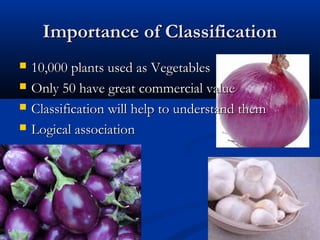
 10,000 plants used as Vegetables10,000 plants used as Vegetables
 Only 50 have great commercial valueOnly 50 have great commercial value
 Classification will help to understand themClassification will help to understand them
 Logical associationLogical association
Botanical ClassificationBotanical Classification
 Based on similirity and dissimilirity inBased on similirity and dissimilirity in
morphological structuremorphological structure
 Classification treeClassification tree
 KingdomKingdom
 Division (Anthophyta)Division (Anthophyta)
 PhylumPhylum
 Class (Mono Cotyledon, Dicotyledon)Class (Mono Cotyledon, Dicotyledon)
Division AnthophytaDivision Anthophyta
 ClassesClasses
MonocotyledonsMonocotyledons
 Alliaceae (Alliaceae (Onion, GarlicOnion, Garlic))
 Liliaceae (Liliaceae (AsparagusAsparagus))
 Poaceae (Poaceae (SweetSweet CornCorn))
DicotyledonsDicotyledons
Apiaceae (Apiaceae (CarrotCarrot,, ParsleyParsley))
Brassicaceae (Brassicaceae (CabbageCabbage,,
CauliflowerCauliflower,, TurnipTurnip,, RadishRadish))
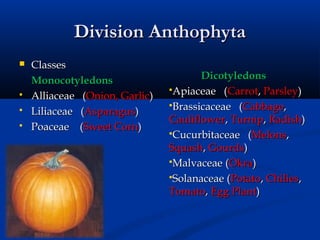
Cucurbitaceae (Cucurbitaceae (MelonsMelons,,
SquashSquash,, GourdsGourds))
Malvaceae (Malvaceae (OkraOkra))
Solanaceae (Solanaceae (PotatoPotato,, ChiliesChilies,,
TomatoTomato,, EggEgg PlantPlant))
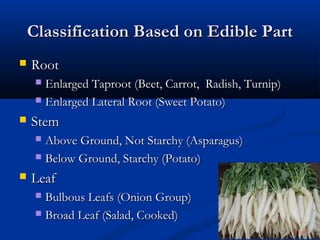
Classification Based on Edible PartClassification Based on Edible Part
 RootRoot
 Enlarged Taproot (Beet, Carrot, Radish, Turnip)Enlarged Taproot (Beet, Carrot, Radish, Turnip)
 Enlarged Lateral Root (Sweet Potato)Enlarged Lateral Root (Sweet Potato)
 StemStem
 Above Ground, Not Starchy (Asparagus)Above Ground, Not Starchy (Asparagus)
 Below Ground, Starchy (Potato)Below Ground, Starchy (Potato)
 LeafLeaf
 Bulbous Leafs (Onion Group)Bulbous Leafs (Onion Group)
 Broad Leaf (Salad, Cooked)Broad Leaf (Salad, Cooked)
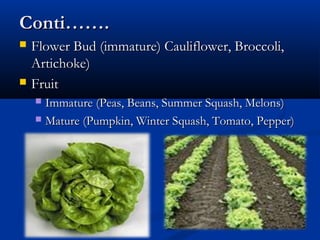
Conti…….Conti…….
 Flower Bud (immature) Cauliflower, Broccoli,Flower Bud (immature) Cauliflower, Broccoli,
Artichoke)Artichoke)
 FruitFruit
 Immature (Peas, Beans, Summer Squash, Melons)Immature (Peas, Beans, Summer Squash, Melons)
 Mature (Pumpkin, Winter Squash, Tomato, Pepper)Mature (Pumpkin, Winter Squash, Tomato, Pepper)
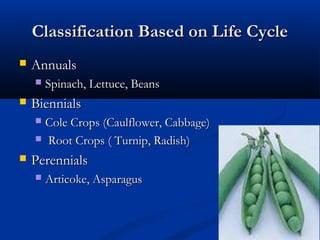
Classification Based on Life CycleClassification Based on Life Cycle
 AnnualsAnnuals
 Spinach, Lettuce, BeansSpinach, Lettuce, Beans
 BiennialsBiennials
 Cole Crops (Caulflower, Cabbage)Cole Crops (Caulflower, Cabbage)
 Root Crops ( Turnip, Radish)Root Crops ( Turnip, Radish)
 PerennialsPerennials
 Articoke, AsparagusArticoke, Asparagus
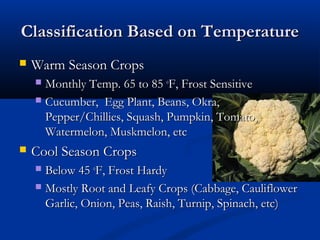
Classification Based on TemperatureClassification Based on Temperature
 Warm Season CropsWarm Season Crops
 Monthly Temp. 65 to 85Monthly Temp. 65 to 85 oo
F, Frost SensitiveF, Frost Sensitive
 Cucumber, Egg Plant, Beans, Okra,Cucumber, Egg Plant, Beans, Okra,
Pepper/Chillies, Squash, Pumpkin, Tomato,Pepper/Chillies, Squash, Pumpkin, Tomato,
Watermelon, Muskmelon, etcWatermelon, Muskmelon, etc
 Cool Season CropsCool Season Crops
 Below 45Below 45 oo
F, Frost HardyF, Frost Hardy
 Mostly Root and Leafy Crops (Cabbage, CauliflowerMostly Root and Leafy Crops (Cabbage, Cauliflower
Garlic, Onion, Peas, Raish, Turnip, Spinach, etc)Garlic, Onion, Peas, Raish, Turnip, Spinach, etc)
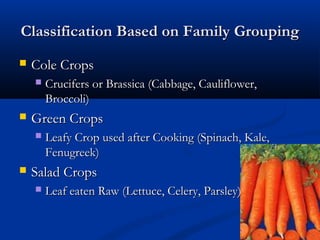
Classification Based on Family GroupingClassification Based on Family Grouping
 Cole CropsCole Crops
 Crucifers or Brassica (Cabbage, Cauliflower,Crucifers or Brassica (Cabbage, Cauliflower,
Broccoli)Broccoli)
 Green CropsGreen Crops
 Leafy Crop used after Cooking (Spinach, Kale,Leafy Crop used after Cooking (Spinach, Kale,
Fenugreek)Fenugreek)
 Salad CropsSalad Crops
 Leaf eaten Raw (Lettuce, Celery, Parsley)Leaf eaten Raw (Lettuce, Celery, Parsley)
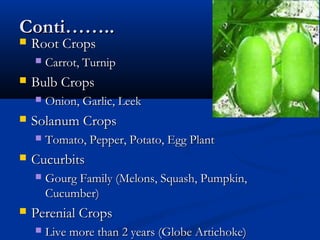
Conti……..Conti……..
 Root CropsRoot Crops
 Carrot, TurnipCarrot, Turnip
 Bulb CropsBulb Crops
 Onion, Garlic, LeekOnion, Garlic, Leek
 Solanum CropsSolanum Crops
 Tomato, Pepper, Potato, Egg PlantTomato, Pepper, Potato, Egg Plant
 CucurbitsCucurbits
 Gourg Family (Melons, Squash, Pumpkin,Gourg Family (Melons, Squash, Pumpkin,
Cucumber)Cucumber)
 Perenial CropsPerenial Crops
 Live more than 2 years (Globe Artichoke)Live more than 2 years (Globe Artichoke)
Other ClassificationOther Classification
 Environment SensitivityEnvironment Sensitivity
 Soil pHSoil pH
 Moisture LevelMoisture Level
 Frost SensitivityFrost Sensitivity
 Seed SizeSeed Size
 Plantation MethodPlantation Method
 Root SizeRoot Size
 classification of vegetables

classification of vegetables

  • 2.
    What is Classification?Whatis Classification?  Classification is the process of grouping things togetherClassification is the process of grouping things together on the basis of the features they have in common. It is aon the basis of the features they have in common. It is a way of summarizing what we know – a kind of filingway of summarizing what we know – a kind of filing system. Anything can be classified (furniture, vehicles,system. Anything can be classified (furniture, vehicles, emotions).emotions).  We are referring here specifically aboutWe are referring here specifically about plants/Vegetablesplants/Vegetables  The study of plant classification is known as taxonomyThe study of plant classification is known as taxonomy (‘taxon’ means ‘group’) and it is done by specialized(‘taxon’ means ‘group’) and it is done by specialized botanists called ‘taxonomists’.botanists called ‘taxonomists’.
  • 3.
    HistoryHistory  Since ancienttimes people has named categorized plantsSince ancient times people has named categorized plants that surround them or upon which they were dependentthat surround them or upon which they were dependent  Every culture, society, and religion has taken it as its dutyEvery culture, society, and religion has taken it as its duty to name and organize the plants in its area into someto name and organize the plants in its area into some manageable arrangement.manageable arrangement.  The earliest organizations, naturally, were based upon theThe earliest organizations, naturally, were based upon the uses of plants by people.uses of plants by people.  One can readily summarize that plants could be simplyOne can readily summarize that plants could be simply divided intodivided into  Useful PlantsUseful Plants 2. Harmful Plants2. Harmful Plants  People classified plants with simple names referring to theirPeople classified plants with simple names referring to their Use, Growing HabitUse, Growing Habit oror Virtual AttributeVirtual Attribute
  • 4.
    Classification Schemes/TypesClassification Schemes/Types  BotanicalClassificationBotanical Classification  Classification based on Edible PartsClassification based on Edible Parts  Classification based on Life CyclesClassification based on Life Cycles  Classification based on TemperatureClassification based on Temperature  Classification based on Family GroupingClassification based on Family Grouping  Other ClassificationsOther Classifications
  • 5.
    Importance of ClassificationImportanceof Classification  10,000 plants used as Vegetables10,000 plants used as Vegetables  Only 50 have great commercial valueOnly 50 have great commercial value  Classification will help to understand themClassification will help to understand them  Logical associationLogical association
  • 6.
    Botanical ClassificationBotanical Classification Based on similirity and dissimilirity inBased on similirity and dissimilirity in morphological structuremorphological structure  Classification treeClassification tree  KingdomKingdom  Division (Anthophyta)Division (Anthophyta)  PhylumPhylum  Class (Mono Cotyledon, Dicotyledon)Class (Mono Cotyledon, Dicotyledon)
  • 7.
    Division AnthophytaDivision Anthophyta ClassesClasses MonocotyledonsMonocotyledons  Alliaceae (Alliaceae (Onion, GarlicOnion, Garlic))  Liliaceae (Liliaceae (AsparagusAsparagus))  Poaceae (Poaceae (SweetSweet CornCorn)) DicotyledonsDicotyledons Apiaceae (Apiaceae (CarrotCarrot,, ParsleyParsley)) Brassicaceae (Brassicaceae (CabbageCabbage,, CauliflowerCauliflower,, TurnipTurnip,, RadishRadish)) Cucurbitaceae (Cucurbitaceae (MelonsMelons,, SquashSquash,, GourdsGourds)) Malvaceae (Malvaceae (OkraOkra)) Solanaceae (Solanaceae (PotatoPotato,, ChiliesChilies,, TomatoTomato,, EggEgg PlantPlant))
  • 8.
    Classification Based onEdible PartClassification Based on Edible Part  RootRoot  Enlarged Taproot (Beet, Carrot, Radish, Turnip)Enlarged Taproot (Beet, Carrot, Radish, Turnip)  Enlarged Lateral Root (Sweet Potato)Enlarged Lateral Root (Sweet Potato)  StemStem  Above Ground, Not Starchy (Asparagus)Above Ground, Not Starchy (Asparagus)  Below Ground, Starchy (Potato)Below Ground, Starchy (Potato)  LeafLeaf  Bulbous Leafs (Onion Group)Bulbous Leafs (Onion Group)  Broad Leaf (Salad, Cooked)Broad Leaf (Salad, Cooked)
  • 9.
    Conti…….Conti…….  Flower Bud(immature) Cauliflower, Broccoli,Flower Bud (immature) Cauliflower, Broccoli, Artichoke)Artichoke)  FruitFruit  Immature (Peas, Beans, Summer Squash, Melons)Immature (Peas, Beans, Summer Squash, Melons)  Mature (Pumpkin, Winter Squash, Tomato, Pepper)Mature (Pumpkin, Winter Squash, Tomato, Pepper)
  • 10.
    Classification Based onLife CycleClassification Based on Life Cycle  AnnualsAnnuals  Spinach, Lettuce, BeansSpinach, Lettuce, Beans  BiennialsBiennials  Cole Crops (Caulflower, Cabbage)Cole Crops (Caulflower, Cabbage)  Root Crops ( Turnip, Radish)Root Crops ( Turnip, Radish)  PerennialsPerennials  Articoke, AsparagusArticoke, Asparagus
  • 11.
    Classification Based onTemperatureClassification Based on Temperature  Warm Season CropsWarm Season Crops  Monthly Temp. 65 to 85Monthly Temp. 65 to 85 oo F, Frost SensitiveF, Frost Sensitive  Cucumber, Egg Plant, Beans, Okra,Cucumber, Egg Plant, Beans, Okra, Pepper/Chillies, Squash, Pumpkin, Tomato,Pepper/Chillies, Squash, Pumpkin, Tomato, Watermelon, Muskmelon, etcWatermelon, Muskmelon, etc  Cool Season CropsCool Season Crops  Below 45Below 45 oo F, Frost HardyF, Frost Hardy  Mostly Root and Leafy Crops (Cabbage, CauliflowerMostly Root and Leafy Crops (Cabbage, Cauliflower Garlic, Onion, Peas, Raish, Turnip, Spinach, etc)Garlic, Onion, Peas, Raish, Turnip, Spinach, etc)
  • 12.
    Classification Based onFamily GroupingClassification Based on Family Grouping  Cole CropsCole Crops  Crucifers or Brassica (Cabbage, Cauliflower,Crucifers or Brassica (Cabbage, Cauliflower, Broccoli)Broccoli)  Green CropsGreen Crops  Leafy Crop used after Cooking (Spinach, Kale,Leafy Crop used after Cooking (Spinach, Kale, Fenugreek)Fenugreek)  Salad CropsSalad Crops  Leaf eaten Raw (Lettuce, Celery, Parsley)Leaf eaten Raw (Lettuce, Celery, Parsley)
  • 13.
    Conti……..Conti……..  Root CropsRootCrops  Carrot, TurnipCarrot, Turnip  Bulb CropsBulb Crops  Onion, Garlic, LeekOnion, Garlic, Leek  Solanum CropsSolanum Crops  Tomato, Pepper, Potato, Egg PlantTomato, Pepper, Potato, Egg Plant  CucurbitsCucurbits  Gourg Family (Melons, Squash, Pumpkin,Gourg Family (Melons, Squash, Pumpkin, Cucumber)Cucumber)  Perenial CropsPerenial Crops  Live more than 2 years (Globe Artichoke)Live more than 2 years (Globe Artichoke)
  • 14.
    Other ClassificationOther Classification Environment SensitivityEnvironment Sensitivity  Soil pHSoil pH  Moisture LevelMoisture Level  Frost SensitivityFrost Sensitivity  Seed SizeSeed Size  Plantation MethodPlantation Method  Root SizeRoot Size