
Jupite Mark U. Banayag, L.Agr
Faculty
Compostela Valley State College
Purok 10, Poblacion, Compostela, 8803 Compostela Valley
CLASSIFICATION OF
AGRICULTURAL CROPS
• Plants can be classified according
to the following criteria:
–(1) botanical,
–(2) descriptive, and
–(3) agricultural.
JMUBanayag
• Botanical Classification
– based on the morphological characteristics of
plants as well as on their anatomy, physiology
and DNA sequences.
• Descriptive Classification
– based on the environmental adaptation,
growth habit and other observable features.
• Agricultural Classification
– plants can be broadly classified as either
useful or unuseful. Those which are useful are
called crops while those which are not useful
are called weeds.
JMUBanayag
BOTANICAL CLASSIFICATION
OF CROPS
JMUBanayag
Botanical Classification
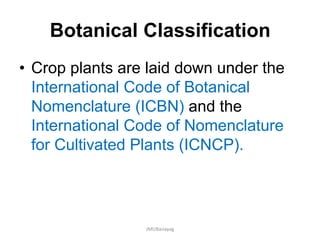
• Crop plants are laid down under the
International Code of Botanical
Nomenclature (ICBN) and the
International Code of Nomenclature
for Cultivated Plants (ICNCP).
JMUBanayag
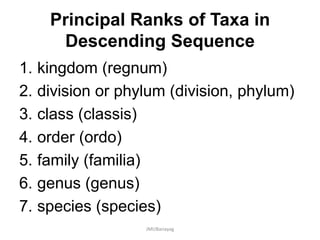
Principal Ranks of Taxa in
Descending Sequence
1. kingdom (regnum)
2. division or phylum (division, phylum)
3. class (classis)
4. order (ordo)
5. family (familia)
6. genus (genus)
7. species (species)
JMUBanayag
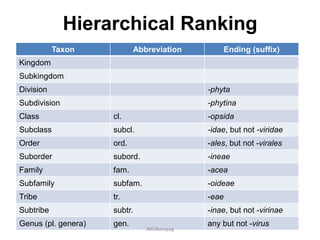
Hierarchical Ranking
Taxon Abbreviation Ending (suffix)
Kingdom
Subkingdom
Division -phyta
Subdivision -phytina
Class cl. -opsida
Subclass subcl. -idae, but not -viridae
Order ord. -ales, but not -virales
Suborder subord. -ineae
Family fam. -acea
Subfamily subfam. -oideae
Tribe tr. -eae
Subtribe subtr. -inae, but not -virinae
Genus (pl. genera) gen. any but not -virus
JMUBanayag
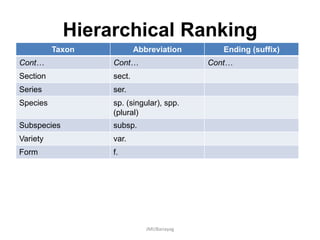
Hierarchical Ranking
Taxon Abbreviation Ending (suffix)
Cont… Cont… Cont…
Section sect.
Series ser.
Species sp. (singular), spp.
(plural)
Subspecies subsp.
Variety var.
Form f.
JMUBanayag
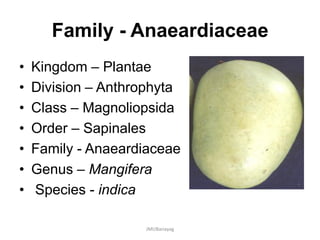
Family - Anaeardiaceae
• Kingdom – Plantae
• Division – Anthrophyta
• Class – Magnoliopsida
• Order – Sapinales
• Family - Anaeardiaceae
• Genus – Mangifera
• Species - indica
JMUBanayag
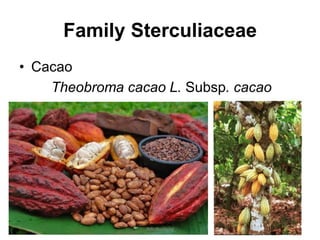
Family Sterculiaceae
• Cacao
Theobroma cacao L. Subsp. cacao
JMUBanayag
DESCRIPTIVE
CLASSIFICATION OF CROPS
JMUBanayag
A. Crop Classifications According to
Mode of Reproduction
Sexual-
plants that develop from a seed or spore
after undergoing union of male and female
gametes. Examples: palms and ferns.
Asexual-
plants which reproduce by any vegetative
means without the union of the sexual gametes
or by apomixis. Examples: red mombin
(sineguelas), breadfruit, mangosteen.
JMUBanayag
B. Crop Classifications According to
Mode of Pollination
Naturally self-pollinated crops-
The predominant mode of pollination in
these plants is self-pollination in which both
pollen and embryo sac are produced in the
same floral structure or in different flowers
but within the same plant.
Examples: rice, most pulses, okra,
tobacco, tomato.
JMUBanayag
B. Crop Classifications According to
Mode of Pollination
Naturally cross-pollinated crops-
Pollen transfer in these plants is from
the anther of one flower to the stigma of
another flower in a separate plant, although
self-pollination may reach 5 percent or more.
Examples: corn and many grasses,
avocado, grape, mango, many plants with
unisexual or imperfect flowers.
JMUBanayag
B. Crop Classifications According to
Mode of Pollination
Both self- and cross-pollinated crops-
these plants are largely self-pollinated
but varying amounts of cross-pollination
occur.
Examples: cotton and sorghum.
JMUBanayag
C. Crop Classifications According to
Life Span
Annual-
a plant which live within a short period of
time, for a few weeks or months, perpetuated
by seed, and which die soon after producing
seeds; a plant which germinate, grow, flower,
produce seed, and die all in one season.
Examples: rice, corn, cowpea, mungbean,
squash.
JMUBanayag
C. Crop Classifications According to
Life Span
Biennial-
a plant which requires two growing
seasons to complete its life cycle, the first for
vegetative growth and accumulation of food
reserves, and the second for the production of
reproductive parts. It grows from a seed,
produces flower and seed and then dies in two
growing seasons.
Examples: bulb onion, cabbage, carrot, celery,
raddish.
JMUBanayag
C. Crop Classifications According to
Life Span
Perennial-
a plant that lives indefinitely, including all
trees and shrubs and many herbaceous plants
with underground stems (e.g. corm, rhizome,
tuber) like banana and clump-forming grasses.
Perennial plants continue growing and
produce seeds year after year, either from a
single plant or, in herbaceous plants, from
succeeding regrowth.
JMUBanayag
D. Crop Classifications
According To Growth Habit
1. Herbs- succulent plants with self-
supporting stems.
Examples: aglaonema, banana, dumbcane,
sugarcane, tomato.
2. Vines- herbaceous climbing or twining
plants without self-supporting stems.
Examples: charantia (ampalaya), cucumber,
luffa (patola), pole sitao, yam.
JMUBanayag
D. Crop Classifications
According To Growth Habit
3. Lianas- woody climbing or twining plants
which depend on other plants for vertical
support to climb up to the top of the canopy.
These climbers often form bridges between
the forest canopy (Wikipedia, 2010).
Examples: Climbing bamboo, grape, Jade
vine (Strongylodon macrobotrys), rattans, passion
fruit.
JMUBanayag
D. Crop Classifications
According To Growth Habit
4. Shrubs- small trees or tree-like plants,
generally less than 5 meters in height but by
other authorities it is restricted to small,
erect, woody plants which produce several
trunks from the base.
Examples: Barbados cherry, pink jasmine
(kamuning), Siam weed (hagonoy), santan,
Lantana.
JMUBanayag
D. Crop Classifications
According To Growth Habit
5. Trees- plants having erect and continuous
growth with a large development of woody
tissue, with a single distinct stem or trunk,
reaching a height of 5 meters or more.
Examples: durian, mango, molave (Vitex
parviflora), narra (Pterocarpus indicus),
tamarind.
JMUBanayag
E. Crop Classifications
According to Leaf Retention
• 1. Evergreen-
–plants that maintain their leaves
throughout the year. Abscissed leaves
are continually replaced by new flushes.
• Examples: pines, banana, papaya, palms
and most tropical plants.
JMUBanayag
E. Crop Classifications
According to Leaf Retention
• 2. Deciduous-
– plants which naturally shed off or lose leaves
annually for extended periods. Natural leaf
shedding is pronounced in deciduous trees of
temperate regions.
– In the Philippines, defoliation occurs during
summer months in Fire Tree (Delonix regia)
and red mombin or siniguelas. Many other
plants exhibit partial defoliation during drought
periods.
JMUBanayag
F. Crop Classifications According to
Ecological Adaptation or Habitat
• 1. Aquatic, hydrophyte or hydrophytic
plant –
– a plant adapted to growing in water or
waterlogged soil. It may grow entirely
submerged, partly submerged or floating, or
anchored to the ground in bogs, swamps, or
beside the edges of ponds, lakes or streams.
Examples: azolla, kangkong (Ipomea
aquatica), bulrush (Cyperus spp.), lotus
(Nelumbo nucifera), water lily (Nymphaea
spp.), mangrove species.
JMUBanayag
F. Crop Classifications According to
Ecological Adaptation or Habitat
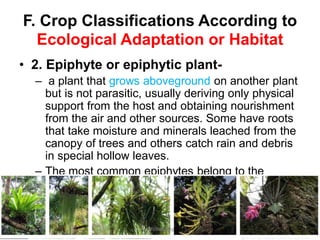
• 2. Epiphyte or epiphytic plant-
– a plant that grows aboveground on another plant
but is not parasitic, usually deriving only physical
support from the host and obtaining nourishment
from the air and other sources. Some have roots
that take moisture and minerals leached from the
canopy of trees and others catch rain and debris
in special hollow leaves.
– The most common epiphytes belong to the
bromyliad, orchid, and fern families; also called
air plant or tree dweller.
JMUBanayag
F. Crop Classifications According to
Ecological Adaptation or Habitat
• 3. Halophyte or halophytic plant-
– a plant that is able to grow in habitats
excessively rich in salts or under saline
conditions.
– Examples: nipa, talisay, bakawan (Rhizophora
mucronata) and other mangrove species.
Coconut, cashew and tamarind have varying
levels of tolerance to saline conditions.
JMUBanayag
F. Crop Classifications According to
Ecological Adaptation or Habitat
• 4. Lithophyte or lithophytic plant-
– a plant adapted to growing on rocks or in
rocky terrain with little humus, absorbing
nutrients from the atmosphere, rain, and
decaying matter which accumulate on the
rocks. Vanda, Ascocenda, Ascocentrum, and
Trudelia orchids can be grown as lithophytes
(McKinley, 2005). Dendrobium has also been
grown in pots filled with gravel or stone.
JMUBanayag
F. Crop Classifications According to
Ecological Adaptation or Habitat
• 5. Mesophyte or mesophitic plant-
– a terrestrial plant which is adapted to
moderate conditions for growth, i.e. not too
dry and not too wet
• (e.g. corn and most commercially-grown crops).
• 6. Parasite or parasitic plant-
– a plant which grows on another plant from
which it takes part or all nourishment
• (e.g. Cassytha, Loranthaceae (mistletoe family),
Rafflesia; Neottia and Corallorhiza orchids).
JMUBanayag
F. Crop Classifications According to
Ecological Adaptation or Habitat
• 7. Saprophyte or saprophytic crop-
– grows on decaying organic matter and has no
green tissue.
• This classification applies to the mushrooms, which are
fungi.
• 8. Sciophyte or sciophytic plant-
– a plant that is adapted to low light intensity or
shade,
• e.g. most ferns and mosses, black pepper, cacao,
coffee, lanzones, mangosteen, hot pepper, gingers, and
many orchids can tolerate or require shade.
JMUBanayag
F. Crop Classifications According to
Ecological Adaptation or Habitat
• 9. Terrestrial or land plant-
– a plant which grows on land, rooting in the
soil. It has aerial parts, collectively called
shoot, and an underground part called root
which absorbs most of its water and nutrient
needs from the soil.
– Most agricultural crops are terrestrial and are
further subclassified into various groups such
as halophytes, mesophytes, sciophytes and
xerophytes depending on climatic and special
adaptations.
JMUBanayag
F. Crop Classifications According to
Ecological Adaptation or Habitat
• 10. Xerophyte, xerophytic or xeric
plant-
– a plant which is adapted to conditions with
little or no water.
• Examples: adelfa, bromyliads, euphorbias, cacti
and many succulents.
JMUBanayag
AGRICULTURAL
CLASSIFICATION OF PLANTS
JMUBanayag
A. Crop vs. Weed
Crop
– In agriculture, plants are classified as either crop or
weed. A crop is any useful plant, or a plant which is
grown for any purpose.
– It is utilized by man directly or indirectly, raw or
processed.
– Direct utilization is exemplified by the use of cereal
grains as staple while they are indirectly consumed by
man when they are first fed to livestock for meat, or
processed into sugar for human consumption .
– These plants are intentionally grown or managed for
various uses such as for food, spices, sugar, drinks,
fiber, clothing, beverages, medicines, oils, tannins,
rubber, ornamentation, fuels, construction materials,
soil improvement, organic farming, landscaping and
many more. JMUBanayag
A. Crop vs. Weed
Weed
– a weed is an unintended plant or any plant which grows
where it is not wanted.
– It competes with the intended crop for space, soil water,
nutrients and light or becomes a nuisance in any manner.
– Many have allelopathic effect on other plants, both crop
and weed, by releasing harmful allelochemicals which
are considered plant-produced herbicides. Such plants
include Lantana and neem tree (Ferguson and
Rathinasabapathi, 2003), hagonoy (Chromolaena
odorata) (PCA, 2003) and yellow nutsedge (Culquhoun,
2006).
– Any plant can be a weed, depending on where it grows
and how man is affected.JMUBanayag
B. Agronomic vs. Horticultural Crops
• Agronomic crops
– also called “field crops”.
– They are mostly annual herbaceous plants
that are grown under extensive or large-scale
culture.
– The usable products are usually in high dry
matter form. By tradition, cereals, seed
legumes, root and tuber crops, sugar crops,
latex and rubber crops, pasture and forage
crops, and fiber crops are classified under
agronomic crops.
JMUBanayag
B. Agronomic vs. Horticultural Crops
• Horticultural crops
– referred to as “garden crops”.
– those grown under any of the fields of
horticulture such as olericulture or vegetable
crops production, pomology or fruit crops
production, and ornamental horticulture
(floriculture and landscape horticulture), as
well as spices and medicinal plants.
– Horticultural products are generally utilized
with high moisture content and are therefore
highly perishable.
JMUBanayag
B. Agronomic vs. Horticultural Crops
• Crops are grouped into either agronomic
of horticultural depending on how intensive
they are grown and how they are used.
• This system of classification is highly
artificial, arbitrary and is not mutually
exclusive.
– Ex. Corn is considered agronomic crop and/or
Horticultural crop
JMUBanayag
Agronomic crops
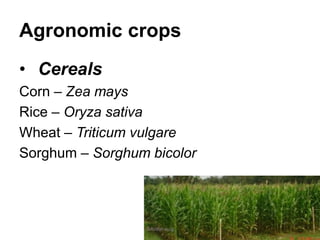
• Cereals
Corn – Zea mays
Rice – Oryza sativa
Wheat – Triticum vulgare
Sorghum – Sorghum bicolor
JMUBanayag
Agronomic crops
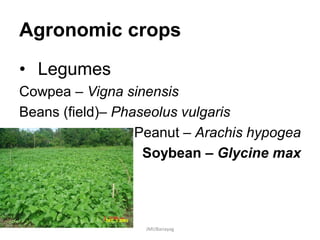
• Legumes
Cowpea – Vigna sinensis
Beans (field)– Phaseolus vulgaris
Peanut – Arachis hypogea
Soybean – Glycine max
JMUBanayag
Agronomic crops
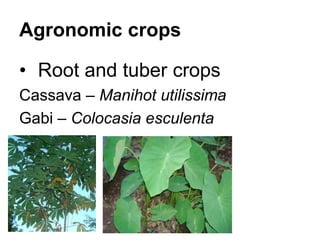
• Root and tuber crops
Cassava – Manihot utilissima
Gabi – Colocasia esculenta
JMUBanayag
Agronomic crops
• Root and tuber crops
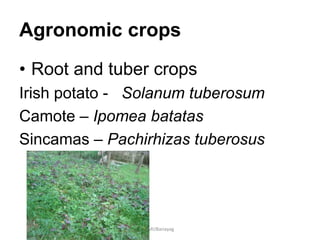
Irish potato - Solanum tuberosum
Camote – Ipomea batatas
Sincamas – Pachirhizas tuberosus
JMUBanayag
Agronomic crops
• Sugar crop
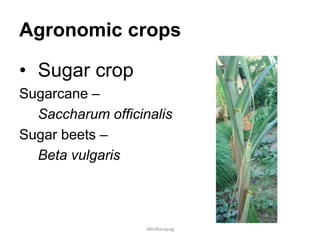
Sugarcane –
Saccharum officinalis
Sugar beets –
Beta vulgaris
JMUBanayag
Horticultural crops
• Fruits (Pomology)
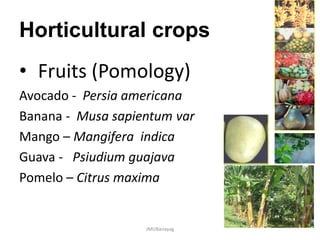
Avocado - Persia americana
Banana - Musa sapientum var
Mango – Mangifera indica
Guava - Psiudium guajava
Pomelo – Citrus maxima
JMUBanayag
Horticultural crops
• Fruits (Pomology)
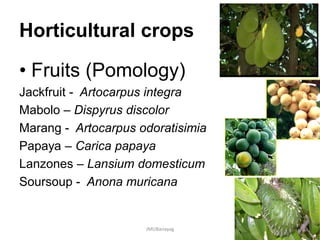
Jackfruit - Artocarpus integra
Mabolo – Dispyrus discolor
Marang - Artocarpus odoratisimia
Papaya – Carica papaya
Lanzones – Lansium domesticum
Soursoup - Anona muricana
• S o u r s o p
JMUBanayag
Horticultural crops
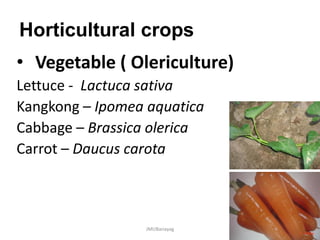
• Vegetable ( Olericulture)
Lettuce - Lactuca sativa
Kangkong – Ipomea aquatica
Cabbage – Brassica olerica
Carrot – Daucus carota
JMUBanayag
Horticultural crops
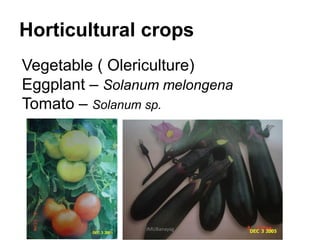
Vegetable ( Olericulture)
Eggplant – Solanum melongena
Tomato – Solanum sp.
JMUBanayag
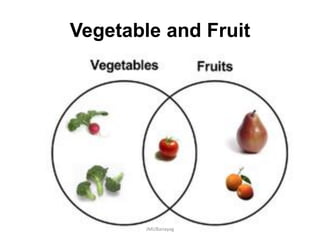
Vegetable and Fruit
JMUBanayag
Horticultural crops
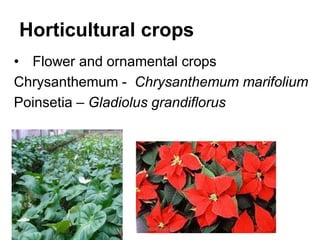
• Flower and ornamental crops
Chrysanthemum - Chrysanthemum marifolium
Poinsetia – Gladiolus grandiflorus
JMUBanayag
C. Agricultural Classifications
Based on Primary Uses
• 1. Food Crops –
– plants grown primarily for the harvesting of
any part which is used by man as food or
processed into food product.
– This classification is a collective term for
crops which are variously subclassified into
smaller groups such as cereals, root and
tuber crops, legume seed crops, sugar crops,
beverage crops, fruit crops and vegetables.
JMUBanayag
C. Agricultural Classifications
Based on Primary Uses
• 2. Non-food Crops-
– plants grown for the production of non-food
products such as fiber, fodder, alcohol,
tobacco, industrial oil, rubber, gums and
resins, drugs, etc. or for ornamentation.
– Included in this classification are fiber crops,
pasture and forage crops, rubber crops, latex
and gum crops, dye and tannin crops, biofuel
crops, essential-oil crops, biocidal crops and
most industrial crops.
JMUBanayag
C. Agricultural Classifications
Based on Primary Uses
• 3. Staple Crops-
– plants grown for the harvesting of parts which
are used as staple food. A staple food is one that
is regularly consumed in such quantities as to
form the basis of a traditional diet and from which
people obtain a major proportion of their energy
and nutrient requirements.
– In the Philippines, the top staple crop is rice
followed by corn. Cassava is also consumed as
staple by some ethnic groups.
• Examples of other staple crops: wheat, banana and
plantains, breadfruit, millet, white potato, sweet potato,
yam.
JMUBanayag
C. Agricultural Classifications
Based on Primary Uses
• 4. Cereal or Grain Crops –
– annual, herbaceous plants belonging to the
grass family which are grown for their seeds
or grains.
– Grains are harvested mature and utilized
primarily as staple or feed or processed into
carbohydrate-rich products.
– The word “cereal” is derived from Ceres, the
ancient Roman goddess of harvest.
• Examples: corn, millet, rice, sorghum, wheat.
JMUBanayag
C. Agricultural Classifications
Based on Primary Uses
• 5. Legume Seed Crops or Pulses-
– leguminous plants which produce edible, protein-
rich seeds.
– The seeds are utilized in the mature, dry form as
food or feed or processed into various products.
– Being leguminous, they are capable of fixing
nitrogen from the air through symbiotic relation
with Rhizobium bacteria.
• Examples: cowpea, mungbean, peanut, peas, pigeon
pea (Cajanus cajan).
JMUBanayag
C. Agricultural Classifications
Based on Primary Uses
• 6. Root and Tuber Crops or Tuberous
Crops-
– plants with modified, swollen root or
underground stem. These organs are rich
sources of carbohydrate and are commonly
used as staple, livestock feed, or as raw
materials for industrial purposes, such as
starch and alcohol production, or processed
into various food products.
JMUBanayag
C. Agricultural Classifications
Based on Primary Uses
• 7. Oil Seed Crops-
– plants grown for their seeds which are rich
source of edible and industrial oil.
– The important oil seed crops in the world
include soybeans, peanut, sunflower, oil palm,
sesame and cotton. However, the leading
crop in the Philippines is the coconut, followed
far behind by oil palm.
JMUBanayag
C. Agricultural Classifications
Based on Primary Uses
• 8. Sugar and Sweetener Crops –
– plants grown primarily for the production of
sugar or other sweet-tasting products.
– These are derived from various parts of
certain plants such as from stems, bulb and
other underground organs, leaves, flowers,
fruits, seeds, sap and resin (Hagelberg,
2003).
• Examples: sugarcane, sugar beet (a temperate
crop), sweet sorghum, Stevia, corn, sweet potato,
cassava, rice, many palms.
JMUBanayag
C. Agricultural Classifications
Based on Primary Uses
• 9. Beverage Crops-
– plants which are sources of various drinks
including fruit juices, tea, coffee, cocoa, toddy,
beer and wine.
– They supply water which is essential to
human nutrition. Some of these drinks also
provide vitamins and minerals. Others have
stimulating or relaxing effects.
• Examples: cacao, coconut, coffee, soursop, tea.
JMUBanayag
C. Agricultural Classifications
Based on Primary Uses
• 10. Rubber Crops-
– plants grown for the production of latex which is
processed into the industrial product called
rubber. Rubber is an elastic hydrocarbon polymer
constructed of isoprene units. It has widespread
uses, from household to industrial products, with
the main bulk in the transportation sector.
• Examples: para rubber tree (Hevea brasiliensis),
Castilla rubber (Castilla elastica), Ceara rubber
(Manihot glaziovii), guayule (Parthenium argentatum),
Lagos Silk Rubber (Funtumia elastica).
JMUBanayag
C. Agricultural Classifications
Based on Primary Uses
• 12. Dye and Tannin Crops-
– plants grown as sources of tannin and
coloring substances. Tannin is an aromatic,
phenolic substance which is obtained from
barks and other plant organs and variously
used in tanning, medicines, dyeing, ink
manufacture, etc.
• Examples: anatto or achuete, Indian almond or
talisay, indigo (Indigofera tinctoria), bakawan
(Rhizophora and Bruguiera).
JMUBanayag
C. Agricultural Classifications
Based on Primary Uses
• 13. Fiber Crops-
– plants grown as sources of fiber, a strong,
thread-like material used in making textiles,
rope, twine and similar materials.
– The fiber is extracted from the bark, leaves, or
other organs including the husk of coconut.
• Examples: abaca, jute, kenaf, maguey and
ramie.
JMUBanayag
C. Agricultural Classifications
Based on Primary Uses
• 14. Pasture and Forage Crops –
– plants grown or managed as vegetable feed
for grazing animals. They are classified as
either native or improved species, grasses or
legumes, and may be fed fresh or dry or in
processed form.
• Examples: carabao grass, paragrass, napier, ipil-
ipil, renzoni.
JMUBanayag
C. Agricultural Classifications
Based on Primary Uses
• 15. Biofuel Crops-
– plants grown for the production of fuel that is
used as additive or replacement for petroleum
products.
– The main biofuels are bioethanol, an alcohol
derived from fermented sugar or starch, and
biodiesel from vegetable oils.
• Examples: sugarcane, cassava, corn, coconut,
castor bean, Jatropha.
JMUBanayag
C. Agricultural Classifications
Based on Primary Uses
• 16. Olericultural or Vegetable Crops –
– plants (except mushroom) grown for their
succulent and edible parts such as the roots,
stems, leaves, young tops, fruits or seeds for use
in culinary preparations either fresh or preserved
in the fresh state.
– These crops are further classified into different
groupings according to similarities in edible
parts, growth habits, methods of culture and
botanical family. Melons are generally included
in this crop classification.
JMUBanayag
C. Agricultural Classifications
Based on Primary Uses
• 16. Olericultural or Vegetable Crops
– Vegetable Classifications Based on Edible
Part
• Fruit, root, leaves, etc.
– Vegetable Classifications by Family
• Cucurbitaceae, Leguminosae or Fabaceae, etc.
JMUBanayag
C. Agricultural Classifications
Based on Primary Uses
• 17. Pomological or Fruit Crops and Nuts–
– plants grown primarily for their edible fruits or closely
related structures which, as a rule, are consumed raw.
– Fruits borne on trees are called tree fruits, among
which are the duhat, durian, jackfruit, mango,
mangosteen and papaya.
– Fruits borne on low-growing plants such as shrubs,
vines, lianas and some herbs are called small fruits
(e.g. grape, passion fruit, pineapple, strawberry).
– Nuts are grown for their fruits which are high in fat. The
nut is a simple, dry, indehiscent fruit with a hard outer
covering. Examples: cashew, macadamia, pili.
JMUBanayag
C. Agricultural Classifications
Based on Primary Uses
• 18. Spice Crops-
– plants grown for the production of aromatic
materials or substances which are used as
food flavoring or for other purposes because
of their fragrance or preservative qualities.
Spices are in solid or liquid forms.
• Examples: black pepper, garlic, ginger, hot pepper,
onion, turmeric.
JMUBanayag
C. Agricultural Classifications
Based on Primary Uses
• 19. Essential-oil Crops- plants grown for
the extraction of essential oils which are
volatile, aromatic substances for
perfumery and other uses.
– Examples: citronella, eucalyptus, ilang-ilang,
peppermint, sampagita.
JMUBanayag
C. Agricultural Classifications
Based on Primary Uses
• 20. Ornamental Crops –
– plants which are grown primarily for
decoration or landscaping or to be
appreciated because of their attractive flowers
or foliage.
– They are further classified as cutflowers, cut
foliage, turfgrasses, groundcovers, hedges,
accents, specimen plants, avenue trees,
screens, topiaries, fillers and others.
JMUBanayag
C. Agricultural Classifications
Based on Primary Uses
• 21. Biocidal Crops-
– plants containing organic compounds with
pesticidal or anti-microbial properties.
– The effective parts are either directly applied
or seeped in water for foliar spray. Many have
been commercially exploited by extracting the
active ingredients.
• Examples: chrysanthemum (Chrysanthemum
cineriaefolium), kayos (Dioscorea hispida),
lagtang, makabuhay (Tinospora crispa), tobacco,
tubli (Derris elliptica), neem.
JMUBanayag
C. Agricultural Classifications
Based on Primary Uses
• 23. Industrial Crops –
– plants grown to provide materials for industrial
processing and production of non-food
products such as biofuel, sugar, rubber,
starch, industrial oil, aromatic compounds,
steroids, medicinal drugs, organic pestides,
tannins and dye.
JMUBanayag
C. Agricultural Classifications
Based on Primary Uses
• 24. Plantation Crops –
– Many of those who are engaged in the growing of
plantation crops are corporate organizations and
multinational companies like Dole Philippines and Del
Monte.
– Any crop can be suited for growing in a plantation.
– plantations which are devoted to fiber crops (cotton,
abaca), trees (e.g. falcata, mahogany), bamboo (e.g. giant
bamboo, thorny bamboo), industrial crops (e.g.
sugarcane, coconut, palm oil, rubber), beverage crops
(coffee, cacao, tea), fruit crops (e.g. banana, pineapple),
nuts (e.g. cashew), vegetables (e.g. asparagus), spices
(e.g. turmeric JMUBanayag
D. Special-Purpose Classifications
of Crops
• Nurse crop-
– any crop which is grown to provide shade and
increase humidity for the benefit of the main crop
during its seedling and early stages of growth.
• Companion crop-
– any crop which is planted close to the main crop
to complement the latter’s growth and production,
or to maximize utilization of space because they
do not compete. Examples:
• Black pepper is planted with live madre de cacao
(Gliricidia sepium) to serve as trellis.
JMUBanayag
D. Special-Purpose Classifications
of Crops
• Cover crop-
– a crop grown mainly to control soil erosion,
regulate soil temperature, control weeds and
reduce evaporative losses. Leguminous vines
such as improved pasture and forage crops are
excellent cover crops. As legumes they can
enrich the soil fertility by fixing atmospheric
nitrogen.
• Agroforest Crop –
– any crop which is suited under a cropping system
consisting of mixed agricultural and forest crops.
JMUBanayag
D. Special-Purpose Classifications
of Crops
• Green manure crop-
– a leguminous crop grown to be plowed under the
soil to increase organic matter and serve as
organic fertilizer.
– Mungbean (mungo) is ideal for this purpose.
Seeds of mungbean are commonly broadcasted
in a field of rice immediately after harvest and
allowed to grow using residual water, thus also
becoming a catch crop. In time for tillage in
preparation for the next rice crop, the mungbean
plants are plowed under and allowed to
decompose.
JMUBanayag
D. Special-Purpose Classifications
of Crops
• Contour Hedgerow Crop-
– nitrogen-fixing trees and shrubs which are grown
along contour lines in sloping lands under the Sloping
Agricultural Land Technology (SALT). These crops are
grown mainly to produce green manure and mulch, to
serve as firebreak, to stabilize the soil and to control
soil erosion. Examples:
• a. Madre de Cacao, kakawate (Gliricidia sepium)
• b. Giant Ipil-ipil (Leucaena latisiliqua)
• c. Acid Ipil-ipil (Leucaena diversifolia)
• d. Flemingia (Flemingia macrophylla)
• e. Renzoni (Desmodium renzonii)
• f. Red Powderpuff (Calliandra calothyrsus)
• g. Yellow Cassia (Senna spectabilis)
JMUBanayag
D. Special-Purpose Classifications
of Crops
• Trap crop or Decoy crop-
– plants grown to attract certain insect pests or
parasites because they are favorite hosts.
– They act as decoys to lure pests away from
the main crop. Also, they make pest control
easier because the insects are concentrated
on a few plants. Control measures will be
concentrated to the infested plants including
spraying of appropriate pesticides or these
plants can be simply pulled out and destroyed
together with the pests.JMUBanayag
D. Special-Purpose Classifications
of Crops
• Examples of trap crops and the insect pests that
they attract:
– a. Basil (Ocimum basilicum)- green, loopy tomato
caterpillar.
– b. Garlic (Allium sativum)- greenfly.
– c. Chive (Allium schoenoprasum)- greenfly and
cutworms.
– d. Corn (Zea mays)- cotton bollworm.
– e. Marigold (Calendula officinalis)- caterpillars and
cutworms.
– f. Nasturtium (Tropaeolum majus)- aphids.
– g. Tarragon (Artemisia dracunculus)- loopy caterpillar.
– h. Tobacco (Nicotiana tabacum)- cotton bollworm.
JMUBanayag
D. Special-Purpose Classifications
of Crops
• Insect pest repellant crop-
– plants grown along the borders and at
strategic places in the farm to repel insect
pests because of their strong aroma and anti-
herbivory properties.
• Basil (Ocimum basilecum)
• Chive (Allium schoenoprasum)
• Garlic (Allium sativum)
• Marigold or Amarillo (Tagetes sp.)
• Rosemary (Rosmarinus officinalis)-
• Thyme (Thymus vulgaris)JMUBanayag
D. Special-Purpose Classifications
of Crops
• Natural enemies attractant crop-
– flowering plants grown at strategic places in
the farm to attract natural enemies of insect
pests.
– Examples:
• a. Dill (Anethum graveolens)- can be grown to
attract spiders, lacewings and parasitic wasps
which eat or parasitize caterpillars, beetles and
aphids.
• b. Tagetes, Calendula and Nasturtiums- attract
hoverflies whose larvae feed on aphids.
JMUBanayag
• Credits to the owners of slides and contents being used.
Disclaimer: The content provided in this presentation is for information / educational purpose only. The author
or the owner of the content makes no representatives as the accuracy or completeness of any information
provided in this slide. The owner will also not be liable for any errors or omissions in the information nor the
availability of this information. The author or the owner will also not be liable for any damages or losses from
the display or use of this information.
Slide Credits:
JMUBanayag

Classification of Agricultural Crops

  • 1.
    Jupite Mark U.Banayag, L.Agr Faculty Compostela Valley State College Purok 10, Poblacion, Compostela, 8803 Compostela Valley CLASSIFICATION OF AGRICULTURAL CROPS
  • 2.
    • Plants canbe classified according to the following criteria: –(1) botanical, –(2) descriptive, and –(3) agricultural. JMUBanayag
  • 3.
    • Botanical Classification –based on the morphological characteristics of plants as well as on their anatomy, physiology and DNA sequences. • Descriptive Classification – based on the environmental adaptation, growth habit and other observable features. • Agricultural Classification – plants can be broadly classified as either useful or unuseful. Those which are useful are called crops while those which are not useful are called weeds. JMUBanayag
  • 4.
  • 5.
    Botanical Classification • Cropplants are laid down under the International Code of Botanical Nomenclature (ICBN) and the International Code of Nomenclature for Cultivated Plants (ICNCP). JMUBanayag
  • 6.
    Principal Ranks ofTaxa in Descending Sequence 1. kingdom (regnum) 2. division or phylum (division, phylum) 3. class (classis) 4. order (ordo) 5. family (familia) 6. genus (genus) 7. species (species) JMUBanayag
  • 7.
    Hierarchical Ranking Taxon AbbreviationEnding (suffix) Kingdom Subkingdom Division -phyta Subdivision -phytina Class cl. -opsida Subclass subcl. -idae, but not -viridae Order ord. -ales, but not -virales Suborder subord. -ineae Family fam. -acea Subfamily subfam. -oideae Tribe tr. -eae Subtribe subtr. -inae, but not -virinae Genus (pl. genera) gen. any but not -virus JMUBanayag
  • 8.
    Hierarchical Ranking Taxon AbbreviationEnding (suffix) Cont… Cont… Cont… Section sect. Series ser. Species sp. (singular), spp. (plural) Subspecies subsp. Variety var. Form f. JMUBanayag
  • 9.
    Family - Anaeardiaceae •Kingdom – Plantae • Division – Anthrophyta • Class – Magnoliopsida • Order – Sapinales • Family - Anaeardiaceae • Genus – Mangifera • Species - indica JMUBanayag
  • 10.
    Family Sterculiaceae • Cacao Theobromacacao L. Subsp. cacao JMUBanayag
  • 11.
  • 12.
    A. Crop ClassificationsAccording to Mode of Reproduction Sexual- plants that develop from a seed or spore after undergoing union of male and female gametes. Examples: palms and ferns. Asexual- plants which reproduce by any vegetative means without the union of the sexual gametes or by apomixis. Examples: red mombin (sineguelas), breadfruit, mangosteen. JMUBanayag
  • 13.
    B. Crop ClassificationsAccording to Mode of Pollination Naturally self-pollinated crops- The predominant mode of pollination in these plants is self-pollination in which both pollen and embryo sac are produced in the same floral structure or in different flowers but within the same plant. Examples: rice, most pulses, okra, tobacco, tomato. JMUBanayag
  • 14.
    B. Crop ClassificationsAccording to Mode of Pollination Naturally cross-pollinated crops- Pollen transfer in these plants is from the anther of one flower to the stigma of another flower in a separate plant, although self-pollination may reach 5 percent or more. Examples: corn and many grasses, avocado, grape, mango, many plants with unisexual or imperfect flowers. JMUBanayag
  • 15.
    B. Crop ClassificationsAccording to Mode of Pollination Both self- and cross-pollinated crops- these plants are largely self-pollinated but varying amounts of cross-pollination occur. Examples: cotton and sorghum. JMUBanayag
  • 16.
    C. Crop ClassificationsAccording to Life Span Annual- a plant which live within a short period of time, for a few weeks or months, perpetuated by seed, and which die soon after producing seeds; a plant which germinate, grow, flower, produce seed, and die all in one season. Examples: rice, corn, cowpea, mungbean, squash. JMUBanayag
  • 17.
    C. Crop ClassificationsAccording to Life Span Biennial- a plant which requires two growing seasons to complete its life cycle, the first for vegetative growth and accumulation of food reserves, and the second for the production of reproductive parts. It grows from a seed, produces flower and seed and then dies in two growing seasons. Examples: bulb onion, cabbage, carrot, celery, raddish. JMUBanayag
  • 18.
    C. Crop ClassificationsAccording to Life Span Perennial- a plant that lives indefinitely, including all trees and shrubs and many herbaceous plants with underground stems (e.g. corm, rhizome, tuber) like banana and clump-forming grasses. Perennial plants continue growing and produce seeds year after year, either from a single plant or, in herbaceous plants, from succeeding regrowth. JMUBanayag
  • 19.
    D. Crop Classifications AccordingTo Growth Habit 1. Herbs- succulent plants with self- supporting stems. Examples: aglaonema, banana, dumbcane, sugarcane, tomato. 2. Vines- herbaceous climbing or twining plants without self-supporting stems. Examples: charantia (ampalaya), cucumber, luffa (patola), pole sitao, yam. JMUBanayag
  • 20.
    D. Crop Classifications AccordingTo Growth Habit 3. Lianas- woody climbing or twining plants which depend on other plants for vertical support to climb up to the top of the canopy. These climbers often form bridges between the forest canopy (Wikipedia, 2010). Examples: Climbing bamboo, grape, Jade vine (Strongylodon macrobotrys), rattans, passion fruit. JMUBanayag
  • 21.
    D. Crop Classifications AccordingTo Growth Habit 4. Shrubs- small trees or tree-like plants, generally less than 5 meters in height but by other authorities it is restricted to small, erect, woody plants which produce several trunks from the base. Examples: Barbados cherry, pink jasmine (kamuning), Siam weed (hagonoy), santan, Lantana. JMUBanayag
  • 22.
    D. Crop Classifications AccordingTo Growth Habit 5. Trees- plants having erect and continuous growth with a large development of woody tissue, with a single distinct stem or trunk, reaching a height of 5 meters or more. Examples: durian, mango, molave (Vitex parviflora), narra (Pterocarpus indicus), tamarind. JMUBanayag
  • 23.
    E. Crop Classifications Accordingto Leaf Retention • 1. Evergreen- –plants that maintain their leaves throughout the year. Abscissed leaves are continually replaced by new flushes. • Examples: pines, banana, papaya, palms and most tropical plants. JMUBanayag
  • 24.
    E. Crop Classifications Accordingto Leaf Retention • 2. Deciduous- – plants which naturally shed off or lose leaves annually for extended periods. Natural leaf shedding is pronounced in deciduous trees of temperate regions. – In the Philippines, defoliation occurs during summer months in Fire Tree (Delonix regia) and red mombin or siniguelas. Many other plants exhibit partial defoliation during drought periods. JMUBanayag
  • 25.
    F. Crop ClassificationsAccording to Ecological Adaptation or Habitat • 1. Aquatic, hydrophyte or hydrophytic plant – – a plant adapted to growing in water or waterlogged soil. It may grow entirely submerged, partly submerged or floating, or anchored to the ground in bogs, swamps, or beside the edges of ponds, lakes or streams. Examples: azolla, kangkong (Ipomea aquatica), bulrush (Cyperus spp.), lotus (Nelumbo nucifera), water lily (Nymphaea spp.), mangrove species. JMUBanayag
  • 26.
    F. Crop ClassificationsAccording to Ecological Adaptation or Habitat • 2. Epiphyte or epiphytic plant- – a plant that grows aboveground on another plant but is not parasitic, usually deriving only physical support from the host and obtaining nourishment from the air and other sources. Some have roots that take moisture and minerals leached from the canopy of trees and others catch rain and debris in special hollow leaves. – The most common epiphytes belong to the bromyliad, orchid, and fern families; also called air plant or tree dweller. JMUBanayag
  • 27.
    F. Crop ClassificationsAccording to Ecological Adaptation or Habitat • 3. Halophyte or halophytic plant- – a plant that is able to grow in habitats excessively rich in salts or under saline conditions. – Examples: nipa, talisay, bakawan (Rhizophora mucronata) and other mangrove species. Coconut, cashew and tamarind have varying levels of tolerance to saline conditions. JMUBanayag
  • 28.
    F. Crop ClassificationsAccording to Ecological Adaptation or Habitat • 4. Lithophyte or lithophytic plant- – a plant adapted to growing on rocks or in rocky terrain with little humus, absorbing nutrients from the atmosphere, rain, and decaying matter which accumulate on the rocks. Vanda, Ascocenda, Ascocentrum, and Trudelia orchids can be grown as lithophytes (McKinley, 2005). Dendrobium has also been grown in pots filled with gravel or stone. JMUBanayag
  • 29.
    F. Crop ClassificationsAccording to Ecological Adaptation or Habitat • 5. Mesophyte or mesophitic plant- – a terrestrial plant which is adapted to moderate conditions for growth, i.e. not too dry and not too wet • (e.g. corn and most commercially-grown crops). • 6. Parasite or parasitic plant- – a plant which grows on another plant from which it takes part or all nourishment • (e.g. Cassytha, Loranthaceae (mistletoe family), Rafflesia; Neottia and Corallorhiza orchids). JMUBanayag
  • 30.
    F. Crop ClassificationsAccording to Ecological Adaptation or Habitat • 7. Saprophyte or saprophytic crop- – grows on decaying organic matter and has no green tissue. • This classification applies to the mushrooms, which are fungi. • 8. Sciophyte or sciophytic plant- – a plant that is adapted to low light intensity or shade, • e.g. most ferns and mosses, black pepper, cacao, coffee, lanzones, mangosteen, hot pepper, gingers, and many orchids can tolerate or require shade. JMUBanayag
  • 31.
    F. Crop ClassificationsAccording to Ecological Adaptation or Habitat • 9. Terrestrial or land plant- – a plant which grows on land, rooting in the soil. It has aerial parts, collectively called shoot, and an underground part called root which absorbs most of its water and nutrient needs from the soil. – Most agricultural crops are terrestrial and are further subclassified into various groups such as halophytes, mesophytes, sciophytes and xerophytes depending on climatic and special adaptations. JMUBanayag
  • 32.
    F. Crop ClassificationsAccording to Ecological Adaptation or Habitat • 10. Xerophyte, xerophytic or xeric plant- – a plant which is adapted to conditions with little or no water. • Examples: adelfa, bromyliads, euphorbias, cacti and many succulents. JMUBanayag
  • 33.
  • 34.
    A. Crop vs.Weed Crop – In agriculture, plants are classified as either crop or weed. A crop is any useful plant, or a plant which is grown for any purpose. – It is utilized by man directly or indirectly, raw or processed. – Direct utilization is exemplified by the use of cereal grains as staple while they are indirectly consumed by man when they are first fed to livestock for meat, or processed into sugar for human consumption . – These plants are intentionally grown or managed for various uses such as for food, spices, sugar, drinks, fiber, clothing, beverages, medicines, oils, tannins, rubber, ornamentation, fuels, construction materials, soil improvement, organic farming, landscaping and many more. JMUBanayag
  • 35.
    A. Crop vs.Weed Weed – a weed is an unintended plant or any plant which grows where it is not wanted. – It competes with the intended crop for space, soil water, nutrients and light or becomes a nuisance in any manner. – Many have allelopathic effect on other plants, both crop and weed, by releasing harmful allelochemicals which are considered plant-produced herbicides. Such plants include Lantana and neem tree (Ferguson and Rathinasabapathi, 2003), hagonoy (Chromolaena odorata) (PCA, 2003) and yellow nutsedge (Culquhoun, 2006). – Any plant can be a weed, depending on where it grows and how man is affected.JMUBanayag
  • 36.
    B. Agronomic vs.Horticultural Crops • Agronomic crops – also called “field crops”. – They are mostly annual herbaceous plants that are grown under extensive or large-scale culture. – The usable products are usually in high dry matter form. By tradition, cereals, seed legumes, root and tuber crops, sugar crops, latex and rubber crops, pasture and forage crops, and fiber crops are classified under agronomic crops. JMUBanayag
  • 37.
    B. Agronomic vs.Horticultural Crops • Horticultural crops – referred to as “garden crops”. – those grown under any of the fields of horticulture such as olericulture or vegetable crops production, pomology or fruit crops production, and ornamental horticulture (floriculture and landscape horticulture), as well as spices and medicinal plants. – Horticultural products are generally utilized with high moisture content and are therefore highly perishable. JMUBanayag
  • 38.
    B. Agronomic vs.Horticultural Crops • Crops are grouped into either agronomic of horticultural depending on how intensive they are grown and how they are used. • This system of classification is highly artificial, arbitrary and is not mutually exclusive. – Ex. Corn is considered agronomic crop and/or Horticultural crop JMUBanayag
  • 39.
    Agronomic crops • Cereals Corn– Zea mays Rice – Oryza sativa Wheat – Triticum vulgare Sorghum – Sorghum bicolor JMUBanayag
  • 40.
    Agronomic crops • Legumes Cowpea– Vigna sinensis Beans (field)– Phaseolus vulgaris Peanut – Arachis hypogea Soybean – Glycine max JMUBanayag
  • 41.
    Agronomic crops • Rootand tuber crops Cassava – Manihot utilissima Gabi – Colocasia esculenta JMUBanayag
  • 42.
    Agronomic crops • Rootand tuber crops Irish potato - Solanum tuberosum Camote – Ipomea batatas Sincamas – Pachirhizas tuberosus JMUBanayag
  • 43.
    Agronomic crops • Sugarcrop Sugarcane – Saccharum officinalis Sugar beets – Beta vulgaris JMUBanayag
  • 44.
    Horticultural crops • Fruits(Pomology) Avocado - Persia americana Banana - Musa sapientum var Mango – Mangifera indica Guava - Psiudium guajava Pomelo – Citrus maxima JMUBanayag
  • 45.
    Horticultural crops • Fruits(Pomology) Jackfruit - Artocarpus integra Mabolo – Dispyrus discolor Marang - Artocarpus odoratisimia Papaya – Carica papaya Lanzones – Lansium domesticum Soursoup - Anona muricana • S o u r s o p JMUBanayag
  • 46.
    Horticultural crops • Vegetable( Olericulture) Lettuce - Lactuca sativa Kangkong – Ipomea aquatica Cabbage – Brassica olerica Carrot – Daucus carota JMUBanayag
  • 47.
    Horticultural crops Vegetable (Olericulture) Eggplant – Solanum melongena Tomato – Solanum sp. JMUBanayag
  • 48.
  • 49.
    Horticultural crops • Flowerand ornamental crops Chrysanthemum - Chrysanthemum marifolium Poinsetia – Gladiolus grandiflorus JMUBanayag
  • 50.
    C. Agricultural Classifications Basedon Primary Uses • 1. Food Crops – – plants grown primarily for the harvesting of any part which is used by man as food or processed into food product. – This classification is a collective term for crops which are variously subclassified into smaller groups such as cereals, root and tuber crops, legume seed crops, sugar crops, beverage crops, fruit crops and vegetables. JMUBanayag
  • 51.
    C. Agricultural Classifications Basedon Primary Uses • 2. Non-food Crops- – plants grown for the production of non-food products such as fiber, fodder, alcohol, tobacco, industrial oil, rubber, gums and resins, drugs, etc. or for ornamentation. – Included in this classification are fiber crops, pasture and forage crops, rubber crops, latex and gum crops, dye and tannin crops, biofuel crops, essential-oil crops, biocidal crops and most industrial crops. JMUBanayag
  • 52.
    C. Agricultural Classifications Basedon Primary Uses • 3. Staple Crops- – plants grown for the harvesting of parts which are used as staple food. A staple food is one that is regularly consumed in such quantities as to form the basis of a traditional diet and from which people obtain a major proportion of their energy and nutrient requirements. – In the Philippines, the top staple crop is rice followed by corn. Cassava is also consumed as staple by some ethnic groups. • Examples of other staple crops: wheat, banana and plantains, breadfruit, millet, white potato, sweet potato, yam. JMUBanayag
  • 53.
    C. Agricultural Classifications Basedon Primary Uses • 4. Cereal or Grain Crops – – annual, herbaceous plants belonging to the grass family which are grown for their seeds or grains. – Grains are harvested mature and utilized primarily as staple or feed or processed into carbohydrate-rich products. – The word “cereal” is derived from Ceres, the ancient Roman goddess of harvest. • Examples: corn, millet, rice, sorghum, wheat. JMUBanayag
  • 54.
    C. Agricultural Classifications Basedon Primary Uses • 5. Legume Seed Crops or Pulses- – leguminous plants which produce edible, protein- rich seeds. – The seeds are utilized in the mature, dry form as food or feed or processed into various products. – Being leguminous, they are capable of fixing nitrogen from the air through symbiotic relation with Rhizobium bacteria. • Examples: cowpea, mungbean, peanut, peas, pigeon pea (Cajanus cajan). JMUBanayag
  • 55.
    C. Agricultural Classifications Basedon Primary Uses • 6. Root and Tuber Crops or Tuberous Crops- – plants with modified, swollen root or underground stem. These organs are rich sources of carbohydrate and are commonly used as staple, livestock feed, or as raw materials for industrial purposes, such as starch and alcohol production, or processed into various food products. JMUBanayag
  • 56.
    C. Agricultural Classifications Basedon Primary Uses • 7. Oil Seed Crops- – plants grown for their seeds which are rich source of edible and industrial oil. – The important oil seed crops in the world include soybeans, peanut, sunflower, oil palm, sesame and cotton. However, the leading crop in the Philippines is the coconut, followed far behind by oil palm. JMUBanayag
  • 57.
    C. Agricultural Classifications Basedon Primary Uses • 8. Sugar and Sweetener Crops – – plants grown primarily for the production of sugar or other sweet-tasting products. – These are derived from various parts of certain plants such as from stems, bulb and other underground organs, leaves, flowers, fruits, seeds, sap and resin (Hagelberg, 2003). • Examples: sugarcane, sugar beet (a temperate crop), sweet sorghum, Stevia, corn, sweet potato, cassava, rice, many palms. JMUBanayag
  • 58.
    C. Agricultural Classifications Basedon Primary Uses • 9. Beverage Crops- – plants which are sources of various drinks including fruit juices, tea, coffee, cocoa, toddy, beer and wine. – They supply water which is essential to human nutrition. Some of these drinks also provide vitamins and minerals. Others have stimulating or relaxing effects. • Examples: cacao, coconut, coffee, soursop, tea. JMUBanayag
  • 59.
    C. Agricultural Classifications Basedon Primary Uses • 10. Rubber Crops- – plants grown for the production of latex which is processed into the industrial product called rubber. Rubber is an elastic hydrocarbon polymer constructed of isoprene units. It has widespread uses, from household to industrial products, with the main bulk in the transportation sector. • Examples: para rubber tree (Hevea brasiliensis), Castilla rubber (Castilla elastica), Ceara rubber (Manihot glaziovii), guayule (Parthenium argentatum), Lagos Silk Rubber (Funtumia elastica). JMUBanayag
  • 60.
    C. Agricultural Classifications Basedon Primary Uses • 12. Dye and Tannin Crops- – plants grown as sources of tannin and coloring substances. Tannin is an aromatic, phenolic substance which is obtained from barks and other plant organs and variously used in tanning, medicines, dyeing, ink manufacture, etc. • Examples: anatto or achuete, Indian almond or talisay, indigo (Indigofera tinctoria), bakawan (Rhizophora and Bruguiera). JMUBanayag
  • 61.
    C. Agricultural Classifications Basedon Primary Uses • 13. Fiber Crops- – plants grown as sources of fiber, a strong, thread-like material used in making textiles, rope, twine and similar materials. – The fiber is extracted from the bark, leaves, or other organs including the husk of coconut. • Examples: abaca, jute, kenaf, maguey and ramie. JMUBanayag
  • 62.
    C. Agricultural Classifications Basedon Primary Uses • 14. Pasture and Forage Crops – – plants grown or managed as vegetable feed for grazing animals. They are classified as either native or improved species, grasses or legumes, and may be fed fresh or dry or in processed form. • Examples: carabao grass, paragrass, napier, ipil- ipil, renzoni. JMUBanayag
  • 63.
    C. Agricultural Classifications Basedon Primary Uses • 15. Biofuel Crops- – plants grown for the production of fuel that is used as additive or replacement for petroleum products. – The main biofuels are bioethanol, an alcohol derived from fermented sugar or starch, and biodiesel from vegetable oils. • Examples: sugarcane, cassava, corn, coconut, castor bean, Jatropha. JMUBanayag
  • 64.
    C. Agricultural Classifications Basedon Primary Uses • 16. Olericultural or Vegetable Crops – – plants (except mushroom) grown for their succulent and edible parts such as the roots, stems, leaves, young tops, fruits or seeds for use in culinary preparations either fresh or preserved in the fresh state. – These crops are further classified into different groupings according to similarities in edible parts, growth habits, methods of culture and botanical family. Melons are generally included in this crop classification. JMUBanayag
  • 65.
    C. Agricultural Classifications Basedon Primary Uses • 16. Olericultural or Vegetable Crops – Vegetable Classifications Based on Edible Part • Fruit, root, leaves, etc. – Vegetable Classifications by Family • Cucurbitaceae, Leguminosae or Fabaceae, etc. JMUBanayag
  • 66.
    C. Agricultural Classifications Basedon Primary Uses • 17. Pomological or Fruit Crops and Nuts– – plants grown primarily for their edible fruits or closely related structures which, as a rule, are consumed raw. – Fruits borne on trees are called tree fruits, among which are the duhat, durian, jackfruit, mango, mangosteen and papaya. – Fruits borne on low-growing plants such as shrubs, vines, lianas and some herbs are called small fruits (e.g. grape, passion fruit, pineapple, strawberry). – Nuts are grown for their fruits which are high in fat. The nut is a simple, dry, indehiscent fruit with a hard outer covering. Examples: cashew, macadamia, pili. JMUBanayag
  • 67.
    C. Agricultural Classifications Basedon Primary Uses • 18. Spice Crops- – plants grown for the production of aromatic materials or substances which are used as food flavoring or for other purposes because of their fragrance or preservative qualities. Spices are in solid or liquid forms. • Examples: black pepper, garlic, ginger, hot pepper, onion, turmeric. JMUBanayag
  • 68.
    C. Agricultural Classifications Basedon Primary Uses • 19. Essential-oil Crops- plants grown for the extraction of essential oils which are volatile, aromatic substances for perfumery and other uses. – Examples: citronella, eucalyptus, ilang-ilang, peppermint, sampagita. JMUBanayag
  • 69.
    C. Agricultural Classifications Basedon Primary Uses • 20. Ornamental Crops – – plants which are grown primarily for decoration or landscaping or to be appreciated because of their attractive flowers or foliage. – They are further classified as cutflowers, cut foliage, turfgrasses, groundcovers, hedges, accents, specimen plants, avenue trees, screens, topiaries, fillers and others. JMUBanayag
  • 70.
    C. Agricultural Classifications Basedon Primary Uses • 21. Biocidal Crops- – plants containing organic compounds with pesticidal or anti-microbial properties. – The effective parts are either directly applied or seeped in water for foliar spray. Many have been commercially exploited by extracting the active ingredients. • Examples: chrysanthemum (Chrysanthemum cineriaefolium), kayos (Dioscorea hispida), lagtang, makabuhay (Tinospora crispa), tobacco, tubli (Derris elliptica), neem. JMUBanayag
  • 71.
    C. Agricultural Classifications Basedon Primary Uses • 23. Industrial Crops – – plants grown to provide materials for industrial processing and production of non-food products such as biofuel, sugar, rubber, starch, industrial oil, aromatic compounds, steroids, medicinal drugs, organic pestides, tannins and dye. JMUBanayag
  • 72.
    C. Agricultural Classifications Basedon Primary Uses • 24. Plantation Crops – – Many of those who are engaged in the growing of plantation crops are corporate organizations and multinational companies like Dole Philippines and Del Monte. – Any crop can be suited for growing in a plantation. – plantations which are devoted to fiber crops (cotton, abaca), trees (e.g. falcata, mahogany), bamboo (e.g. giant bamboo, thorny bamboo), industrial crops (e.g. sugarcane, coconut, palm oil, rubber), beverage crops (coffee, cacao, tea), fruit crops (e.g. banana, pineapple), nuts (e.g. cashew), vegetables (e.g. asparagus), spices (e.g. turmeric JMUBanayag
  • 73.
    D. Special-Purpose Classifications ofCrops • Nurse crop- – any crop which is grown to provide shade and increase humidity for the benefit of the main crop during its seedling and early stages of growth. • Companion crop- – any crop which is planted close to the main crop to complement the latter’s growth and production, or to maximize utilization of space because they do not compete. Examples: • Black pepper is planted with live madre de cacao (Gliricidia sepium) to serve as trellis. JMUBanayag
  • 74.
    D. Special-Purpose Classifications ofCrops • Cover crop- – a crop grown mainly to control soil erosion, regulate soil temperature, control weeds and reduce evaporative losses. Leguminous vines such as improved pasture and forage crops are excellent cover crops. As legumes they can enrich the soil fertility by fixing atmospheric nitrogen. • Agroforest Crop – – any crop which is suited under a cropping system consisting of mixed agricultural and forest crops. JMUBanayag
  • 75.
    D. Special-Purpose Classifications ofCrops • Green manure crop- – a leguminous crop grown to be plowed under the soil to increase organic matter and serve as organic fertilizer. – Mungbean (mungo) is ideal for this purpose. Seeds of mungbean are commonly broadcasted in a field of rice immediately after harvest and allowed to grow using residual water, thus also becoming a catch crop. In time for tillage in preparation for the next rice crop, the mungbean plants are plowed under and allowed to decompose. JMUBanayag
  • 76.
    D. Special-Purpose Classifications ofCrops • Contour Hedgerow Crop- – nitrogen-fixing trees and shrubs which are grown along contour lines in sloping lands under the Sloping Agricultural Land Technology (SALT). These crops are grown mainly to produce green manure and mulch, to serve as firebreak, to stabilize the soil and to control soil erosion. Examples: • a. Madre de Cacao, kakawate (Gliricidia sepium) • b. Giant Ipil-ipil (Leucaena latisiliqua) • c. Acid Ipil-ipil (Leucaena diversifolia) • d. Flemingia (Flemingia macrophylla) • e. Renzoni (Desmodium renzonii) • f. Red Powderpuff (Calliandra calothyrsus) • g. Yellow Cassia (Senna spectabilis) JMUBanayag
  • 77.
    D. Special-Purpose Classifications ofCrops • Trap crop or Decoy crop- – plants grown to attract certain insect pests or parasites because they are favorite hosts. – They act as decoys to lure pests away from the main crop. Also, they make pest control easier because the insects are concentrated on a few plants. Control measures will be concentrated to the infested plants including spraying of appropriate pesticides or these plants can be simply pulled out and destroyed together with the pests.JMUBanayag
  • 78.
    D. Special-Purpose Classifications ofCrops • Examples of trap crops and the insect pests that they attract: – a. Basil (Ocimum basilicum)- green, loopy tomato caterpillar. – b. Garlic (Allium sativum)- greenfly. – c. Chive (Allium schoenoprasum)- greenfly and cutworms. – d. Corn (Zea mays)- cotton bollworm. – e. Marigold (Calendula officinalis)- caterpillars and cutworms. – f. Nasturtium (Tropaeolum majus)- aphids. – g. Tarragon (Artemisia dracunculus)- loopy caterpillar. – h. Tobacco (Nicotiana tabacum)- cotton bollworm. JMUBanayag
  • 79.
    D. Special-Purpose Classifications ofCrops • Insect pest repellant crop- – plants grown along the borders and at strategic places in the farm to repel insect pests because of their strong aroma and anti- herbivory properties. • Basil (Ocimum basilecum) • Chive (Allium schoenoprasum) • Garlic (Allium sativum) • Marigold or Amarillo (Tagetes sp.) • Rosemary (Rosmarinus officinalis)- • Thyme (Thymus vulgaris)JMUBanayag
  • 80.
    D. Special-Purpose Classifications ofCrops • Natural enemies attractant crop- – flowering plants grown at strategic places in the farm to attract natural enemies of insect pests. – Examples: • a. Dill (Anethum graveolens)- can be grown to attract spiders, lacewings and parasitic wasps which eat or parasitize caterpillars, beetles and aphids. • b. Tagetes, Calendula and Nasturtiums- attract hoverflies whose larvae feed on aphids. JMUBanayag
  • 81.
    • Credits tothe owners of slides and contents being used. Disclaimer: The content provided in this presentation is for information / educational purpose only. The author or the owner of the content makes no representatives as the accuracy or completeness of any information provided in this slide. The owner will also not be liable for any errors or omissions in the information nor the availability of this information. The author or the owner will also not be liable for any damages or losses from the display or use of this information. Slide Credits: JMUBanayag