Jupite Mark U. Banayag, L.Agr
Faculty
Compostela Valley State College
Purok 10, Poblacion, Compostela, 8803 Compostela Valley
pitebanayag@gmail.com
FRUITS & PLANTATION CROPS
with Horticultural Classification
JMUBanayag
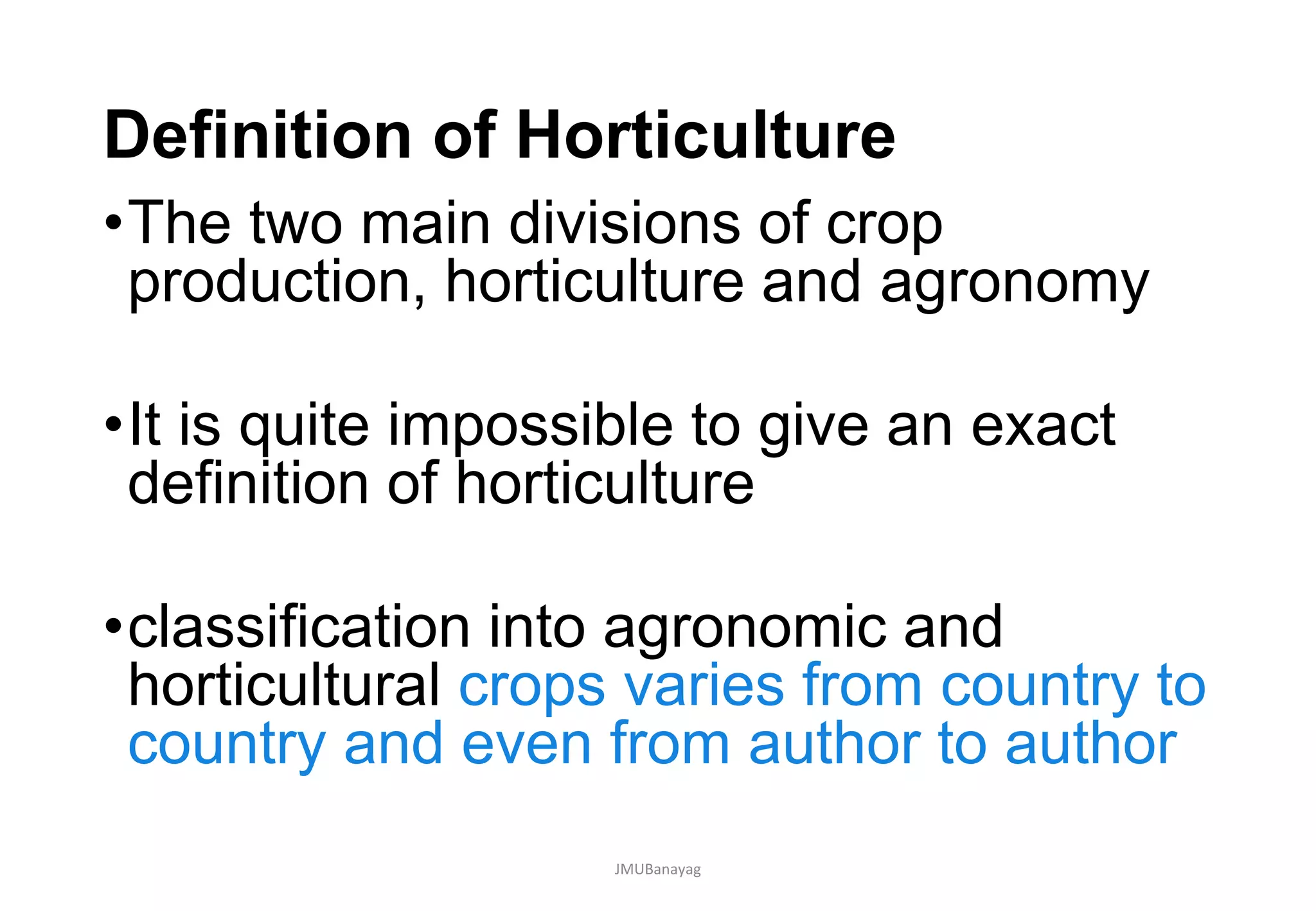
Definition of Horticulture
•The two main divisions of crop
production, horticulture and agronomy
•It is quite impossible to give an exact
definition of horticulture
•classification into agronomic and
horticultural crops varies from country to
country and even from author to author
JMUBanayag
Definition of Horticulture Cont.
•Horticulture is the growing of flowers,
fruits and vegetables, and of plants for
ornament and fancy - (Ohio State University n.d.) (Liberty Hyde
Bailey (1858-1954), an American scholar who can be considered as one of the
Fathers of Horticultural Science along with Thomas Andrew Knight (1759-1838) and
John Lindley (1799-1865) (Janick 2002))
•Horticulture is derived from the Latin words
• hortus, meaning garden, and
• cultura, meaning cultivation
• (The New Webster's Dictionary of the English Language,
international edition, 2004. Lexicon Publications, Inc. p.468).
JMUBanayag
Definition of Horticulture Cont.
• it is the branch of agriculture concerned with
intensively cultured plants directly used by man for
food, for medicinal purposes, or for esthetic
gratification - Janick (1972)
• Horticulture is the science and art involved in the
cultivation, propagation, processing and marketing
of ornamental plants, flowers, turf, vegetables,
fruits, and nuts. It is unique among plant sciences
because it not only involves science and technology, but
it also incorporates art and principles of design. -
Louisiana State University (2011)
JMUBanayag
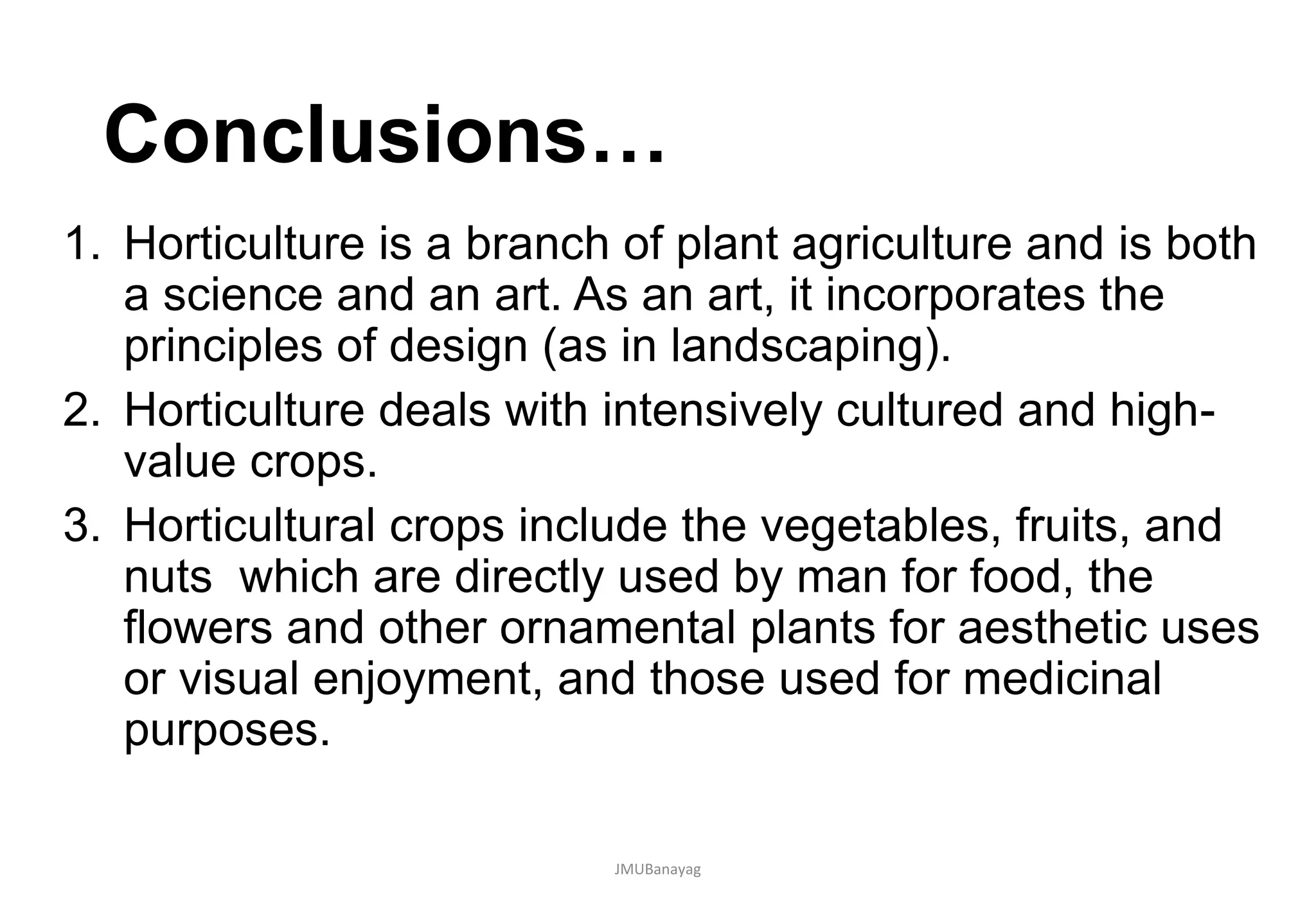
Conclusions…
1. Horticulture is a branch of plant agriculture and is both
a science and an art. As an art, it incorporates the
principles of design (as in landscaping).
2. Horticulture deals with intensively cultured and high-
value crops.
3. Horticultural crops include the vegetables, fruits, and
nuts which are directly used by man for food, the
flowers and other ornamental plants for aesthetic uses
or visual enjoyment, and those used for medicinal
purposes.
JMUBanayag
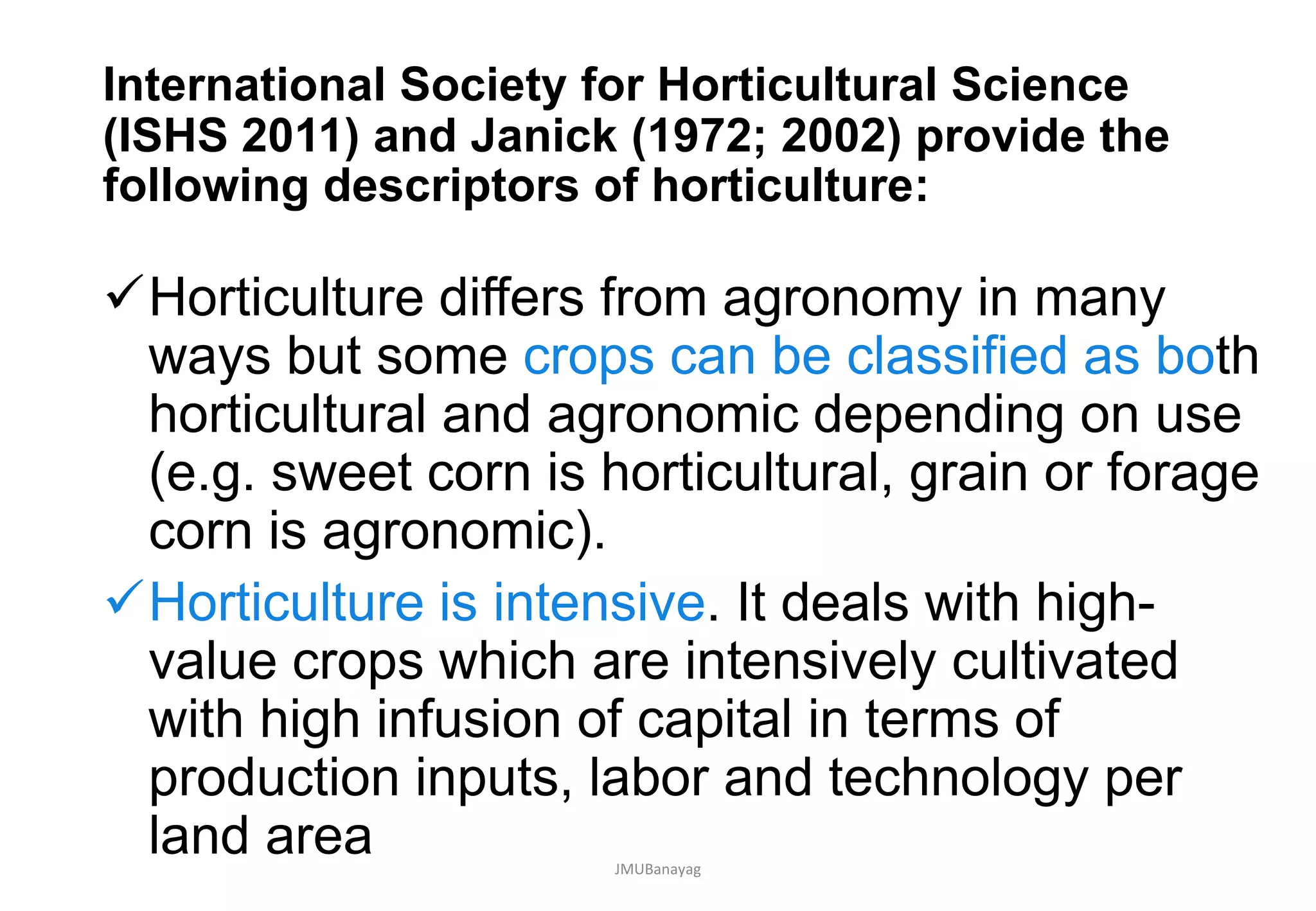
International Society for Horticultural Science
(ISHS 2011) and Janick (1972; 2002) provide the
following descriptors of horticulture:
Horticulture differs from agronomy in many
ways but some crops can be classified as both
horticultural and agronomic depending on use
(e.g. sweet corn is horticultural, grain or forage
corn is agronomic).
Horticulture is intensive. It deals with high-
value crops which are intensively cultivated
with high infusion of capital in terms of
production inputs, labor and technology per
land area JMUBanayag
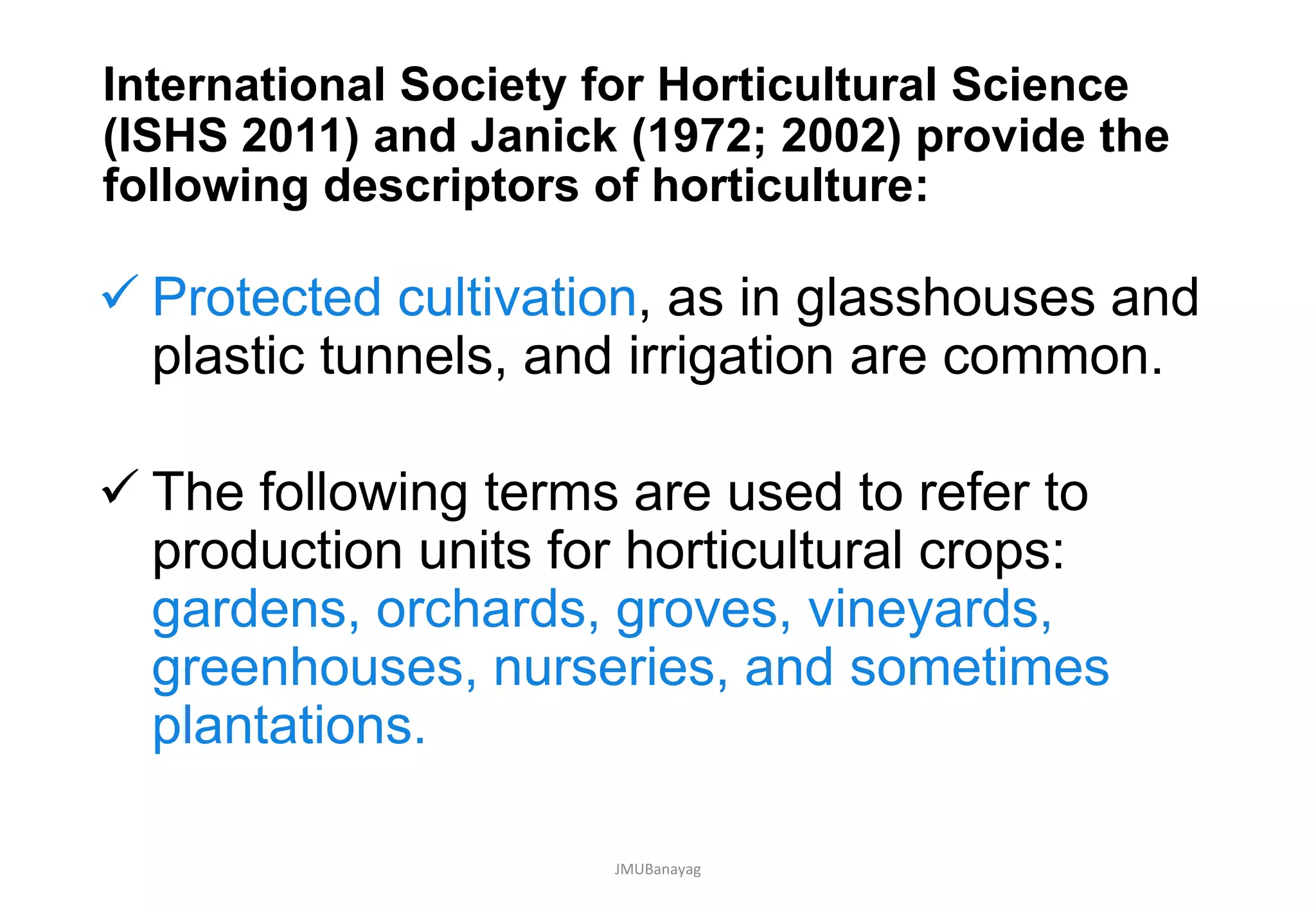
International Society for Horticultural Science
(ISHS 2011) and Janick (1972; 2002) provide the
following descriptors of horticulture:
 Protected cultivation, as in glasshouses and
plastic tunnels, and irrigation are common.
 The following terms are used to refer to
production units for horticultural crops:
gardens, orchards, groves, vineyards,
greenhouses, nurseries, and sometimes
plantations.
JMUBanayag
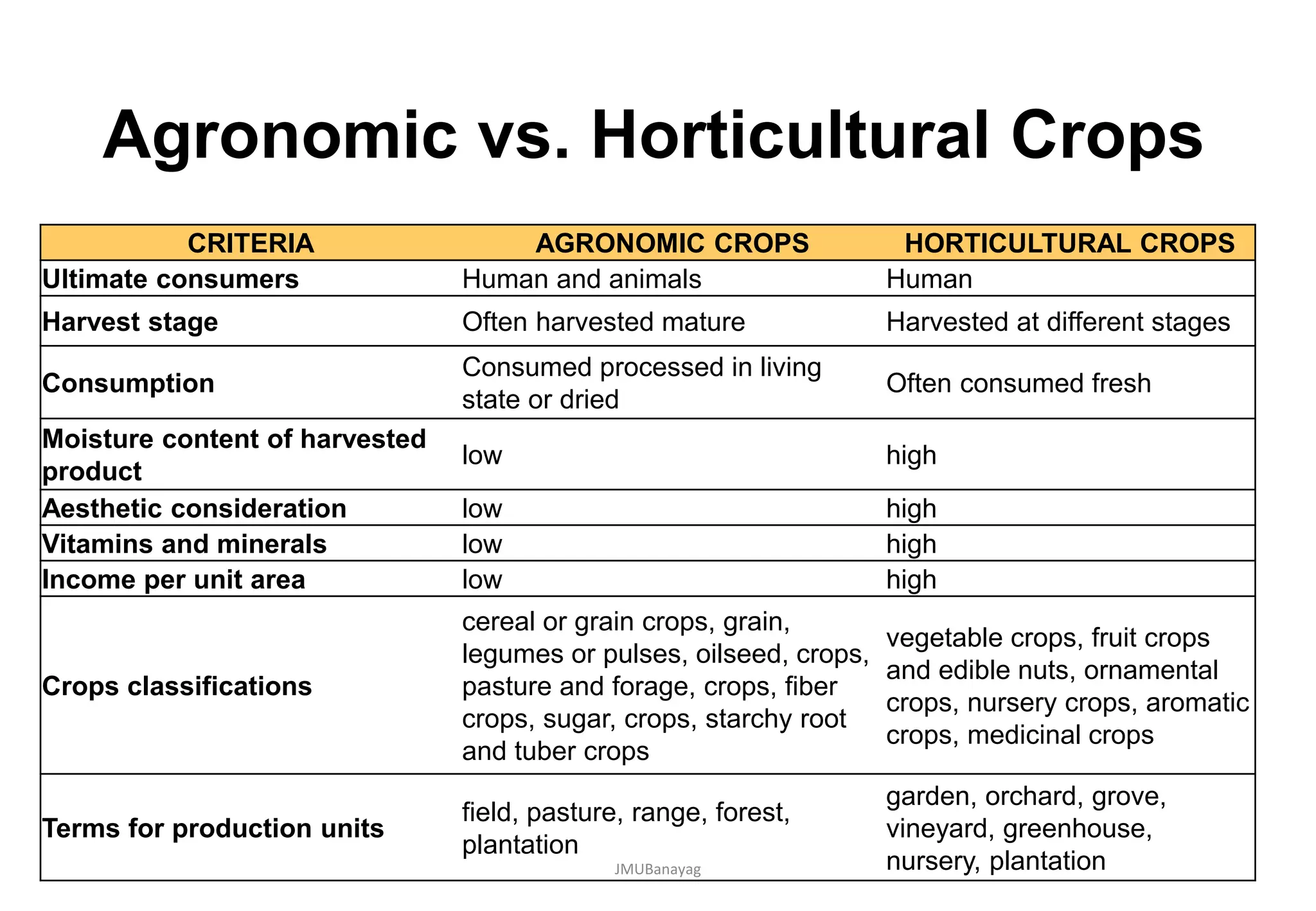
Agronomic vs. Horticultural Crops
CRITERIA AGRONOMIC CROPS HORTICULTURAL CROPS
Ultimate consumers Human and animals Human
Harvest stage Often harvested mature Harvested at different stages
Consumption
Consumed processed in living
state or dried
Often consumed fresh
Moisture content of harvested
product
low high
Aesthetic consideration low high
Vitamins and minerals low high
Income per unit area low high
Crops classifications
cereal or grain crops, grain,
legumes or pulses, oilseed, crops,
pasture and forage, crops, fiber
crops, sugar, crops, starchy root
and tuber crops
vegetable crops, fruit crops
and edible nuts, ornamental
crops, nursery crops, aromatic
crops, medicinal crops
Terms for production units
field, pasture, range, forest,
plantation
garden, orchard, grove,
vineyard, greenhouse,
nursery, plantationJMUBanayag
BRANCHES OF HORICULTURE
JMUBanayag
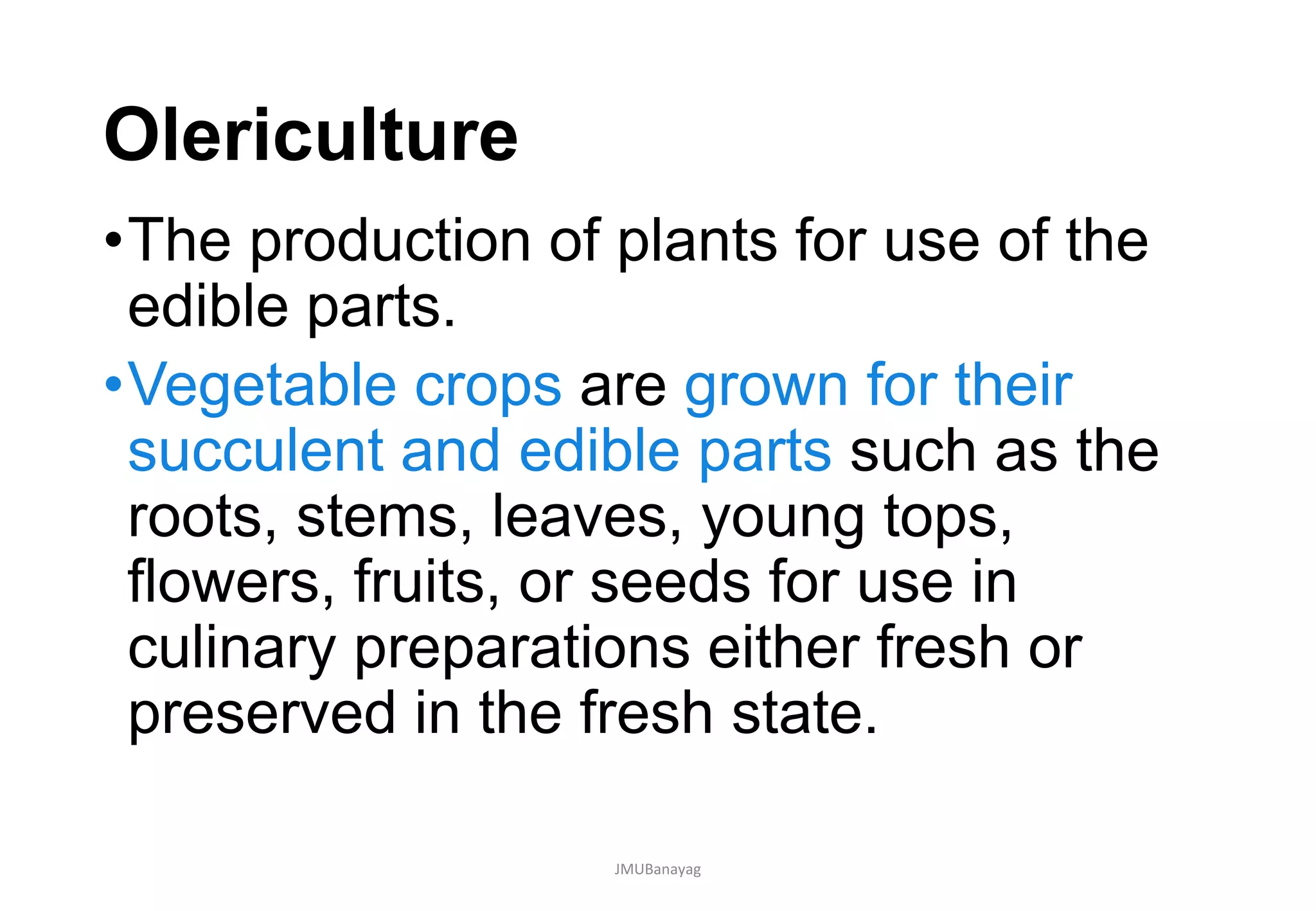
Olericulture
•The production of plants for use of the
edible parts.
•Vegetable crops are grown for their
succulent and edible parts such as the
roots, stems, leaves, young tops,
flowers, fruits, or seeds for use in
culinary preparations either fresh or
preserved in the fresh state.
JMUBanayag
Vegetable crops can be classified into
categories as:
•Salad crops - lettuce, celery
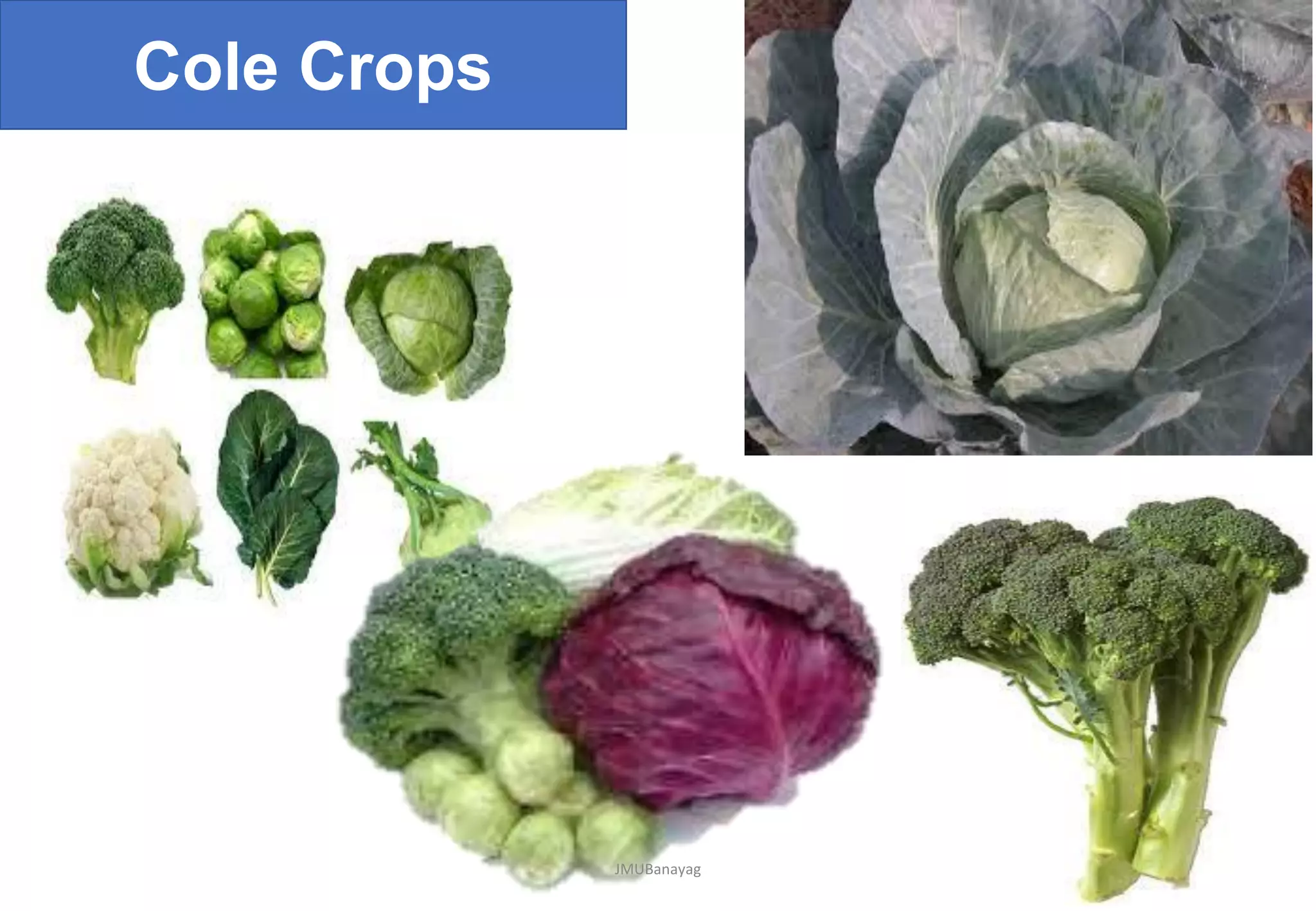
•Cole crops - cabbage and cauliflower
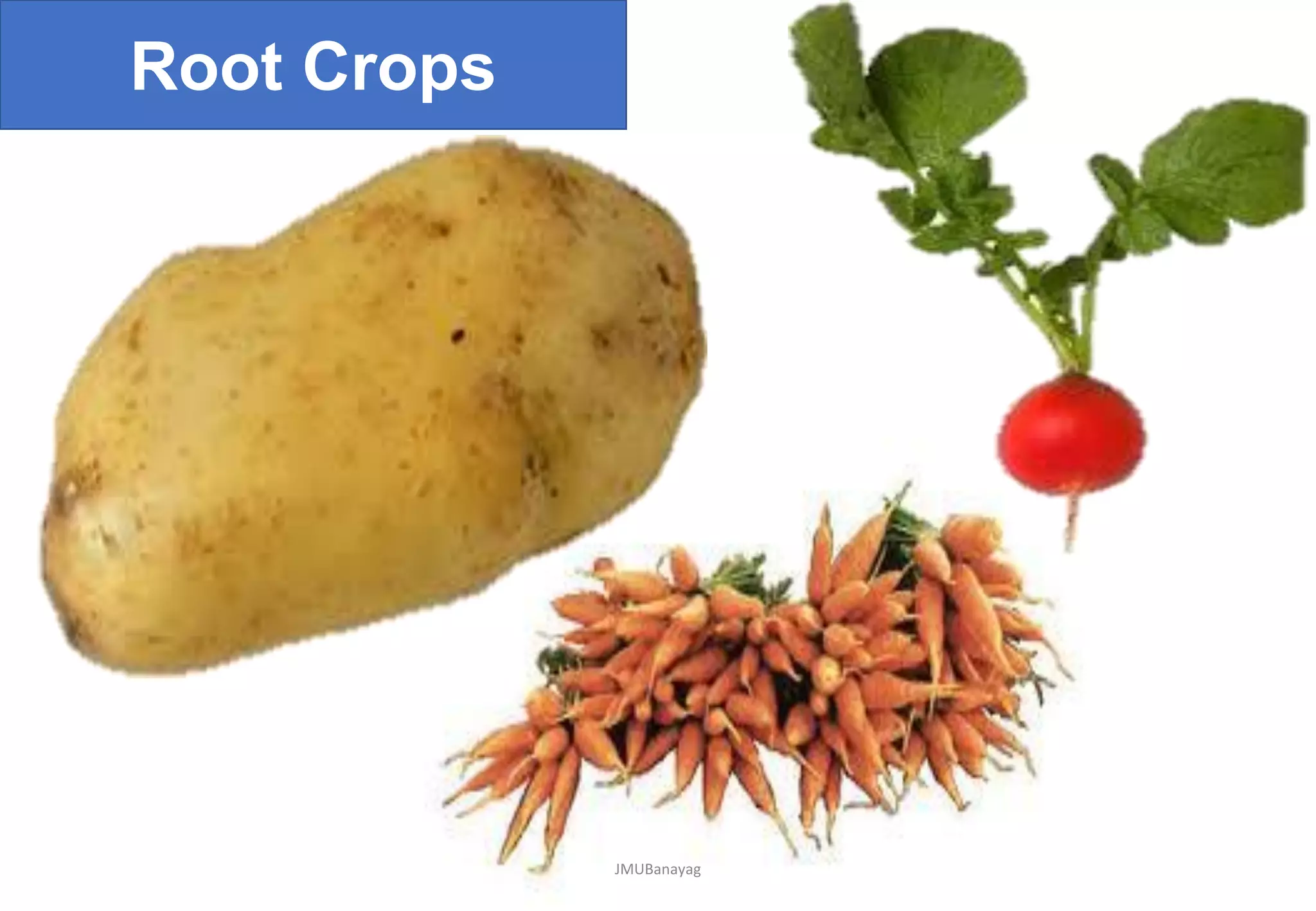
•Root crops (tubers) - potatoes, beets,
carrots, radishes
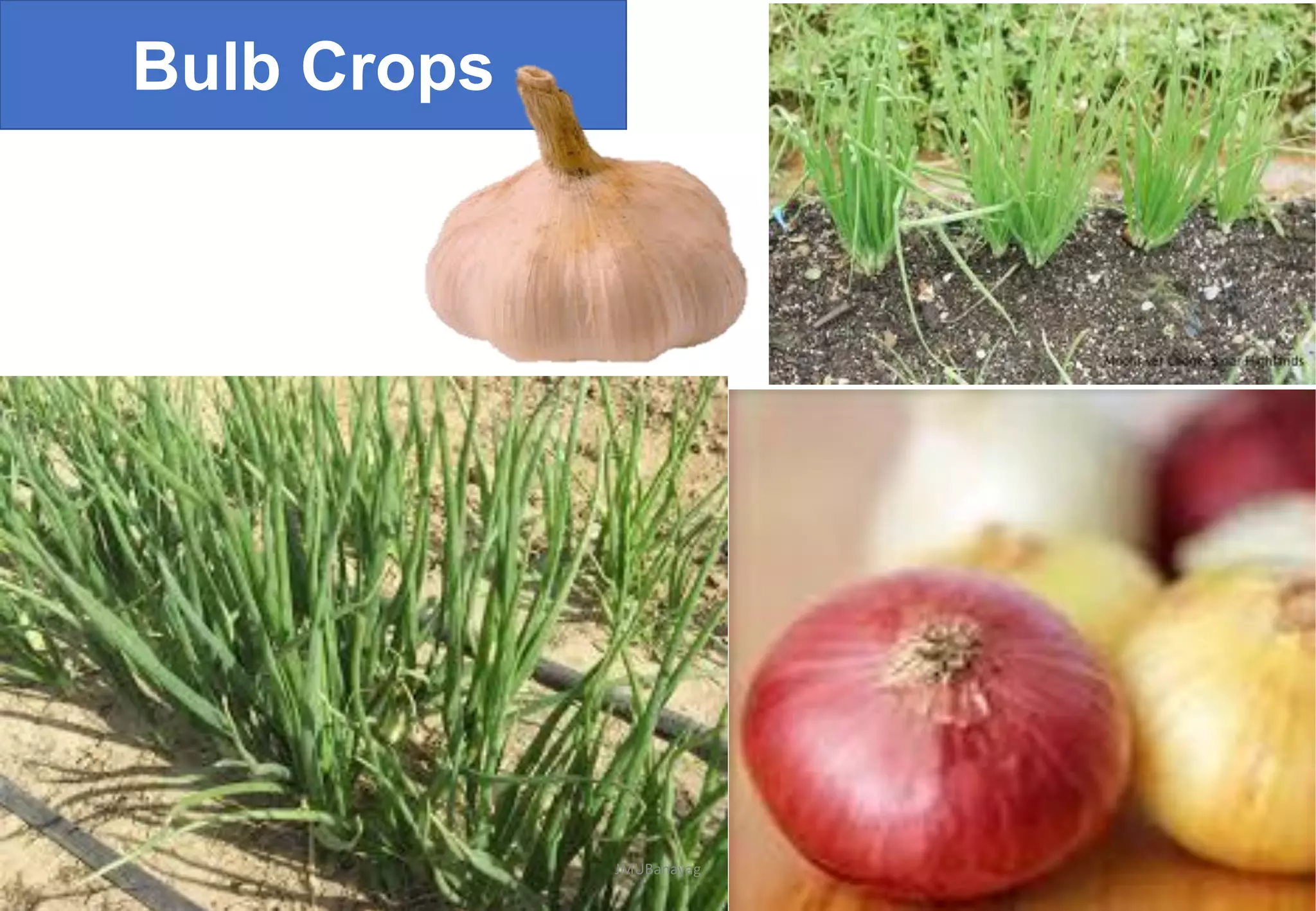
•Bulb crops - onions, leeks
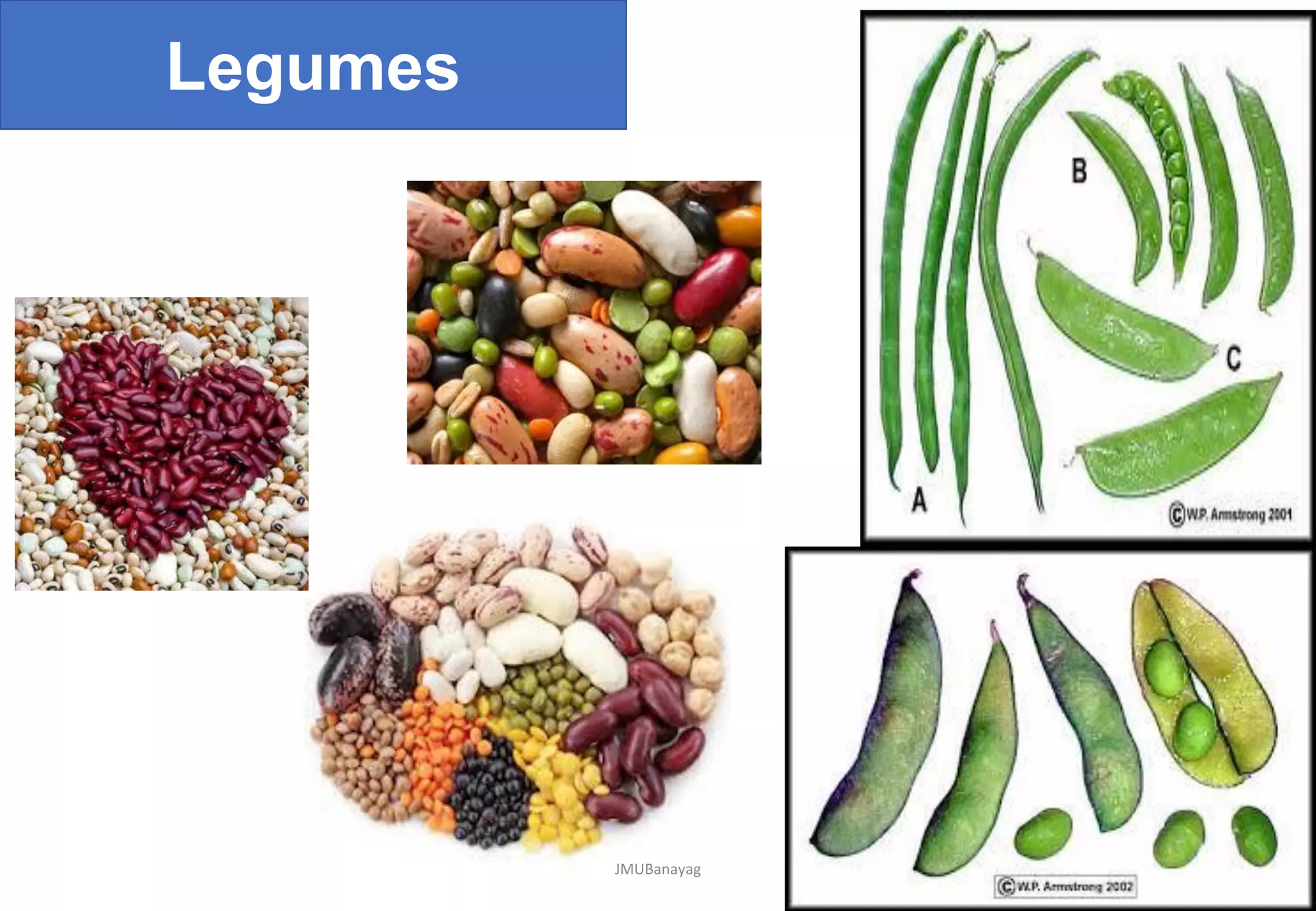
•Legumes - beans, peas
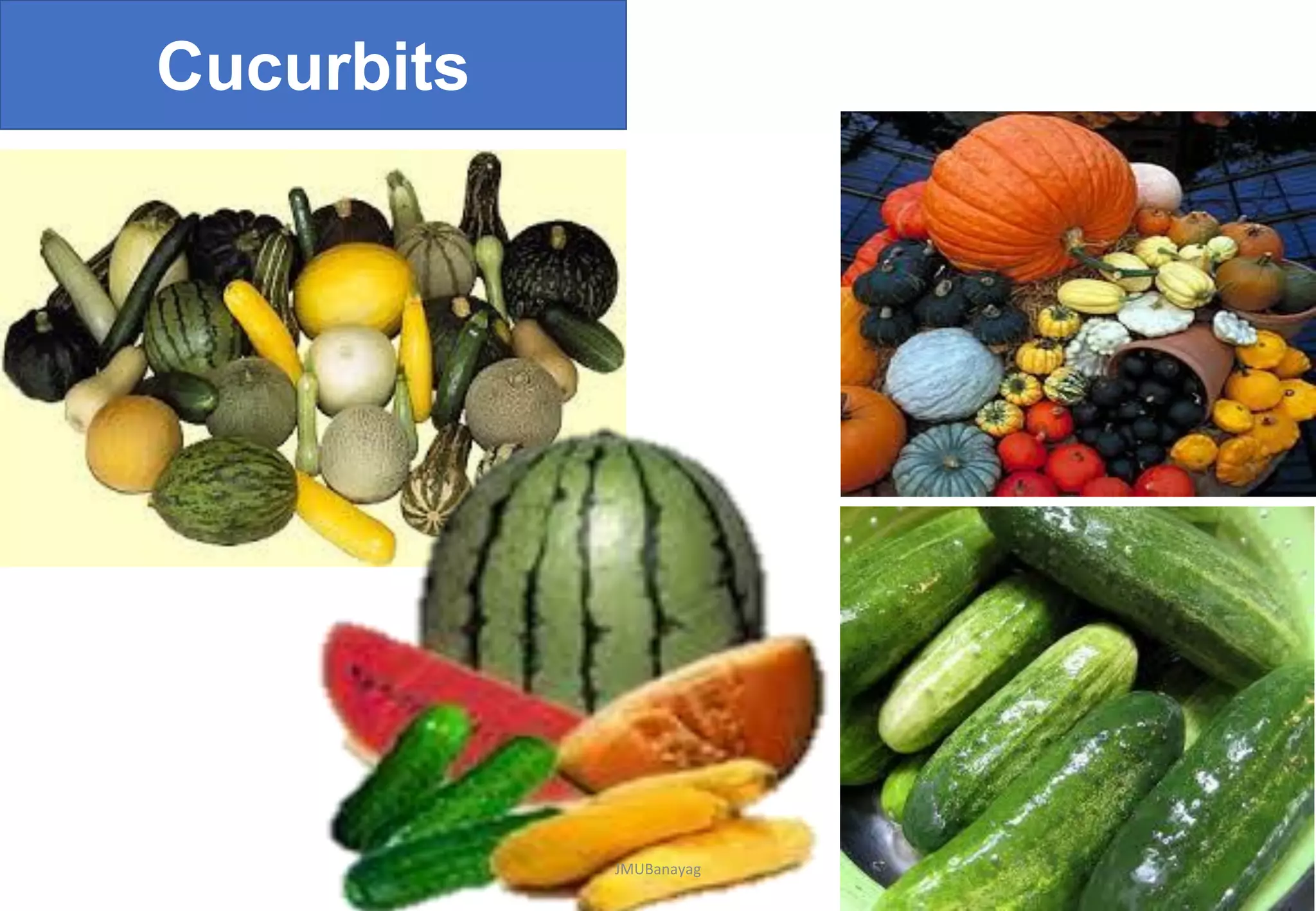
•Cucurbits - melons, squash, cucumber
•Solanaceous crops - tomatoes, peppers
JMUBanayag
Salad Crops
JMUBanayag
Cole Crops
JMUBanayag
Root Crops
JMUBanayag
Bulb Crops
JMUBanayag
Legumes
JMUBanayag
Cucurbits
JMUBanayag
Solanaceous Crops
JMUBanayag
Pomology
•The branch of horticulture which
deals with fruit crops.
•Fruit crops are grown for their edible
fruits which, as a rule, are
consumed raw.
JMUBanayag
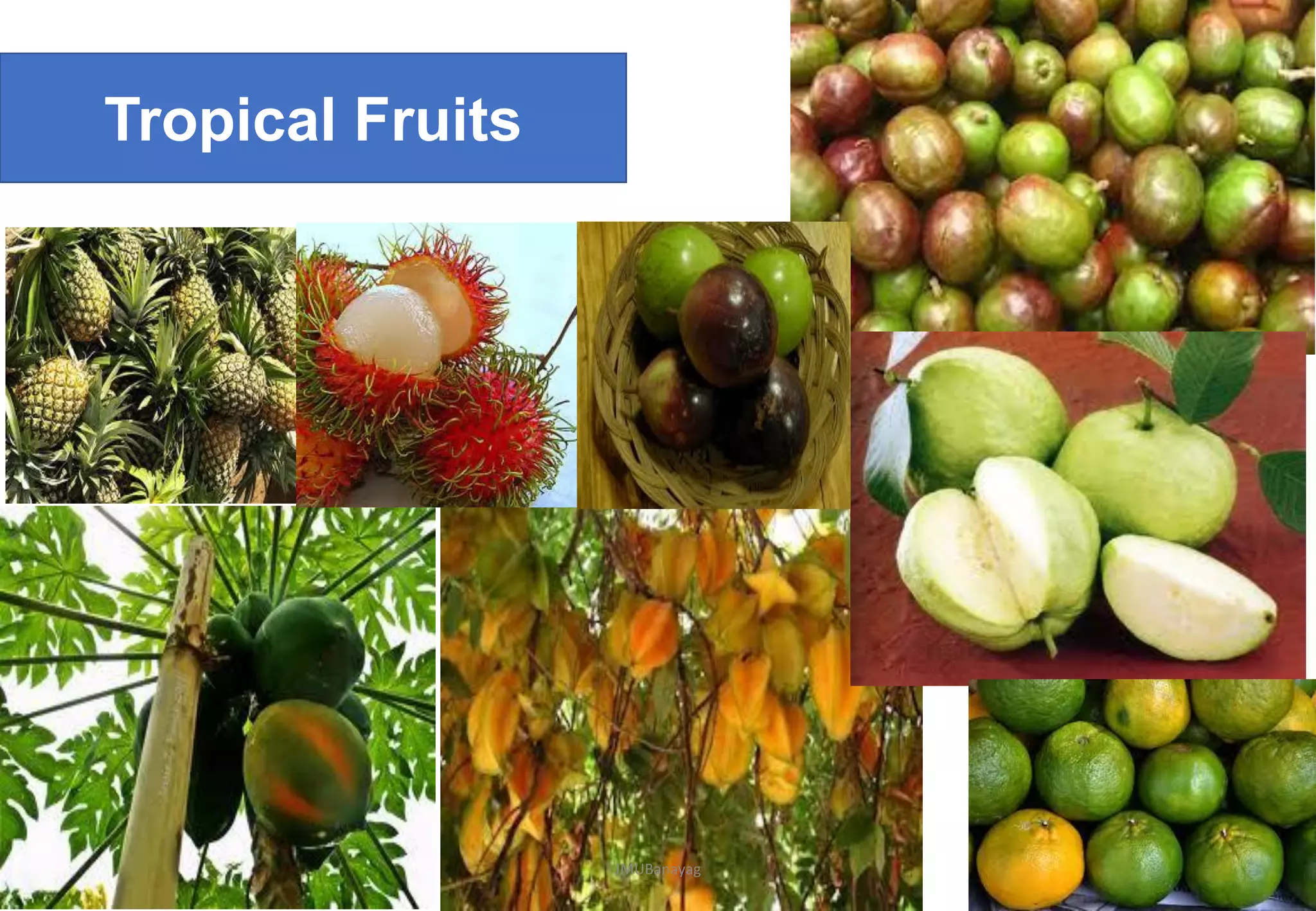
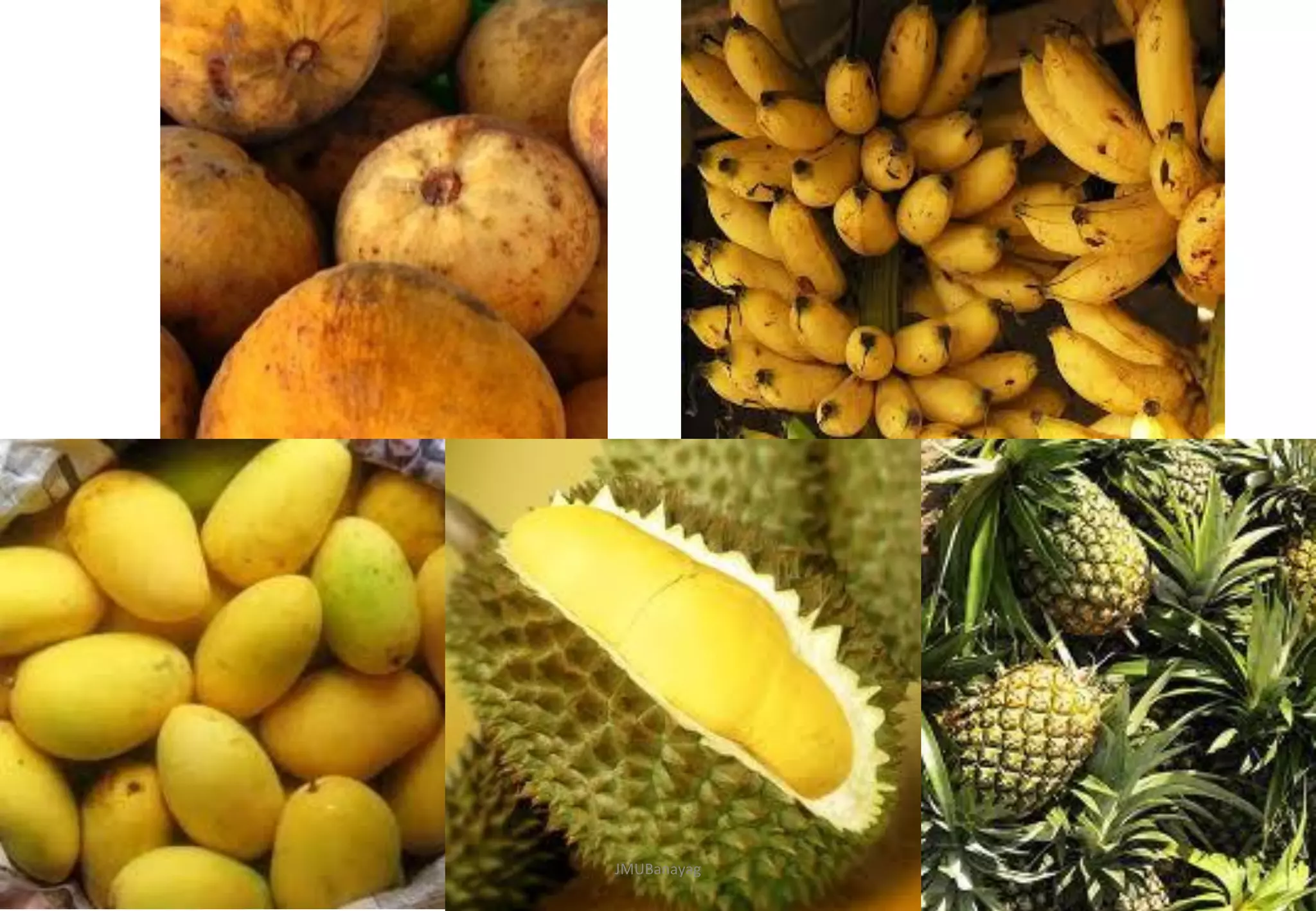
Tropical Fruits
JMUBanayag
JMUBanayag
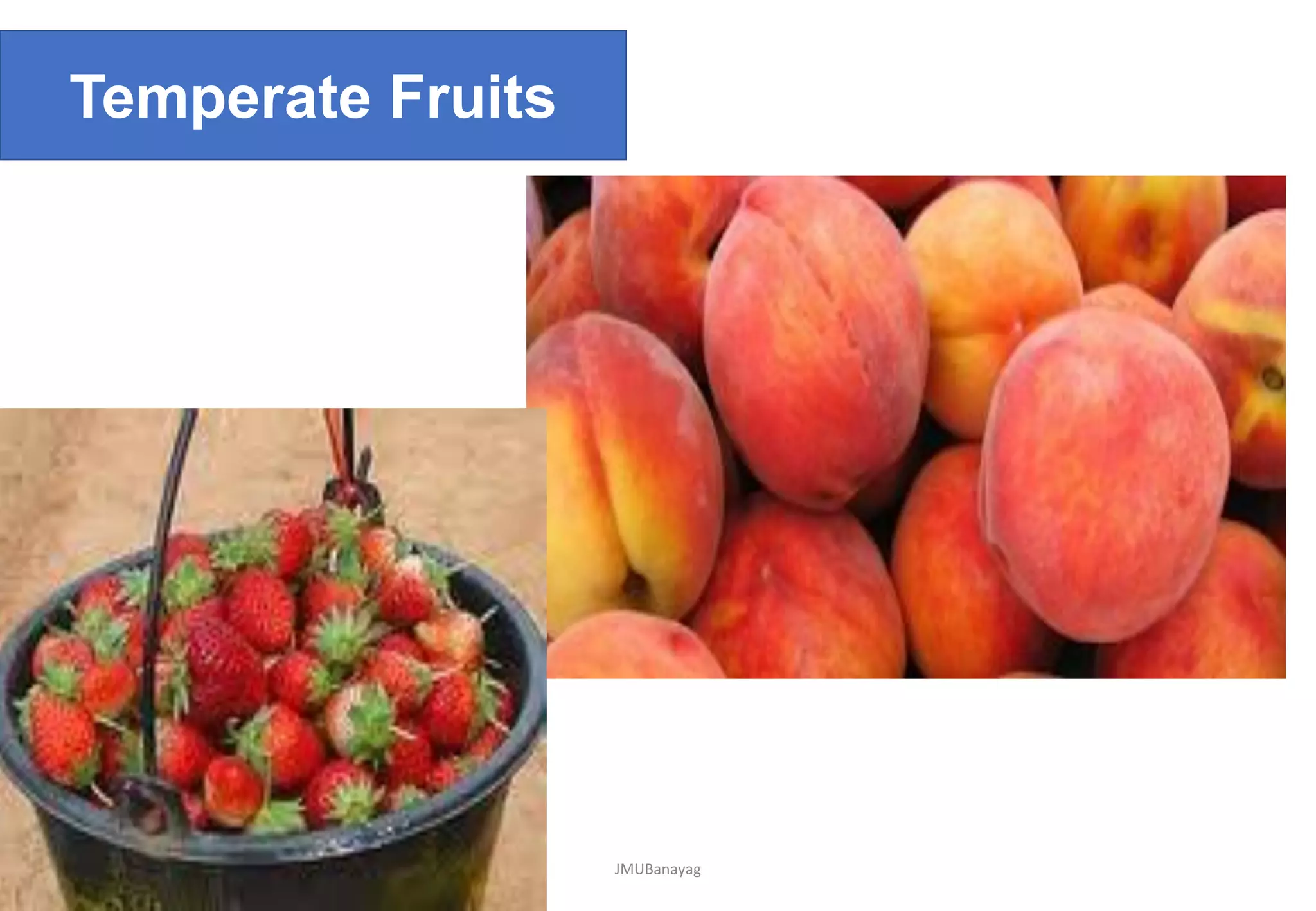
Temperate Fruits
JMUBanayag
Floriculture
•The cultivation and management of cut
flowers, flowering plants, and foliage plants
including their use in ornamental construct
such as flower arrangement.
•A term that is used interchangeably with
floriculture is ornamental horticulture.
JMUBanayag
JMUBanayag
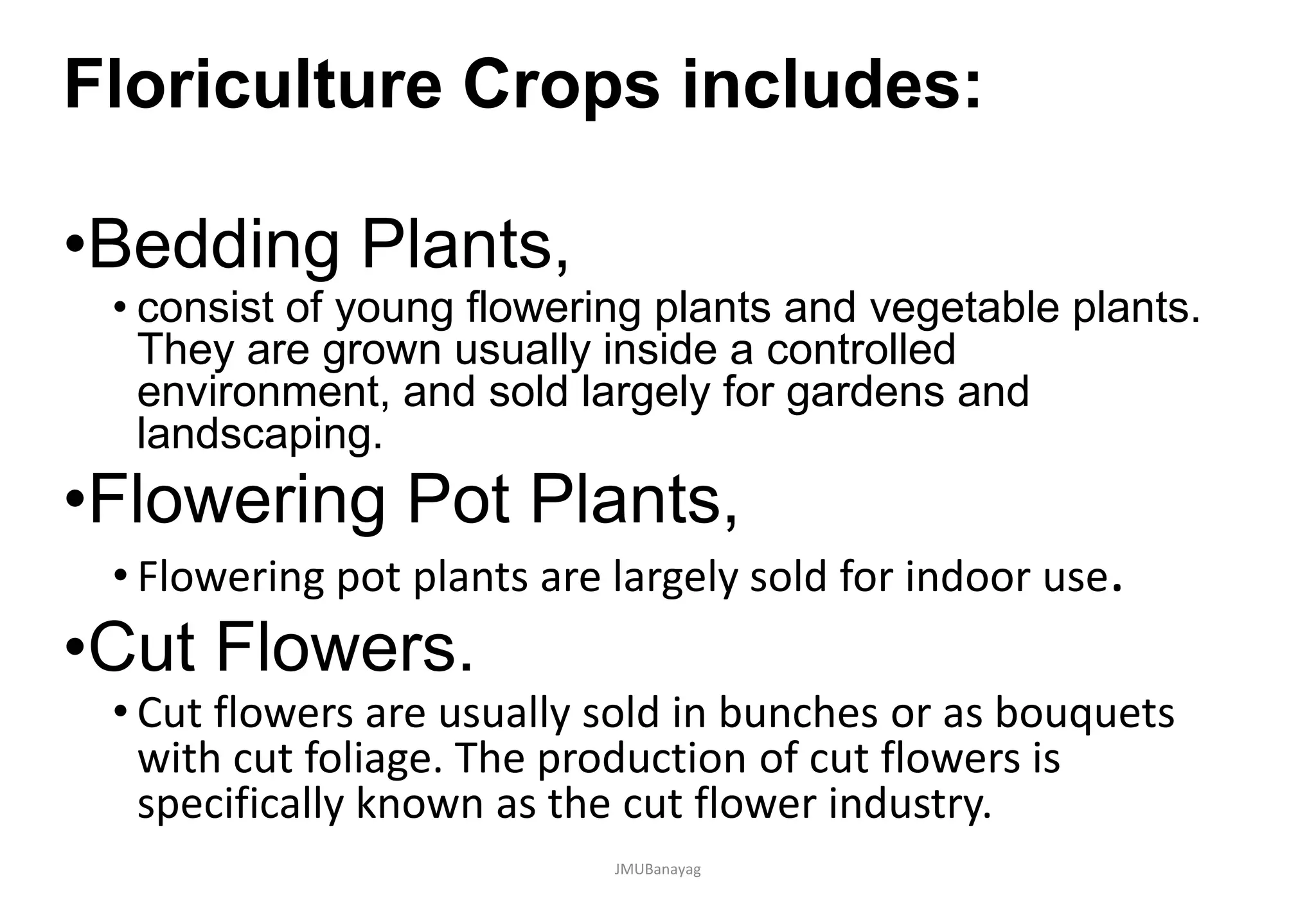
Floriculture Crops includes:
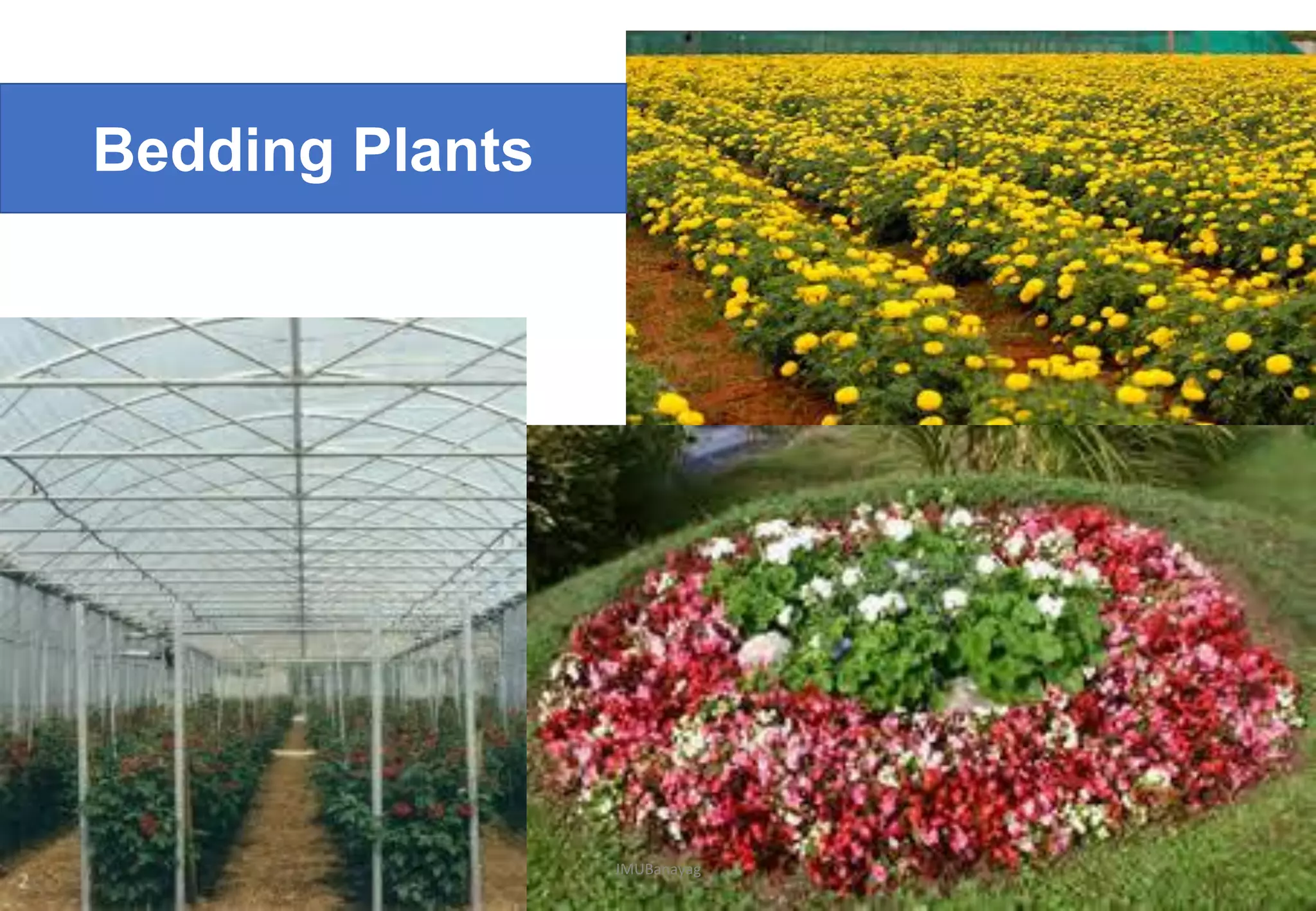
•Bedding Plants,
• consist of young flowering plants and vegetable plants.
They are grown usually inside a controlled
environment, and sold largely for gardens and
landscaping.
•Flowering Pot Plants,
• Flowering pot plants are largely sold for indoor use.
•Cut Flowers.
• Cut flowers are usually sold in bunches or as bouquets
with cut foliage. The production of cut flowers is
specifically known as the cut flower industry.
JMUBanayag
Bedding Plants
JMUBanayag
Flowering Pot Plants
JMUBanayag
Cut Flowers
JMUBanayag
Flower: The Reproductive Organ of
Plants
JMUBanayag
What is Fruit?
•Technically, a fruit is a mature, ripened
ovary.
•Contain the seed (ripened ovules) and
pericarp (the tissue that surrounds the
seeds)
•Two main functions:
•to prevent the seeds from drying
•to disperse the seeds.
JMUBanayag
Pollination
JMUBanayag
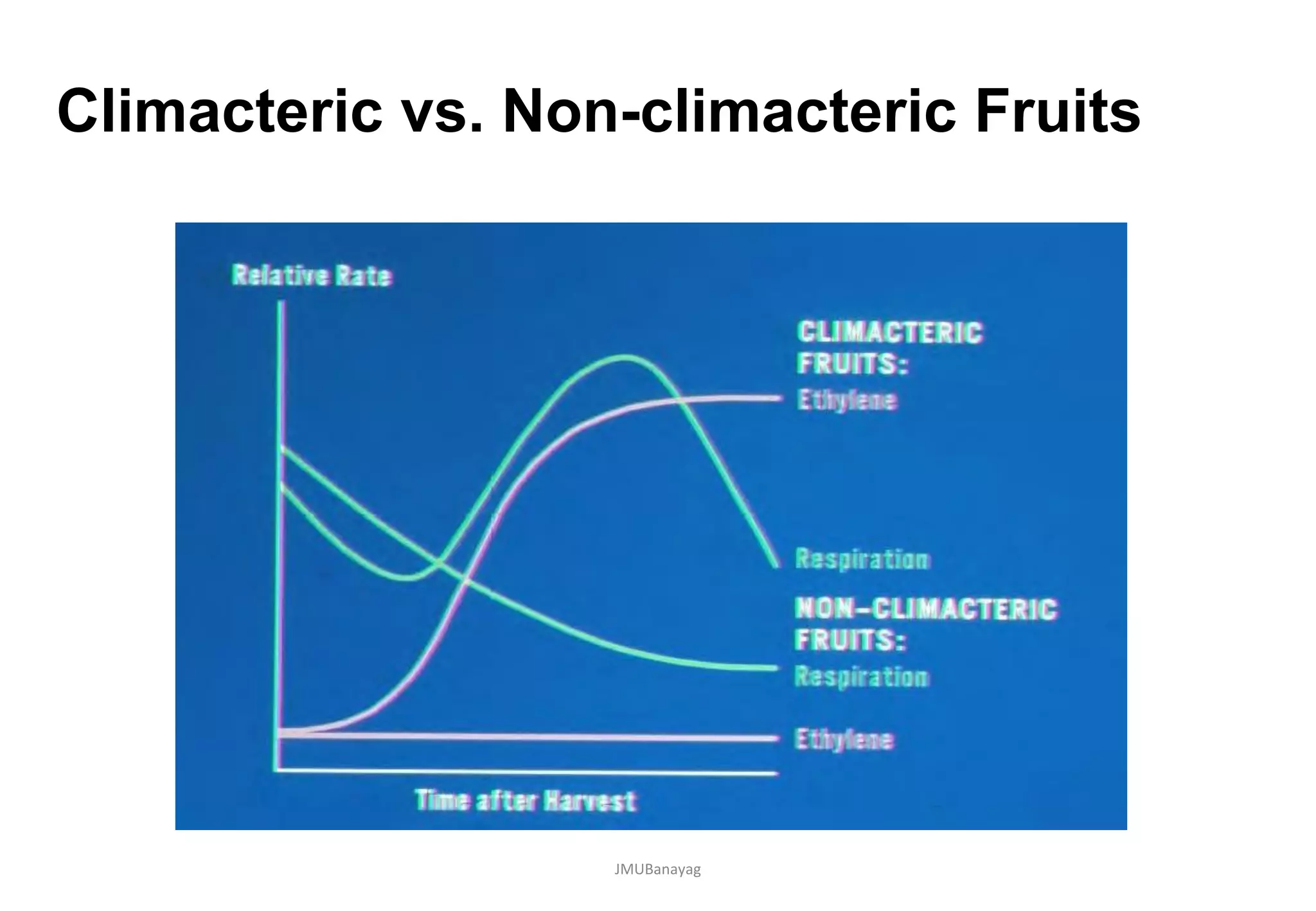
Climacteric vs. Non-climacteric Fruits
JMUBanayag
Parts of a Fruit
JMUBanayag
JMUBanayag
1. strawberry a berry?
2. Is coconut a nut?
3. Is peanut a nut?
JMUBanayag
Types of fruits: Description
1. Fleshy fruit are juicy.
a. Berry has an entirely fleshy ovary. Tomatoes, dates,
blueberries, bananas, peppers, and cranberries.
b. Hesperidium have a leathery rind. Examples include
oranges, grapefruits, lemons, and limes.
c. Pepo is a type of fruit defined by hard rind and a fleshy
inner matrix. Watermelons, cantaloupe, squash, and
pumpkins.
d. Drupe is a fruit with a fleshy exterior and a single hard,
stony pit surrounding the seed. Cherries, peaches, olives,
mango, raspberry coconut, plums.
e. Pomes have a fleshy exterior and a center with papery
carpels. Apples and pears.
JMUBanayag
JMUBanayag
Types of fruits: Description
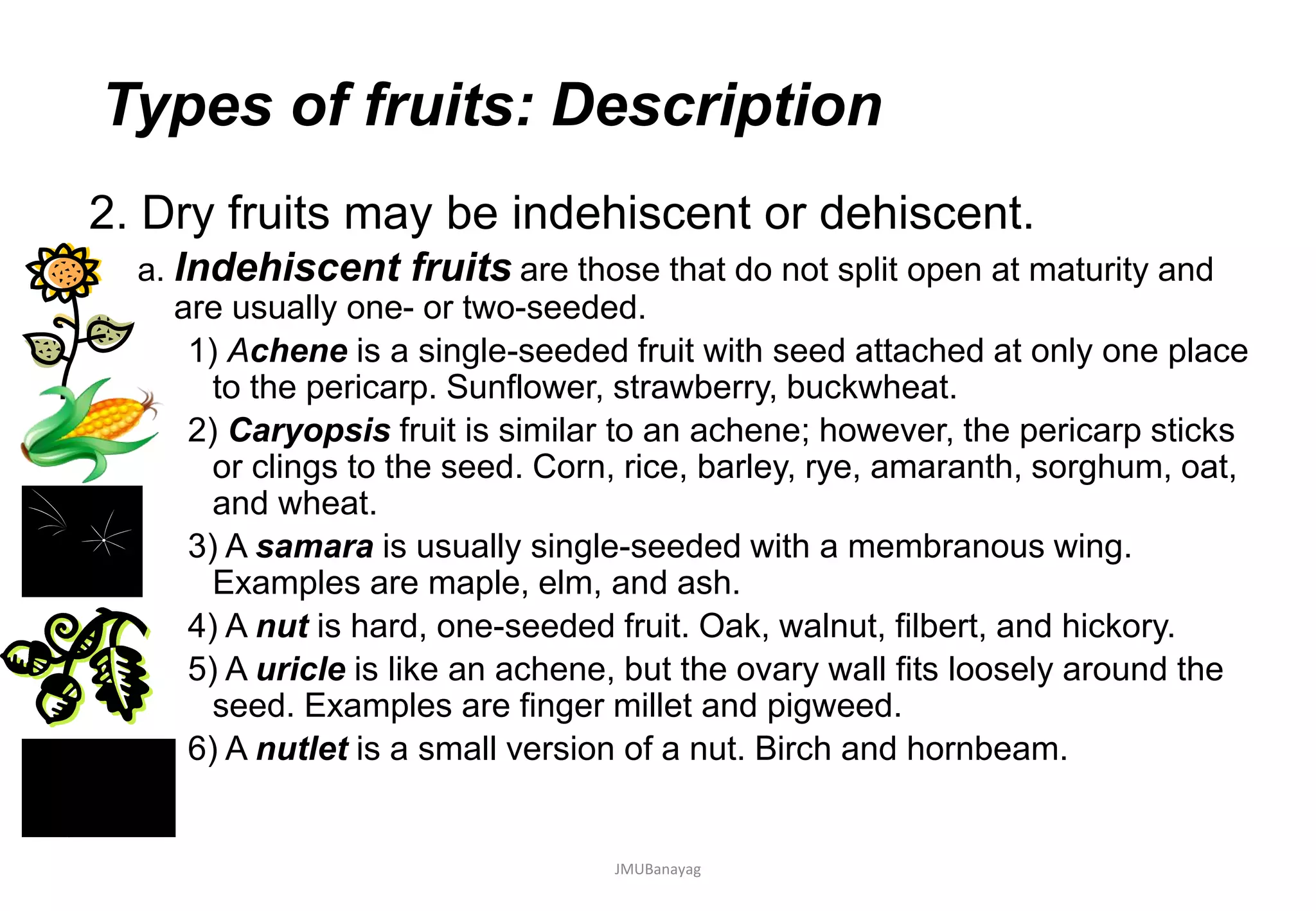
2. Dry fruits may be indehiscent or dehiscent.
a. Indehiscent fruits are those that do not split open at maturity and
are usually one- or two-seeded.
1) Achene is a single-seeded fruit with seed attached at only one place
to the pericarp. Sunflower, strawberry, buckwheat.
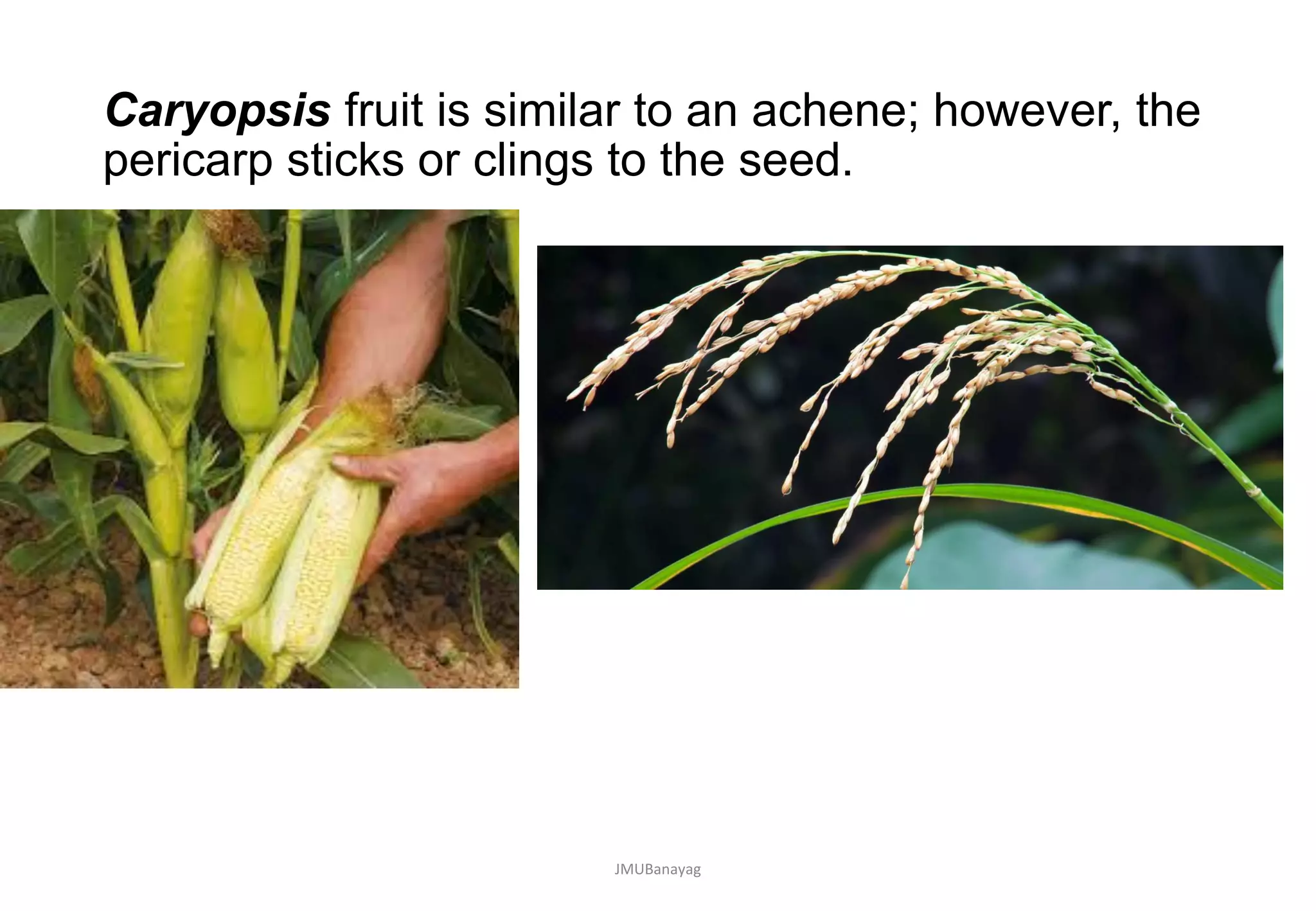
2) Caryopsis fruit is similar to an achene; however, the pericarp sticks
or clings to the seed. Corn, rice, barley, rye, amaranth, sorghum, oat,
and wheat.
3) A samara is usually single-seeded with a membranous wing.
Examples are maple, elm, and ash.
4) A nut is hard, one-seeded fruit. Oak, walnut, filbert, and hickory.
5) A uricle is like an achene, but the ovary wall fits loosely around the
seed. Examples are finger millet and pigweed.
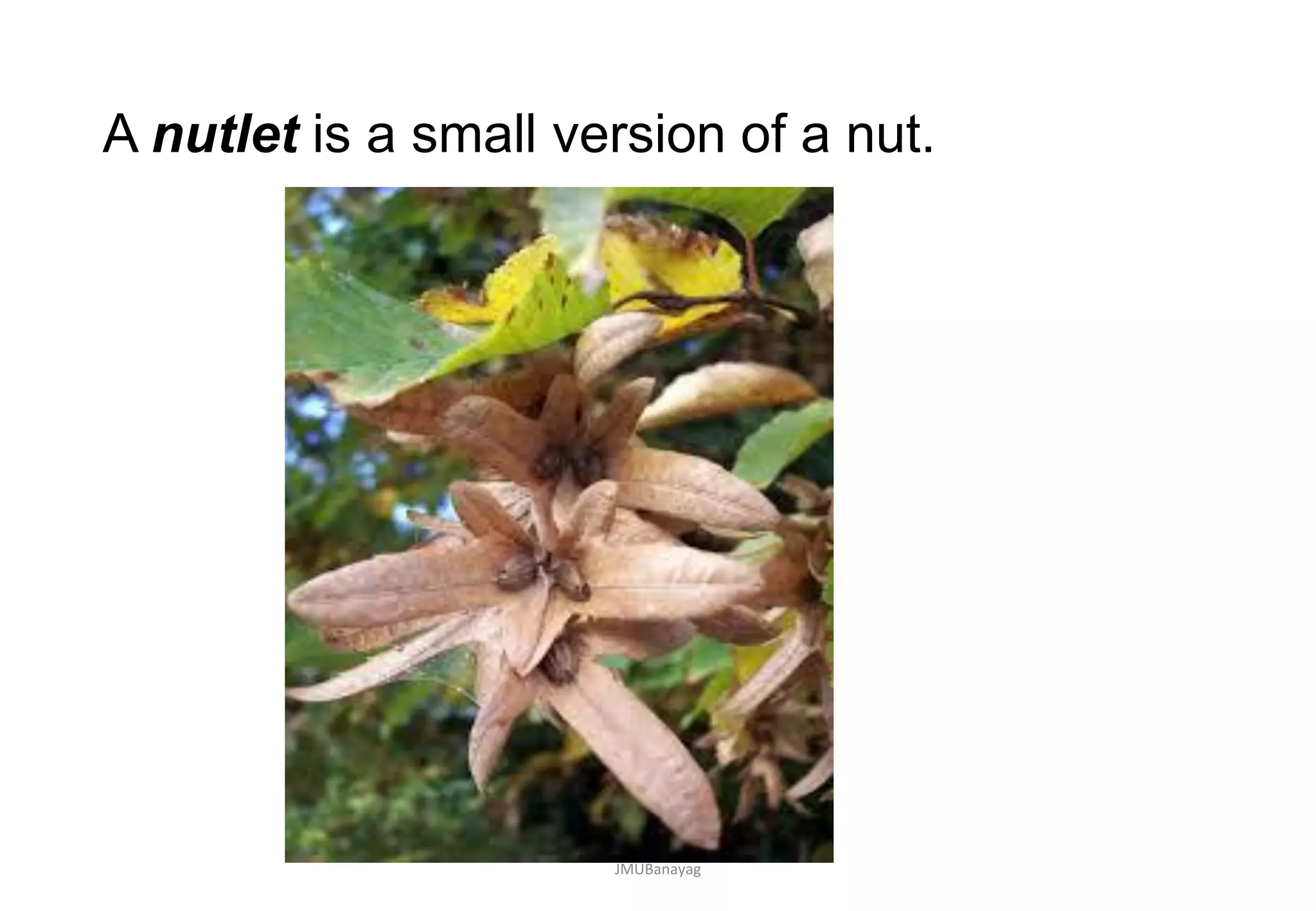
6) A nutlet is a small version of a nut. Birch and hornbeam.
JMUBanayag
Achene is a single-seeded fruit with seed
attached at only one place to the pericarp.
JMUBanayag
Caryopsis fruit is similar to an achene; however, the
pericarp sticks or clings to the seed.
JMUBanayag
samara is usually single-seeded with a
membranous wing
Maple Elm
JMUBanayag
A nut is hard, one-seeded fruit.
JMUBanayag
A uricle is like an achene, but the ovary wall
fits loosely around the seed.
JMUBanayag
A nutlet is a small version of a nut.
JMUBanayag
Types of fruits: Description
b. Dehiscent fruits are fruits that split open upon maturation.
1) A legume (pod) is composed of a single carpel and has two
longitudinal sutures. Soybeans, green beans, and peas.
2) A follicle is composed of a single carpel and splits open along one
suture. Milkweed.
3) A capsule is composed of more than one carpel that are united and
form many-seeded fruits. Okra and cotton.
4) A pyxis is a type of capsule with a lid that falls from the fruit. An
example is purslane.
JMUBanayag
follicle
JMUBanayag
pyxis
JMUBanayag
Types of fruits: Origin
1. Simple fruits
- develop from a single ovary of a single pistil.
- fleshy
JMUBanayag
Types of fruits: Origin
1. Simple fruits
- develop from a single ovary of a single pistil.
- dry
JMUBanayag
Types of fruits: Origin
2. Aggregate fruits
- develop from a single flower that has many pistils.
- Raspberries are an aggregate of drupes.
- Strawberries are an aggregate of achenes
JMUBanayag
JMUBanayag
Types of fruits: Origin
3. Multiple fruits
- consist of a number of flowers that fused to form a mass
- pineapples, edible fig, mulberry, osage-orange, and
breadfruit
JMUBanayag
JMUBanayag
Plantation Crops
• plants grown in large tracts of land under intensive
culture, usually in a tropical or subtropical country,
where products are sold in distant markets rather
than for local consumption
• requires plenty of labor and large investment of
capital
• corporate organizations and multinational
companies - Dole Philippines and Del Monte.
JMUBanayag
Classification of Plantation Crops
• Fiber crops (cotton, abaca, buri, kapok, sisal)
• Trees (e.g. falcata, mahogany)
• Bamboo (e.g. giant bamboo, thorny bamboo),
• Industrial crops (e.g. sugarcane, coconut, palm oil,
rubber, papaya),
• Beverage crops (coffee, cacao, tea),
• Fruit crops (e.g. banana, pineapple),
• Nuts (e.g. cashew, Pili nut)
JMUBanayag
Classification of Plantation Crops
•Vegetables (e.g. asparagus),
•Spices (e.g. turmeric, pepper, laurel, etc.),
•Aromatic crops (ilang-ilang, vanilla, citronella,
etc.),
•Medicinal and Pesticidal crops (banaba,
lagundi, neem, etc)
•Tobacco
JMUBanayag
Botanical classification
•Plant Kingdom
•Division I – Thallophyta (algae)
•Division II – Bryophyta (mosses & liverworts)
•Division III – Pteridophyta (ferns & fern allies)
•Division IV – Spermatophyta (seed plants)
• Class 1 – Gymnospermae (pine trees)
• Class II – Angiospermae (flowering plants)
• Subclass I – Monocotyledonae
• Subclass II – Dicotyledonae
JMUBanayag
Family Anacardiaceae
•Cashew
Anacardium occidentale L.
•Mango
Mangifera indica L.
•Purple mombin
Spondias purpurea L.
JMUBanayag
Family Agavaceae
•Maguey
Agave cantala Roxb.
•Sisal
Agave sisalana Perr.
JMUBanayag
Family Annonaceae
•Soursop, labana
Annona muricata L.
•Sugar apple, atis
Annona squamosa L.
JMUBanayag
Family Arecaceae
• Sugar Palm
Arenga pinnata (Wumb) Merr.
• Coconut
Cocos nucifera L.
• African oil palm
Elaeis guineensis Jacq.
JMUBanayag
Family Bixaceae
•Annato, Lipstick tree
Bixa orellana L.
JMUBanayag
Family Bombacaceae
• Silk-cotton tree
Ceiba pentandra (L.) Gaertn
• Durian
Durio zibethinus Murr.
JMUBanayag
Family Bromeliaceae
•Pineapple
Ananas comosus (L.) Merr.
JMUBanayag
Family Burseraceae
•Pili nut
Canarium ovatum Engl.
JMUBanayag
Family Caricaceae
•Papaya
Carica papaya L.
JMUBanayag
Family Clusiaceae
•Mangosteen
Garcinia mangostana L.
JMUBanayag
Family Ebenaceae
•Mabolo
Diospyros discolor Willd.
JMUBanayag
Family Euphorbiaceae
•Rubber
Hevea brasiliensis (Wild. Ex A. Juss.)
•Castor bean
Ricinus communis L.
JMUBanayag
Family Lamiaceae
•Japanese mint
Mentha arvensis L.
JMUBanayag
Family Lauraceae
•Cinnamon
Canella verum J.S. Presl.
•Avocado
Persea americana Mill.
JMUBanayag
Family Leguminosae
•Camachile
Pithecellobium dulce (Roxb.) Benth
•Tamarind
Tamarindus indica L.
JMUBanayag
Family Lythraceae
•Banaba
Lagerstroemia speciosa Pers.
JMUBanayag
Family Meliaceae
•Lanzones
Lansium domesticum Corr.
•Santol
Sandoricum koetjape (Burm.f.) Merr.
JMUBanayag
Family Moraceae
• Breadfruit
Artocarpus altilis (Parkins.) Fosb.
• Kamansi / seeded breadfruit
Artocarpus camansi Blco
• Jackfruit
Artocarpus heterophyllus Lam.
• Marang
Artocarpus odoratissimus Blco.
JMUBanayag
Family Musaceae
•Abaca
Musa textilis Nee
•Banana
- Musa balbisiana Colla (BB: Butuhan)
- Musa acuminata Colla; M. cavendisshii
(AA: Lacatan, Seňorita; AAA: Cavendish,
Grand Nain, Gros Michel)
- Musa paradisiaca L. (ABB: Saba, Cardava)
JMUBanayag
JMUBanayag
Family Myrtaceae
• Guava
Psidium guajava L.
• Java plum
Syzgium cumini (L.) Skeels
• Wax apple, Macopa
Syzygium samarangense
(Blume) Merrill & Perry
• Watery Rose Apple, Tambis
Syzygium aqueum (Burm.f.) Alston
JMUBanayag
Family Orchidaceae
• Vanilla
Vanilla planifolia Andr.
JMUBanayag
Family Oxalidaceae
•Camias
Averrhoa balimbi L.
•Starfruit
Averrhoa carambola L.
JMUBanayag
Family Passifloraceae
•Passion fruit
Passiflora edulis Sims.
•Granadilla
Passiflora quadrangularis L.
JMUBanayag
Piperaceae
•Black pepper
Piper nigrum L.
JMUBanayag
JMUBanayag
Punicaceae
•Pomegranate, granada
Punica granatum L.
JMUBanayag
Family Rosaceae
•Apple
Malus pumila, M. communis, etc.
•Pears
Pyrus communis
•Almonds
Prunus dulcis
•Strawberry
Fragaria vesca L. subsp. vesca
JMUBanayag
Family Rubiaceae
•Coffee
Coffea robusta
Coffea arabica
Coffea excelsa
JMUBanayag
Family Rutaceae
•Calamansi, calamondin
Citrofortunella mitis (Blanco.) J. Ingram &
H.E. Moore
•True Lime
Citrus aurontifolia (Christm. & Panzer) Swingle
•Tahiti Lime
Citrus latifolia (Lour.)
JMUBanayag
Family Rutaceae
• Lemon
Citrus limon (L.) Burm.f.
• Pummelo
Citrus maxima (Burm.) Merr,
• Kulubut, kabuyau
Citrus hystrix DC.
• Mandarin
Citrus reticulata Blanco
• Sweet orange
Citrus sinensis (L.) Osbeck
JMUBanayag
Family Sapindaceae
• Rambutan
Nephelium lappaceum L.
• Lychee
Litchi chinensis Sonn.
JMUBanayag
Family Sapotaceae
• Starapple, caimito
Chrysophyllum cainito L.
• Chico, sapota
Manilkara zapota (L.) P. Van Royen
• Canistel, tiesa
Pouteria campechiana (kunth) Baehni
• Miracle fruit
Synsepalum dulcificum
(Schumach. & Thonn.) Daniell
JMUBanayag
Family Sterculiaceae
• Cacao
Theobroma cacao L. Subsp. cacao
JMUBanayag
Family Theaceae
•Tea
Camellia sinensis (L.) O. Kuntze var. sinensis L.
JMUBanayag
Family Verbenaceae
• Five-leaved chaste, lagundi
Vitex negundo L.
JMUBanayag
Family Vitaceae
•Grape
Vitis vinifera L.
JMUBanayag
Family Zingiberaceae
•Turmeric
Curcuma longa L.
JMUBanayag
• Credits to the owners of slides and contents being used.
Disclaimer: The content provided in this presentation is for educational purpose only. The author or the owner
of the content makes no representatives as the accuracy or completeness of any information provided in this
slide. The owner will also not be liable for any errors or omissions in the information nor the availability of this
information. The author or the owner will also not be liable for any damages or losses from the display or use
of this information.
Slide Credits:
JMUBanayag

Fruits and Plantation Crops with Horticultural Classification

  • 1.
    Jupite Mark U.Banayag, L.Agr Faculty Compostela Valley State College Purok 10, Poblacion, Compostela, 8803 Compostela Valley pitebanayag@gmail.com FRUITS & PLANTATION CROPS with Horticultural Classification JMUBanayag
  • 2.
    Definition of Horticulture •Thetwo main divisions of crop production, horticulture and agronomy •It is quite impossible to give an exact definition of horticulture •classification into agronomic and horticultural crops varies from country to country and even from author to author JMUBanayag
  • 3.
    Definition of HorticultureCont. •Horticulture is the growing of flowers, fruits and vegetables, and of plants for ornament and fancy - (Ohio State University n.d.) (Liberty Hyde Bailey (1858-1954), an American scholar who can be considered as one of the Fathers of Horticultural Science along with Thomas Andrew Knight (1759-1838) and John Lindley (1799-1865) (Janick 2002)) •Horticulture is derived from the Latin words • hortus, meaning garden, and • cultura, meaning cultivation • (The New Webster's Dictionary of the English Language, international edition, 2004. Lexicon Publications, Inc. p.468). JMUBanayag
  • 4.
    Definition of HorticultureCont. • it is the branch of agriculture concerned with intensively cultured plants directly used by man for food, for medicinal purposes, or for esthetic gratification - Janick (1972) • Horticulture is the science and art involved in the cultivation, propagation, processing and marketing of ornamental plants, flowers, turf, vegetables, fruits, and nuts. It is unique among plant sciences because it not only involves science and technology, but it also incorporates art and principles of design. - Louisiana State University (2011) JMUBanayag
  • 5.
    Conclusions… 1. Horticulture isa branch of plant agriculture and is both a science and an art. As an art, it incorporates the principles of design (as in landscaping). 2. Horticulture deals with intensively cultured and high- value crops. 3. Horticultural crops include the vegetables, fruits, and nuts which are directly used by man for food, the flowers and other ornamental plants for aesthetic uses or visual enjoyment, and those used for medicinal purposes. JMUBanayag
  • 6.
    International Society forHorticultural Science (ISHS 2011) and Janick (1972; 2002) provide the following descriptors of horticulture: Horticulture differs from agronomy in many ways but some crops can be classified as both horticultural and agronomic depending on use (e.g. sweet corn is horticultural, grain or forage corn is agronomic). Horticulture is intensive. It deals with high- value crops which are intensively cultivated with high infusion of capital in terms of production inputs, labor and technology per land area JMUBanayag
  • 7.
    International Society forHorticultural Science (ISHS 2011) and Janick (1972; 2002) provide the following descriptors of horticulture:  Protected cultivation, as in glasshouses and plastic tunnels, and irrigation are common.  The following terms are used to refer to production units for horticultural crops: gardens, orchards, groves, vineyards, greenhouses, nurseries, and sometimes plantations. JMUBanayag
  • 8.
    Agronomic vs. HorticulturalCrops CRITERIA AGRONOMIC CROPS HORTICULTURAL CROPS Ultimate consumers Human and animals Human Harvest stage Often harvested mature Harvested at different stages Consumption Consumed processed in living state or dried Often consumed fresh Moisture content of harvested product low high Aesthetic consideration low high Vitamins and minerals low high Income per unit area low high Crops classifications cereal or grain crops, grain, legumes or pulses, oilseed, crops, pasture and forage, crops, fiber crops, sugar, crops, starchy root and tuber crops vegetable crops, fruit crops and edible nuts, ornamental crops, nursery crops, aromatic crops, medicinal crops Terms for production units field, pasture, range, forest, plantation garden, orchard, grove, vineyard, greenhouse, nursery, plantationJMUBanayag
  • 9.
  • 10.
    Olericulture •The production ofplants for use of the edible parts. •Vegetable crops are grown for their succulent and edible parts such as the roots, stems, leaves, young tops, flowers, fruits, or seeds for use in culinary preparations either fresh or preserved in the fresh state. JMUBanayag
  • 11.
    Vegetable crops canbe classified into categories as: •Salad crops - lettuce, celery •Cole crops - cabbage and cauliflower •Root crops (tubers) - potatoes, beets, carrots, radishes •Bulb crops - onions, leeks •Legumes - beans, peas •Cucurbits - melons, squash, cucumber •Solanaceous crops - tomatoes, peppers JMUBanayag
  • 12.
  • 13.
  • 14.
  • 15.
  • 16.
  • 17.
  • 18.
  • 19.
    Pomology •The branch ofhorticulture which deals with fruit crops. •Fruit crops are grown for their edible fruits which, as a rule, are consumed raw. JMUBanayag
  • 20.
  • 21.
  • 22.
  • 23.
    Floriculture •The cultivation andmanagement of cut flowers, flowering plants, and foliage plants including their use in ornamental construct such as flower arrangement. •A term that is used interchangeably with floriculture is ornamental horticulture. JMUBanayag
  • 24.
  • 25.
    Floriculture Crops includes: •BeddingPlants, • consist of young flowering plants and vegetable plants. They are grown usually inside a controlled environment, and sold largely for gardens and landscaping. •Flowering Pot Plants, • Flowering pot plants are largely sold for indoor use. •Cut Flowers. • Cut flowers are usually sold in bunches or as bouquets with cut foliage. The production of cut flowers is specifically known as the cut flower industry. JMUBanayag
  • 26.
  • 27.
  • 28.
  • 29.
    Flower: The ReproductiveOrgan of Plants JMUBanayag
  • 30.
    What is Fruit? •Technically,a fruit is a mature, ripened ovary. •Contain the seed (ripened ovules) and pericarp (the tissue that surrounds the seeds) •Two main functions: •to prevent the seeds from drying •to disperse the seeds. JMUBanayag
  • 31.
  • 32.
  • 33.
    Parts of aFruit JMUBanayag
  • 34.
  • 35.
    1. strawberry aberry? 2. Is coconut a nut? 3. Is peanut a nut? JMUBanayag
  • 36.
    Types of fruits:Description 1. Fleshy fruit are juicy. a. Berry has an entirely fleshy ovary. Tomatoes, dates, blueberries, bananas, peppers, and cranberries. b. Hesperidium have a leathery rind. Examples include oranges, grapefruits, lemons, and limes. c. Pepo is a type of fruit defined by hard rind and a fleshy inner matrix. Watermelons, cantaloupe, squash, and pumpkins. d. Drupe is a fruit with a fleshy exterior and a single hard, stony pit surrounding the seed. Cherries, peaches, olives, mango, raspberry coconut, plums. e. Pomes have a fleshy exterior and a center with papery carpels. Apples and pears. JMUBanayag
  • 37.
  • 38.
    Types of fruits:Description 2. Dry fruits may be indehiscent or dehiscent. a. Indehiscent fruits are those that do not split open at maturity and are usually one- or two-seeded. 1) Achene is a single-seeded fruit with seed attached at only one place to the pericarp. Sunflower, strawberry, buckwheat. 2) Caryopsis fruit is similar to an achene; however, the pericarp sticks or clings to the seed. Corn, rice, barley, rye, amaranth, sorghum, oat, and wheat. 3) A samara is usually single-seeded with a membranous wing. Examples are maple, elm, and ash. 4) A nut is hard, one-seeded fruit. Oak, walnut, filbert, and hickory. 5) A uricle is like an achene, but the ovary wall fits loosely around the seed. Examples are finger millet and pigweed. 6) A nutlet is a small version of a nut. Birch and hornbeam. JMUBanayag
  • 39.
    Achene is asingle-seeded fruit with seed attached at only one place to the pericarp. JMUBanayag
  • 40.
    Caryopsis fruit issimilar to an achene; however, the pericarp sticks or clings to the seed. JMUBanayag
  • 41.
    samara is usuallysingle-seeded with a membranous wing Maple Elm JMUBanayag
  • 42.
    A nut ishard, one-seeded fruit. JMUBanayag
  • 43.
    A uricle islike an achene, but the ovary wall fits loosely around the seed. JMUBanayag
  • 44.
    A nutlet isa small version of a nut. JMUBanayag
  • 45.
    Types of fruits:Description b. Dehiscent fruits are fruits that split open upon maturation. 1) A legume (pod) is composed of a single carpel and has two longitudinal sutures. Soybeans, green beans, and peas. 2) A follicle is composed of a single carpel and splits open along one suture. Milkweed. 3) A capsule is composed of more than one carpel that are united and form many-seeded fruits. Okra and cotton. 4) A pyxis is a type of capsule with a lid that falls from the fruit. An example is purslane. JMUBanayag
  • 46.
  • 47.
  • 48.
    Types of fruits:Origin 1. Simple fruits - develop from a single ovary of a single pistil. - fleshy JMUBanayag
  • 49.
    Types of fruits:Origin 1. Simple fruits - develop from a single ovary of a single pistil. - dry JMUBanayag
  • 50.
    Types of fruits:Origin 2. Aggregate fruits - develop from a single flower that has many pistils. - Raspberries are an aggregate of drupes. - Strawberries are an aggregate of achenes JMUBanayag
  • 51.
  • 52.
    Types of fruits:Origin 3. Multiple fruits - consist of a number of flowers that fused to form a mass - pineapples, edible fig, mulberry, osage-orange, and breadfruit JMUBanayag
  • 53.
  • 54.
    Plantation Crops • plantsgrown in large tracts of land under intensive culture, usually in a tropical or subtropical country, where products are sold in distant markets rather than for local consumption • requires plenty of labor and large investment of capital • corporate organizations and multinational companies - Dole Philippines and Del Monte. JMUBanayag
  • 55.
    Classification of PlantationCrops • Fiber crops (cotton, abaca, buri, kapok, sisal) • Trees (e.g. falcata, mahogany) • Bamboo (e.g. giant bamboo, thorny bamboo), • Industrial crops (e.g. sugarcane, coconut, palm oil, rubber, papaya), • Beverage crops (coffee, cacao, tea), • Fruit crops (e.g. banana, pineapple), • Nuts (e.g. cashew, Pili nut) JMUBanayag
  • 56.
    Classification of PlantationCrops •Vegetables (e.g. asparagus), •Spices (e.g. turmeric, pepper, laurel, etc.), •Aromatic crops (ilang-ilang, vanilla, citronella, etc.), •Medicinal and Pesticidal crops (banaba, lagundi, neem, etc) •Tobacco JMUBanayag
  • 57.
    Botanical classification •Plant Kingdom •DivisionI – Thallophyta (algae) •Division II – Bryophyta (mosses & liverworts) •Division III – Pteridophyta (ferns & fern allies) •Division IV – Spermatophyta (seed plants) • Class 1 – Gymnospermae (pine trees) • Class II – Angiospermae (flowering plants) • Subclass I – Monocotyledonae • Subclass II – Dicotyledonae JMUBanayag
  • 58.
    Family Anacardiaceae •Cashew Anacardium occidentaleL. •Mango Mangifera indica L. •Purple mombin Spondias purpurea L. JMUBanayag
  • 59.
    Family Agavaceae •Maguey Agave cantalaRoxb. •Sisal Agave sisalana Perr. JMUBanayag
  • 60.
    Family Annonaceae •Soursop, labana Annonamuricata L. •Sugar apple, atis Annona squamosa L. JMUBanayag
  • 61.
    Family Arecaceae • SugarPalm Arenga pinnata (Wumb) Merr. • Coconut Cocos nucifera L. • African oil palm Elaeis guineensis Jacq. JMUBanayag
  • 62.
    Family Bixaceae •Annato, Lipsticktree Bixa orellana L. JMUBanayag
  • 63.
    Family Bombacaceae • Silk-cottontree Ceiba pentandra (L.) Gaertn • Durian Durio zibethinus Murr. JMUBanayag
  • 64.
  • 65.
  • 66.
  • 67.
  • 68.
  • 69.
    Family Euphorbiaceae •Rubber Hevea brasiliensis(Wild. Ex A. Juss.) •Castor bean Ricinus communis L. JMUBanayag
  • 70.
  • 71.
    Family Lauraceae •Cinnamon Canella verumJ.S. Presl. •Avocado Persea americana Mill. JMUBanayag
  • 72.
    Family Leguminosae •Camachile Pithecellobium dulce(Roxb.) Benth •Tamarind Tamarindus indica L. JMUBanayag
  • 73.
  • 74.
    Family Meliaceae •Lanzones Lansium domesticumCorr. •Santol Sandoricum koetjape (Burm.f.) Merr. JMUBanayag
  • 75.
    Family Moraceae • Breadfruit Artocarpusaltilis (Parkins.) Fosb. • Kamansi / seeded breadfruit Artocarpus camansi Blco • Jackfruit Artocarpus heterophyllus Lam. • Marang Artocarpus odoratissimus Blco. JMUBanayag
  • 76.
    Family Musaceae •Abaca Musa textilisNee •Banana - Musa balbisiana Colla (BB: Butuhan) - Musa acuminata Colla; M. cavendisshii (AA: Lacatan, Seňorita; AAA: Cavendish, Grand Nain, Gros Michel) - Musa paradisiaca L. (ABB: Saba, Cardava) JMUBanayag
  • 77.
  • 78.
    Family Myrtaceae • Guava Psidiumguajava L. • Java plum Syzgium cumini (L.) Skeels • Wax apple, Macopa Syzygium samarangense (Blume) Merrill & Perry • Watery Rose Apple, Tambis Syzygium aqueum (Burm.f.) Alston JMUBanayag
  • 79.
    Family Orchidaceae • Vanilla Vanillaplanifolia Andr. JMUBanayag
  • 80.
    Family Oxalidaceae •Camias Averrhoa balimbiL. •Starfruit Averrhoa carambola L. JMUBanayag
  • 81.
    Family Passifloraceae •Passion fruit Passifloraedulis Sims. •Granadilla Passiflora quadrangularis L. JMUBanayag
  • 82.
  • 83.
  • 84.
  • 85.
    Family Rosaceae •Apple Malus pumila,M. communis, etc. •Pears Pyrus communis •Almonds Prunus dulcis •Strawberry Fragaria vesca L. subsp. vesca JMUBanayag
  • 86.
    Family Rubiaceae •Coffee Coffea robusta Coffeaarabica Coffea excelsa JMUBanayag
  • 87.
    Family Rutaceae •Calamansi, calamondin Citrofortunellamitis (Blanco.) J. Ingram & H.E. Moore •True Lime Citrus aurontifolia (Christm. & Panzer) Swingle •Tahiti Lime Citrus latifolia (Lour.) JMUBanayag
  • 88.
    Family Rutaceae • Lemon Citruslimon (L.) Burm.f. • Pummelo Citrus maxima (Burm.) Merr, • Kulubut, kabuyau Citrus hystrix DC. • Mandarin Citrus reticulata Blanco • Sweet orange Citrus sinensis (L.) Osbeck JMUBanayag
  • 89.
    Family Sapindaceae • Rambutan Nepheliumlappaceum L. • Lychee Litchi chinensis Sonn. JMUBanayag
  • 90.
    Family Sapotaceae • Starapple,caimito Chrysophyllum cainito L. • Chico, sapota Manilkara zapota (L.) P. Van Royen • Canistel, tiesa Pouteria campechiana (kunth) Baehni • Miracle fruit Synsepalum dulcificum (Schumach. & Thonn.) Daniell JMUBanayag
  • 91.
    Family Sterculiaceae • Cacao Theobromacacao L. Subsp. cacao JMUBanayag
  • 92.
    Family Theaceae •Tea Camellia sinensis(L.) O. Kuntze var. sinensis L. JMUBanayag
  • 93.
    Family Verbenaceae • Five-leavedchaste, lagundi Vitex negundo L. JMUBanayag
  • 94.
  • 95.
  • 96.
    • Credits tothe owners of slides and contents being used. Disclaimer: The content provided in this presentation is for educational purpose only. The author or the owner of the content makes no representatives as the accuracy or completeness of any information provided in this slide. The owner will also not be liable for any errors or omissions in the information nor the availability of this information. The author or the owner will also not be liable for any damages or losses from the display or use of this information. Slide Credits: JMUBanayag