Protected cultivation ofProtected cultivation of
AnthuriumAnthurium
Botanical Name : Anthurium andreanum
Family:  Araceae
Ch.no: 20
• Grown for the showy cut flowers or for their unusually 
attractive foliage. 
• Used in the various floral decorations or for bouquet making.
• It has bold effect and lasting qualities of flowers when cut. 
• The name Anthurium is derived form the Greek ‘anthos’,  
meaning flower, and ‘oura’, meaning tail, referring to the 
spadix.
• World trade is 2nd
 i.e just next to orchids among the tropical 
flowers.
• Cut Flowers are mainly produced at Coorg in Karnataka, 
Kerala, Yercurd in Tamil Nadu.
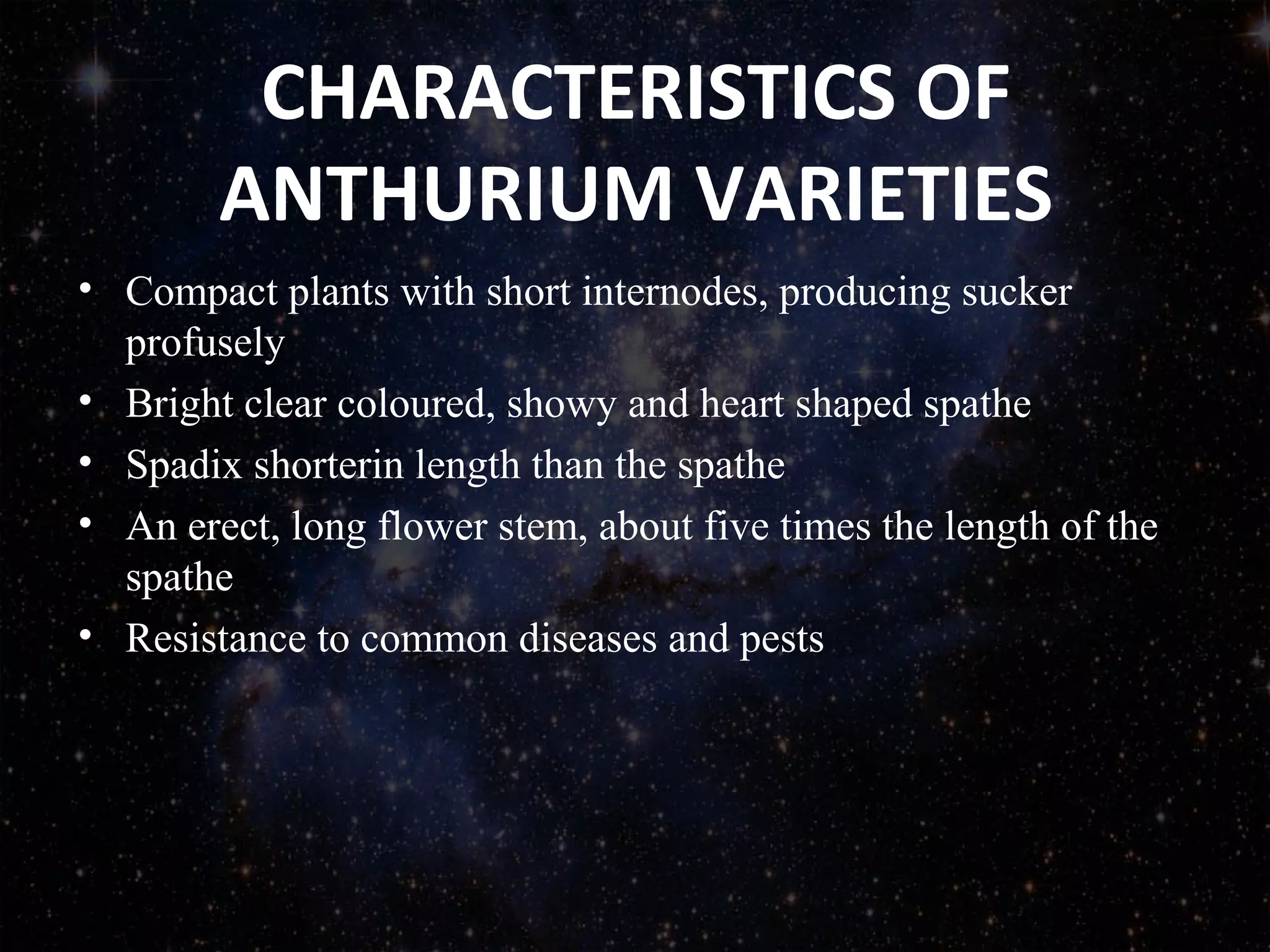
CHARACTERISTICS OF
ANTHURIUM VARIETIES
• Compact plants with short internodes, producing sucker 
profusely
• Bright clear coloured, showy and heart shaped spathe
• Spadix shorterin length than the spathe
• An erect, long flower stem, about five times the length of the 
spathe
• Resistance to common diseases and pests
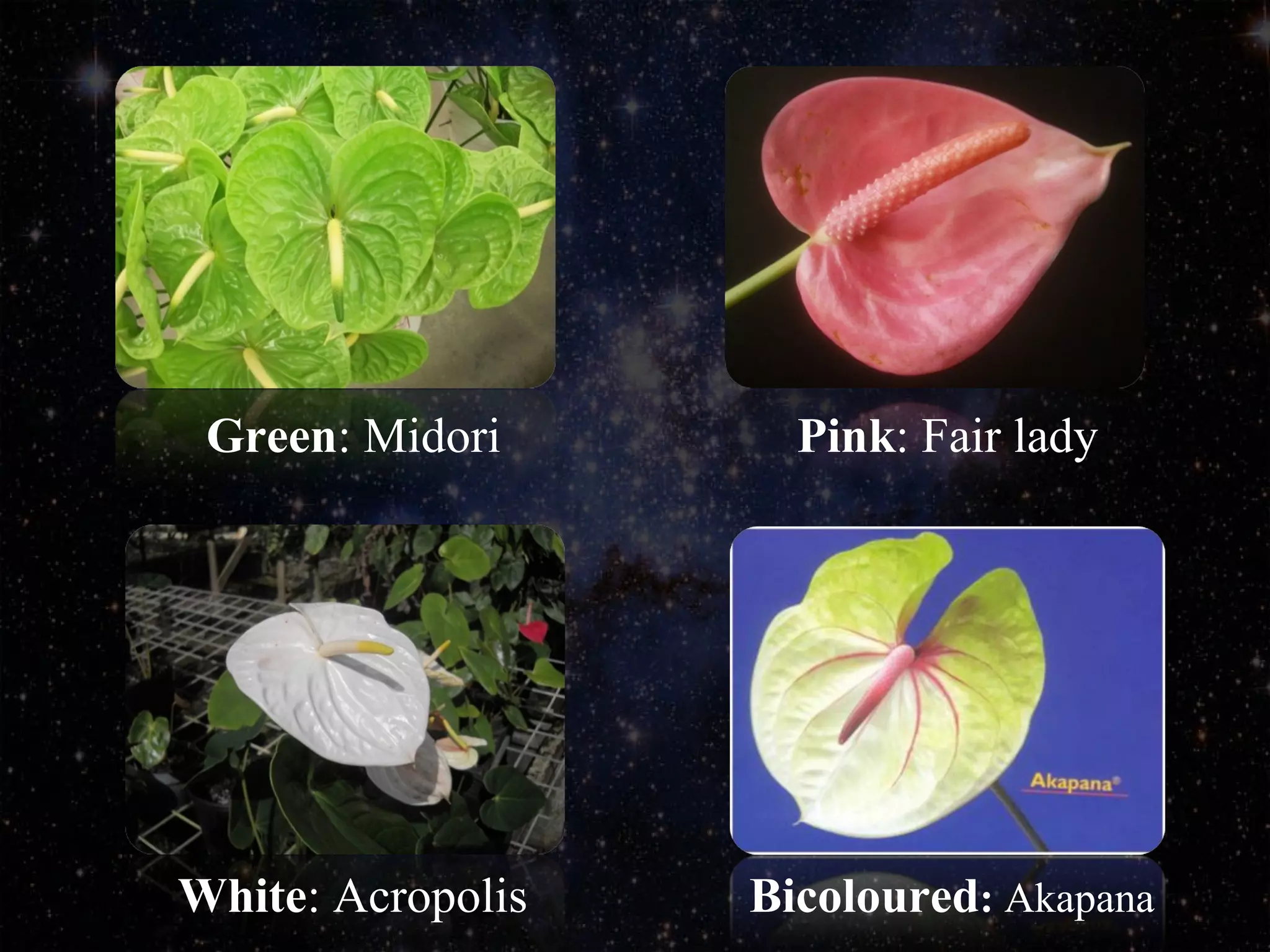
• Cultivars are based on spathe colour
Red: Tropical Orange: Casino
Chocolate: Tropic Night
Green: Midori Pink: Fair lady
White: Acropolis Bicoloured: Akapana
For pot culture
• Highly organic, well aerated with good water 
retention  capacity and drainage 
• Soil, coarse sand, farm yard manure layer-wise. 
• Media for pots should have:-
high porosity
low salt concentration
pH must be 5.5-6.5
For raised beds
• 4 inches brick pieces, 3 inches charcoal, 2 inches coconut husk
and small portion of coco peat & sand in 3: 1 ratio filled in the
beds one after another in layers. And finally planting is done.
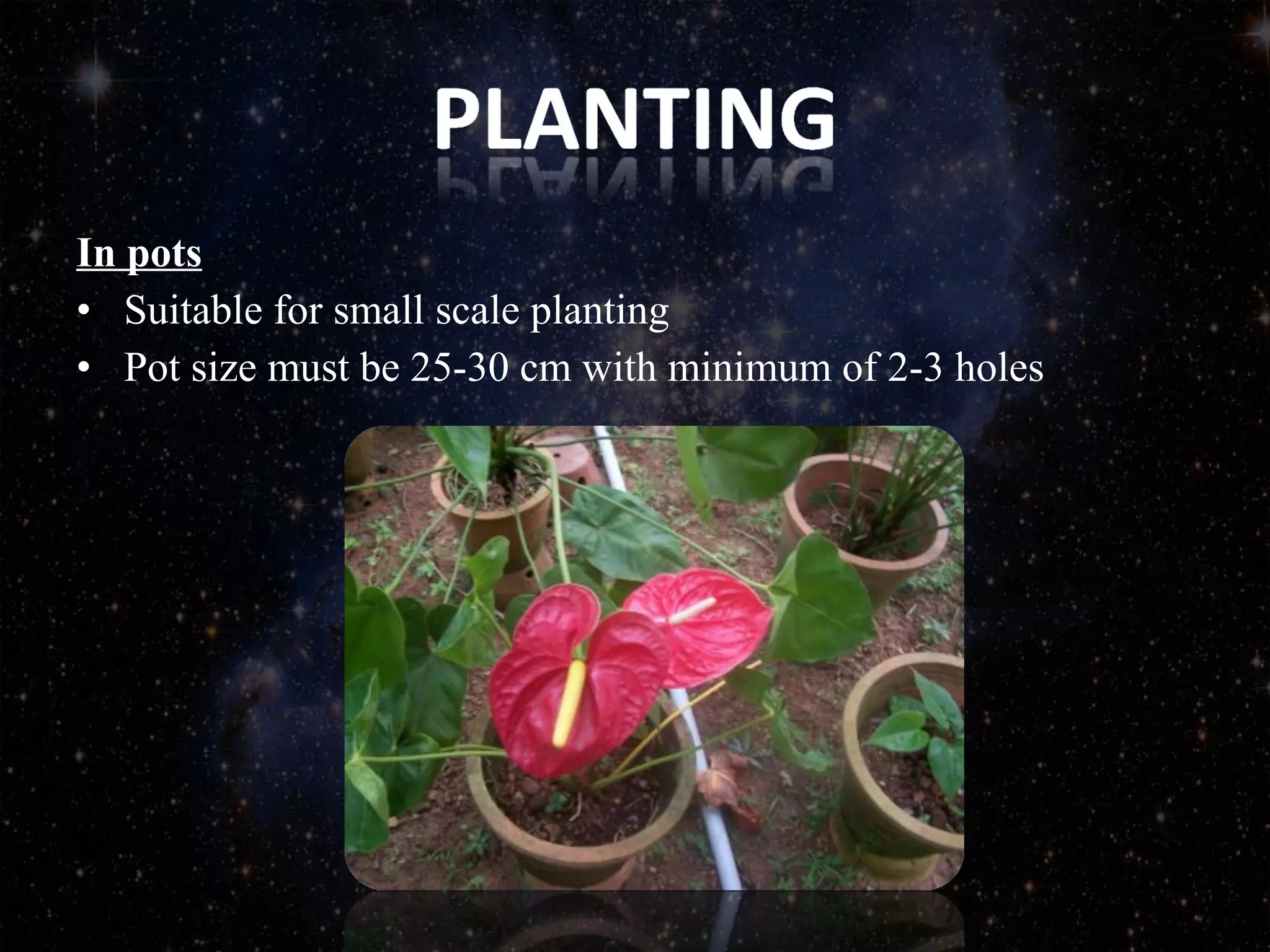
In pots
• Suitable for small scale planting
• Pot size must be 25-30 cm with minimum of 2-3 holes
On raised beds
• 30 cm raised beds with 3 inches slope, framed with cemented
brick walls or bamboos in shadenets
• Bed size: 1-1.2 m breadth and length according to the
convenience.
• Bed to bed: 50 cm
• Spacing:- 45 x 45 cm or 30 x 30 cm
1. Division
2. Cuttings
3. Tissue culture
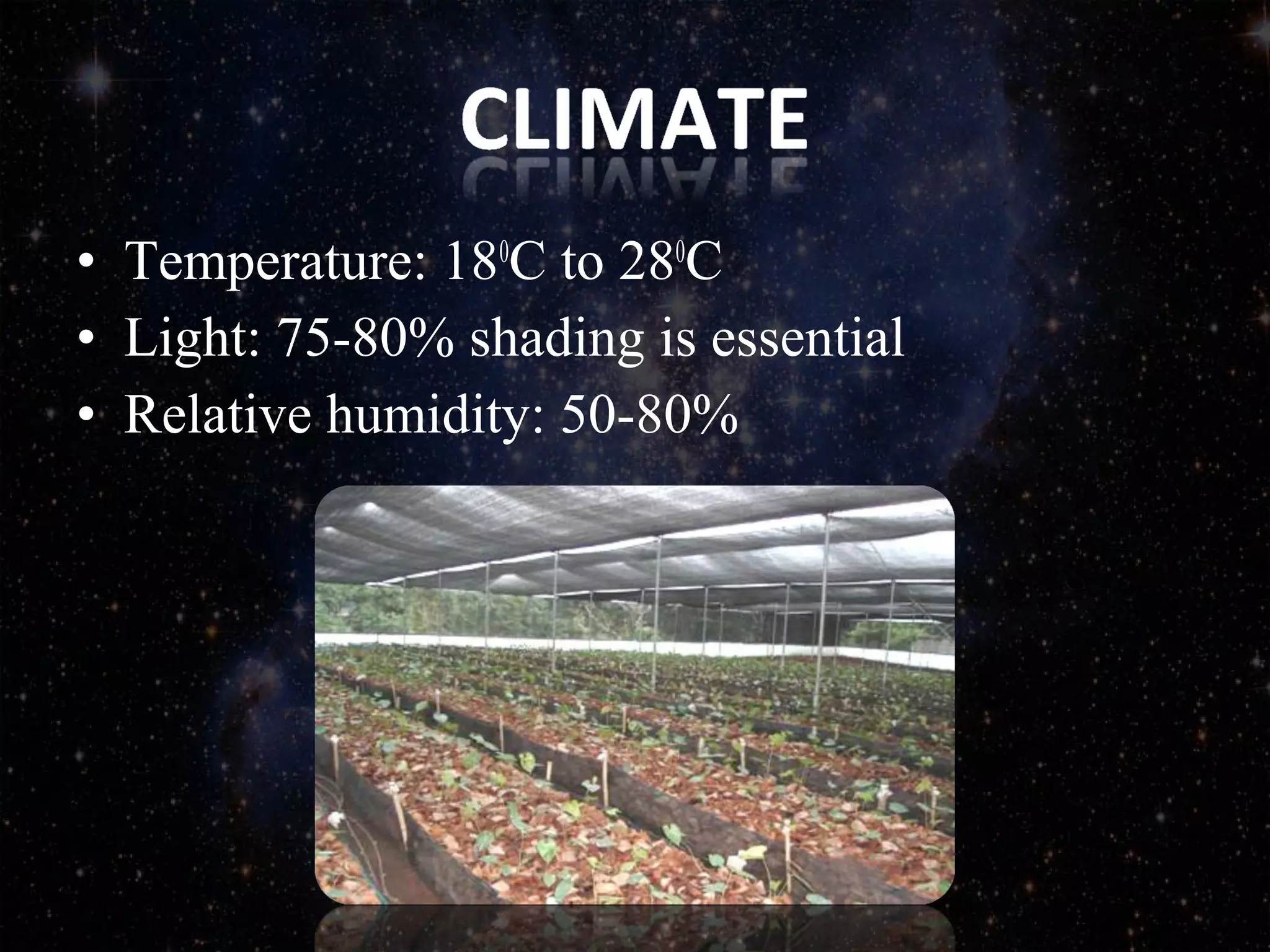
• Temperature: 180
C to 280
C
• Light: 75-80% shading is essential
• Relative humidity: 50-80%
• Foliar application of 1g urea + 2g MOP/ lit
ever week
• NPK 19:19:19 @ 2 gm/lit once a week
• Anthurium requires generous watering.
• Plants are to be watered twice daily during summer
months.
• Method of irrigation may be sprinkler, micro-
sprinkler, manual watering etc.
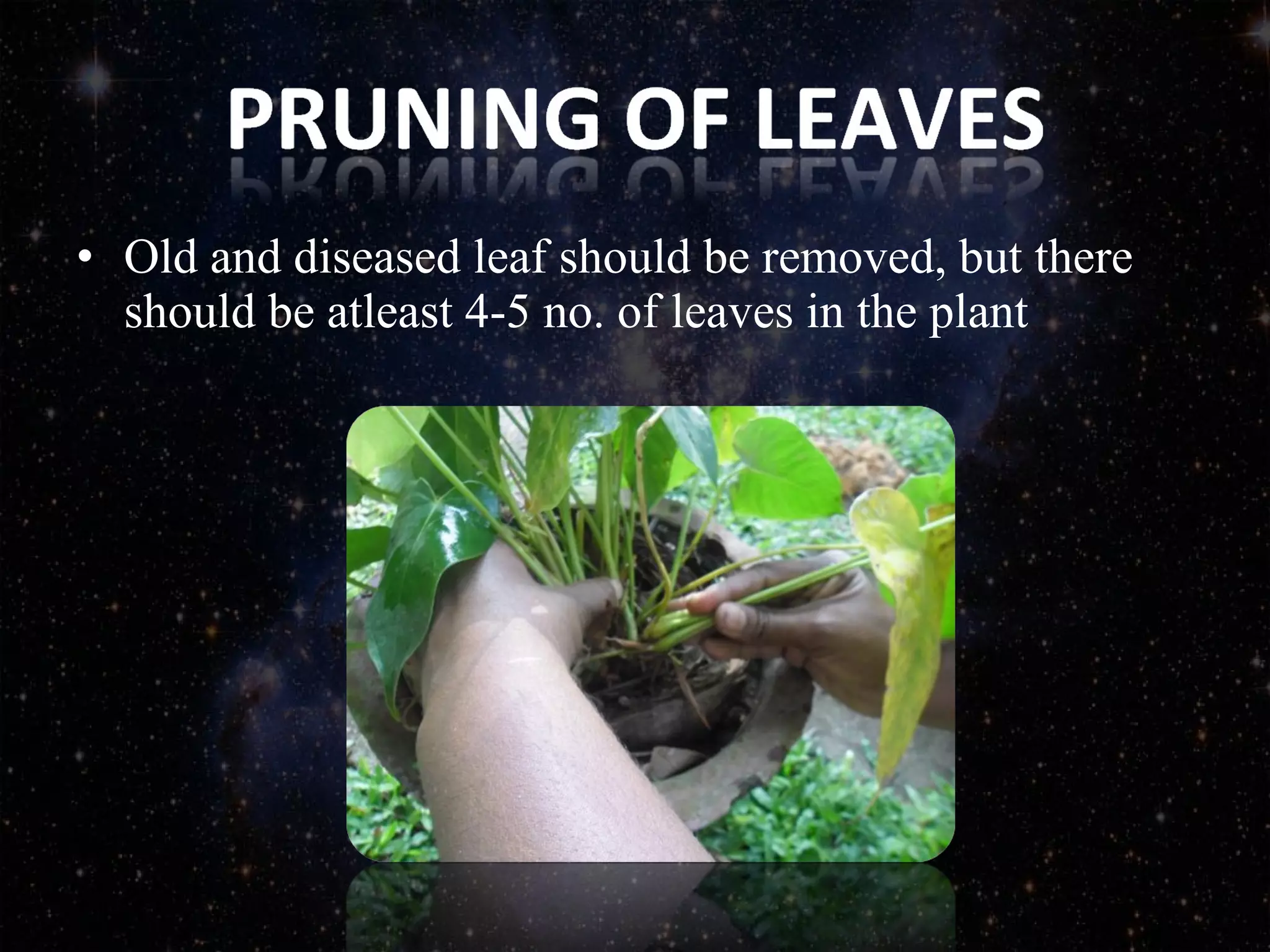
• Old and diseased leaf should be removed, but there
should be atleast 4-5 no. of leaves in the plant
• Most anthurium plants naturally produce small sucker
at the base of the plant. The suckers should be
removed at any stage.
• The maturity of the flowers for harvesting is
determined by the firmness of the peduncle and the
degree of colour of the spadix.
• Best time for harvest is when 1/3 to 2/3 of the flowers
on the spike are open.
• Harvesting in the morning time is preferrable
• After cutting above 3 cm, stalks are dipped in water
to prevent dry out.
• For distant markets the cut ends of each flower stem
should be wrapped with cotton pad soaked with water
covered with wax paper or polythene and secure tide.
• Soft protection material is put in between the spathe
and spadix of flowers with soaked cotton pads at the
cut ends. Foam plastic supports are provided in the
box and flowers are secured carefully with tape. The
spathe along with the spadix is then inserted into a
polythene cover of appropriate size and there after
placed in cartons. Lining of cartons with polythene
sheet and moist paper insulation are necessary to
maintain proper humidity as well as to prevent
injuries to the flower.
• Anthurium can easily be stored at 130
C for 2-3 weeks
and will last 2-4 weeks in an arrangement.
• Exposure of flowers to temperature below 130
C
causes the red flowers to turn blue, dark red flowers
being most succeptible.
Vase life
• Hydroxyquinoline resulted in additional bloom
opening of the flowers and also increase the vase life.
The Federations of Dutch Flower Auctions grading
specification for class-I flowers:-
• Absolute freshness
• Pest and disease free
• Fault free
• Stalks must be straight and significantly firm to carry the
influorescence
• Green petal margins are permitted
Pest management
• Aphids: can be controlled by Malathion or Rogor application
• Mealy bugs: can be controlled by Malathion
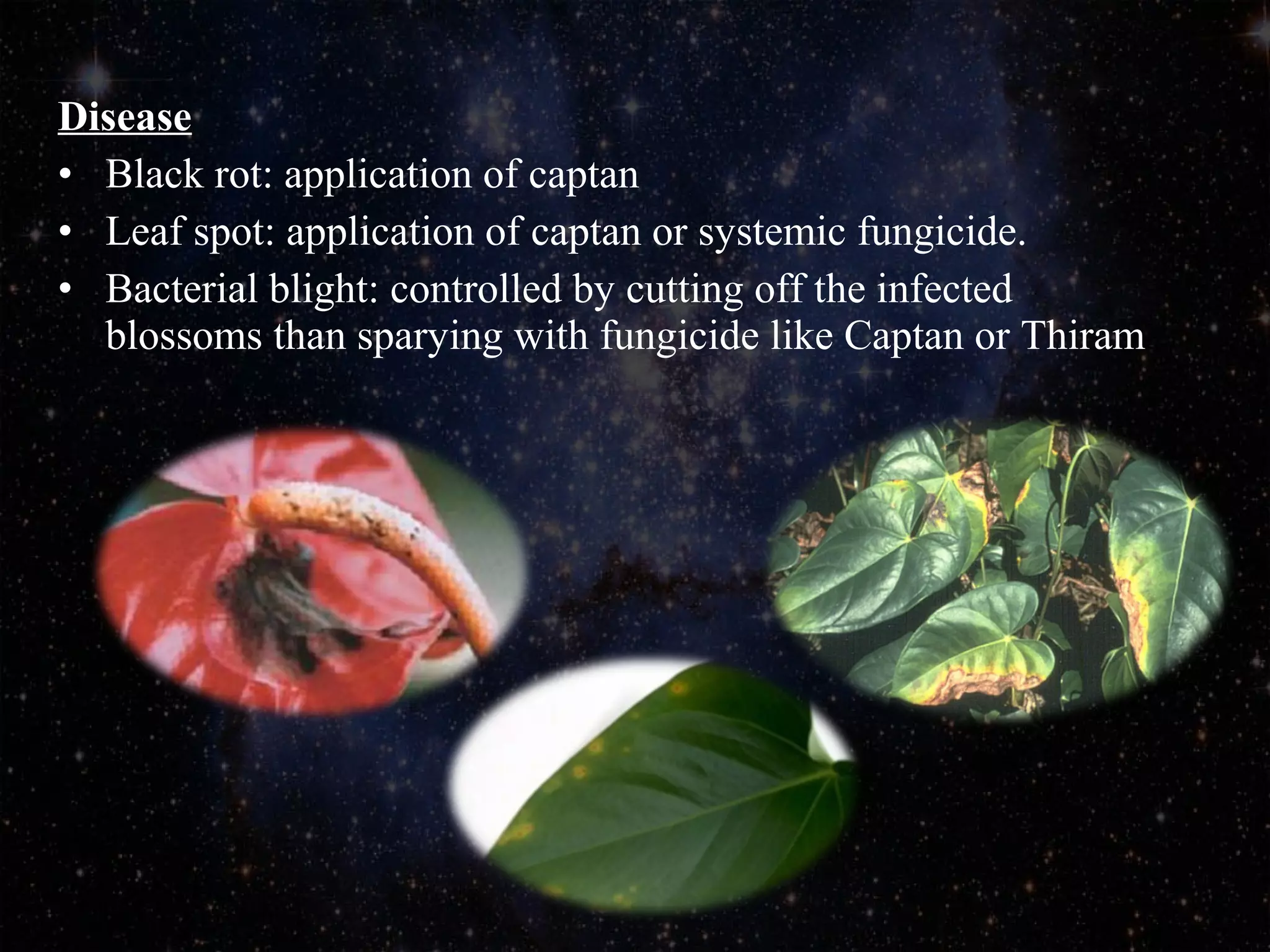
Disease
• Black rot: application of captan
• Leaf spot: application of captan or systemic fungicide.
• Bacterial blight: controlled by cutting off the infected
blossoms than sparying with fungicide like Captan or Thiram
THANK YOU

Anthurium

  • 1.
    Protected cultivation ofProtectedcultivation of AnthuriumAnthurium
  • 2.
    Botanical Name : Anthuriumandreanum Family:  Araceae Ch.no: 20
  • 3.
    • Grown for the showy cut flowers or for their unusually  attractive foliage.  • Used in the various floral decorations or for bouquet making. •It has bold effect and lasting qualities of flowers when cut.  • The name Anthurium is derived form the Greek ‘anthos’,   meaning flower, and ‘oura’, meaning tail, referring to the  spadix. • World trade is 2nd  i.e just next to orchids among the tropical  flowers. • Cut Flowers are mainly produced at Coorg in Karnataka,  Kerala, Yercurd in Tamil Nadu.
  • 4.
    CHARACTERISTICS OF ANTHURIUM VARIETIES •Compact plants with short internodes, producing sucker  profusely • Bright clear coloured, showy and heart shaped spathe • Spadix shorterin length than the spathe • An erect, long flower stem, about five times the length of the  spathe • Resistance to common diseases and pests
  • 5.
    • Cultivars arebased on spathe colour Red: Tropical Orange: Casino Chocolate: Tropic Night
  • 6.
  • 7.
    For pot culture •Highly organic, well aerated with good water  retention  capacity and drainage  • Soil, coarse sand, farm yard manure layer-wise.  • Media for pots should have:- high porosity low salt concentration pH must be 5.5-6.5
  • 8.
    For raised beds •4 inches brick pieces, 3 inches charcoal, 2 inches coconut husk and small portion of coco peat & sand in 3: 1 ratio filled in the beds one after another in layers. And finally planting is done.
  • 9.
    In pots • Suitablefor small scale planting • Pot size must be 25-30 cm with minimum of 2-3 holes
  • 10.
    On raised beds •30 cm raised beds with 3 inches slope, framed with cemented brick walls or bamboos in shadenets • Bed size: 1-1.2 m breadth and length according to the convenience. • Bed to bed: 50 cm • Spacing:- 45 x 45 cm or 30 x 30 cm
  • 11.
  • 12.
    • Temperature: 180 Cto 280 C • Light: 75-80% shading is essential • Relative humidity: 50-80%
  • 13.
    • Foliar applicationof 1g urea + 2g MOP/ lit ever week • NPK 19:19:19 @ 2 gm/lit once a week
  • 14.
    • Anthurium requiresgenerous watering. • Plants are to be watered twice daily during summer months. • Method of irrigation may be sprinkler, micro- sprinkler, manual watering etc.
  • 15.
    • Old anddiseased leaf should be removed, but there should be atleast 4-5 no. of leaves in the plant
  • 16.
    • Most anthuriumplants naturally produce small sucker at the base of the plant. The suckers should be removed at any stage.
  • 17.
    • The maturityof the flowers for harvesting is determined by the firmness of the peduncle and the degree of colour of the spadix. • Best time for harvest is when 1/3 to 2/3 of the flowers on the spike are open. • Harvesting in the morning time is preferrable
  • 18.
    • After cuttingabove 3 cm, stalks are dipped in water to prevent dry out. • For distant markets the cut ends of each flower stem should be wrapped with cotton pad soaked with water covered with wax paper or polythene and secure tide.
  • 19.
    • Soft protectionmaterial is put in between the spathe and spadix of flowers with soaked cotton pads at the cut ends. Foam plastic supports are provided in the box and flowers are secured carefully with tape. The spathe along with the spadix is then inserted into a polythene cover of appropriate size and there after placed in cartons. Lining of cartons with polythene sheet and moist paper insulation are necessary to maintain proper humidity as well as to prevent injuries to the flower.
  • 21.
    • Anthurium caneasily be stored at 130 C for 2-3 weeks and will last 2-4 weeks in an arrangement. • Exposure of flowers to temperature below 130 C causes the red flowers to turn blue, dark red flowers being most succeptible. Vase life • Hydroxyquinoline resulted in additional bloom opening of the flowers and also increase the vase life.
  • 22.
    The Federations ofDutch Flower Auctions grading specification for class-I flowers:- • Absolute freshness • Pest and disease free • Fault free • Stalks must be straight and significantly firm to carry the influorescence • Green petal margins are permitted
  • 23.
    Pest management • Aphids:can be controlled by Malathion or Rogor application • Mealy bugs: can be controlled by Malathion
  • 24.
    Disease • Black rot:application of captan • Leaf spot: application of captan or systemic fungicide. • Bacterial blight: controlled by cutting off the infected blossoms than sparying with fungicide like Captan or Thiram
  • 26.