KINGDOMS AND
CLASSIFICATION
BIODIVERSITY
• The variability among living organisms
from all types of ecosystem (e.g.
terrestrial, marine)
• This includes diversity
– within species
– between species
– of ecosystems
TAXONOMY – classification
• All living organisms are classified into
different groups.
• This allows a kind of ‘filing system’ so that
any new discoveries are easily incorporated
into a group and relationships between
groups of similar organisms can be studied.
• It also makes international communication
easier and more efficient. That is because all
new discoveries will have recognised names
which are the same in all countries, and
they will all belong to a universally accepted
groups.
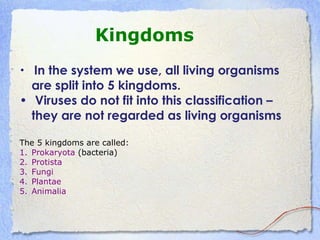
Kingdoms
• In the system we use, all living organisms
are split into 5 kingdoms.
• Viruses do not fit into this classification –
they are not regarded as living organisms
The 5 kingdoms are called:
1. Prokaryota (bacteria)
2. Protista
3. Fungi
4. Plantae
5. Animalia
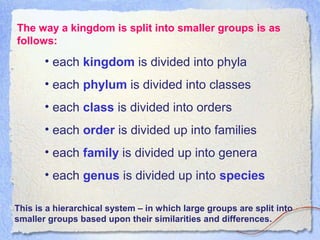
The way a kingdom is split into smaller groups is as
follows:
This is a hierarchical system – in which large groups are split into
smaller groups based upon their similarities and differences.
• each kingdom is divided into phyla
• each phylum is divided into classes
• each class is divided into orders
• each order is divided up into families
• each family is divided up into genera
• each genus is divided up into species
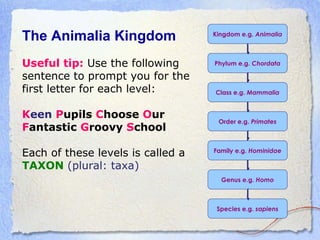
The Animalia Kingdom
Useful tip: Use the following
sentence to prompt you for the
first letter for each level:
Keen Pupils Choose Our
Fantastic Groovy School
Each of these levels is called a
TAXON (plural: taxa)
Kingdom e.g. Animalia
Phylum e.g. Chordata
Class e.g. Mammalia
Order e.g. Primates
Family e.g. Hominidae
Genus e.g. Homo
Species e.g. sapiens
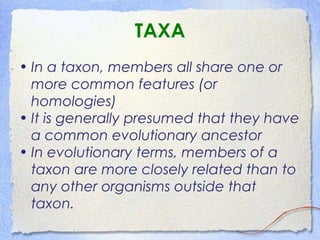
TAXA
• In a taxon, members all share one or
more common features (or
homologies)
• It is generally presumed that they have
a common evolutionary ancestor
• In evolutionary terms, members of a
taxon are more closely related than to
any other organisms outside that
taxon.
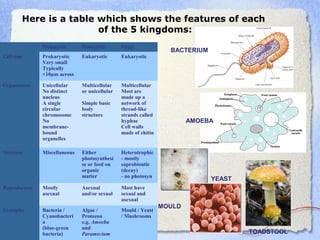
Here is a table which shows the features of each
of the 5 kingdoms:
BACTERIUM
AMOEBA
MOULD
YEAST
TOADSTOOL
  Prokaryota: Protoctista: Fungi:
Cell type Prokaryotic
Very small
Typically 
<10µm across 
Eukaryotic Eukaryotic
Organisation Unicellular
No distinct 
nucleus
A single 
circular 
chromosome
No 
membrane-
bound 
organelles
Multicellular 
or unicellular
 
Simple basic 
body 
structure
Multicellular
Most are 
made up a 
network of 
thread-like 
strands called 
hyphae
Cell walls 
made of chitin
Nutrition Miscellaneous Either 
photosynthesi
se or feed on 
organic 
matter
Heterotrophic 
- mostly 
saprobiontic
(decay)
- no photosyn
Reproduction Mostly 
asexual
Asexual 
and/or sexual
Most have 
sexual and 
asexual 
Examples Bacteria /
Cyanobacteri
a
(blue-green 
bacteria)
Algae / 
Protozoa
e.g. Amoeba 
and 
Paramecium
Mould / Yeast 
/ Mushrooms
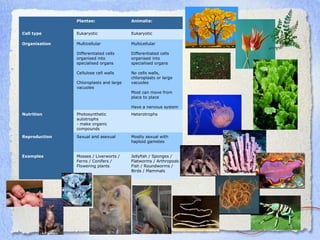
  Plantae: Animalia:
Cell type Eukaryotic Eukaryotic
Organisation Multicellular
Differentiated cells 
organised into 
specialised organs
Cellulose cell walls
Chloroplasts and large 
vacuoles
Multicellular
Differentiated cells 
organised into 
specialised organs
No cells walls, 
chloroplasts or large 
vacuoles
Most can move from 
place to place
Have a nervous system 
Nutrition Photosynthetic 
autotrophs
- make organic 
compounds
Heterotrophs
Reproduction Sexual and asexual Mostly sexual with 
haploid gametes
Examples Mosses / Liverworts / 
Ferns / Conifers / 
Flowering plants
Jellyfish / Sponges / 
Flatworms / Arthropods 
Fish / Roundworms / 
Birds / Mammals 
BINOMIAL NAMES
• Each species has its own unique two-
part Latin binomial name, made up of
the genus and species names
• This was first introduced by Carl
Linnaeus.
Species
• The species is the lowest level of
classification within each Kingdom.
• All members of a species:
– have a similar morphology (body features),
physiology (how organs and body systems
function), and behaviour
– are capable of interbreeding to produce fertile
offspring
– are reproductively isolated (in time, place or
behaviour) from other species.
Genus
• A genus is a group of similar or closely related
species
• For example: Ranunculus = genus name for
buttercups.
• The Ranuculus genus includes:
Ranunculus aquatalis = water crowfoot
Ranunculus repens = creeping buttercup
• A genus could include just one species in some
examples, but more often it includes several
species.
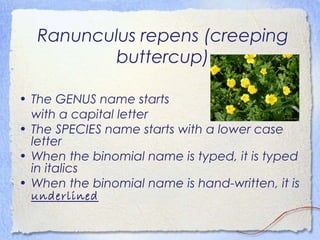
Ranunculus repens (creeping
buttercup)
• The GENUS name starts
with a capital letter
• The SPECIES name starts with a lower case
letter
• When the binomial name is typed, it is typed
in italics
• When the binomial name is hand-written, it is
underlined
USING KEYS TO IDENTIFY
ORGANISMS
• Dichotomous keys have 2 alternatives to choose from at each stage
of the key
• These are artificial classifications based upon easily visible features
When using a key:
• Always read both choices, even if the first seems to be the logical
one at first.
• Be sure you understand the meaning of the terms involved. Do not
guess.
• When measurements are given, use a calibrated scale. Do not guess.
• Since living things are always somewhat variable, do not base your
conclusion on a single observation. Study several specimens to be
sure your specimen is typical.
• If the choice is not clear, for whatever reason, try both divisions. If you
end up with two possible answers, read descriptions of the two
choices to help you decide.
• Having arrived at an answer in a key, do not accept this as
absolutely reliable. Check a description of the organism to see if it
agrees with the unknown specimen.

Kingdoms and classification

  • 1.
  • 2.
    BIODIVERSITY • The variabilityamong living organisms from all types of ecosystem (e.g. terrestrial, marine) • This includes diversity – within species – between species – of ecosystems
  • 3.
    TAXONOMY – classification •All living organisms are classified into different groups. • This allows a kind of ‘filing system’ so that any new discoveries are easily incorporated into a group and relationships between groups of similar organisms can be studied. • It also makes international communication easier and more efficient. That is because all new discoveries will have recognised names which are the same in all countries, and they will all belong to a universally accepted groups.
  • 4.
    Kingdoms • In thesystem we use, all living organisms are split into 5 kingdoms. • Viruses do not fit into this classification – they are not regarded as living organisms The 5 kingdoms are called: 1. Prokaryota (bacteria) 2. Protista 3. Fungi 4. Plantae 5. Animalia
  • 5.
    The way akingdom is split into smaller groups is as follows: This is a hierarchical system – in which large groups are split into smaller groups based upon their similarities and differences. • each kingdom is divided into phyla • each phylum is divided into classes • each class is divided into orders • each order is divided up into families • each family is divided up into genera • each genus is divided up into species
  • 6.
    The Animalia Kingdom Usefultip: Use the following sentence to prompt you for the first letter for each level: Keen Pupils Choose Our Fantastic Groovy School Each of these levels is called a TAXON (plural: taxa) Kingdom e.g. Animalia Phylum e.g. Chordata Class e.g. Mammalia Order e.g. Primates Family e.g. Hominidae Genus e.g. Homo Species e.g. sapiens
  • 7.
    TAXA • In ataxon, members all share one or more common features (or homologies) • It is generally presumed that they have a common evolutionary ancestor • In evolutionary terms, members of a taxon are more closely related than to any other organisms outside that taxon.
  • 8.
    Here is atable which shows the features of each of the 5 kingdoms: BACTERIUM AMOEBA MOULD YEAST TOADSTOOL   Prokaryota: Protoctista: Fungi: Cell type Prokaryotic Very small Typically  <10µm across  Eukaryotic Eukaryotic Organisation Unicellular No distinct  nucleus A single  circular  chromosome No  membrane- bound  organelles Multicellular  or unicellular   Simple basic  body  structure Multicellular Most are  made up a  network of  thread-like  strands called  hyphae Cell walls  made of chitin Nutrition Miscellaneous Either  photosynthesi se or feed on  organic  matter Heterotrophic  - mostly  saprobiontic (decay) - no photosyn Reproduction Mostly  asexual Asexual  and/or sexual Most have  sexual and  asexual  Examples Bacteria / Cyanobacteri a (blue-green  bacteria) Algae /  Protozoa e.g. Amoeba  and  Paramecium Mould / Yeast  / Mushrooms
  • 9.
      Plantae: Animalia: Celltype Eukaryotic Eukaryotic Organisation Multicellular Differentiated cells  organised into  specialised organs Cellulose cell walls Chloroplasts and large  vacuoles Multicellular Differentiated cells  organised into  specialised organs No cells walls,  chloroplasts or large  vacuoles Most can move from  place to place Have a nervous system  Nutrition Photosynthetic  autotrophs - make organic  compounds Heterotrophs Reproduction Sexual and asexual Mostly sexual with  haploid gametes Examples Mosses / Liverworts /  Ferns / Conifers /  Flowering plants Jellyfish / Sponges /  Flatworms / Arthropods  Fish / Roundworms /  Birds / Mammals 
  • 10.
    BINOMIAL NAMES • Eachspecies has its own unique two- part Latin binomial name, made up of the genus and species names • This was first introduced by Carl Linnaeus.
  • 11.
    Species • The speciesis the lowest level of classification within each Kingdom. • All members of a species: – have a similar morphology (body features), physiology (how organs and body systems function), and behaviour – are capable of interbreeding to produce fertile offspring – are reproductively isolated (in time, place or behaviour) from other species.
  • 12.
    Genus • A genusis a group of similar or closely related species • For example: Ranunculus = genus name for buttercups. • The Ranuculus genus includes: Ranunculus aquatalis = water crowfoot Ranunculus repens = creeping buttercup • A genus could include just one species in some examples, but more often it includes several species.
  • 13.
    Ranunculus repens (creeping buttercup) •The GENUS name starts with a capital letter • The SPECIES name starts with a lower case letter • When the binomial name is typed, it is typed in italics • When the binomial name is hand-written, it is underlined
  • 14.
    USING KEYS TOIDENTIFY ORGANISMS • Dichotomous keys have 2 alternatives to choose from at each stage of the key • These are artificial classifications based upon easily visible features When using a key: • Always read both choices, even if the first seems to be the logical one at first. • Be sure you understand the meaning of the terms involved. Do not guess. • When measurements are given, use a calibrated scale. Do not guess. • Since living things are always somewhat variable, do not base your conclusion on a single observation. Study several specimens to be sure your specimen is typical. • If the choice is not clear, for whatever reason, try both divisions. If you end up with two possible answers, read descriptions of the two choices to help you decide. • Having arrived at an answer in a key, do not accept this as absolutely reliable. Check a description of the organism to see if it agrees with the unknown specimen.