Diversity, change and continuity
Biodiversity and Classification
In biology, taxonomy is the science of naming, defining and classifying groups of biological
organisms on the basis of shared characteristics. The biological classification system is based
on research in biology, anatomy, ecology, biochemistry, genetics, embryology and other fields.
It is a scientific method of classification used in biology to group similar organisms that share
common features, and is universally accepted.
The Taxonomic Hierarchy
Classification is usually a hierarchical process, beginning with general and broad differences,
and then systematically introducing more and more detailed and specific criteria. Organisms are
grouped together into groups or taxa (singular: taxon) and these groups are given a taxonomic
rank; groups of a given rank can be grouped together to form a super-group of higher rank, thus
creating a taxonomic hierarchy.
Classification is hierarchical because the important features inherited from a common ancestor
determine the group in which the organisms are placed. For example: humans and whales both
feed their young on milk and it is this characteristic inherited from a common ancestor which
places them in the same class (mammals) even though their habitat is completely different.
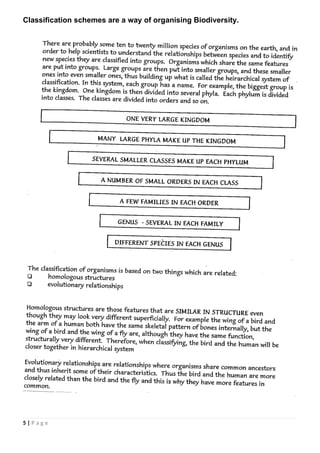
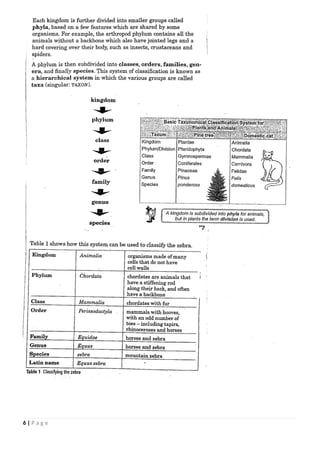
Each organism is grouped into one of 5 large groups or kingdoms , which are subdivided into
smaller groups called phyla (singular: phylum) and then smaller and smaller groups.
Kingdom
Phylum
Class
Order
Family
Genus
Species
A taxon (plural: taxa) is a group of organisms that are classified as a unit. This can be specific
or general. For example, we could say that all humans are a taxon at the species level since
they are all the same species, but we could also say that humans along with all other primates
are a taxon at the order level, since they all belong to the order Primates.
Systematics is the study of the identification, taxonomy, and nomenclature (naming) of
organisms, including the classification of living things with regard to their natural relationships,
and the study of evolution of the major groups, and variation within groups.
Biological systematics is the study of the diversification of living forms, both past and present,
and the relationships among living things through time. ... Systematics, in other words, is used
to understand the evolutionary history of life on Earth.
Cladogram
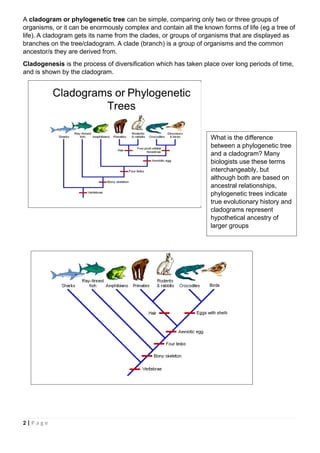
A cladogram is a diagram used to represent a hypothetical relationship between groups of
animals, called a phylogeny. A cladogram is used by scientists studying phylogenetic
relationships to visualize the groups of organisms being compared, to show how they are
related, and their most recent common ancestors.
1 | P a g e
A cladogram or phylogenetic tree can be simple, comparing only two or three groups of
organisms, or it can be enormously complex and contain all the known forms of life (eg a tree of
life). A cladogram gets its name from the clades, or groups of organisms that are displayed as
branches on the tree/cladogram. A clade (branch) is a group of organisms and the common
ancestor/s they are derived from.
Cladogenesis is the process of diversification which has taken place over long periods of time,
and is shown by the cladogram.
2 | P a g e
What is the difference
between a phylogenetic tree
and a cladogram? Many
biologists use these terms
interchangeably, but
although both are based on
ancestral relationships,
phylogenetic trees indicate
true evolutionary history and
cladograms represent
hypothetical ancestry of
larger groups
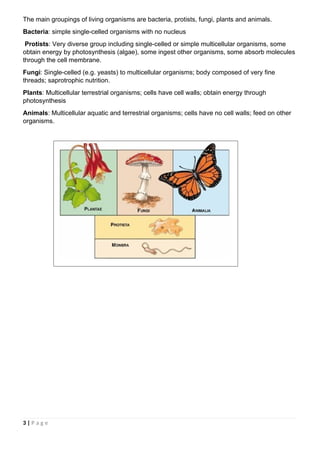
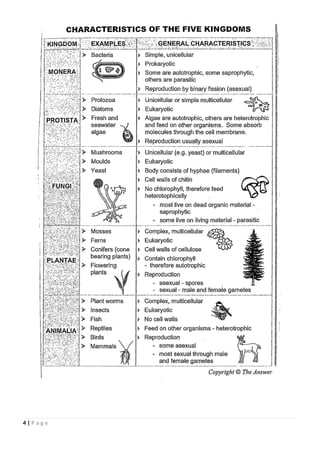
The main groupings of living organisms are bacteria, protists, fungi, plants and animals.
Bacteria: simple single-celled organisms with no nucleus
Protists: Very diverse group including single-celled or simple multicellular organisms, some
obtain energy by photosynthesis (algae), some ingest other organisms, some absorb molecules
through the cell membrane.
Fungi: Single-celled (e.g. yeasts) to multicellular organisms; body composed of very fine
threads; saprotrophic nutrition.
Plants: Multicellular terrestrial organisms; cells have cell walls; obtain energy through
photosynthesis
Animals: Multicellular aquatic and terrestrial organisms; cells have no cell walls; feed on other
organisms.
3 | P a g e
4 | P a g e
Classification schemes are a way of organising Biodiversity.
5 | P a g e
6 | P a g e
History of classification
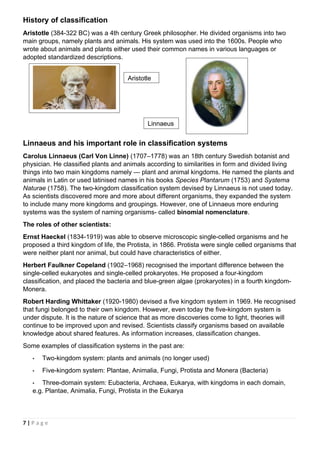
Aristotle (384-322 BC) was a 4th century Greek philosopher. He divided organisms into two
main groups, namely plants and animals. His system was used into the 1600s. People who
wrote about animals and plants either used their common names in various languages or
adopted standardized descriptions.
Linnaeus and his important role in classification systems
Carolus Linnaeus (Carl Von Linne) (1707–1778) was an 18th century Swedish botanist and
physician. He classified plants and animals according to similarities in form and divided living
things into two main kingdoms namely — plant and animal kingdoms. He named the plants and
animals in Latin or used latinised names in his books Species Plantarum (1753) and Systema
Naturae (1758). The two-kingdom classification system devised by Linnaeus is not used today.
As scientists discovered more and more about different organisms, they expanded the system
to include many more kingdoms and groupings. However, one of Linnaeus more enduring
systems was the system of naming organisms- called binomial nomenclature.
The roles of other scientists:
Ernst Haeckel (1834-1919) was able to observe microscopic single-celled organisms and he
proposed a third kingdom of life, the Protista, in 1866. Protista were single celled organisms that
were neither plant nor animal, but could have characteristics of either.
Herbert Faulkner Copeland (1902–1968) recognised the important difference between the
single-celled eukaryotes and single-celled prokaryotes. He proposed a four-kingdom
classification, and placed the bacteria and blue-green algae (prokaryotes) in a fourth kingdom-
Monera.
Robert Harding Whittaker (1920-1980) devised a five kingdom system in 1969. He recognised
that fungi belonged to their own kingdom. However, even today the five-kingdom system is
under dispute. It is the nature of science that as more discoveries come to light, theories will
continue to be improved upon and revised. Scientists classify organisms based on available
knowledge about shared features. As information increases, classification changes.
Some examples of classification systems in the past are:
• Two-kingdom system: plants and animals (no longer used)
• Five-kingdom system: Plantae, Animalia, Fungi, Protista and Monera (Bacteria)
• Three-domain system: Eubacteria, Archaea, Eukarya, with kingdoms in each domain,
e.g. Plantae, Animalia, Fungi, Protista in the Eukarya
7 | P a g e
Aristotle
Linnaeus
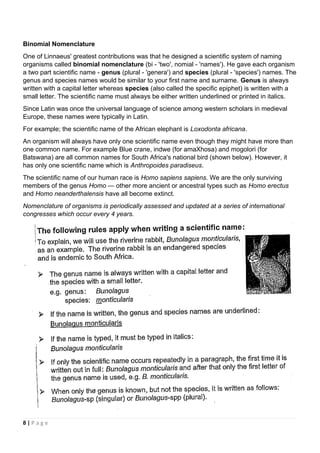
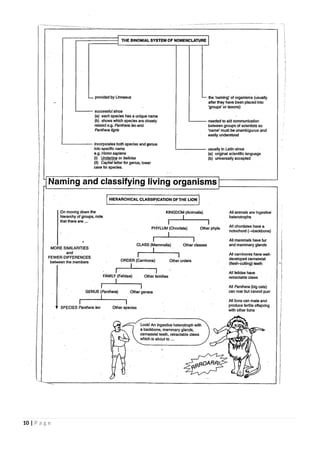
Binomial Nomenclature
One of Linnaeus' greatest contributions was that he designed a scientific system of naming
organisms called binomial nomenclature (bi - 'two', nomial - 'names'). He gave each organism
a two part scientific name - genus (plural - 'genera') and species (plural - 'species') names. The
genus and species names would be similar to your first name and surname. Genus is always
written with a capital letter whereas species (also called the specific epiphet) is written with a
small letter. The scientific name must always be either written underlined or printed in italics.
Since Latin was once the universal language of science among western scholars in medieval
Europe, these names were typically in Latin.
For example; the scientific name of the African elephant is Loxodonta africana.
An organism will always have only one scientific name even though they might have more than
one common name. For example Blue crane, indwe (for amaXhosa) and mogolori (for
Batswana) are all common names for South Africa's national bird (shown below). However, it
has only one scientific name which is Anthropoides paradiseus.
The scientific name of our human race is Homo sapiens sapiens. We are the only surviving
members of the genus Homo — other more ancient or ancestral types such as Homo erectus
and Homo neanderthalensis have all become extinct.
Nomenclature of organisms is periodically assessed and updated at a series of international
congresses which occur every 4 years.
8 | P a g e
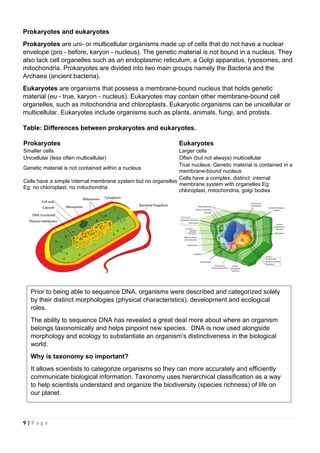
Prokaryotes and eukaryotes
Prokaryotes are uni- or multicellular organisms made up of cells that do not have a nuclear
envelope (pro - before, karyon - nucleus). The genetic material is not bound in a nucleus. They
also lack cell organelles such as an endoplasmic reticulum, a Golgi apparatus, lysosomes, and
mitochondria. Prokaryotes are divided into two main groups namely the Bacteria and the
Archaea (ancient bacteria).
Eukaryotes are organisms that possess a membrane-bound nucleus that holds genetic
material (eu - true, karyon - nucleus). Eukaryotes may contain other membrane-bound cell
organelles, such as mitochondria and chloroplasts. Eukaryotic organisms can be unicellular or
multicellular. Eukaryotes include organisms such as plants, animals, fungi, and protists.
Table: Differences between prokaryotes and eukaryotes.
Prokaryotes Eukaryotes
Smaller cells Larger cells
Unicellular (less often multicellular) Often (but not always) multicellular
Genetic material is not contained within a nucleus
True nucleus: Genetic material is contained in a
membrane-bound nucleus
Cells have a simple internal membrane system but no organelles
Eg: no chloroplast, no mitochondria
Cells have a complex, distinct internal
membrane system with organelles Eg:
chloroplast, mitochondria, golgi bodies
9 | P a g e
Prior to being able to sequence DNA, organisms were described and categorized solely
by their distinct morphologies (physical characteristics), development and ecological
roles.
The ability to sequence DNA has revealed a great deal more about where an organism
belongs taxonomically and helps pinpoint new species. DNA is now used alongside
morphology and ecology to substantiate an organism’s distinctiveness in the biological
world.
Why is taxonomy so important?
It allows scientists to categorize organisms so they can more accurately and efficiently
communicate biological information. Taxonomy uses hierarchical classification as a way
to help scientists understand and organize the biodiversity (species richness) of life on
our planet.
10 | P a g e
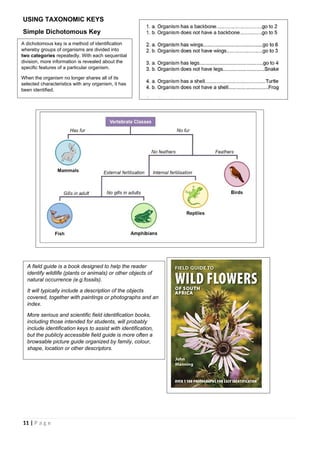
USING TAXONOMIC KEYS
Simple Dichotomous Key
11 | P a g e
A dichotomous key is a method of identification
whereby groups of organisms are divided into
two categories repeatedly. With each sequential
division, more information is revealed about the
specific features of a particular organism.
When the organism no longer shares all of its
selected characteristics with any organism, it has
been identified.
A field guide is a book designed to help the reader
identify wildlife (plants or animals) or other objects of
natural occurrence (e.g.fossils).
It will typically include a description of the objects
covered, together with paintings or photographs and an
index.
More serious and scientific field identification books,
including those intended for students, will probably
include identification keys to assist with identification,
but the publicly accessible field guide is more often a
browsable picture guide organized by family, colour,
shape, location or other descriptors.

NOTES CLASSIFICATION for Grade 10 CAPS.

  • 1.
    Diversity, change andcontinuity Biodiversity and Classification In biology, taxonomy is the science of naming, defining and classifying groups of biological organisms on the basis of shared characteristics. The biological classification system is based on research in biology, anatomy, ecology, biochemistry, genetics, embryology and other fields. It is a scientific method of classification used in biology to group similar organisms that share common features, and is universally accepted. The Taxonomic Hierarchy Classification is usually a hierarchical process, beginning with general and broad differences, and then systematically introducing more and more detailed and specific criteria. Organisms are grouped together into groups or taxa (singular: taxon) and these groups are given a taxonomic rank; groups of a given rank can be grouped together to form a super-group of higher rank, thus creating a taxonomic hierarchy. Classification is hierarchical because the important features inherited from a common ancestor determine the group in which the organisms are placed. For example: humans and whales both feed their young on milk and it is this characteristic inherited from a common ancestor which places them in the same class (mammals) even though their habitat is completely different. Each organism is grouped into one of 5 large groups or kingdoms , which are subdivided into smaller groups called phyla (singular: phylum) and then smaller and smaller groups. Kingdom Phylum Class Order Family Genus Species A taxon (plural: taxa) is a group of organisms that are classified as a unit. This can be specific or general. For example, we could say that all humans are a taxon at the species level since they are all the same species, but we could also say that humans along with all other primates are a taxon at the order level, since they all belong to the order Primates. Systematics is the study of the identification, taxonomy, and nomenclature (naming) of organisms, including the classification of living things with regard to their natural relationships, and the study of evolution of the major groups, and variation within groups. Biological systematics is the study of the diversification of living forms, both past and present, and the relationships among living things through time. ... Systematics, in other words, is used to understand the evolutionary history of life on Earth. Cladogram A cladogram is a diagram used to represent a hypothetical relationship between groups of animals, called a phylogeny. A cladogram is used by scientists studying phylogenetic relationships to visualize the groups of organisms being compared, to show how they are related, and their most recent common ancestors. 1 | P a g e
  • 2.
    A cladogram orphylogenetic tree can be simple, comparing only two or three groups of organisms, or it can be enormously complex and contain all the known forms of life (eg a tree of life). A cladogram gets its name from the clades, or groups of organisms that are displayed as branches on the tree/cladogram. A clade (branch) is a group of organisms and the common ancestor/s they are derived from. Cladogenesis is the process of diversification which has taken place over long periods of time, and is shown by the cladogram. 2 | P a g e What is the difference between a phylogenetic tree and a cladogram? Many biologists use these terms interchangeably, but although both are based on ancestral relationships, phylogenetic trees indicate true evolutionary history and cladograms represent hypothetical ancestry of larger groups
  • 3.
    The main groupingsof living organisms are bacteria, protists, fungi, plants and animals. Bacteria: simple single-celled organisms with no nucleus Protists: Very diverse group including single-celled or simple multicellular organisms, some obtain energy by photosynthesis (algae), some ingest other organisms, some absorb molecules through the cell membrane. Fungi: Single-celled (e.g. yeasts) to multicellular organisms; body composed of very fine threads; saprotrophic nutrition. Plants: Multicellular terrestrial organisms; cells have cell walls; obtain energy through photosynthesis Animals: Multicellular aquatic and terrestrial organisms; cells have no cell walls; feed on other organisms. 3 | P a g e
  • 4.
    4 | Pa g e
  • 5.
    Classification schemes area way of organising Biodiversity. 5 | P a g e
  • 6.
    6 | Pa g e
  • 7.
    History of classification Aristotle(384-322 BC) was a 4th century Greek philosopher. He divided organisms into two main groups, namely plants and animals. His system was used into the 1600s. People who wrote about animals and plants either used their common names in various languages or adopted standardized descriptions. Linnaeus and his important role in classification systems Carolus Linnaeus (Carl Von Linne) (1707–1778) was an 18th century Swedish botanist and physician. He classified plants and animals according to similarities in form and divided living things into two main kingdoms namely — plant and animal kingdoms. He named the plants and animals in Latin or used latinised names in his books Species Plantarum (1753) and Systema Naturae (1758). The two-kingdom classification system devised by Linnaeus is not used today. As scientists discovered more and more about different organisms, they expanded the system to include many more kingdoms and groupings. However, one of Linnaeus more enduring systems was the system of naming organisms- called binomial nomenclature. The roles of other scientists: Ernst Haeckel (1834-1919) was able to observe microscopic single-celled organisms and he proposed a third kingdom of life, the Protista, in 1866. Protista were single celled organisms that were neither plant nor animal, but could have characteristics of either. Herbert Faulkner Copeland (1902–1968) recognised the important difference between the single-celled eukaryotes and single-celled prokaryotes. He proposed a four-kingdom classification, and placed the bacteria and blue-green algae (prokaryotes) in a fourth kingdom- Monera. Robert Harding Whittaker (1920-1980) devised a five kingdom system in 1969. He recognised that fungi belonged to their own kingdom. However, even today the five-kingdom system is under dispute. It is the nature of science that as more discoveries come to light, theories will continue to be improved upon and revised. Scientists classify organisms based on available knowledge about shared features. As information increases, classification changes. Some examples of classification systems in the past are: • Two-kingdom system: plants and animals (no longer used) • Five-kingdom system: Plantae, Animalia, Fungi, Protista and Monera (Bacteria) • Three-domain system: Eubacteria, Archaea, Eukarya, with kingdoms in each domain, e.g. Plantae, Animalia, Fungi, Protista in the Eukarya 7 | P a g e Aristotle Linnaeus
  • 8.
    Binomial Nomenclature One ofLinnaeus' greatest contributions was that he designed a scientific system of naming organisms called binomial nomenclature (bi - 'two', nomial - 'names'). He gave each organism a two part scientific name - genus (plural - 'genera') and species (plural - 'species') names. The genus and species names would be similar to your first name and surname. Genus is always written with a capital letter whereas species (also called the specific epiphet) is written with a small letter. The scientific name must always be either written underlined or printed in italics. Since Latin was once the universal language of science among western scholars in medieval Europe, these names were typically in Latin. For example; the scientific name of the African elephant is Loxodonta africana. An organism will always have only one scientific name even though they might have more than one common name. For example Blue crane, indwe (for amaXhosa) and mogolori (for Batswana) are all common names for South Africa's national bird (shown below). However, it has only one scientific name which is Anthropoides paradiseus. The scientific name of our human race is Homo sapiens sapiens. We are the only surviving members of the genus Homo — other more ancient or ancestral types such as Homo erectus and Homo neanderthalensis have all become extinct. Nomenclature of organisms is periodically assessed and updated at a series of international congresses which occur every 4 years. 8 | P a g e
  • 9.
    Prokaryotes and eukaryotes Prokaryotesare uni- or multicellular organisms made up of cells that do not have a nuclear envelope (pro - before, karyon - nucleus). The genetic material is not bound in a nucleus. They also lack cell organelles such as an endoplasmic reticulum, a Golgi apparatus, lysosomes, and mitochondria. Prokaryotes are divided into two main groups namely the Bacteria and the Archaea (ancient bacteria). Eukaryotes are organisms that possess a membrane-bound nucleus that holds genetic material (eu - true, karyon - nucleus). Eukaryotes may contain other membrane-bound cell organelles, such as mitochondria and chloroplasts. Eukaryotic organisms can be unicellular or multicellular. Eukaryotes include organisms such as plants, animals, fungi, and protists. Table: Differences between prokaryotes and eukaryotes. Prokaryotes Eukaryotes Smaller cells Larger cells Unicellular (less often multicellular) Often (but not always) multicellular Genetic material is not contained within a nucleus True nucleus: Genetic material is contained in a membrane-bound nucleus Cells have a simple internal membrane system but no organelles Eg: no chloroplast, no mitochondria Cells have a complex, distinct internal membrane system with organelles Eg: chloroplast, mitochondria, golgi bodies 9 | P a g e Prior to being able to sequence DNA, organisms were described and categorized solely by their distinct morphologies (physical characteristics), development and ecological roles. The ability to sequence DNA has revealed a great deal more about where an organism belongs taxonomically and helps pinpoint new species. DNA is now used alongside morphology and ecology to substantiate an organism’s distinctiveness in the biological world. Why is taxonomy so important? It allows scientists to categorize organisms so they can more accurately and efficiently communicate biological information. Taxonomy uses hierarchical classification as a way to help scientists understand and organize the biodiversity (species richness) of life on our planet.
  • 10.
    10 | Pa g e
  • 11.
    USING TAXONOMIC KEYS SimpleDichotomous Key 11 | P a g e A dichotomous key is a method of identification whereby groups of organisms are divided into two categories repeatedly. With each sequential division, more information is revealed about the specific features of a particular organism. When the organism no longer shares all of its selected characteristics with any organism, it has been identified. A field guide is a book designed to help the reader identify wildlife (plants or animals) or other objects of natural occurrence (e.g.fossils). It will typically include a description of the objects covered, together with paintings or photographs and an index. More serious and scientific field identification books, including those intended for students, will probably include identification keys to assist with identification, but the publicly accessible field guide is more often a browsable picture guide organized by family, colour, shape, location or other descriptors.