
Taxonomy is the branch of
biology concerned with the
grouping and naming of
organisms
Biologists who study this are
called taxonomists
People wanted to organize
their world so they began
grouping, or classifying
everything they saw.
Things that swim
Things that fly
Things that crawl
Things that walk on four legs
Things that chew their food
Things that swallow food whole
Things that are toxic
To help us study the earth
To help us organize all the
species we discover . . .
To give every species a name
based on a standard method
so scientists from different
countries can talk about the
same animal without
confusion
Carolus Linnaeus was a
Swedish botanist
Developed a 7-level (taxa)
classification system based
on similarities between
organisms
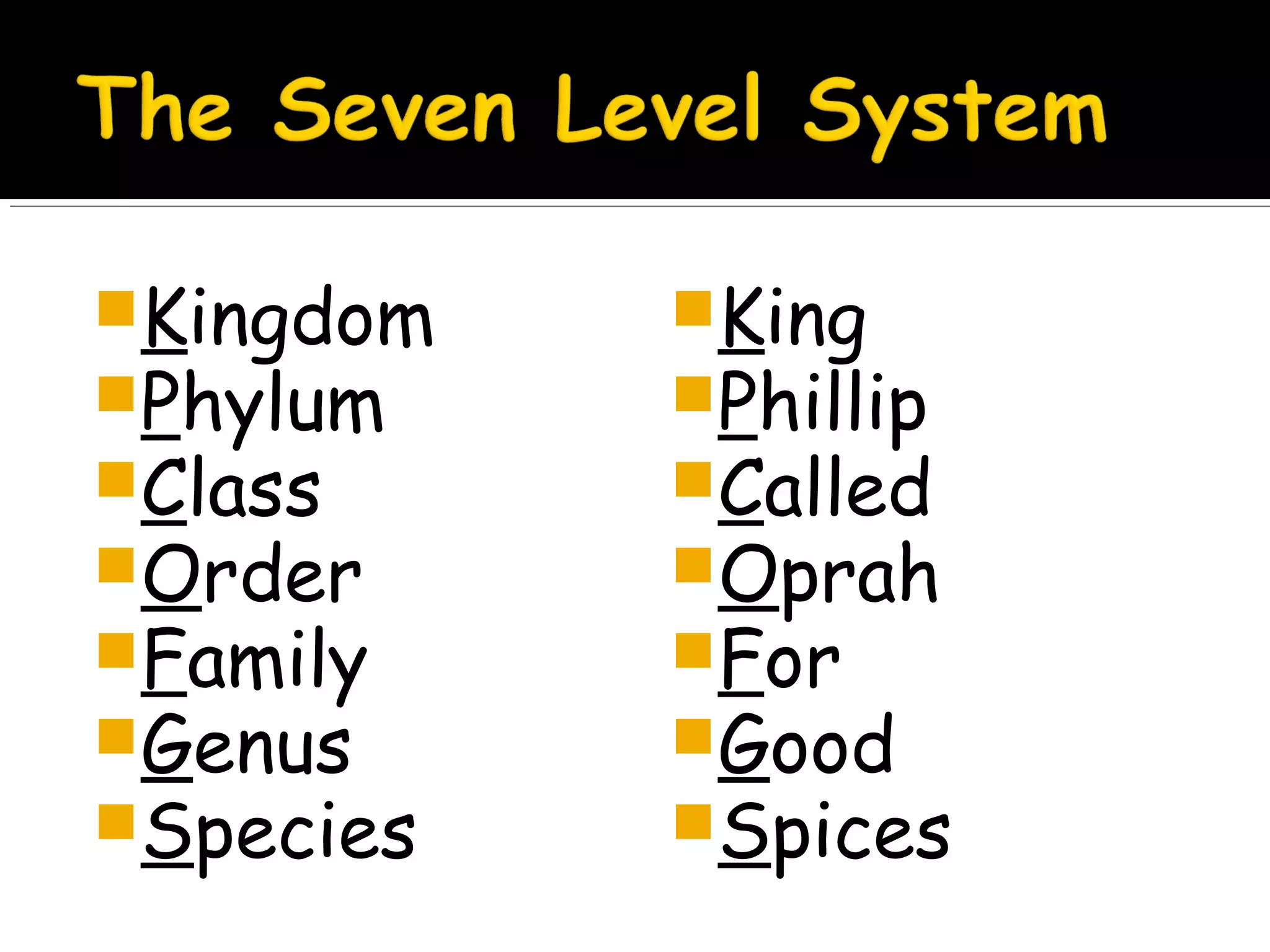
Kingdom
Phylum
Class
Order
Family
Genus
Species
King
Phillip
Called
Oprah
For
Good
Spices
There are 6 broad kingdoms
Every living thing that we
know of fits into one of the
six kingdoms
Each level gets more specific
as fewer organisms fit into
any one group
Canis lupus is the scientific
name for a gray wolf.
Canis is the genus name
lupus is the species name
This system uses a binomial
nomenclature
A genus consists of a group
of closely related species
Other animals in the Canis
group include dogs and
coyotes
The genus name is always
Capitalized
A species consists of animals
that can mate and produce
fertile offspring
Only grey wolves are known
as lupus.
The species name is always
lowercase
Bi means two
Nomen means name
A binomial nomenclature is a
classification system using
two names to identify an
organism
 Kingdom - Animalia
 Phylum - Chordata
 Class - Mammalia
 Order - Primates
 Family - Hominidae
 Genus - Homo
 Species - sapiens

Taxonomy

  • 2.
    Taxonomy is thebranch of biology concerned with the grouping and naming of organisms Biologists who study this are called taxonomists
  • 3.
    People wanted toorganize their world so they began grouping, or classifying everything they saw.
  • 4.
    Things that swim Thingsthat fly Things that crawl Things that walk on four legs Things that chew their food Things that swallow food whole Things that are toxic
  • 5.
    To help usstudy the earth To help us organize all the species we discover . . .
  • 6.
    To give everyspecies a name based on a standard method so scientists from different countries can talk about the same animal without confusion
  • 7.
    Carolus Linnaeus wasa Swedish botanist Developed a 7-level (taxa) classification system based on similarities between organisms
  • 8.
  • 9.
    There are 6broad kingdoms Every living thing that we know of fits into one of the six kingdoms Each level gets more specific as fewer organisms fit into any one group
  • 10.
    Canis lupus isthe scientific name for a gray wolf. Canis is the genus name lupus is the species name This system uses a binomial nomenclature
  • 11.
    A genus consistsof a group of closely related species Other animals in the Canis group include dogs and coyotes The genus name is always Capitalized
  • 12.
    A species consistsof animals that can mate and produce fertile offspring Only grey wolves are known as lupus. The species name is always lowercase
  • 13.
    Bi means two Nomenmeans name A binomial nomenclature is a classification system using two names to identify an organism
  • 14.
     Kingdom -Animalia  Phylum - Chordata  Class - Mammalia  Order - Primates  Family - Hominidae  Genus - Homo  Species - sapiens