GOPIKA V NAIR
1ST MSc ZOOLOGY
MAHATMA GANDHI COLLEGE,
THIRUVANANTHAPURAM

 Widely accepted convention of zoology that rules the formal
scientific naming of animals.
 Also known as ICZN Code.
 Published by International Commission on Zoological
Nomenclature [ICZN] takes its power from International Union
of Biological Sciences [IUBS].
 Ensures that every animal has a unique & universally accepted
scientific name.
WHAT IS ICZN?

 System of rules & recommendations
 Fundamental Goal : provide maximum continuity in the
naming of all animals with
 Uniqueness
 Universality &
 Stability
 Guide only the nomenclature of animals, leaves zoologist the
freedom in classifying new taxa.
WHAT IS ICZN?

 First introduced by a British ornithologist, zoologist &
palaeontologist Hugh E. Strickland, conceived a code for
introducing uniformity in international nomenclature it was
modified & evolved to the present systems
 1st edition - 1961
 4th edition – 1999
 ICZN is independent from other nomenclature systems like
Botanical nomenclature (ICBN).
 E.g. :
 Fig Shell (Gastropod animal) & Fig Tree (Plant)
 Genus Abronia in both plants & animals
BRIEF HISTORY

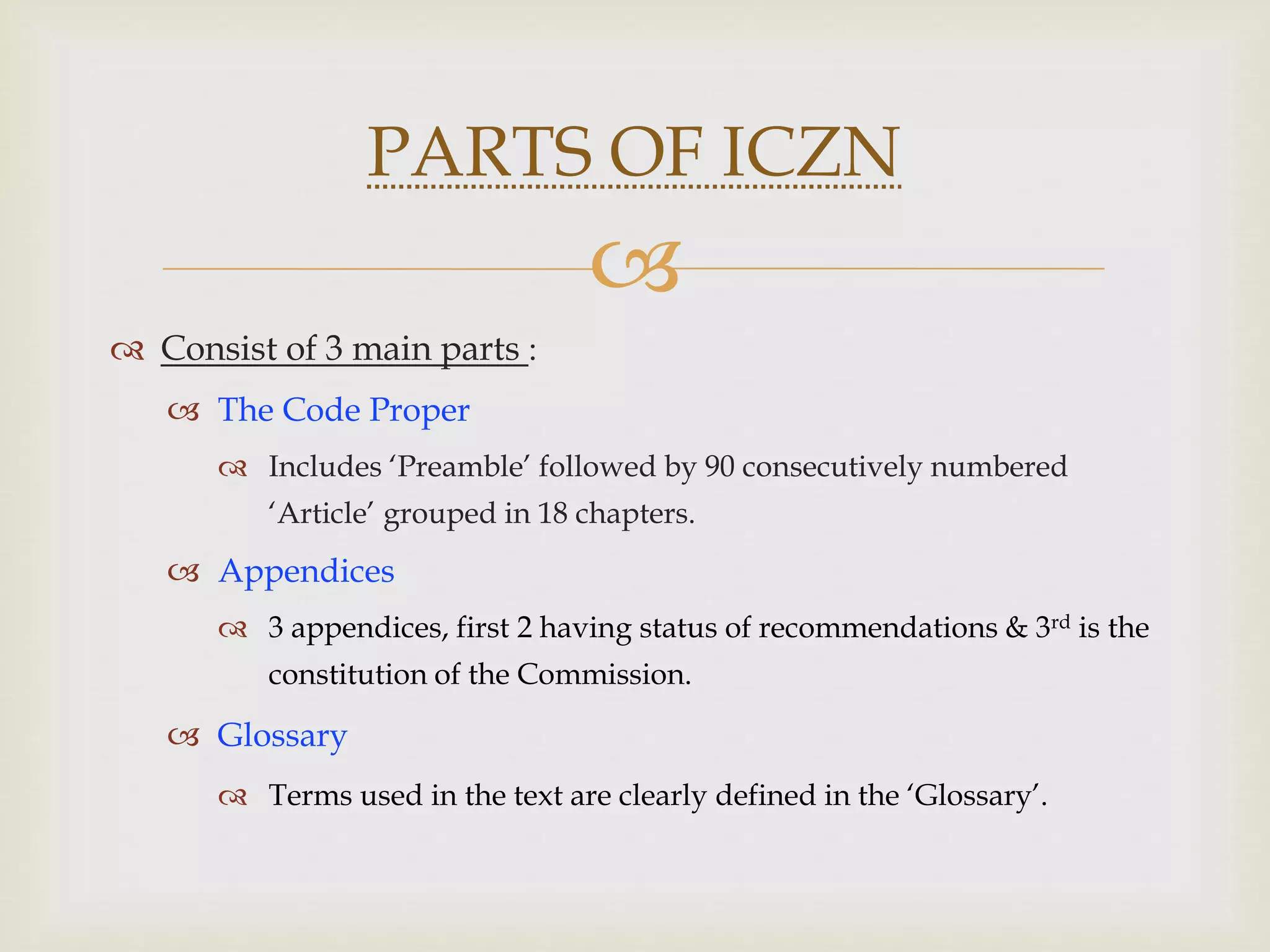
 Consist of 3 main parts :
 The Code Proper
 Includes ‘Preamble’ followed by 90 consecutively numbered
‘Article’ grouped in 18 chapters.
 Appendices
 3 appendices, first 2 having status of recommendations & 3rd is the
constitution of the Commission.
 Glossary
 Terms used in the text are clearly defined in the ‘Glossary’.
PARTS OF ICZN

 The rules principally regulate :
 How names are correctly established in the frame of
binomial nomenclature.
 Which name must be used in case of name conflicts.
 How scientific literature must cite names.
PRINCIPLES OF ICZN

 There are six basic principles :
1) Principle of binomial nomenclature.
2) Principle of priority.
3) Principle of co-ordination.
4) Principle of the first reviser.
5) Principle of homonymy.
6) Principle of typification.
PRINCIPLES OF ICZN

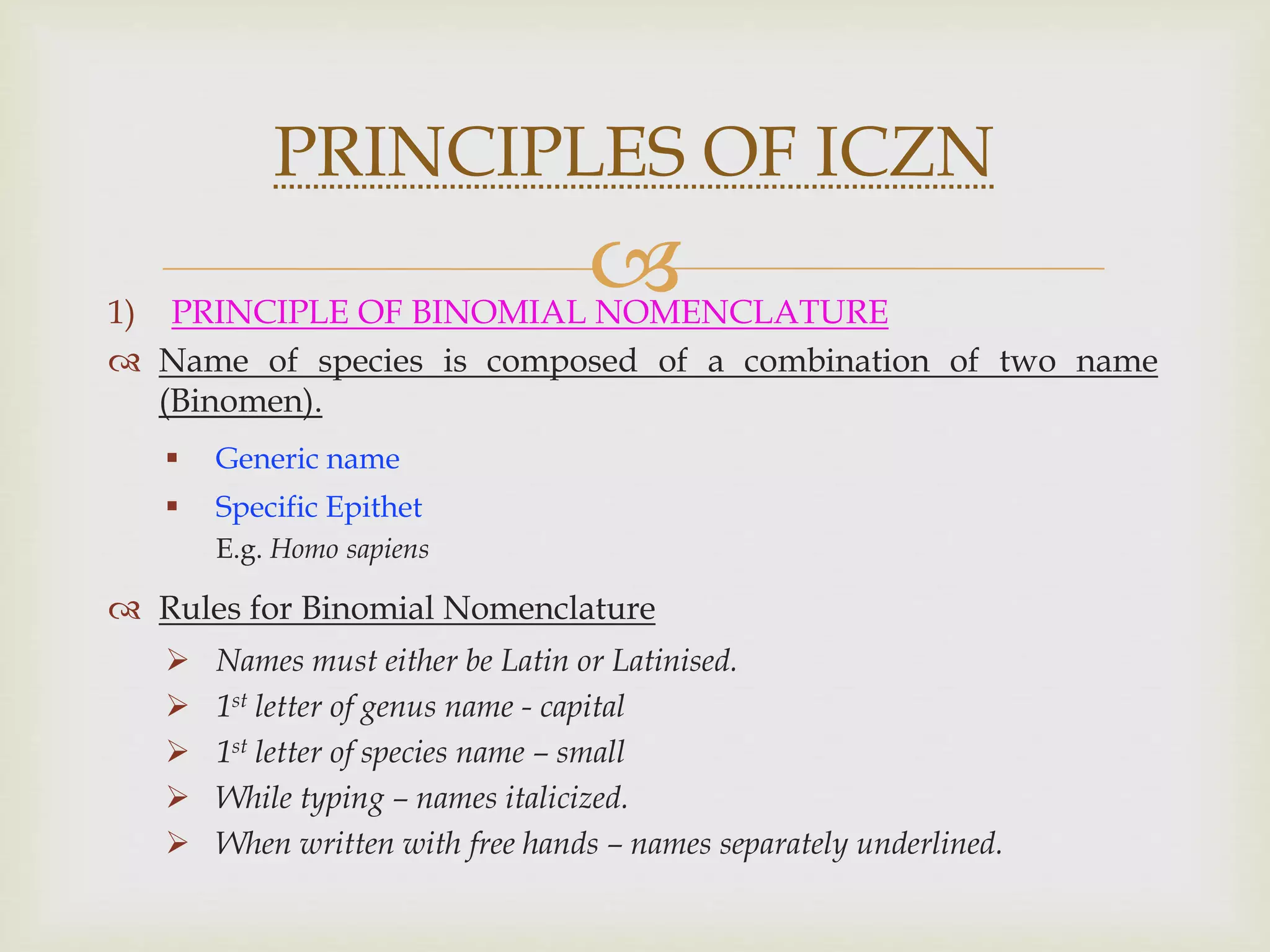
1) PRINCIPLE OF BINOMIAL NOMENCLATURE
 Name of species is composed of a combination of two name
(Binomen).
 Generic name
 Specific Epithet
E.g. Homo sapiens
 Rules for Binomial Nomenclature
 Names must either be Latin or Latinised.
 1st letter of genus name - capital
 1st letter of species name – small
 While typing – names italicized.
 When written with free hands – names separately underlined.
PRINCIPLES OF ICZN

2) PRINCIPLE OF PRIORITY
 First formulated in 1842
 Correct formal scientific name for an animal taxon is the oldest
available valid name.
 1815 George Ord named a species of Pronghorn – Antilocapra americana
 1855 John Edward Gray published same species – Antilocapra anteflexa
 Here, based on Principle of priority the name Antilocapra americana
takes priority & Antilocapra anteflexa becomes a junior synonym.
PRINCIPLES OF ICZN

3) PRINCIPLE OF CO-ORDINATION
 Publishing a new zoological name automatically & simultaneously
establishes all corresponding names in the relevant other ranks
with the same type.
 E.g. 1 – Publishing a species name (binomen) – Homo sapiens also
establishes the sub-species name (trinomen) – Homo sapiens sapiens
 E.g. 2 – Publishing a family name – Giraffidae also establishes the
super-family name – Giraffoidea & the sub-family name -
Giraffinae
PRINCIPLES OF ICZN

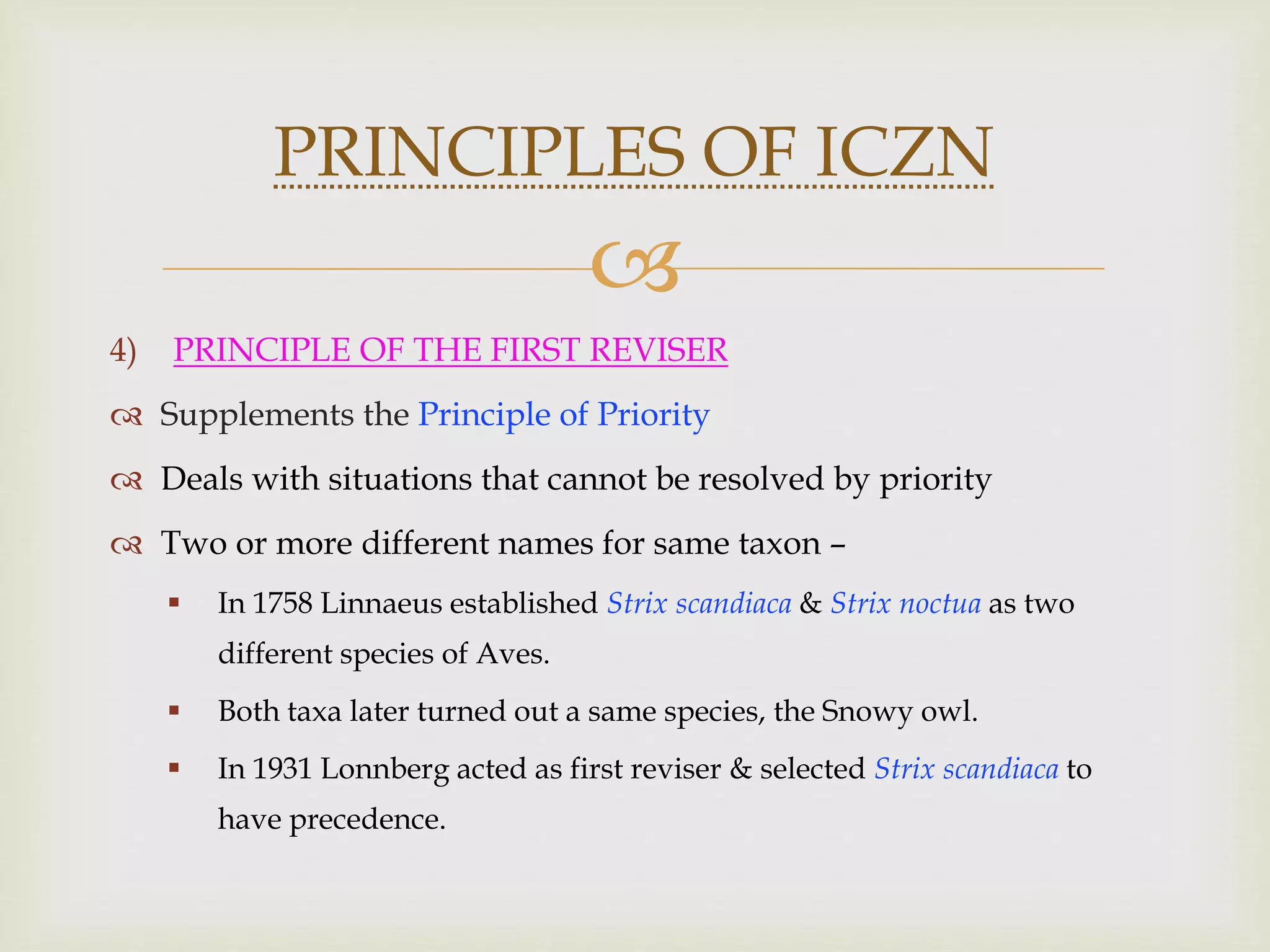
4) PRINCIPLE OF THE FIRST REVISER
 Supplements the Principle of Priority
 Deals with situations that cannot be resolved by priority
 Two or more different names for same taxon –
 In 1758 Linnaeus established Strix scandiaca & Strix noctua as two
different species of Aves.
 Both taxa later turned out a same species, the Snowy owl.
 In 1931 Lonnberg acted as first reviser & selected Strix scandiaca to
have precedence.
PRINCIPLES OF ICZN

5) PRINCIPLE OF HOMONYMY
 The name of each taxon must be unique.
 A name that is a homonym of another name must not be used as a
valid name.
 E.g. – In 1773 Drury established Cerambyx maculatus (Coleoptera) for a
species from Jamaica. In 1775 Fueblin established Cerambyx maculatus
for a different species from Switzerland.
 Principle of Priority apply here and Drury’s name gets precedence &
Fueblin’s name becomes homonym.
PRINCIPLES OF ICZN

6) PRINCIPLE OF TYPIFICATION
 Any family group name must have a type genus.
 Any genus group name must have a type species.
 Any species group name can (not must) have one or more type
specimens usually deposited in a museum collection.
PRINCIPLES OF ICZN

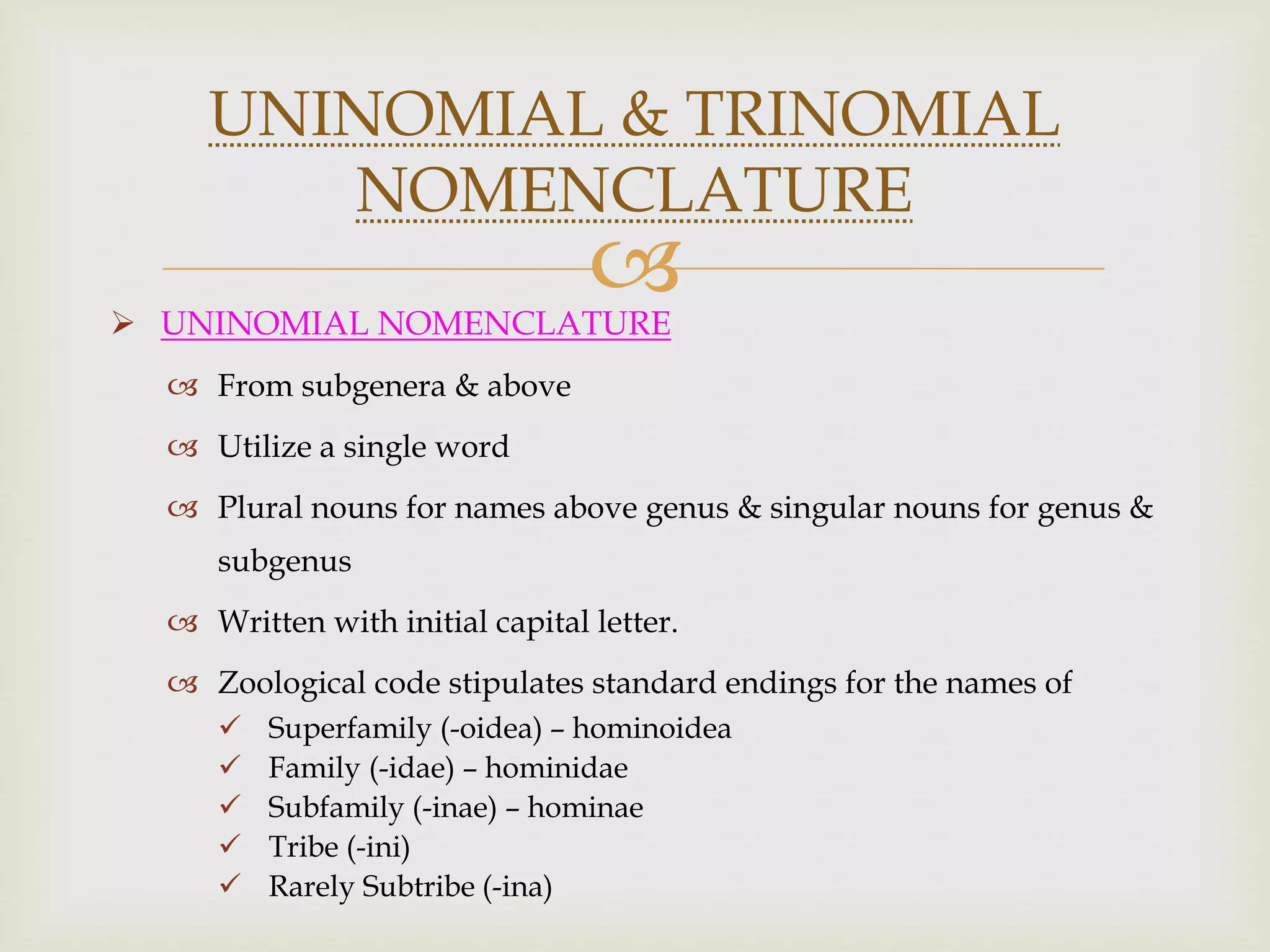
 UNINOMIAL NOMENCLATURE
 From subgenera & above
 Utilize a single word
 Plural nouns for names above genus & singular nouns for genus &
subgenus
 Written with initial capital letter.
 Zoological code stipulates standard endings for the names of
 Superfamily (-oidea) – hominoidea
 Family (-idae) – hominidae
 Subfamily (-inae) – hominae
 Tribe (-ini)
 Rarely Subtribe (-ina)
UNINOMIAL & TRINOMIAL
NOMENCLATURE

 TRINOMIAL NOMENCLATURE
 Used when species further subdivided
 Extends the standard system of binomial nomenclature by adding a third
epithet
 E.g. – Columbia livia domestica (domestic pigeon), Homo sapiens sapiens
 In botany, species further divided into any of subspecies, variety, sub
variety/form whereas in zoology usually subdivided into subspecies level
only. Trinomial name usually includes a qualifier.
 E.g. – Astrophytum myriostigma subvar.glabrum (where ‘subvar’ is the qualifier)
UNINOMIAL & TRINOMIAL
NOMENCLATURE
ICZN.pptx

ICZN.pptx

  • 1.
    GOPIKA V NAIR 1STMSc ZOOLOGY MAHATMA GANDHI COLLEGE, THIRUVANANTHAPURAM
  • 2.
      Widely acceptedconvention of zoology that rules the formal scientific naming of animals.  Also known as ICZN Code.  Published by International Commission on Zoological Nomenclature [ICZN] takes its power from International Union of Biological Sciences [IUBS].  Ensures that every animal has a unique & universally accepted scientific name. WHAT IS ICZN?
  • 3.
      System ofrules & recommendations  Fundamental Goal : provide maximum continuity in the naming of all animals with  Uniqueness  Universality &  Stability  Guide only the nomenclature of animals, leaves zoologist the freedom in classifying new taxa. WHAT IS ICZN?
  • 4.
      First introducedby a British ornithologist, zoologist & palaeontologist Hugh E. Strickland, conceived a code for introducing uniformity in international nomenclature it was modified & evolved to the present systems  1st edition - 1961  4th edition – 1999  ICZN is independent from other nomenclature systems like Botanical nomenclature (ICBN).  E.g. :  Fig Shell (Gastropod animal) & Fig Tree (Plant)  Genus Abronia in both plants & animals BRIEF HISTORY
  • 5.
      Consist of3 main parts :  The Code Proper  Includes ‘Preamble’ followed by 90 consecutively numbered ‘Article’ grouped in 18 chapters.  Appendices  3 appendices, first 2 having status of recommendations & 3rd is the constitution of the Commission.  Glossary  Terms used in the text are clearly defined in the ‘Glossary’. PARTS OF ICZN
  • 6.
      The rulesprincipally regulate :  How names are correctly established in the frame of binomial nomenclature.  Which name must be used in case of name conflicts.  How scientific literature must cite names. PRINCIPLES OF ICZN
  • 7.
      There aresix basic principles : 1) Principle of binomial nomenclature. 2) Principle of priority. 3) Principle of co-ordination. 4) Principle of the first reviser. 5) Principle of homonymy. 6) Principle of typification. PRINCIPLES OF ICZN
  • 8.
     1) PRINCIPLE OFBINOMIAL NOMENCLATURE  Name of species is composed of a combination of two name (Binomen).  Generic name  Specific Epithet E.g. Homo sapiens  Rules for Binomial Nomenclature  Names must either be Latin or Latinised.  1st letter of genus name - capital  1st letter of species name – small  While typing – names italicized.  When written with free hands – names separately underlined. PRINCIPLES OF ICZN
  • 9.
     2) PRINCIPLE OFPRIORITY  First formulated in 1842  Correct formal scientific name for an animal taxon is the oldest available valid name.  1815 George Ord named a species of Pronghorn – Antilocapra americana  1855 John Edward Gray published same species – Antilocapra anteflexa  Here, based on Principle of priority the name Antilocapra americana takes priority & Antilocapra anteflexa becomes a junior synonym. PRINCIPLES OF ICZN
  • 10.
     3) PRINCIPLE OFCO-ORDINATION  Publishing a new zoological name automatically & simultaneously establishes all corresponding names in the relevant other ranks with the same type.  E.g. 1 – Publishing a species name (binomen) – Homo sapiens also establishes the sub-species name (trinomen) – Homo sapiens sapiens  E.g. 2 – Publishing a family name – Giraffidae also establishes the super-family name – Giraffoidea & the sub-family name - Giraffinae PRINCIPLES OF ICZN
  • 11.
     4) PRINCIPLE OFTHE FIRST REVISER  Supplements the Principle of Priority  Deals with situations that cannot be resolved by priority  Two or more different names for same taxon –  In 1758 Linnaeus established Strix scandiaca & Strix noctua as two different species of Aves.  Both taxa later turned out a same species, the Snowy owl.  In 1931 Lonnberg acted as first reviser & selected Strix scandiaca to have precedence. PRINCIPLES OF ICZN
  • 12.
     5) PRINCIPLE OFHOMONYMY  The name of each taxon must be unique.  A name that is a homonym of another name must not be used as a valid name.  E.g. – In 1773 Drury established Cerambyx maculatus (Coleoptera) for a species from Jamaica. In 1775 Fueblin established Cerambyx maculatus for a different species from Switzerland.  Principle of Priority apply here and Drury’s name gets precedence & Fueblin’s name becomes homonym. PRINCIPLES OF ICZN
  • 13.
     6) PRINCIPLE OFTYPIFICATION  Any family group name must have a type genus.  Any genus group name must have a type species.  Any species group name can (not must) have one or more type specimens usually deposited in a museum collection. PRINCIPLES OF ICZN
  • 14.
      UNINOMIAL NOMENCLATURE From subgenera & above  Utilize a single word  Plural nouns for names above genus & singular nouns for genus & subgenus  Written with initial capital letter.  Zoological code stipulates standard endings for the names of  Superfamily (-oidea) – hominoidea  Family (-idae) – hominidae  Subfamily (-inae) – hominae  Tribe (-ini)  Rarely Subtribe (-ina) UNINOMIAL & TRINOMIAL NOMENCLATURE
  • 15.
      TRINOMIAL NOMENCLATURE Used when species further subdivided  Extends the standard system of binomial nomenclature by adding a third epithet  E.g. – Columbia livia domestica (domestic pigeon), Homo sapiens sapiens  In botany, species further divided into any of subspecies, variety, sub variety/form whereas in zoology usually subdivided into subspecies level only. Trinomial name usually includes a qualifier.  E.g. – Astrophytum myriostigma subvar.glabrum (where ‘subvar’ is the qualifier) UNINOMIAL & TRINOMIAL NOMENCLATURE