C las s ification of P lants and
             Anim als
     S cie nce S tu d y G u id e
Wh at is clas s ification?


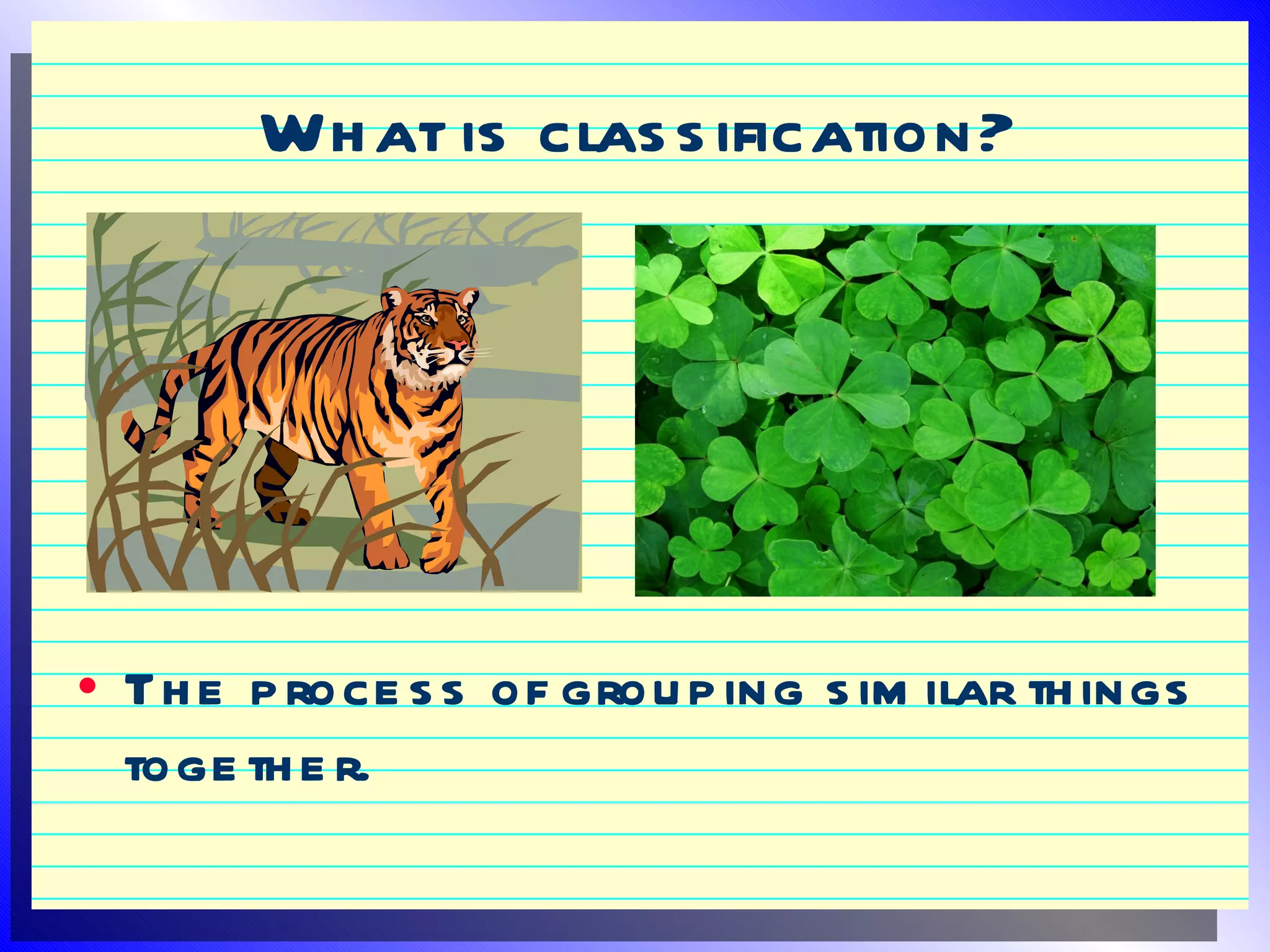
• Th e p roce s s of grou p ing s im ilar th ings
  toge th e r.
H ow is it u s e fu l to s cie ntis ts ?
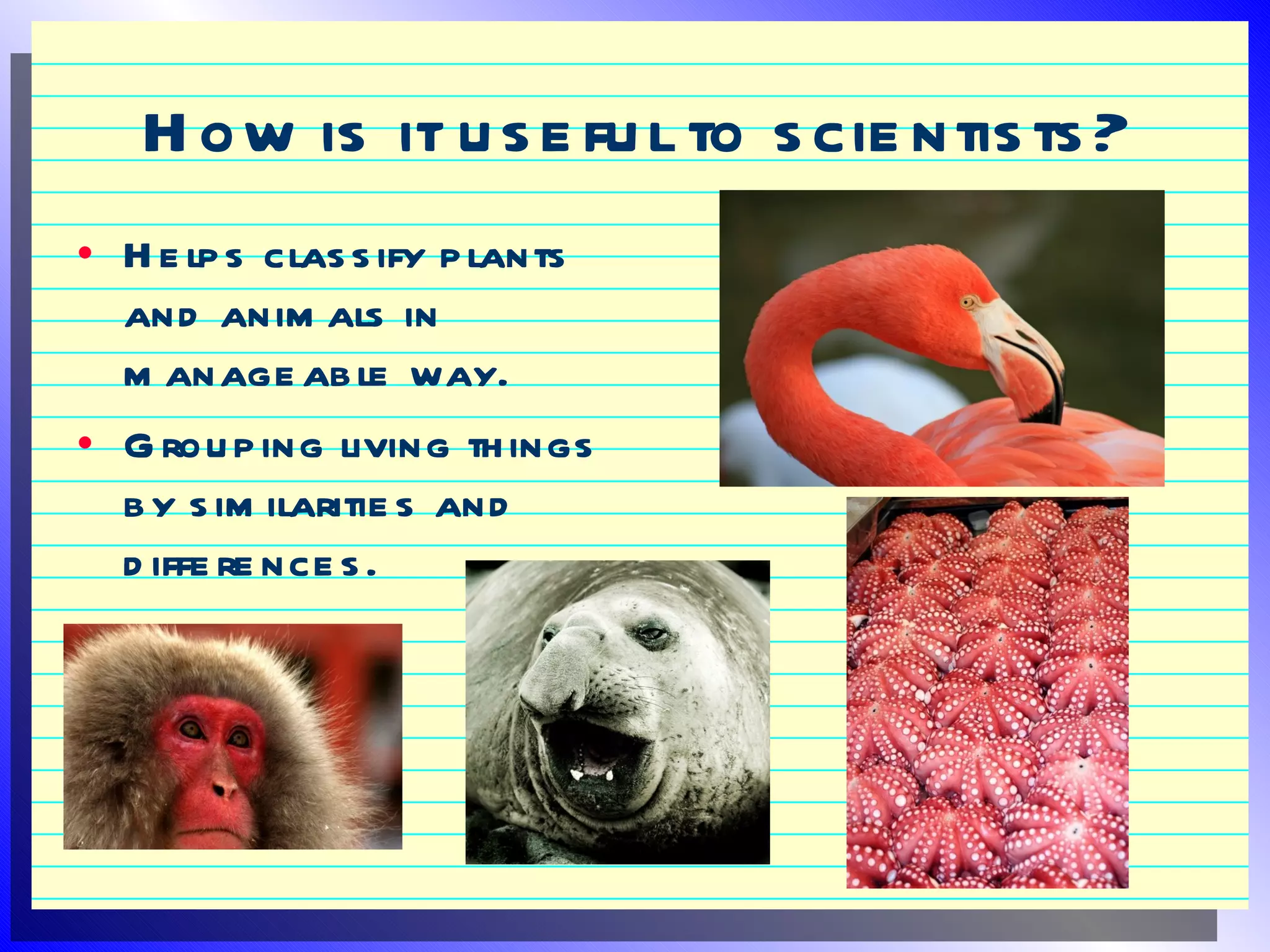
• H e lp s clas s ify p lants
  and anim als in
  m anage ab le way.
• G rou p ing living th ings
  b y s im ilaritie s and
  d iffe re nce s .
H ow d o you clas s ify organis m s ?
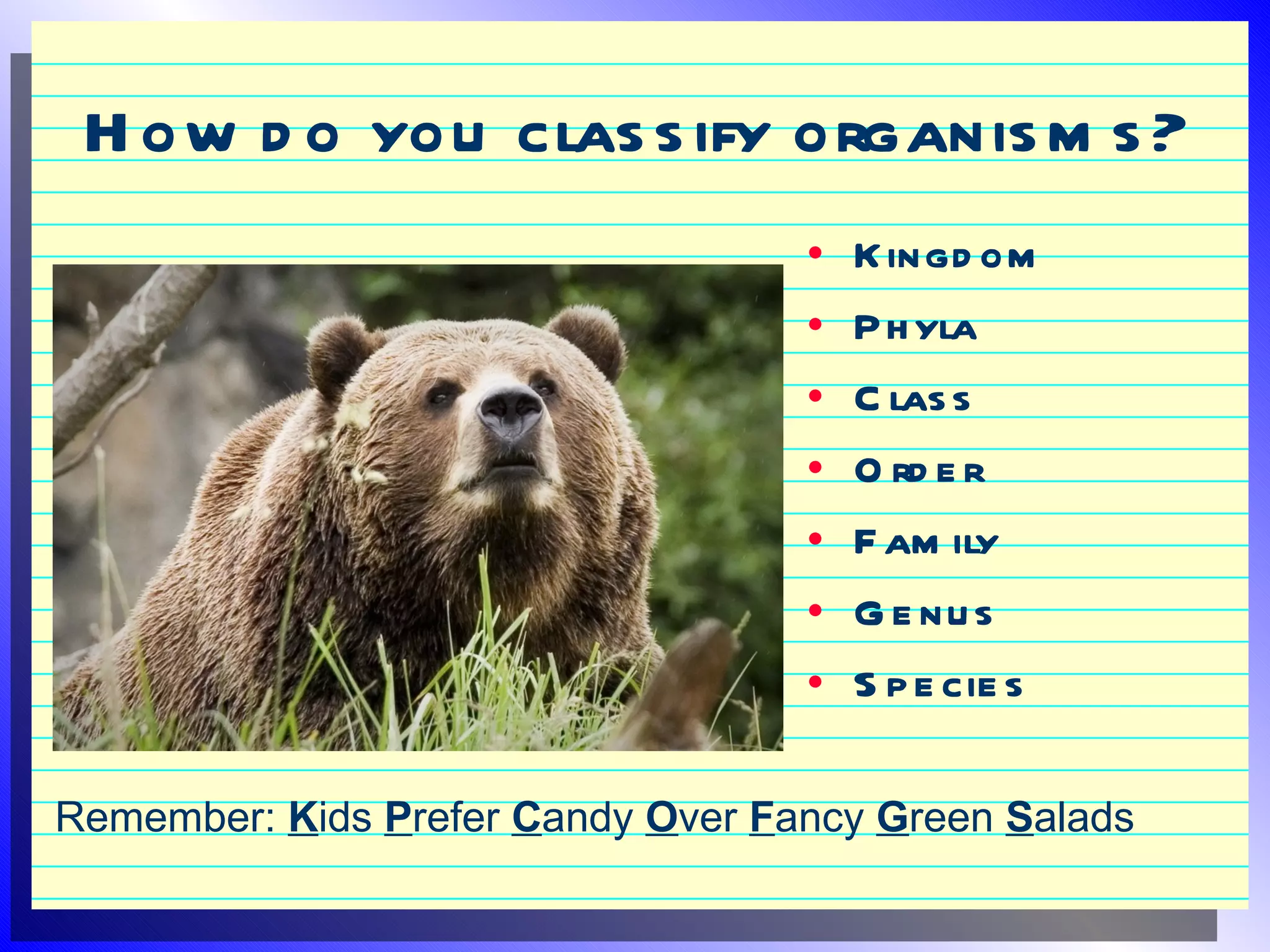
                                   •   Kingd om
                                   •   P h yla
                                   •   C las s
                                   •   O rd e r
                                   •   F am ily
                                   •   G e nu s
                                   •   S p e cie s

Remember: Kids Prefer Candy Over Fancy Green Salads
H ow d o s cie ntis ts grou p
                  organis m s ?
• G rou p ing organis m s
  b y fe atu re s th e y
  s h are .
   •   S h ap e
   •   S ize
   •   Bod y p arts
   •   C olor
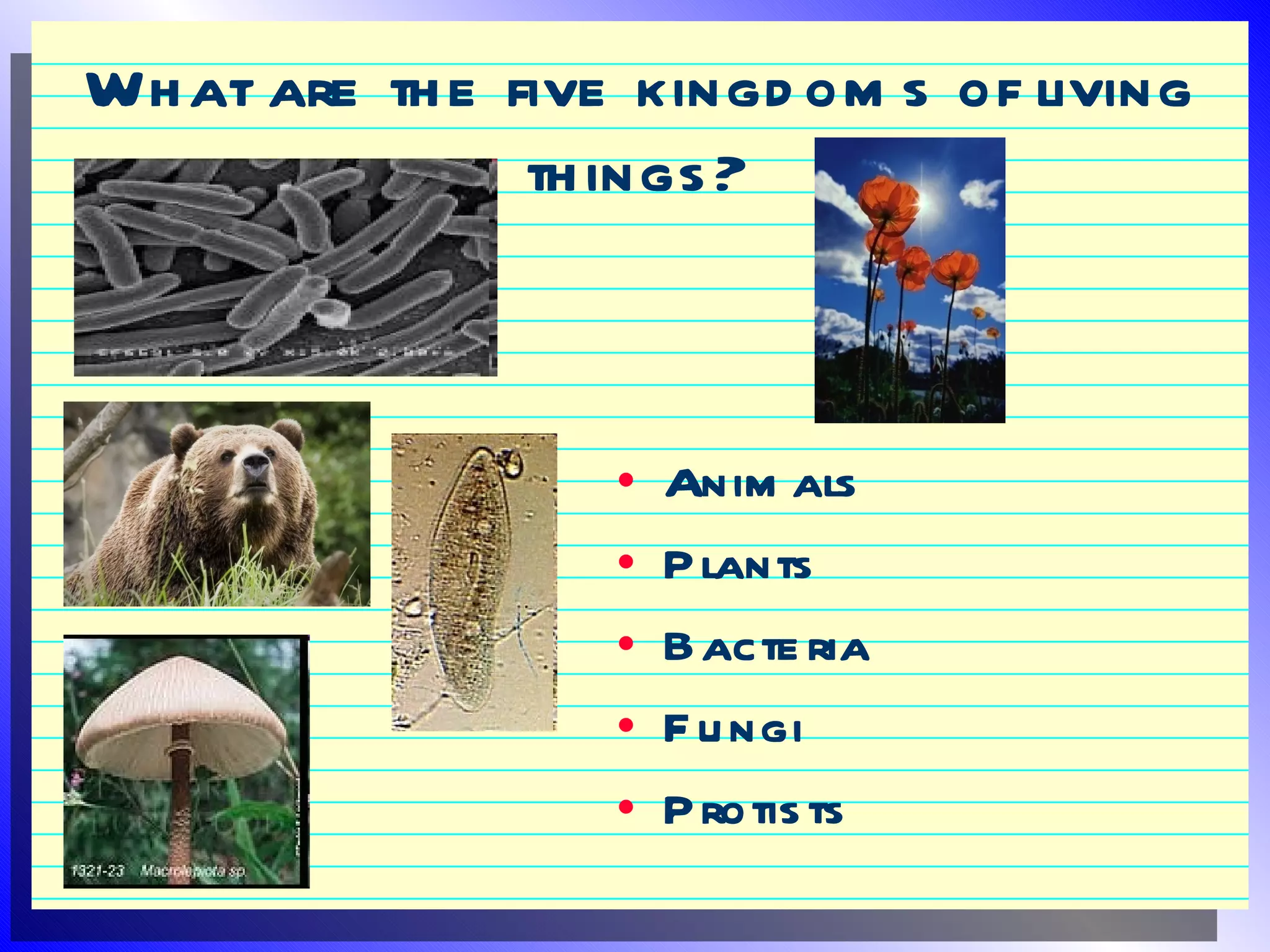
Wh at are th e five kingd om s of living
                th ings ?


                   •   Anim als
                   •   P lants
                   •   Bacte ria
                   •   F u ngi
                   •   P rotis ts
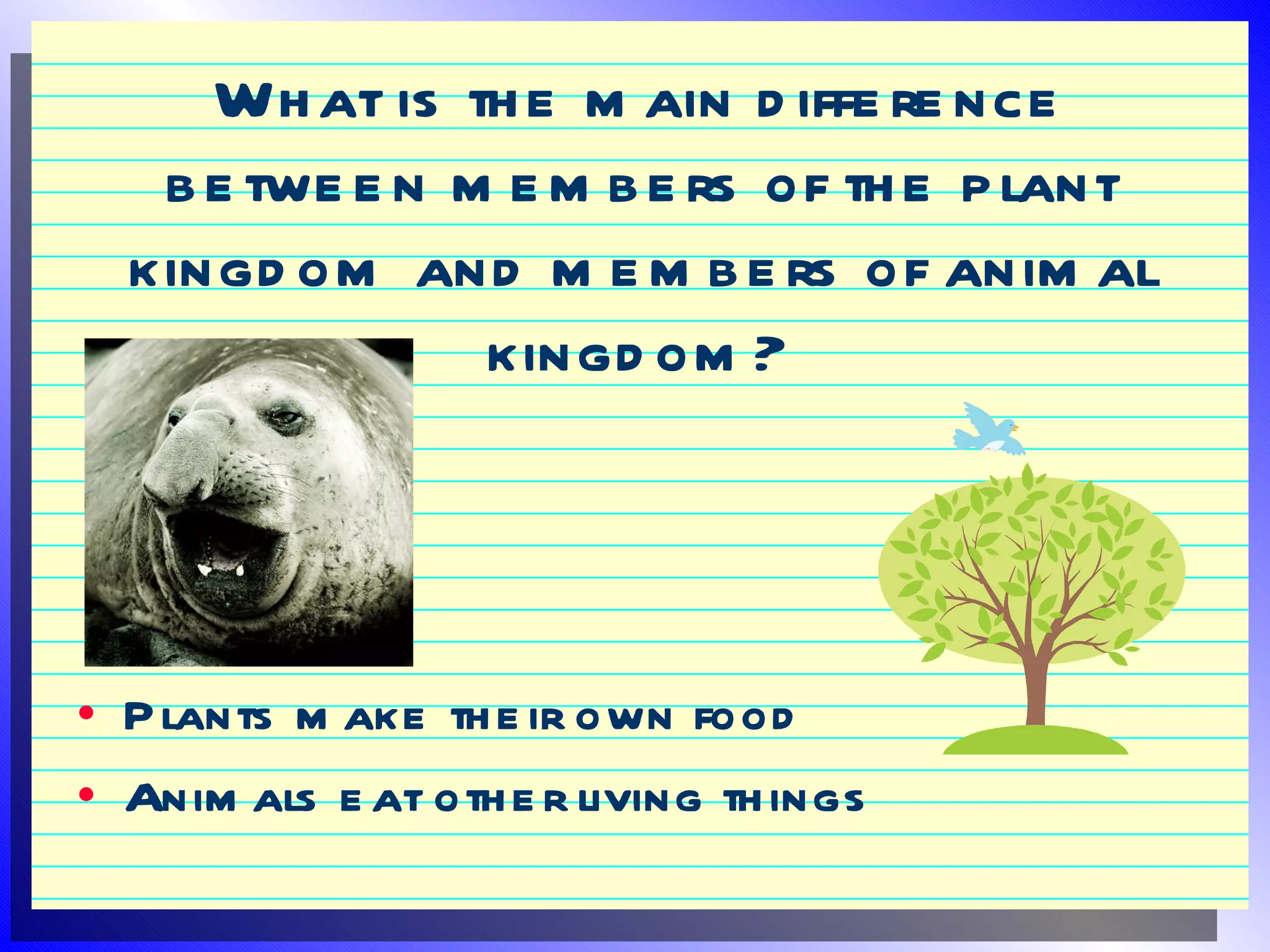
Wh at is th e m ain d iffe re nce
   b e twe e n m e m b e rs of th e p lant
  kingd om and m e m b e rs of anim al
                kingd om ?


• P lants m ake th e ir own food
• Anim als e at oth e r living th ings
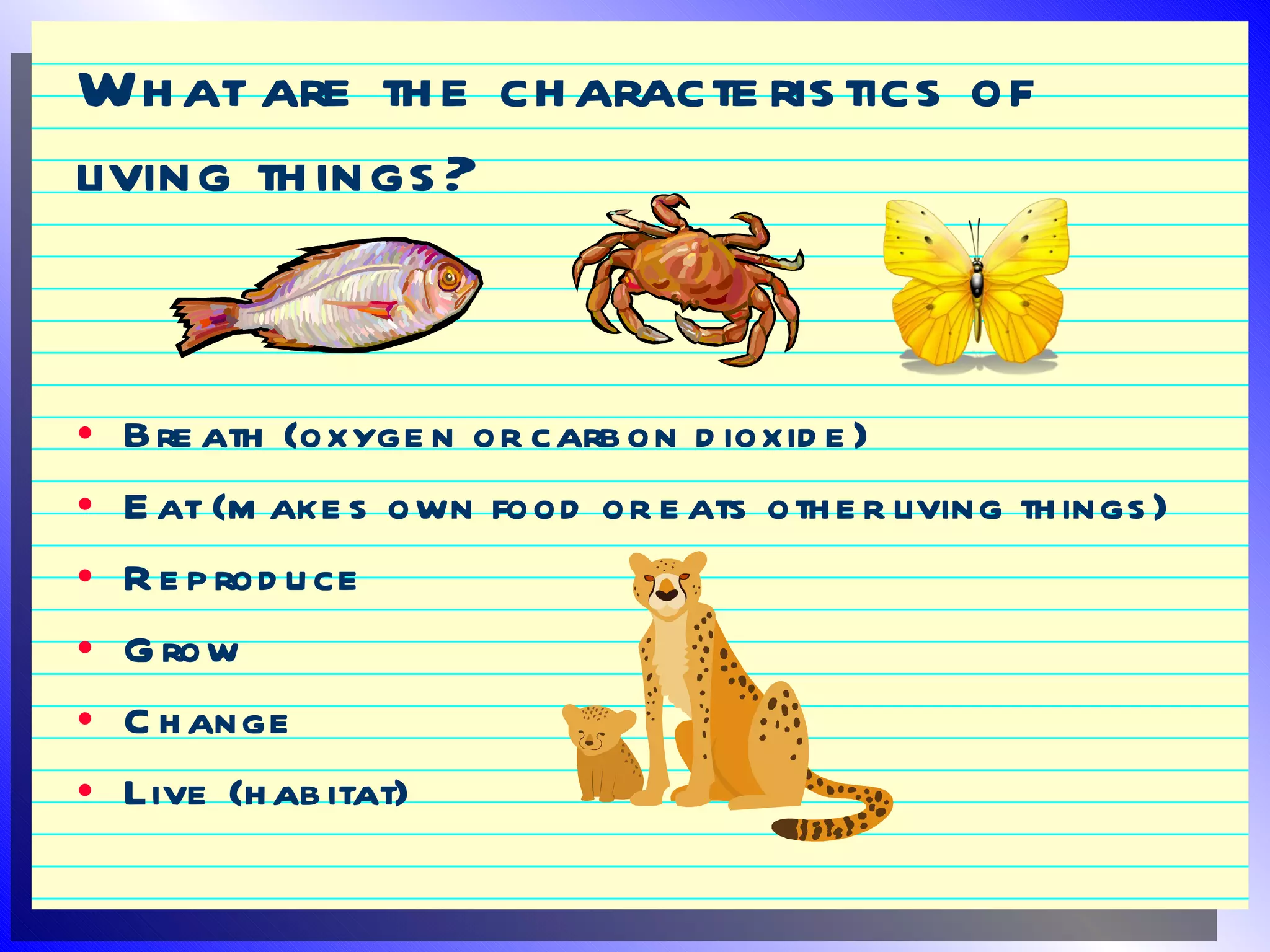
Wh at are th e ch aracte ris tics of
living th ings ?


•   Bre ath (oxyge n or carb on d ioxid e )
•   E at (m ake s own food or e ats oth e r living th ings )
•   R e p rod u ce
•   G row
•   C h ange
•   Live (h ab itat)
H ow are anim als clas s ifie d into
grou p s ?

• Th e large s t way
  anim als are b roke n
  into grou p s is
  b as e d on wh e th e r
  th e y h ave
  b ackb one s or h ave
  no b ackb one .
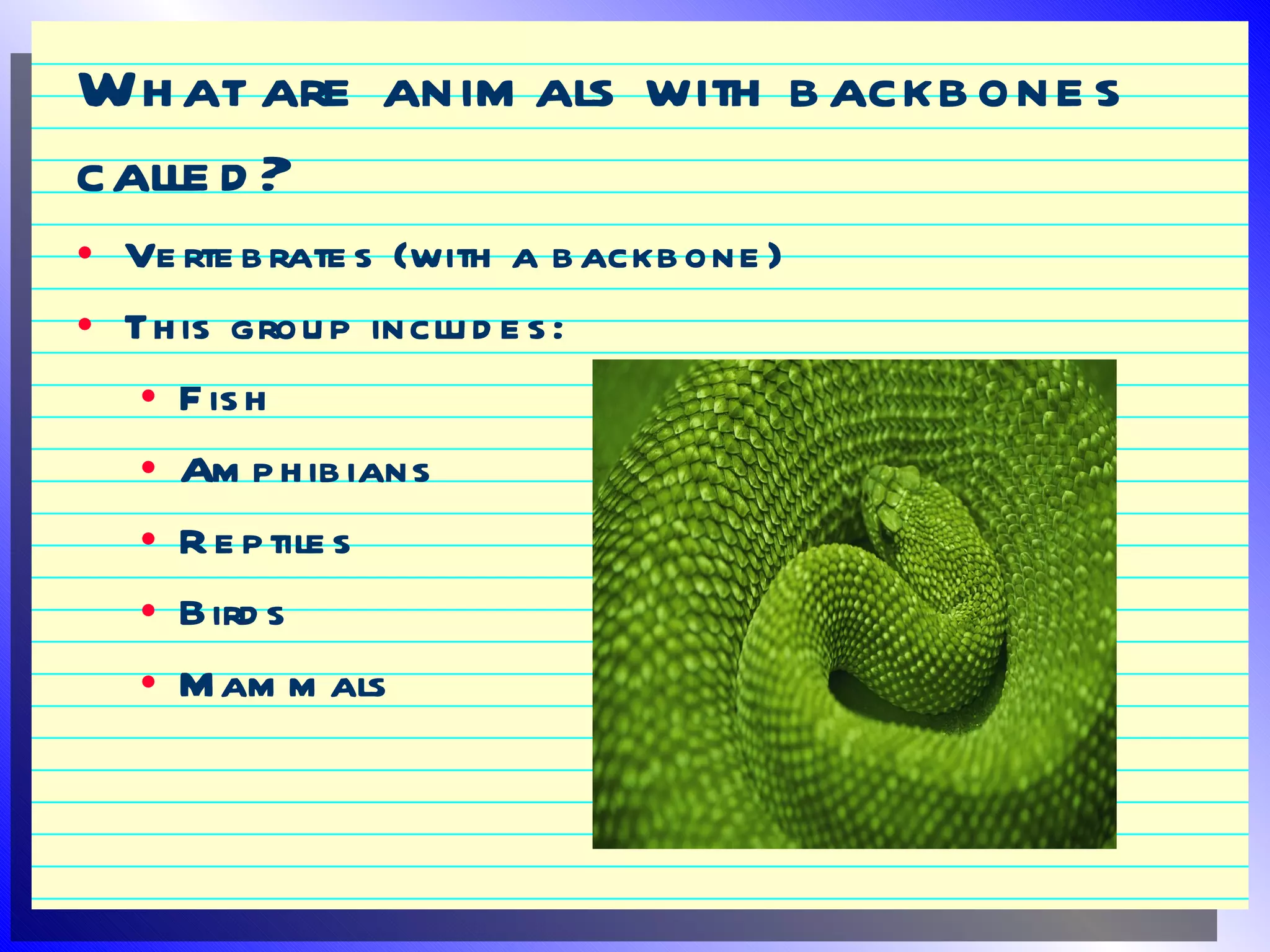
Wh at are anim als with b ackb one s
calle d ?
• Ve rte b rate s (with a b ackb one )
• Th is grou p inclu d e s :
   • F is h
   • Am p h ib ians
   • R e p tile s
   • Bird s
   • M am m als
Wh at are th e ch aracte ris tics of fis h ?

•   Ve rte b rate s
•   C old -b lood e d
•   H ave gills and s cale s
•   Live in wate r
Wh at are th e ch aracte ris tics of
re p tile s ?
                     •   Ve rte b rate s
                     •   C old -b lood e d
                     •   H ave s cale s
                     •   Live on land
                     •   U s u ally lay e ggs
Wh at are th e ch aracte ris tics of
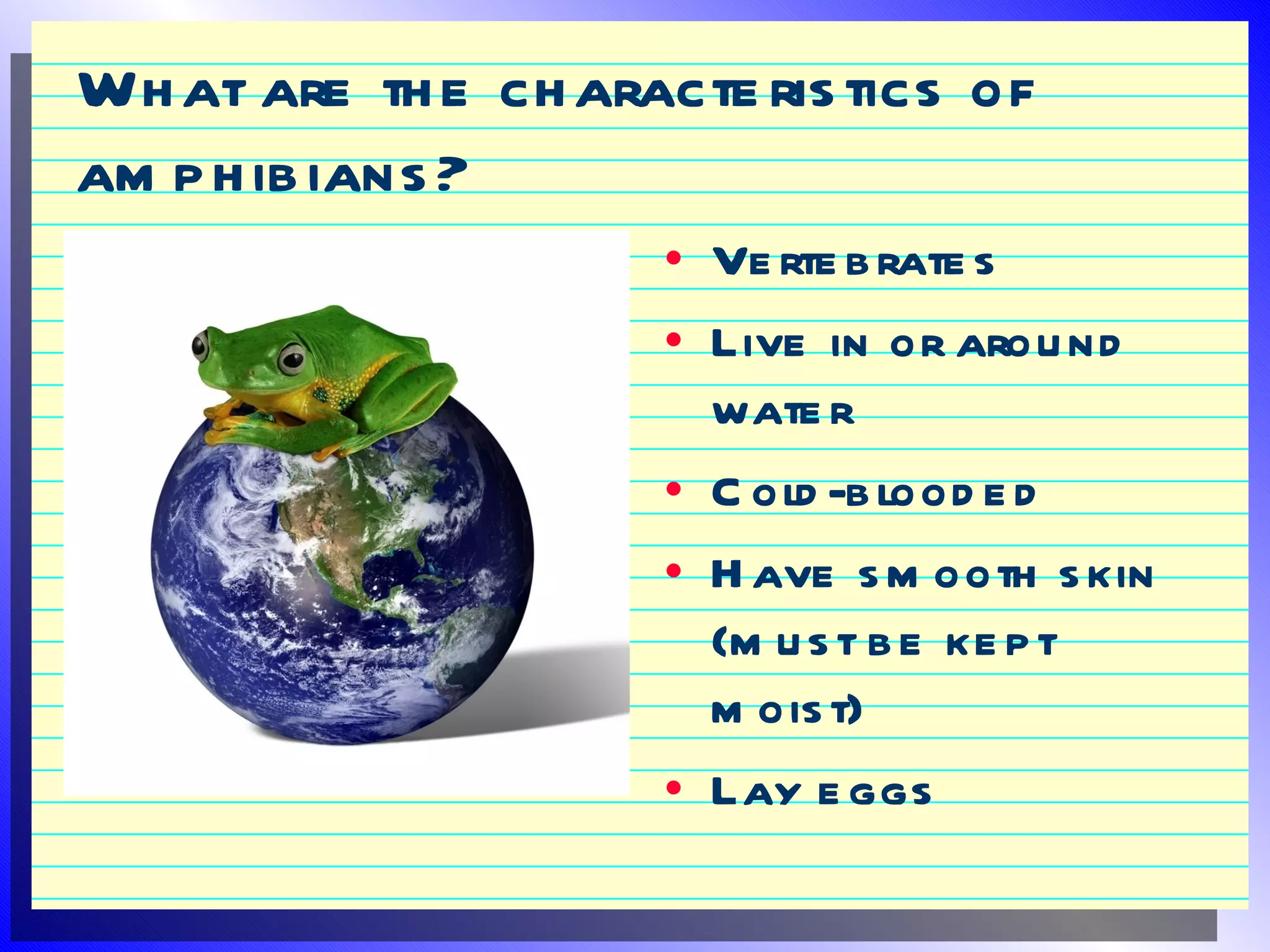
am p h ib ians ?
                      • Ve rte b rate s
                      • Live in or arou nd
                        wate r
                      • C old -b lood e d
                      • H ave s m ooth s kin
                        (m u s t b e ke p t
                        m ois t)
                      • Lay e ggs
Wh at are th e ch aracte ris tics of
b ird s ?

•   Ve rte b rate s
•   H ave h ollow b one s
•   H ave fe ath e rs
•   Warm -b lood e d
•   M os t can fly
•   Lay e ggs
•   H ave b e aks
Wh at are th e ch aracte ris tics of
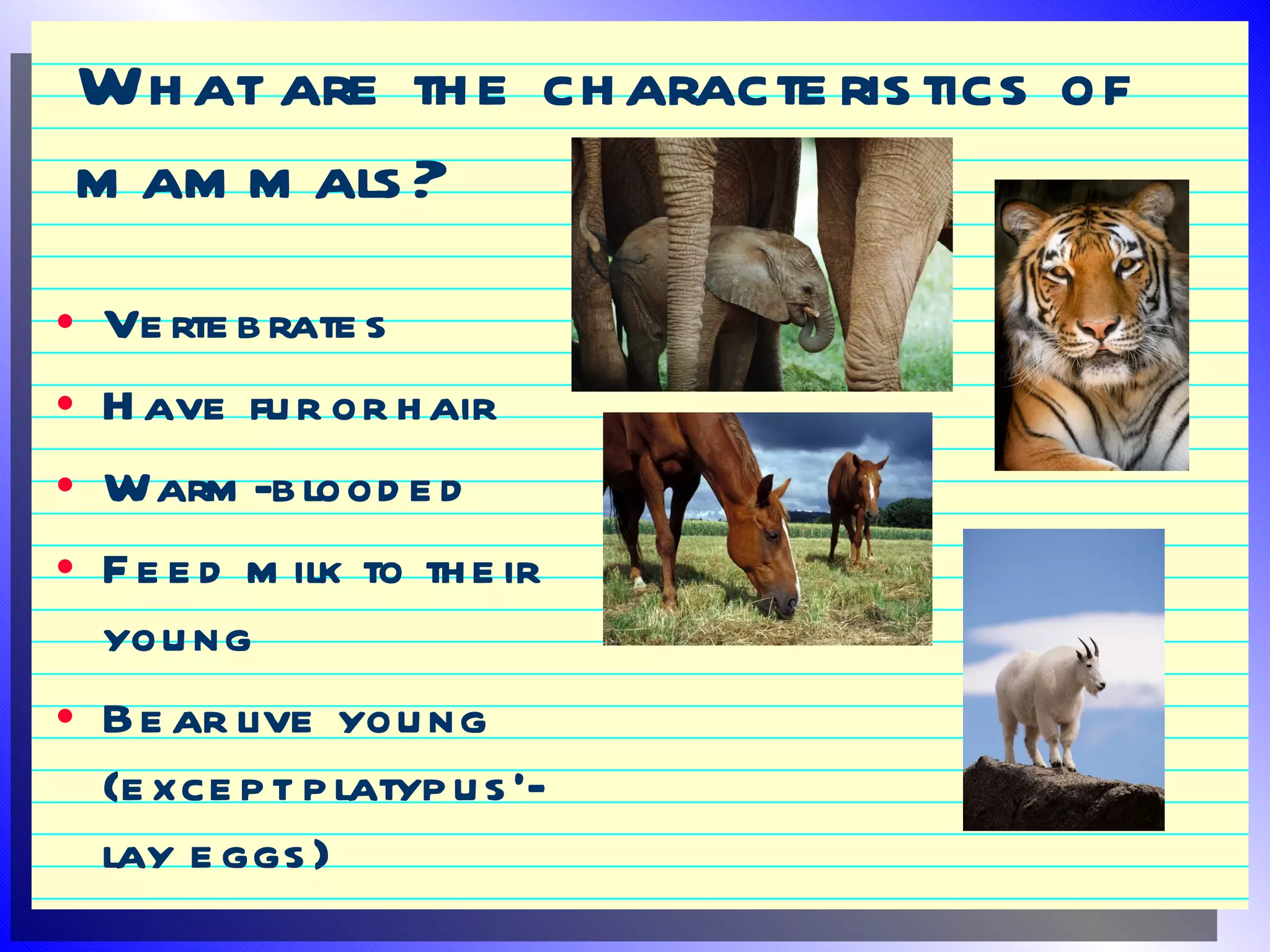
    m am m als ?
• Ve rte b rate s
• H ave fu r or h air
• Warm -b lood e d
• F e e d m ilk to th e ir
  you ng
• Be ar live you ng
  (e xce p t p latyp u s ’-
  lay e ggs )
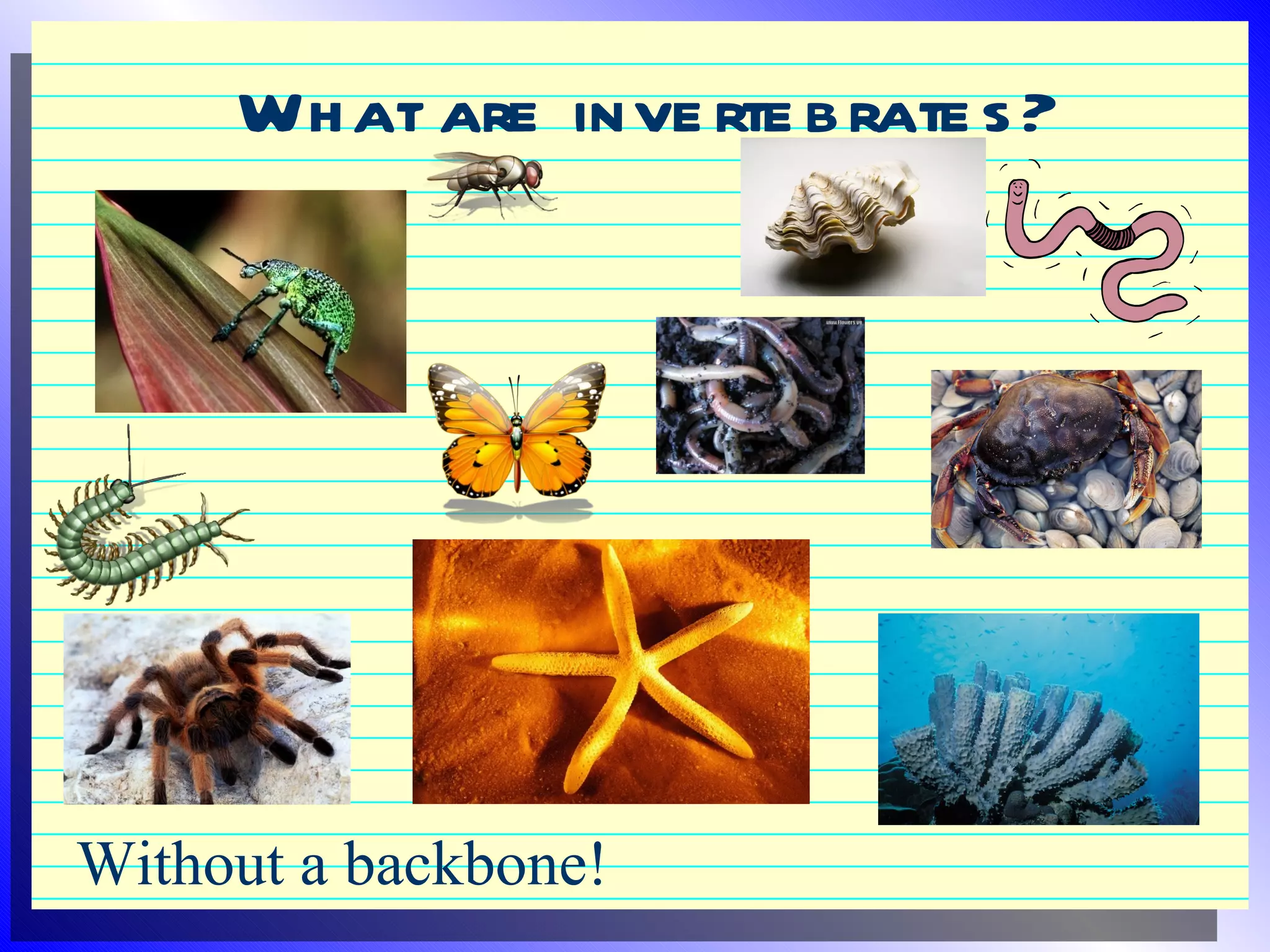
Wh at are anim als with ou t
b ackb one s calle d ?
• Inve rte b rate s (with ou t a
  b ackb one
• Th is grou p inclu d e s :
   • S p onge s                    •   U rch ins
   • Ane m one s                   •   Ins e cts
   • Je llyfis h                   •   S p id e rs
   • Worm s                        •   Ticks
   • S nails                       •   Lob s te rs
   • S e a s tars                  •   C rab s
   • M ollu s ks                   •   C rayfis h
Wh at are inve rte b rate s ?


Without a backbone!
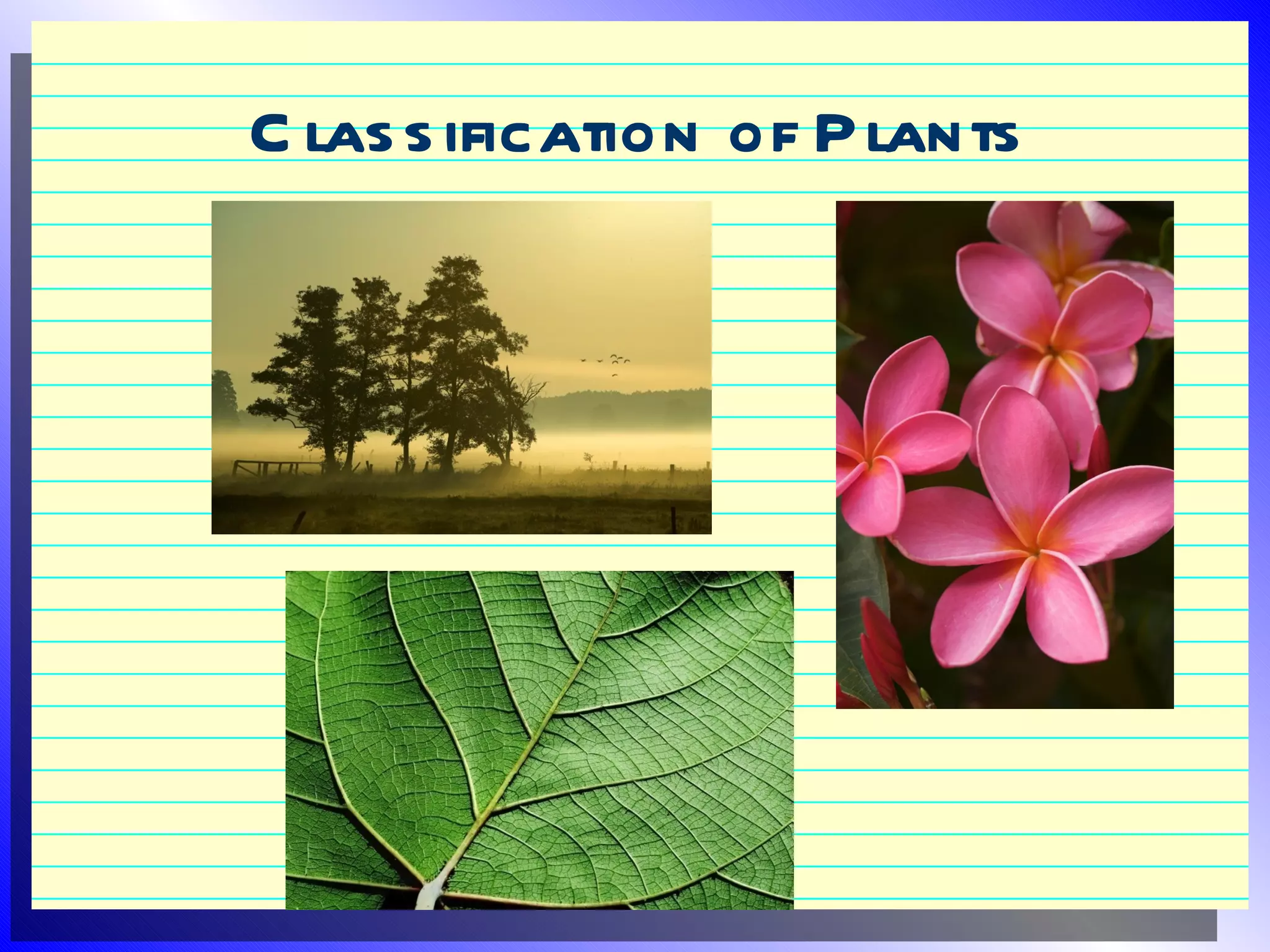
C las s ification of P lants
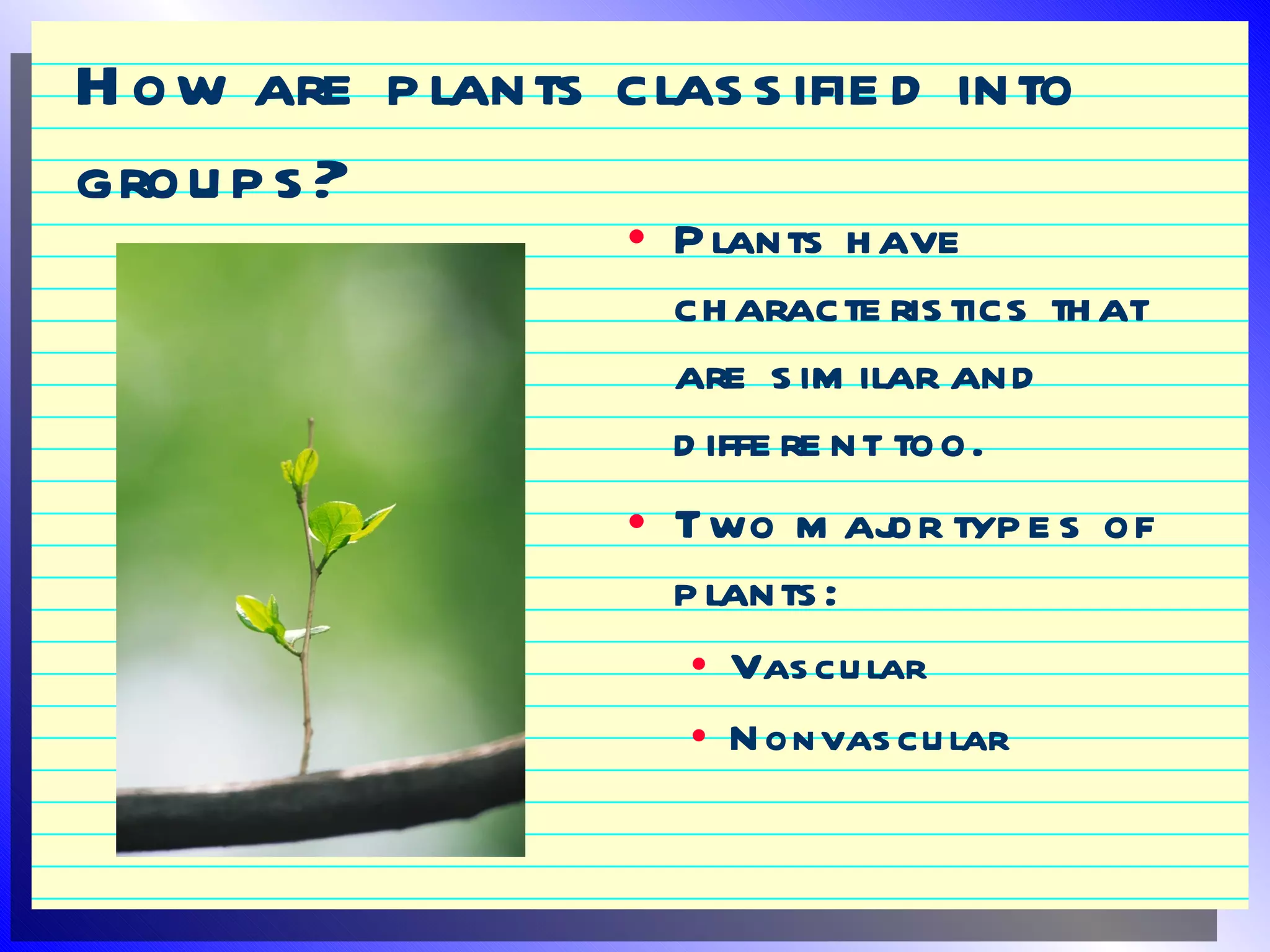
H ow are p lants clas s ifie d into
grou p s ?
                   • P lants h ave
                     ch aracte ris tics th at
                     are s im ilar and
                     d iffe re nt too.
                   • Two m aj typ e s of
                                 or
                     p lants :
                      • Vas cu lar
                      • N onvas cu lar
Wh at are vas cu lar p lants ?
• P lants th at h ave
  tiny ‘tu b e s ’ th at ru n
  b e twe e n th e roots
  and le ave s .
• E xam p le s :
   • Tre e s
   • F e rns
   • G ras s
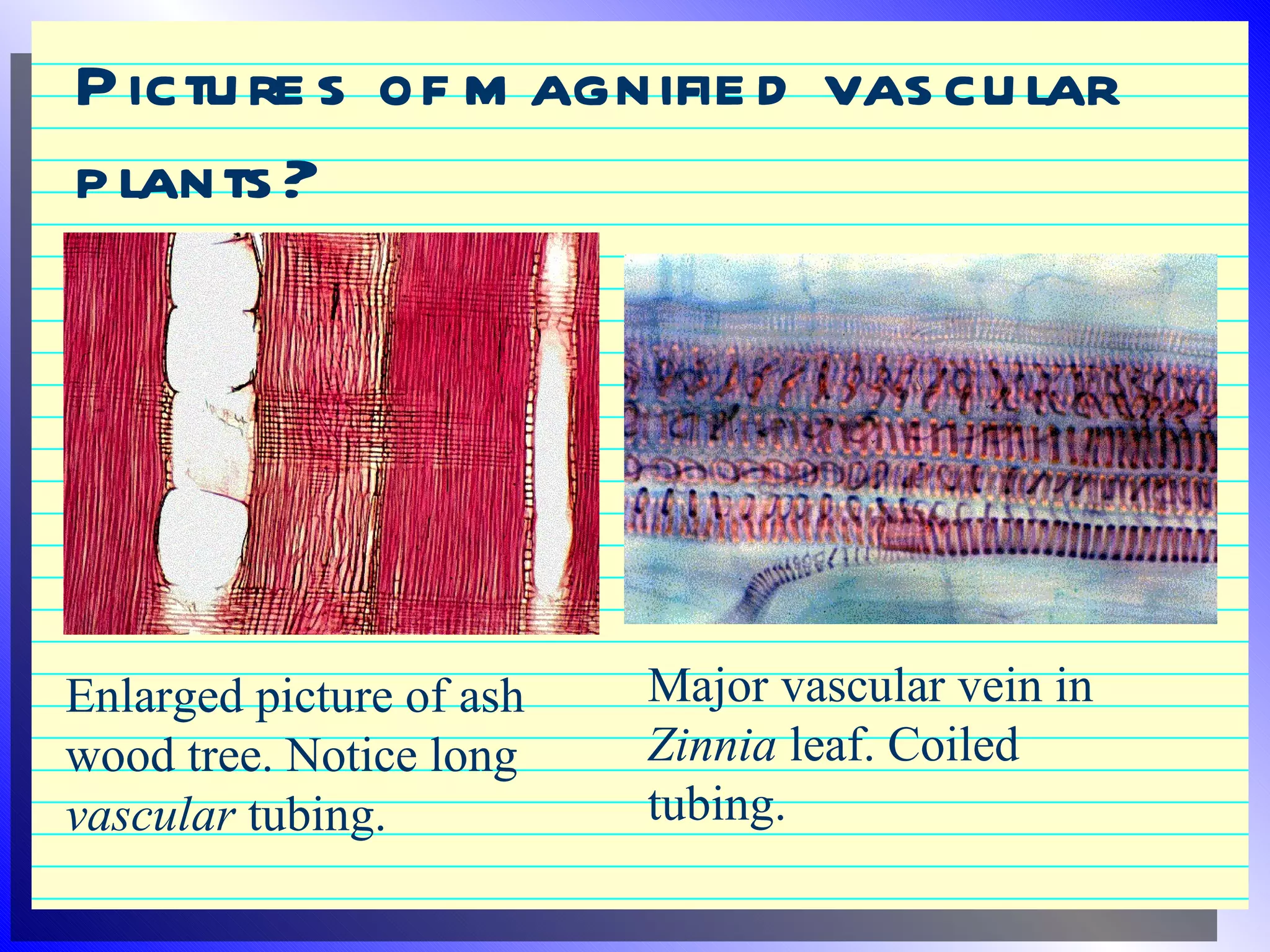
P ictu re s of m agnifie d vas cu lar
p lants ?


Enlarged picture of ash   Major vascular vein in
wood tree. Notice long    Zinnia leaf. Coiled
vascular tubing.          tubing.
M ore p ictu re s of vas cu lar p lants .


Magnified horizontal view (400x). The strands consist of
tubes with spirally thickened walls that appear like
minute coiled springs.
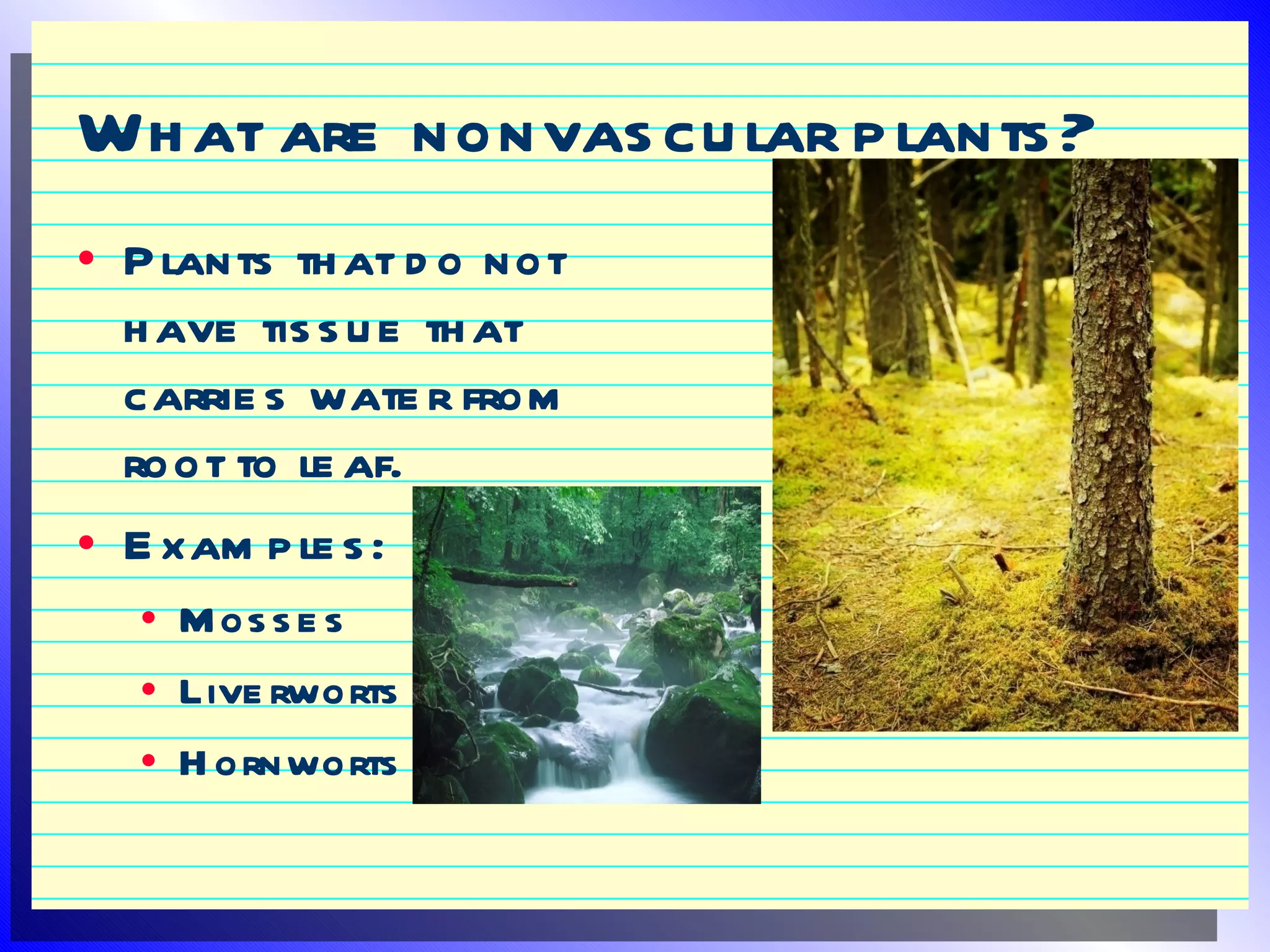
Wh at are nonvas cu lar p lants ?
• P lants th at d o not
  h ave tis s u e th at
  carrie s wate r from
  root to le af.
• E xam p le s :
  • M os s e s
  • Live rworts
  • H ornworts
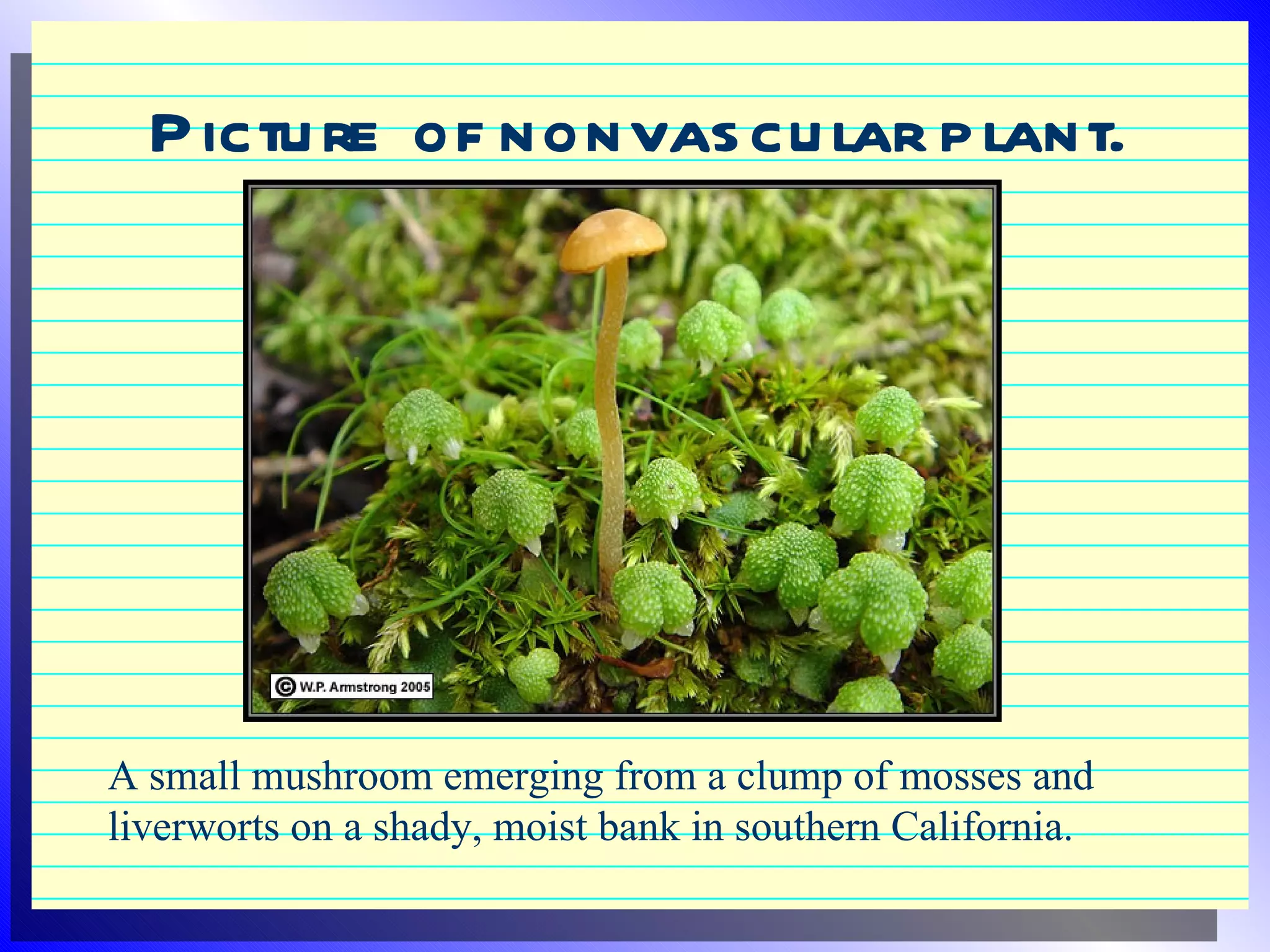
P ictu re of nonvas cu lar p lant.


A small mushroom emerging from a clump of mosses and
liverworts on a shady, moist bank in southern California.
C las s ification R e vie w
• P lants and Anim als are ‘m u lti-ce lle d ’
  organis m s .
• 7 ways to clas s ify all living th ings
   • Kingd om , p h ylu m , clas s , ord e r, fam ily, ge nu s ,
     s p e cie s
• 5 K ingd om s are :
   • Anim als , P lants , Bacte ria, F u ngi, and P rotis ts

Classification of-plants-and-animals

  • 1.
    C las sification of P lants and Anim als S cie nce S tu d y G u id e
  • 2.
    Wh at isclas s ification? • Th e p roce s s of grou p ing s im ilar th ings toge th e r.
  • 3.
    H ow isit u s e fu l to s cie ntis ts ? • H e lp s clas s ify p lants and anim als in m anage ab le way. • G rou p ing living th ings b y s im ilaritie s and d iffe re nce s .
  • 4.
    H ow do you clas s ify organis m s ? • Kingd om • P h yla • C las s • O rd e r • F am ily • G e nu s • S p e cie s Remember: Kids Prefer Candy Over Fancy Green Salads
  • 5.
    H ow do s cie ntis ts grou p organis m s ? • G rou p ing organis m s b y fe atu re s th e y s h are . • S h ap e • S ize • Bod y p arts • C olor
  • 6.
    Wh at areth e five kingd om s of living th ings ? • Anim als • P lants • Bacte ria • F u ngi • P rotis ts
  • 7.
    Wh at isth e m ain d iffe re nce b e twe e n m e m b e rs of th e p lant kingd om and m e m b e rs of anim al kingd om ? • P lants m ake th e ir own food • Anim als e at oth e r living th ings
  • 8.
    Wh at areth e ch aracte ris tics of living th ings ? • Bre ath (oxyge n or carb on d ioxid e ) • E at (m ake s own food or e ats oth e r living th ings ) • R e p rod u ce • G row • C h ange • Live (h ab itat)
  • 9.
    H ow areanim als clas s ifie d into grou p s ? • Th e large s t way anim als are b roke n into grou p s is b as e d on wh e th e r th e y h ave b ackb one s or h ave no b ackb one .
  • 10.
    Wh at areanim als with b ackb one s calle d ? • Ve rte b rate s (with a b ackb one ) • Th is grou p inclu d e s : • F is h • Am p h ib ians • R e p tile s • Bird s • M am m als
  • 11.
    Wh at areth e ch aracte ris tics of fis h ? • Ve rte b rate s • C old -b lood e d • H ave gills and s cale s • Live in wate r
  • 12.
    Wh at areth e ch aracte ris tics of re p tile s ? • Ve rte b rate s • C old -b lood e d • H ave s cale s • Live on land • U s u ally lay e ggs
  • 13.
    Wh at areth e ch aracte ris tics of am p h ib ians ? • Ve rte b rate s • Live in or arou nd wate r • C old -b lood e d • H ave s m ooth s kin (m u s t b e ke p t m ois t) • Lay e ggs
  • 14.
    Wh at areth e ch aracte ris tics of b ird s ? • Ve rte b rate s • H ave h ollow b one s • H ave fe ath e rs • Warm -b lood e d • M os t can fly • Lay e ggs • H ave b e aks
  • 15.
    Wh at areth e ch aracte ris tics of m am m als ? • Ve rte b rate s • H ave fu r or h air • Warm -b lood e d • F e e d m ilk to th e ir you ng • Be ar live you ng (e xce p t p latyp u s ’- lay e ggs )
  • 16.
    Wh at areanim als with ou t b ackb one s calle d ? • Inve rte b rate s (with ou t a b ackb one • Th is grou p inclu d e s : • S p onge s • U rch ins • Ane m one s • Ins e cts • Je llyfis h • S p id e rs • Worm s • Ticks • S nails • Lob s te rs • S e a s tars • C rab s • M ollu s ks • C rayfis h
  • 17.
    Wh at areinve rte b rate s ? Without a backbone!
  • 18.
    C las sification of P lants
  • 19.
    H ow arep lants clas s ifie d into grou p s ? • P lants h ave ch aracte ris tics th at are s im ilar and d iffe re nt too. • Two m aj typ e s of or p lants : • Vas cu lar • N onvas cu lar
  • 20.
    Wh at arevas cu lar p lants ? • P lants th at h ave tiny ‘tu b e s ’ th at ru n b e twe e n th e roots and le ave s . • E xam p le s : • Tre e s • F e rns • G ras s
  • 21.
    P ictu res of m agnifie d vas cu lar p lants ? Enlarged picture of ash Major vascular vein in wood tree. Notice long Zinnia leaf. Coiled vascular tubing. tubing.
  • 22.
    M ore pictu re s of vas cu lar p lants . Magnified horizontal view (400x). The strands consist of tubes with spirally thickened walls that appear like minute coiled springs.
  • 23.
    Wh at arenonvas cu lar p lants ? • P lants th at d o not h ave tis s u e th at carrie s wate r from root to le af. • E xam p le s : • M os s e s • Live rworts • H ornworts
  • 24.
    P ictu reof nonvas cu lar p lant. A small mushroom emerging from a clump of mosses and liverworts on a shady, moist bank in southern California.
  • 25.
    C las sification R e vie w • P lants and Anim als are ‘m u lti-ce lle d ’ organis m s . • 7 ways to clas s ify all living th ings • Kingd om , p h ylu m , clas s , ord e r, fam ily, ge nu s , s p e cie s • 5 K ingd om s are : • Anim als , P lants , Bacte ria, F u ngi, and P rotis ts