Cladograms
Tuesday 3-28-17
Today you need
• Notebook – just 3 quick
definitions
• Something to write with
Objective
• Analyze shared and derived
characteristics and organize
them into a cladogram
As always dear students
• Key concepts are underlined
• New vocabulary terms are in green
Cladograms are diagrams that show the
evolutionary relationships among a
group of organisms.
This cladogram shows the evolutionary
relationship among several vertebrates.
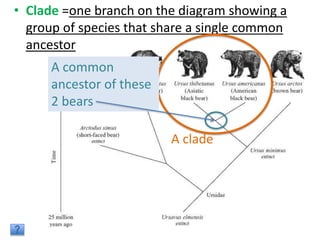
• Clade =one branch on the diagram showing a
group of species that share a single common
ancestor
A clade
A common
ancestor of these
2 bears
• Derived characteristic = a trait that arose in
the common ancestor of a particular lineage
and was passed along to its descendants
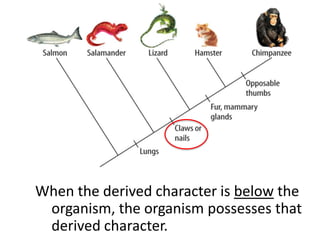
When the derived character is above an
organism, the organism lacks that
derived character.
When the derived character is below the
organism, the organism possesses that
derived character.
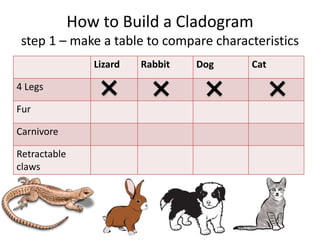
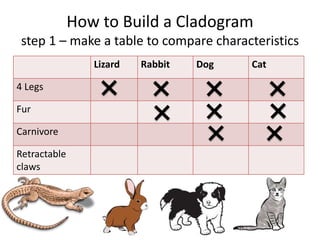
How to Build a Cladogram
step 1 – make a table to compare characteristics
Lizard Rabbit Dog Cat
4 Legs
Fur
Carnivore
Retractable
claws
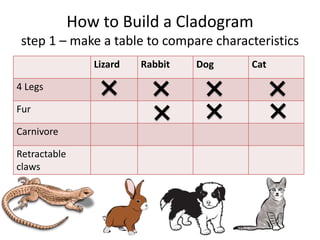
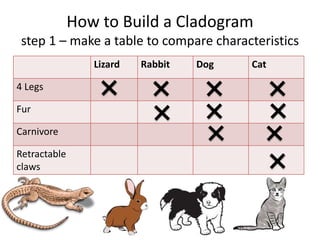
How to Build a Cladogram
step 1 – make a table to compare characteristics
Lizard Rabbit Dog Cat
4 Legs
Fur
Carnivore
Retractable
claws
How to Build a Cladogram
step 1 – make a table to compare characteristics
Lizard Rabbit Dog Cat
4 Legs
Fur
Carnivore
Retractable
claws
How to Build a Cladogram
step 1 – make a table to compare characteristics
Lizard Rabbit Dog Cat
4 Legs
Fur
Carnivore
Retractable
claws
Step 2: create a diagram to
compare characteristics
Venn Diagrams are helpful.
A.
B.
C. D.
• Four groups are represented by circular regions
• Regions that overlap, share common members.
• Regions that do not overlap do not have common
members.
A.
B.
C. D.
Matching:
Animals with 4 legs
4-legged animals with fur
Animals with fur that are carnivores
Carnivores with retractable claws
A
B
C
D
A.
B.
C.
D.
Step 3: arrange the characteristics and
organisms in a branching diagram
Practice
Cladograms
Cladograms
Cladograms
Cladograms
Cladograms

Cladograms

  • 1.
  • 2.
    Tuesday 3-28-17 Today youneed • Notebook – just 3 quick definitions • Something to write with Objective • Analyze shared and derived characteristics and organize them into a cladogram
  • 3.
    As always dearstudents • Key concepts are underlined • New vocabulary terms are in green
  • 4.
    Cladograms are diagramsthat show the evolutionary relationships among a group of organisms.
  • 5.
    This cladogram showsthe evolutionary relationship among several vertebrates.
  • 6.
    • Clade =onebranch on the diagram showing a group of species that share a single common ancestor A clade A common ancestor of these 2 bears
  • 7.
    • Derived characteristic= a trait that arose in the common ancestor of a particular lineage and was passed along to its descendants
  • 8.
    When the derivedcharacter is above an organism, the organism lacks that derived character.
  • 9.
    When the derivedcharacter is below the organism, the organism possesses that derived character.
  • 11.
    How to Builda Cladogram step 1 – make a table to compare characteristics Lizard Rabbit Dog Cat 4 Legs Fur Carnivore Retractable claws
  • 12.
    How to Builda Cladogram step 1 – make a table to compare characteristics Lizard Rabbit Dog Cat 4 Legs Fur Carnivore Retractable claws
  • 13.
    How to Builda Cladogram step 1 – make a table to compare characteristics Lizard Rabbit Dog Cat 4 Legs Fur Carnivore Retractable claws
  • 14.
    How to Builda Cladogram step 1 – make a table to compare characteristics Lizard Rabbit Dog Cat 4 Legs Fur Carnivore Retractable claws
  • 15.
    Step 2: createa diagram to compare characteristics Venn Diagrams are helpful. A. B. C. D.
  • 16.
    • Four groupsare represented by circular regions • Regions that overlap, share common members. • Regions that do not overlap do not have common members. A. B. C. D.
  • 17.
    Matching: Animals with 4legs 4-legged animals with fur Animals with fur that are carnivores Carnivores with retractable claws A B C D A. B. C. D.
  • 18.
    Step 3: arrangethe characteristics and organisms in a branching diagram
  • 19.